Showing posts with label carbon tax. Show all posts

Australian Government killed emissions scheme despite knowing it could shave $15 billion off electricity bills  

Posted by Big Gav in , ,

The Australian government is copping a huge amount of flack about its lack of energy policy this week, having first flip flopped (at the behest of the fundamentalist wing of the party) on suggestions that it might consider reintroducing carbon pricing in response to calls from energy industry participants and now having been found to have killed an emissions trading scheme that would have reduced power costs - Government killed emissions scheme despite knowing it could shave $15 billion off electricity bills.

State governments are now talking about introducing their own carbon pricing schemes (see the link for a good summary of carbon pricing schemes around the world) to make up for the policy chaos in Canberra which is stifling investment in energy.

The Turnbull government has been sitting on advice that an emissions intensity scheme - the carbon policy it put on the table only to rule out just 36 hours later - would save households and businesses up to $15 billion in electricity bills over a decade.

While Malcolm Turnbull has rejected this sort of scheme by claiming it would push up prices, analysis in an Australian Electricity Market Commission report handed to the government months ago finds it would actually cost consumers far less than other approaches, including doing nothing.

Australian Government To Reintroduce Carbon Pricing ?  

Posted by Big Gav in ,

Apparently re-introduction of carbon pricing is a possibility being considered by the Australian government, following pressure from energy industry groups to reduce policy uncertainty and start planning for a de-carbonised future - Conservatives furious over climate review. A dummy spit from the usual suspects happened shortly after the prospect was aired.

Australian Energy Council chief Matthew Warren, representing the bulk of generators, said the most important thing for the industry was a policy that would withstand changes in government. "We'd go for almost anything that has a substantial chance of succeeding and garners bipartisan support, because we can build on it," he said. Mr Warren said a decade of uncertainty on climate and energy policy had driven away investment, leaving a system "now materially degrading before our eyes". He said the energy industry wanted some form of carbon price linked to a clear emissions target that extended beyond 2030 - something the review will consider - to trigger investments in new power stations that would last decades.

Australian Industry Group chief Innes Willox said the country could only play its part in tackling climate change at lowest cost if investors believed policies would survive. "Bipartisanship on climate and energy is the only way forward. The alternative is costly failure," he said.

The Climate Institute said the country had a clear choice: between a review that set Australia on a pathway to zero emissions, or continued the policy chaos of the past 10 years. Deputy chief executive Erwin Jackson said the goal must be a policy framework that was capable of decarbonising the electricity system well before 2050. It must include some form of carbon price, but that alone would not be enough as experience had taught that any scheme would be a political compromise.

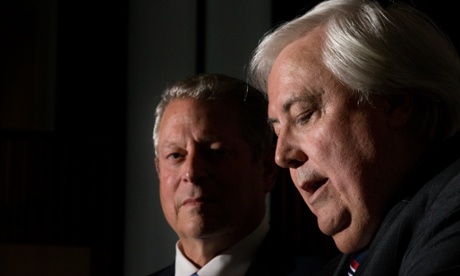
The Clive Palmer and Al Gore show  

Posted by Big Gav in , , , ,

When I read the first news report on this I immediately dismissed it as satire and ignored it - it was only after seeing it appear on a few news outlets that I realised that they were serious and the combination of populism and spite for Tony Abbott had led the colossus of the crossbench, coal baron Clive Palmer to join forces with climate crusader Al Gore in the most unlikely alliance I could possibly think of. As a result it seems the Renewable Energy Target, Clean Energy Finance Corporation and Australian Renewable Energy Authority may all survive the government's attempts to kill them off (Clive didn't go so far as to promise to keep the carbon tax though even that looks like outliving the 1 week Tony Abbott promised it would be abolished within) - Al Gore and Clive Palmer: behind the scenes of an unlikely bromance. I also found the conspiracy theory that Malcolm Turnbull engineered this during his dinner with Clive shortly beforehand kind of interesting.

The extraordinary Gore-Palmer drama began about 10 weeks ago when the quietly spoken but very effective former Australian Conservation Foundation head, Don Henry, approached a former adviser to Tony Windsor, John Clements, to ask whether he could open a line of communication with Clive Palmer.

Henry is an international board member of Gore’s “climate reality project”. Clements and Windsor had struck up a friendly relationship with Palmer during the last parliament. Palmer’s three senators held the key to the future of most of Australia’s existing climate change legislation. It was an unusual, but potentially powerful, mix.

Clements was sceptical – was the conservationist just lining up to have a go at Palmer? He was persuaded the dialogue would be serious.

Phone calls began, between Henry and Palmer and between Palmer and Gore. Would the Palmer United party (PUP) keep the clean energy finance corporation, the climate change authority, even the emissions trading scheme in a kind of hibernating state in preparation for tougher international action?

Just over two weeks ago Ben Oquist, now strategy director at the Australia Institute but previously chief of staff to Greens leaders Bob Brown and Christine Milne and a canny political and parliamentary operator, flew to Brisbane to share a Japanese lunch with Palmer and his media adviser Andrew Crook. Should he meet Gore, Palmer asked, as the three discussed the details of climate policy.

The talks with Henry culminated in a meeting last Thursday at the Hyatt Hotel in Canberra, down the road from parliament house, between Henry, Palmer, Clements and Crook, where the broad outline of Wednesday’s PUP announcements were discussed, as well as the idea of a joint press conference with Gore, who was already in Australia for a “climate reality” workshop. ...

Gore then wavered about the idea of standing at a podium beside the leader of a party that was promising to repeal the world-class carbon pricing scheme. At the last minute he was convinced to go ahead because PUP was promising to reintroduce the scheme in a different form in the near future and had also agreed to retain the renewable energy target, which it had previously intended to try to abolish, and which the government has been preparing to dramatically wind back.

And so it came about that Gore and Palmer, an unlikely duo, stood at a podium to announce the certain repeal of Australia's carbon pricing scheme and the very uncertain possibility that an emissions trading scheme would be reintroduced sometime in the future. ...

The carbon price will almost certainly be repealed. Direct Action is likely to go down as well. But some parts of the current climate change laws will be retained: the CEFC, the independent climate change authority and the RET.

Here’s why B.C.’s carbon tax is super popular — and effective  

Posted by Big Gav in ,

Grist has a look at the "best tax ever" - British Columbia's carbon tax - Here’s why B.C.’s carbon tax is super popular — and effective.

Suppose that you live in Vancouver and you drive a car to work. Naturally, you have to get gas regularly. When you stop at the pump, you may see a notice like the one above, explaining that part of the price you’re paying is, in effect, due to the cost of carbon. That’s because in 2008, the government of British Columbia decided to impose a tax on greenhouse gas emissions from fossil fuels, enacting what has been called “the most significant carbon tax in the Western Hemisphere by far.”

A carbon tax is just what it sounds like: The B.C. government levies a fee, currently 30 Canadian dollars, for every metric ton of carbon dioxide equivalent emissions resulting from the burning of various fuels, including gasoline, diesel, natural gas, and, of course, coal. That amount is then included in the price you pay at the pump — for gasoline, it’s 6.67 cents per liter (about 25 cents per gallon) — or on your home heating bill, or wherever else the tax applies. (Most monetary amounts in this piece will be in Canadian dollars, which are currently worth about 89 American cents.)

If the goal was to reduce global warming pollution, then the B.C. carbon tax totally works. Since its passage, gasoline use in British Columbia has plummeted, declining seven times as much as might be expected from an equivalent rise in the market price of gas, according to a recent study by two researchers at the University of Ottawa. That’s apparently because the tax hasn’t just had an economic effect: It has also helped change the culture of energy use in B.C. “I think it really increased the awareness about climate change and the need for carbon reduction, just because it was a daily, weekly thing that you saw,” says Merran Smith, the head of Clean Energy Canada. “It made climate action real to people.”

It also saved many of them a lot of money. Sure, the tax may cost you if you drive your car a great deal, or if you have high home gas heating costs. But it also gives you the opportunity to save a lot of money if you change your habits, for instance by driving less or buying a more fuel-efficient vehicle. That’s because the tax is designed to be “revenue neutral” — the money it raises goes right back to citizens in the form of tax breaks. Overall, the tax has brought in some $5 billion in revenue so far, and more than $3 billion has then been returned in the form of business tax cuts, along with over $1 billion in personal tax breaks, and nearly $1 billion in low-income tax credits (to protect those for whom rising fuel costs could mean the greatest economic hardship). According to the B.C. Ministry of Finance, for individuals who earn up to $122,000, income tax rates in the province are now Canada’s lowest.

Labor party signals carbon standoff by demanding emissions trading scheme  

Posted by Big Gav in ,

The Guardian reports (somewhat to my surprise) that Labor is going to try to defend the carbon tax and its transition to an emission trading scheme - Labor party signals carbon standoff by demanding emissions trading scheme.

Labor will oppose Tony Abbott’s long promised repeal of the carbon price if the Coalition fails to implement an internationally linked emissions trading scheme. ... Shadow cabinet resolved on Friday to hold Labor’s election posture on carbon pricing. Labor will allow the “tax” to go in favour of a cap on pollution and a floating carbon price from July 2014. ...

“The opposition will move amendments consistent with our pre-election commitments to terminate the carbon tax on the basis of moving to an effective emissions trading scheme,” the Labor leader, Bill Shorten, told reporters in Canberra on Friday. “However, if our amendments are not successful, we will oppose the government’s repeal legislation in line with our long held principled position to act on climate change to build a modern economy,” he said.

Shorten was asked by reporters whether the ALP would be better off politically rolling over and accepting Abbott’s mandate to abolish the carbon “tax”. He replied Labor would “never be a rubber stamp for Tony Abbott”. “We won’t be bullied by Tony Abbott because he doesn’t accept the science of climate change,” Shorten said.

Carbon Price Comes Into Effect, World Doesn't End - Not That It Will Help Labor  

Posted by Big Gav in ,

Australia's carbon tax commenced on July 1 and the nation's economy seems to be trundling along OK, in spite of the apocalyptic predictions of the conservative fringe who seem to think that the small (and largely compensated for) cost is somehow going to wipe out one of the few well performing developed economies. Crikey's Bernard Keane has a look at the lunatic fringe and their opponents - the pathetic rabble in the Labor government who introduced the tax (not that they would have ever done such a thing if the Greens hadn't forced them to) and are hoping the electorate will base their beliefs on evidence at the next election - Labor and the myth of the rational voter.

Amid the torrent of earnest declarations, comments and wisecracks to mark the start of the carbon price yesterday, there was a moment of bright, shining stupidity that captured the entirety of this “debate”. Radio entertainer Neil Mitchell lashed out at Wayne Swan on Twitter for noting that Whylla, contra Tony Abbott’s apocalyptic claims, remained in existence.

“Is this stuff from Wayne Swan really the level of political debate we want?” he angrily demanded. “People in Whyalla and Yallourn and similar are actually concerned for their future. This reaction is offensive to them.”

It’s apt that we’ve reached the point where the mere assertion of a fact, and one as anodyne as the continued existence of a town, should be deemed by a media figure (albeit one whose job description is to be professionally offended on behalf of his audience) as “offensive”. The carbon price has always been a fact-allergic debate. I speak not so much of the senility of the anti-carbon tax protesters with their hilarious signs and deep anger at a world that won’t stop changing on them. Nor of the proud leadership of the assertion-based community by News Limited, with its decreasingly trusted newspapers.

It goes back further than that, to the original Kevin Rudd policy which was, let us not forget, a truly wretched concoction the development of which demonstrated all the faults that eventually killed that government.

To cover politics in that period was to hear, ad nauseum, the dulcet tones of Penny Wong averring “can I say, we think we’ve got the balance right” for a policy that in effect delayed any action on decarbonisation until the 2020s courtesy of a series of cave-ins to rentseekers, while Labor devoted itself to the twin, and incompatible, goals of trying to both win Coalition support for the package and split its opponents on the issue. When, finally, the policy was abandoned in the face of a crude but effective campaign by Tony Abbott, and Rudd’s fortunes slumped, it was no more than his government deserved for a deeply cynical approach to an issue it had portrayed as the greatest moral challenge of our time.

That his successor promptly ensnared herself in the same issue (LOL citizens’ assembly) and then smashed her credibility to CO2-molecule sized pieces with her post-election reversal was every bit as much just desserts for the women who’d lobbied Rudd hard to dump the issue and run.

As if taking his lead from his opponents, Abbott’s approach has been every bit as mendacious and more. Climate action is the issue par excellence on which Abbott has exemplified his political trademark, a tendency not so much (as Gillard is often accused) to believe in nothing as to believe in everything, occupying all possible positions on an issue, leading the Coalition’s primary advocate of a carbon tax to become its most dogged opponent. But that reversal was merely the platform for an extended campaign of wild overstatement. Abbott’s predictions of the end of Whyalla and other centres and various industries remain unwithdrawn, although some of the metaphors he has deployed have, rather in the manner of Maxwell Smart’s “would you believe” in the face of an incredulous villain, been replaced with softer versions as time has gone on.

With such examples from their political leaders, voters have followed suit. Voters are irrationally convinced that what is in effect a modest carbon price will have grotesque impacts on the economy, far beyond those occasioned by, say, the financial crisis. According to Essential Research, more than half of voters believe the carbon price will increase fuel prices “a lot” when it will have no effect at all. Around 40% believe it will increase grocery prices “a lot”. Nearly a third think it will increase unemployment a lot; one in five think (contrarily) it will increase interest rates a lot.

We’re not talking about the idiot fringe here waving “Bob Brown’s Bitch” placards and likely to die decades before the most serious impacts of climate change are felt. These are real, normal voters, with apparently functioning brains.

The Labor plan — or more correctly the Gillard plan — is that in the face of evidence that the carbon price has lifted unemployment or interest rates or the price of bananas, such voters will abandon their prejudice and look anew and sympathetically at the government. In aid of such a magical transformation, the government is running a campaign at almost election-level intensity, with the Prime Minister’s press staff spending the last 48 hours churning out media alert after media alert. The government will also be aided by a likely further fall in inflationery pressures that will see CPI remain almost flat, while fuel prices may even fall further.

But voters won’t change their minds at all, and certainly not in the time between now and the next election. For one thing, this sort of change, if it occurs, takes a long time: despite the fact that the GST is now firmly embedded in the Australian economy, 30% of voters still think it was a bad idea. That’s after more than a decade.

But, worse, the Labor fantasy is based — irrationally — on the idea of a rational voter. This is less than ever a plausible view of democratic Australia. We’re decreasingly willing to let facts influence our views of public policy. We regard the economy through a lens of our partisan beliefs, so that Liberal voters see only economic misery and financial hardship. We think we’re doing it tough financially even as we travel overseas. We’re convinced many multiples of asylum seekers are arriving than ever set foot here. We refuse to accept the copious evidence that our incomes have risen far more quickly than prices in recent years. We filter information out that doesn’t accord with our views. If that leaves us with no information at all, that’s no problem.

The cliché that you’re entitled to your own opinions but not your own facts thus appears decreasingly relevant. Indeed, not merely are you entitled to your own facts, it’s right to be offended, Neil Mitchell-style, at anyone offering contrary information. To be contradicted by someone is damn near an attack on your freedom of speech. The irrational anger that motivates some climate denialists to make threats of death and injury to scientists is only an extreme example of the fact that many of us now feel entitled to our own facts.

Perhaps it’s why everyone is so “offended” now. Offence is an entirely subjective state, one unable to be contradicted by any smart-aleck quoting evidence.

Labor’s plan to turn its fortunes around is a fantasy, a fact-based fantasy when the real world relies on make-believe. We’ll spend the next couple of months establishing that. Then it’ll be back to square one. Back to where Labor was in February.

Green Day: Australian Carbon Tax Passes Senate  

Posted by Big Gav in , ,

SP at TOD ANZ notes the passage of Australia's carbon tax bill - Oz Carbon Tax Passes Senate.

The Australian "Carbon Tax" has been passed in the Senate and will become law. It remains to be seen if Tony Abbott, should he get elected, follows through with his hubristic and dogmatic threats of repealing the law.

The Greens are understandably pleased.

Mining interests and The Australian have predicted this will trigger the imminent demise of the entire Australian economy, even though the more likely threat is due to financial problems in Europe. Piers Akerman (hat tip Deltoid) dredges up the old Dark Ages analogy to describe the horror that is about to befall us all at the hands of the "Green Cultists" who, for some unexplained reason want to rain doom on us all.

I guess we all have our own favourite falling sky to fret over...

The SMH also has a report - Senate passes carbon tax.
The Gillard government declared victory for a "historic economic reform" today after the Senate finally passed a carbon tax - laws that have created political havoc for four years and have been debated for more than a decade. The government won the historic vote in the upper house 36 to 32.

Labor and the Greens combined to pass the 18 "Clean Energy Future" bills just after midday, to applause from the packed public galleries.

Finance Minister and former climate change minister Senator Penny Wong said that, on the Labor side of politics, "we accept the science, we accept the need to act [on climate change], and, like John Howard and Malcolm Turnbull, we accept the science and the advice that putting a price on carbon is the best way to reduce emissions."

A $23 a tonne carbon tax will now be paid by about 500 high-emitting companies from next July, with about half the revenue to be returned to households in the form of tax cuts and increases in pensions and family payments, to compensate them as electricity generators pass through the cost of the new tax.

Another $9.2 billion over the first four years of the carbon pricing scheme will be paid to high-emitting industries with overseas competitors not subject to a tax. They will receive up to 94.5 per cent of their emission permits for free.

The carbon price is designed to meet the emissions reduction target endorsed by both major parties of at least 5 per cent by 2020, compared with 2000 levels. Labor is now promising to cut Australia's emissions by 80 per cent by 2050.

Next the ABC's take - Carbon tax passes Senate.
Earlier, directly following the vote, there was glee from the Government and Greens and dismay by the Opposition who were first out of the Senate doors to voice their protests. ...

They were followed closely by the Greens, when leader Bob Brown prefaced his remarks "from the grim to the grinning".

Senator Brown says today is "a green letter day" that will "echo down through the ages". "The great debate on this legislation is over," he said, vowing the legislation will never be rescinded despite threats by Opposition Leader Tony Abbott to do so. People 50 years, or 500 years, from now will thank us for doing this. This is a vote for Australian householders, economic planners and ecologically sound business, as well as the Great Barrier Reef, Ningaloo, the Murray-Darling Basin and 700,000 property owners on our coastal margins."

Environmental crusader former US vice-president Al Gore said on his website "the voice of the people of Australia has rung out loud and clear". He praised the efforts of Ms Gillard in shepherding the legislation through, saying "as the world's leading coal exporter, there's no doubt that opposition to this legislation was fierce".

The SMH has a roundup of some of the reactions - Climate groups welcome carbon tax.
Climate action groups have hailed Parliament's approval of a carbon tax while warning it is just a first step.

"At last we can begin the long game of catch-up towards more progressive international players on reducing our carbon emissions," Greenpeace spokesman Dae Levin said shortly after watching government legislation clear the Senate today.
While the vote was important, Ms Levin said it was critical not to lose sight of what still needed to be done to protect the community from polluting industries. "This is really just a first step," she said.

Greenpeace is urging the government to drop the $12 billion worth of subsidies provided to the fossil fuel industry. The Australian Conservation Foundation said the new laws would make the big polluters pay. "Industries that do want to contribute to creating a cleaner and healthier future for our children and grandchildren now have a financial incentive to find new, cleaner ways to do business," foundation chief executive Don Henry said in a statement.


The Australian Solar Energy Society said today's vote was a major step forward for the renewable energy industry. "We are finally penalising pollution and rewarding clean energy," chief executive John Grimes said in a statement. "This will deliver substantial investment in solar power and position Australia as a solar nation."

The Investor Group on Climate Change, comprising industry superannuation organisations with $700 billion in funds under management, said the legislation would provide greater regulatory certainty and investment opportunity. "Passage of these bills will provide a platform for future investment in renewable energy and low-carbon technologies," chief executive Nathan Fabian said. "It is in the interests of investors that it remain in place to maintain a certain regulatory environment."

OxFam Australia said the federal government had taken a first step in helping the nation catch up to others on tacking climate change. "The passage of this legislation is a historic shift in direction for Australia that will help build trust with other countries and momentum towards the critical United Nations Framework Convention on Climate Change negotiations in Durban, South Africa, later this month," executive director Andrew Hewett said in a statement. ...

The Australian Geothermal Energy Association said the legislation would boost the industry. "The carbon pricing framework and clean energy fund will hasten the development of geothermal energy projects here in Australia," chief executive Susan Jeanes said. "Geothermal energy is the great hope for the future supply of low cost, emissions free, baseload energy around the world over the coming decades and beyond." ...

Clean energy sources will be able to compete on a level playing field with emissions-intensive sources with the passage of the tax, the Clean Energy Council said. The peak body representing Australia's clean energy sector said Australia was now doing its part to tackle the threat of climate change. "Our industry has been calling for the right policy environment and a carbon price is a crucial part of that," council chief executive Matthew Warren said. "The establishment of the Australian Renewable Energy Agency and the $10 billion Clean Energy Finance Corporation will give emerging technologies the boost they need to prove their potential as mainstream energy sources. "The clean energy sector is poised to unlock billions of dollars in investment that will provide employment for tens of thousands of people."

The peak energy efficiency body says the legislation will save Australian homes and businesses over $5 billion a year. "A carbon price will actually help businesses, by giving them the certainty they need to invest in changes that are long overdue," Energy Efficiency Council chief executive Rob Murray-Leach said.

And finally, Crikey's Bernard Keane has a look at the driving force behind the legislation - It’s the Greens’ day, anyway you look at it.
It’s done. A carbon price, of a fashion, a poor one, so weak it needs to be bolstered by an extensive array of taxpayer spending, passed the Senate at 12.44. The journey embarked on by Julia Gillard on 24 February, which has seen her government and her leadership hammered mercilessly, is mostly over.

The vote passed as expected, last minute efforts by the Coalition to thwart a vote defeated by the Labor-Greens majority. The public gallery — from where Greg Combet watched proceedings — cheered an earlier procedural vote; the final vote went through with a decidedly anticlimactic silence. Opposition senators keen to delay proceedings had to settle for getting up and leaving the chamber after every vote, forcing the maximum period between divisions.

At deadline, the opposition were still trying to prevent the Bill titles being read by the Senate clerks.

This is the package that Labor promised it wouldn’t deliver before the last election, and one that has far more “direct action” than the package agreed by Malcolm Turnbull in 2009. And it comes nearly four years after both parties went to the 2007 election promising Australians an emissions trading scheme. It’s a reform John Howard, Kevin Rudd, Brendan Nelson and Malcolm Turnbull all failed on.

Even Julia Gillard, who’ll go down in history as the woman who managed to achieve what any number of male leaders couldn’t, didn’t particularly want it. Instead, it was the Greens who dragged Labor back to do what it had promised and then resiled from. It’s their day, having seized on the opportunity afforded by a minority government, adeptly exploiting the hung parliament delivered by Labor’s ineptitude.

Much of the post-election commentary on the Greens focused on whether the responsibilities of the balance of power would destroy them as it destroyed the Democrats. By becoming part of the process from the start, rather than only being played in at the death, the Greens managed to shape the package to a form likely to appeal to their base, which was always suspicious of “market mechanisms” anyway. The Greens have thus passed their first major balance of power test with flying colours.

The Coalition has had it good for most of 2011, as Labor struggled with a lack of policy detail and a rampant Tony Abbott. Now, it seems, the tide has turned against it. Its repeal policy looks increasingly problematic, and its own “direct action” policy is discredited. The only thing in its favour remains voter resentment toward Julia Gillard over her backflip on the issue.

But in the chamber today, like their Coalition forebears in 1993 on native title and like the Labor Party on the GST in 1999, the opposition looks a party stranded by ideology and opportunism on the wrong side of history.

Australian Carbon Tax Law Introduced To Parliament  

Posted by Big Gav in , , ,

The Australian Parliament has commenced debating the new carbon tax law (dubbed Australia's Clean Energy Future - nice title !).

The debate isn't highlighting anything new - the opposition thinks the world will end when it is introduced, the government and greens think it an essential step forward (which is true, though it doesn't go far enough) and the media is by and large producing almost no useful analysis of the various claims being made.

Still - it should go through regardless - the only interesting question is will Malcolm Turnbull tell Abbott to get stuffed and cross the floor to vote with the government. Fingers crossed.

The Climate Spectator has an article on a PwC report into low carbon growth - Down to business on carbon.

The sudden evaporation of a goodly portion of the federal opposition's sitting members on Tuesday as the Prime Minister began introducing the bills of her government's Clean Energy Future package might betray a lack of consensus on carbon pricing among Australia's politicians, but it seems big business is well and truly present on the issue. A new major global report has found that the world’s largest listed companies are increasingly embracing climate change policies, regardless of – and even in spite of – broad-ranging uncertainty in politics. The 10th annual Carbon Disclosure Project (CDP) Global 500 report, put together in conjunction with global accountancy firm PwC, has examined the carbon reduction activities of the world’s largest listed companies through an in-depth analysis of 396 of the world’s largest companies, and has found that 68 per cent have climate change at the heart of business strategies, up from 48 per cent in 2010.

The report, Accelerating Low Carbon Growth, which is due to be released Wednesday, also shows a significant rise in the number of companies reporting reduced greenhouse gas emissions as a result of various emissions reduction activities (45 per cent, up from 19 per cent in 2010). A correlation was also established between higher stock market performance over time, and representation on CDP’s Carbon Performance Leadership Index (CPLI) and the Carbon Disclosure Leadership Index (CDLI). Companies with a strategic focus on climate change provided investors with approximately double the average total return of the Global 500 from January 2005 to May 2011.

CDP's Director for Australia and New Zealand, James Day, said the results highlighted that, despite all the debate in Canberra, emission reductions are being made in large companies throughout the world.

And the SMH notes the carbon tax plan will allow polluters to buy permits from abroad (and that the Abbott alternative plan is hopelessly impractical) - Abbott plan 'would double carbon cost.
TONY ABBOTT has described the carbon tax as ''the longest political suicide note in Australian history'' and a ''completely pointless exercise'' because it would allow Australian companies to buy some greenhouse gas emission reductions overseas.

But the Australian Industry Greenhouse Network - which represents mining and manufacturing industries - said it agreed with the federal Treasury that Mr Abbott's plan of achieving 5 per cent emission reductions domestically would at least double the cost, whether done with a carbon price or through his proposed ''direct action''. ...

But Michael Hitchens, the chief executive of the industry network, said if Australia wanted the cheapest way to cut emissions, ''we should have full flexibility to purchase international units''. ''We understand from Treasury modelling that the cost of abatement might double if we try to achieve the full abatement domestically. We think those figures are about right,'' he said.

Treasury modelling found that domestic-only reductions would cost an average of $69 a tonne between now and 2020, compared with $29 a tonne under the government plan, which allows some overseas permits. The Coalition has budgeted $15 a tonne in its ''direct action'' plan and says this is capped.

Rob Oakeshott, who with fellow crossbenchers Andrew Wilkie and Tony Windsor will ensure the bills pass the lower house, told Parliament the Coalition's plan did not make sense because it assumed ''the ongoing ability to buy a product [greenhouse abatement] at one third of its price''. …

The former Coalition leader Malcolm Turnbull said he had not yet decided whether to speak on the bills, which will be voted on in the lower house on October 12. He said the Gillard government scheme had ''a lot in common'' with the Rudd government's emissions trading scheme, which he had agreed to pass.

Queensland to be left in the dark ?  

Posted by Big Gav in , , ,

The Brisbane Times has an article on possible electricity shortages emerging in Queensland - Queensland to be left in the dark.

Warnings that Queensland could experience power shortages in two years proved the need for a carbon tax, according to the Climate Institute.

But the state government and energy provider Origin have denied the state is at risk of power shortages as argued by the Australian Energy Market Operator.

Its Electricity Statement of Opportunities report found Queensland would be the first jurisdiction in Australia to experience shortages if it failed to attract more investment in power stations.

Climate Institute CEO John Connor said the report warned uncertainty over the carbon tax could deter or distort energy investments costing electricity consumers up to $5 billion in higher bills.

"It's clear that the best possible outcome for electricity consumers is decisive action from our politicians to cut our carbon emissions by putting a price on carbon," Mr Connor said.

"Without a pollution price and the clarity of the renewable energy target, investors will try and second guess government policy, make inefficient decisions or delay investment and this will increase electricity costs.

"A pollution price will be a green light for the electricity sector to get on with the job of building the infrastructure needed to provide clean energy power for Australians."

A spokesman for electricity company Origin responded to questions with a short statement saying the company was "well placed to underpin our positions in Queensland".

Energy Minister Stephen Robertson also said Queensland was "well placed" to have the electricity generating capacity to meet the energy demands of a fast-growing state.

‘‘Queensland is fortunate to have a number of large-scale energy project proposals that should ensure we meet energy demand in 2013-14 and beyond,’’ he said in a statement.

“These include ERM Power Ltd’s 500 megawatt Braemar 3 gas power station, Origin Energy’s 500 megawatt Darling Downs Stage 2 gas-fired project and the 44 megawatt solar thermal project at the Kogan Creek power station.’’

Australia's Carbon Tax  

Posted by Big Gav in , , ,

Crikey has a summary of the new carbon tax introduced by the Australian government over the weekend (dubbed Australia's "Clean Energy Future" - sounds like a good title for a blog) - Carbon tax: Gillard’s ‘Clean Energy Future’ at a glance. The price is lower than I'd hoped, oil is exempt and there is lots of compensation for polluters - but its a start and the tax free threshold for income tax has been increased from $6000 to $18000 (ie. they are replacing income tax with a tax on pollution) so its a start I guess.

The government has announced its “Clean Energy Future” package to commence from July 1, 2012.

Price:

* Carbon price of $23 a tonne starting July 1, 2012, rising by 2.5% in 2013-14 and 2014-15
* Floating price from July 1, 2015
* Price floor of $15 a tonne (indexed), ceiling of $20 above the expected international price (indexed).

Pollution target:

* 5% reduction by 2020 as default position, new target of 80% reduction by 2050
* First 5 years’ caps announced in 2014 budget, extended every year by one year
* Nine-member Climate Change Authority (headed by Bernie Fraser) to recommend caps and targets and advise on all aspects of the scheme
* First report February 2014, then every two years. Government required to explain why if it does not adopt CCA targets.

Coverage:

* Stationary energy, industrial processes, fugitive emissions, emissions from non-legacy waste
* Agriculture not covered, light commercial and household transport not covered
* Other transport to face reduced business fuel tax credits outside agriculture, aviation to face higher excise;
* PC to review fuel excise arrangements regarding emissions intensity
* International permit use not permitted until >2015; maximum of 50% of international permits can be used by an entity.

Expected economic impact:

* 0.7% CPI rise in 2012-13
* GDP growth reduced by >0.1% pa
* 10% increase in electricity prices in 2012-13.

Household compensation:

* Pension to rise by 1.7%
* Self-funded retirees to receive increase in Senior Supplement
* Family Tax Benefit to rise by 1.7%.

Tax cuts:

* Two-stage increase in the tax-free threshold from $6000 to $18,200 on July 1, 2012 and $19,400 in 2015-16 – tax cut of $300pa for incomes up to $68,000
* Matching adjustment to tax rates to increase second tier (30%) to 32.5% and then to 33%; other tier rates to remain the same; no one to face a tax increase as a result of tax changes
* One million people no longer have to lodge tax return.

Industry compensation:

* $9.2 billion in compensation

Emissions intensive trade exposed industries

* Under Jobs and to receive assistance on three tiers:

1. 94.5% of free permits for industries with average baseline of a minimum 2,000t CO2-e/$m revenue or 6,000t CO2-e/$m value added
2. 66% of free permits for industries with average baseline of a minimum 1,000t CO2-e/$m revenue or 3,000t CO2-e/$m value added
3. 50% for LNG industry

* Assistance to be scaled back 1.3% pa
* Assistance to apply for at least six years
* Productivity Commission to review assistance in 2014-15 (or earlier if there is evidence of windfall gains) with the goal of assistance being wound back in 2018 to levels proposed by Garnaut Review if PC agrees

Steel Transformation Plan: $300 million for “innovation” in steel manufacturing (in addition to EITE assistance plus an additional allocation of free permits)

Coal Sector Jobs Package: $1.26 billion over six years to assist with emissions from gassy mines

Clean Technology Program: $1.2 billion to support low-emissions manufacturing

Energy Security Fund: to pay for closure of up to 2000MW of highly-emissions intensive generation capacity by 2020, provide $5.5 billion in free permits and cash to the sector to 2016-17, establish an Energy Security Council

Clean Energy Finance Corporation: to invest $10 billion over five years from 2013-14 in renewables and low emissions technologies (not Carbon Capture and Storage), run by an independent board

Australian Renewable Energy Agency to oversee $3.2b in renewables funding, in addition to any dividends from Clean Energy Finance Corporation

Fiscal impact:

* Revenue: $7.7-$8.6 billion pa to 2014-15
* Fuel tax savings: ~$600 million pa
* Household assistance: $4.1-$4.8 billion pa
* Industry compensation: $2.8-$3.3 billion pa
* Total impact: Additional cost to the budget (beyond scheme revenue) of $3.96 billion over four years including this year — spending to be accommodated within goal of return to surplus and 2% real spending cap.

Ross Gittins at the SMH reckons the punters will get used to it pretty quickly - Tax will be neither as good nor as bad as we're told.
SO NOW, supposedly, we know exactly what to expect when, as seems likely, the carbon tax comes into effect on July 1 next year.

The average household's costs will increase by about $10 a week. All but the top 10 per cent of households will receive tax cuts and benefit increases to compensate them for this higher cost and two-thirds of households will be fully compensated.

Uncertainty over? Don't you believe it. Now begins the search for the devil in the details. And what a frantic, spine-tingling, imaginative search it will be, led not by seekers after truth but by all those who stand to gain by convincing us disaster is about to befall us and our economy.
Advertisement: Story continues below

There is much distrust of Julia Gillard and her assurances, particularly since she has broken her election promise not to introduce such a tax in this term. But how much trust can we place in her critics? Since the Coalition, in its day, has supported putting a price on carbon emissions, can we be sure Tony Abbott's change of heart isn't motivated primarily by desire to win back government?

We will be assailed by business people telling us how devastating the tax would be for jobs in their industry. Can we be sure they aren't exaggerating as they jockey for concessions? If we doubt the word of politicians, can we trust the predictions of business people?

This scheme is hellishly complex, so it contains much scope for apprehension, justified or otherwise. It is designed to change our behaviour without penalising most households - itself a puzzle to many people - so this will in time change the shape of the economy.

In truth, some industries will gain while others lose. We will hear at full voice from those fearing they will lose, while the winners stay mum, as do the great majority of industries that will be little affected.

Psychology sheds as much light on these questions as does economics. The safest prediction is that the tax won't be as bad as its critics fear, nor as benign as its defenders claim.

We can be sure of this because of humans' well-researched inability to accurately predict the future.

We almost always expect bad things to be worse than they prove to be and good things to be better than they prove.

And psychology teaches us another lesson: once the tax starts we will get used to it very quickly.

Crikey's Bernard Keane has a more in-depth look - Carbon tax: the policy and the politics.
This is a better package than the CPRS it is so closely modelled on, but not by a lot.

The key problem with the CPRS was that compensation for emissions intensive industries was so great and went for so long that it neutered the price signal, meaning the entire scheme was a giant money circulator that wouldn’t have started decarbonising the economy until well into the 2020s.

The same levels of assistance will apply to big polluters again, but this time the Productivity Commission will be on the case to review whether the assistance is justified and there’s an in-built bias toward reduction in assistance to the levels proposed by Ross Garnaut in his updated report if the PC agrees. But big polluters have a guarantee that their assistance won’t be cut until at least 2017, although the PC can start its 2014-15 review early if it believes there are industries making windfall gains from compensation.

In which case, the PC should start today, because it’s the scheme is a bonanza for big polluters.

There will also be an independent body to examine the case for accelerating Australia’s laughably unambitious target of 5% by 2020. The Climate Change Authority should become a potent independent source of advice that will pressure future governments inclined to recalcitrance in the key issue of how quickly we proceed with decarbonising the economy. In this regard, the increase in Australia’s emission reduction target from 60% to 80% by 2050 will become increasingly important.

So two independent sources of pressure on future governments to improve this scheme in its two critical features: how much the price signal is neutered by compensation, and how fast we should be reducing emissions. The effectiveness of these two bodies in making the case for harder and faster progress will determine the effectiveness of the scheme. Yesterday, the Greens were fairly sanguine about that, suggesting that between the 80% target and the sheer volume of money being spent on renewables, going faster won’t be a problem. We’ll see.

The other key advantage over the CPRS is the use of tax cuts aimed at addressing EMTRs for low-income earners. This isn’t merely sensible policy, it’s actually consistent with the government’s own reform efforts so far under Julia Gillard, aimed at increasing workforce participation. The Government has correctly picked up, at least partly, on Ross Garnaut’s recommendation that the Government try to get more bang for its microeconomic buck by using compensation to improve Effective Marginal Tax Rates.

That’s the good news.

The bad news is that, like the CPRS, the biggest polluters will get the biggest handouts. The coal industry will get a staggering $1.2 billion from taxpayers in straight cash - an outrageous cave-in to the industry that is responsible, more than any other, for Australia’s contribution to global warming. The steel industry will get $300 million plus an increase in free permits above and beyond the 94.5% it will already get.

And the Clean Energy Finance Corporation may turned out to be problematic. Why is a government investing directly in an industry? What at happens if and when investments in renewables and low-emissions technology go bad? On the other hand, like the new ARENA, having industry and financial expertise guiding government spending on renewables rather than bureaucrats and ministers might achieve more than years of sub-par renewables industry policy has.

And buying abatement from the electricity sector is the kind of policy garbage we’re used to from the Opposition — clear government winner-picking. It’s an implicit acknowledgement that a low carbon price and heavy compensation won’t drive a rapid transition to less emissions-intensive electricity generation.

Indeed, courtesy of the Greens and a low carbon price, between the purchase of electricity generation abatement, the investment in renewables and the Government’s carbon farming initiative, there is much “direct action” about this plan. That means taxpayers will, yet again, be spending far too much to buy abatement - although this lacks the sheer lunacy of Greg Hunt’s “soil magic”, a plan in which the majority of Australia’s carbon abatement task would be achieved by a process owing more to Old Moore’s Almanack and biodynamic farming than science or economics. ...

This is about as voter-friendly a package as you can get while still doing something about climate change. With tax cuts for low income earners, generous overcompensation for pensions recipients and handouts to rentseekers to mute claims of job losses, the package minimises the potential for scare campaigns and special pleading.

The Guardian has an article by Richard Flanagan on the tax - Australia's carbon tax is a brave start by a government still gripped by fear.
Australia's Black Saturday fires of February 2009 burned over a million acres of land and killed 173 people. It happened because of record high temperatures and a 20% drop in rainfall over the previous 12 years. It was what climate experts had been predicting for some years: the megafire. A megafire is hell come to earth.

The energy equivalent to 1,500 Hiroshima-sized atomic bombs was released in a fire storm that saw rivers of flame – sometimes rising 100 metres in the air – flowing through the countryside, generating winds of up to 120km an hour with new fires spotlighting 35km ahead of the main fire front.

Black Saturday reminded many Australians of what they know only too well: that of all the advanced economies, Australia is perhaps the one most vulnerable to climate change. And yet support for action on climate change, which was a key factor in the ending of 11 years of conservative government in 2007, has now largely collapsed.

In a story of ironies, a Labor government rarely characterised in recent times by either vision or courage has just announced a raft of measures, centred on a carbon tax, to reduce Australia's carbon emissions, an act at once brave and visionary. It was, though, forced on them by others.

It has been the strangest of battles that has already claimed two opposition leaders and one prime minister. And depending on who wins it, the rictus smile of Australian public life – behind which has hidden for years a paralysis of thought and action and has seen the coal and iron ore barons, the shock jocks and the Murdoch press seeming to set the political agenda as much as parliament – will continue or begin to break. ...

That there is to be any action at all is to the credit of the Greens, who won the balance of power in the Australian senate in that election and made the carbon tax the condition of their support for Gillard's minority Labor party. But the package of measures now announced are far from what the Greens argue is necessary to combat climate change by a nation which in spite of its small (22 million) population is one of the world's top 20 carbon polluters.

Perhaps it could not be otherwise. Australia has avoided recession because of its resource industries. Unemployment is under 5%. The coal, iron and gas barons combine massive wealth with a certain psychological dominance – without us, where would Australia be? – which is implicit in all their public posturing and pressurising. They interpret national interest as their profit and loss ledger and that, they regard, along with their successful bullying of public life, as being under attack from a carbon tax.

Along with Abbott's Liberals, they are keenly aware of Labor's tenuous hold on power. Gillard's minority government survives on just a one-seat margin and is languishing in the polls at 27%. Whoever wins the carbon tax battle wins government at the next election.

Gillard, on her side, has to placate her coalition of Greens and independent rural MPs, soothe an electorate worried about cost of living increases, and throw enough protection money at the big resource companies to stop them fully setting their dogs on her. The measures thus contain a large reform of tax in favour of the poor and large subsidies to big business to compensate for reduced profits. Her dilemma is that the only package she can get up in consequence is one that fails to deliver the very change that is needed.

And so, though designed with mechanisms for increasing decarbonisation, the tax begins life as modest in its impact, riddled with compromises, exclusions, bribes to both voters and corporations, a low carbon price of $23 (£15) a tonne and a very low carbon emission reduction target of 5% by 2020 – about half that required to stabilise carbon emissions at 550 parts per million (ppm), if other countries take comparable action.

The government's own climate change adviser, Ross Garnaut, has calculated that halting the growth in emissions at 550ppm-650ppm would lead to an average temperature rise of 3C to 4C – a rise with disastrous implications for Australia. Selling such a convoluted raft of measures is difficult: former Labor prime minister Bob Hawke has compared it to making "ice cream out of a bucket of shit''.

And selling it is a prime minister with the speech and appearance of a dying metronome – sometimes seeming so inept it has been said she couldn't sell the wheel – dragging along behind her a Labor party that must now present the measure Labor didn't want as Labor's achievement.

It may be that the carbon tax is the final chapter in the strange death of Labor Australia. A once great reforming tradition is now too often the captive of fears and dogmas generated in the service of corporate Australia; under attack from the right by an able populist leader, who has never been burdened by the need for consistency or coherence and rarely challenged on either; and from the left by the increasingly popular Green party.

Many arguments are already being made against the tax. The best argument that can be made for it is that, like all great reforms, it is a historic beginning. And perhaps it is the hope implicit in the carbon tax that is its most important feature.

Among many other reforms, Australians pioneered the secret ballot and universal suffrage. Whether Australia still has the courage it once had, or whether it has simply become the United Arab Emirates of the west, content to roll on for a decade or two more glossing over its fundamental problems while brown coal and fracked gas continues to keep the country afloat, remains to be seen.

The carbon tax thus looms over Australia as a large question: does Australia have the desire to move into the 21st century, or will it continue its retreat into a past as a colonial quarry for the empires of others, its public life ever more run at the dictate of large corporations, its people ever more fearful of the megafires of the future?

Crikey's "Rooted" blog has the final word, explaining why the tax is a good thing - Why a price on pollution is worth it.
Yesterday the Sunday Telegraph ran a headline about Tim Tams and Weet-Bix — and how Gillard would use them as ‘typical Aussie’ products that would rise only a fraction under the carbon price. Today as I open the newspaper I can see that the headlines are similar: how much will this cost? What will the compensation be? Who will be better off when we introduce a policy to put a price on pollution?

The government even has a calculator on its website where you can work out how much it will cost you (I’ll be $33 better off, in case you were wondering).

But despite the government banging on and on about the fact that Australian families won’t be worse off under a carbon price, people still aren’t listening, because we have forgotten to talk about the ‘why’.

Why are we doing this in the first place?

Many polls have shown that people are willing to pay something to clean up our environment and invest in the future, because they can see that the outcome is worthwhile. But in this climate debate we have got sucked into the cost frame and stopped talking about what we’re trying to achieve — and people won’t pay for something if they don’t understand the point of it.

So let’s talk about what is worth paying for:

Powering Australia by 100% renewable energy is worth it.

Cleaning up our skies so we can breathe easier is worth it.

Shutting down the most inefficient power stations in the world, is worth it.

Stopping our biggest polluters pumping tonnes of pollution into the atmosphere for free, is worth it.

And ensuring that our kids still have a planet to live on in the future, is definitely worth it.

The policy announced yesterday, with $10 billion of new money for clean energy projects, and increasing the government’s emission reduction target from 60% to 80% by 2050 is a really great step in the right direction, and we need all politicians to support it, because it will start getting us to the future we want to see.

The Carbon Tax Debate  

Posted by Big Gav in , ,

The ABC has a look at some of the campaigning over the carbon tax - Carbon's Bill.

CHRIS CLARK: But a $26 carbon price has been welcomed by some.

JOHN CONNOR, CLIMATE INSTITUTE: Not a bad starting point. It will drive changes in the way in which generation - energy generation - is delivered right now.

CHRIS CLARK: But it's not enough for others.

SIMON O'CONNOR, ACF: If Australia's serious about tackling climate change $26 is not enough and we're really going need to see the price at a much higher level.

CHRIS CLARK: As for managing the transition to a low-carbon economy, Professor Garnaut wants the politics taken out of the decision making and three independent bodies set up: A committee to establish emissions-reduction targets; an agency to oversee the carve-up of compensation; and a carbon bank to regulate the emissions trading scheme.

MATTHEW WARREN, CLEAN ENERGY COUNCIL: We've seen independent bodies like the Reserve Bank handle very difficult decisions like setting interest rates. We think there's real merit in going down this path and looking at that for a carbon price.

Pro tax groups held rallies around the country today - the SMH has a report on the 8000 people at the SYdney rally (apparently Melbourne had over 10,000 as well - Thousands rally in support of carbon price.
As many as 8000 people have rallied in Sydney to urge the federal government to set a price on carbon, as part of a national climate change campaign in cities across the country.

Holding placards with slogans such as "cut carbon pollution, unlock clean energy" and "say yes to cutting carbon pollution", they gathered at Sydney's Prince Alfred Park this morning to deliver a message: climate change is happening, and something needs to be done.

"What people are asking for is an ambitious price (on carbon), an investment in renewable energy," rally organiser and national director of GetUp, Simon Sheik, said. "Today is a big day, because today Australian's will ask their government for a price on carbon."

Simultaneous rallies were being held in most capital cities as the second stage of the "Say Yes" campaign launched late last week by actors Cate Blanchett and Michael Caton.

The advertisement, which urges Australians to say yes to the federal government's proposed carbon emissions tax, stirred controversy among some sections of the media.

Community climate advocate Ramya Krishnan slammed the controversy surrounding Ms Blanchett's contribution to the campaign. "I hear about families who are struggling just like everyone else who want to live in a better world for their children to grow up. The shock jocks don't speak for Western Sydney, and neither does Tony Abbott."

Police said the Sydney crowd numbered between 7500 and 8000.

Pollution Taxes Not Income Taxes - Mass Support For a Carbon Tax  

Posted by Big Gav in , , , , ,

The latest manifestation of the bizarre anti-carbon tax "rallies" was held in Sydney today, attracting a somewhat motley crew of angry pensioners and various fringe right wing groups to listen to a gaggle of hate radio jocks and Senator Eric Abetz fulminating against climate science and the government's proposed carbon tax. The SMH has a report on the astro-turf groups organising the rally - Rally movers and shakers surf the astroturf of US-style politics.

It was the ''Ju-liar'' line that grabbed the attention for Alan Jones's recent interview with the Prime Minister. But more noteworthy was the prerecorded call he played her.

''Brad'' systematically hammered out a list of anti-government hot-button issues - ''the pink batts, the school halls, the bloody internet thing and now this''. He'd been up since 3am, he said, ''trying to earn money for these clowns to pee it up against the wall''.

Brad's gift for the soundbite raised the question: are we going the way of the US in the way we do politics?

Wednesday's events in Canberra suggest so: a street protest over an issue that's more about adverse effect on big business than little people. It was organised by an outfit with opaque links to conservative political interests. It was spruiked by a radio network that's long been the local answer to the Fox News Channel in the US. On the day, it saw many of the nation's highest-standing political hawks firing up the masses from the rostrum. And there in support were reps from even the most esoteric elements of the right.

The Consumers and Taxpayers Association was just two weeks old when its ''No Carbon Tax'' rally hit the nation's capital. The association describes itself on its website as ''a group of everyday working Australians who believe in democracy and good government for consumers and taxpayers'', none of whom identify themselves on the site. There is more than a whiff in there of that rising phenomenon of our time, the art-cum-science known as astroturfing. The term refers to fake grassroots movements - organised, big-dollar lobbying masquerading as street-level activism. It is not new, but it is finding increasing popularity and sophistication with growth in communications bandwidth.

The British journalist, George Monbiot, has found organisations calling for tenders on ''persona management'' systems, designed to flood online discussion sites with comments of predetermined slant from fake Joe Publics. They can even roll out complete identities across Facebook and other prospective validation media.

Astroturfing practitioners necessarily operate from the shadows. But they have found themselves uncomfortably spotlit for their role in the US Tea Party movement. The Tea Party is synonymous with grassroots mobilisation against Obama administration policies, especially the ''threat'' of universal health cover, and the temporary bailout of selected corporations and banks to reduce the fallout of the global financial crisis.

Last year's Astro Turf Wars was the Melbourne filmmaker Taki Oldham's expose of the movement's puppeteers. The stirrings of Atlanta's Tea Party Patriots in 2009 were genuine grassroots. But as Tea Party groups flickered to life across the US, big-brand right-wing organisations such as FreedomWorks and Americans for Prosperity stepped in with bellows and fuel - cash, infrastructure, media training and mascots, including the Republican wunderfrau Sarah Palin and the Fox jock Glenn Beck.

Identifying astroturf is not very hard. First, as Oldham points out, there is the incongruity between who is doing the protesting and what is at stake. Tea Party rallies see the poor and middle class shout the defence of a health cover system that demands their money or their lives. They demand the right of the rich to make more money and pay less tax at whatever social cost, and condemn climate science in defence of oil billionaires.

Monbiot has found notable spikes in online abuse and disruption around ''issues where companies stand to lose or gain billions: such as climate change, public health and corporate tax avoidance''.

Oldham's film traces a path through Americans for Prosperity to the Koch family, owners of America's largest private energy concern and one of the country's big air polluters.

Australia has not seen astroturfing on the grand scale of the US. In 2004 Westfield paid a $3.5 million settlement arising out of litigation over political strategist Ken Hooper's fake ''North Strathfield Residents' Action Group'' decrying the development of the old Arnotts factory in Homebush by a competitor. And last year the Alliance of Australian Retailers, convened to protest against plain cigarette packaging, was revealed as a front for the tobacco giant Philip Morris.

The activist group GetUp! has drawn fire for being less than forthcoming with on-demand details of the unions helping finance it. The Opposition's leader in the Senate, Eric Abetz, a supporter of Wednesday's rally, described GetUp! as a ''repugnant'' organisation ''which pretends to educate young people about policy issues while taking advantage of their political inexperience''. But what's missing from GetUp! is the ulterior motive, the misalignment between means and ends. Where is the equivalent of poor people baying for rich peoples' rights at their own manifest expense? In the US, the poor and downtrodden can be corralled into welfare-bashing for reasons best explained by John Steinbeck: ''The poor see themselves not as an exploited proletariat but as temporarily embarrassed millionaires.''

I went along to the alternative "pro carbon tax" rally organised by GetUp to see how many people could be coaxed into supporting a tax (admittedly the rhetoric at the rally was a lot better than the moron level fare served up by the astro-turfers - who need to recycle year old news to keep the fires burning - with the speakers talking about taxing pollution rather than income, which is how the carbon tax should be viewed). They seemed to do pretty well - Belmore Park was full, and GetUp's Simon Sheikh estimated there were 8000 people at the "pro" rally versus 2000 people at the "anti" rally, in spite of the skeptics rally being heavily promoted in the conservative media - Thousands demonstrate for and against carbon tax.
A short distance away in Belmore Park, thousands more people gathered to call for action on climate change: including putting a price on pollution and investing in renewable energy.

The Hyde Park demonstration mirrored in size and tone a rally held in Canberra recently. Organisers were hoping for 5000 people to turn up to today's event although it remains unclear what the exact head count was. ...

At the Belmore Park event organised by GetUp, the social action group's national director Simon Sheikh encouraged protesters by saying: "We are closer than ever to the future that we demand. "We are the last line of defence for Mother Nature," he said.

Despite leaked government papers revealing a carbon tax could set households back over $800, the message from protesters was that it was money worth spending to secure the future for upcoming generations. Many signs read "Carbon price, our kids are worth it".

"We must achieve a price on pollution and substantially invest in renewable energy," Mr Sheikh said. The Hyde Park rally left him unperturbed. "I literally can't see the back of this crowd," he shouted from the stage. "Eight thousand people can fit into this park and it is absolutely full."

BHP Boss: Time For A Carbon Tax  

Posted by Big Gav in , , , ,

The SMH has an article on a recent speech by BHP CEO Marius Kloppers, calling for a carbon tax to be introduced to Australia - BHP boss dumps on future of coal.

THE world's largest miner, BHP Billiton, has weighed into the climate change debate, warning that Australia should ''look beyond coal'' and towards other energy sources.

The chief executive of BHP, Marius Kloppers, said Australia's economy will suffer if it does not significantly reduce its carbon emissions in anticipation of a global carbon price. ''Failure to do so will place us at a competitive disadvantage in a future where carbon is priced globally,'' he said.

BHP is one of the world's largest producers of thermal coal, which made up about 8 per cent of its revenue last year. And while BHP and the broader mining industry have acknowledged the need for action on climate change, Mr Kloppers is now calling for Australia to take a lead on the issue. ...

Mr Kloppers stressed the need for a clear price signal on carbon emissions and recommended a combination of a carbon tax, land use actions and a limited emissions trading system, which could apply to electricity generators. He said Australia's energy production was particularly carbon intensive and the highest among OECD countries in terms of tonnes of carbon emitted per unit of energy. Coal-fired power stations account for almost half of the country's emissions.

''Australia will need to look beyond just coal towards the full spectrum of available energy solutions,'' he said.

The Business Spectator also has a look at the Kloppers speech - Kloppers' big call.
There can be no doubting now that a carbon price is back on the political agenda. Big business – or, more to the point, the biggest business – has spoken, and there is now no hiding from the issue.

BHP Billiton CEO Marius Kloppers certainly made a dramatic intervention into the debate. He took three three pillars of the fossil fuel lobby’s defence of the status quo and threw them out the door. He didn’t just skirt around their Maginot Line, he ploughed straight through it. And he’s challenged the nation’s politicians to do something about it.

The three key elements from Kloppers speech was that it was clear that Australia did need to take strong action to reduce its emissions, it needed to look beyond coal and towards other energy sources, and it needed to do so to protect its international competitiveness.

The need for global action on climate change is not, apparently, just a left-wing conspiracy. And it is now, once again, a front page issue.

More from the Business Spectator - Kloppers outflanks the pollies on carbon.
News that BHP Billiton wants Australia to be a first-mover in imposing a carbon tax serves to underline the policy overlap that exists between the Greens, independents and a large part of corporate Australia – the desire to begin reducing carbon emissions sooner rather than later – but it also highlights the highly disparate levels of trust they have for market mechanisms to do the job. ...

Kloppers has outflanked both Labor and the Coalition with this announcement, pointing out that the major parties have been too timid on this issue: "If we get a global price for carbon and we have got a carbon-intensive generation centre, companies like BHP Billiton that consume the energy will eventually lose their competitiveness because it will pay a higher price for its energy.''

Taking stock of climate change — what now?  

Posted by Big Gav in , , ,

Bernard Keane from Crikey can sense a shift in momentum towards a carbon tax in Australia (something I've held for many years is a better option than an emissions trading scheme) - Taking stock of climate change — what now?.

The removal of Penny Wong from the climate change portfolio in favour of Greg Combet provides an opportunity to take stock of where we’re at on climate change and what should be the Government’s priority.

Opinion is undoubtedly swinging away from an emissions trading scheme toward a carbon tax, and it’s been happening both among progressive economists like John Quiggin and right-wing commentators like Michael Stutchbury. A similar change is going on within Cabinet, although the conversion isn’t yet complete. A carbon tax isn’t as elegant and economically pure as an emissions trading scheme, and not as efficient, but the original debate omitted the simple reality that politicians — or certainly the politicians we now have — can’t be relied upon to develop a complex policy without allowing every rentseeker in the country to defile it.

In short, a relatively simple carbon tax is superior to a badly designed ETS (exhibit #1, the CPRS), particularly if it applies to imports but not to exports, at a stroke removing much of the potential for whingeing from trade-exposed industries.

But where does a carbon tax — or even a revised CPRS stripped of its decades of handouts to polluters — fit within overall climate change policy?

The Rudd Government’s climate change policy was two-fold: implement its election commitment to establish an ETS (and increase the mandatory renewable energy target) and use climate change in the same way that Labor had used it before the 2007 election, to wedge the Coalition.

Its implementation of the ETS commitment was, initially, excellent — Ross Garnaut was engaged to prepare a comprehensive report on climate change, identify appropriate emissions targets and how best to achieve them. There was a Green Paper and White Paper process conducted by the Government to develop its ETS model. Wong’s technocratic air seemed to suit the process. But at that point, the interests of climate change action would have best been served by Kevin Rudd and Wayne Swan being mysteriously replaced by John Howard and Peter Costello — specifically, the second-term versions of both.

It was Howard and Costello’s skill and patience in resisting demands from rentseekers and special interests in relation to the GST that was needed in the face of demands from whingeing industries like the miners. Instead, Rudd and his Cabinet caved in — pre-emptively caved in on some issues, then caved in again later as the rentseekers sniffed blood and came to Canberra for a killing.

The relentless use of climate change as a political weapon also went well, with Brendan Nelson and then Malcolm Turnbull having to deal with a hopelessly divided party on the issue. But that, too, ended up going poorly. Tony Abbott may be a global cooling advocate who can barely maintain the fiction of “giving the planet the benefit of the doubt” for more than five seconds, but there was great justice in how he turned climate change back on Kevin Rudd. Penny Wong’s complete lack of political touch and robotic adherence to the Government line and talking points didn’t help the Government’s apparent helplessness in the face of the bad man yelling “great big new tax.”

Now there’s no commitment to an ETS, just a vague, years-long commitment to a carbon price, with the hung Parliament having delivered, via Christine Milne, an intra-Parliamentary mechanism for developing a model, with external “expert” input, including potentially from business.

That mechanism could progress things by developing a wide-ranging consensus on a model across parts of the political spectrum, economists, business representatives and unions, which Greg Combet is well-credentialled to facilitate. But it may not deliver anything of the sort, and more to the point it won’t obviate the need, at some point, for a political leader to demonstrate something approaching courage.

It thus might serve to take a step back and understand exactly what it is Australia should do on climate change.

Much of the debate around climate change is still skewed by the assumption that what we do matters; that, faced with say the slow drying up of the Murray-Darling Basin, we can control our fate by cutting our own emissions.

As the recalcitrants like to note, we only account for a tiny part of the world’s emissions. In climate change terms, we are a mendicant state. Our future is heavily dependent on the actions of the world’s biggest economies. As a country that will be more exposed, and more quickly exposed, to the impacts of climate change the highest priority is any sort of effective international regime that will reduce the growth in emissions, with the aim of stabilising carbon levels. ...

No need to be afraid of a tax on carbon  

Posted by Big Gav in ,

The SMH has a look at the benefits of a carbon tax for Australia - No need to be afraid of a tax on carbon.

The most significant policy issue in the deal struck between the Australian Greens and the Australian Labor Party was that of climate policy.

Agreement between the parties that a carbon price is paramount to tackling carbon pollution signals a restoration of a significant climate policy agenda in Australia, since earlier efforts were so carelessly abandoned by Kevin Rudd last April. The agreement on a carbon price is well overdue; given the overwhelming recognition that a carbon price is central to effective emissions reductions.

This has been the case since Sir Nicholas Stern's landmark report in 2006, which identified a carbon price as a key element to cutting emissions. And despite independent MP Bob Katter's poor opinion of Sir Nicholas (describing him as ''a lightweight''), Stern remains a pre-eminent expert on the economics of climate change.
Nothing has changed since his report in terms of the need for a carbon price; only the urgency of its application has increased.

Achieving this in Australia, however, has been difficult to date – the Carbon Pollution Reduction Scheme (CPRS) was a miserable attempt at pricing carbon, and its flawed approach (rejected quite rightly by the Greens and others) with inadequate targets, excessive use of offsetting and unnecessary compensation to polluters, has contributed to the discrediting of emissions trading as the preferred option for pricing carbon internationally.
While Opposition Leader Tony Abbott remains vehement in his opposition to new taxes, he doesn't (yet) appear to understand that his policy of direct investment is just another way of putting a price on carbon. And while Abbott may be opposed to the idea of a specific carbon tax, the allocation of funds to reduce carbon emissions is using revenue collected through taxation.

To argue that we shouldn't have a carbon price because it will drive up electricity prices is nonsense – electricity prices are already going up and will go up even further without a carbon price, because there is no incentive to invest in energy generation infrastructure while there is uncertainty around a price on carbon. Capital expenditure on power generation in Australia is expected to decline $10 billion over the next five years unless there is a price on carbon.

It is to be hoped the discussion will soon turn from the rather nebulous concept of a carbon price to actual mechanisms – and for that the most appropriate tool is a carbon tax. Supported by most environmental economists (and others such as Nobel Laureate Joseph Stiglitz and Jeremy Sachs), a carbon tax is already in place in many European jurisdictions where it has reduced emissions while maintaining, even improving in some instances, economic productivity.

Most arguments against a carbon tax incorrectly identify the misplaced allocation of funds as a flaw of the mechanism itself, rather than its faulty implementation. A carbon tax is a way of obtaining revenue (appropriately, by taxing polluters). What is done with that revenue determines what its impact will be on the community, whether it is supporting low income or vulnerable households or supporting the expansion of renewables — not the tax itself. Its popular appeal could also be enhanced by reducing other taxes, such as income taxes, while maintaining the pressure on polluters to find ways to cut emissions.

Running on empty ? The peak oil debate  

Posted by Big Gav in , , ,

The Australia Institute has released a paper - Running on empty ? The peak oil debate (pdf) - looking at peak oil and suggesting the best way of spurring early adaptation is to adopt a carbon tax, thus encouraging faster uptake of renewables and energy efficiency measures.

From the introduction :

Like climate change, the possibility of peak oil poses an uncomfortable challenge to citizens and governments alike in the 21st century. 'Peak oil' is the term first used by M K Hubbert in the 1950s to describe the point in time at which the worldwide production of crude oil extraction will be maximised. But while it is inevitable that production will peak at some point, it is uncertain when that point will be reached.

Peak oil concerns exploded during the rapid escalation of oil prices prior to the 2007 global financial crisis (GFC), and resurfaced recently when oil prices appeared to resume their upward trend. These concerns have been underscored by official bodies such as the International Energy Agency (IEA) warning of a possible 'supply crunch' brought about by a lack of new investment following the GFC.

The paper suggests that a carbon tax rather than a trading system is the optimal method for pricing carbon, but ultimately the method is not as important as the existence of a price that is relatively uniform across countries and is sufficiently high to materially affect production and consumption decisions, particularly the decision as to whether or not to pursue the development of emission-intensive alternatives to oil. In the medium term, the circumstances created by a price on carbon will likely expand the use of natural gas, both for power generation and transport; in the long term, it is likely to expand the role of electric vehicles and non-fossil forms of power generation.

As with climate change, the most cost-effective response to the inevitable but uncertain timing of peak oil is to invest in early adaptation. It will be impossible to redesign cities, switch the vehicle fleet to new forms of fuel and transform the location decisions of producers in a timely manner after the oil supply has peaked. Early investment in adaptation measures will pay high dividends in the future, whether in response to peak oil, climate change or simply better city design and reduced congestion on roads.

The paper concludes by suggesting that the peak-oil issue is sufficiently important for regular official re-assessments of the situation to be designed and implemented. If mitigation actions are not planned in advance, the alternative may be for a future where periodic price spikes and shortages affect the nation's ability to manage the economic cycle by causing the re-emergence of 'stop-start' economic conditions such as those experienced in the 1970s.

Crikey has some commentary on the paper - The dirty topic of peak oil: get ready to reduce your reliance.
Wouldn’t it be funny if we spent so long arguing about what to do about climate change that we ran out of cheap oil first? No, it wouldn’t really, it would be catastrophic.

But given the government’s delay in producing an Energy White Paper and the steady backsliding on the need to actually reduce our greenhouse gas emissions in Australia, it is not beyond the realms of possibility. Even the usually optimistic International Energy Agency (IEA) is starting to sound a little nervous.

No one can say with certainty how much oil is left in the ground nor how much it will cost to take it out. As with climate change, the search for certainty in relation to oil supply is a fool’s errand. But while no-one can say with certainty how much is left, virtually no economists or oil industry analysts disagree with the statement that oil production cannot keep growing forever. The notion that oil production must one day peak is now referred to as ‘peak oil’.

While there is virtually no debate that oil production must one day peak, there is much debate about the timing and significance of such a peak. For those who have become accustomed to talking about emission reduction targets for 2020 and 2050 it may come as some surprise to learn that the mid-range forecasts for the peak in global oil production are 10-15 years. This does not mean that there will be no oil in 10 or 15 years time, but it means oil is going to get a LOT more expensive. Put simply, if demand continues to rise and supply starts to fall the days of the average Australian driving their Landcruiser to work will be over.

We need a great big tax on carbon  

Posted by Big Gav in ,

The ABC has a column on why we need a carbon tax - We need a great big tax on carbon.

Our brand new Prime Minister has nominated "putting a price on carbon" as one of the goals of her government. Re-badging the ETS as "putting a price on carbon" is a deceptive piece of political spin.

Julia Gillard didn't invent this new expression for the pre-Global Financial Crisis drive by the financial sector for a great big global derivatives scheme that many people thought would become the largest derivatives trading market in the world.

For the most obvious of reasons (lots of money) there were and are very powerful people (mostly accountants and lawyers) that desperately argued that rejecting the ETS is the same as being a climate change sceptic. They are still conceptually, joined at the hip in most of the propaganda about how to combat climate change.

If climate change is the greatest moral challenge of our times then maybe we should stop people making a fortune out of it. They will if they sell a lot more derivatives than need to be sold at prices that are either a lot higher or lower than they should be to achieve the purpose of putting a price on carbon emissions.

Are governments going to allow shorting the markets to sell emission derivatives that aren't owned by the seller? Will market systems be created that permit huge bundles of derivatives to be sold at any given moment to arbitrage minute price differences from market to market? Will there be a global market (that will be a first that will take half a century to achieve)? And after all that, why is an ETS more efficient or equitable than a tax?

This is, simply put, a complete perversion of the social policy imperative.

A consumption tax puts a wholesale price on carbon. It doesn't allow a retail price that can be doubled by managers and manipulators of an emissions derivatives trading market. No proponent of the ETS has denied that the system is a derivative which will enable the global derivatives punters to expand the ETS to a size that is far beyond its original worthy purpose.

Any sceptic should have a look at what has happened in the past 20 years in the market for foreign currencies, which is essential for the sale of exports and the purchase of imports. In Australia 2010, the market for the Aussie dollar is more than 300 times the market volume needed to enable international traders to sell Australian dollars and obtain the foreign currency they need to pay for imports of goods and services.

An ETS is better for some - the operators and the traders. It will also hugely benefit the accountants who will measure how many ETS derivatives are needed to reduce a company's carbon footprint to the determined policy level at any point in time. They will then have the life time job of auditing emissions. Audits are the continuing source of income for accounting firms. They love them.

Some are already profiting from the idea. I wonder what airlines do with the money they receive when passengers opt to pay a charge to remove their carbon footprint?

Back to first principles. What are we trying to do? Reduce carbon emissions. How do we do that? Tax carbon emissions so heavily that the emitters - you and I - start to watch our emissions because they cost too much. Sounds boring but it is just like taxing tobacco, alcohol and petrol. They are taxes intended to reduce the consumption of goods that are regarded as anti-social. The cost to our society from their consumption massively outweighs any GST or other conventional tax. So we put a great big tax on them and every body pays at a rate equal to their consumption of the anti-social goods.

Indonesia plans carbon tax, geothermal push  

Posted by Big Gav in , , ,

The SMH has an article on a proposal for Indonesia to dramataically increase the use of geothermal power, one of the key elemenets in the Desertec Asia plan - Indonesia plans carbon tax, geothermal push.

AS AUSTRALIA battles over an emissions trading scheme, Indonesia is set to release its draft climate change policy, which would establish a carbon tax, set up geothermal energy projects and protect forests.

The potential carbon tax, part of Indonesia's ''green paper'' on climate change, would apply to the combustion of fossil fuels and start at $9 a tonne of carbon dioxide, rising 5 per cent in real terms per year until 2020.

The tax could be coupled with cuts to subsidies for coal and oil-generated power, in an attempt to promote clean energy in the one of the world's fastest-growing economies. ...

Indonesia will also develop a detailed plan to tap the country's huge geothermal potential - which represents 40 per cent of the world's hot-rock resources. The geothermal strategy is aimed at partially offsetting a 7 per cent increase in energy demand every year.

The plan includes a geothermal tariff, in which the Government subsidises the purchase of clean energy by electricity retailers.

Our carbon bubble danger  

Posted by Big Gav in ,

The Business Spectator has a pair of articles on the problems with carbon trading and why a carbon tax is preferable - Our carbon trading blunder.

It’s a tragedy that the climate change debate is being used to pull the Coalition apart and to possibly bring on a double dissolution, because the political skirmish is obscuring significant events that have occurred since the current set of policies were framed.

This week the change really came home to me when I discussed the latest developments with a state environment minister who seemed tantalised by the possibilities created by the new events. But with all policies virtually locked in, and the opposition in disarray, the widened debate is left to media commentators.

In today’s commentary I am ignoring the rising number of climate change sceptics which are a hidden force bubbling below the surface. A majority of Australians want to slash our use of carbon in a way that creates the least disruption to the economy. If we are not very careful, the present track will lead us to a carbon reduction policy that does the economy great harm.

As I have explained many time before, the discovery of huge reserves of gas – which burns with much lower carbon emissions than coal – in Queensland and NSW in North West Shelf quantities, gives Australia the opportunity to combine gas and renewable energy sources to slash emissions at a manageable cost (New energy can't wait, July 15). The United States is in a similar situation and the high-profile political figure Robert Kennedy Jr has woken up to the new paradigm.

To justify the investment in low carbon fuel sources, it is necessary to make carbon emissions a cost. In essence that’s what the emissions trading scheme is all about.

The trouble is that the proposed Australian version is complex and traps people and organisations that the community does not want to trap.

Many moons ago politicians on both sides of federal parliament and in most states abandoned the idea of a carbon tax because they reckoned it would be unpalatable to voters. But in those days they had budget surpluses and did not believe they needed an extra tax. Now they desperately need additional tax revenue to cover their huge deficits and are looking around for all sorts of nasty taxes.

So why not re-visit a carbon tax at a rate set at on the basis of an international formula? This would require a rebate for all export industries and a tax on the carbon content of imports. In other words, the price of carbon is lifted no matter where in the world it comes from. It's simple and it's easy to understand a tax and with wide community acceptance it would become the new GST to reduce the deficit. Fans of carbon trading will protest that selling carbon permits can raise just as much revenue for the government if the price is set correctly – however, the way the government's carbon trading plans are already being manipulated by interest groups suggests that in practice this would not happen.

And the second installment - Our carbon bubble danger.
A decade ago, when the accountants were debating a new set of accounting rules, business was too busy to be active in the discussions. The result is an international mess. We could never have imagined our accountants would get it so wrong. Similarly with sub-prime, who could have imagined American bankers being so stupid?

When it comes to carbon trading, we are once again too busy running our businesses to realise what is happening. I fear that the greatest legacy of the 'ute-gate' affair will soon be a that it did not give Malcolm Turnbull and the coalition the breathing space to step back from the carbon trading issues and devise a better way to achieve the government’s objective, rather than simply raising questions.

And there is a much better way to achieve the government’s carbon reduction objective. The best place to start such an examination process is the Conversation section of Business Spectator where we have been deluged with some wonderful commentaries – including commentaries from people who question whether carbon is the issue. I urge all my readers and all politicians to be updated on how much the carbon facts have moved since the Coalition government first proposed carbon trading.

When I initially raised the issue I was tentative because I knew that I was probably too late to have an impact on the debate, but the Conversation contributions have convinced me of the virtues of a carbon tax. And two private emails have added a new dimension: one from Clunies Ross award winner and Cosmos magazine founder Alan Finkel; and a second from a Sydney merchant banker who knows just how much money his sector will make from carbon trading. This merchant banker, who has asked that his name be withheld, gives a new perspective on a carbon tax.

Finkel in the June issue of Cosmos says that of the $23 billion expected to be raised via carbon permits in the first two years in Australia, ”every dollar will be returned in handouts, with not a cent allocated to technology research or investment in building infrastructure capacity”.

“Cunning traders” will exploit the scheme’s complexity as they did with the complexity of mortgages and derivatives created over the past 10 years, wreaking havoc on the global financial system.

Finkel says: “Do we really need to create a whole new market employing hundreds of highly paid lawyers, traders, brokers, analysts, bookkeepers and others just to buy and sell permits – or hoard, speculate or profiteer from them?”

A carbon tax can raise money “simply and fairly” because governments already have agencies that collect taxes efficiently. “No matter how small the price impact, it would stimulate more behavioural change than if there were no price increase at all.

“At a modest $10 per tonne, the annual revenue in Australia would be $6 billion. This would help pay for measures such as phasing out coal-fired electricity – replacing it with lower emissions sources such as gas-fired power, or near-zero emission options such as wind, solar and nuclear.

“It could pay for research into new technologies to improve energy efficiency and behavioural change, and mitigate the coming impacts of climate change”.

But the merchant baker has a different way of using a carbon tax.

“We could ‘do something’ about reducing Australia’s greenhouse gas emissions by taxing them fairly heavily, encouraging pass-through of the costs to consumers and using the tax proceeds to compensate consumers by cutting income taxes and raising social benefits, with the net effect being revenue neutral", he says.

”This would increase the costs of energy, transport and other CO2 intensive goods and services enough to stimulate and accelerate research, development and introduction of non-polluting alternatives (by the private sector).

“It would give consumers the ability to pay the new higher prices and would reward everyone who, in the past or future, did or does something to lower their greenhouse gas emissions."

Statistics

Locations of visitors to this page

blogspot visitor
Stat Counter

Total Pageviews

Ads

Books

Followers

Blog Archive

Labels

australia (619) global warming (423) solar power (397) peak oil (355) renewable energy (302) electric vehicles (250) wind power (194) ocean energy (165) csp (159) solar thermal power (145) geothermal energy (144) energy storage (142) smart grids (140) oil (139) solar pv (138) tidal power (137) coal seam gas (131) nuclear power (129) china (120) lng (117) iraq (113) geothermal power (112) green buildings (110) natural gas (110) agriculture (91) oil price (80) biofuel (78) wave power (73) smart meters (72) coal (70) uk (69) electricity grid (67) energy efficiency (64) google (58) internet (50) surveillance (50) bicycle (49) big brother (49) shale gas (49) food prices (48) tesla (46) thin film solar (42) biomimicry (40) canada (40) scotland (38) ocean power (37) politics (37) shale oil (37) new zealand (35) air transport (34) algae (34) water (34) arctic ice (33) concentrating solar power (33) saudi arabia (33) queensland (32) california (31) credit crunch (31) bioplastic (30) offshore wind power (30) population (30) cogeneration (28) geoengineering (28) batteries (26) drought (26) resource wars (26) woodside (26) censorship (25) cleantech (25) bruce sterling (24) ctl (23) limits to growth (23) carbon tax (22) economics (22) exxon (22) lithium (22) buckminster fuller (21) distributed manufacturing (21) iraq oil law (21) coal to liquids (20) indonesia (20) origin energy (20) brightsource (19) rail transport (19) ultracapacitor (19) santos (18) ausra (17) collapse (17) electric bikes (17) michael klare (17) atlantis (16) cellulosic ethanol (16) iceland (16) lithium ion batteries (16) mapping (16) ucg (16) bees (15) concentrating solar thermal power (15) ethanol (15) geodynamics (15) psychology (15) al gore (14) brazil (14) bucky fuller (14) carbon emissions (14) fertiliser (14) matthew simmons (14) ambient energy (13) biodiesel (13) investment (13) kenya (13) public transport (13) big oil (12) biochar (12) chile (12) cities (12) desertec (12) internet of things (12) otec (12) texas (12) victoria (12) antarctica (11) cradle to cradle (11) energy policy (11) hybrid car (11) terra preta (11) tinfoil (11) toyota (11) amory lovins (10) fabber (10) gazprom (10) goldman sachs (10) gtl (10) severn estuary (10) volt (10) afghanistan (9) alaska (9) biomass (9) carbon trading (9) distributed generation (9) esolar (9) four day week (9) fuel cells (9) jeremy leggett (9) methane hydrates (9) pge (9) sweden (9) arrow energy (8) bolivia (8) eroei (8) fish (8) floating offshore wind power (8) guerilla gardening (8) linc energy (8) methane (8) nanosolar (8) natural gas pipelines (8) pentland firth (8) saul griffith (8) stirling engine (8) us elections (8) western australia (8) airborne wind turbines (7) bloom energy (7) boeing (7) chp (7) climategate (7) copenhagen (7) scenario planning (7) vinod khosla (7) apocaphilia (6) ceramic fuel cells (6) cigs (6) futurism (6) jatropha (6) nigeria (6) ocean acidification (6) relocalisation (6) somalia (6) t boone pickens (6) local currencies (5) space based solar power (5) varanus island (5) garbage (4) global energy grid (4) kevin kelly (4) low temperature geothermal power (4) oled (4) tim flannery (4) v2g (4) club of rome (3) norman borlaug (2) peak oil portfolio (1)