The V3 Spin Cell was developed through collaboration with industrial design team Nectar Design. The company believes that the Spin Cell could be a game-changer in its market. On their website V3 explains that if one places a 20x solar concentration on a flat, static solar panel then “the temperature quickly reaches 260 degrees F, the solder melts within ten seconds, and the PV fails. With the same concentration on the Spin Cell, the temperature never exceeds 95 degrees F.”
The one meter-diameter cones feature a layer of hundreds of triangular photovoltaic cells positioned at an angle of 56 degrees, encased in a “static hermetically-sealed outer lens concentrator.” The photovoltaic cone spins with the assistance of a “small amount” of its own solar-generated power which feeds a Maglev system, intended to reduce the noise generated by the cones as well as any required maintenance.
The ANU team, whose CST technology harnesses the power of the sun using a 500 square meter solar concentrator dish, made the breakthrough by redesigning the system’s receiver in a way that halved its convection losses and boosted its conversion of sunlight into steam from 93 per cent to 97 per cent.
According to the ANU’s Dr John Pye, the new design could result in a 10 per cent reduction in the cost of solar thermal electricity. “Ultimately the work in this project is all about reducing the cost of concentrating solar thermal energy,” he said. “Our aim is to get costs down to 12 cents per kilowatt-hour of electricity, so that this technology will be competitive.
The Climate Spectator reports that Silex's long delayed CPV plant for Mildura in Victoria may at last be moving ahead - All Systems go.
Silex Systems has finally secured formal agreement from the federal government to continue the $75 million of fund granted to a proposed 152MW concentrated solar project in Mildura. The fate of the grant had been in some doubt, because the company that originally received the grant, Solar Systems, went bankrupt in late 2009 before being bought by Silex early in 2010. Silex says the grant – combined with $50 million in funds from the Victorian government – will enable the company to progress to a 2MW pilot plant, then a 100MW demonstration project that could be expanded by a further 50MW at a later date.
Silex says it has refined and solved many of the technical difficulties that had plagued the original project, and which had forced the company into receivership because its shareholders, which include TRUenergy and several private, either couldn’t or wouldn’t provide more funds. The unique 'dense array' concentrating PV technology is said to be deal for large commercial and utility-scale solar projects, and Silex says the Mildura facility has the potential to be of the one of the largest and most efficient solar power stations in the world.
Silex says it continues to investigate opportunities to construct utility-scale solar plants in Australia and US, as well as growth opportunities worldwide. The $75 million of Commonwealth funding was announced in 2006 as part of the Low Emissions Technology Demonstration Fund. The Federal Government has further assisted the project with a $4.5 million grant under the Asia Pacific Partnership on Clean Development and Climate, of which approximately $1.9 million was transferred to Solar Systems.
With a 150 MW project planned in San Diego and a 25-year PPA in place, CPV has at last entered the commercial arena. Standing in the New Mexico desert, a 1 MW Concentrating Photovoltaic (CPV) power plant is establishing a route for the emergence of this utility-scale technology. Installation of this first pilot commercial deployment began in the summer of 2010 and the plant was commissioned early in 2011, with official inauguration in April.
Located on the tailings site of Chevron Mining Inc's (CMI) molybdenum mine in Questa, New Mexico, some 2000 metres above sea level in an area of the US noted for its high levels of Direct Normal Irradiance (DNI), its developers say the project will demonstrate the technology as well as a practical use of previously impacted land. Electricity produced from the installation will be sold to the Kit Carson Electric Cooperative, through a power purchase agreement.
Covering some 20 acres (8 ha) the site has 173 CPV modules, each of which has an area of about 18 by 21 feet (35 m²) and is pole mounted on dual axis trackers supplied by a major manufacturer. The Concentrix technology uses Fresnel lenses to concentrate sunlight almost 500 times onto high efficiency multi-junction PV cells. With this technology, Soitec claims to achieve AC system efficiencies of 25% and more, significantly higher than currently available conventional solar PV technology, and as a result, cost reductions of 10%-20% could be reached, depending on the location of the installation, it says. ...
CPV systems are typically more efficient than conventional solar systems at locations with both high ambient temperatures and dry weather conditions. Because of the very low temperature coefficient of its solar cells, a CPV system's performance is much less affected by temperature than other photovoltaic technologies. Another key advantage of CPV technology is the very low levels of water required for operations, essentially used in cleaning only, a crucial consideration for the water-constrained regions to which it is suited, such as the Imperial Valley, which is some 150 miles (230 km) from the coast.
Indeed, such technology is expected to work best in areas with higher DNI like northern New Mexico and southern California, as well as in north and southern Africa, the Middle East, and much of China and India. Certainly, in 2010 Soitec announced that it had joined the Desertec Industrial Initiative (Dii) as Associated Partner and Medgrid as a founding member, in the expectation that the decision will pave the way to utility-scale CPV projects in the Middle East and North Africa (MENA).
IT LOOKS like a planetary tattoo designed to be seen from space, a vast set of concentric circles inscribed in the skin of southern California’s desert. Ground was broken on the Ivanpah power plant, which is to be one of the biggest solar installations in the world, last October. Already, some of the rings of mirrors which will eventually concentrate acres-worth of desert sunshine on to collectors perched atop 140-metre-high towers are in place. And as of this week, so is the financing.
BrightSource, based in Oakland, California, announced on April 11th that it had finalised $1.6 billion in loans for Ivanpah from America’s government. At the same time it announced that Google had taken a $168m stake in the project.
Ivanpah needs all this money because BrightSource’s technology requires it to be vast compared with other types of solar installation. Most solar power comes from photovoltaic cells that turn sunlight directly into electricity: installations of this type can be any size. BrightSource’s system, like other “solar thermal” technologies, concentrates the sun’s heat to drive turbines; and the high-performance steam turbines it relies on are big. The three to be installed at Ivanpah will together have a greater capacity than all the “utility scale” photovoltaic plants yet built in America.
It was once thought that photovoltaic installations might attain a similar size as they spread across America’s West (a prospect viewed with alarm by some environmentalists). There are now indications that this won’t happen. Nathaniel Bullard of Bloomberg New Energy Finance has been looking at photovoltaic projects registered with California ISO, the state’s grid operator, since 2007. Their median size started off close to 100MW; now it is around 20MW. Not all these projects will be completed—but it seems a reasonable assumption that bigger ones may be more likely to fall by the wayside. If so, the average size will drop even more dramatically.
Mr Bullard thinks the photovoltaic business is learning that small, if not exactly beautiful, is easier to get past environmental controls and planning consents, and handier if you want to feed into existing grids. “Brownfield” industrial sites near towns beat desert skies.
This is not to say that big photovoltaic projects are finished. The day after the Department of Energy bestowed its beneficence on Ivanpah, it offered a conditional loan of $1.2 billion to SunPower, a maker of high-efficiency photovoltaic cells, for a 250MW project, the California Valley Solar Ranch near San Luis Obispo. SunPower will build and operate the plant; NRG Solar, a subsidiary of NRG Energy of New Jersey, will own it. (NRG Solar is also investing up to $300m in Ivanpah.)
Such big projects make sense for large solar-cell producers like SunPower and Arizona-based First Solar, since they provide reliable demand with which to keep their manufacturing plants running at peak efficiency. Tom Werner, SunPower’s chief executive, says that although the Solar Ranch project is “on the large side”, there is a role for photovoltaic plants of all sizes, and his company has plenty more of similar scale in the pipeline. As experience grows, he hopes to find banks, rather than governments, to finance them.
Whereas being extremely big remains optional for photovoltaics, for thermal-solar companies such as BrightSource it is a must. BrightSource hopes that in time its technology will prove sufficiently efficient and reliable to overcome the disadvantage of having to raise so much capital. If so, Ivanpah will be the ground on which it makes its case.
A startup called Solar Junction says its pilot manufacturing plant is producing solar cells units that are more efficient than the best ones on the market today. The advance, based on new semiconductor materials that the company has developed, could help make a type of solar power system called concentrated photovoltaics a far more attractive way to generate electricity from the sun.
Concentrated photovoltaic systems account for a small fraction of total solar power today—with only several megawatts of production capacity installed, compared to many gigawatts of capacity for conventional solar panels. They're limited to very sunny areas, where they compete with solar thermal, the cheapest form of solar power today, which uses mirrors to concentrate sunlight for the purpose of generating steam for steam turbines. Advances in solar cell efficiency have only recently made concentrated photovoltaic systems economical in some areas.
Craig Stauffer, cofounder of Solar Junction, based in San Jose, California, says his company's new cells could bring the price of solar power to below 10 cents per kilowatt hour, compared to 16.5 cents per kilowatt hour or more for typical solar panels. Solar Junction's cells require fewer layers than many other ultra-efficient solar cells and are better matched to the solar spectrum.
Solar Junction's cells are designed for photovoltaic systems that use mirrors or lenses to concentrate sunlight 1,000 times. Concentrating sunlight improves the efficiency of most solar cells, but solar cells designed for use under such high concentrations—called multi-junction cells--do particularly well because they incorporate two or three semiconductor layers for absorbing different colors of sunlight, rather than the single semiconductor layer used in conventional solar panels.
Concentrated solar power has been held back by the difficulty of finding semiconductors that divide up the spectrum in the optimal way, but that also have matching crystalline structures, which makes the cells easy to fabricate. Solar Junction's technology tackles the problem for the infrared end of the spectrum, the part that's proven the most challenging for multi-junction cell developers. In conventional multi-junction cells semiconductor materials designed for this part of the spectrum either absorb light that's too far into the infrared or aren't compatible with the other semiconductors in the cell, and so require costly buffer layers.
The Atlantic has an article on an interesting form of concentrating solar power that uses a fuel cell like technique to generate electricity - Shooting for the Sun.
In March 2003, the independent inventor Lonnie Johnson faced a roomful of high-level military scientists at the Office of Naval Research in Arlington, Virginia. Johnson had traveled there from his home in Atlanta, seeking research funding for an advanced heat engine he calls the Johnson Thermoelectric Energy Converter, or JTEC (pronounced “jay-tek”). At the time, the JTEC was only a set of mathematical equations and the beginnings of a prototype, but Johnson had made the tantalizing claim that his device would be able to turn solar heat into electricity with twice the efficiency of a photovoltaic cell, and the Office of Naval Research wanted to hear more.
Projected onto the wall was a PowerPoint collage summing up some highlights of Johnson’s career: risk assessment he’d done for the space shuttle Atlantis; work on the nuclear power source for NASA’s Galileo spacecraft; engineering help on the tests that led to the first flight of the B-2 stealth bomber; the development of an energy-dense ceramic battery; and the invention of a remarkable, game-changing weapon that had made him millions of dollars—a weapon that at least one of the men in the room, the father of two small children, recognized immediately as the Super Soaker squirt gun.
Mild-mannered and bespectacled, Johnson opened his presentation by describing the idea behind the JTEC. The device, he explained, would split hydrogen atoms into protons and electrons, and in so doing would convert heat into electricity. Most radically, it would do so without the help of any moving parts. Johnson planned to tell his audience that the JTEC could produce electricity so efficiently that it might make solar power competitive with coal, and perhaps at last fulfill the promise of renewable solar energy. But before he reached that part of his presentation, Richard Carlin, then the head of the Office of Naval Research’s mechanics and energy conversion division, rose from his chair and dismissed Johnson’s brainchild outright. The whole premise for the device relied on a concept that had proven impractical, Carlin claimed, citing a 1981 report co-written by his mentor, the highly regarded electrochemist Robert Osteryoung. Go read the Osteryoung report, Carlin said, and you will see.
End of meeting.
Concerned about what he might have missed in the literature, Johnson returned home and read the inch-thick report, concluding that it addressed an approach quite different from his own. Carlin, it seems, had rejected the concept before fully comprehending it. (When I reached Carlin by phone recently, he said he did not remember the meeting, but he is familiar with the JTEC concept and now thinks that the “principles are fine.”) Nor was Carlin alone at the time. Wherever Johnson pitched the JTEC, the reaction seemed to be the same: no engine could convert heat to electricity at such high efficiency rates without the use of moving parts.
Johnson believed otherwise. He felt that what had doomed his presentation to the Office of Naval Research—and others as well—was a collective failure of imagination. It didn’t help that he was best known as a toy inventor, nor that he was working outside the usual channels of the scientific establishment. Johnson was stuck in a Catch-22: to prove his idea would work, he needed a more robust prototype, one able to withstand the extreme heat of concentrated sunlight. But he couldn’t build such a prototype without research funding. What he needed was a new pitch. Instead of presenting the JTEC as an engine, he would frame it as a high-temperature hydrogen fuel cell, a device that produces electricity chemically rather than mechanically, by stripping hydrogen atoms of their electrons. The description was only partially apt: though both devices use similar components, fuel cells require a constant supply of hydrogen; the JTEC, by contrast, contains a fixed amount of hydrogen sealed in a chamber, and needs only heat to operate. Still, in the fuel-cell context, the device’s lack of moving parts would no longer be a conceptual stumbling block.
Indeed, Johnson had begun trying out this new pitch two months before his naval presentation, in a written proposal he submitted to the Air Force Research Laboratory’s peer-review panel. The reaction, when it came that May, couldn’t have been more different. “Funded just like that,” he told me, snapping his fingers, “because they understood fuel cells—the technology, the references, the literature. The others couldn’t get past this new engine concept.” The Air Force gave Johnson $100,000 for membrane research, and in August 2003 sent a program manager to Johnson’s Atlanta laboratory. “We make a presentation about the JTEC, and he says”—here Johnson, who is black, puts on a Bill-Cosby-doing-a-white-guy voice—“‘Wow, this is exciting!’” A year later, after Johnson had proved he could make a ceramic membrane capable of withstanding temperatures above 400 degrees Celsius, the Air Force gave him an additional $750,000 in funding.
The key to the JTEC is the second law of thermodynamics. Simply put, the law says that temperature differences tend to even out—for instance, when a hot mug of coffee disperses its heat into the cool air of a room. As the heat levels of the mug and the room come into balance, there is a transfer of energy.
Work can be extracted from that transfer. The most common way of doing this is with some form of heat engine. A steam engine, for example, converts heat into electricity by using steam to spin a turbine. Steam engines—powered predominantly by coal, but also by natural gas, nuclear materials, and other fuels—generate 90 percent of all U.S. electricity. But though they have been refined over the centuries, most are still clanking, hissing, exhaust-spewing machines that rely on moving parts, and so are relatively inefficient and prone to mechanical breakdown.
Johnson’s latest JTEC prototype, which looks like a desktop model for a next-generation moonshine still, features two fuel-cell-like stacks, or chambers, filled with hydrogen gas and connected by steel tubes with round pressure gauges. Where a steam engine uses the heat generated by burning coal to create steam pressure and move mechanical elements, the JTEC uses heat (from the sun, for instance) to expand hydrogen atoms in one stack. The expanding atoms, each made up of a proton and an electron, split apart, and the freed electrons travel through an external circuit as electric current, charging a battery or performing some other useful work. Meanwhile the positively charged protons, also known as ions, squeeze through a specially designed proton-exchange membrane (one of the JTEC elements borrowed from fuel cells) and combine with the electrons on the other side, reconstituting the hydrogen, which is compressed and pumped back into the hot stack. As long as heat is supplied, the cycle continues indefinitely. Click here to find out more!
“Lonnie’s using temperature differences to create pressure gradients,” says Paul Werbos, an energy expert and program director of the National Science Foundation. “Only instead of using those pressure gradients to move an axle or a wheel, he’s forcing ions through a membrane.” Werbos, who spent months vetting the JTEC and eventually awarded Johnson’s team a $75,000 research grant in 2006, describes the JTEC as “a fundamentally new way, a fundamentally well-grounded way, to convert heat to electricity.” Regarding its potential to revolutionize energy production on a global scale, he says, “It has a darn good chance of being the best thing on Earth.” ...
Commercial photovoltaic solar cells convert approximately 20 percent of received solar energy into electricity. The best solar-energy systems today—thermal-power plants that concentrate the sun’s heat to drive turbines—operate at a rate of about 30 percent efficiency. The JTEC, Johnson claims, could double that figure, cutting the cost of producing solar power in half from its current average of 25 cents per kilowatt-hour, and making it competitive with coal.
“There’s a lot of debate in Washington about carbon emissions and energy,” Paul Werbos says—“about coal, nuclear power, and oil, what I call the three horsemen of the apocalypse. If we can cut the cost of solar energy in half, it becomes possible to escape from the three horsemen. The importance of this is just unbelievable.”
Amonix recently launched its newest solar concentrator, which converts one fourth of the sunlight that falls on it into AC electricity. That's compared with the approximately 18 percent system efficiency--including inverters that convert solar's DC power to useable AC power--of the most efficient photovoltaic systems that don't use special optics or track the sun.
To collect sunlight as efficiently as possible, Amonix starts with a massive 23.5-meter-by-15-meter array. The array is covered with thin, plastic Fresnel lenses, each measuring 350 square centimeters, that focus sunlight to an area that's .7 square centimeters. The sunlight, concentrated to 500 times its normal intensity, hits an ultra-efficient multi-junction solar cell that converts 39 percent of the light into electricity. The cell, made by Spectrolab, is the most efficient in the world, demonstrating more than 41 percent efficiency in lab tests. To further enhance performance, Amonix uses a tracking system that keeps the lenses pointed within .8 degrees of the angle of the sun throughout the day.
Utility companies, however, have been reluctant to invest in any concentrated photovoltaic systems due in part to the device's high level of complexity. Proper functioning of each component is crucial because the lenses require very precise alignment with the sun in order to focus light on the solar cells. "The difference between being in alignment and being one degree off is the entire system works or it doesn't," says Johanna Schmidtke, an analyst with Lux Research.
Amonix's technology already accounts for some 13 megawatts of installed capacity, which represents more than half of all installed concentrated photovoltaic capacity in the world. And so long as Amonix can prove its reliability, its technology offers several distinct environmental advantages over other types of utility-scale solar.
Solar engineers have long sought to develop an energy-generating glazing that is as capable of producing power as it is easy on the eyes. The feat may just have been accomplished by The Center for Architecture Science and Ecology (CASE), who have developed a concentrating solar system that is not only modern and attractive but extremely efficient and cost effective. The system is made up of rows of pyramid-shaped glass receptors that move with sunlight throughout the day, magnifying the incoming light and capturing it in a small photovoltaic cell located in the center of each pyramid.
CASE’s receptors can be fitted to existing buildings or built into new designs. The concentrating solar cells are strung on wires with tracking mechanisms that turn the receptors in the direction of the sun throughout the day. Since they are made from glass they are transparent and allow light to pass through windows, which makes them perfect for adding solar power to building facades while maximizing available daylight.
The glass pyramid shape actually serves to magnify light and increase the natural lighting inside a building while decreasing the need for artificial light. The design is also meant to capture thermal energy trapped inside the glass pyramids that is not converted into electricity to be used for heating and cooling systems.
Dow Chemical is moving full speed ahead to develop roof shingles embedded with photovoltaic cells. To facilitate the move, the U.S. Department of Energy has backed Dow's efforts with a $17.8 million tax credit that will help the company launch an initial market test of the product later this year.
In October 2009, the chemical giant unveiled its product, which can be nailed to a roof like ordinary shingles by roofers without the help of specially trained solar installers or electricians. The solar shingles will cost 30 to 40 percent less than other solar-embedded building materials and 10 percent less than the combined costs of conventional roofing materials and rack-mounted solar panels, according to company officials.
Dow isn't the first company to incorporate solar cells into building materials. In recent years, a number of leading solar manufacturers have launched small lines of solar shingles, tiles, and window glazes. But as Dow looks to bring its shingles mainstream, other solar manufacturers are backing away from the products. Suntech Power, the Chinese solar maker, and the largest crystalline silicon photovoltaic manufacturer in the world, has several integrated solar systems on the market, but with the recent downturn in new housing construction, the company has focused instead on ramping up conventional photovoltaic panel output, says Jeffrey Shubert, Suntech Power marketing director for North and South America.
Engineering headaches have hindered the C.S.P. market, as has price: according to UBS, the cost per kilowatt-hour in 2009 is in the 15- to 40-cent range, making this power source more expensive than wind, but on par with photovoltaics. Within a decade or so, UBS projects that C.S.P. will be roughly equivalent to wind energy thanks to technology improvements. ...
Ausra claims it can produce steam for 20 to 30 percent less than parabolic trough systems. “Our technology moves it to the next level,” said the company’s chief executive, Robert Fishman, who added that the Ausra would announce three large projects in the United States, Australia and the Middle East later this fall.
The holy grail of the C.S.P. industry, meanwhile, is the recently announced Desertec Initiative, a monumental European/Middle Eastern plan to build vast solar reflector systems (and wind farms) in the north-African desert over the next several decades.
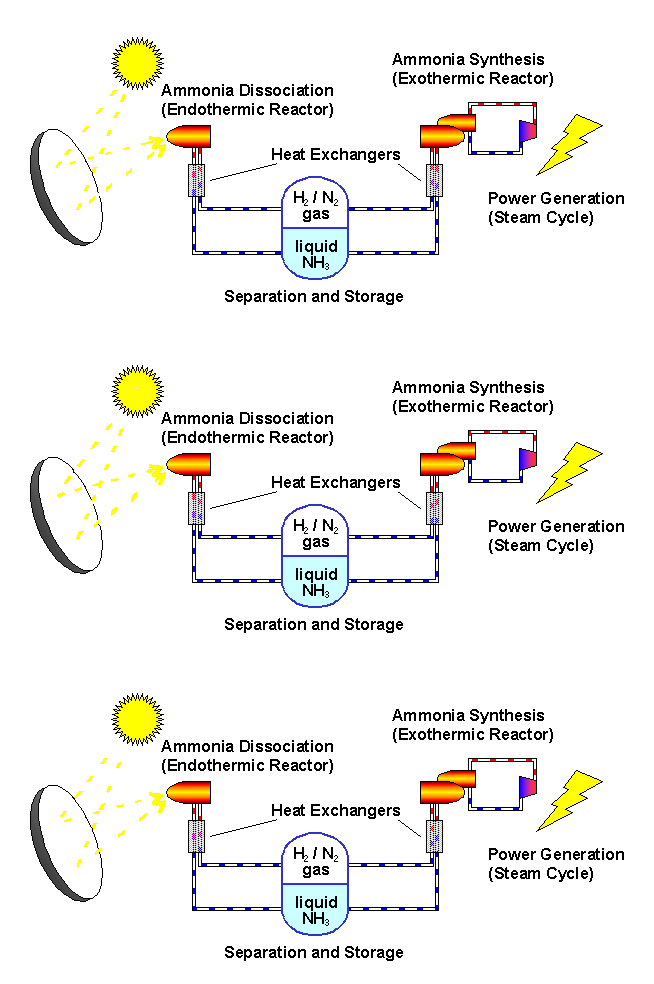
The foundations are being laid for a $15 million solar plant at Whyalla. A demonstration plant of four big dishes will combine solar power with ammonia energy storage technology.
Whyalla's deputy mayor Eddie Hughes says it is great to see something tangible after nearly 13 years of planning. "The first pad is to form a working base for the construction of the dishes," he said.
Mr Hughes says the 500-square-metre dishes will be the largest in the world. "They're going to be quite spectacular, I think they will attract a lot of attention," he said. "These are the largest solar dishes in the world, capable of generating temperatures in excess of 2,000 degrees."
He denies the plant will create another industrial eyesore for Whyalla. "Oh, I think they're going to be exceptionally beautiful to look at," he said.
Mr Hughes says, if the demonstration plant can successfully provide base load power, a 600-dish plant will be considered, at a likely cost of $350 million. It would be able to provide power to 19,000 homes.
Clark Energy Group has been selected to develop the largest solar power project in Department of Defense history at Fort Irwin, California. Joining Clark Energy Group in their efforts to construct and manage the Fort Irwin Solar Energy project will be Acciona Solar Power.
The selection of Clark and Acciona was made by the U.S. Army Corps of Engineers, Baltimore District, Enhanced Use Leasing (EUL) program working in partnership with Fort Irwin and the Department of the Army.
The Fort Irwin Solar Energy EUL will entail a flexible, phased, multi-technology approach to delivering up to 1,000 megawatts (MW) of power generation. The Clark-Acciona proposal features the development of both photovoltaic and concentrated solar thermal technologies at an industrial scale.
The proposed development will ultimately include over 500 MW of solar power that will produce 1,250 gigawatt-hours (GWh) of renewable energy per year at Fort Irwin facilities. The Clark-Acciona plan calls for a phased implementation that considers site characteristics, constraints, available resources, current and future technologies, cost, access to transmission lines and length of approval and connection processes at each stage of construction.
The Fort Irwin Solar Energy EUL pilot project is an initiative of the Secretary of the Army's Senior Energy Council. The council is tasked with coordinating and promoting energy security and policy for the Army by utilizing measures to conserve and use energy wisely while also encouraging the production of alternative sources of energy from the Army's substantial land holdings across the United States.
Technology Review has an article on the state of play in the solar power industry, with the industry declaring "incremental advances have made transformational technologies unnecessary" - Solar Industry: No Breakthroughs Needed.
The federal government is behind the times when it comes to making decisions about advancing the solar industry, according to several solar-industry experts. This has led, they argue, to a misplaced emphasis on research into futuristic new technologies, rather than support for scaling up existing ones. That was the prevailing opinion at a symposium last week put together by the National Academies in Washington, DC, on the topic of scaling up the solar industry.
The meeting was attended by numerous experts from the photovoltaic industry and academia. And many complained that the emphasis on finding new technologies is misplaced. "This is such a fast-moving field," said Ken Zweibel, director of the Solar Institute at George Washington University. "To some degree, we're fighting the last war. We're answering the questions from 5, 10, 15 years ago in a world where things have really changed."
In the past year, the federal government has announced new investments in research into "transformational" solar technologies that represent radical departures from existing crystalline-silicon or thin-film technologies that are already on the market. The investments include new energy-research centers sponsored by the Department of Energy and a new agency called ARPA-Energy, modeled after the Defense Advanced Research Projects Agency. Such investments are prompted by the fact that conventional solar technologies have historically produced electricity that's far more expensive than electricity from fossil fuels.
In fact, Energy Secretary Steven Chu has said that a breakthrough is needed for photovoltaic technology to make a significant contribution to reducing greenhouse gases. Researchers are exploring solar cells that use very cheap materials or even novel physics that could dramatically increase efficiency, which could bring down costs.
But industry experts at the Washington symposium argued that new technologies will take decades to come to market, judging from how long commercialization of other solar technologies has taken. Meanwhile, says Zweibel, conventional technologies "have made the kind of progress that we were hoping futuristic technologies could make." For example, researchers have sought to bring the cost of solar power to under $1 per watt, and as of the first quarter of this year one company, First Solar, has done this.
These cost reductions have made solar power cheaper than the natural-gas-powered plants used to produce extra electricity to meet demand on hot summer days. With subsidies, which Zweibel argues are justified because of the "externalities" of other power sources, such as the cost from pollution, solar can be competitive with conventional electricity even outside peak demand times, at least in California. And projected cost decreases will make solar competitive with current electricity prices in more areas, even without subsidies.
Representatives of the solar industry say the federal government should do more to remove obstacles that are slowing the industry's development. One issue is financing for new solar installations, which can be much more expensive if lending institutions deem them high risk. A recent extension of federal tax credits and grants for solar investments is a step in the right direction, many solar experts say. But more could be done. A price on carbon would help make solar more economically competitive and more attractive to lenders.
Stirling Energy Systems (SES), based in Phoenix, has decreased the complexity and cost of its technology for converting the heat in sunlight into electricity, allowing for high-volume production. It will begin building very large solar-power plants using its equipment as soon as next year.
The company is currently building a 1.5-megawatt, 60-unit demonstration plant that will use the company's latest design. Stirling expects to finish that project by the end of the year. It also has contracts with two California utilities to supply a total of 800 megawatts of solar power in Southern California. The first of the plants that will supply this power could be built starting the middle of next year, pending government permits and loan guarantees from the U.S. Department of Energy (DOE).
The projects are part of a resurgence in what's known as solar thermal power. Various solar thermal technologies were developed starting in the 1970s, but a breakdown in government funding and incentives caused them to stall before they reached a scale of production large enough to drive down costs and allow them to compete with conventional sources of electricity. "It was a classic problem with solar. The market support to bring solar to high volume wasn't there," says Ian Simington, the chairman of SES and chief executive of the solar division of NTR, a company based in Dublin, Ireland, that bought a controlling share of SES last year.
Recent state mandates and incentives for renewable energy have led to a new push to commercialize the technology. There are over six gigawatts of concentrated solar power under contract in the southwestern United States right now, says Thomas Mancini, program manager for concentrated-solar-power technology at Sandia National Laboratory in Albuquerque, NM. That's equivalent to about six nuclear-power plants. BrightSource Energy has contracts to provide 2.6 gigawatts of solar power with concentrated solar power (a previous version of this story cited only one of two 1.3 gigawatt contracts), and Solar Millenium has announced a project that would generate nearly one gigawatt of power.
Stirling Energy Systems technology uses 12-meter-wide mirrors in the shape of a parabolic dish to concentrate sunlight onto a Stirling engine. The difference in temperature between the hot and cool sides of the engine is used to drive pistons and generate 25,000 watts of electricity. The first phase of the company's large-scale projects will use 12,000 of these dishes to generate 300 megawatts of power. Simington expects electricity from the systems to cost between 12 and 15 cents per kilowatt hour, higher than the cheapest sources of electricity--such as coal-fired power plants--but competitive in many markets, especially in the afternoon, when prices are highest.
Earlier this month the company unveiled its production design. Compared to several prototypes that have been tested for several years at Sandia National Laboratory, the new design cuts about two metric tons from the weight of each dish and reduces the number of mirrors in each from 80 to 40. The simplified design can be built in large quantities using equipment in existing factories for automobiles.
Technology Review has an article on making solar power cheaper using concentrators combined with PV panels - Cheaper Solar Concentrators.
Skyline Solar, a startup that today announced its existence to the world, has developed a cheaper way to harvest energy from the sun. The company's solar panels concentrate sunlight onto a small area, reducing the amount of expensive semiconductor material needed to generate electricity.
The technology will bring the cost of solar power in line with the average cost of electricity, at least in sunny areas, says Ben Eiref, Skyline Solar's director of product management. Currently, solar power can be far more expensive than electricity from conventional sources; many governments have resorted to subsidies to increase its use.
Skyline Solar has raised $24.6 million to date and has been awarded $3 million by the Department of Energy to speed up production. It has also installed a pilot power plant that can produce 24 kilowatts of electricity, and has started production of its solar panels with the goal of selling them later this year. They are designed for commercial installations in the 1-to-10-megawatt range, such as on food-processing and water-treatment facilities at the edges of cities or in rural areas.
The startup isn't the first company to attempt to reduce costs by concentrating sunlight onto smaller solar cells. But Skyline Solar says that it can better compete with other energy sources by combining two technologies that can be produced in high volume using existing equipment and that have been demonstrated in the field for decades: conventional silicon solar cells and reflective parabolic troughs, which are used now in solar thermal plants. In these thermal plants, the long, curved troughs concentrate light on tubes, heating up a fluid inside them that, in turn, is used to drive power-generating turbines. Skyline Solar has replaced those tubes with narrow solar panels, adding a heat sink to keep them from getting too hot. The troughs concentrate the light by about a factor of 10, increasing the power output of the panels by about the same amount as conventional solar panels without concentrators. (To compensate for the increased power output, the company has incorporated larger electrical contacts into the panels.)
All of Europe’s energy needs could be supplied by building an array of solar panels in the Sahara, the climate change conference has been told.
Technological advances combined with falling costs have made it realistic to consider North Africa as Europe’s main source of imported energy. By harnessing the power of the Sun, possibly in tandem with wind farms along the North African coastline, Europe could easily meet its 2020 target of generating at least 20 per cent of its energy from renewable sources.
“It [North Africa] could supply Europe with all the energy it needs,” Anthony Patt, of the International Institute for Applied Systems Analysis, in Austria, told scientists. “The Sun is very strong there and it is very reliable.
“There is a growing number of cost estimates of both wind and concentrated solar power for North Africa that start to compare favourably with alternative technologies. The cost of moving \ long distances has really come down.”
Dr Patt said only a fraction of the Sahara, probably the size of a small country, needed to be covered to extract enough energy to supply the whole of Europe. He told the conference that calculations show that a £50 billion investment by governments over the next ten years would be enough to make Saharan solar power an attractive and viable prospect for private investors.
Solar power uses mirrors to focus the Sun’s rays at a thin pipe containing either water or salt. The rays boil the water or turn the salt molten and the energy is extracted by using the heat to power turbines.
Trials of concentrated solar power are being planned for Egypt, Morocco, Algeria and Dubai. Libya and Tunisia could also be considered as sources of European electricity.
Receiving energy from North Africa would, the conference heard, reduce dependence on fossil fuels, which drive climate change by emitting carbon dioxide. The renewable source of energy would also mean that Europe relied less on Russia and the Middle East for fuel.
Attractive as Saharan solar power is, Dr Patt said, there remained the challenge of overcoming political hurdles, such as opposition from residents across Europe to having transmission cables installed near their homes. Piecemeal transmission networks were a further problem.
However, he was enthusiastic about the “fantastic wind resource” and the potential of putting wind farms along the North African coast. Winds created by the Sun heating the air are especially strong during the summer, when European wind turbines, including those in Britain, are at their least productive.
Feeding heat from the sun into coal-fired power stations could turn out to be the cheapest way to simultaneously expand the use of solar energy and trim coal plants' oversize carbon footprints.
At least that's what the Electric Power Research Institute (EPRI), a nonprofit organization backed by the electricity industry, is hoping. Last week, the institute launched a nine-month, $640,000 study to pin down the scale of the opportunity and the engineering challenges involved with making these seemingly disparate technologies work together. The study will examine the potential use of solar-thermal technology at a pair of coal-fired power stations, in New Mexico and North Carolina.
Combining solar power with fossil fuels is not a wholly new idea: over half a dozen new and existing natural-gas power stations are being designed or adapted to incorporate solar-thermal technology, which involves capturing heat generated using fields of mirrors and heat-collection tubes.
Retrofitting existing power plants is a low-cost option for solar-thermal projects because the steam turbines that are needed come for free. Such is the case at a giant natural-gas- and oil-fired power plant operated by the utility Florida Power and Light (FPL) in Martin County, FL, where construction of a solar-thermal collector field of 180,000 mirrors covering roughly 500 acres began in December 2008. Steam turbines can comprise 30 percent of the cost of a stand-alone solar-thermal plant.
FPL's solar field will provide up to 75 megawatts of the Martin County plant's 3,705-megawatt capacity by feeding solar-generated steam into the plant's steam turbines. This solar energy is just sufficient to replace the steam currently generated using relatively inefficient "duct" burners that employ extra gas to increase the heat fed into the steam turbines during spikes in power demand.
Purpose-built hybrid solar/natural-gas power plants, such as those being constructed by Flagsol GmbH in Egypt and by Spanish solar-power developer Abengoa in Morocco and Algeria, should boost efficiency even more. Heat from the solar collector fields will be blended with heat from the gas turbines to produce hotter steam. At retrofitted gas plants or stand-alone solar-thermal plants, steam generated directly from solar collectors tops out at 400 °C. At a purpose-built hybrid plant, this heat can generate 500 to 550 °C steam when combined with the heat already used to power the steam generator, meaning more efficient operation.
But the overall efficiency of retrofitted hybrid solar-gas plants is still limited. That's because a gas steam turbine that has been modified to accommodate waste heat plus solar heat will suffer an efficiency penalty from running at partial load whenever the sun goes down. This is part of the reason why none of the solar-gas hybrid plants under construction rely on solar for more than 15 percent of their power.
In contrast, coal-fired power plants do not suffer from this efficiency cap because they already produce electricity primarily using a steam turbine. As the sun waxes and wanes, the coal feed to the boilers can be adjusted to keep heat production steady and the steam turbine running at full tilt.
The largest series of solar installations in history, more than 1,300 megawatts, is planned for the desert outside Los Angeles, according to a new deal between the utility Southern California Edison and solar power plant maker, BrightSource.
The momentous deal will deliver more electricity than even the largest nuclear plant [BG: this isn't true, though its getting up there], spread out among seven facilities, the first of which will start up in 2013. When fully operational, the companies say the facility will provide enough electricity to power 845,000 homes — more than exist in San Francisco — though estimates like that are notoriously squirrely.
The technology isn't the familiar photovoltaics — the direct conversion of sunlight into electricity — but solar thermal power, which concentrates the sun's rays to create steam in a boiler and spin a turbine.
"We do see solar as the large untapped resource, particularly in Southern California," said Stuart Hemphill, vice president of renewable energy and power at Southern California Edison. "It's barely tapped and we're eager to see it expand in our portfolio."
BrightSource is the reincarnation of Luz International, which built the only currently operating solar thermal facility during the 1980s in the Mojave Desert. After natural gas and energy prices plunged in 1985, that operation became unprofitable. The group's engineers and founders moved the business to Israel, where they continued to work on their technology.
The new deal breaks the company's own record for the largest ever solar deal. The new installations, when completed, will produce 3.7 billion kilowatt hours of electricity per year. Previously, they'd cut a deal to deliver 900 megawatts of power to the Northern California utility, PG&E.
"Coupled with our earlier partnership with PG&E, this agreement proves that the energy industry recognizes the important role that solar thermal will play in the energy future," John Woolard, CEO of BrightSource, said in a press conference with reporters.
While Brightsource is a leader in the field, a variety of other companies compete in the solar thermal space. Google.org and other investors have backed eSolar's with $130 million funding. Abu Dhabi's clean-tech fund, Masdar, has funded a $1.2 billion solar thermal company called Torresol. Yet another player, Abengoa, recently signed a $4 billion deal with Arizona Public Utilities, and Stirling Energy Systems, a company that has adapted the Stirling Engine, a 200-year-old invention, for concentrated solar power, even pulled in a $100 million investment.
A German research institute has squeezed 41.1 percent out of a solar cell built with highly efficient materials, though whether the expensive technology could find mass-market adoption remains to be seen.
The Fraunhofer Institute for Solar Energy Systems announced its achievement Friday and said it is working with Azure Power and Concentrix Solar to commercialize the research.
Scientists at Fraunhofer built the three-layer cell using gallium-indium-phosphide, gallium-indium-arsenide and germanium. The cell was able to convert 41.1 percent of the sunlight that hits it when researchers concentrate the sunlight 454 times, Fraunhofer said.
Using concentrated sunlight is key to make this project more than just a quest for high efficiencies. Gallium arsenide and other semiconductor compounds in the same family are expensive compared with silicon, which is less efficient but is much cheaper. Most of the solar cells made for the market today use silicon. Those cells are then assembled into panels for installation.
Gallium-arsenide solar cells have been used to run satellites and other space crafts, government-funded projects that don't put a premium on using the cheapest materials possible.
Cost, of course, is a much bigger deal for solar companies competing to build power plants or sell solar panels to consumers. By using concentrated sunlight, which can be done by with mirrors and lenses, a solar panel wouldn't need as much gallium-arsenide cells to generate ample electricity. This is the sales pitch from a growing number of companies in the emerging concentrating solar sector.
Concentrix is one of the better-known concentrating solar companies and a Fraunhofer spinoff. Last fall, the company opened a factory to make concentrating solar panels. It has an initial production capacity of 25 megawatts per year, but could expand to up to 100 megawatts per year.
Concentrix's best solar panel has an average efficiency of 27.2 percent, the company said. Solar cells typically lose some of their efficiencies once they are assembled into a panel, so the efficiency numbers for solar panels are lower than the figures for the cells.
SolFocus, based in Mountain View, Calif., is another concentrating solar company that has attracted a lot of attention.
How big was the Spanish solar market in 2008? Three times bigger than many analysts have anticipated.
Spain's National Energy Commission (CNE) this week estimated that about 3.1 gigawatts of solar power were connected to the grid from January through November 2008, said Gordon Johnson, head of the alternative energy research at Hapoalim Securities in New York City.
Since the Spanish program began, around 3.75 gigawatts have been installed there. The 3.1-gigawatt number is an estimate, because only nearly 2 gigawatts worth of the installations have been registered with the government and connected to the grid. But the CNE expects the final number to be higher because it's still collecting registration data.
At more than 3 gigawatts, the Spanish market growth far surpassed estimates by many analysts. Many had believed the country would only add around 1 gigawatts of new capacity in 2008.
One last piece of solar news from Greentech Media looks at a novel "three-in-one" solar system from Colorado's BrightPhase Energy which combines photovoltaics, solar thermal and natural light - Can You Go Cheaper Than First Solar?.
BrightPhase Energy has cross-bred a skylight with a venetian blind and a lot of solar technology to come up with what could turn out to be a highly efficient energy system for homes or low-slung commercial buildings.
The Photensity essentially allows the building owner to exploit the sun in three ways. First, it contains silicon solar cells rated at about an 18 percent efficiency that convert sunlight into electric power. Second, a fluid-filled pipe collects heat from the sun, which can then be used to heat water in the building or run heat-driven cooling systems. A concentrator does double duty by focusing heat for the pipe and light for the solar cells.
Third, because the photovoltaic cells are mounted on separated strips that resemble the slats in venetian blinds, the Photensity also lets light into the building, reducing the need for internal lights.
If you convert the thermal energy (in btus) and the light (measured in lumens) into watts, the entire system produces power for around $1.80 per watt completely installed.
"We are roughly two to three times more energy dense than some of the better PV modules out there," said David Buemi, co-founder and vice president of sales and marketing who added that the company discounts the amount of heat that a customer might use in its calculations.
Granted, that's a best case scenario coming from the marketing guy of the company, but if it's even somewhat close, it rivals the numbers from the best solar makers. First Solar in November said it had managed to drop the price of producing its cadmium telluride solar panels to $1.08 a watt and sources said that the figure has dropped to 75 cents a watt in some of its factories in Malaysia (see ty-milestone-says-report-5389.html">First Solar Reaches Grid-Parity Milestone, Says Report).
But that's just the cost of the modules, which only accounts for around one-third of the cost of a solar system completely installed. A $40 million system for Sempra Generation near Boulder City, Nev. – which consists of 168,300 First Solar panels – costs around $3.17 per watt fully installed, according to a recent note from Mark Bachman, an equity analyst at Pacific Crest.
EcoGeek has a post promoting SkyFuel's view that their parabolic mirror solar thermal power technology will be cheaper than existing alternatives - SkyFuel’s Solar Thermal: Lighter, Cheaper, Better.
SkyFuel, a company which has been working with the National Renewable Energy Laboratory on utility-scale concentrated solar power plants, has recently come out with a new parabolic trough system. The technology itself is not new – mirrors reflect and concentrate sunlight onto a salt solution which boils and turns a turbine. Skyfuel’s system stands out, though, because it is cheaper, lighter and easy to manufacture and install.
The parabolic mirrors themselves are made out of plastic and silver, instead of glass. The plastic is what makes the system cheaper – 25% cheaper, according to SkyFuel. They claim that they can offer electricity below 15 cents; currently the standard for solar thermal, though higher than the average cost of non-renewable electricity. And the light weight of the plastic means that the entire system can be loaded onto a single flatbed truck and shipped to its destination.
As more and more utilities try to meet their renewable portfolio standards, the demand for solar thermal is increasing. Solar thermal is a proven, and the low cost and easy installation of Skyfuel’s system only sweetens the deal. Plus, Skyfuel’s troughs can be connected to existing steam turbines – this lowers the cost even further, and allows utilities to “retrofit” old power plants.



 Posts




