Showing posts with label ausra. Show all posts

Areva steps into the sun in Queensland  

Posted by Big Gav in , , , , , , ,

The Climate Spectator reports that recent speculation that Areva's push into solar thermal power would soon bear fruit has proved to be true, with the company announcing a 44MW CSP plant to supplement the existing coal fired plant at Kogan Creek in Queensland (OK - its not as good as a Spanish or Californian style large scale pure CSP plant with molten salt storage, but its a step forward) - Areva's sunshine test.

It’s been just over a year since French nuclear giant Areva bought out the aspiring solar thermal energy developer Ausra, but the purchase of the Californian-based company with the Australian-grown technology may be about to pay dividends.

On Wednesday, Areva announced it had confirmed financing details with the federal government and its joint venture partner CS Energy for a 44MW solar booster project at the Kogan Creek coal-fired power station on Queensland’s Darling Downs. The company hopes that it will be the first of a string of projects to be announced in Australia, the Middle East, India, Africa and the US over coming months that could lead to $1 billion of revenue within 3-5 years, and set Areva on its way to becoming a leading player in the global solar energy market. It’s pitching all its solar hopes on this one technology.

The Kogan Creek Solar Booster project gave Prime Minister Julia Gillard a wonderful new photo opportunity, and the government some hope that one of the many projects to which it has allotted grants may finally come to fruition. The $105 million project, which will begin construction in the next few months and be completed by 2013, will receive $32 million from the federal government’s renewable energy demonstration program, as well as $35 million from a Queensland government fund. CS Energy will contribute the rest.

The project was originally announced last year as a 23MW facility, but improvements in the final design and in the technology since it was first awarded the grant means that it will be able to run at a capacity of 44MW at peak solar times. That makes it the largest project of its type in the world, and the first commercial-scale operation for Areva Solar, which previously had an 8MW booster plant at the Liddell power station in NSW and a 5MW Kimberlina demonstration plant at Bakersfield, California, where much of its recent technology improvements have been achieved.

The technology, conceived by Dr David Mills at Sydney University, before he and his partners moved to California in the search of venture capital, is known as Compact Linear Fresnel (CLFR) which uses modular flat mirrors to focus the sun’s heat onto centralised receivers, where water flowing through a system of tubes is boiled, producing steam. The major achievements over the last 12-18 months has been upgrading the ability to deliver medium pressure, saturated steam to be able to provide high pressure, superheated steam (400°C), a breakthrough that will increase its range of applications, including to industrial ones and lower its costs.

Areva says booster projects such as that at Kogan Creek are particularly attractive because they reduce the levelised cost of electricity to 30 per cent below that of stand-alone solar thermal power plants, mostly because they take advantage of existing infrastructure (including grid connection) and they can be built in a year or less.

Areva says these sort of projects will allow the company to deploy rapidly in the 30MW-50MW project range, increase the customer’s comfort level with the technology and ability to deliver – a crucial step towards executing on a large scale basis. It sees plants on a scale of around 100MW-140MW would be an optimum size for this type of facility.

Still, the ability to deliver super-heated steam means that the technology can also operate on a stand-alone basis. It is still in the running in the government’s solar flagships contest, with a stand-alone 250MW facility that it proposes to develop with WindProspect, also in Queensland. It has also been involved with the Midwest Solar consortium in WA, although it is unclear where that project is heading at the moment.

Solar thermal has taken a back seat to solar PV in recent years, thanks to the generous government incentives that have caused a massive increase in scale in the PV industry, and huge reductions in costs, driven also by price pressure from Chinese manufacturers.

Areva believes its technology is the lowest CSP (concentrated solar power) offering on the market, although that remains to be seen, because not much of any solar thermal technology has been developed at scale. Certainly, it uses the least amount of land. It claims it generates up to three times more peak power per hectare of land than competing solar technologies. This high energy density translates into lower costs, a smaller environmental footprint, and an ability to produce a simple, modular system that is easily scaled.

“I think there is space for both solar PV and solar thermal,” says Tom Bartolomei, senior vice president at Areva Solar. “Everyone recognises the improvement in PV in cost scales – as we enhance our skill sets in building these things, that’s where we will get better value per megawatt hour. That will take time.” He says installation costs for booster systems will likely come in around $1,500 to $2,000 per kilowatt, while those for standalone units will be between $3,000-$4,000/kW.

A Few Rays Of Sunshine For Clean Energy In The Australian Budget  

Posted by Big Gav in , , , ,

The Clean Energy Council is mildly pleased with last night's budget announcements from the government - New renewable energy funding a step in the right direction.

Australia’s clean energy industry has welcomed the Rudd Government’s increased investment in renewable energy and energy efficiency in the 2010 Federal Budget, but says much work is still required.

The Federal Government will provide $652.5 million over four years to establish a Renewable Energy Future Fund as well as $1.8 billion for the Resource Exploration Refundable Tax Offset, under which technologies such as geothermal and wave will be eligible. ...

Mr Warren said it was important that government support recognized the different stages of clean technology development, which may require different types of financial support. “Until we have some clear carbon price, Australia’s climate strategy will need to focus on developing and deploying clean energy technologies, development of a comprehensive and effective energy efficiency strategy and more dynamic electricity networks that enable these new clean power stations to get their energy to market,” he said.

John at Crikey's "Rooted" blog is less enthusiastic (for offshore readers, "rooted" means "f*cked" in Australian) - Rooted budget.
This Budget is rooted. It puts and end to the pretense that the Rudd Government is serious about tackling environmental issues. It is a Budget dominated by short-term thinking and an almost complete abandonment of climate change as an issue of national importance.

With the recent backlflip on the CPRS, many were expecting some new, serious initiatives to fill the void. Instead, funding to environmental programmes has been cut, fossil fuel subsidies remain untouched, and the only sweetener is a new $652 Million renewable energy fund- another piecemeal and inadequate response. One suspects that it was only included so that Mr Swann could say the words “renewable energy” repeatedly in his budget speech.

As if to disguise their failure, the Budget announcement was followed with rapid fire announcements that had the word “solar” in them – to try to create illusion of climate action. However, these announcements were all just about existing programmes, including the shortlist for projects under the Solar Flagships Programme.

It is clear that Rudd and Swann just don’t get it. One-off injections of funding in to renewable energy projects or R&D are useful, but the transition of renewable energy from a small market player to the ubiquitous source of energy that it needs to become is going to require long term incentives and mechanisms to drive investment. A well designed feed-in-tarrif would do the job, as would well designed tax credits, combined of course with a carbon tax or properly designed ETS.

My co-editor Phil at TOD ANZ has a post on the funding announced for the "Solar Flagships" program, with Wizard Energy being one beneficiary - Renewable Energy Development Program Projects & Solar Flagships Shortlist.
The Australian Government has awarded $92 million to two large-scale solar energy demonstration projects

The two projects are:

- 23 megawatt solar boost to coal-fired turbines at Kogan Creek, near Chinchilla in western Queensland ($32 million), using Ausra (now Areva) Compact Linear Fresnel Reflector technology; and

- a 40 megawatt concentrated solar thermal demonstration plant at Whyalla, South Australia, using Australia's own "Big Dish" technology ($60 million).

Combined with investment from the successful applicants, the two projects will deliver about $320 million in solar energy investment in Australia and more than 60 megawatts equivalent of solar peak load generation capacity, within the next four years.

These projects will save almost 100,000 tonnes of CO2 emissions a year.

Additional details of the projects follows:

• CS Energy Pty Ltd - $31.8 million

The CS Energy project at Kogan Creek in Queensland will demonstrate the Compact Linear Fresnel Reflector (CLFR) solar array technology developed in Australia by Ausra Pty Ltd. This technology is now being marketed world-wide by the Areva Group. The project will be attached to the existing Kogan Creek A Power Station to provide a 23 megawatt equivalent superheated steam solar boost to the coal-fired turbines. This will allow an increase in energy output as well as saving around 35,600 tonnes of CO2 emissions per year. CS Energy is a Queensland Government-owned corporation.

• N.P. Power Pty Ltd (Whyalla Solar Oasis Consortium) - $60.0 million

The Whyalla Solar Oasis Consortium will demonstrate Wizard Power's ‘Big Dish’ concentrated solar thermal power generation technology developed at the Australian 2 National University in 1994. The 40 megawatt demonstration plant at Whyalla will utilise 300 ‘Big Dish’ solar thermal concentrators that will be built on site using Wizard Power Pty Ltd’s proprietary factory-in-the-field concept. The technology is easily scalable and a successful demonstration of the ‘Big Dish’ technology will open the way for further deployment of the technology, both within Australia and overseas. The project will generate power for about 9,500 average households and save about 60,000 tonnes of CO2 emissions a year. The Whyalla Solar Oasis Consortium consists of N.P. Power Pty Ltd, Sustainable Power Partners Pty Ltd and Wizard Power Pty Ltd.

AuSES welcomes this funding announcement, and congratulates the two projects selected. We look forward to seeing the emergence of large scale solar as a result of this announcement. ...


Solar Flagship Shortlist Announced

The Australian Government has announced eight projects that will be invited to participate in the second stage of assessment for Round One of the $1.5 billion Solar Flagships Program.

The shortlisted projects will share up to $15 million in feasibility funding going into the second stage of assessment:

Solar photovoltaic

o AGL Energy proposes a multi-site project using thin film cadmium telluride solar photovoltaic technology generating up to150MW at multiple sites across Australia including ACT, NSW, Victoria, Queensland and South Australia;

o TRUenergy proposes a single site near Mildura, using thin film cadmium telluride solar photovoltaic technology to generate up to 180MW;

o Infigen Suntech’s crystalline silicon solar photovoltaic technology would be deployed at up to three sites in New South Wales or Victoria to generate up to 195MW; and

o BP Solar proposes a single axis tracking photovoltaic system to generate 150MW from plants constructed at several locations in New South Wales.

Solar thermal

o ACCIONA Energy Oceania proposes to generate 200MW using solar thermal parabolic trough technology at a single site in either Queensland or South Australia;

o Parsons Brinckerhoff proposes to construct a 150MW solar thermal parabolic trough power station at Kogan Creek in Queensland;

o Wind Prospect CWP proposes to use linear fresnel technology at Kogan Creek in Queensland to construct a 250MW power plant; and

o Transfield proposes to convert the Collinsville coal-fired power station in Queensland into a 150MW solar thermal linear fresnel power plant.

The Solar Flagships Council has also made recommendations relating to the siting of photovoltaic projects.


There is also some additional funding for the Australian Solar Institute.
The latest Australian Solar Institute (ASI) funding for solar energy has announced five projects will receive grants worth a total of $18.5 million.

The latest grants are:

• $5.0 million for a $24.1 million project run by the University of New South Wales in collaboration with Silex Solar and Suntech Power to improve the performance of screen printed solar PV cells;

• $2.25 million for a $5.4 million project run by BT Imaging Pty Ltd to improve the performance of photovoltaic manufacturing;

• $2.25 million for a $15.6 million project run by Sapphicon Semiconductor Pty Ltd to develop a high-efficiency solar module on a wafer based thin film;

• $4.0 million for a $9.0 million project run by CSIRO and the Australian National University to develop advanced solar thermal energy storage technologies; and

• $4.95 million for an Australian National University led $13.4 million applied research project in collaboration with industry partner, Transform Solar (an Origin Energy JV) to help develop the next generation of solar cells.

It was interesting to see that Areva (who I've speculated previously will give up on nuclear power and switch horses to solar power) is one of the companies involved in the CSP projects. Giles Parkinson has a column on this at the Business Spectator - The giant backing Australian solar.
The French nuclear giant Areva might have made one of the deals of the year when it snapped up Ausra, the solar thermal energy company founded by Australian researcher David Mills.

Areva bought a cash-strapped Ausra for an estimated $US200 million in February and plans to use the technology to lead a major push into the solar thermal energy market, which it wants to dominate in the same way as it does the global nuclear industry.

The purchase has paid early dividends in Australia, with its technology being chosen for a $32 million grant to build a 23MW solar-boosting project for the coal-fired Kogan Creek power station in Queensland, and short-listed for one of two projects to get substantial backing under the $1.5 billion solar flagships program.

When the idea of the Kogan Creek solar booster was first unveiled by the Bligh state government last year, it was said that it was not warmly embraced by the power station’s operators, CS Energy.

But a 'change of culture' at the largely coal-fired power utility has seen it become heavily involved in the development of solar projects. Perhaps it has seen the future. Apart from the solar booster plan with Areva, it is involved in two other projects that were yesterday short-listed in round one of the federal government’s $1.5 billion solar flagships project, announced on the same day as the government revealed its withdrawal from the FutureGen clean coal alliance.

CS Energy has teamed up with the European-based Wind Prospect CWP to use Ausra’s linear Fresnel technology to build a massive 250MW solar plant at Kogan Creek. It will be boosted by the use of gas from the huge coal seam methane reserves in the surrounding Surat Basin.

CS Energy is also involved in a consortium led by the US engineering firm Parsons Brinckerhoff that proposes to construct a 150MW solar thermal plant using parabolic trough technology at Kogan Creek.

Indeed, the Surat Basin may emerge as a major centre for solar energy developments because of its strong solar resources and its CSG reserves. The wind prospect consortium is believed to be toying with the idea of building a solar-boosted gas plant, although the economics of this and the solar flagships proposal will depend – to a large extent – on the existence of a carbon price.

Another hybrid proposal to make the short-list is Transfield’s plan to convert the Collinsville coal-fired power station in Townsville to a gas boosted solar plant, using linear fresnel technology developed by Novatec Biosol, a German-based company majority owned by Transfield.

As a sign of the government’s inherent conservatism on these matters, none of the big name US and Spanish proponents of the new generation solar tower technologies, such as BritghSource, e-Solar and Cobra, made the short-list.

The Solar Flagships program aims to build one large scale solar thermal plant and one large scale photovoltaic plant in round one, with a further two plants to be built in round 2.

In the solar thermal section, the other short-listed project proposed by Spanish group Acciona, for a yet-to-be decided location in either South Australia or Queensland, will use parabolic trough technology.

BrightSource Alters Solar Plant Plan to Address Concerns Over Desert Tortoise  

Posted by Big Gav in , , ,

The New York Times has a post on slow progress for BrightSource and their proposed solar thermal power project in Southern California - BrightSource Alters Solar Plant Plan to Address Concerns Over Desert Tortoise.

The developer of California’s first new solar power plant in 20 years has proposed revamping the project in an attempt to defuse concern over its effect on the imperiled desert tortoise.

“This reconfiguration is pretty minimal from what we’ve seen and it hasn’t really addressed the core issues on the impact on desert tortoise and rare plants,” said a representative of an environmental group said.

BrightSource Energy on Thursday plans to submit a new design to regulators that shrinks the size of the 4,000-acre Ivanpah Solar Energy Generating Station by 12 percent, reducing the number of desert tortoises that must be relocated and avoiding an area of rare plants.

The portion of the project that would most affect wildlife will be cut by 23 percent. The power plant’s electricity generation would fall from 440 megawatts to 392 megawatts.

Since BrightSource submitted an application to build a solar thermal power plant in August 2007, environmental groups have objected to its location in the Ivanpah Valley in the Southern California desert, saying it would eliminate tortoise habitat.

Surveys have found 25 desert tortoises on the site, which is about 45 miles south of Las Vegas.

Similar disputes have slowed some of the other dozen solar power plants now undergoing licensing in California, and the resolution of the Ivanpah issues could point the way to removing such obstacles.

“I want to make clear to everybody that this is an extremely important project,” Jeffrey Byron, a member of the California Energy Commission, said at a Jan. 11 hearing on the Ivanpah solar farm. “This represents the first of what we hope will be many renewable projects that will come before the energy commission.” ...

BrightSource, which is backed by Google, Morgan Stanley, Chevron and BP, has signed contracts to supply 2,600 megawatts of electricity to California utilities, which are struggling to meet a state mandate to obtain 33 percent of their power from renewable sources by 2020.

Giles Parkinson at The Australian has a bit more on the purchase of Ausra by Areva - Solar technology heads offshore for sunnier future .
THIS is a tale of two emerging solar technologies. One that gauged the state of the local market and decided to try its luck overseas and has now been bought by the world's biggest nuclear energy group, and the other that elected to stay at home, seduced by a massive government subsidy, and has now been sold to a local company at a bargain basement price.

The fortunes of Ausra and Solar Systems have captivated those behind similar emerging technologies such as solar, geothermal and wave because they are confronted by the same dilemma: should they stay or should they go to greener pastures? The experience of these two companies and the current state of Australian policy suggests there is little incentive to stay.

It was an extraordinary coincidence that the sale of both companies -- leaders in their respective fields -- was announced within an hour of each other last Tuesday, and the contrasting fortunes could not have been more dramatic.

Ausra was sold to Areva and the solar thermal energy technology developed by UNSW researcher David Mills will now be used as the springboard for the French giant's ambitions to dominate the global solar thermal energy market in the same way it does nuclear. Solar Systems, the company that was at one time to build the world's largest solar energy utility, has been sold to the listed Silex Systems, which says it will invest around $10 million to see if it can resolve the issues around the concentrated solar photovoltaic technology and help it deliver on its former promise. ...

The truth remains, however, that despite the hugely abundant natural sources of renewable energy, and the undoubted brilliance of its researchers and engineers, Australia remains a lousy place to invest in and develop renewable energy.

There is no market-based mechanism or government incentive that supports a broad portfolio of technologies, and the government still limits itself to one-off subsidies to a chosen few, which means the focus goes on the construction of "trophy" projects rather than the development of technology.

Marine, solar and even geothermal groups are seriously considering packing their bags for more receptive regimes overseas. At least there, the thought might be, they can get access to finance and attract major developers.

Areva Switching From Nuclear Power To Solar ?  

Posted by Big Gav in , , , , ,

REW reports that French energy company has purchased solar thermal power company Ausra - Areva To Acquire CSP Company Ausra . Is this a sign they see real future growth opportunities in solar and nuclear as (at best) a legacy business ?

Areva this week said that it will acquire 100% of Ausra, provider of large-scale concentrated solar power solutions. This acquisition launches Areva's new global solar energy business and the company said that it reflects Areva's strategic objective to be the world leader in concentrated solar power (CSP) and will further strengthen and diversify its renewables portfolio.

This acquisition is expected to close in the next few months, subject to customary regulatory approval. Ausra will continue to operate out of its existing Mountain View, California headquarters.

"Today is about making a strong company even stronger. With Areva, Ausra is joining forces with one of the world's global energy leaders. Combining Areva's financial and commercial strengths, and its energy expertise, with Ausra's proven technology and experienced management team will help position Areva for even greater success in the renewable and carbon-free energy industry," said Dr. Robert Fishman, Ausra's chairman and CEO.

Ausra's Compact Linear Fresnel Reflector (CLFR) solar steam generators are designed for existing fossil-fired plants, new standalone solar and solar/fossil hybrid power plants and for industrial process steam customers. Ausra is the first solar steam boiler manufacturer to be awarded the ASME 'S' Stamp the industry hallmark of acceptance and certification.

The market for concentrated solar power plants is expected to grow substantially in the next decade with an average annual growth rate of 20% and should reach an estimated installed capacity of over 20 GW by 2020. With this acquisition, Areva is planning to capture large market share in the emergin sector.

Late last year, Ausra was selected as the solar steam boiler supplier for the proposed 100-megawatt JOAN1 concentrated solar thermal power (CSP) project currently under development in Ma'an, Jordan.

Ausra Gets $25.5M to Pursue New Direction  

Posted by Big Gav in , , ,

Greentech Media reports that solar thermal company Ausra is continuing to refocus on equipment for building CSP power plants, rather than trying to build plants itself - Ausra Gets $25.5M to Pursue New Dreams.

Ausra, the solar-thermal equipment maker who recently changed its business plan, said Tuesday night it had raised $25.5 million.
Advertisement

The Mountain View, Calif.-based company received the money from Khosla Ventures, Kleiner Perkins Caufield & Beyers, KERN Partners, Generation Investment Management and Starfish Ventures. It was only last October when the company said it had raised $60.6 million (see Ausra Bags $60.6M to Finish Plant).

Ausra plans to use the money to pursuit the new business strategy it announced in January this year. The company, which had aspired to be a power producer, decided that developing large power plants was too costly and beyond the capabilities of a startup company (see Inside Ausra's Big Change).

Instead, the company would focus on developing and selling mirrors, pipes and other components primarily for building steam-generating facilities. The move would broaden Ausra's customer base to include oil companies, food processors, hospitals and power plant operators.

The startup already has a deal to supply the equipment to a coal mine operator in Australia.

Ausra's technology involves erecting mirrors that concentrate the sun's light for heating up water in pipes to produce steam. It has a factory in Las Vegas that can produce 350 megawatts worth of equipment per year.

The company stills has a contract to deliver solar power from a 177-megawatt plant to Pacific Gas and Electric (see Ausra to Build 177-Megawatt Solar-Thermal Plant). In January, the company said it remained committed to finishing that project.

Ausra's Prospects Dimming  

Posted by Big Gav in , , ,

Cleantech.com reports that Ausra is refocusing and downsizing as financing large scale solar thermal power projects becomes more difficult - Ausra shaves staff as it chases immediate revenue.

Palo Alto, Calif.-based Ausra released a statement today, saying it plans to focus on being a technology and equipment supplier instead of independent power producer to begin immediately generating revenue. The solar thermal power developer laid off about 10 percent of its staff this week.

Ausra CEO Bob Fishman said the new strategy means the company will sell Ausra-manufactured equipment to utilities and industrial companies wanting to generate power. Ausra plans to begin selling 50-megawatt solar-steam generating systems to food processors, enhanced oil recovery firms, and utilities. "Ausra can quickly ramp up and install these low-cost projects as early as 2009 or 2010, while large power projects can take three to four years," Fishman said in a release. "This will allow the company to deploy its technology and generate revenue immediately, while the larger projects are obtaining permits and getting transmission access."

The credit crunch has dried up sources of funding for many large-scale projects.

Fishman said Ausra is focused in the long term on providing solar thermal technology and equipment for large-scale power and industrial steam projects. "While Ausra’s direct steam for industrial customers is creating major near-term opportunities, building large projects, like the 177-megawatt project for PG&E in California, remains a long term focus in the U.S., Australia, and the Middle East," Fishman said. "The company intends to thrive not just survive in the current economic environment and beyond."

More at REW - Ausra's Utility-scale CSP Plans Change.
It has been rumored in recent weeks that Ausra was dropping its near-term plans to build utility-scale solar thermal plants in the California desert. Now, Bob Fishman, the company's CEO, has said that while the company will still move forward with development of a 177-megawatt project with Pacific Gas & Electric, it will be scaling back plans for other, similar sized projects in the near future.

Fishman said that the company still has confidence in solar thermal technologies and their applications and will continue to operate in that space. ... Ausra will also be expanding it's product line to include building medium-sized (50-MW equivalent) solar steam generating systems for food processors and enhanced oil recovery firms, and utilities for power augmentation.

The company said that it still has plans to move into building large, utility-scale projects in the U.S. Australia and the Middle East. This plans however are now in the long-term rather than short- to medium-term

Not all news from the CSP sector is bleak, however - Cleantech.com reports on an Israeli startup that is concentrating on smaller scale, distributed solar thermal projects - Israeli startup grabs $5M for distributed solar thermal.
Yavne, Israel-based AORA said it raised $5 million from solar investors EZKlein Partners and L&Q Solar, coming out of stealth mode to reveal its proprietary solar thermal technology.

AORA plans to use the funds to build its first commercial solar thermal gas-turbine power station at Kibbutz Samar in Israel's southern Arava region by the end of March. Work has already started on the half-acre site, which is expected to have the capacity to produce 100 kilowatts of electricity and 170 kilowatts of heat, said Shimon Klein, managing partner of EZKlein.

AORA is pursuing a model of decentralized power using a hybrid solar thermal technology that can produce electricity around the clock.

COO Yuval Susskind told the Cleantech Group that the company is targeting an untapped market that's less impacted by the current credit crunch than massive installations, such as those planned by BrightSource Energy or Ausra.

"The solar industry is segmented into two themes: there's the photovoltaics that you put on homes, and on the other hand there are the huge solar companies out in the desert," Susskind said. "In the middle there's nobody working on providing 100 kilowatts to 5 megawatts of solar thermal and doing it close to people's homes."

Ausra CEO Robert Fishman talks about funding solar  

Posted by Big Gav in ,

The SF Chronicle has an interview with the CEO of solar thermal power company Ausra - Robert Fishman talks about funding solar.

Q: Banks have pretty much stopped lending, and renewable power projects are having a hard time getting financing. How do we break the logjam?

A: It's going to require some action from the federal government, and I think the stimulus package in the form it's taking will help. There's a lot of good stuff in there; we're just hoping it gets out of Congress in one piece.

Q: What specific provisions in the stimulus package would help?

A: There's a lot of versions floating around, but one of them is letting the tax credit (for solar projects) become a grant. It's kind of like getting your tax refund up front. The net cost to the government is the same. It just allows the tax credit to become something more liquid to get projects moving.

Q: Can renewable power keep growing now that oil and natural gas prices are low again?

A: The real question that people have to ask themselves is not what the cost of renewable energy is compared to natural gas-fired energy. It's what are you really trying to solve here? We're trying to solve security issues with imported energy, and solve climate change and create jobs. Also remember, energy prices at the moment are artificially low because of the low economic activity.

Cloudy Skies For Solar Power  

Posted by Big Gav in , , , ,

The Green Wombat reports that the land rush for good solar thermal power sites has shifted from California to Nevada, where there are fewer constraints - Credit crisis shakes up solar land rush.

The land rush to stake prime sites in the Mojave Desert for solar power plants has moved east from California to a state that knows a thing or two about desert dreaming and scheming — Nevada.

When Green Wombat’s story on the solar land rush was published in the July 21 issue of Fortune (see “The Southwest desert’s real estate boom”), solar energy developers, financiers and speculators had filed lease claims on 226,000 acres of federal land in Nevada. Today, 702,000 acres are in play, largely thanks to Goldman Sachs’ aggressive moves to lock up land. The New York investment giant has put claims on about 300,000 acres of Bureau of Land Management dirt in the Silver State – in one week alone, it filed claims on some 187,000 acres.

Given its financial firepower, Goldman’s designs on the desert have been a matter of intense interest. (The firm also has filed claims on 125,000 acres in California.) Goldman (GS) declined to discuss its solar strategy, but a review of BLM documents and interviews with green energy executives sheds some light on its power plans as the financial crisis triggers a shakeout in the solar land rush.

Over the past two years, scores of companies — from Silicon Valley startups to Chevron (CVX) to utility FPL (FPL) — have scrambled to put lease claims on the nation’s best solar real estate to build massive megawatt solar power plants. In California, where utilities face a state mandate to obtain 20% of their electricity from renewable sources by 2010 with a 33% target by 2020, claims have been filed on nearly 1 million acres. If all those solar stations were built, they would generate a staggering 60,000 megawatts of electricity, or nearly twice the power that California currently consumes.

With most of the prime solar hot spots taken in California, the action is moving to sun-drenched states like Nevada where there’s plenty of wide-open desert land. The BLM has yet to issue any leases and is currently evaluating the applications on a first come, served basis. A key consideration: whether the applicant can deploy a viable solar technology.

But with the credit crunch threatening to derail many of those projects, companies are jockeying to score the best sites - those near transmission lines and water - when the weak are weeded out by a failure to obtain financing or a proven solar technology. Some sites have two or three companies queued up in case the first company in line falters.

For its part, Goldman Sachs has brought in its Cogentrix Energy subsidiary to develop its solar projects, according to BLM records. Cogentrix is a Charlotte, N.C.-based owner and operator of coal and natural gas-fired power plants that Goldman acquired for $2.4 billion in 2003.

“Cogentrix doesn’t have a solar technology,” says Rob Morgan, executive vice president and chief development officer for Silicon Valley solar startup Ausra. He says Ausra, which is building a solar power plant for utility PG&E and itself has staked claims in Arizona and Nevada, has held discussions with Goldman about its solar technology.

Strange court decisions blocking construction of new transmission capacity (in what must be the world's most protected strip of desert) aren't helping - Big Solar project short-circuited.
The risky nature of Big Solar projects has been driven home with California regulators’ move to kill a controversial $1.3 billion transmission line that would have connected massive solar power stations in the desert to coastal cities.

“These projects are unlikely to proceed,” wrote Jean Vieth, an administrative law judge with the California Public Utilities Commission, in a ruling rejecting San Diego Gas & Electric’s Sunrise Powerlink transmission line.

Phoenix-based Stirling Energy Systems in 2005 scored a contract to provide SDG&E (SRE) with up to 900 megawatts of electricity to be generated by as many as 36,000 solar dishes. A few months later, the utility filed an application to build the Sunrise Powerlink, a new transmission line to connect the Stirling power plants and other renewable energy projects to the coast.

But the utility’s proposal to build 150-foot-high transmission towers right through wilderness areas of Anza-Borrego State Park, home to a host of protected species, triggered a long-running fight with green groups that generated an 11,000-page environmental impact report. On Halloween, Vieth issued a ruling that found that despite state mandates to cut greenhouse gas emissions, the environmental impact of the transmission project was frightening.

“The potentially high economic costs to ratepayers and the potential implications for our [greenhouse gas] policy objectives do not justify the severe environmental damage that any of the transmission proposals would cause,” concluded Vieth in a 265-page decision.

The battle isn’t over — the public utilities commission will vote in December whether to accept the judge’s ruling. They will also consider an alternative decision issued by a commissioner assigned to review the case. That decision would let SDG&E build a transmission line along a different route under certain conditions.

But the case highlights the conflicting environmental values that will dog solar power projects. In other words, just what trade-offs are we willing to make to secure a planet-friendly source of energy? In this case, the judge ruled that to avoid the environmental damage of a massive new transmission line, the preferred alternative is to build more fossil-fuel plants close to San Diego along with a smaller-scale solar power station and a huge increase in rooftop solar arrays. The judge acknowledged that such an alternative “would cause substantially more GHG emissions than the proposed project and other transmission proposals.”

The judge’s second preferred alternative was to build only renewable-energy projects near San Diego that would not require big new transmission lines. Some Sunrise Powerlink opponents argue that San Diego has enough roof space to generative massive amounts of electricity from photovoltaic solar panels. (The cost of such an undertaking was left unsaid.)

Moving down under, the SMH reports that BP are shutting their solar PV plant, citing problems with expanding the existing site, along with low economies of scale and long distances from silicon suppliers - BP shuts Sydney solar plant.
In a major blow for the state's solar industry, BP will close its Sydney solar panel factory at the end of March, leading to a loss of 200 jobs. The British energy group will shift its manufacturing operations offshore to lower costs.

"The challenge for solar power is to reduce its costs to the level at which it competes on an equal footing with conventional electricity delivered through the power grid. To do this we need to expand at scale and reduce costs,'' the global chief executive of BP Solar, Reyad Fezzani, said this morning in a statement.

"We've looked at all options in our Sydney manufacturing site and the physical location, lack of expansion potential and lease agreements just don't make it competitive,'' Mr Fezzani said, adding that the most modern solar photovoltaic manufacturing plants are up to 20 times larger than the Sydney site.

BP invests about $2.3 billion a year in alternative energy and has solar-cell plants in countries including Germany, the United States, Spain, France and India.

The closure of the plant, at Sydney Olympic Park, comes ahead of a supposed boom in renewable power - including solar, wing, biomass and other ways of generating electricity without greenhouse gas emissions - predicted by the Federal Government. According to modelling done by the Federal Treasury, the renewable energy industry is expected to expand 30 times over by the year 2050.

Despite appeals from the solar industry, the Federal Government is yet to introduce legislation to bring in a "feed-in tariff'', in which people who generate their own solar power get paid above market rates per kilowatt hour. It voted down legislation introduced into Federal Parliament by the Greens last week.

While the Federal Government may be content to slow the progress of the clean energy industry, the NSW govt is showing some spirit for a change and has introduced a feed-in tariff here - Get paid for solar power on your roof.
HOUSEHOLDERS who put solar panels on their roofs and generate power that feeds back into the electricity grid will be paid a fee, but how much will not be decided until January.

The move to introduce the "feed-in tariff" will be announced today by the NSW Minister for Environment and Climate Change, Carmel Tebbutt, at a solar power conference in Sydney.

It marks an end to the State Government's opposition to solar subsidies. The Energy Minister, Ian Macdonald, is backing it despite strong objections from one of the state's main energy retailers, Energy Australia. NSW is the last state to introduce the solar subsidy or feed-in tariff.

"We know the community want to act on climate change and this is one way the NSW Government can support people who want cleaner, greener energy," Ms Tebbutt told the Herald. "A feed-in tariff makes solar panels more affordable because people are paid for the clean electricity they produce."

But the minister and a state taskforce on the tariff, which will report in January, will face intense lobbying from the solar industry, which does not want NSW to follow the example of Victoria, South Australia and Queensland. Those states have announced only a minimal solar feed-in tariff that leaves most solar households with little or no fee after they pay their own electricity bills.

"We're pleased that NSW is looking at a feed-in tariff," said Muriel Watt, who chairs the main solar panel industry group. But Dr Watt said NSW should introduce a "gross" feed-in tariff where power companies pay households for all the electricity they generate, including their own, at a premium rate. The household would then be billed at the normal rate for their own power use. This would be an incentive to people who invest in solar panels to feed into the electricity grid.

Dr Watt said states such as Victoria paying "net" feed-in tariffs provided little incentive for households to install solar panels.

Ausra La Vista, Baby  

Posted by Big Gav in , , , ,

Expatriate Australian solar power company Ausra was one of the companies that featured heavily in my post on concentrating solar thermal power earlier in the year.

California Governor Arnold Schwarzenegger has opened Ausra's first plant, a 5 MW plant at Kimberlina in central California (the first to open in 20 years) which will generate enough electricity during peak hours to power 3,500 homes. Ausra's next plant will be a 177 MW plant nearby in San Luis Obispo County.

The SMH quoted Schwarzenegger as saying "This next generation solar power plant is further evidence that reliable, renewable and pollution-free technology is here to stay, and it will lead to more California homes and businesses powered by sunshine. Not only will this large-scale solar facility generate power to help us meet our renewable energy goals, it will also generate new jobs as California continues to pioneer clean-tech industry".

Competitor Brightsource (backed by Google, Chevron and Goldman Sachs) is building a number of similar installations that will total of 900MW, leading the way in a real estate boom in the Mojave desert.

VentureBeat points out that not all new plants will be in the larger size ranges, noting that companies like eSolar and Sopogy are looking at (relatively) small-scale solar thermal plants to generate steam for industrial processes. VentureBeat also notes the financial situation hasn't impacted existing plans for new CSP plants.

For the moment, it doesn’t look like the credit crunch is delaying plans for larger, utility-scale deployments of 50MW and upward, at least according to what company execs have told me. Most plants haven’t yet begun construction, and can spend time locating funding sources during permitting, while others have already secured debt or equity money to build. However, an extended recession could trim the number of plants that go online over the next four to five years.

The Australian reports that Ausra is lobbying the Australian government to introduce a feed in tariff which would allow the company to compete in the local electricity market.
Ausra Australia CEO Bob Matthews said the cost of the company's technology was on par with gas-powered electricity generation in the US, where tariff incentives made renewable energy power production attractive. Mr Matthews has been lobbying government in Australia to introduce a feed-in tariff for renewable energy operators where they are given a guaranteed premium over the market rate for electricity.

"I have inquiries for projects equal to thousands of megawatts around Australia,' said Mr Matthews. "But other than the coal-fired projects and some off-grid applications I can't compete right now with black energy and there's no incentives in the system to level the playing field." While Ausra is based in the US and received first-round funding from US venture capitalists, its founder is expat solar energy pioneer David Mills. Part of the firm's $US60.6 million second-round funding package comes from local venture capitalist Starfish Ventures.

Can Australia Be A Green Superpower ?  

Posted by Big Gav in , , ,

News Ltd (somewhat surprisingly, given their customary love for all things coal and uranium related) have an article advocating Australia switch to clean energy sources - How we can be a green super power.

"I challenge our nation to commit to producing 100% of its electricity from clean energy within 10 years" - Al Gore

Al Gore says the United States should embark on a "man on the moon"-style effort to satisfy all of America's electricity needs by renewable energy within a decade. Just 10 years. That’s an incredibly bold vision - a real stretch goal. But it is also what’s needed to avert a climate crisis.

So why not do the same in Australia? Here, it could become a "nation-building" symbol of pride, akin to the 19th Century construction of the Overland Telegraph Line or the post-WW II Snowy Hydro Scheme.

Eighty per cent of Australians support carbon trading. A carbon price will open up huge new 21st Century markets, as price signals lead to a retooling of our energy economy away from dirty power sources like coal.

Australia has more than enough wind, geothermal and solar energy to make it happen. The question is not the availability of resources. It is national will, adequate leadership and sufficient commitment.

Al Gore says his plan is "achievable, affordable and transformative." It is, both in the US and in Australia.

Fossil fuels like coal and oil are rising in price due to scarcity and supply bottlenecks, coupled to spiralling demand. Meanwhile, the costs of renewables are falling due to innovation, research and development, and rapidly-increasing economies of scale. Just like computers and mobile phones, the more you invest in these technologies and the more widespread their use, the cheaper they become.

Also, unlike fossil fuels, there will never be scarcity in renewables - ever. "Peak sun" and "peak geothermal" remain billions of years away. "Peak oil" and "peak coal" are right around the corner. ...

Renewable energy economics is radically transformative. Civilisation has never experienced a long-term epoch of declining energy costs such as it will see in renewable energy. Scarcity could become irrelevant. Renewable energy is an infinite resource that's falling in price due to rapid technological research and development.

"Moore's Law” has been successful since the early 1970s in predicting that computer prices will halve, and processing power double, every 18 months. This literally transformed modern society.

Falling energy prices due to the uptake of huge amounts of "flat price" (free once built) renewable energy could be even more positive. We only need to choose to follow this obvious path.

The time is right. We have a huge windfall of export receipts to invest in decarbonising our economy. Carbon trading will provide tens of billions of dollars more per year to invest in upgrading to cleaner energy sources.

If coupled with proper economic reform that progressively eliminates $10 billion of annual domestic fossil fuel subsidies in Australia , we could lay the groundwork for a "long boom" akin to the early years of the 20th century when our nation got rich on agricultural commodities

If we want to become an energy superpower we'll need to keep companies like Ausra at home instead of forcing them to move offshore. The Australian reports the company has raised more funding - $76m lights up solar tech maker. Co-founder John O'Donnell has moved on now the company is established, hopefully to start another cleantech venture.
THE Australian-founded solar energy technology company Ausra has scored a $US60.6 million ($76 million) funding package from venture capitalists -- including the local fund Starfish Ventures -- to help it crank up the production of its Fresnel lens-based power generators.

The Ausra investment is the first renewable energy investment for Starfish Ventures.
Ausra develops solar power plants using relatively inexpensive Fresnel lens technology that can stand alone or be grafted on to dirty coal-fired plants to reduce their carbon footprint.

Fresnel lenses are less efficient, but much cheaper, than conventional lenses and have traditionally been used in lighthouses. The powerplants work by focusing sunlight on water and generating steam that drives an electricity-producing turbine.

The Ausra investment is the first renewable energy investment for Starfish Ventures.

Ausra investment director Aaron Fyke said Ausra's long-term goal was to build solar plants at near the costs of coal-fired plants. Ausra is close to completing a 5-megawatt solar thermal plant near Bakersfield, California, and proposes to build a 177MW plant for Pacific Gas & Electric in California.

Fortune's Green Wombat reports that Chinese solar company Suntech is moving into the US market as well - China’s solar giant makes U.S. move.
In another sign that the financial crisis is not slowing the solar industry, Suntech, the giant Chinese solar module maker, made a big move into the United States market on Thursday. The company announced a joint venure with green energy financier MMA Renewable Ventures to build solar power plants and said it would acquire California-based solar installer EI Solutions.

Founded in 2001, Suntech (STP) recently overtook its Japanese and German rivals to become the world’s largest solar cell producer. The company has focused on the lucrative European market and only opened a U.S. outpost, in San Francisco, last year. The joint venture with MMA Renewable Ventures (MMA) - called Gemini Solar - will build photovoltaic power plants bigger than 10 megawatts.

Most solar panels are produced for commercial and residential rooftops, but in recent months utilities have been signing deals for massive megawatt photovoltaic power plants. Silicon Valley’s SunPower (SPWRA) is building a 250-megawatt PV power station for PG&E (PCG) while Bay Area startup OptiSolar inked a contract with the San Francisco-based utility for a 550-megawatt thin-film solar power plant. First Solar (FSLR), a Tempe, Ariz.-based thin-film company, has contracts with Southern California Edision (EIX) and Sempre to build smaller-scale solar power plants.

Suntech’s purchase of EI Solutions gives it entree into the growing market for commercial rooftop solar systems. EI has installed large solar arrays for Google, Disney, Sony and other corporations.

“Suntech views the long-term prospects for the U.S. solar market as excellent and growing,” said Suntech CEO Zhengrong Shi in a statement.

Who Killed The Solar Tax Credit ?  

Posted by Big Gav in , , ,

The Business Spectator has a look at the bright prospects for solar thermal power in the US - assuming the fossil fuel industry doesn't manage to kill it off - Sunny prospects.

Solar energy is often labelled too expensive and too unreliable to be considered a solution to the world’s clean energy challenge. But there is a growing acceptance that that is no longer the case, which is why the US fossil fuel industry is mounting such a ferocious challenge to the proposed extension of tax credits to the solar industry by the US Congress.

A bill to extend what is known as the Investment Tax Credit for another eight years has been brought to a standstill by the Republican Party, which is under intense pressure from the fossil fuel lobby to block the bill, or at least negotiate a compromise that allows the lobby to drill in previously inaccessible areas in the US.

The debate has drawn in Barack Obama, who on Monday lambasted presidential rival John McCain and his fellow Republicans for trying to “drill their way” out of the energy crisis. Even the most famous driller of them all, the Texan oil man T Boone Pickens, agreed with Obama and called for the renewable energy tax incentives to be passed.

The level of concern from the fossil fuel industry about the emergence of solar thermal – along with other renewables – is not hard to understand. After more than a decade of hibernation caused by cheap coal and oil and a lack of government initiatives to support solar thermal, the industry is experiencing a surge of investment and its prospects look compelling.

In 2007, 100Mw of new solar thermal capacity came online across the world, the start of a rollout that is expected to add another 5,600Mw over the next four years in the US and Spain alone. If the current growth levels are maintained, by 2020, global capacity could reach 200,000Mw – equivalent to four times Australia’s current power generation capacity, or 135 coal-fired power plants.

According to David Mills, the former University of New South Wales research scientist who moved to California in 2006 to establish his company Ausra with the help of private backing, solar thermal could replace 90 percent of fossil fuel-generated electricity in the US, and most of the oil used for transport. And, he says, it could be done for less than it would cost to continue importing oil.

A separate study published in the magazine Scientific American this year suggests solar could account for more than two thirds of US electricity and more than one third of its transport energy needs.

Ausra recently signed an agreement with California’s Pacific Gas and Electricity to develop 77Mw of solar thermal power – enough to power 120,000 homes – by 2011. Within six months it expects to have contracts for 1,000Mw of solar thermal power, and negotiations are continuing for a further 5,000Mw.

A Sunny Future For Victoria ?  

Posted by Big Gav in , , , , ,

The ABC reports that Victorian Premier John Brumby says up to six solar energy plants could be built across Victoria.

A solar plant will be built in north-west Victoria, but Mr Brumby, who is in Bendigo today, says the region is well placed to have more. He says the solar energy plants he has seen overseas have been simple technology and visually unobtrusive.

Mr Brumby says solar energy is the key to meeting renewable energy targets. "We are impeccably well placed in the north of the state, across the north, across the great divide for more solar facilities," he said. "There are of course both manufacturing facilities and of course the ongoing maintenance opportunities in a job sense."

His new found enthusiasm may have been sparked by a visit to Nevada, where he checked out the new Ausra manufacturing plant and the Nevada Solar One power plant (as well as hobnobbing with Arnie in California).
While work is under way on the development of a 154-megawatt solar power station in the state's north-west, Mr Brumby said he could "foresee another three or four plants of that potential size and scale over the next decade".

The $420 million solar plant near Mildura, a partnership between TRUenergy and Melbourne-based company Solar Systems, is expected to provide enough green power for 45,000 homes by the time work is completed in 2013.

Mr Brumby said Victoria had excellent prospects for solar power, particularly in the north and north-west, and large industrial users in the western suburbs could benefit from the technology.

"I really want to push this through, and we're seeing just great opportunities," he said, adding that he would like work to begin on another solar plant in Victoria within two years.

Last month's state budget included a $72 million fund for large-scale, renewable energy projects. The Premier also told The Age he was considering a mandatory solar energy component within the state's renewable energy target, possibly at a quarter of the overall 10% target to be achieved by 2016.

"If we set the 2.5% target, that will lead to a very high degree of interest (from companies) … you'll see a rush of activity," he said.

Mr Brumby made the comments as he and Queensland Premier Anna Bligh toured solar facilities in the US state of Nevada, which has a renewable energy target of 20% by 2015, of which 5% must be solar.

They visited a new Las Vegas factory for Ausra — the solar thermal technology company founded by former Sydney University professor Dr David Mills — and a 75-megawatt solar thermal plant in Boulder City.

After taking part in a solar thermal business forum — in collaboration with the Clinton Foundation's climate initiative — the two premiers jointly announced a $680,000 project to develop a solar atlas for Victoria and Queensland that would help companies identify the best locations for solar investment.

Ausra Opens First U.S. Solar Thermal Power Factory  

Posted by Big Gav in , ,

Ausra has announced they have opened their first production line for manufacturing solar thermal power plant components.

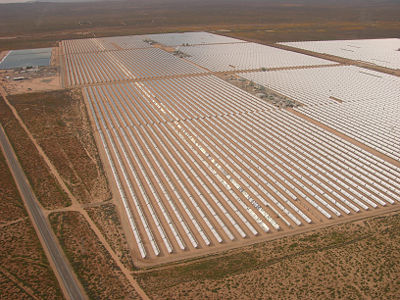
Ausra, the developer of utility-scale solar thermal power headquartered in Palo Alto, CA, today officially opened the reflector production line of its first North American manufacturing and distribution center in Las Vegas. The 130,000-square-foot, highly automated manufacturing and distribution center will supply the reflectors, absorber tubes, and other key components of the company's solar thermal power plants to the rapidly growing Southwestern solar power industry.

U.S. Senate Majority Leader Harry Reid (D-NV) and Ausra President and CEO Robert Fishman officially started the reflector production line. ... "This is a crossover point for this industry," said Fishman. "Ausra's factory is accelerating Nevada's and America's solar future by tripling worldwide manufacturing capacity, relieving the supply constraint that has slowed the industry, and continuing to drive down costs. By a 94 percent majority, the American public wants solar power development to help address rising prices for traditional energy sources. We're ready to respond now with a clean, reliable and cost-competitive energy choice that will be an economic development machine for the country. Herein Southern Nevada alone, developers are planning over $50 billion of future solar power plants."

Solar Energy for Nighttime and Cloudy Days  

Posted by Big Gav in , , ,

The New York Times has a reasonably good article on energy storage for solar thermal power plants (via the WSJ's Environmental Capital blog). They talk to Ausra's John O'Donnell, but talk about molten salt based energy storage instead of the water based system Ausra are proposing.

The NYT also has a post on home wind power turbines.

Solar power, the holy grail of renewable energy, has always faced the problem of how to store the energy captured from the sun’s rays so that demand for electricity can be met at night or whenever the sun is not shining.

The difficulty is that electricity is hard to store. Batteries are not up to efficiently storing energy on a large scale. A different approach being tried by the solar power industry could eliminate the problem.

The idea is to capture the sun’s heat. Heat, unlike electric current, is something that industry knows how to store cost-effectively. For example, a coffee thermos and a laptop computer’s battery store about the same amount of energy, said John S. O’Donnell, executive vice president of a company in the solar thermal business, Ausra. The thermos costs about $5 and the laptop battery $150, he said, and “that’s why solar thermal is going to be the dominant form.”

Solar thermal systems are built to gather heat from the sun, boil water into steam, spin a turbine and make power, as existing solar thermal power plants do — but not immediately. The heat would be stored for hours or even days, like water behind a dam.

A plant that could store its output could pick the time to sell the production based on expected price, as wheat farmers and cattle ranchers do. Ausra, of Palo Alto, Calif., is making components for plants to which thermal storage could be added, if the cost were justified by higher prices after sunset or for production that could be realistically promised even if the weather forecast was iffy. Ausra uses Fresnel lenses, which have a short focal length but focus light intensely, to heat miles of black-painted pipe with a fluid inside.

A competitor a step behind in signing contracts, but with major corporate backing, plans a slightly different technique in which adding storage seems almost trivial. It is a “power tower,” a little bit like a water tank on stilts surrounded by hundreds of mirrors that tilt on two axes, one to follow the sun across the sky in the course of the day and the other in the course of the year. In the tower and in a tank below are tens of thousands of gallons of molten salt that can be heated to very high temperatures and not reach high pressure.

“You take the energy the sun is putting into the earth that day, store it and capture it, put it into the reservoir, and use it on demand,” said Terry Murphy, president and chief executive of SolarReserve, a company backed in part by United Technologies, the Hartford conglomerate.

Power plants are typically designed with a heat production system matched to their electric generators. Mr. Murphy sees no reason why his should. His design is for a power tower that can supply 540 megawatts of heat. At the high temperatures it could achieve, that would produce 250 megawatts of electricity, enough to run a fair-size city.

It might make more sense to produce a smaller quantity and run well into the evening or around the clock or for several days when it is cloudy, he said.

At Black & Veatch, a builder of power plants, Larry Stoddard, the manager of renewable energy consulting, said that with a molten salt design, “your turbine is totally buffered from the vagaries of the sun.” By contrast, “if I’ve got a 50 megawatt photovoltaic plant, covering 300 acres or so, and a large cloud comes over, I lose 50 megawatts in something like 100 to 120 seconds,” he said, adding, “That strikes fear into the hearts of utility dispatchers.”

Thermal storage using molten salt can work in a system like Ausra’s, with miles of piping, but if the salt is spread out through a serpentine pipe, rather than held in a heavily insulated tank, it has to be kept warm at night so it does not solidify, among other complications.

A tower design could also allow for operation at higher latitudes or places with less sun. Designers could simply put in bigger fields of mirrors, proponents say. A small start-up, eSolar, is pursuing that design, backed by Google, which has announced a program to try to make renewable electricity for less than the price of coal-fired power.

Mr. Murphy helped build a power tower at a plant in Barstow, Calif., sponsored by the Energy Department in the late ’90s. It ran well, he said, but natural gas, a competing fuel, collapsed in price, and the state had few requirements for renewable power.

“There were not renewable portfolio standards,” Mr. Murphy said. “Nobody cared about global warming, and we weren’t killing people in Iraq.”


Solve Climate also has a post on energy storage, and the need to get it right so that solar and wind can provide baseload power.
AIChE explains that to compete with fossil fuels as a primary source of continuous power, solar will need a massive electricity storage system (MES). It argues for 100 gigawatts, or 100,000 megawatts, of storage capacity, at minimum. That's about 10% of the total installed capacity of the US grid, which stands at 1,076 gigawatts.

And without MES, solar simply can't be a baseload provider. Apparently, that’s been a point lost on many, argues AIChE:
The public understanding and perception of solar power seems to be that, to displace fossil and other fuels in power generation, all that is needed for renewable sources to be the principal supplier is to install more wind farms, solar cells, or thermal conversion systems. Such perception is incomplete and oversimplified, and must be remedied.

And it’s not just the public who's failed to "get it." It's the DOE too.

AIChE reports that the agency is spending a piddly $2 million a year on energy storage technologies. That could change though, and rather soon.

The energy bill signed by the president into law in December 2007 includes a title on "Energy Storage and Competitiveness." It earmarks tens of millions of dollars a year for ten years for developing energy storage.

But it’s a mere authorization of funding, not the real thing. And unless those dollars begin to flow, America will be putting the cart before the horse.

Why?

Because R&D funding is being poured into improving the conversion efficiency of solar energy -- and other sources -- into electricity. And that's great. But it could be for naught if we haven't a clue how to dispatch the power for utility-scale use.

Best to flesh out the big missing piece of energy storage right now, before we get even further behind the renewable energy curve.

Concentrating On The Important Things - Solar Thermal Power  

Posted by Big Gav in , , , , ,

While we spend a lot of time talking about traditional energy sources based on depleting resources that are extracted from the ground, I think its important to remember that the fastest growing sources of energy are solar and wind, and that these will never run out. As M King Hubbert put it regarding solar power in particular:

The biggest source of energy on this earth, now or ever, is solar. I used to think it was so diffuse as to be impractical. But I’ve changed my mind. It’s not impractical…This technology exists right now. So if we just convert the technology and research and facilities of the oil and gas industries, the chemical industry and the electrical power industry—we could do it tomorrow. All we’ve got to do is throw our weight into it.

Both Stuart Staniford's recent "Powering Civilization to 2050" post and (to a lesser extent) Scientific American's "Solar Grand Plan" concentrated on using photovoltaic solar cells to provide the bulk of our energy needs. While both thin film and traditional silicon based PV cells seem to set new efficiency records every couple of months (a CIGS cell recently reached 19.9% efficiency in lab tests, and multi-crystalline silicon PV cells recently reached 19.5% efficiency), the most promising mechanism for large scale solar power generation seems to be solar thermal power (often referred to as concentrating solar power, or CSP).


While this subject has been covered previously at TOD (from a slightly UK-centric viewpoint), I thought it was worth revisiting as solar thermal power has received a lot of press attention lately, as experience with generating power in this way grows and the potential becomes clearer to a larger number of parties.

History

Concentrated sunlight has been used to perform useful tasks for many centuries. A legend claims Archimedes used polished shields to concentrate sunlight on a Roman fleet to repel them from Syracuse in 212 BC. Leonardo Da Vinci considered using large scale solar concentrators to weld copper in the 15th century. Auguste Mouchout successfully powered a steam engine with sunlight in 1866 - the first known example of a concentrating solar-powered mechanical device.

Concentrating Solar Power (CSP) systems use lenses or mirrors combined with tracking systems to focus sunlight which is then used to generate electricity. The primary mechanisms for concentrating sunlight are the parabolic trough, the solar power tower (not to be confused with solar updraft towers) and the parabolic dish. The high temperatures produced by CSP systems can also be used to provide heat and steam for a variety of applications (cogeneration). CSP technologies require direct sunlight (insolation) to function and are of limited use in locations with significant cloud cover.

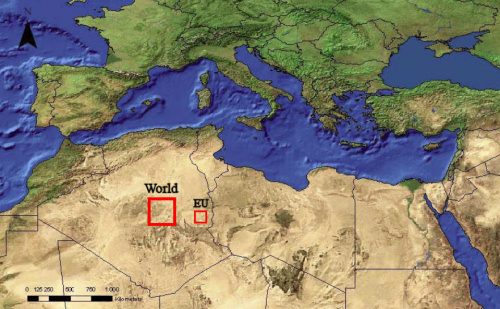
Solar thermal power plants have been in commercial use in southern California since 1985. An area of desert around 250 km by 250 km covered with CSP power generation could supply all the world's current electricity demand.


Solar thermal plants can be built in their entirety within a few years - much faster than many conventional power projects. Solar thermal plants are built almost entirely with modular, commodity materials (and thus have short development and construction times) and do not encounter the sort of opposition on environmental grounds that traditional forms of power generation like coal and nuclear face.

Operational plants include :

* US (California) - 354 MW FPL's Solar Energy Generating Systems (SEGS) plant, using parabolic troughs
* US (Arizona) - 1 MW Acciona Energy's Saguaro Solar Generating Station using parabolic troughs
* Spain (Seville) - 11 MW Abengoa's PS10 solar tower
* Australia (NSW) - 35 MW Liddell Power Station using fresnel reflectors
* US (Nevada) - 64 MW Acciona Energy's Nevada Solar One plant (not to be confused with the Solar One / Solar Two experimental plants) using parabolic troughs


Plants currently under construction :

* Spain (Seville) - 20 MW Abengoa's PS20 solar tower
* Spain (Seville) - 20 MW (each) Abengoa's PS20 and AZ20 solar towers
* Spain (Seville) - 50 MW (each) Abengoa's Solnova 1 and 3 using parabolic troughs (5 plants planned in all)
* Spain (Andalusia) - 17 MW Sener's Solar Tres solar tower (molten salt energy storage)
* Spain (Andalusia) - 50 MW (each) Sener's Andasol I, II and III plants (molten salt energy storage)


Solar Thermal Heating Up

There has been a spate of new announcements regarding solar thermal power over the past year - there are over 5,800 MW of solar thermal plants in the planning stages worldwide.

The company receiving the most attention seems to be Ausra, a company set up by Dr David Mills (who pioneered the CSP plant at the Liddell power plant in New South Wales using compact linear Fresnel-reflector technology) with backing from Vinod Khosla and Kleiner, Perkins, Caulfield & Byers (see here for a brief demo of how their technology works). Mills estimates that solar thermal plants could provide more than 90 percent of current U.S. power demand at prices competitive with coal and natural gas. "There's almost no limit to how much you can put into the grid," he says.

Mills presented a paper (pdf) at the IEA SolarPACES conference in Las Vegas recently which revealed some interesting statistics about the construction cost of solar-thermal technologies: US$3,000 per kW of capacity, estimating this will drop to US$1,500 per kW over the next "several" years. The New York Times last year quoted GE Energy executives estimating coal plant construction between US$2,000 and US$3,000 per kW. Ausra says it can generate electricity for 10 cents per kWh (close to the current cost using natural gas), and it expects the price to drop even further.

According to Technology Review:
What distinguishes Ausra's design is its relative simplicity. In conventional solar-thermal plants such as Solel's, a long trough of parabolic mirrors focuses sunlight on a tube filled with a heat-transfer fluid, often some sort of oil or brine. The fluid, in turn, produces steam to drive a turbine and produce electricity. Ausra's solar collectors employ mass-produced and thus cheaper flat mirrors, and they focus light onto tubes filled with water, thus directly producing steam. Ausra's collectors produce less power, but that power costs less to produce.

Ausra is initially planning a 177 MW plant in California, and has committed to supply 1,500 MW of power to Californian utilities PG&E and FPL. They are also rumoured to be moving in to Texas as well.

PG&E have also signed a 25-year deal with Ausra competitor Solel Solar Systems of Israel to buy power from a 553 MW solar thermal plant that Solel is developing in California's Mojave Desert. FPL has also hired Solel to upgrade the SEGS solar-thermal plants it operates in the Mojave.

Another PG&E contract is with BrightSource to supply between 500 MW and 900 MW of power per year from solar tower plants in California, beginning in 2011, with the first of a number of 100 MW facilities being built in Ivanpah.

Other companies active in the US include eSolar (linked to Google's energy initiatives), RocketDyne and SkyFuel.

Abu Dhabi's Masdar Initiative and Spain's Sener are have formed a joint venture to build and operate concentrating solar power plants across the world's sunbelt regions called Torresol Energy.


Independently of Torresol, Masdar is developing its 100 MW "Shams 1" CSP plant in Abu Dhabi.

Algeria and Germany have signed a a joint research agreement for the development of a new generation of large-scale, low-cost solar thermal power plants (which could contribute to the Desert-TREC vision of large scale CSP in North Africa powering Europe).

More new plants are being planned in :

* Algeria - 20 MW Abengoa's plant in Hassi-R'Mel
* Australia - 10 MW Queensland State Government facility in Cloncurry
* Australia - 154 MW Solar Systems and TRUEnergy's plant in Mildura
* Egypt - 70 MW plant in Kuraymat
* Iran - 17 MW plant in Yazd
* Israel - 250 MW plant in Ashalim
* Morocco - 20 MW Abengoa's plant in Ain-Ben-Mathar
* US (Arizona) - 280 MW Abengoa and Arizona Public Service's plant in Gila Bend
* US (California) - 50 MW Inland Energy's plant in Victorville
* US (California) - 250 MW FPL Energy's Beacon Solar Energy Project

Feasibility studies are also being done in Oman, China and Mexico.

Energy Storage

One of the key differentiating factors between solar thermal power and solar PV is that heat energy is more easily (and efficiently) stored than electricity, with solar thermal plants often combining energy storage into the design to enable around-the-clock, dispatchable electricity generation.

Most solar thermal plants are looking to use molten salt for storing energy - other alternatives being developed are graphite (in the Cloncurry development), heated water / steam (for the Ausra plants) and heat-transfer oil such as therminol (for the Abengoa plant in Arizona).

Cost

The existing plants prove that concentrated solar power is practical, but costs must decrease. Electricity from solar thermal plants currently costs between US$0.13 per kilowatt hour (kWh) and US$0.17 per kWh, depending on the location of the plant and the amount of sunshine it receives. Conventional power plants generate electricity for between US$0.05 and US$0.15 per kilowatt hour (not including any carbon taxes or cap and trade related costs) but in most places it's below US$0.10 (wind power generally costs around US$0.08 per kWh).

An economic analysis released last month by Severin Borenstein (pdf), director of the University of California's Energy Institute, notes that solar thermal power will become cost competitive with other forms of power generation decades before photovoltaics will, even if greenhouse-gas emissions are not taxed aggressively.

In 2006 a report by the Solar Task Force (pdf) of the Western Governors’ Association concluded that CSP could provide electricity at US$0.10 per kWh or less by 2015 if 4 GW of plants were constructed.

According to Bernhard Milow from the German Aerospace Center (DLR) electricity from solar thermal plants could cost as little as €0.04 per kWh [US $0.06/kWh] by 2020, with well sited plants potentially generating power at lower prices than coal.

The US DOE began supporting large scale CSP last year, aiming to reduce the cost of CSP power to 7-10¢/kWh by 2015 and 5-7¢/kWh by 2020. The DOE estimated that reaching these cost targets could lead to installation of up to 35,000 MW of new generating capacity by 2030 in the US. James Fraser at The Energy Blog commented at the time that it was 5 years too late (given recent commercial activity in the area) and that PV solar may beat these price goals before solar thermal does, but that more solar options are good in any case, as both PV and thin film solar manufacturing will be constrained by availability for materials for some time as production continues to accelerate.

Another estimate from Sandia labs showed solar thermal costs (for solar towers) could fall to around 4 cents per kWh by 2030.


Stirling Engines

Another variant on the solar thermal power theme are Stirling engine based power plants, which generate electricity directly rather than first storing the energy as heat.

Stirling Energy Systems seems to be the leader in this field, with some reports talking about agreements with Southern California Edison and San Diego Gas & Electric for up to 1.75 GW of power. The company recently set a new world record of 31.25% for Solar-to-Grid conversion efficiency.

Other companies pursuing stirling engine based solutions are Infinia and SunPower (not to be confused with its larger namesake in the PV industry).


Passive Solar Thermal - Solar Hot Water And Others

Generating power isn't the only way to utilise solar thermal energy of course - solar hot water is a very cheap and efficient way of replacing gas or electricity usage with solar energy. Solar hot water systems are in widespread use in Australia, with state and federal governments encouraging people to upgrade their home hot water systems to solar - almost cost free in some states. The New Zealand government is also encouraging the use of solar hot water systems.

Some larger scale uses of solar thermal hot water are being put in place by Abengoa in Texas and Colorado.

Solar hot water is in wide use in China as well, with the city of Rizhao becoming somewhat famous for achieving widespread takeup of the units.

An unusual variation of the direct capture of solar energy in the form of heat is from a Dutch company that has developed a "Road Energy System" that siphons heat from roads and parking lots to heat offices and homes.

And one final use of solar thermal power - it can keep your house warm, if your windows face the right way, and even better, have insulating glass that doesn't let the heat out again - which could help make your building energy positive.

Solar thermal power could supply most of US Demand  

Posted by Big Gav in , , , ,

Ausra's David Mills has been promoting solar thermal power as the answer to all our energy needs (when coupled with large scale energy storage). While this is theoretically true, I suspect once we've completed the transition to 100% clean energy solar thermal will supply maybe half the required energy - with PV (especially thin film) and a range of other renewables making up the rest.

"I took it as a theoretical presentation – what in theory could one do if you were starting from scratch," said Tom Fair from Nevada Power's renewable energy program. Fair was discussing the presentation David Mills, CEO of Palo Alto, Calif.-based Ausra, gave at the International Energy Agency's SolarPACES solar research conference in Las Vegas, Nev.

Mills said that over 90 percent of the nation's electricity, and most of the transportation sector's energy needs, could be supplied by solar thermal technology within the next 50 years. The study is available here. It's possible from a technology standpoint, Fair told Cleantech.com. "Deploying everything in that timepoint is obviously a challenge," he said. "There's still a lot of infrastructure in electricity and transportation that would need to be replaced."

One of the key improvements that would need to be made is in storage. Mills said the solar thermal plants would need just 16 hours of storage to continuously generate electricity. Fair said Mills' idea was "a really great target to shoot for. We'd like to see it become commercially viable."

Nevada Power is getting some of its energy from renewable sources, including a 64 megawatt solar thermal plant and a 12 MW photovoltaic plant. A geothermal power plant is expected to supply another 18 to 30 MW to the company's customers. Ausra itself has a manufacturing plant in Las Vegas that is expected to go online next month. ...

One of the storage technologies currently being used is molten salts, which must maintain a temperature above 200 degrees Celsius to continuously provide energy. Keeping the molten salts from freezing without taking energy from the grid is a hurdle, said Jenkins-Stark.

The solar day is now 24 hours long, according to John O'Donnell, Ausra's executive vice president. He said Spanish solar thermal power station Andasol is currently running 24-7 and has a 16-hour storage reservoir.

One of the factors in Mills' paper that makes the storage viable is using an oversized solar field – this allows some of the energy collected during the day to keep the electricity generation process running all night long as well, at no extra storage cost. The biggest thing about Mills' work, O'Donnell said, is that it proposes a path forward "where there's no cost increase."

The correlations Mills found between electricity load and seasonal changes suggest that the notion of using solar thermal power for the whole nation within a few decades is viable.

"We can move to an all-renewable future with the technologies commercially available right now," O'Donnell added. "It's more a matter of mobilization and deployment."

Richard Caputo, a director on the board of the San Diego Renewable Energy Society, said making Mills' proposal a reality would require more high voltage DC lines to carry the electricity from the southwestern U.S. to the rest of the country. It's an investment that would have to be made, he said, but not necessarily now.

"When you think the future and you think renewables, you start building it within two decades so it'll be ready in four decades," he said. "After World War II, the country decided it needed a national road system. Now's the time to decide we need a national electric system."

Statistics

Locations of visitors to this page

blogspot visitor
Stat Counter

Total Pageviews

Ads

Books

Followers

Blog Archive

Labels

australia (619) global warming (423) solar power (397) peak oil (355) renewable energy (302) electric vehicles (250) wind power (194) ocean energy (165) csp (159) solar thermal power (145) geothermal energy (144) energy storage (142) smart grids (140) oil (139) solar pv (138) tidal power (137) coal seam gas (131) nuclear power (129) china (120) lng (117) iraq (113) geothermal power (112) green buildings (110) natural gas (110) agriculture (91) oil price (80) biofuel (78) wave power (73) smart meters (72) coal (70) uk (69) electricity grid (67) energy efficiency (64) google (58) internet (50) surveillance (50) bicycle (49) big brother (49) shale gas (49) food prices (48) tesla (46) thin film solar (42) biomimicry (40) canada (40) scotland (38) ocean power (37) politics (37) shale oil (37) new zealand (35) air transport (34) algae (34) water (34) arctic ice (33) concentrating solar power (33) saudi arabia (33) queensland (32) california (31) credit crunch (31) bioplastic (30) offshore wind power (30) population (30) cogeneration (28) geoengineering (28) batteries (26) drought (26) resource wars (26) woodside (26) censorship (25) cleantech (25) bruce sterling (24) ctl (23) limits to growth (23) carbon tax (22) economics (22) exxon (22) lithium (22) buckminster fuller (21) distributed manufacturing (21) iraq oil law (21) coal to liquids (20) indonesia (20) origin energy (20) brightsource (19) rail transport (19) ultracapacitor (19) santos (18) ausra (17) collapse (17) electric bikes (17) michael klare (17) atlantis (16) cellulosic ethanol (16) iceland (16) lithium ion batteries (16) mapping (16) ucg (16) bees (15) concentrating solar thermal power (15) ethanol (15) geodynamics (15) psychology (15) al gore (14) brazil (14) bucky fuller (14) carbon emissions (14) fertiliser (14) matthew simmons (14) ambient energy (13) biodiesel (13) investment (13) kenya (13) public transport (13) big oil (12) biochar (12) chile (12) cities (12) desertec (12) internet of things (12) otec (12) texas (12) victoria (12) antarctica (11) cradle to cradle (11) energy policy (11) hybrid car (11) terra preta (11) tinfoil (11) toyota (11) amory lovins (10) fabber (10) gazprom (10) goldman sachs (10) gtl (10) severn estuary (10) volt (10) afghanistan (9) alaska (9) biomass (9) carbon trading (9) distributed generation (9) esolar (9) four day week (9) fuel cells (9) jeremy leggett (9) methane hydrates (9) pge (9) sweden (9) arrow energy (8) bolivia (8) eroei (8) fish (8) floating offshore wind power (8) guerilla gardening (8) linc energy (8) methane (8) nanosolar (8) natural gas pipelines (8) pentland firth (8) saul griffith (8) stirling engine (8) us elections (8) western australia (8) airborne wind turbines (7) bloom energy (7) boeing (7) chp (7) climategate (7) copenhagen (7) scenario planning (7) vinod khosla (7) apocaphilia (6) ceramic fuel cells (6) cigs (6) futurism (6) jatropha (6) nigeria (6) ocean acidification (6) relocalisation (6) somalia (6) t boone pickens (6) local currencies (5) space based solar power (5) varanus island (5) garbage (4) global energy grid (4) kevin kelly (4) low temperature geothermal power (4) oled (4) tim flannery (4) v2g (4) club of rome (3) norman borlaug (2) peak oil portfolio (1)