Showing posts with label iraq oil law. Show all posts

Trump's Threat To Steal Iraq's Oil  

Posted by Big Gav in , , ,

The spectacle of Donald Trump abruptly transitioning the US political system into open fascism is quite horrifying even from the other side of the Pacific, however by and large ourlocal media aren't bothering to report the details.

Paul McGeough at the SMH gets to do a summary piece each day though (today's piece looking on the blatant blackmail involved in the new anti-muslim immigration laws, with countries that host Trump properties exempt and those without them hit hard - it's more a mafia style shakedown than a real immigration policy).

Long time business writer Michael Pascoe was also moved to voice his shock ("Australia is investing billions in madman Donald Trump") after Trump's bizarre interview with ABC News recently where he once again threatened to steal Iraq's oil.

As I've noted here many times before, Iraq has the world's largest and cheapest to extract oil reserves, and trying to gain control of them was a major reason for the Iraq war.

Bush and the neocons at least tried to maintain a fig leaf of legality around their attempt's to bully the Iraqi government into signing over control of the oil, so Trump's naked imperialism has managed to outrage the entire political spectrum outside of the fascist right.

The Washington Post - Trump’s illegal, impossible, and ‘beyond goofy’ idea of seizing Iraq’s oil.

The United States can’t just walk off with Iraq’s oil when it decides to get out. In 2015, Iraq produced about 4 million barrels a day, enough crude oil to fill more than 700 Trump Towers. Billions of barrels more sit underground in conventional reservoirs. The International Energy Agency has estimated that Iraq could produce twice as much as it does currently — by 2035. That means taking the oil would take decades. That might explain Trump’s suggestion that “a certain group” should be left behind to hold down parts of the country so that the United States could siphon off oil. What he didn’t say is that that group – undoubtedly U.S. soldiers — could be there quite a while. ...

“To ‘take the oil’ would require the United States to occupy Iraq. We tried that after 2003 with something approaching 200,000 troops and it did not work,” said Andrew Bacevich, a retired colonel and professor of history and international relations at Boston University. “What would effective occupation actually require? A minimum of a half-million troops, perhaps more.” Bacevich added, “Presumably, Trump would have them stay until the oil runs out, which would entail an occupation running into decades. The total cost? Probably more than the value of the oil itself. The whole idea is beyond goofy.”

Juan Cole - Trump to CIA: We now have 2nd Chance to take Iraq’s Oil.

The United Nations Charter and other treaty instruments that are part of US law actually abolished the principle of ‘to the victors go the spoils.’ Conquering states in a war are not allowed to annex territory from the vanquished as of 1945. That’s what is wrong with the Israeli creeping annexation of Palestine since 1967.

Given that the US has 6000 troops in Iraq, as Thomas Doherty pointed out, this kind of talk puts them in danger from Iraqi nationalists who may begin seeing them not as allies against ISIL but as stalking horses for a sinister imperialism. Trump just painted a big red target on the backs of our troops. ...

This isn’t speculation: the great Borzou Daragahi reports that the Iraqis are indeed ‘pissed’ and ready to fight for their oil.

Trump is also wrong that Iraqi petroleum fueled Daesh (ISIS, ISIL), or that the US could have “taken” Iraqi petroleum. This is because he does not know Iraqi geography or political geography. Most oil in Iraq is either down in Shiite territory at Basra (the vast majority of what is pumped) or up in Kurdish-held territory at Kirkuk. Daesh in Iraq had relatively little access to petroleum revenues, and the experts on it believe that contributions from Gulf supporters and taxes and plunder from local people (including on agriculture) were much more important. The situation is perhaps a little different in Syria, but we’re talking about Iraq.

The Independent - Iraq says Donald Trump's threat to seize the country's oil makes no sense.

US enemies and friends would oppose the move. While Iraqi Prime Minister Haider al-Abadi has accepted US help to retake Isis-held territory in his country, he has repeatedly asserted Iraqi sovereignty. He said of Trump's oil vow in November, “I am going to judge him by what he does later.” Reuters reported Mr al-Abadi as saying: “It wasn't clear what he meant. Did he mean in 2003 or to prevent the terrorists from seizing Iraq's oil? Iraq's oil is constitutionally the property of the Iraqis.”

The Atlantic - Why Iraq Needs the Oil.

It is into this delicate situation that Trump has pitched himself, without apparent regard to the consequences. That his threat to strip Iraq of its oil survived his transition into the White House demands careful consideration of what the proposal could actually entail. The U.S. military would not, as Trump has suggested, occupy Iraq to oversee the illegal extraction of crude from its oil fields, which are dispersed across the country. ...

Or he could just push the Iraqi government to award favorable contracts to American companies like ExxonMobil, whose former CEO Rex Tillerson has just been confirmed as secretary of state. Tillerson’s previous escapades, of course, present a cautionary tale. Under Tillerson, ExxonMobil purchased oil rights to land blocks controlled by the KRG in 2011—a deal that directly challenged the authority of the Iraqi government and was partially responsible for an armed stand-off between the Iraqi army and the Kurdish peshmerga.

Tillerson’s record of aggressively asserting corporate interests into decidedly thorny diplomatic climates also reflects the lack of common purpose among Trump’s team. James Mattis, Trump’s secretary of defense, has a record of seeking to confront Iran’s growing influence in Baghdad. Destabilizing Iraq’s oil sector would weaken Baghdad’s hold on the country, thereby strengthening Iran’s position.

The Boston Globe - As Trump muses about seizing Iraq oil, energy experts say it makes no sense.

“This is foolish,” Kenneth Pollack, a senior fellow at Brookings Institution, said. “This is a typical Trump remark. It’s moronic. It makes no sense. We couldn’t just suddenly grab Iraq’s oil and walk away with it.” In order to extract the oil, American forces would need to occupy the country, a costly, dangerous, and politically risky process, Pollack said. He added Iraqi resistance to these efforts would be quite strong given oil is a crucial source of income for the country.

In response to Trump’s comments, Massachusetts Representative Seth Moulton, a former Marine, tweeted on Saturday, “No. That’s pillaging, and it’s a war crime.”

The Guardian - Trump's plan to seize Iraq's oil: 'It's not stealing, we're reimbursing ourselves'.

The idea predates Trump’s presidential campaign. As far back as 2011, he was telling the Wall Street Journal that this was his policy for Iraq. “You heard me, I would take the oil,” he said. “I would not leave Iraq and let Iran take the oil.” And he insisted to ABC News that this did not amount to national theft. “You’re not stealing anything,” Trump said. “We’re reimbursing ourselves … at a minimum, and I say more. We’re taking back $1.5tn to reimburse ourselves.”

As a security strategy, this presents huge problems from almost every angle, according to military, strategic, legal and oil experts. First of all, there are issues of principle and legality. Trump’s frequent invocation of the “spoils of war” seems to hark back to a bygone age of conquistadors and plunder-based imperialism, illegal now under the laws of war.

“In international law, you can’t take civilian goods or seize them. That would amount to a war crime,” Anthony Cordesman, the Arleigh Burke chair in strategy at the Centre for Strategic and International Studies. “Oil exports were almost the only Iraqi source of money. So you would have to pay for government salaries, maintain the army, and you have triggered a level of national animosity far worse than we did. It would be the worst kind of neo-colonialism. Not even Britain did that.”

Jay Hakes, the author of A Declaration of Energy Independence, about the relationship between US national security and Middle Eastern oil, was similarly unsparing. “It is hard to overstate the stupidity of this idea,” he wrote on Real Clear Energy. “Even our allies in the Middle East regard oil in their lands as a gift from God and the only major source of income to develop their countries. Seizing Iraq’s oil would make our current allies against Isis our new enemies. We would likely, at the least, have to return to the massive military expenditures and deployment of American troops at the war’s peak.”

Iraqi oil production cutback plan adds to global supply fear ?  

Posted by Big Gav in , ,

The battle for control of Iraq's oil seems to be moving into interesting territory, with the US due to remove all troops from the country by the end of the year (something which will never happen of course).

In the lead up to the last Iraqi election there was a spurt of deals done which didn't give the international oil companies particularly good terms - now the election is over and the punters are back in their usual position of having no influence, these deals are looking to be renegotiated - within production levels being reduced and the oil majors getting a bigger cut of the action - another case of history repeating itself.

The Australian has a good example of how this is being reported, focusing on the national production targets being reduced rather than where the money is going - Iraqi oil production cutback plan adds to global supply fear.

IRAQ is preparing to halve its official oil production target, forcing companies including BP and Shell to renegotiate their contracts.

The country's Oil Ministry, with backing from the Prime Minister Nouri al-Maliki, will set a new target to produce between 6.5 million and 7 million barrels per day by 2017, down from original plans to pump 12 million barrels, according to industry insiders.

Iraq, which is a member of the OPEC cartel that pumps 40 per cent of the world's oil, produces about 2.68 million barrels a day, barely higher than under Saddam Hussein.

It had been hoped that with a huge injection of foreign investment, it would be able to challenge Saudi Arabia as the world's biggest oil exporter this decade.

Confirmation it has scrapped the old target will add to fears that global supply will be unable to keep pace with demand in coming years.

It is understood that government negotiations to change the long-term service agreements signed by companies in the past two years based on the old production target will begin soon.

Analysts said companies would seek improved terms to compensate them for losing out on revenue, which at present is earned for each barrel of oil produced above a base target.

Baghdad believes it would not be in its interests to try to achieve the 12 million target by 2017 because boosting global supply would depress prices.

Ministers also argue that there is not sufficient demand for the extra oil, despite soaring prices. Last month, Saudi Arabia cut its output by 800,000 barrels a day after pumping more in response to the political crisis in North Africa, complaining that the extra crude was sitting in tankers with no customers.

High oil prices, which have doubled since the 12 million target was set two years ago, will compensate Iraq for the lower production. ...

Samuel Ciszuk, senior energy analyst for IHS Energy, said an over-ambitious target was politically motivated, being set before elections in 2009. "It was clearly designed to impress the Iraqis ahead of the elections. The oil majors will now seek more attractive terms."

Moon Of Alabama has a cynical view of some of the diplomacy being undertaken in Iraq as the troop withdrawal date looms - The Extortion Of Iraq.
The consigliere was send out to deliver first a threat
Gates: Iraq will face problems if U.S. troops withdraw

"They will not be able to do the kind of job in intelligence fusion. They won't be able to protect their own airspace. They will have problems with logistics and maintenance."

then an offer
Gates: Some US troops may stay if Iraq wants

and making clear that it can not be refused
Gates Presses Iraq to Decide on Extension of U.S. Presence

But the guy in charge of pizza joint says "No!"
Sadr calls for an end to 'US occupation'

Al Jazeera correspondent Jane Arraf, reporting from Baghdad, said that this time Sadr had not only warned US troops but also the contractors.

What will the mafia Don do next?

Iraqi Oil: What is hidden inside the Oil Contracts from the 1st and 2nd Bid Rounds ?  

Posted by Big Gav in , ,

ZNet has a look at the Iraq oil law - Iraqi Oil: What is hidden inside the Oil Contracts from the 1st and 2nd Bid Rounds ? (via Energy Bulletin). I found the point that the international oil companies will get additional payments for *not* producing oil kind of interesting, given their long history of suppressing Iraqi oil production.

Over eleven months have passed since the signing of the oil contracts between the Federal Ministry of Oil in Baghdad and the International oil companies (IOCs) resulting from the first and second bid rounds. However, to this date none of these contracts have been publicly released or published in any foreign language. Amazingly, all the contracts are written in English and none of them have even been translated into Arabic by the oil ministry in Baghdad, for the Iraqi people or even their representatives in the Federal parliament in Baghdad to look at and to see how their future is going to be shaped.

I have now obtained access to some of the contracts. My sources have specified that I cannot publish them in full, but I can discuss several aspects of them, which I shall do here.

My analyses will not cover the consequences of these contracts for the future of the Iraqi oil and gas industries or the future relations between Iraq and OPEC and its effect on international oil prices, as I already have covered these important topics in my previous articles [Iraqi Oil: The influence of the 1st Bid Round on the Future of Iraq's National Oil and Gas industries and [Iraqi Oil: Are the 1st and 2nd Bid Rounds Part of A Wise Resource Development Strategy Or Could They Turn Out To Be Steps in the Wilderness? ]

... Conclusions

1. Articles 12 and 37 explain the reasons for the secrecy surrounding the 1st and 2nd bid round oil contracts and the lack of real transparency by the Federal Ministry in Baghdad. Not only have the contracts not been made public, but they have not even been translated into Arabic, which should make every Iraqi suspicious of the motives behind all the secrecy covering the contracts to this date.

2. Article 12 shows that the margin of profits which were agreed on officially with the IOCs' contractors does not represent the only profit that the IOCs will receive from the Iraqi Ministry of Oil, as the Ministry of Oil will compensate the contractors for the quantity of oil that they do not produce, which will in itself represent a penalty on the Iraqi people, whilst the IOC will receive additional profits for doing nothing.

3. Article 37 is a very significant article in terms of setting up the economic future of the Iraqi people and their future sovereignty. Therefore it is not wise to leave these vital decisions in the hands of bureaucrats in the Ministry of Oil or, for that matter, in the hands of a very weak government, without allowing the Iraqi people to have their say on their future by ensuring that such laws can only turn into lawful contracts if they are at least passed by an elected parliament, as required by existing Law number 97 dated 1967 which is still in force, or by a public referendum.

4. There are some analysts who believe that the US oil companies lost out from the awarded contracts, since only two of them, Exxon Mobil and Occidental have been awarded contracts. In my judgment this was not the case, as today what we call the International Oil Companies are really no longer national oil companies operating in the international market, as was the case up to the 1970s. In today's market, what we call IOCs are in fact multinational oil companies (MOC), owned by the multinational financial institutions (mostly US), with share holders from around the globe, and not by one nation's share holders. It is more likely today that the external size of operations and profits of theses companies comes from projects from all over the globe rather than from one nation, as shown by the cases of BP, Shell and most others including CNPC.

5. The contracts awarded in the 1st and 2nd bid rounds confirm that the US occupation of Iraq which started in 2003 did achieve some of its targets. In particular the occupation succeeded in ensuring that the future control of Iraqi oil stayed in the hands of the multinational oil companies and not in the hands of the Iraqi people and their legislative body.

Middle East & Africa Iraq, Iran and the politics of oil  

Posted by Big Gav in , ,

The Economist has an article on plans to expand oil production in Iraq - Iraq, Iran and the politics of oil.

Iraq is now trying to recover its glory, with plans to quadruple production or more. This could transform the global oil industry; it also threatens two other founding members of OPEC. Saudi Arabia might have to share its leadership of the organisation and Iran faces an even greater setback. Close relations with China, based on Beijing’s thirst for oil, have helped Iran to avoid isolation over its nuclear programme. But Chinese oil companies are now turning their attention to Iraq, with American backing.

Yet Iraq will have to pull off an unprecedented feat. In the history of the modern oil industry, no country has increased output with the speed the Iraqis envisage. Over the next seven years Iraq intends to go from producing 2.5m barrels per day to 12m b/d, a target that exceeds Saudi Arabia’s current output by more than 30%. To this end, Iraq has signed ten deals with most of the world’s top oil companies. Some got down to work this month.

The expansion plan was drawn up by Hussein al-Shahristani, the oil minister. He snared an initial deal with BP last summer, ensuring that its chief competitors, Royal Dutch Shell and Exxon Mobil, would follow suit. At the same time he made deals with Lukoil of Russia and China National Petroleum Corporation, giving him additional leverage. The clever dishing out of contracts was matched by ruthless pricing. The minister insisted that companies take less than $2 per barrel, leaving most of the gain, perhaps as much as 95%, to the Iraqi state. The minister’s hard bargaining headed off antipathy from nationalistic Iraqis. Desperate for money to build schools and hospitals, many welcomed the deals made with the hated foreign oil majors, whose predecessors once dominated Iraq.

Mr Shahristani is hoping for easy re-election in national polls on March 7th. But progress will be slower than he has led voters to believe. Even an advanced nation would struggle to add enough wells and pipelines to handle the equivalent of the total Saudi output. In decrepit Iraq, achieving Mr Shahristani’s plans is especially ambitious. Oil companies will need to build paved roads from scratch and they will have to bring in all their own equipment.

Such logistical delays will be compounded by manpower shortages. The industry does not have enough qualified specialists. Furthermore, the government needs to connect new oilfields with export facilities. That means laying hundreds of miles of pipelines and building countless pumping stations. For the time being, most Iraqi oil leaves the country via a single terminal near Umm Qasr in the northern Arabian Gulf. It is old and American experts have warned that it could run into problems. Foster Wheeler, an oil-services company, is building three extra pipelines and four new offshore moorings for tankers close to Basra, but that is still inadequate. There is talk of upgrading an existing pipeline to Turkey, but negotiations have yet to start. A pipeline to Syria has been closed for years and renovating it has been hampered by political squabbles.

At least the political obstacles to increasing production are less daunting than the technical ones. Admittedly Iraq is still plagued by an insurgency, there is no oil law, making the current government the sole guarantor of deals with foreign companies, and there is a dispute about the ownership of the oil in the Kurdish region in the north of the country, especially around the city of Kirkuk. But worries that an oil boom could spark a fight for control are overdone. Years of sectarian warfare have given Iraqis enough of a hangover to make them at least try to share revenues, as the 2010 national budget shows. After much debate and many delays, parliament agreed on January 26th that oil-producing provinces will receive an additional $1 per extracted barrel from the central government, which controls the industry. To compensate resource-poor provinces, a special subsidy was created for border regions. In addition, religious centres will get $20 per visa or visiting pilgrim.

Mission Accomplished ?  

Posted by Big Gav in , , , , , ,

The saga of Iraq's oil has made the press again, with international oil majors making major inroads into their goal of tapping Iraq's oil fields. The ABC reports on the auctioning off of production rights for some of the country's largest fields - Untapped oil fields auctioned in Iraq.

Iraq has completed its second international oil auction, awarding seven foreign firms the right to exploit some of the country's largest untapped oil fields. One of the biggest contracts was won by a consortium of Russia's Lukoil and and Norway's Statoil. Another went to Royal Dutch Shell and Malaysia's Petronas. ...

The Iraqi oil minister says the successful deals will boost the country's oil production by almost five million barrels a day, almost double the current production rate.

The BBC is headlining a greatly increased Iraqi oil production capacity -Iraq oil capacity 'to reach 12m barrels per day'.
Iraq's oil capacity could reach 12 million barrels per day (bpd) in six years, the country's oil minister says.

Hussein al-Shahristani told reporters in Baghdad that oil producers would not necessarily operate at full capacity, but would take into account demand. Saudi Arabia, the world's largest oil exporter, has a capacity of 12.5m bpd.

Earlier, a joint bid by Russian and Norwegian oil firms won the contract for the "supergiant" West Qurna field, said to have reserves of 13bn barrels.

Lukoil and Statoil will get $1.15 a barrel and will work to raise output from West Qurna Phase 2, in the Basra region, to 1.8m bpd. In June, a winning bid to develop another Iraqi field received $2 a barrel.

On Friday, the contract to develop the 12.6bn-barrel Majnoon field in southern Iraq was won by a consortium led by Shell. It also pledged to increase daily production to 1.8m barrels, up from only 46,000.

Rights for the eastern Halfaya field, with 4.1bn barrels of reserves, went to a consortium led by the Chinese state oil company, CNPC.

Patrick Cockburn at The Independent reports that the Iraqi government is claiming that it isn't giving up control of the fields - Rush for Iraq's oil in defiance of bombers.
The profits for the oil companies will be limited under contracts now being agreed, but they have evidently decided to accept this to secure an entry ticket to a potential Iraqi oil bonanza.

"The second round of bidding represents a new era in the history of the Iraqi oil industry," said the Prime Minister Nouri al-Maliki as he opened the auction. For once such hyperbole may be true because it will see foreign oil companies returning to Iraq en masse for the first time since oil was nationalised in 1972.

Iraqis are intensely suspicious that President Bush's invasion of Iraq in 2003 was motivated by a plan to get hold of Iraqi oil. The government is intent on showing that it is not giving away control of Iraqi oil, the country's only asset. "The old way was in darkened rooms, behind closed doors," said Mr Maliki. "But today what is happening is clear to everyone."

The success of the oil auction is crucial to the future of Mr Maliki because present oil revenues, at around $60bn a year are only just enough to pay salaries and government expenses. There is little left for development and reconstruction of the economy, ruined by continuing conflict and sanctions since the start of the Iran-Iraq war in 1980. Critics argue that Iraq's own oil industry could have raised ouput by itself, but it is crippled by lack of money, organisation, equipment and personnel.

The Oil Ministry's strategy seems to have paid off. In the first auction in June only BP and China's CNPC were willing to accept a fee of $2 for each barrel of extra crude above a minimum production target produced in the super giant Rumaila, one of the largest oilfields in the world. But in recent weeks other big companies have followed suit. Mr Shahristani said: "They will not have a share of Iraqi oil, and our country will have total control over production."

The Guardian had an article before the auction wondering what it means for Iraq - Will oil empower or emasculate Iraq?.
The timing could not have been worse. On Tuesday afternoon, set against the sleek backdrop of a London hotel, the vice-chairman of Iraq's oil and gas committee, Abdul-Hadi al-Hassani, told the BBC that the time is right to invest in Iraq as the government has "gone from strength to strength".

A short distance across town, Sir John Scarlett, head of MI6 and gatekeeper to some of the precious "intelligence" that triggered the war, refused to confirm or deny the report that an Iraqi taxi driver was responsible for the "45 minutes" WMD claim.

While the future and the past of Iraq were being discussed in London, Baghdad was burning in the present, as fire engines were still dousing the smouldering car wrecks and the ambulances were still carefully collecting the remains of some of the 127 people who had been blown up in the co-ordinated blasts that hit the capital.

Despite the progress in reducing levels of violence, clearly Iraq remains a highly dangerous and significantly underdeveloped place. In the first six months of this year only 25,000 Iraqis returned to the country and 4.6 million Iraqis remain internally and externally displaced. In the past six years the country's scores on press freedom and corruption perception indexes have got worse. February's statistics showed only 20% of Iraqis have access to sewage and 45% clean water.

Kurdistan: A lot of oil, a lot of risk  

Posted by Big Gav in , ,

The Toronto Globe and Mail has an interesting update on the state of the Iraqi oil industry - Kurdistan: A lot of oil, a lot of risk.

In the bright, open lobby of the Erbil International Hotel in the Kurdistan region of northern Iraq, Western businessmen in blue jeans huddle with regional officials in business suits. Sitting quietly nearby, their weapons checked at the door, is a gaggle of security men, many of them former Kurdish fighters, now in civilian clothes.

These days, Kurdish leaders and international investors assembling here speak a common language: oil. Kurdistan sits on plenty of it, and the region's current peace is a welcome feature for oil companies looking to explore here.

But Kurdistan's oil fields pale in comparison with the mega oil fields to the south. The Kurds are staking a potentially explosive claim on the area around Kirkuk, which holds vastly more rewarding, but risky opportunities.

Just 90 kilometres south of Erbil, Kirkuk and its resources are at the centre of a power struggle between Iraqi Kurds and Arabs that threatens the fragile stability of the entire country. The resulting sectarian strife makes the region a dangerous place in which to do business.

Unlike Erbil, Western executives rarely venture to Kirkuk. When they do, they travel in three-car armoured convoys, accompanied by heavily armed private security forces, and they mostly stick to the outskirts to avoid trouble, like the car bomb that killed six in a market last month.

With nearly a quarter of the world's easily accessible, light oil reserves and huge tracts of unexplored land, Iraq's oil industry offers immense rewards, both to the country and the international oil companies that are warily pursuing deals.

And for a growing number of companies, the threat of political violence re-erupting in Iraq is a risk worth taking. International oil giants coming to Iraq are already looking past the days of war and regional conflict, as they jockey to secure a piece of the prize early.

On Dec. 11, the major oil players will have a key opportunity to place their bets on Iraq's future. Baghdad plans to auction off the right to develop 10 unexplored but highly prospective oil and gas fields, including some near Kirkuk, following a similar auction earlier this year.

Some 40 of the world's biggest oil companies are qualified to bid next week. Their ultimate success hinges on Iraq's ability to forge political compromises that will allow for peaceful development. The crucial test is Kirkuk, where Kurds and Arab Iraqis battle for control of the area, while coveted oil resources offer lasting economic benefits. ...

If things go well – an enormous if – Iraq could boost its production from 2.5 million barrels a day to more than seven million by 2016, making it the third-largest producer after Saudi Arabia and Russia.

That additional Iraqi supply would have a major impact on world oil markets, helping to moderate prices by replacing production from depleting reserves elsewhere and meeting rising demand from the developing world.

In Iraq, the usual geological and financial challenges for international oil companies are magnified by sectarian violence, legal minefields and political strife. The conditions are less than ideal, and some early projects will likely produce only a modest return on capital. ...

Mr. Gheit says all the major oil companies are struggling to maintain production as current fields decline and international opportunities remain limited. Companies like Exxon Mobil Corp. have to increase production by 200,000 barrels a day from new fields just to offset declines from existing production. That's the reason such companies are investing heavily in Canada's oil sands, even though costs are enormous.

From where Iraqi Oil Minister Hussain al-Shahristani sits – in the ministry's rundown office building on the north side of the capital, shielded by concrete barriers and layers of Iraqi forces – the country's oil policy looks due south.

While the northern regions of Kirkuk and Kurdistan figure prominently in Baghdad's plan to boost its oil production over the longer term, it's the vast array of giant, proven fields in southern Iraq that are expected in the short term to catapult the country into oil's big leagues.

Iraqi Oil Update  

Posted by Big Gav in ,

The Australian has an update on the fate of Iraq's oil, or as they put it, they Iraqi government (although not the parliament) is holding a "welcome-back party for Big Oil" - Shahristani plan to help rebuild war-ravaged economy.

The government intends to auction off oil contracts to foreign companies for the first time since Iraq nationalised its oil industry more than three decades ago. If all goes according to plan in the first round, foreign oil companies will move in to help Iraq revive production at six developed fields that have suffered from years of war and neglect.

But Iraq's fractious politics have complicated the process. Some lawmakers and oil officials have called for a delay of the auction. The man behind the plan, Oil Minister Hussain al-Shahristani, appeared before Parliament yesterday, where some lawmakers questioned the legality of the proposed contracts and what they called favourable terms for the foreign companies.

But the auction appears to have sufficient political support to go ahead on schedule, and Mr Shahristani and other government officials vowed to plow ahead.

Mr Shahristani's oil deals are crucial to this war-torn country's economy. Iraq is thought to have one of the world's largest supplies of crude oil, with 115 billion barrels in proven reserves. But foreign know-how is the key to its plans to boost oil output to four million barrels a day within four to five years, from 2.4m barrels now.

Despite security risks, Western oil companies are clamoring to get in. Iraq is still relatively unexplored, offering big companies a potentially easy-to-tap source of growth. Some are touting Iraq as the most important opening of petroleum fields since the discovery in 2000 of the giant Kashagan field in the Caspian Sea.

Some 120 companies have expressed interest in bidding for the contracts at the June 29 and 30 auction, according to the Oil Ministry. Thirty-five companies qualified to bid, including Exxon Mobil, Royal Dutch Shell, Italy's Eni, Russia's Lukoil and China Petroleum & Chemical, or Sinopec. The six oil fields at stake are believed to hold reserves of more than 43 billion barrels. Foreigners will not get the most prized piece of the action - ownership stakes in the reserves - but will be paid fees for ramping up output.

Just over 20 out of about 80 known oil fields in Iraq have been fully or partially developed, and most of its production comes from just three giants, north and south Rumaila and Kirkuk. Because lots of the black gold is considered relatively easy to extract, oil experts estimate that exploration and development in Iraq costs $US1.50 to $US2.25 ($1.60) a barrel, compared with about $US5 in Malaysia or $US20 in Canada. ...


Western oil companies were kicked out of Iraq in 1972, amid of a wave of nationalisation of Middle East petroleum. Oil production hit at least three million bpd before Iraq invaded Kuwait in 1990, then fell sharply to 300,000 barrels after economic sanctions and trade embargoes were imposed. Production rebounded to about 2.5 million barrels before the US invasion in 2003.

Iraqi lawmakers have squabbled for years over a draft petroleum law that would set a legal framework for foreign companies to start drilling again. Tired of waiting, Mr Shahristani in 2008 unilaterally invited oil companies to bid on contracts. As global companies are reluctant to explore undeveloped fields in Iraq without an oil law, Mr Shahristani has focused on getting foreign help to pump from existing fields.

Iraq Oil Update  

Posted by Big Gav in , ,

Energy Bulletin has a good mini-round up of news from Iraq, starting with a report from The Times on a large oil find in northern Iraq - Heritage Oil strikes big in Kurdish Iraq.

A huge oil discovery in Kurdish Iraq sent the share price of Heritage Oil, the London-based explorer, soaring yesterday and added further pressure on Baghdad to issue permits for long-awaited exports of crude oil from the region.

Heritage said that tests completed on a well drilled in its Miran West concession revealed reserves of between 2.3 billion and 4.2 billion barrels. Heritage reckons that between half and 70 per cent of the oil is recoverable, suggesting that at least one billion barrels can be brought to the surface.

...The find has potentially greater political consequences: at present there is no export route for Kurdish oil because of continuing arguments between Baghdad and the Kurdish Regional Government (KRG) in Arbil. Negotiations are under way to secure permits from Baghdad to allow oil from Tawke, a separate discovery by DNO, a Norwegian oil company, to be transported via Iraq’s northern pipeline to the Turkish port of Ceyhan.

The FT, meanwhile, is noting that even though the infamous Iraq Oil Law still hasn't been passed, the majors are heading back in anyway - Oil groups set to end 40-year exile from Iraq.
International oil companies are preparing to go back into Iraq by the end of the year, despite Baghdad's failure to pass an oil law and continuing concerns over security.

BP and Royal Dutch Shell are among companies expected to bid for oil service contracts next month, with the long-term objective of being allowed to develop the world's third-largest oil reserves.

In the past week, executives from many of the world's biggest oil companies - expelled almost 40 years ago - have assured Iraqi officials they plan to commit to working in the country.

...For five years, following the US invasion of Iraq, oil executives had been insisting on better security and the passage of a hydrocarbon law - seen as crucial by the Bush administration as an indicator of political stability - before they would be willing to invest billions of dollars. Now the companies say they are prepared to return to Iraq even though the country's oil law remains bogged down by political discord and its fragile peace faces two imminent tests: the forthcoming elections and the US military's departure.

Thamir Ghadhban, chairman of the advisory board to Iraq's prime minister and a former oil minister, told the Financial Times that the coming bidding round - the first since the end of the 2003 war - would be heavily subscribed.

"International oil companies are short of reserves and opportunities and countries control almost 88 per cent of oil reserves. The only real opportunity is Iraq."

The Times reports that CFR head Richard Haass is lobbying for Obama to renege on his promise to pull all troops out of the country by 2012, due to a surge in militant activity (after they stopped paying the Sunni tribesmen enough to keep them docile - looks like the success of the "surge" was due to the surge of cash, not of troops) - we'll see how much change in US foreign policy really has happened before too long, I guess - Iraq bloodshed rises as US allies defect.
IRAQ is threatened by a new wave of sectarian violence as members of the “Sons of Iraq” – the Sunni Awakening militias that were paid by the US to fight Al-Qaeda – begin to rejoin the insurgency.

If the spike in violence continues, it could affect President Barack Obama’s pledge to withdraw all combat troops from Iraqi cities by the end of June. All US troops are due to leave the country by 2012.

A leading member of the Political Council of Iraqi Resistance, which represents six Sunni militant groups, said: “The resistance has now returned to the field and is intensifying its attacks against the enemy. The number of coalition forces killed is on the rise.”

...Richard Haass, president of the US Council on Foreign Relations, who returned from a visit to Iraq last week, said: “It is obvious there are still multiple faultlines in society. In my view, Iraq and the United States are going to have to adjust the timelines and leave a residual force of tens of thousands beyond 2011.”

The resistance council recently issued a call to disaffected Sons of Iraq to take up arms against US and Iraqi troops after the government of Nouri al-Maliki failed to integrate them into the national security forces.

...The US had been paying nearly 100,000 Sons of Iraq to participate in its security “surge”, but handed over responsibility for their welfare to the Iraqi government last month. Their pay has since dried up. Only 5,000 members of the Awakening have been employed by the Iraqi security forces.

...Obama may now become a hostage to events, Haass fears. “This administration has so much on its plate in terms of foreign policy that the last thing it needs is an Iraq that unravels. If it has to do a bit more than it wanted, that could be a pretty good investment.”

The Oil giants are itching to invade Iraq  

Posted by Big Gav in , , , ,

The Times has an update on the efforts of western oil majors to secure Iraq's oil, noting "The big players have been shut out since nationalisation in 1972. Now they see their chance to get in" - Oil giants are itching to invade Iraq.

Yet since the Iraqi government nationalised the industry in 1972, oil’s main players have been shut out. Years of war and violence have kept them at bay.

That may be about to change. In October the Baghdad government kicked off a round of bidding to allow international oil companies to exploit eight of the country’s largest oil and gasfields. BP, Royal Dutch Shell, Exxon Mobil and Gazprom are among the 35 companies that have put concerns about security to one side and thrown their hats in the ring. The deals would pave the way for the first significant foreign investment in the country’s biggest fields in more than three decades. Some side deals have already been signed — last month Shell announced a $4 billion (£2.7 billion) gas joint venture with the Iraqi government and opened a permanent office in the country.

For Iraq the timing couldn’t be better. As reserves dry up around the world and national governments tighten their grip on what is left, the industry is more desperate than ever to get its hands on the Iraqi honey-pot. The plummeting oil price, from a high of $147 a barrel this summer to a new low of $36 last week, has focused their minds.

Along with Saudi Arabia, Iraq is one of the cheapest countries to extract oil from, costing as little as $4-$5 per barrel thanks to the easy geology and high flow rates.

That is a long way from more exotic endeavours such as Canada’s tar sands, where extraction can cost $50 a barrel or more. Labour is also cheap. Addax, which has made $248m so far this year, pays $15 a day to the manual labourers who work at Taq Taq.

In terms of easily accessible and plentiful oil, Iraq is the final frontier. But if the experience of Addax and the other intrepid few who have ventured into Iraq is anything to go by, getting it out of the ground will be a long, tortuous process. ...

Iraq is still struggling to find its feet. Last week the UN passed a resolution barring companies and governments during the next year from suing the fragile government for damages suffered under Saddam Hussein’s rule. The fear is that a wave of lawsuits, from the likes of Kuwait, would decimate the government’s coffers just when it desperately needs to invest in rebuilding.

Then there is the issue of domestic politics. Outside Kirkuk, an unfinished 25km pipeline is a bleak testament to the role it plays for the few that have ventured into the country. DNO, the Norwegian oil group, stopped construction nearly a year ago with the pipeline just a couple of yards short of the Kirkuk-Ceyhan pipeline. Since then it has been waiting for government approval to lay the final section. Until that happens, the 50,000 barrels-a-day facility it built in Tawke to feed it remains idle. Every day that passes, $2m worth of oil — at today’s price — remains in the ground.

The problem boils down to a long-simmering row between semi-autonomous Kurdistan and the central government. Like Addax and its partner in Taq Taq, Genel Enerji of Turkey, DNO received its permission to drill from the Kurdistan regional government (KRG), not the oil ministry in Baghdad. In total, the KRG has signed a total of 20 so-called production-sharing agreements with western companies. The terms are generous, allowing developers to recoup their full development cost and then share the revenue.

The deals have infuriated Hussein Shahristani, the Iraqi oil minister. He has been trying to finalise an oil law that will govern rights and revenue-sharing for the whole country. Oil accounts for about 95% of the government’s revenue. The draft law proposes more stringent technical service agreements for new foreign entrants, which leaves the ownership of reserves in Iraqi hands and pays the companies a fee.

The KRG’s deals, he has said, are “illegal”. He has threatened to bar any company that deals with the Kurds from bidding for the giant fields in the south. That is why the likes of BP and Shell have kept out of Kurdistan. They are hoping they will now be repaid for their patience.

Iraq’s oil and the future  

Posted by Big Gav in , , ,

Energy Bulletin has a post from ASPO's Kjell Aleklett on Iraqi oil reserves which has some interesting observations, though I still think the numbers being quoted are too pessimistic - Iraq’s oil and the future.

Wednesday the 13th of November will be a day to remember. For a number of hours I and my research group had the opportunity to discuss Iraq’s oil in detail with Dr Issam A. R. al-Chalabi. He has worked in Iraq’s oil industry for 23 years and has been chairman for SCOP, the State Company for Oil Projects, the chairman of INOC, the Iraq National Oil Company, as well as Iraq’s vice-oil minister and oil minister. At the time of war in Kuwait he was dismissed and moved to Jordan. Few people can have a better knowledge of Iraq’s oil.

Jean Laherrere, the former head of exploration for Total, has made a summary of the oil discoveries in Iraq. It shows that during the years that Dr al-Chalabi had leading positions in Iraq their discoveries increased from 70 to 140 billion barrels. Today, Iraq is reported to have 115 billion barrels in its reserves. Our conversation began with a discussion of the size of these reserves. Are there “political barrels” in the reserves and how had they arrived at the figure of 115 billion barrels?

In 1968 the decision was made to hold Iraq’s oil reserve figures secret, but during his time Dr al-Chalabi worked to have them openly accounted. He asserted that during the years that he was responsible for Iraq’s reserve figures there was not a single time that Saddam Hussein had ordered him to report these in any way to suit a political purpose.

The precondition for finding oil is suitable geological structures. In Iraq there are 525 of these to investigate. Obviously they have chosen the most promising structures to investigate first. To date they have studied 125 of these. When Dr al-Chalabi was responsible for this activity Iraq had 40 seismological teams and 30 to 40 teams drilling for oil. The seismological investigations were all of a 2D nature. The first opportunity he had to introduce 3D equipment was in 1990, just before he was removed. Dr al-Chalabi considers that Iraq is still virgin territory in terms of exploration. An exploration well, a so-called “wildcat”, can either be dry or can hit oil. He said that they had been very successful and that 73 % of the wells that they drilled had resulted in new finds, a fantastic success rate that is probably among the world’s best. Despite difficult conditions, exploration continued during the eight years of the war with Iran. Iraq also has the right to drill for oil in a small area of the Persian Gulf but so far they have not done so.

In June 1990 a group of geologists and petroleum engineers gathered to assess Iraq’s oil reserves. Geologists are usually optimists and they reported that the reserves should be 140 billion barrels. When the petroleum engineers made a more realistic estimation with, among other things, a recovery factor in the range of 15 to 25 %, they arrived at a figure of 115 billion barrels of oil. Compared with Saudi Arabia that uses a recovery factor of over 50%, that is a very conservative judgement. One reason for the conservative viewpoint is that they only had access to 2D seismological analyses.

In the structures that they have researched they have only drilled shallow wildcats but with modern deep drilling technology Dr al-Chalabi estimates that they will find significantly more oil in the old structures than in all the remaining structures yet to be explored. The figure that was cited was twice as much. With this as a guide and the estimate that they will find an additional 30-60 billion barrels in the old structures we can expect that Iraq has a future potential of 40-60 billion barrels, i.e. a maxiumum of two years of global oil consumption.

Dr al-Chalabi considered that the period spanning 1973 to 1980 was Iraq’s golden age for oil. Then there was money and also peace in Iraq. From Figure 1 we can also see that it was a very successful period. They found, among others, the field “East Bagdad”. In reality, part of Bagdad’s population lives on an oilfield. ...

Oil production figures show that war is an effective way to stop production. The southern part of the field Rumaila lies in Kuwait. This part may amount to 5% of the field’s total area. The question of where exactly the border lies in the desert has been a source of tension. Kuwait decided to begin production from its part of the field before there was an agreement with Iraq. The geological structures are such that, if one pumps out oil in the south it will automatically be refilled from the reservoir in the north – Iraq’s oil was flowing under the border. To counter this a number of oil wells were opened on the Iraqi side of the border. Many assert that the oil production from Rumaila was one of the reasons behind Iraq’s invasion of Kuwait. Today the UN has set the border so that even the wells that earlier lay in Iraq now lie in Kuwait.

In 1979 there were well advanced plans to increase oil production to 6 million barrels per day. War and politics changed these plans drastically. However, the oil is still there in the ground and at the end of the 1980s they began to discuss the old plans again. Once again war and politics put a spanner in the works.

With marginal investments today’s production, (that comes from 18 or 19 fields), could be increased by 4 million barrels per day. With additional investment in new fields the old plans can be realised and Iraq can become a nation with an oil production of 6 million barrels per day. Our calculations are not as optimistic but we certainly do not have all the correct numbers.

We then approached the political part of our discussion. Time and again Dr al-Chalabi brought up Iraq’s law number 80 from 1961 that states that parliamentary approval is needed for foreign companies to obtain ownership rights over oil in Iraq. They are now discussing a new oil law that will transfer the power to make this decision to the government and there is a great deal of opposition to this among the population.

Recently they called for tenders for extraction rights in a number of oil fields. The fact that 125 companies from all over the world expressed their interest shows that Iraq’s oil is decisive for future global production. Dr al-Chalabi does not think that these companies should be responsible for production. He thinks that responsibility should remain in Iraqi hands. Certainly Iraq needs help from service companies and maybe also foreign oil companies but the right to determine over oil production should remain with the people. What is happening now is taking Iraq back to the time just after the first world war. “When one mentions Iraq one thinks of oil and when one mentions oil one thinks of Iraq.” Alan Greenspan, Colin Powell and more and more of those that steered USA’s invasion of Iraq now confess that the war was about oil.

I wrote in a debate article in Uppsala Nya Tidning [Uppsala’s daily newspaper] on 3 October 2002, ”The war that is now being planned against Iraq can be dressed up in whatever suit they wish and made to smell nice with the help of eau de cologne but when you unbutton the jacket it still smells of oil”. I was criticised then for my views but one can see now that I was right.

To conclude we discussed Iraq’s discoveries of natural gas. These are modest compared with the reserves in Iran and Qatar. The discussion quickly moved to the agreement that Shell recently signed with the Iraqi company South Gas. Dr al-Chalabi became very agitated and asserted that Shell, in principle, has obtained a monopoly on gas extraction in Iraq and the price they paid is only a tenth of what may be worth 40 billion dollars in 20 year’s time. He was involved with the construction of the natural gas infrastructure and asserted that the repairs needed are quite limited. Iraq’s people should take care of gas production themselves.

This is part of the information that we received. As a university-based researcher I am very pleased that Dr al-Chalabi thought it was completely OK to report our conversation openly. We will look critical at the numbers, but in terms of future discoveries in Iraq they will probably find many more oil fields. The question is if they will ever find any more supergiants. Adding all supergiants and giants oilfields our list adds up to 27 “elephants”. The world needs the production from these fields. According to Dr. al-Chalabi, the Iraqi government plan to sell out the five supergiants with around 43 billion barrels. In a planned second round they collect most of the rest giant fields with 52 billion barrels. Left over for Iraq will be 115 – 95 = 20 billion barrels. I can understand if Dr. al-Chalabi is upset, as he has been part of the discovery of 70 billion of the barrels that will be on the market.

Bush's Final Push For Iraq's Oil  

Posted by Big Gav in

Truthout has a report on the final push to get the Iraq oil law and an agreement keeping US forces in the country passed - In Final Days, Bush Pushes for Iraq's Oil.

As the Bush administration rumbles to an end, it is pushing with increasing urgency for a commitment to a long-term US presence in Iraq. Though the military aspect of this "commitment" has garnered substantial publicity, the administration is equally invested in the economic aspect: securing US control over Iraqi oil before Bush leaves office, according to experts in the field.

A leaked version of the US-Iraq status-of-forces agreement (SOFA), supplied and translated for Truthout by American Friends Service Committee Iraq consultant Raed Jarrar, states that the US will indefinitely "continue to protect Iraq's natural resources of gas and oil and protect Iraq's foreign financial and economic assets."

According to Jarrar, the Bush administration and the government of Iraqi Prime Minister Nouri al-Maliki are in basic agreement on the SOFA, probably because an American presence in Iraq would keep Maliki in power. However, the overwhelming majority of the Iraqi Parliament and the Iraqi people oppose the pact and reject US control over Iraq's resources.

In October, just as the Bush and Maliki administrations were attempting to finalize the SOFA's terms - under the wary gaze of Parliament - the Iraqi cabinet dropped another big one in Parliament's lap: the Iraq oil law. The law would set the rules for foreign investment in Iraq's oil industry, and determine how oil revenues are shared within Iraq. Many in Parliament say both the SOFA and the oil law would prolong the US occupation, allowing American control over both its people and its resources. Parliament will debate the oil law this week.

Cleric Hashim al-Ta'i, of the Iraqi Islamic Party, captured the sentiments of many in a late October sermon on the Baghdad Satellite Channel, saying, "There is a unanimous Iraqi voice which says: No to an agreement that consolidates the occupation and prolongs its life; no to an agreement that consolidates sectarianism and racism and fragments the country into groups and cantons; no to an agreement that mortgages the country and its resources for many decades."

However, that unified voice clashes with another, very powerful voice in Iraq: American and British oil companies, which share the interests of the Bush team, according to Antonia Juhasz, a fellow with both the Institute for Policy Studies and Oil Change International.

"US and British oil companies and the Bush administration have been circling their wagons in Iraq over the last few months to bring both the SOFA and the Iraq oil law to a conclusion before Bush's term in office officially comes to a close," Juhasz told Truthout. "The Bush administration, US oil companies and the al-Maliki government are all on the same timeline for trying to lock in the continued presence of the US military in Iraq, which is the al-Maliki government's only hope of holding on to power - and US oil corporations' only hope of securing their long-sought control over Iraqi oil."

The large oil companies seek long-term contracts that would give them control over much of Iraq's oil and oil production, according to Juhasz. Although Kurdistan has entered into several contracts with foreign oil companies, Iraqi Oil Minister Hussein Al Shahristani declared that any contract signed before the passage of the oil law is void.

In addition to pushing the international SOFA and Iraq's oil law, the Bush administration is attempting to unilaterally carve a place in US law for a takeover of Iraqi oil, according to Jim Fine, legislative secretary for foreign policy for the Friends Committee on National Legislation. In a signing statement tacked on to the 2009 Defense Authorization Bill, Bush excused himself from a provision intended to rein in US power of Iraq's oil.

The statement - if one accepts it as authoritative - would allow Bush to use defense funds "to exercise United States control of the oil resources of Iraq." Bush wrote that prohibiting such a use of funds "purport(s) to impose requirements that could inhibit the president's ability to carry out his constitutional obligations."

Experts view this latest expansion of Bush's powers in Iraq as a kind of rush to the finish line: an attempt to accomplish as many of the administration's oil-control goals before it steps down and the Obama administration - which may well have different ideas - steps up. Bush's signing statement could forebode a weighty US push for Iraq's oil in the next two months, whether or not the SOFA passes, according to Fine.

"The signing statement is in effect a corollary to the Bush doctrine of preventive warfare, which he is now extending to military action to seize control of natural resources in a foreign country," Fine told Truthout. "The logic of the signing statement is inescapable and extremely dangerous. Absent repudiation by a future president, this and other authorities that President Bush has asserted in signing statements constitute a foundation for draconian unilateral action by the US."

However, the US's next president seems to have a very different interpretation of the US's relationship to Iraq's oil. In fact, Juhasz took the title of her book, "The Tyranny of Oil," from a line in President-elect Barack Obama's Iowa Caucus victory speech. Obama emphasized his hopes for a transition away from oil and toward sustainable energy sources throughout his campaign. He has also promised a drawdown of troops in Iraq.

The next two months will measure just how far President Bush is willing to go to fulfill the objectives that, many say, underlie his occupation of Iraq. Erik Leaver, Foreign Policy in Focus's policy outreach director, says that the administration's last-ditch efforts - the signing statements, the SOFA, the oil law pressure - demonstrate that Bush has not taken his eye off Iraqi oil.

"Although Bush has verbally assured the Iraqi people that we are not occupying their country for oil, the actions of the United States
indicate otherwise," Leaver told Truthout. "The language calling for the protection of Iraq's oil resources in the long term agreement between Iraq and the US is another strong indication of what the US intent is inside of Iraq - gaining long-term access to Iraq's oil."

Iraq's Oil: The Greatest Prize Of All  

Posted by Big Gav in , ,

I am saddened that it is politically inconvenient to acknowledge what everyone knows: the Iraq war is largely about oil - Alan Greenspan (2007)

The Guardian had an interesting article recently on the auction of 40 billion barrels of Iraqi oil reserves.
The biggest ever sale of oil assets will take place today, when the Iraqi government puts 40bn barrels of recoverable reserves up for offer in London. BP, Shell and ExxonMobil are all expected to attend a meeting at the Park Lane Hotel in Mayfair with the Iraqi oil minister, Hussein al-Shahristani.

Access is being given to eight fields, representing about 40% of the Middle Eastern nation's reserves, at a time when the country remains under occupation by US and British forces. Two smaller agreements have already been signed with Shell and the China National Petroleum Corporation, but today's sale will ignite arguments over whether the overthrow of Saddam Hussein was a "war for oil" that is now to be consummated by western multinationals seizing control of strategic Iraqi reserves.

The subject of Iraqi oil is one which has fascinated me for a number of years, so in this post I'll outline why I believe that Iraq probably has the world's largest oil reserves - or, as Daniel Yergin once said of the middle east, it is "the greatest single prize in all history" (echoing a similar statement by George Kennan at the end of world war 2).

The Control Of Oil
What people need to hear, loud and clear, is that we're running out of energy in America - George W Bush (2001)

A few years ago I came across a book from the 1970's about the oil industry called "The Control Of Oil". The book was written by John M Blair, an antitrust economist who worked for the Federal Trade Commission and the Senate Subcommittee on Antitrust and Monopoly, paying particular attention to the oil industry. The book draws on his experience and the hearings conducted by Senator Frank Church's Subcommittee on Multinational Corporations into the industry in the wake of the oil price shocks of the early 1970s.

A reviewer at Amazon did a good job of concisely summarising the book, in particular noting that there was no supply shock in the years that the price shock occurred:
"The Control of Oil," By Dr. John M. Blair is a brilliant look at how the price of crude oil was determined by giant petroleum companies (the seven sisters) and a dozen members of the Organization of Petroleum Exporting Countries (OPEC). Blair traces the history of these controls and explains how they recklessly triggered the 1970's global energy crisis.

This 1976 publication is a classic. To this end, Blair spent thirty-two years in the federal government. He started in 1938 as an author of monographs for pre-World War II investigations. Early on, he made his name focusing on the sizable concentrations of economic power in the oil industry by the Rockefeller family and family foundation.

Afterwards he spent nearly a decade with the Federal Trade Commission as an Assistant Chief Economist and finally Blair spent fourteen years as Chief Economist of the Senate Subcommittee on Anti-trust and Monopoly. What makes this book truly special is the author's enormous access to critical government information.

Blair describes the oil industry's principal tax preferences, which worked to the advantage of the major companies and against smaller nonintegrated companies that could have favorably altered the availability and price of oil to consumers. The author also goes into great detail to reveal how the "Arab Embargo" that set the stage for the massive oil price explosion of October 1973 - January 1974 had little impact on supply and that in reality there was no crude oil shortfall. Ultimately, Blair emphasizes the need for developing alternate energy sources in the future.

The introductory section in the book includes an analysis of the lead up to the original Hubberts Peak (of US oil production) and presents a range of estimates for world ultimately recoverable oil reserves - all around the 2 trillion barrel mark still predicted by the ASPO. Unfortunately the author discounted the main oil peak (at that time predicted for around 2000) on the basis that, at the time, this was a full generation away, and that therefore the world will have moved onto a more sustainable and efficient energy model (he uses hydrogen as an example) and will have abandoned gas guzzling cars etc.

I had a good chuckle at that section.

The bulk of the book is divided into 3 parts - "The Control of Foreign Oil", "The Control of Domestic Oil" and "Erosion and Explosion".

The first part looks at the history of how the oil majors (known as "the seven sisters" at the time - Exxon, Mobil, SoCal, Texaco, Gulf, BP and Shell) manoeuvred to control the majority of the non-communist world's oil reserves, particularly in the middle east. In particular this involves examining the structure of the oil companies created in Iraq, Saudi Arabia, Kuwait and Iran, and the measures taken to ensure that the local governments followed the instructions of the oil companies, including the overthrow in the 1950's of Iran's democratically elected government of Mohammed Mossadeq when he tried to nationalise the oil industry.

Middle east oil was important to the oil majors in the days when there was far more supply available than required by the industrial economies of the time. The oil majors put in place a series of byzantine arrangements (such as the Achnacarry agreement) in order to restrict production and control the distribution ("marketing") of oil in order to maintain their desired profit margins and minimise the possibility of competition arising.

There is also a brief section on the attempt of the Italian state owned energy companies under Enrico Mattei to break the hold of the majors on oil refining and distribution in Italy. Mattei was successful for a while, but eventually he began expanding his enterprises outside and elsewhere in Europe and action was taken. Political pressure was applied to put a stop to this (with Exxon even donating money to the Italian Communist party - not a common move by American multinationals during the cold war - in order to get them to support moves against Mattei). Mattei eventually died in a mysterious plane crash, which put an end to the entire experiment.

The second section of the book looks at how oil production and distribution were controlled within the United States. The role of Rockefeller's "Standard Oil" monopoly is only briefly touched on, but the behaviour of the collection of oil companies that resulted from the breakup this organisation is examined at some length, along with the role of the Texas Railroad Commission in restricting production within the US (prorationing), and the import controls put in place by the government to restrict imports of foreign oil. The astounding range of tax breaks and transfers of money from the US Treasury to the oil companies is also examined at some length.

Part 3 discusses the events in the years leading up to the oil price shocks of 1973 and 1974. The oil price shocks were enabled by a range of factors - the arrival of Hubbert's peak for US oil production, and what Blair calls "The Evisceration of the Libyan Independents" (where Colonel Gaddafi's coup somehow resulted in the independent oil producers operating in Libya, who had made major dents in both the oil price and the market share of the majors, suddenly being effectively wiped out) and "The Crippling of the Private Branders" which describes how the majors throttled the supply of oil to the independent petrol retailing chains and refineries in the US.

By the time 1973 arrived, the majors were in a position where they once again controlled the oil coming into the US and the retailing of petrol and other refined oil products. Towards the end of the year, the Arab oil "embargo" was put in place and the price of oil sky-rocketed - as did the profit margins of the oil majors. In spite of the widely held belief that this event restricted the flow of crude, in actual fact the total oil production for the year grew at the customary 10% over the previous year (oil production growth was carefully managed for many years to achieve approximately 10% growth in supply each year - which made for a very smooth "Hubbert curve" up to the mid-1970's) - the "embargo" was preceded by a rapid rise in production for the preceding 6 months.

Some examination of the winers and losers in the whole episode is made - with the oil majors and the OPEC governments coming out ahead the most, the US in general doing fairly well thanks to petro-dollar recycling, but the developing world getting financially wiped out (which much of it still hasn't recovered from).

The History of Iraq's Oil
The Middle East with two thirds of the world's oil and the lowest cost, is still where the prize ultimately lies, even though companies are anxious for greeter access there, progress continues to be slow - Dick Cheney (1999)

The British captured Iraq from the Ottoman Empire during world war 1. A country-wide insurrection began in 1920, and the British spent the next 10 years fighting a "war of pacification" against the insurgents (some things never change) and making heavy use of the fledgling RAF to do so. Winston Churchill was reputedly responsible for the use of gas against the Kurds in Iraq's north during this period, making him the role model for Saddam's later atrocities, though it is not clear if this actually happened (for that matter, Saddam also disputed that he was responsible for the Halabja massacre).

Britain granted independence to Iraq in 1932, leaving the country in the hands of a Sunni monarchy (though it maintained large permanent military bases in the country and maintained an indirect form of colonial control). During world war 2 the country was re-occupied as the British sought to protect the Iraqi oil fields free from German (and American) aspirations, with control being handed back to the monarchy after the war.

In 1958, the monarchy was overthrown by a nationalist military coup. After a period of instability, the Baath party seized power in 1968 and managed to consolidate control over the country, putting down a communist rebellion in the south and a Kurdish rebellion in the north. The 1972, Iraq nationalised its oil reserves and pushed the previous owners of the IPC out of the country.

Saddam Hussein formally assumed control in 1979, embarking on an 8 year war with Iran initially and shortly afterwards invading Kuwait (after accusing them of stealing Iraqi oil) and setting off the first Gulf War. A significant amount of Iraqi oil infrastructure was damaged during Saddam's wars, and the post-war sanctions restricted Iraqi oil production and exports. The second Gulf War and the insurgency that followed caused further damage.

Iraq currently produces around 2.2 million barrels of oil a day - 300,000 b/d less than its average before the US invasion in 2003. Iraq pumped as much as 3.7m b/d before the war with Iran in 1979.

The most interesting (and to this post, relevant) part of "The Control Of Oil" was on Iraq. Iraq was used as the "swing producer" in the middle east for a long period of time, with production throttled back and forth as demand required (Saudi Arabia and Iran were less amenable to this sort of manipulation).

The history of the Iraq Petroleum Company (IPC - a joint venture of BP, Shell and some of the american oil majors, along with "Mr Five per Cent", Calouste Gulbenkian) was examined in some detail, in particular the suppression of oil discoveries in Iraq in order to avoid the Iraqi government forcing the IPC to develop newly discovered oil fields. The chapter concerned can be found here:
Although its original concession of March 14, 1925 covered all of Iraq, the Iraq Petroleum Co., under the ownership of BP (23.75%), Shell (23.75%), CFP (23.75%), Exxon (11.85%), Mobil (11.85%), and Gulbenkian (5.0%), limited its production to fields constituting only one-half of 1 percent of the country’s total area. During the Great Depression, the world was awash with oil and greater output from Iraq would simply have driven the price down to even lower levels. Delaying tactics were employed not only in actual drilling and development, but also in conducting negotiations on such matters as pipeline rights-of-way. While such tactics ensured the limitation of supply, they were not without their dangers. If the Iraqi government learned that IPC was neither actively seeking new fields not exploiting proved and productive areas, it might withdraw or narrow IPC’s concession, or worse, award it to some independent willing and anxious to maximize production.

Suppression of Discoveries

From almost the beginning of its operations IPC not only suppressed production in Iraq (as well as in nearby lands) but went to considerable lengths to conceal that fact from the Iraqi government.

Of the many concession areas exclusively preempted by IPC, none was rapidly developed. IPC had held the area east of the Tigris River in the Mosul and Baghdad vilayets since1931, and by 1950 the only developed field was Kirkuk. Qatar is another illustration of “sitting on” a concession. Fearful that the area would fall to outside interests, Anglo-Iranian in 1932 obtained a two-year exclusive license for a geological examination of this peninsula. These exploration rights were expanded into a concession in 1935, and in 1936 were given to IPC under the terms of the Red Line Agreement. BP and Shell, however, were not anxious to develop more production in the Persian Gulf because of the effect this would have upon production in Iran. Although Mobil wanted more crude from the Persian Gulf, drilling did not start until three years and five months after the signing of the geological survey. A productive well was completed in 1939, and a few others were drilled after the war began; but in 1941, an official (Mr. Sellers) wrote: “….. as there is excess of petroleum products available from AIOC and Cal-Tex in Persian Gulf, it is obvious productive wells in Qatar will not be expedited at present time.” Commercial production in substantial quantities did not begin until 1950- eighteen years after the first exploration of the area. ...

World War II interrupted the operations of IPC in most of its concessions, and political disturbances handicapped its activities since that time. Yet even after allowing for these difficulties, in 1948 production in Iran was seven times larger than in Iraq, while in 1936 production in Iran was a little more than double that in Iraq. In Saudi Arabia commercial production did not begin until 1938, but by 1948 it was almost six times the production of Iraq.

The restrictive policies of the Iraq Petroleum Company during its early years have been summarized as follows:

Following the discovery of oil in Iraq in October, 1927, these three groups (BP, Shell, and Exxon-Mobil) employed a variety of methods to retard developments in Iraq and prolong the period before the entry of Iraq oil into world markets. Among the tactics used to retard the developments of Iraq oil were the requests for an extension of time in which to make the selection plots for IPC’s exclusive exploitation, the delays in constructing a pipeline, the practice of preempting concessions for the sole purpose of preventing them form falling into other hands, the deliberate reductions in drilling and development work, and the drilling of shallow holes without any intention of finding oil.

Restrictive policies were continued even after a pipeline was completed, for in 1935, IPC’s production was a shut back several hundred thousand tons. Moreover, for a time, a sales coordinating committee was established to work out a “common policy regarding the sale of Iraq oil.” Again in 1938 and 1939, the Big Three opposed any “enlargement of the pipeline and the corresponding increase in production” on the ground that additional production would upset the world oil market. Although the Big Three eventually conceded to the demands of the French (CFP) for some expansion, no action was taken until after World War II.

While the restriction of Iraqi production during the 1930’s had its roots in the generally depressed economic conditions of the time, the continued curtailment of Iraq’s output after World War II stemmed from different causes. With the development of Saudi Arabia and Kuwait, the US firms- which owned 100 percent of the former and 50 percent of the latter- gained large-scale sources of supply that were far more attractive to them than Iraq, where their ownership interest was only 23.75 percent. A later complication was the emergence of Libya as an important and largely uncontrollable source of Middle East countries. To the question of whether Libyan output could be accommodated within the limits of the overall growth rate Page answered, “Of course, with Iraq down.” Indeed, keeping Iraq “down” was the only means by which the high growth rates of iran and Saudi Arabia could be sustained in the face of Libya’s expansion without creating a price-reducing surplus.

That the IPC continued its restrictive practices into recent years I corroborated by an excerpt from what Senator Muskie referred to as “this intelligence report,” which he read into the record of the Senate Subcommittee on Multinational Corporations on March 28, 1974. According to the Senator, the report was “dated February 1967 and it has to do with this question of the potential in Iraq.”

In 1966 a study was made of the geological, geographical and other petroleum exploration data of the areas of Iraq relinquished by IPC, Iraq Petroleum Co. The purpose of the study was to help government let new concessions and obtain more advantageous terms from foreign oil firms. The study indicated that the untapped reservoirs of oil in Iraq appear to be fantastic.

There is every evidence that millions of barrels of oil will be found in the new concessions. Some of those new vast oil reservoirs had been discovered previously by IPC but they were not exploited because of the distance to available transportations, the heavy expense of building new pipelines and the fact that IPC has had a surplus of oil in its fields that are already served by existing pipelines.

The files yielded proof that IPC had drilled and found wildcat wells that would have produced 50,000 barrels of oil per day. The firm plugged these wells and did not classify them at all because the availability of such information would have made the companies’ bargaining positions with Iraq more troublesome. Many of these areas had been returned to the Government in settlement of the petroleum concession conflict between the Government and IPC.

So How Much Oil Does Iraq Have ?
The ... difference between North Korea and Iraq is that we had virtually no economic options with Iraq because the country floats on a sea of oil - Paul Wolfowitz (2003)

Estimates of Iraqi oil reserves vary wildly, with the figures below showing the extent of the variation.

SourceEstimated Reserves
(billion barrels)
Colin Campbell (ASPO)61
DOE / IEA112
Oil and Gas Journal115
BP Statistical Review115
USGS145
Petroleum Economist Magazine200
Federation of American Scientists215
Council on Foreign Relations / James A. Baker III Institute300
Center for Global Energy Studies300
Taha Hmud Moussa (Saddam's deputy oil minister)300
Benito Livigni (former manager of ENI and Gulf Oil Company)400


On a more anecdotal note, one poster at peakoil.com referenced a comment about Iraqi reserves in the documentary, "The Power Of Nightmares".
I think it was a segment of the BBC's "The Power of Nightmares"in which the owner of a small British petroleum exploration and development firm spoke about Iraq's true reserve totals. He did not give a total estimate - because it's not known - only that there was an awful lot of oil in Iraq. He said it in such a way as to be more than emphatic - talking about the amount of oil in Iraq in dreamy tones as if he were a conquistador talking about el Dorado.

He had completed making certain arrangements for the development of specific untapped fields with the Iraqi leadership when 911, and the subsequent invasion of Iraq spoiled his plans.

Gal Luft's survey for the Brooking Insitution ("How Much Oil Does Iraq Have?") made the following notes about the uncertainty surrounding estimates.
Given Iraq's poor record of reporting on other issues of international concern, there is every reason to suspect that Saddam Hussein's regime was less than candid in its reports on oil reserve estimates—especially during the past 12 years, when Iraq's oil fields were inaccessible to reputable Western companies.

Even before the 1990-91 Gulf War, it was difficult to assess what still lay beneath the Iraqi sands. Most of the geological data about Iraq's reserves was gathered before the nationalization of the Iraq Petroleum Company in 1972. From then on, data on Iraq's oil reserves was closely guarded by Saddam's regime, which limited the ability of the international community to conduct an external audit. For the most part, Iraq's oil data has been marred with inconsistencies, gross approximations, and, at times, bold exaggerations. In 1987, for example, despite the fact that it was in the midst of war with Iran and its oil industry was mostly static, Iraq claimed to have more than doubled its reported reserves from 47 bbl to 100 bbl. The increase was a lie: it was just creative bookkeeping designed to increase Baghdad's OPEC quota rather than the result of new oil discoveries. Over the last six years, Iraq has claimed that its reserves have remained constant, despite the fact that it produced close to a billion barrels per year through the oil-for-food program and its various smuggling operations via Syria, Jordan, Turkey, and the Persian Gulf.

As for undiscovered reserves, external auditing is even more difficult and Iraq's claims are even more dubious. Issam al-Chalabi, Iraq's oil minister from 1987 to 1990, admitted in the March 24, 2003 issue of the OGJ that Iraq's oil figures are "preliminary in nature since work was often interrupted by political problems, and the technology used is now outdated." Large parts of the country, especially in Iraq's Western Desert and its northwest, are still untapped and need to be explored. This is where the DOE and USGS really part company. According to the DOE-EIA's Iraq web page, deep oil-bearing formations located in the vast Western Desert region could possibly yield as much as 100 bbl. This again contrasts with the detailed data of the USGS, which suggests only a 50 percent possibility of 6.6 bbl in Iraq's Western Desert petroleum system. Even under its most optimistic scenario, the USGS predicts no more than 14 bbl coming from this area.

However, there are some facts that are undisputed. First, Iraq has considerable oil reserves and low production costs. Second, because of Iraq's isolation over the last decade—during which exploration technology has greatly improved—there has been almost no use of the most sophisticated exploration techniques such as seismological surveys, magnetometers, and sniffers in Iraq. Furthermore, most of the fields have not been explored down to the deepest layers of the ground, where plenty of oil can be found. Out of the 74 fields that have been discovered and evaluated, only 15 are actually operating. In addition, there are 526 prospective drilling sites in Iraq today, but just 125 of them have actually been drilled. Of those, 90 have shown potential as oil fields, but only 30 have been even partially developed. This means that once on the ground with sophisticated exploration tools, petrogeologists could establish in relatively short time a far more accurate picture of the scope of Iraq's reserve than the one we have today.

The most recent assessment I've seen comes from Barham Salih (Iraq's Deputy Prime Minister) earlier this year, where he announced the country has the world’s largest proven oil reserves, with "as much as 350 billion barrels".

As Luft noted, Iraq's oil production costs are among the lowest in the world (estimated to be around US$1.50 per barrel), but only about 2,000 oil wells have been drilled in Iraq - compared with about 1 million wells in Texas alone, which underscores just how undeveloped the country is as an oil province.

Some of the few artifacts that surfaced from the secretive "Energy Task Force" conducted by Dick Cheney in 2001 were a map of Iraq's oil, including a number of blocks in the western desert denoted "Earmarked for production sharing" along with a list of "Foreign Suitors for Iraqi Oilfield Contracts".
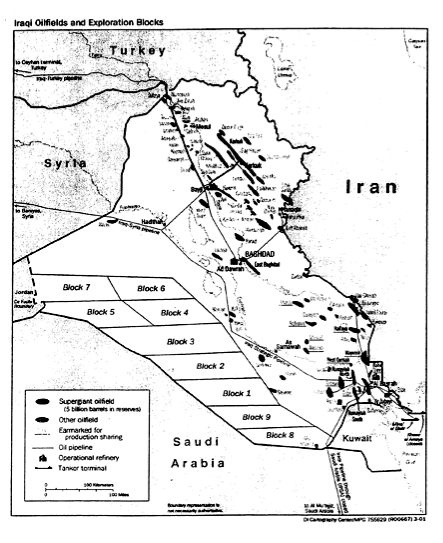


In David Strahan's book "The Last Oil Shock", he notes "the CIA was also well aware of Iraq’s unique value, having secretly paid for new maps of its petroleum geology to be drawn as early as 1998".

The Iraq Oil Law
One of our greatest helpers has been the State Department - John D Rockefeller (1909)

One of the more interesting pieces of political maneuvering in occupied Iraq has been the attempt to pass a law governing how Iraq's oil reserves and oil revenues will be divided and what role international oil companies will play in the country.

There have been persistent claims the law is about to be passed for well over a year, but so far the Iraqi Parliament has managed to avoid doing any such thing.

The proposed law has been the subject of a lot of controversy during that time (with the Bush administration making it one of the primary "benchmarks" it wants the Iraqi government to meet), with this summary of "key facts" from Oil Change International being a good outline of the major complaints:
The proposed Iraq hydrocarbon law would take the majority of Iraq’s oil out of the exclusive hands of the Iraqi government and open it to international oil companies for a generation or more. The law is a dramatic break from the past. Foreign oil companies will have a stake in Iraq’s vast oil wealth for the first time since 1972, when Iraq nationalized the oil industry.

BearingPoint, a Virginia based contractor is being paid $240m for its work in Iraq, winning an initial contract from the US Agency for International Development (USAid) within weeks of the fall of Saddam Hussein in 2003. A BearingPoint employee, based in the US embassy in Baghdad, was hired to advise the Iraqi Ministry of Oil on drawing up a new hydrocarbon law. BearingPoint employees gave $117,000 to the 2000 and 2004 Bush election campaigns, more than any other Iraq contractor.

The process of drafting the oil law has been particularly troubling. The timeline of which entities have seen the draft when suggests that Iraqi interests are not being considered first and foremost:

* Draft shown to US government and major oil companies – July 06
* Draft shown to the International Monetary Fund September 06
* Draft shown to Iraqi Parliament: February 07

The Iraq National Oil Company would have exclusive control of just 17 of Iraq’s 80 known oil fields, leaving two-thirds of known — and all of its as yet undiscovered — reserves open to foreign control.

The law sets no minimum standard for the extent to which foreign companies would not have to invest their earnings in the Iraqi economy, partner with Iraqi companies, hire Iraqi workers or share new technologies.

The international oil companies could also be offered some of the most corporate-friendly contracts in the world, including what are called production sharing agreements. These agreements are the oil industry’s preferred model, but are roundly rejected by all the top oil producing countries in the Middle East because they grant long-term contracts (20 to 30 years in the case of Iraq’s draft law) and greater control, ownership and profits to the companies than other models. In fact, they are used for only approximately 12 percent of the world’s oil.

Iraq’s neighbors Iran, Kuwait and Saudi Arabia maintain nationalized oil systems and have outlawed foreign control over oil development. They all hire international oil companies as contractors to provide specific services as needed, for a limited duration, and without giving the foreign company any direct interest in the oil produced

Iraqis may very well choose to use the expertise and experience of international oil companies. They are most likely to do so in a manner that best serves their own needs if they are freed from the tremendous external pressure being exercised by the Bush administration, the oil corporations — and the presence of 140,000 members of the American military.

The leadership of Iraq’s five trade union federations released a statement opposing the law and rejecting ‘’the handing of control over oil to foreign companies, which would undermine the sovereignty of the state and the dignity of the Iraqi people.’’ They ask for more time, less pressure and a chance at the democracy they have been promised.

When I first read about the proposed law, the point that instantly caught my eye was the handing over of all "undiscovered" oil to possible foreign exploitation - which makes a lot of sense if you consider Professor Blair's stories about suppressed oil discoveries back in the old days (along with large swathes of the country remaining unexplored).

Of course, the Iraqi government may have thwarted this particular tactic with it's announcement this year upping reserves to 350 billion barrels, thus restricting the "undiscovered" category to any amount found beyond this number.
The Iraqi Deputy Prime Minister told The Times that new exploration showed that his country has the world’s largest proven oil reserves, with as much as 350 billion barrels. The figure is triple the country’s present proven reserves and exceeds that of Saudi Arabia’s estimated 264 billion barrels of oil. Barham Salih said that the new estimate had been based on recent geological surveys and seismic data compiled by “reputable, international oil companies . . . This is a serious figure from credible sources.”

In the meantime the Iraqis are perhaps hoping they can dawdle over passing any law for as long as it takes for US troops to leave the country - something the Iraqis are asking to occur by 2011.

Various tactics have been tried by the oil companies as well, ranging from attempts to negotiate contracts directly with the Kurdish regional government in the north, to a range of no bid oil contracts (later cancelled) to the recent sell-off discussions in London that I started the post with (the outcome of which doesn't seem to have been reported anywhere that I can find).
Of course it’s about oil, we can’t really deny that - General John Abizaid (2007)

Conclusion

As we frequently find elsewhere, there is very little in the way of transparent data regarding Iraq's oil reserves, so many interpretations of what are going on seem to be basically political in nature.

However, given the history of Iraq's oil industry and its largely undeveloped state (even when considering well known reserves), I think some of the higher estimates for Iraq's oil reserves are likely true.

The Iraq Oil Ministry is continuing trying to get the oil law passed, and predicting potential production in the 10 million barrel per day range (even the limited sell off currently under consideration could result in an increase in production to 4.5 million barrels per day, according to the Wall Street Journal).

It is numbers like these that make me think the global decline rates we will see post peak won't be as steep as some people fear - however I hope that the Iraqis manage to free themselves from outside influences and get to determine the fate of their own property, rather than an occupying army ensuring that foreign oil firms take the lions share of the income this oil generates.
People say we’re not fighting for oil. Of course we are. They talk about America’s national interest. What the hell do you think they’re talking about? We’re not there for figs - Republican Senator Charles Hagel

Statistics

Locations of visitors to this page

blogspot visitor
Stat Counter

Total Pageviews

Ads

Books

Followers

Blog Archive

Labels

australia (619) global warming (423) solar power (397) peak oil (355) renewable energy (302) electric vehicles (250) wind power (194) ocean energy (165) csp (159) solar thermal power (145) geothermal energy (144) energy storage (142) smart grids (140) oil (139) solar pv (138) tidal power (137) coal seam gas (131) nuclear power (129) china (120) lng (117) iraq (113) geothermal power (112) green buildings (110) natural gas (110) agriculture (91) oil price (80) biofuel (78) wave power (73) smart meters (72) coal (70) uk (69) electricity grid (67) energy efficiency (64) google (58) internet (50) surveillance (50) bicycle (49) big brother (49) shale gas (49) food prices (48) tesla (46) thin film solar (42) biomimicry (40) canada (40) scotland (38) ocean power (37) politics (37) shale oil (37) new zealand (35) air transport (34) algae (34) water (34) arctic ice (33) concentrating solar power (33) saudi arabia (33) queensland (32) california (31) credit crunch (31) bioplastic (30) offshore wind power (30) population (30) cogeneration (28) geoengineering (28) batteries (26) drought (26) resource wars (26) woodside (26) censorship (25) cleantech (25) bruce sterling (24) ctl (23) limits to growth (23) carbon tax (22) economics (22) exxon (22) lithium (22) buckminster fuller (21) distributed manufacturing (21) iraq oil law (21) coal to liquids (20) indonesia (20) origin energy (20) brightsource (19) rail transport (19) ultracapacitor (19) santos (18) ausra (17) collapse (17) electric bikes (17) michael klare (17) atlantis (16) cellulosic ethanol (16) iceland (16) lithium ion batteries (16) mapping (16) ucg (16) bees (15) concentrating solar thermal power (15) ethanol (15) geodynamics (15) psychology (15) al gore (14) brazil (14) bucky fuller (14) carbon emissions (14) fertiliser (14) matthew simmons (14) ambient energy (13) biodiesel (13) investment (13) kenya (13) public transport (13) big oil (12) biochar (12) chile (12) cities (12) desertec (12) internet of things (12) otec (12) texas (12) victoria (12) antarctica (11) cradle to cradle (11) energy policy (11) hybrid car (11) terra preta (11) tinfoil (11) toyota (11) amory lovins (10) fabber (10) gazprom (10) goldman sachs (10) gtl (10) severn estuary (10) volt (10) afghanistan (9) alaska (9) biomass (9) carbon trading (9) distributed generation (9) esolar (9) four day week (9) fuel cells (9) jeremy leggett (9) methane hydrates (9) pge (9) sweden (9) arrow energy (8) bolivia (8) eroei (8) fish (8) floating offshore wind power (8) guerilla gardening (8) linc energy (8) methane (8) nanosolar (8) natural gas pipelines (8) pentland firth (8) saul griffith (8) stirling engine (8) us elections (8) western australia (8) airborne wind turbines (7) bloom energy (7) boeing (7) chp (7) climategate (7) copenhagen (7) scenario planning (7) vinod khosla (7) apocaphilia (6) ceramic fuel cells (6) cigs (6) futurism (6) jatropha (6) nigeria (6) ocean acidification (6) relocalisation (6) somalia (6) t boone pickens (6) local currencies (5) space based solar power (5) varanus island (5) garbage (4) global energy grid (4) kevin kelly (4) low temperature geothermal power (4) oled (4) tim flannery (4) v2g (4) club of rome (3) norman borlaug (2) peak oil portfolio (1)