Showing posts with label low temperature geothermal power. Show all posts

Cheap fresh water for Queensland country towns using geothermal heat  

Posted by Big Gav in , , ,

The University of Queensland thinks that geothermal energy could be used to produce fresh water via reverse osmosis in the outback - Cheap fresh water for Queensland country towns using geothermal heat.

An underground source of hot-rock energy may have the potential to produce low-cost fresh water, according to The University of Queensland's Queensland Geothermal Energy Centre of Excellence.

The Centre's research has found that Queensland has ample geothermal energy resources to power thermal desalination plants and provide clean water for small towns suffering from water shortages.

Centre Director Professor Gurgenci said the geothermal-powered desalination systems could play a pivotal role in helping ease the water crisis facing small towns.

“This may not be the solution for large-scale desalination needed for cities like Brisbane, but should have a significant contribution in smaller towns like Dalby and Maleny, which have recently experienced extreme water shortages,” he said.

“Overseas experience suggests that these systems can be scaled up to provide 10 to 20 kilolitres of water per day while also helping greenhouse plant growing.”

Queensland's geothermal resources range from high-temperature Hot Fractured Rock (HFR) of the Cooper, Eromanga and possibly Drummond Basins to Hot Sedimentary Aquifiers (HSA) of the Great Artesian Basin.

Professor Gurgenci said that while some of these resources may not be hot enough for electricity generation, they would be a perfect fit for thermal desalination of underground brackish aquifers.

“Australian emphasis so far has been on large-scale desalination using reverse osmosis technology although an overwhelming fraction of desalination around the whole is done by thermal means,” Professor Gurgenci said.

“Studies indicate that for plants in the range of one to 100 megalitres per day, thermal desalination technologies are more suitable than reverse osmosis especially if there is a cheap and abundant supply of heat.

“A geothermal-powered desalination plant in that range can easily provide the entire fresh water needs for an outback city at the cost of around 80 cents to $1.60 per kilolitre.”

The estimated cost developed by the Centre's researchers significantly undercuts the 2010/2011 bulk water prices of $1.00 to $2.00 per kilolitre outlined by the Queensland Water Commission.

Cheaper Low Temperature Geothermal Power  

Posted by Big Gav in ,

Technology Review has an article on improving Low Temperature Geothermal Power generation using a "superior type of heat-extracting fluid " - Cheaper Geothermal.

Researchers at Pacific Northwest National Laboratory in Richland, WA, say they've developed a superior type of heat-extracting fluid that could dramatically improve the economics of producing renewable power from low-temperature geothermal resources.

Lab fellow Pete McGrail says the liquid is used to absorb the heat from hot water that's been pumped from underground into a geothermal plant's heat exchanger. The liquid can potentially boost the rate of heat capture by 20 to 30 percent. Researchers engineered proprietary nanomaterials made up of metals linked by organic molecules. They found that adding the nanomaterials to a fluid such as hexane or pentane significantly enhanced the heat-trapping properties of the liquid.

"The hope here is that by improving the efficiency as much as we think we can, a project can become economic at much shallower depths," says McGrail. "You'd be able to deploy in what would now be considered marginal or uneconomic areas."

There's no shortage of geothermal energy under our feet. Drill deep enough and the heat is there. An MIT-led study from 2006 concluded that geothermal power systems have the potential to supply 100 gigawatts of power to the United States by 2050, but only if new drilling and rock-fracturing technologies and advanced plant designs emerge that could lower development costs.

Story continues below


Improved technologies are required because most economical geothermal plants today generate electricity by using steam or hot water directly from naturally formed high-temperature reservoirs, such as the Geysers field in California. The wells are relatively shallow, the water is 360 degrees Fahrenheit or hotter, and the rock is porous enough to sufficiently circulate water. Tapping geothermal resources in less-ideal locations requires drilling deeper and forcing fractures in rock, both of which add immense cost. It also means making the most of lower-temperature heat resources, which is accomplished using binary-cycle plants that extract and repurpose the heat from underground hot water rather than using the hot water directly to spin a turbine.

In these plants, water pumped into an injection well absorbs heat from hot rock and is pumped back up through a separate extraction well at temperatures ranging from 150 degrees Fahrenheit to 300 degrees Fahrenheit. The hot water is then passed through a heat exchanger, along with a fluid with a low boiling point. This fluid, which flows in its own closed loop within the plant, absorbs the heat from the water and flashes into vapor under high pressure. The vapor passes through a turbine, generating power, and is then condensed and recycled back through the loop.

McGrail and his research team stumbled on a way to boost the energy-conversion rate as the two loops pass through a heat exchanger. Initially, they had developed proprietary materials for another project to improve the capture of carbon dioxide emitted from a fossil-fuel plant. They realized that the materials had remarkable thermodynamic qualities when added to an organic fluid. The new fluid has the potential to capture up to 30 percent more heat from a closed water loop, and, because of its rapid expansion and contraction capabilities, it can achieve higher pressures for driving the turbine.

"It's one of those moments in the lab where you look at the data and say, 'Wow!'" says McGrail. His group has received a $1.2 million grant from the Department of Energy's geothermal technologies program to build a benchtop prototype that shows the properties of the fluid in action.

A new geothermal power station for Birdsville  

Posted by Big Gav in

Australia.to has a report on an upgrade to the low temperature geothermal power plant at Birdsville in Queensland - Bligh invests up to $4.3 million in new geothermal power station for Birdsville.

Birdsville's landmark geothermal power station will be upgraded to produce more clean energy for the remote south western Queensland community.

Mines and Energy Minister Stephen Robertson said today the Bligh Government is investing up to $4.3 million to help replace ageing equipment at the Ergon Energy-owned and operated plant. The funding will provide a 50 per cent subsidy for the project which will invest in new, leading edge geothermal technology.

"The Birdsville geothermal power station is the only one of its kind in Australia to tap into this clean renewable energy source to provide emission-free power," Mr Robertson said. "The plant draws its energy from near-boiling water taken deep from within the Great Artesian Basin that supplies water for the town. The power station currently generates about 30 per cent of Birdsville's energy supplies. It's also helping the local environment by reducing greenhouse gas emissions by about 400 tonnes a year and diesel fuel consumption by approximately 160,000 litres." ...

The Birdsville power station was first commissioned in 1992 and remains Australia's only operational geothermal power station capable of electricity generation 24 hours a day. The energy source comes from hot water taken from the Great Artesian Basin at a depth of 1,280 metres. This hot bore water provides a 'free' energy resource, which would otherwise be wasted when water is cooled before use.

The ABC reports the local mayor is very enthusiastic about the plant - More backing sought for outback geothermal power.
he Diamantina Mayor says he would like to see more Government support for the geothermal sector, because he says it is the most sustainable power source. The Queensland Government has committed $9 million for a new geothermal plant to be built at Birdsville in the state's far west.

Mayor Robbie Dare says a large portion of the town's electricity is already provided by geothermal sources, using water taken from the Great Artesian Basin.

"It's been successfully running there for 20 years and it runs 24-hours-a-day, unlike wind or solar," he said. "It's so cheap. Fuel is one of the dearest commodities to run a generator right out here in the outback."

"This just runs off the heat of the water, once it's up and running it's just virtually maintenance. It should be put in all over Australia. This new plant will almost run the town again, or will run the town again."

Low Temperature Geothermal Power  

Posted by Big Gav in , , , , , , , , , ,

The ABC recently had a report on plans to power north-west Queensland with low temperature geothermal power using hot water from the Great Artesian Basin.

A Brisbane-based company says it could supply geothermal power to all of north-west Queensland. Clean Energy Australasia wants to build a $50 million geothermal power station near Longreach. But it has now also revealed plans to build a pilot geothermal project near BHP's Cannington mine at McKinlay, south of Cloncurry. The company's Joe Reichman says the Mount Isa region needs about 500 megawatts of power a year and geothermal resources could easily provide that. "It'll change the region into a powerhouse," he said. Mr Reichman says the company has applied for federal and state government grants and has support from the major mining companies in the region. If the projects proceed they would be the first geothermal power plants in Australia.

Low temperature geothermal power is a relatively new (and very low profile) form of extracting energy from geothermal sources that provides yet another option for meeting our energy needs cleanly and sustainably.

Low Temperature Geothermal Power

When geothermal power is mentioned, people usually think of traditional high temperature geothermal power stations using water from volcanic areas, such as those found in Iceland, New Zealand, the US and elsewhere around the ring of fire.

More recently, interest in enhanced / engineered geothermal systems (EGS) - also known as hot dry rock (HDR) or hot fractured rock (HFR) geothermal power - has been high, with a number of experimental projects underway in Australia and Europe.

Low temperature geothermal power is also starting to attract significant interest, as lower temperature water resources are common in many countries (for example, waste hot water produced by oil and gas wells - in Texas alone, more than 12 billon barrels are produced, with oil companies usually re-injecting the waste water into the earth) and new technologies are beginning to appear that allow these resources to be developed commercially.

UTC Power has developed a low-cost Rankine cycle system that can convert temperatures as low as 195 °F (91 °C) into electricity. The technology is similar to a steam engine, with steam or hot water vaporizes a hydrofluorocarbon refrigerant that drives the turbine (it has been compared to a "refrigerator compressor running backwards").

Geothermal Power In The Great Artesian Basin

The Great Artesian Basin provides the only reliable source of water through much of inland Australia. The basin is the largest and deepest artesian basin in the world, covering a total of 1,711,000 square km. It underlies 23% of the continent, including most of Queensland, the south-east corner of the Northern Territory, the north-east part of South Australia, and northern New South Wales. The basin is 3000 metres (10,000 ft) deep in places and is estimated to contain 64,900 cubic kilometres of groundwater.

Most recharge water enters the rock formations from relatively high ground near the eastern edge of the basin (in Queensland and New South Wales) and very gradually flows towards the south and west. Because the sandstones are permeable, water gradually makes its way through the pores between the sand grains, flowing at a rate of one to five metres per year. Discharge water eventually exits through a number of springs and seeps, mostly in the southern part of the basin. It takes up to two million years for water to travel to the springs in the Lake Eyre area.
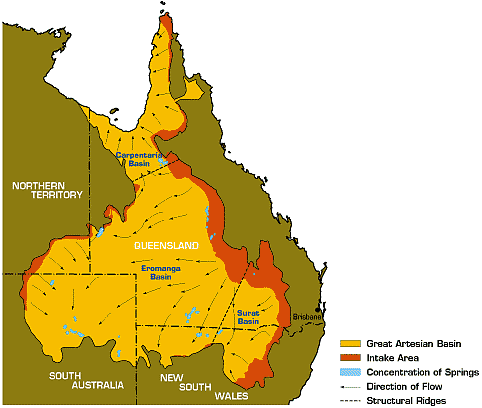


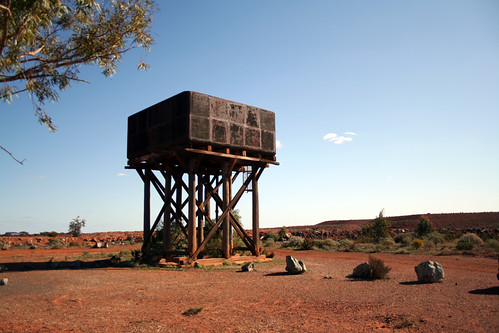
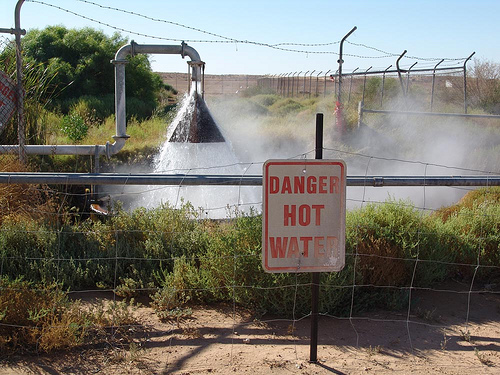
Temperatures of the artesian groundwater (which is generally of a very good quality) range from 30o to 100o C at the well heads. As the groundwater is too hot for town water supply and for stock to drink, it needs to be cooled down before consumption. That is why cooling towers can be seen throughout the region.

The ABC report's claim that the Longreach plant would be Australia's first geothermal power plant is incorrect.

A small (120 kW) power station (pdf) has been in operation at Birdsville in western Queensland since the early 1990's - one of the few low-temperature geothermal power stations in the world. The plant derives its energy from the near-boiling (98 degrees C) water taken from the Great Artesian Basin (at a depth of 1230m) that provides a water supply for the town. Operation of this geothermal power station reduced the town's diesel consumption by about 160,000 litres per year.


The Victorian town of Portland (in the Otway Basin) also operated a district heating scheme using water from geothermal sources for about 20 years, though this did not generate power.

Geothermal Power In The United States

The UTC plant has been trialled at the Chena Hot Springs in Alaska, with the first plant going online in July 2006. A second unit began operating later that year. Together, the two power units are contributing to the resort owner's goal of making Chena the first totally renewably powered and fueled community in the United States. The Chena experience is motivating other cities in Alaska, including Anchorage to investigate setting up larger scale geothermal plants.

UTC installed more production systems at another location in New Mexico in August this year.

Utah company Raser Technologies is looking to build a range of geothermal power plants throughout the western United States using Rankine cycle systems, with their first plant going live in Utah earlier this month.

Some oil fields also produce hot water which can be used to drive Rankine cycle power plants, with trials being performed in Wyoming.

Geothermal Power In Germany

Germany is interested in deriving significant amounts of energy from both EGS / HFR and low temperature geothermal sources. There are already four small geothermal power plants successfully operating in Germany, albeit supplying only a tiny amount of electricity.

The first geothermal plant to start operating in Germany is situated in Neustadt-Glewe in the north-eastern part of the country. The 230-kW combined electricity and heat power plant started up in 2003 and extracts water with a temperature of 97 °C from a well 2250 meters under the ground. It supplies 1,300 households with heat and a further 500 households with electricity.

Other plants now operating are the 3.5-MW plant at Unterhaching close to Munich, in Bavaria which is the first geothermal plant in Germany to use Kalina cycle technology. At that plant water is extracted at a temperature of 122 °C from a well 3,500 meters deep. Another 2.5-MW plant in Landau taps water of 150°C that is located 3,000 meters beneath the ground. Another 550-kW plant is due to go into operation in Bruchsal shortly, extracting water at temperatures of 128°C from a well 2500 meters deep.

More plants (as big as 8-10 MW) are due to go into operation in 2009-2010 in Sauerlach, Dürrnhaar, Riedstadt, Speyer, Gross Schoenebeck and Mauerstetten. By 2015 there could be more than a hundred plants operating - around 150 geothermal power plant projects are in the pipeline according to the German government. One major constraint on expanding the program has been shortages of drilling equipment.

Geothermal Power In New Zealand

While New Zealand already generates a significant portion of its power using traditional geothermal sources, the country is also conducting a NZ$2.6 million research program into low temperature geothermal power.

Conclusion

Low temperature geothermal power has the advantage of being clean, continuously available energy that can be generated in a wide variety of locations.

Plants will likely to continue to be relatively small-scale, making it a classic distributed energy generation alternative (like biogas and solar PV), with growth probably remaining low profile for some time.

In the long run, I expect we'll see a useful and significant amount of our energy needs being produced using this technology.

Cross posted from Our Clean Energy Future.

Statistics

Locations of visitors to this page

blogspot visitor
Stat Counter

Total Pageviews

Ads

Books

Followers

Blog Archive

Labels

australia (619) global warming (423) solar power (397) peak oil (355) renewable energy (302) electric vehicles (250) wind power (194) ocean energy (165) csp (159) solar thermal power (145) geothermal energy (144) energy storage (142) smart grids (140) oil (139) solar pv (138) tidal power (137) coal seam gas (131) nuclear power (129) china (120) lng (117) iraq (113) geothermal power (112) green buildings (110) natural gas (110) agriculture (91) oil price (80) biofuel (78) wave power (73) smart meters (72) coal (70) uk (69) electricity grid (67) energy efficiency (64) google (58) internet (50) surveillance (50) bicycle (49) big brother (49) shale gas (49) food prices (48) tesla (46) thin film solar (42) biomimicry (40) canada (40) scotland (38) ocean power (37) politics (37) shale oil (37) new zealand (35) air transport (34) algae (34) water (34) arctic ice (33) concentrating solar power (33) saudi arabia (33) queensland (32) california (31) credit crunch (31) bioplastic (30) offshore wind power (30) population (30) cogeneration (28) geoengineering (28) batteries (26) drought (26) resource wars (26) woodside (26) censorship (25) cleantech (25) bruce sterling (24) ctl (23) limits to growth (23) carbon tax (22) economics (22) exxon (22) lithium (22) buckminster fuller (21) distributed manufacturing (21) iraq oil law (21) coal to liquids (20) indonesia (20) origin energy (20) brightsource (19) rail transport (19) ultracapacitor (19) santos (18) ausra (17) collapse (17) electric bikes (17) michael klare (17) atlantis (16) cellulosic ethanol (16) iceland (16) lithium ion batteries (16) mapping (16) ucg (16) bees (15) concentrating solar thermal power (15) ethanol (15) geodynamics (15) psychology (15) al gore (14) brazil (14) bucky fuller (14) carbon emissions (14) fertiliser (14) matthew simmons (14) ambient energy (13) biodiesel (13) investment (13) kenya (13) public transport (13) big oil (12) biochar (12) chile (12) cities (12) desertec (12) internet of things (12) otec (12) texas (12) victoria (12) antarctica (11) cradle to cradle (11) energy policy (11) hybrid car (11) terra preta (11) tinfoil (11) toyota (11) amory lovins (10) fabber (10) gazprom (10) goldman sachs (10) gtl (10) severn estuary (10) volt (10) afghanistan (9) alaska (9) biomass (9) carbon trading (9) distributed generation (9) esolar (9) four day week (9) fuel cells (9) jeremy leggett (9) methane hydrates (9) pge (9) sweden (9) arrow energy (8) bolivia (8) eroei (8) fish (8) floating offshore wind power (8) guerilla gardening (8) linc energy (8) methane (8) nanosolar (8) natural gas pipelines (8) pentland firth (8) saul griffith (8) stirling engine (8) us elections (8) western australia (8) airborne wind turbines (7) bloom energy (7) boeing (7) chp (7) climategate (7) copenhagen (7) scenario planning (7) vinod khosla (7) apocaphilia (6) ceramic fuel cells (6) cigs (6) futurism (6) jatropha (6) nigeria (6) ocean acidification (6) relocalisation (6) somalia (6) t boone pickens (6) local currencies (5) space based solar power (5) varanus island (5) garbage (4) global energy grid (4) kevin kelly (4) low temperature geothermal power (4) oled (4) tim flannery (4) v2g (4) club of rome (3) norman borlaug (2) peak oil portfolio (1)