Posted
by Big Gav
in
ambient energy,
internet of things
IEEE Spectrum has a look at a newly recognised form of ambient energy - Earth’s Infrared Radiation: New Renewable Energy Frontier?.
The Earth continuously emits 100 million gigawatts of infrared heat into outer space. That’s enough to power all of humanity many thousands of times over. Capturing even a fraction of that would mean an end to our energy woes. Harvard University researchers are now proposing a way to harvest this untapped source of renewable energy.
They have come up with two designs for a device they call an “emissive energy harvester” that would convert IR radiation into usable power. Today's technology isn't sufficient for an efficient, affordable harvester, the researchers say. But they've laid out a few different paths towards such devices in the journal Proceedings of the National Academy of Sciences.
Stanford University has a post on a small radio device that uses ambient energy to power itself - making it a building block for the "internet of things" - Stanford engineer aims to connect the world with ant-sized radios.
A Stanford engineering team has built a radio the size of an ant, a device so energy efficient that it gathers all the power it needs from the same electromagnetic waves that carry signals to its receiving antenna – no batteries required.
Designed to compute, execute and relay commands, this tiny wireless chip costs pennies to fabricate – making it cheap enough to become the missing link between the Internet as we know it and the linked-together smart gadgets envisioned in the "Internet of Things."
"The next exponential growth in connectivity will be connecting objects together and giving us remote control through the web," said Amin Arbabian, an assistant professor of electrical engineering who recently demonstrated this ant-sized radio chip at the VLSI Technology and Circuits Symposium in Hawaii.
Much of the infrastructure needed to enable us to control sensors and devices remotely already exists: We have the Internet to carry commands around the globe, and computers and smartphones to issue the commands. What's missing is a wireless controller cheap enough to so that it can be installed on any gadget anywhere.
"How do you put a bi-directional wireless control system on every lightbulb?" Arbabian said. "By putting all the essential elements of a radio on a single chip that costs pennies to make."
Posted
by Big Gav
in
ambient energy,
james gosling,
monitoring
The Server Side notes that James Gosling (the guy who invented Sun's Java programming language) has joined a company developing remote sensor robots - Gosling sails away from Google and Android.
So, James has moved from the company that brought us a software program called Android, to a company named Liquid Robotics, that makes real-life androids. Well, perhaps they're not quite 'androids' in the truest sense of the word, but they are nifty little robots that use solar-power and energy harvested from the ocean's waves to sail around the globe collecting reams of information and data.
Apparently, this type of remote data collection is a billion dollar industry, and if Liquid Robotics can manage to perfect the onboard robotics embedded into their tiny little 'wave gliders', while figuring out how to collect, manage and interpolate all of the information that gets sent back to the data center, then a good chunk of that billion dollars could be theirs. "I'll be involved in both the onboard software - sensing, navigation and autonomy - and in the datacenter, dealing with the in-rush of data. The current systems work well, but they have a variety of issues that I look forward to working on." Says James Gosling on his nighthacks blog.
Posted
by Big Gav
in
ambient energy,
batteries,
piezoelectricity
Technology Review has a look at small scale devices harnessing ambient energy from their environment - Power-Scavenging Batteries.
MicroGen Systems, a startup based in Ithaca, New York, is developing energy-harvesting chips designed to power wireless sensors like those used to monitor tire pressure and environmental conditions. The chips convert the energy from environmental vibrations into electricity that's then used to charge a small battery. The chips could eliminate the need to replace batteries in these devices, which today requires a trip to a mechanic or, for networks of sensors that are widely distributed, a lot of legwork.
The core of MicroGen's chips is a one-centimeter-squared array of tiny silicon cantilevers that oscillate when the chip is jostled. At the base of the cantilevers is a bit of piezoelectric material: when it's strained by vibrations, it produces an electrical potential that can be used to generate electrical current. The cantilever array is mounted on top of a postage-stamp-sized, thin-film battery that stores the energy it generates. The current passes from the piezoelectric array through an electrical device that converts the current to a form compatible with the battery. When the chip is shaken by, say, the vibrations of a rotating tire, it can produce about 200 microwatts of power.
"If you can get it down to a small size, 200 microwatts is potentially quite useful," says David Culler, chair of computer science at the University of California, Berkeley, and a pioneer in developing wireless sensor networks for environmental monitoring and other applications. However, he notes, engineers are developing "zillions of harvesters" that produce energy from light, heat, radio-frequency waves, or vibration, and convert it into electrical energy that can be used right away or stored on a battery. Culler believes solar power is the technology to beat for most wireless-sensor applications.
Posted
by Big Gav
in
ambient energy,
hygroelectricity
Kevin Bullis at Technology Review has a look at research into extracting electricity from clouds - Generating Power from Electricity in the Air.
Lightning is a powerful manifestation of the electrical charge that can accumulate in the atmosphere. New research, presented at the ACS meeting in Boston on Wednesday, suggests that it might be possible to harness that electrical charge.
Fernando Galembeck, of the University of Campinas in Brazil, has shown that water vapor in humid air can accumulate charge and transfer it to materials it comes in contact with. He says it might be possible to design collectors that exploit this behavior to generate electricity. The technology, which he calls "hygroelectricity" could provide an alternative to solar power in places without much sunlight but with a lot of humidity. It could also be used to prevent lightning strikes, he says, by draining electrical charge out of the air. He notes, however, that the research is very early stage and that such technology could be a long time coming.
Posted
by Big Gav
in
ambient energy,
nikolai tesla
The Economist has a look at wireless energy distribution and efforts to power devices using ambient energy - Power from thin air (there is also an accompanying video).
ANYONE whose mobile phone has ever run out of juice—which means, these days, more than half the world’s population—will like the idea of getting electrical power out of the air. The notion is far from new. A little over a century ago, the inventor Nikola Tesla drew up ambitious plans to transmit electrical power without wires. He carried out a series of experiments in which electric lights were illuminated via electrostatic induction, by connecting them to metal sheets suspended in a strong electric field produced by a distant transmitter. In 1898 he proposed a “world system” of giant towers that would form both a global wireless communications network and a means of delivering electricity over large areas without wires.
The construction of the first such tower, the Wardenclyffe Tower, on Long Island, began in 1901. Tesla’s backers included the financier J.P. Morgan, who invested $150,000. But before the tower was completed, Morgan and the other backers pulled out. They worried that the delivery of electricity through the air could not be metered, and there would be nothing to stop people from helping themselves.
But has Tesla had the last laugh after all? Today several firms—including Fulton Innovation, eCoupled, WiTricity and Powercast—are pursuing various technologies that deliver electrical power without wires (though over shorter distances than Tesla had in mind). WiTricity has demonstrated the ability to send enough energy across a room to run a flat-screen television using its approach, called “resonant magnetic coupling”. This is different from Tesla’s approach, but the firm’s founders have acknowledged his pioneering work.
In the long run, however, it may be Morgan who is vindicated, as researchers find ways to pull power out of the air without paying for it—a technique known as “energy scavenging” or “energy harvesting”. It is already possible to power small electronic devices, such as wireless sensors installed in buildings and industrial machinery, using a dedicated microwave transmitter nearby. The sensors pick up the microwaves with an antenna and convert the signal into electrical energy. But as power requirements drop and energy-scavenging technology improves, it will become increasingly practical to power these and other devices using just “ambient” energy—the sea of existing radio waves produced by television, radio and mobile-phone transmitters. ...
Ambient radio waves have largely been ignored as a potential power source until recently, because the power of a broadcast radio signal rapidly decreases with distance. That is not to say that radio waves cannot pack a punch from a distance. Advocates of “satellite solar power”, for example, dream of beaming gigawatts of solar power down to Earth from geostationary satellites more than 35,000km up. The same approach has been used in ground-based experiments to beam one kilowatt of power over a distance of several kilometres, notes Peter Fisher, a physicist at the Massachusetts Institute of Technology. But ambient radiation is much weaker.
One way to address this problem is to harvest radiation from multiple sources. Last year Nokia, the world’s largest handset-maker, raised eyebrows with research showing that this approach could scavenge nearly 100 times as much energy as Dr Smith’s approach. Markku Rouvala, an engineer at Nokia Research Centre in Cambridge, England, harvested as much as 5 milliwatts of power using a “wide band” receiver capable of mopping up radio signals between 500MHz and 10GHz—including radio, TV, Wi-Fi and mobile-phone signals—from nearby transmitters. It takes at least 20 milliwatts to keep a mobile phone operating in standby mode, but Nokia hopes that power scavenging might eventually deliver 50 milliwatts, enough to trickle-charge a phone.
At the Consumer Electronics Show in January, RCA showed off a gadget designed to harvest energy from nearby Wi-Fi transmitters, which can then be used to recharge a mobile phone. RCA says it plans to launch the device, dubbed Airnergy, later this year.
The first devices to be powered entirely by ambient energy are likely to be sensors, calculators and clocks. But the hope is that music-players, e-readers and mobile phones will eventually follow, says Dr Smith. There are other means of harvesting ambient energy, from vibrations, movement or heat. But the attraction of radio waves is that they are pretty much everywhere. It’s like recycling energy, says Dr Fisher. “It’s energy that’s around, and is not doing anything else,” he says.

Posted
by Big Gav
in
ambient energy
Technology Review has a look at a new technique for making road transport more efficient by capturing wasted energy in shock absorbers - Electricity-Generating Shock Absorbers.
Shock absorbers that generate electricity, which are being developed by Cambridge, MA-based Levant Power, can lower fuel consumption by 1.5 to 6 percent, depending on the vehicle and driving conditions. The system can also improve vehicle handling.
Levant has demonstrated the technology in road tests with a Humvee and will expand testing to trucks, buses, and other vehicles this summer. The shock absorbers look like conventional ones from the outside, except for a power cord coming out of one end, and they can be installed in ordinary vehicles by mechanics. They plug into a power management device that can also manage power from other sources, such as regenerative braking systems, thermoelectric devices that convert waste heat into electricity, or solar panels. The power is then fed into the car's electrical system to reduce the amount of load on the alternator.
As in a conventional shock absorber, the Levant technology uses a piston moving through oil to damp down movement. But Levant has developed a modified piston head that includes parts that spin as it moves through the oil, turning a small generator housed within the shock absorber. To improve vehicle handling, the power controller uses information from accelerometers and other sensors to change the resistance from the generators, which stiffens or softens the suspension. For example, if the sensors detect the car starting a turn, the power controller can increase the resistance from the shock absorbers on the outer wheels, improving cornering, says David Diamond, the vice president of business development at Levant.
The system performs best on heavy, off-road vehicles moving quickly over rough terrain, so the company is targeting military applications. The company has emphasized using off-the-shelf parts, where possible, to keep down costs. Diamond notes that active shock absorbers have failed commercially in the past because they were too expensive. What distinguishes the new system is its relatively low cost and ability to generate electricity, he says. The shock absorbers and control electronics will cost slightly more than conventional shock absorbers, he says, but in applications such as commercial trucking, the fuel savings are expected to pay for the extra costs within 18 months.
Posted
by Big Gav
in
ambient energy,
piezoelectricity
Technology Review has an article on efforts to capture energy when users press the touch-screens of mobile devices - Self-Powered Flexible Electronics.
Now researchers at Samsung and Sungkyunkwan University in Korea have come up with a way to capture power when a touch screen flexes under a user's touch. The researchers have integrated flexible, transparent electrodes with an energy-scavenging material to make a film that could provide supplementary power for portable electronics. The film can be printed over large areas using roll-to-roll processes, but are at least five years from the market.
The screens take advantage of the piezoelectric effect--the tendency of some materials to generate an electrical potential when they're mechanically stressed. Materials scientists are developing devices that use nanoscale piezoelectronics to scavenge mechanical energy, such as the vibrations caused by footsteps. But the field is young, and some major challenges remain. The power output of a single piezoelectric nanowire is quite small (around a picowatt), so harvesting significant power requires integrating many wires into a large array; materials scientists are still experimenting with how to engineer these screens to make larger devices.
Posted
by Big Gav
in
ambient energy,
piezoelectricity,
vibration power
Anthill magazine has a look at an ambient energy collection device being trialled in the UK - Switched-on innovation converts pedestrian footsteps into energy.
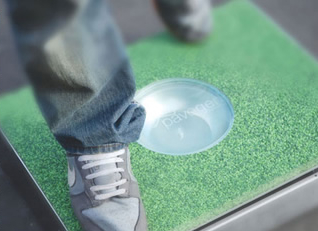
There’s an interesting post over on Springwise about Pavegen slabs, an eco innovation by UK-based Pavegen Systems, which harvest the kinetic energy from pedestrian footsteps and converts it into electricity.
They look a little bit like floodlights embedded in an astroturf tennis court, but they are designed to be prominent in order to encourage pedestrians to step on them. As Volkswagen demonstrated last year, simple environmental incentives can dramatically alter pedestrian behaviour. Five percent of the energy Pavegen harvests from each step is expended on lighting up its LED — affirmation for the pedestrian that the energy transfer was successful.
The energy can be used to power traffic lights, safety signs and other outdoor ambient items that require electricity. Pavegen slabs have already been trialed in East London, with the developers now seeking investment.
Technology Review also has a look at harvesting energy from motion, in their case via a piezoelectric material called PZT -
Flexible Sheets Capture Energy from Movement.
Researchers at Princeton University have created a flexible material that harvests record amounts of energy when stressed. The researchers say the material could be incorporated into the soles of shoes to power portable electronics, or even placed on a heart patient's lungs to recharge a pacemaker as he breathes.
The energy-harvesting rubber sandwiches ribbons of a piezoelectric material called PZT between pieces of silicone. When mechanically stressed, a piezoelectric material generates a voltage that can be used to produce electrical current; a current can also be converted back into mechanical movement.
The rubber material can harness 80 percent of the energy applied when it is flexed--four times more than existing flexible piezoelectric materials.
Flexibility could prove vital if energy-harvesting technology is to take off. For example, the military tested stiff-soled piezoelectric shoes as a power source, but soldiers complained of foot pain. And previous flexible energy harvesters--based on piezoelectric polymers, nanowires, or other types of crystal--put out little electrical current.
PZT is the most efficient piezoelectric material known, but its crystalline structure means that it must be grown at high temperatures, which normally melt a flexible substrate. The Princeton researchers, led by mechanical engineering professor Michael McAlpine, got around this by making PZT at high temperatures and then transferring thin ribbons of the material onto silicone. ...
Proof-of-concept tests described this week in the journal Nano Letters show that the rubber-encased PZT ribbons maintain their high power-conversion efficiency. McAlpine says the simple printing process should readily scale up to make larger sheets; he has filed a patent on the process.
Vibration related energy harvesting also appears prominently in an article about unusual energy technology at Cleantech.com -
Renewable energies you don't hear about every day.
Mechanical energy from piezoelectric generators
Israel-based Innowattech has developed a new alternative energy system that harvests mechanical energy imparted to roadways, railways and runways from passing vehicles, trains and pedestrian traffic and converts it into electricity by installing generators beneath a road's asphalt layer.
The company says it ran a successful trial along a ten metre stretch of road and plans to expand the trial to several one-kilometre stretches of road in Israel.
It's not alone. Washington D.C.-based New Energy Technologies claims it's developed something similar (see New device for capturing kinetic energy from vehicles).
Piezoelectrics that recoup energy from spinning auto tires are also being investigated by Silicon Valley-based EoPlex (see Printing up cleantech, towards the end of the story). ...
Motion energy harvesting
Researchers are working to harness energy from movement — such as from walking and natural vibrations in the environment — by using “tunable” devices.
While some devices already exist for converting kinetic energy to electrical energy, they’re limited to a narrow range of motions, or frequencies. But what about technology that could convert a range of vibrations instead of just a narrow band?
Research in this area is going on at Duke university in North Carolina.
Their technology is basically a small cantilever that releases power when strained. It is several inches long and a quarter inch wide, with a magnet on one end that interacts with nearby movable magnets. By changing the distance of the movable magnets, the researchers were able to “tune” the interactions of the system with its environment, and thus produce electricity over a broader spectrum of frequencies.
Motion is also harnessed by M2E Power of Idaho, which is pursuing a batteries for the military that charge themselves by the movement of troops' bodies (see M2E captures $8M with kinetic energy). The objective: Generate power throughout the day so soldiers don't have to carry as many heavy batteries.
Posted
by Big Gav
in
ambient energy,
vibration power
Fast Company has a post on mobile phones use vibration power - Will Vibrations Power Your Next Cell Phone?
We've covered the concept of kinetic energy before and have even seen it put to work at a Sainsbury grocery store, where vehicles in the parking lot power the checkout line. Now researchers at the University of Bristol in the U.K. are taking energy harvesting to the next level with a device that can use the tiniest vibrations to generate power.
Current energy-harvesting devices can only function if a certain number of vibrations per second are achieved, making it impossible to harvest energy from, say, human movement, which is inherently unpredictable. The researchers' new device can gather energy from a much wider range of vibration frequencies, opening up kinetic energy to a whole new world of applications.
So where can we expect to see kinetic energy-powered devices in the future? Bristol researchers speculate that just a few milliwatts of power could be harvested by their device to power MP3 players, cell phones, heart monitors, and more. In many cases, the device could replace the need for batteries.
Posted
by Big Gav
in
ambient energy,
pavegen,
pavement power
World Architecture News has an article on an ambient energy collection device built by Pavegen - Pavement power.
According to inventor Laurence Kemball-Cook a paving stone on a busy street is stepped on by more than 50,000 pedestrians everyday and he’s seen the light by harvesting that pedestrian power. Every time the rubber Pavegen stone is stepped on, it flexes 5mm and the dynamo technology stores the kinetic energy produced.
The Pavegen System could power lights, computers, automatic doors and ticket machines at tube stations information displays, street lighting, shop frontages, train and bus timetables and wayfinding solutions.
The slab glows when stepped on indicating that energy has been generated to users. Five paving slabs distributed over a section of a pavement will provide sufficient power to illuminate a bus information panel overnight.
Posted
by Big Gav
in
2oc,
ambient energy,
geo pressure,
london,
natural gas pipelines
Cleantech.com has an article on an unusual energy source being harnessed by a UK startup called 2OC which is working with the National Grid to generate 20 MW using wasted pressure in natural gas pipelines - Pressure in gas pipelines to power London.
Bath, England-based startup 2OC unveiled its plan today to generate electricity for London by 2010 using wasted pressure in the natural gas pipeline grid.
2OC is working with the UK National Grid on a joint venture called Blue-NG to use turbines to take advantage of the enormous pressure released when sourcing natural gas underground before it can be pumped through pipelines. 2OC proposes that 20-centimeter devices called turbo expanders can generate energy from that pressure, and is planning to install its first turbine later this year in east London to generate 20 megawatts of power by 2010.
The method—dubbed geo-pressure—is expected to be used at eight sites during the next couple years, the company said.
2OC launched in 2005 with the goal of generating 1 gigawatt of power for the UK using geo-pressure.
Similar technology has been tested in the U.S. and Europe but has been too costly to be implemented. Blue-NG plans to add a combined heat and power engine to the device to generate heat and electricity, improving efficiency to more than 70 percent. The engine could run on a variety of fuels.
2OC also says the technology could potentially provide data centers, power plants, air conditioners or refrigerators with a cheap source of cold air because the temperature of natural gas drops along with pressure.

Posted
by Big Gav
in
ambient energy,
vibration power
The Times of India reports on British schemes to capture some ambient energy from footstep vibrations.
A new technology under development by a British company would allow harnessing of the power of footsteps of pedestrians to generate electricity for lighting up public places.
The technology, developed by London-based The Facility, uses a flooring system that incorporates a matrix of hydraulic compression pads. The pressure of the footsteps on these pads pushes fluid through a micro-turbine and generates electricity.
In 2007, a version of the technology that used the energy of passing trains to power a flood detector underwent successful trial at a bridge in the Midlands, Britain.
There are plans to use this technology in the stairs to the Spinnaker Tower viewing platform in Portsmouth.
The proposal by David Webb of British consultancy Scott Wilson involves use of miniature heel-strike generators installed beneath the stairs to capture the power generated by people walking above.
A study based on foot traffic at London's Victoria underground train station showed that the average 34,000 travellers that pass through the station each hour could power 6,500 light bulbs.

Posted
by Big Gav
in
ambient energy,
kinetic energy
IO9 has a post on an unusal scheme to capture ambient kinetic energy - a nightclub with an energy absorbing dancefloor - Eco Nightclub Powered by Boogie Energy (hat tip Ben). More at Reuters.
A nightclub opening early next month in England is going to save the future — but only if you boogie as hard as you can on their energy-absorbing dance floor. The floor is made from a flexible material that bends as people pound it with their dancing feet. As you can see in this image, the dancing squashes special blocks under the floor that convert motion into into energy that powers the club's lighting and sound system. So maybe Emma Goldman was right about how revolutions should always include dancing?
Another form of kinetic energy that people are attempting to harness is the energy that is expended by bouncing breasts (honest) - Slate has a look at this idea in "
Victoria's Circuit: Harnessing the untapped power of breast motion".
... one day recently I had an idea. As I rode public transportation to the office, my messenger bag slung uncomfortably across my chest, I thought, "Why not put the girls to work?" Human-powered devices are showing up everywhere, from Rotterdam's sustainable dance floor to human-powered gyms in Hong Kong. The time seemed perfect—perhaps even overdue!—for a bra that could harness the untapped power of breast motion.
The idea of an energy-generating bra isn't as crazy as it might sound. A company called Triumph International Japan recently unveiled a solar-powered bra that supposedly will generate enough energy to power an iPod. But I live in foggy San Francisco and prefer not to walk around in my underwear in public. Could someone design an iPod-powering bra for me?
I decided to run the question past some scientists. It turns out that the physics of breast motion have been studied closely for the last two decades by a gamut of researchers, most of them women. LaJean Lawson, a former professor of exercise science at Oregon State University, has studied breast motion since 1985 and now works as a consultant for companies like Nike to develop better sports bra designs. Lawson was enthusiastic about my idea but warned it would be tricky to pull off. You would need the right breast size and the right material, she explained, and the bra itself would have to be cleverly designed. "It's just a matter of finding the sweet spot, between reducing motion to the point where it's comfortable but still allowing enough motion to power your iPod," she said. ...
"So you can generate enough energy to power an iPod?" I asked.
"Definitely," Wang said.
I asked Wang if this bra would be machine-washable.
"You don't need to wash a bra!" he said.
I disagreed. Wang said his team has been working on the washing problem for a while. Nanowire technology can generate electricity only if the space between the wires is maintained, and that space might be affected if the fabric were agitated by washing. One solution would be to layer the fabric so that the parts that directly touch the skin could be washed, leaving the nanowires in between untouched.
There was one more approach I wanted to investigate, one that might supplement Wang's technology. Was there a way to capture the energy of the bra strap, which bears the pressure of holding up the breast mass? To answer this question, I called Larry Rome, a biology professor at the University of Pennsylvania and the creator of Lightning Packs. The Lightning Pack, intended for long-haul hikers and for the military, generates kinetic energy from the vertical displacement of a heavy backpack. Would it be possible to use the kinetic energy generated from a breast's vertical displacement? ...
Still, if someone were to engineer a kinetically powered bra, even one that isn't quite as comfortable as the old-fashioned kind, I'd be intrigued—and I might just start looking at my breasts in a different light. Maybe it's not very sexy to see breasts as a pair of batteries, but oil prices are so high, people are jogging to work. It may be time for breasts to start pulling their own weight.




 Posts




