Donald Trump's energy "plan" seems to attracted pretty much universal condemnation.
The Washington Post dubbed it "dangerous and nonsensical", pointing out the bizarre contradictions embedded within it - "Mr. Trump’s headline policy is “complete American energy independence” by “lifting these draconian [regulations]” so that “we are no longer at the mercy of global markets.”"
Criticism elsewhere included Technology Review (Donald Trump’s “America-First Energy Plan” Shows He Knows Virtually Nothing About the Issue) and Think Progress ("Here’s What Actual Climate Scientists Think Of Trump’s New Energy Plan).
As well as promising a coal and oil based future, Trump has been claiming that California hasn't been having a drought. I guess if you make a living from lying then even the most basic facts can be shrugged off.
Slate dubbed his latest claims "Lies Trump Reality". At least it gave Bernie Sanders another reason to mock him.
Beverly McGuire saw the warning signs before the town well went dry: sand in the toilet bowl, the sputter of air in the tap, a pump working overtime to no effect. But it still did not prepare her for the night last month when she turned on the tap and discovered the tiny town where she had made her home for 35 years was out of water.
"The day that we ran out of water I turned on my faucet and nothing was there and at that moment I knew the whole of Barnhart was down the tubes," she said, blinking back tears. "I went: 'dear God help us. That was the first thought that came to mind."
Across the south-west, residents of small communities like Barnhart are confronting the reality that something as basic as running water, as unthinking as turning on a tap, can no longer be taken for granted.
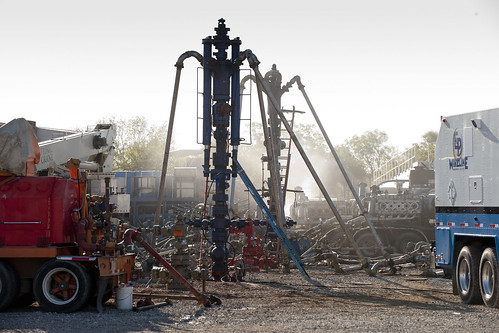
Three years of drought, decades of overuse and now the oil industry's outsize demands on water for fracking are running down reservoirs and underground aquifers. And climate change is making things worse.
In Texas alone, about 30 communities could run out of water by the end of the year, according to the Texas Commission on Environmental Quality.
Nearly 15 million people are living under some form of water rationing, barred from freely sprinkling their lawns or refilling their swimming pools. In Barnhart's case, the well appears to have run dry because the water was being extracted for shale gas fracking.
The town — a gas station, a community hall and a taco truck – sits in the midst of the great Texan oil rush, on the eastern edge of the Permian basin.
A few years ago, it seemed like a place on the way out. Now McGuire said she can see nine oil wells from her back porch, and there are dozens of RVs parked outside town, full of oil workers.
But soon after the first frack trucks pulled up two years ago, the well on McGuire's property ran dry.
No-one in Barnhart paid much attention at the time, and McGuire hooked up to the town's central water supply. "Everyone just said: 'too bad'. Well now it's all going dry," McGuire said.
As an increasing amount of U.S. corn is being used to meet rising ethanol demand, the United States—the world’s dominant producer and exporter of corn—is exporting less.
The first chart shows how the use of U.S. domestic corn has changed over time. The portion of U.S.-grown corn used to make fuel reached 40 percent last year, and will be about the same this year, according to the U.S. Department of Agriculture. At the same time, the worst drought in half a century throughout the Midwest corn belt has led to severely shrunken forecasts for this year’s United States corn crop, raising concerns that exports will further decrease, intensifying the risk of an international food crisis.
The second chart shows the annual U.S. corn exports since 2005. Though the number of U.S. acres planted with corn was the highest since the late 1930s, this year, U.S. exports have been on a steady decline, dropping from over 60 percent of the world’s corn exports in 2005 to less than 40 percent last year.
As the United States' extended heat wave and drought threaten to raise global food prices, energy production is also feeling the pressure. Across the nation, power plants are becoming overheated and shutting down or running at lower capacity; drilling operations struggle to get the water they need, and crops that would become biofuel are withering.
While analysts say the US should survive this year without major blackouts, more frequent droughts and increased population size will continue to strain power generation in the future.
Power plants are a hidden casualty of droughts, says Barbara Carney of the National Energy Technology Laboratory (NETL) in Morgantown, West Virginia, because they are completely dependent on water for cooling and make up about half the water usage in the US. That makes them vulnerable in a heat wave. If water levels in the rivers that cool them drop too low, the power plant – already overworked from the heat – won't be able to draw in enough water. In addition, if the cooling water discharged from a plant raises already-hot river temperatures above certain thresholds, environmental regulations require the plant to shut down.
One nuclear plant in Connecticut recently had to shut down because the sea water used for cooling was too warm. Nationwide, nuclear generation is at its lowest in a decade, with the plants operating at only 93 per cent of capacity.
Nuclear is the thirstiest power source. According to NETL, the average nuclear plant that generates 12.2 million megawatt hours of electricity requires far more water to cool its turbines than other power plants. Nuclear plants need 2725 litres of water per megawatt hour for cooling. Coal or natural gas plants need, on average, only 1890 and 719 litres respectively to produce the same amount of energy.
The Business Spectator has an article wondering if the drought in the US will cause another spike in food prices and social unrest - A soaring food price fear.
Markets are bracing for a surge in global political unrest, as the worst US drought in half a century sent corn and soybean prices soaring to record highs overnight.
The combination of scorching temperatures and a lack of rain has now pushed corn and soybean prices above the peaks they reached during the 2007-08 food crisis. Overnight, the corn futures price climbed above $US8 a bushel for the first time, while that of soybeans hit a record $US17.12 a bushel.
Although the wheat price has not yet hit record highs, it has jumped more than 50 per cent in the past five weeks, and is now above the level it hit after Russia’s crop failure in 2010, which prompted Moscow to impose a ban on grain exports.
Grain traders have been anxiously monitoring the effect of the drought, which is the worst since 1956 in terms of the areas affected. In its weekly crop report, the US government said that only 31 per cent of the corn crop was in “good to excellent condition”, a sharp drop from its estimate of 40 per cent last week. For soybeans, the estimate dropped to 34 per cent from 40 per cent.
But the devastating US drought will have massive global effects. The United States is the world’s largest exporter of corn, soybeans and wheat – supplying around one-third of these staple grains traded on the global market.
Already, some analysts are warning that the world could be in for a period of intense social and political instability similar to that seen in 2007-08 when soaring food prices sparked riots in dozens of countries. They note that last year’s political instability in the Arab world was partly caused by surging grain prices.
The effect of rising grain prices is most pronounced in poor countries, where people can spend up to three-quarters of their income on food. Because food is such an important part of consumer spending, surging food prices are quickly reflected in a jump in official inflation figures.
If the pictures of those towering wildfires in Colorado haven't convinced you, or the size of your AC bill this summer, here are some hard numbers about climate change: June broke or tied 3,215 high-temperature records across the United States. That followed the warmest May on record for the Northern Hemisphere – the 327th consecutive month in which the temperature of the entire globe exceeded the 20th-century average, the odds of which occurring by simple chance were 3.7 x 10-99, a number considerably larger than the number of stars in the universe.
Meteorologists reported that this spring was the warmest ever recorded for our nation – in fact, it crushed the old record by so much that it represented the "largest temperature departure from average of any season on record." The same week, Saudi authorities reported that it had rained in Mecca despite a temperature of 109 degrees, the hottest downpour in the planet's history.
Not that our leaders seemed to notice. Last month the world's nations, meeting in Rio for the 20th-anniversary reprise of a massive 1992 environmental summit, accomplished nothing. Unlike George H.W. Bush, who flew in for the first conclave, Barack Obama didn't even attend. It was "a ghost of the glad, confident meeting 20 years ago," the British journalist George Monbiot wrote; no one paid it much attention, footsteps echoing through the halls "once thronged by multitudes." Since I wrote one of the first books for a general audience about global warming way back in 1989, and since I've spent the intervening decades working ineffectively to slow that warming, I can say with some confidence that we're losing the fight, badly and quickly – losing it because, most of all, we remain in denial about the peril that human civilization is in.
When we think about global warming at all, the arguments tend to be ideological, theological and economic. But to grasp the seriousness of our predicament, you just need to do a little math. For the past year, an easy and powerful bit of arithmetical analysis first published by financial analysts in the U.K. has been making the rounds of environmental conferences and journals, but it hasn't yet broken through to the larger public. This analysis upends most of the conventional political thinking about climate change. And it allows us to understand our precarious – our almost-but-not-quite-finally hopeless – position with three simple numbers.
If you want a glimpse of some of the worst of global warming, scientists suggest taking a look at U.S. weather in recent weeks.
Horrendous wildfires. Oppressive heat waves. Devastating droughts. Flooding from giant deluges. And a powerful freak wind storm called a derecho.
These are the kinds of extremes climate scientists have predicted will come with climate change, although it's far too early to say that is the cause. Nor will they say global warming is the reason 3,215 daily high temperature records were set in the month of June.
Scientifically linking individual weather events to climate change takes intensive study, complicated mathematics, computer models and lots of time. Sometimes it isn't caused by global warming. Weather is always variable; freak things happen.
And this weather has been local. Europe, Asia and Africa aren't having similar disasters now, although they've had their own extreme events in recent years.
But since at least 1988, climate scientists have warned that climate change would bring, in general, increased heat waves, more droughts, more sudden downpours, more widespread wildfires and worsening storms. In the United States, those extremes are happening here and now.
So far this year, more than 2.1 million acres have burned in wildfires, more than 113 million people in the U.S. were in areas under extreme heat advisories last Friday, two-thirds of the country is experiencing drought, and earlier in June, deluges flooded Minnesota and Florida.
"This is what global warming looks like at the regional or personal level," said Jonathan Overpeck, professor of geosciences and atmospheric sciences at the University of Arizona. "The extra heat increases the odds of worse heat waves, droughts, storms and wildfire. This is certainly what I and many other climate scientists have been warning about."
Kevin Trenberth, head of climate analysis at the National Center for Atmospheric Research in fire-charred Colorado, said these are the very record-breaking conditions he has said would happen, but many people wouldn't listen. So it's I told-you-so time, he said.
While that Arizona-California relationship guarantees full employment for battalions of water lawyers, a far bigger problem looms: climate change. Models for the Southwest have been predicting a 4ºC (7.2ºF) increase in mean temperature by century’s end, and events seem to be outpacing the predictions.
We have already experienced close to 1º C of that increase, which accounts, at least in part, for last summer’s colossal fires and record-setting temperatures -- and it’s now clear that we’re just getting started.
The simple rule of thumb for climate change is that wet places will get wetter and dry places drier. One reason the dry places will dry is that higher temperatures mean more evaporation. In other words, there will be ever less water in the rivers that keep the region’s cities (and much else) alive. Modeling already suggests that by mid-century surface stream-flow will decline by 10% to 30%.
Independent studies at the Scripps Oceanographic Institute in California and the University of Colorado evaluated the viability of Lake Mead and eventually arrived at similar conclusions: after about 2026, the risk of “failure” at Lake Mead, according to a member of the Colorado group, “just skyrockets.” Failure in this context would mean water levels lower than the dam’s lowest intake, no water heading downstream, and the lake becoming a “dead pool.”
If -- perhaps “when” is the more appropriate word -- that happens, California’s Colorado River Aqueduct, which supplies water to Los Angeles, San Diego, and the All-American Canal, which sustains the Imperial and Coachella Valleys, will go just as dry as the Central Arizona Project aqueduct. Meanwhile, if climate change is affecting the Colorado River’s watershed that harshly, it will undoubtedly also be hitting the Sierra Nevada mountain range.
The aptly named Lester Snow, a recent director of California’s Department of Water Resources, understood this. His future water planning assumed a 40% decline in runoff from the Sierras, which feeds the California Aqueduct. None of his contemplated scenarios were happy ones. The Colorado River Aqueduct and the California Aqueduct make the urban conglomerations of southern California possible. If both fail at once, the result will be, as promised, the greatest water crisis in the history of civilization.
Only Patricia Mulroy has an endgame strategy for the demise of Lake Mead. The Southern Nevada Water Authority is, even now, tunneling under the lake to install the equivalent of a bathtub drain at close to its lowest point. At a cost of more than $800 million, it will drain the dregs of Lake Mead for Las Vegas.
Admittedly, water quality will be a problem, as the dead pool will concentrate pollutants. The good news, according to the standard joke among those who chronicle Sin City’s improbable history, is that the hard-partying residents and over-stimulated tourists who sip from Lake Mead’s last waters will no longer need to purchase anti-depressants. They’ll get all the Zoloft and Xanax they need from their tap water.
And only now do we arrive at the third act of this expanding tragedy.
The Age of Thirst: Act III
Those who believe in American exceptionalism hold that the historical patterns shaping the fate of other empires and nations don’t apply to the United States. Be that as it may, we are certainly on track to test whether the U.S. is similarly inoculated against the patterns of environmental history.
Because tree rings record growing conditions year by year, the people who study them have been able to reconstruct climate over very long spans of time. One of their biggest discoveries is that droughts more severe and far longer than anything known in recent centuries have occurred repeatedly in the American Southwest. The droughts of the Dust Bowl in the 1930s, of the 1950s, and of the period from 1998 to 2004 are remembered in the region, yet none lasted a full decade.
By contrast, the drought that brought the civilization of the ancestral Puebloans, or Anasazi, centered at Chaco Canyon, to its knees in the twelfth century, by contrast, lasted more than 30 years. The one that finished off Mesa Verdean culture in the thirteenth century was similarly a “megadrought.”
Jonathan Overpeck, a climate scientist at the University of Arizona who played a major role in the Nobel-Prize-winning work of the Intergovernmental Panel on Climate Change, tells me that the prospect of 130° F days in Phoenix worries him far less than the prospect of decades of acute dryness. “If anything is scary, the scariest is that we could trip across a transition into a megadrought.” He adds, “You can probably bet your house that, unless we do something about these greenhouse gas emissions, the megadroughts of the future are going to be a lot hotter than the ones of the past.”
Other scientists believe that the Southwest is already making the transition to a “new climatology,” a new normal that will at least bring to mind the aridity of the Dust Bowl years. Richard Seager of Columbia University, for instance, suggests that “the cycle of natural dry periods and wet periods will continue, but… around a mean that gets drier. So the depths -- the dry parts of the naturally occurring droughts -- will be drier than we’re used to, and the wet parts won’t be as wet.”
Drought affects people differently from other disasters. After something terrible happens -- tornados, earthquakes, hurricanes -- people regularly come together in memorable ways, rising above the things that divide them. In a drought, however, what is terrible is that nothing happens. By the time you know you’re in one, you’ve already had an extended opportunity to meditate on the shortcomings of your neighbors. You wait for what does not arrive. You thirst. You never experience the rush of compassion that helps you behave well. Drought brings out the worst in us.
After the Chacoan drought, corn-farming ancestral Puebloans still remained in the Four Corners area of the Southwest. They hung on, even if at lower population densities. After the Mesa Verdean drought, everybody left.
By the number of smashed crania and other broken bones in the ruins of the region’s beautiful stone villages, archaeologists judge that the aridifying world of the Mesa Verdeans was fatally afflicted by violence. Warfare and societal breakdown, evidently driven by the changing climate, helped end that culture.
So it matters what we do. Within the limits imposed by the environment, the history we make is contingent, not fated. But we are not exactly off to a good start in dealing with the challenges ahead. The problem of water consumption in the Southwest is remarkably similar to the problem of greenhouse gas pollution. First, people haggle to exhaustion over the need to take action; then, they haggle over inadequate and largely symbolic reductions. For a host of well-considered, eminently understandable, and ultimately erroneous reasons, inaction becomes the main achievement. For this drama, think Hamlet. Or if the lobbyists who argue for business as usual out west and in Congress spring to mind first, think Iago.
We know at least one big thing about how this particular tragedy will turn out: the so-called civilization of the Southwest will not survive the present century, not at its present scale anyway. The question yet to be answered is how much it will have to shrink, and at what cost. Stay tuned. It will be one of the greatest, if grimmest, shows on Earth.
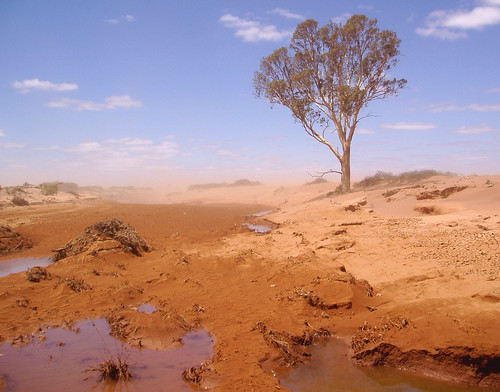
You don't have to wait to find out what the American Southwest will look like when it becomes a permanent dust bowl, with unrelenting drought conditions worse than the 1930 disaster you know from cheery books like The Worst Hard Time. Just watch this video of what it’s like to drive into a "haboob," a.k.a. a gigantic dust storm often seen in the deserts of the Middle East -- hence its Arabic name.
Continuing the planet's recent theme of "extreme weather is the new normal, puny ape-people," this haboob is right in line with scientists' predictions for what will happen to Arizona and the rest of the Southwest -- all the way up to Kansas -- this century.
The worst Texas drought since record-keeping began 116 years ago may crimp an oil and natural- gas drilling boom as government officials ration water supplies crucial to energy exploration.
In the hardest-hit areas, water-management districts are warning residents and businesses to curtail usage from rivers, lakes and aquifers. The shortage is forcing oil companies to go farther afield to buy water from farmers, irrigation districts and municipalities, said Erasmo Yarrito Jr., the state’s overseer of water supplies from the Rio Grande River.
Concern over water usage is especially acute in southern Texas’s Eagle Ford Shale area because drilling there is more water-intensive than other regions, said Robert Mace, a deputy executive administrator of the Texas Water Development Board. “It’s pretty dry down here and a lot of oil companies are looking for water," Mace said.
The water crisis in Texas, the biggest oil- and gas- producing state in the U.S., highlights a continuing debate in North America and Europe over the impact on water supplies of a production technique called hydraulic fracturing. Environmental groups are concerned the so-called fracking method may pose a contamination threat, while farmers in arid regions like south Texas face growing competition for scarce water. …
The Eagle Ford’s peculiar geology means it takes three to four times as much water to fracture as the Barnett Shale near Fort Worth, said Mace, of the state water board. Fracking a single Eagle Ford well requires as much as 13 million gallons of water, enough to supply the cooking, washing and drinking needs of 240 adults for an entire year, he said.
“This is not the drilling your grandparents knew in west Texas," said Sharon Wilson, an organizer for Earthworks’ Oil and Gas Accountability Project, which lobbies for tougher government regulation of oil drillers. “It’s a heavy industrial activity with massive amounts of water and chemicals."
WA Today reports that Perth looks like running out of dam water this summer courtesy of climate change induced declines in rainfall and deforestation, forcing the city to rely on water from aquifers and from the new-ish desalination plants - Perth’s Dry Dams.
Perth's drinking water supplies from dams will run out by the end of next summer even with decent rainfall, according to predictions by the Centre for Water Research. By then, Perth and the South-West would become solely reliant on water supplied from the already stressed Gnangara Mound aquifer and the Kwinana desalination plant, director Jorg Imberger said.
Even using an optimistic calculation that 35 gigalitres (35 billion litres) of rainwater would flow into the city's dams - far greater than the 13 gigalitres last year - the dams would run dry. "(Even) given recycled water, less water use, pumping the surface aquifer at Gnangara Mound a little bit more and hoping for rain, we'll basically have no water left at the end of summer 2012," Professor Imberger said.
The comments confer with the national Climate Commissioner's first report released yesterday, which warns that water availability will be at great risk before the end of the century due to changing rainfall patterns.
WA's South-West region was already "drying out" and all projections showed no improvement, the report by Professor Will Steffen said. "Rainfall is the main driver of run-off, which is the direct link to water availability," the report says. "Hydrological modelling indicates that water availability will likely decline in south-west Western Australia."
Perth's dam capacity is already below 25 per cent and only 10 per cent of that is drinkable. WA Water Commission figures show the average amount of rainfall flowing into the dams has dramatically declined since 1974:
"It's raining less but the reduction into reservoirs has reduced even more because the vegetation is sucking up the rest (due to deforestation)," Professor Imberger said. "Between 30-40 per cent of that reduction is due to climate change. The remainder is down to land clearing - trees are not (there to) recycle water the way they used to be."
But a Water Corporation spokesman said it was too early too predict how much water would be left in the dams by early next year. He said over the past 10 years the dams had averaged 100 billion litres of water per year, although last year only 13 billion litres flowed.
Rainfall flows into the dams had been getting later and later each year but it already started this year. According to the Bureau of Meteorology, the Perth metropolitan area recorded only 59 per cent of its average annual rainfall last year. A record hot summer brought no relief and so far this year, less than 50 millimetres of rain has fallen in Perth.
Professor Imberger said the state government's only option to avoid running out of drinking water was to immediately bring other sources online. That included expanding use of the Yarragadee aquifer in the South-West, doubling capacity of the second desalination plant at Binningup - due to come online by the end of the year to provide 45 gigalitres of water - to 100 gigalitres, and improving water recycling.
Speaking at the launch of the Commission's report, The Critical Decade, into climate science, the report's author, Will Steffen said any climate change policy needs to quickly drive investment away from fossil fuels to ensure long-term emissions reductions. The Commission chief, Tim Flannery, said while efforts should be taken to store carbon in the landscape, it wouldn't prepare the whole economy for the necessary cuts to greenhouse gases. ...
While Professor Steffen did not comment directly on the Coalition's direct action policy, he said if storing carbon in soils is used as the ''the only methodology, as the primary one, and you allow emissions from fossil fuel emissions to go up, you won't solve the climate change problem, the science is clear on that. There is a very good case to be made for getting carbon back into the land, but if that is all you do, or you use that to delay action on fossil fuel emissions, you will have gone backwards a long way,'' he said....
The debate on soil carbon came as the top climate change official confirmed that the government's promise to use more than 50 per cent of the revenue generated by a carbon price for household compensation included measures to reduce the impact of petrol price rises.
GREENS deputy leader Christine Milne has called for a ban on new coal mines, amid signs of a growing gulf between the minor party and Labor as they try to reach an agreement on pricing carbon. Welcoming a Climate Commission report calling for urgent emissions cuts, Senator Milne said her party was pushing for the highest possible carbon price it could achieve in its talks with the government.
She attacked the burgeoning coal seam gas industry as a “disaster”, and said coal industry expansion should end. “(Coal seam gas) is not an industry we should be beginning at a time when we need to be getting away from investment in fossil fuels,” she said. “In terms of coal mines, the Greens have said very clearly no new coal mines, no extension of existing coal mines. Let's invest in renewables.”
There is not much to be happy about these days in Happy, Texas. Main Street is shuttered but for the Happy National Bank, slowly but inexorably disappearing into a High Plains wind that turns all to dust. The old Picture House, the cinema, has closed. Tumbleweed rolls into the still corners behind the grain elevators, soaring prairie cathedrals that spoke of prosperity before they were abandoned for lack of business.
Happy's problem is that it has run out of water for its farms. Its population, dropping 10 per cent a year, is down to 595. The name, which brings a smile for miles around and plays in faded paint on the fronts of every shuttered business – Happy Grain Inc, Happy Game Room – has become irony tinged with bitterness. It goes back to the cowboy days of the 19th century. A cattle drive north through the Texas Panhandle to the rail heads beyond had been running out of water, steers dying on the hoof, when its cowboys stumbled on a watering hole. They named the spot Happy Draw, for the water. Now Happy is the harbinger of a potential Dust Bowl unseen in America since the Great Depression.
'It was a booming town when I grew up,' Judy Shipman, who manages the bank, says. 'We had three restaurants, a grocery, a plumber, an electrician, a building contractor, a doctor. We had so much fun, growing up.' Like all the townsfolk, she knows why the fun has gone. 'It's the decline in the water level,' she says. 'In the 1950s a lot of wells were drilled, and the water went down. Now you can't farm the land.'
Those wells were drilled into a geological phenomenon called the Ogallala Aquifer. It is an underground lake of pristine water formed between two and six million years ago, in the Pliocene age, when the tectonic shifts that pushed the Rocky Mountains skywards were still active. The water was trapped below the new surface crust that would become the semi-arid soil of the Plains, dry and dusty. It stretches all the way down the eastern slope of the Rockies from the badlands of South Dakota to the Texas Panhandle. It does not replenish.
Happy is the canary in the coalmine because the Ogallala is deepest in the north, as much as 300ft in the more fertile country of Nebraska and Kansas. In the south, through the panhandle and over the border to New Mexico, it is 50-100ft. And around Happy, 75 miles south of Amarillo, it is now 0-50ft. The farms have been handed over to the government's Conservation Reserve Programme (CRP) to lie fallow in exchange for grants: farmers' welfare, although they hate to think of it like that. ...
But it was only in the 1940s, after the Dust Bowl (the result of a severe drought and excessive farming in the early 1930s), that the US Geological Survey worked out that the watering holes were clues to the Ogallala, now believed to be the world's largest body of fresh water. They were about to repeat the dreams of man from the days of Ancient Egypt and Judea to turn the desert green, only without the Nile or Jordan. With new technology the wells could reach the deepest water, and from the early 1950s the boom was on. Some of the descendants of Dust Bowl survivors became millionaire landowners.
'Since then,' says David Brauer of the US Agriculture Department agency, the Ogallala Research Service, 'we have drained enough water to half-fill Lake Erie of the Great Lakes.' Billions upon billions of gallons – or, as they prefer to measure it, acre-feet of water, each one equivalent to a football field flooded a foot deep – have been pumped. 'The problem,' he goes on, 'is that in a brief half-century we have drawn the Ogallala level down from an average of 240ft to about 80.'
Brauer's agency was set up in direct response to the Dust Bowl, with the brief of finding ways to make sure that the devastation never happens again. If it does, the impact on the world's food supply will be far greater. The irrigated Plains grow 20 per cent of American grain and corn (maize), and America's 'industrial' agriculture dominates international markets. A collapse of those markets would lead to starvation in Africa and anywhere else where a meal depends on cheap American exports. 'The Ogallala supply is going to run out and the Plains will become uneconomical to farm,' Brauer says. 'That is beyond reasonable argument. Our goal now is to engineer a soft landing. That's all we can do.'
In places throughout the Amazon, some stretches of the region's most important rivers and tributaries have dried up almost entirely, reducing the normally flowing waterways to a vast plain of broken clay and mud. For some people who live and work in this part of the world, life has come to a screeching halt amid the worst drought in recent memory. It is estimated that more than 62 thousand families have been affected by the lack of rainfall with over half the municipalities in the region having enacted a state of emergency. And, on the heels of a recent report about the global droughts to be expected due to climate change -- one can only wonder if such scenes will become more common elsewhere.
Throughout the affected state of Amazonia, rivers provide the only means of access to the outside world for families residing in the regions around the capital of Manaus. As the water ceases to flow because of the drought, these families are left stranded without the means to make a living.
According to officials, the level of the Amazon river will likely be lower than the previous recorded record set back in 1963 once final measurements are made.
One major waterway which runs along Manuas, the Rio Negro, hasn't been this low in the 108 years since recording began, reports Globo Amazonia. The economic impact on this region, one of poorest in Brazil, has been significant.
"Our community... is in a precarious situation. The river has dried up," said Josimar Peixoto, mayor of San Sebastian, a town which depends on the flowing Rio Negro. "With this, families are being harmed because they are without access to transportation."
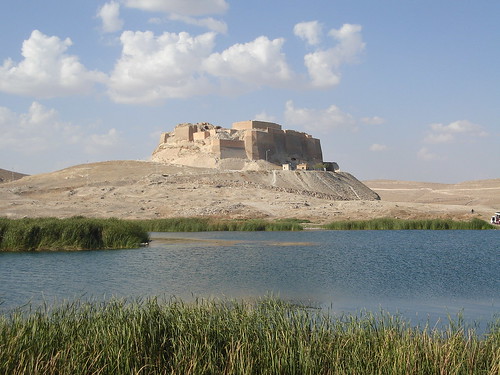
A water shortage described as the most critical since the earliest days of Iraq's civilisation is threatening to leave up to 2 million people in the south of the country without electricity and almost as many without drinking water.
An already meagre supply of electricity to Iraq's fourth-largest city of Nasiriyah has fallen by 50% during the last three weeks because of the rapidly falling levels of the Euphrates river, which has only two of four power-generating turbines left working.
If, as predicted, the river falls by a further 20cm during the next fortnight, engineers say the remaining two turbines will also close down, forcing a total blackout in the city.
Down river, where the Euphrates spills out into the Shatt al-Arab waterway at the north-eastern corner of the Persian Gulf, the lack of fresh water has raised salinity levels so high that two towns, of about 3,000 people, on the northern edge of Basra have this week evacuated. "We can no longer drink this water," said one local woman from the village of al-Fal. "Our animals are all dead and many people here are diseased."
Iraqi officials have been attempting to grapple with the magnitude of the crisis for months, which, like much else in this fractured society, has many causes, both man-made and natural.
Two winters of significantly lower than normal rainfalls – half the annual average last year and one-third the year before – have followed six years of crippling instability, in which industry barely functioned and agriculture struggled to meet half of subsistence needs.
"For thousands of years Iraq's agricultural lands were rich with planted wheat, rice and barley," said Salah Aziz, director of planning in Iraq's agricultural ministry, adding that land was "100% in use".
"This year less than 50% of the land is in use and most of the yields are marginal. This year we cannot begin to cover even 40% of Iraq's fruit and vegetable demand."
During the last five chaotic years, many new dams and reservoirs have been built in Turkey, Syria and Iran, which share the Euphrates and its small tributaries. The effect has been to starve the Euphrates of its lifeblood, which throughout the ages has guaranteed bountiful water, even during drought. At the same time, irrigators have tried tilling marginal land in an attempt for quick yields and in all cases the projects have been abandoned.
THE nation's key food bowl, the Murray Darling Basin, is on the verge of economic collapse as the value of production plunges by at least $5 billion, experts say.
Drought and declining irrigation water have plunged inland Australia's heartland into crisis with the loss of at least one third of the basin's $15 billion annual income. Worse is predicted for the coming financial year if the drought continues.
The demise of the economic powerhouse has pushed towns throughout the basin, particularly along the River Murray, into a severe downturn and population decline.
An ABS report last week showed the population throughout the basin is declining, or static at best, with the District Council of Berri and Barmera suffering the largest and fastest recent drop in SA with 130 people moving out between 2007 and 2008.
Authorities warn the problem has become the biggest crisis Australian agriculture has experienced, threatening the nation's food supply.
Murray Darling Association general manager Ray Najar said the basin's plight will worsen substantially next financial year if the long-running drought continues and there is no water available for irrigation.
Mr Najar said the $5 billion loss of production is very conservative and the actual loss may be nearer to $7 billion.
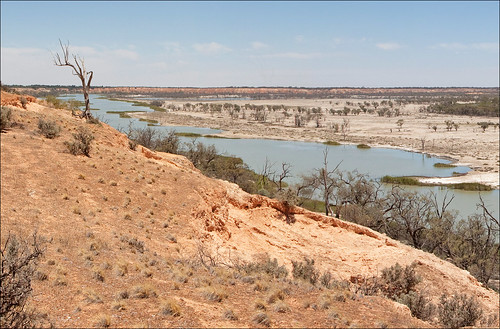
THE amount of water flowing into the stricken Murray River between January and March was the lowest for that quarter in the 117 years that records have been kept.
An unprecedented drought has thrown the river system into decline, according to the guardian for the river.
"We've had big droughts before and big floods before, but what we didn't have was climate change," said Rob Freeman, the chief executive of the Murray-Darling Basin Authority.
A second record has been smashed too - for a three-year period. Water flowing into the system in the three years to March totalled 5160 gigalitres, less than half the previous 11,300 gigalitre minimum during the 1943-46 drought, according to the authority's update.
"It worries me. Normally you break records by small amounts," Mr Freeman said.
As the Bureau of Meteorology predicts more dry weather for the next three months, irrigators have been put on notice that they can expect similar water allocations to the past two years, which means NSW rice growers will get zero and fruit growers who have left trees to die will get no relief unless they buy water.
Wetland ecosystems and floodplains are at further risk and near the Murray mouth in South Australia, the outlook is grim, Mr Freeman said
TomDisptach has an article prompted by the Victorian bushfires, looking at drought conditions worldwide. Tom asks "What Does Economic "Recovery" Mean on an Extreme Weather Planet?" - Nobody Knows How Dry We Are.
It turns out that you don't want to be a former city dweller in rural parts of southernmost Australia, a stalk of wheat in China or Iraq, a soybean in Argentina, an almond or grape in northern California, a cow in Texas, or almost anything in parts of east Africa right now. Let me explain.
As anyone who has turned on the prime-time TV news these last weeks knows, southeastern Australia has been burning up. It's already dry climate has been growing ever hotter. "The great drying," Australian environmental scientist Tim Flannery calls it. At its epicenter, Melbourne recorded its hottest day ever this month at a sweltering 115.5 degrees, while temperatures soared even higher in the surrounding countryside. After more than a decade of drought, followed by the lowest rainfall on record, the eucalyptus forests are now burning. To be exact, they are now pouring vast quantities of stored carbon dioxide, the greenhouse gas considered largely responsible for global warming, into the atmosphere.
In fact, everything's been burning there. Huge sheets of flame, possibly aided and abetted by arsonists, tore through whole towns. More than 180 people are dead and thousands homeless. Flannery, who has written eloquently about global warming, drove through the fire belt, and reported:
"It was as if a great cremation had taken place… I was born in Victoria, and over five decades I've watched as the state has changed. The long, wet and cold winters that seemed insufferable to me as a boy vanished decades ago, and for the past 12 years a new, drier climate has established itself… I had not appreciated the difference a degree or two of extra heat and a dry soil can make to the ferocity of a fire. This fire was different from anything seen before."
Australia, by the way, is a wheat-growing breadbasket for the world and its wheat crops have been hurt in recent years by continued drought.
Meanwhile, central China is experiencing the worst drought in half a century. Temperatures have been unseasonably high and rainfall, in some areas, 80% below normal; more than half the country's provinces have been affected by drought, leaving millions of Chinese and their livestock without adequate access to water. In the region which raises 95% of the country's winter wheat, crop production has already been impaired and is in further danger without imminent rain. All of this represents a potential financial catastrophe for Chinese farmers at a moment when about 20 million migrant workers are estimated to have lost their jobs in the global economic meltdown. Many of those workers, who left the countryside for China's booming cities (and remitted parts of their paychecks to rural areas), may now be headed home jobless to potential disaster. A Wall Street Journal report concludes, "Some scientists warn China could face more frequent droughts as a result of global warming and changes in farming patterns."
Globe-jumping to the Middle East, Iraq, which makes the news these days mainly for spectacular suicide bombings or the politics of American withdrawal, turns out to be another country in severe drought. Americans may think of Iraq as largely desert, but (as we were all taught in high school) the lands between the Tigris and Euphrates Rivers, the "fertile crescent," are considered the homeland of agriculture, not to speak of human civilization.
Well, not so fertile these days, it seems. The worst drought in at least a decade and possibly a farming lifetime is expected to reduce wheat production by at least half; while the country's vast marshlands, once believed to be the location of the Garden of Eden, have been turned into endless expanses of baked mud. That region, purposely drained by dictator Saddam Hussein to tame rebellious "Marsh Arabs," is now experiencing the draining power of nature.
Nor is Iraq's drought a localized event. Serious drought conditions extend across the Middle East, threatening to exacerbate local conflicts from Cyprus and Lebanon to Gaza, the West Bank, and Israel where this January was reported to have been the hottest and driest in 60 years. "With less than 2 months of winter left," Daniel Pedersen has written at the environmental website Green Prophet, "the region has received only 6%-50% of the annual average rainfall, with the desert areas getting 30% or less."
Leaping continents, in Latin America, Argentina is experiencing "the most intense, prolonged and expensive drought in the past 50 years," according to Hugo Luis Biolcati, the president of the Argentine Rural Society. One of the world's largest grain exporters, it has already lost five billion dollars to the drought. Its soybeans -- the country is the third largest producer of them -- are wilting in the fields; its corn -- Argentina is the world's second largest producer -- and wheat crops are in trouble; and its famed grass-fed herds of cattle are dying -- 1.5 million head of them since October with no end in sight.
In our own backyard, much of the state of Texas -- 97.4% to be exact -- is now gripped by drought, and parts of it by the worst drought in almost a century. According to the New York Times, "Winter wheat crops have failed. Ponds have dried up. Ranchers are spending heavily on hay and feed pellets to get their cattle through the winter. Some wonder if they will have to slaughter their herds come summer. Farmers say the soil is too dry for seeds to germinate and are considering not planting." Since 2004, in fact, the state has yoyo-ed between the extremities of flood and drought.
Meanwhile, scientists predict that, as global warming strengthens, the American southwest, parts of which have struggled with varying levels of drought conditions for years, could fall into "a possibly permanent state of drought." We're talking potential future "dust bowl" here. A December 2008 U.S. Geological Survey report warns: "In the Southwest, for example, the models project a permanent drying by the mid-21st century that reaches the level of aridity seen in historical droughts, and a quarter of the projections may reach this level of aridity much earlier." ...
The worst drought in half a century has parched fields across eight provinces in northern China and left nearly four million people without proper drinking water.
Not a drop of rain has fallen on Beijing for more than 100 days, the longest dry spell for 38 years in a city known for its arid climate. The Office of State Flood Control and Drought Relief Headquarters described the drought as a phenomenon “rarely seen in history” as the Government declared a state of emergency.
President Hu Jintao said that all efforts must be made to save the summer grain harvest.
The drought could hardly have come at a worse time for the leadership, which is already gearing for possible social instability with some 20 million rural migrants now out of work after losing their jobs in coastal factories and in cities. Many have returned to work their farms while they wait for the economic climate to improve but may now find they are unable to grow a harvest with no water for irrigation. ...
The absence of rain or snow since November has affected 9.5 million hectares of farmland - 43 per cent of the winter wheat sources.
One agriculture expert said that the drought could reduce annual production in major wheat-growing areas by 2 to 5 percent. Ma Wenfeng said: “The severest-hit regions of Henan and Anhui will see their wheat harvest down by about 20 percent.”
Water shortages, exacerbated by the relentless demands of a rapidly growing economy, are among the main long-term worries for the Government.
FOR the first time in its history, South Australia will have to buy water to guarantee supplies for critical human needs next year. The move reveals the increasing severity of the nation's water crisis at the end of the Murray River.
Necessary water supplies to Adelaide and towns across the state are at this stage not secured from July next year, which has forced the Rann Government on to the open water market. It has already bought 30 gigalitres from water resources shared with NSW and Victoria and admitted yesterday it had spent tens of millions of dollars to bolster the state's supplies.
Authorities must have 201gigalitres in reserve to ensure the water needs of the nation's fifth-largest city and the rest of the state are able to be met.
The state's Water Security Minister, Karlene Maywald, admitted yesterday that the lack of rainfall and dramatic reduction of inflows into the Murray River had meant the state could not accumulate its critical water needs without buying water from its neighbours.
Just over a year ago, water expert Professor Mike Young warned in The Australian that Adelaide could run dry this summer. He said yesterday the Government's move into the water market confirmed the dire situation the city and the state's Riverland food bowl faced in the coming year. ...
The Murray-Darling Basin Commission reports that inflow into the Murray last month was 140 gigalitres, just 18 per cent of the long-term average of 780gigalitres. November was the 38th consecutive month of below-average inflows. Under the River Murray dry flow contingency plans, the first priority is given to critical human needs.
The SMH has an article on rice farmers fleeing the dessicated inland for the wetter climes of NSW's northern rivers region - Parched rice packs up for sea change.
IN ONE of the first big agricultural moves driven by climate change and a lack of irrigation water in the Murray-Darling Basin, the rice industry is looking north.
With the world hungry for more rice and the Riverina rice bowl in south-western NSW parched by years of drought, about 30 farmers on the North Coast are about to plant rice for the first time.
The 600-hectare planting could represent the birth of a commercial rice-growing region that can be sustained by subtropical rainfall and help the industry break its dependence on flooded fields using the increasingly fickle Murray and Murrumbidgee rivers.
Recent CSIRO reports say the median climate change estimate for 2030 predicts average surface water availability falling by 9 per cent in the Murrumbidgee and 14 per cent in the Murray. Government water buy-backs will further reduce irrigation supplies.
The CSIRO says a reduction in irrigation water is likely to have a significant effect on Australia's rice production, but using rain-fed varieties of rice could help the industry expand to new areas. "Chinese breeders have produced [rain-fed] rice varieties with an estimated yield potential of six to seven tonnes per hectare."
Since 2000, the Northern Rivers farmer Gary Woolley has been trialling rain-fed rice near Coraki and harvested his first commercial crop last year, averaging 3.46 tonnes to the hectare compared with the 10 tonnes to the hectare achieved in the Riverina.






 Posts
Posts




