Showing posts with label amory lovins. Show all posts

Is Storage Necessary for Renewable Energy?  

Posted by Big Gav in , ,

Engineering.com has a look at an Amory Lovins presentation on our ability to switch to 100% renewable energy even without energy storage - Is Storage Necessary for Renewable Energy?.

Physicist and energy expert Amory Lovins, chief scientist at The Rocky Mountain Institute, recently released a video in which he claims that renewable energy can meet all of our energy needs without the need for a fossil fuel or nuclear baseload generation. There’s nothing unusual about that - many people have made that claim - but he also suggests that this can be done without a lot of grid-level storage. Instead, Lovins describes a “choreography” between supply and demand, using predictive computer models to anticipate production and consumption, and intelligent routing to deliver power where it’s needed. This “energy dance,” combined with advances in energy efficiency, will allow us to meet all of our energy needs without sacrificing reliability.

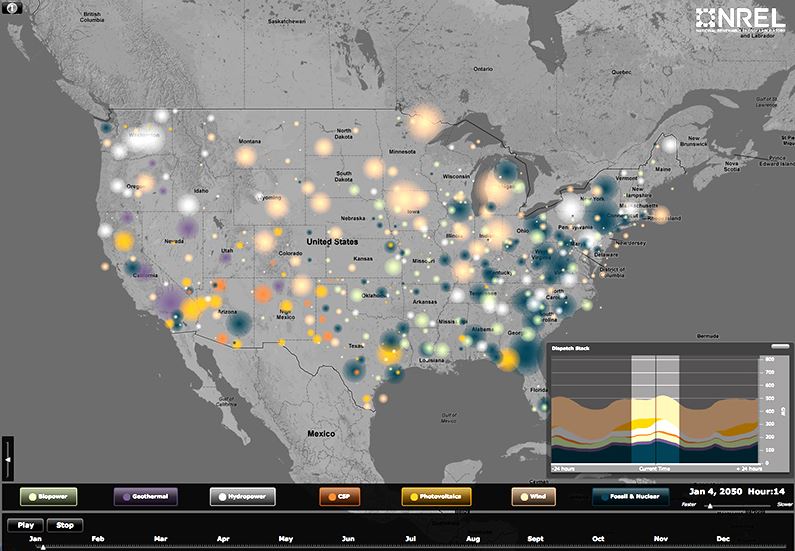
Okay, so there is a little storage involved: ice-storage air conditioning and smart charging of electric vehicles. But where others, including myself, have assumed that large storage devices will need to be added to the grid, Lovins thinks that massive storage facilities are unnecessary, and he presents compelling evidence to support his claim, including actual data from Europe and computer models from NREL. ...

Lovins presents this in the context of storage vs intelligent routing of electricity - which one do we need? That’s a false dichotomy. There will always be a need for storage since many applications are off grid. Obviously storage is needed in order to electrify transportation. So I agree that dynamic routing is the best long term solution for the grid, but we still need to invest in storage technologies. The good thing is that both storage and smart routing can be implemented together, a little at a time, and scaled up gradually.

Amory Lovins: A 40-year plan for energy  

Posted by Big Gav in

TED Talks has a new talk up from Amory Lovins - Amory Lovins: A 40-year plan for energy.

In this intimate talk filmed at TED's offices, energy innovator Amory Lovins shows how to get the US off oil and coal by 2050, $5 trillion cheaper, with no Act of Congress, led by business for profit. The key is integrating all four energy-using sectors—and four kinds of innovation.

Amory Lovins was worried (and writing) about energy long before global warming was making the front -- or even back -- page of newspapers. Since studying at Harvard and Oxford in the 1960s, he's written dozens of books, and initiated ambitious projects -- cofounding the influential, environment-focused Rocky Mountain Institute; prototyping the ultra-efficient Hypercar -- to focus the world's attention on alternative approaches to energy and transportation.

His critical thinking has driven people around the globe -- from world leaders to the average Joe -- to think differently about energy and its role in some of our biggest problems: climate change, oil dependency, national security, economic health, and depletion of natural resources.

Lovins offers solutions as well. His new book and site, Reinventing Fire, offers actionable solutions for four energy-intensive sectors of the economy: transportation, buildings, industry and electricity. Lovins has always focused on solutions that conserve natural resources while also promoting economic growth; Texas Instruments and Wal-Mart are just two of the mega-corporations he has advised on improving energy efficiency.

Fiberforge Lightens Up Car Manufacturing  

Posted by Big Gav in ,

Fast Company has an discussion with Amory Lovins and FiberForge CEO Jon Fox-Rubin about the benefits of making cars using strong, lightweight materials - In an Intense Time for Hybrids and EVs, Fiberforge Lightens Up.

Amory Lovins: CEO & Co-Founder of Rocky Mountain Institute: A typical car today uses everyday a 100 times its weight in ancient plants inefficiently converted into gasoline. What happens to that fuel energy when it goes into your tank, 7/8th of it gets lost before it even gets to the wheels, of the 1/8th that gets to the wheels half of that either heats the air that your pushing aside or heats the tire and road. Only the last 6% of the fuel energy actually accelerates the car and then heats the breaks when you stop. And yet 95% of the mass you’re accelerating is the car not the driver, so 6% of 5%, that's about 0.3%, of the fuel energy ends up moving the driver. This is not very gratifying after 120 something years devoted to engineering effort.

Jon Fox-Rubin: President & CEO Fiberforge: Anything that needs to be moved from Point A to Point B would use less fuel and less energy to accelerate it, move it and decelerate it if it were lighter. And that’s really where the Fiberforge process is aimed at creating affordable structures that are lighter in weight.

Amory: We use carbon composites in military and aerospace where cost is almost no object, it's worth $700 present value to take a lb out of an airplane so they're willing to pay a lot to do that. But to move into automating you need to make these composite structures in a thousand times higher volume and lower cost then now.

Jon: Our main goal for any particular market is really affordability. And so the way we do that is we try to automate the process and turn the carbon fiber into a finished product that can be stamped, just like a steel part today. In an automobile you can stamp a thermoplastic tailored blank that’s made by the Fiberforge process.

The parts are typically designed in industry standard CAD tools, computer aided design tools designed for composites in the 3-D shape they're intended to be, and then we take that and flatten it into a 2-D shape and translate that into a Cad-Cam system. So computer aided design, computer aided manufacturing software system that makes the tool path for the tailored blank. That is the automatic layout system that makes the tailored blank. What you're seeing is a motion table that's moving XY, and rotates under a fixed head that’s part of our patented process. And it's laying up the tape a strip at a time next to one another. And we can layup a blank on the order of a few minutes.

Amory: This has 14 layers that are laid down kind of like plywood with carbon fibers pointing in different directions so you get the strength in the directions you want and not otherwise. And then since this is thermoplastic you can heat it up until it softens, stick it on a hot dye and mold it into the shape you want.

Jon: The heater heats the blank with infrared energy and once the resin is fully molded it shuttles it into the system and then essentially it gets compressed and frozen in place.

Amory: You end up with an amazingly strong material; this particular one is tougher than titanium, and really stiff as you can tell from the sound. So plastics have changed since The Graduate. And you can make this in thirty or sixty seconds and stamp out the parts just like steel, except you need about 10 or 20 times fewer parts to make the auto body, the parts snap precisely together for gluing, no hoist no jigs no robots no welders. And lay color in the mold you can make whatever color you want so you get rid of the paint shop, that's another half-billion dollar investment. So very different way to make cars, it's what's called a disruptive technology. Of course it's smart for automakers to adopt something like that right away before their competitors do and sell them their steel stamping equipment to slow them down.

Jon: I think the first automaker that really gets serious about light weighting and either licenses our technology or comes up with its own competitive technology will really own a key piece of the next generation of transportation.

Amory: An automaker will be smart to spend its own money making the cars lighter rather than try and make the fuel cells cheaper and tanks smaller. You'll get to the same place but with much less time, money and risk.

On Proliferation, Climate, and Oil: Solving for Pattern  

Posted by Big Gav in

Amory Lovins has an article in Foreign Policy on how to solve the myriad problems associated with fossil fuel consumption - On Proliferation, Climate, and Oil: Solving for Pattern.

The problems of proliferation, climate change, and oil dependence share both a nuclear non-solution that confounds U.S. policy goals and a non-nuclear solution that achieves them.

The first four months of 2010 offer a unique opportunity to align the United States' foreign-policy goals with domestic energy policy and new market developments, and thereby to stem what the Pentagon's Nuclear Posture Review will reportedly rank equally with great-power threats -- the spread of nuclear weapons.

Epistemologist Gregory Bateson and farmer-poet Wendell Berry counseled "solving for pattern" -- har­nessing hidden commonalities to resolve complex challenges without making more. President Obama's speech at the recent U.N. climate summit in Copenhagen hinted at such an approach by linking an efficient, clean-energy, climate-safe economy with three other key issues: prosperity, oil displacement, and national security. Keeping proliferation, climate, and oil in separate policy boxes has in the past stalled progress on the first two issues over North/South splits that the third issue intensifies. Yet these three problems share profitable solutions, and seem tough only because of a wrong economic assumption.

One false assumption can distort and defeat policies vital to paramount national interests. The Copenhagen climate conference proved again how pricing carbon and winning international collaboration are hard if policymakers assume climate protection is costly, focusing debate on cost, burden, and sacrifice.

That assumption is backwards: Business experience proves climate protection is not costly but profitable, because saving fuel costs less than buying fuel. Changing the conversation to profits, jobs, and competitive advantage sweetens the politics, melting resistance faster than glaciers. Whether you care most about security, prosperity, or environment, and whatever you think about climate science, you'll favor exactly the same energy choices: focusing on outcomes, not motives, can forge broad consensus.

For instance, a January 2009 study by McKinsey & Company demonstrated how it was possible to cut projected 2030 global greenhouse-gas emissions by 70 percent at a trivial average cost: $6 per metric ton of CO2. Newer technologies and integrative design, which often makes very large energy savings cost less than small or no savings, turning diminishing into expanding returns, could make even bigger abatements cost less than zero­ dollars.

This can be done fast enough. Consider that from 1977 through 1985, U.S. oil intensity (barrels per real GDP dollar) fell 5.2 percent per year. Today, cutting global energy intensity at an annual rate of about 3-4 percent, vs. the historic 1 percent, could abate further climate damage. The United States has long achieved 2-4 percent cuts each year without paying attention; China achieved more than 5 percent reductions from 1976 through 2001 and is on track for 4 percent reductions from 2005 through 2010. Individual firms have been able to achieve 6-16 percent reductions. So why should 3-4 percent be hard, especially with most of the global economic growth in China and India, where making new infrastructure efficient is easier than fixing it later?

Since energy efficiency consistently makes money (billions for many firms), why should this be costly? And why should climate negotiators adopt economists' assumptions about cost rather than business leaders' experiences of profit? The climate conversation gets vastly easier and less necessary when it's shifted from shared sacrifice to informed self-interest.

Many policymakers likewise assume U.S. oil dependence and imports must be permanent. Yet a 2004 Pentagon-cosponsored independent study showed how it was possible to eliminate U.S. oil use by the 2040s at an average cost of about $15 per barrel, led by business for profit. Implemen­tation was launched in 2005 by "institutional acupuncture," then spurred by the 2008 price shock, 2009 policy shifts, and military innovation.

That effort now looks to be on or ahead of schedule: In 2009, "peak oil" emerged, but on the demand side. U.S. gasoline demand reached its apex in 2007. Cambridge Energy Research Associates doubts OECD oil demand will regain its 2005 peak. Deutsche Bank forecasts light-vehicle electrification (at one-third China's planned rate, and without counting the other revolutionary innovations underway) will turn world oil demand downward from 2016 -- reaching, by 2030, 8 percent below 2009. Suburban sprawl is reversing. Just in 2008, government-mandated "feebates" cut inefficient cars' sales in France 42 percent and raised efficient cars' sales 50 percent. Thus oil is becoming uncompetitive even at low prices before it becomes unavailable even at high prices.

Yet with oil as with climate, official assessments ignore these solutions as too detailed, disruptive, novel, or integrative to contemplate. When offered cramped old choices, policymakers all too often perpetuate largely incremental policies. Private firms are more likely to innovate, while governments play catch-up. And intergovernmental negotiations learn slowest of all.

Nuclear Nonsense: Amory Lovins On Stewart Brand  

Posted by Big Gav in , ,

Grist has an article from Amory Lovins on Stewart Brand's new book "Whole Earth Discipline: An Ecopragmatist Manifesto" - Stewart Brand’s nuclear enthusiasm falls short on facts and logic. I like Brand and usually agree with him, but I'm with Amory on this one.

Supporting technical details and citations for this post can be found here: “Four Nuclear Myths” (PDF).

I have known Stewart Brand as a friend for many years. I have admired his original and iconoclastic work, which has had significant impact. In his new book, Whole Earth Discipline: an Ecopragmatist Manifesto (Viking), he argues that environmentalists should change their thinking about four issues: population, nuclear power, genetically modified organisms (GMOs), and urbanization. Many people have asked me to assess his 41-page chapter on nuclear power, so I’ll do that here, because I believe its conclusions are greatly mistaken.

Stewart recently predicted that I wouldn’t accept his nuclear reassessment. He is quite right. His nuclear chapter’s facts and logic do not hold up to scrutiny. Over the past few years, I’ve sent him five technical papers focused mainly on nuclear power’s comparative economics and performance. He says he’s read them, and on p. 98 he even summarizes part of their economic thesis. Yet on p. 104 he says, “We Greens are not economists” and disclaims knowledge of economics, saying environmentalists use it only as a weapon to stop projects. Today, most dispassionate analysts think new nuclear power plants’ deepest flaw is their economics. They cost too much to build and incur too much financial risk. My writings show why nuclear expansion therefore can’t deliver on its claims: it would reduce and retard climate protection, because it saves between two and 20 times less carbon per dollar, 20 to 40 times slower, than investing in efficiency and micropower.

That conclusion rests on empirical data about how much new nuclear electricity actually costs relative to decentralized and efficiency competitors, how these alternatives compare in capacity and output added per year, and which can most effectively save carbon. Stewart’s chapter says nothing about any of these questions, but I believe they’re at the heart of the matter. If nuclear power is unneeded, uncompetitive, or ineffective in climate protection, let alone all three, then we need hardly debate whether its safety and waste issues are resolved, as he claims.

The much ballyhooed "nuclear renaissance" meme has been given short shrift in the SMH today as well - Nuclear delusions keep mushrooming.
Little wonder Australians are reconsidering the nuclear option for electricity production. The recent wave of euphoric predictions of a global nuclear renaissance from industry promoters has created high community expectations.

But on closer scrutiny, nuclear power's real potential is disappointing. Despite over half a century of intensive subsidisation and promotion, it produces less than 15 per cent of the world's electricity. This may seem hard to believe, given the fervour with which its promoters have been singing its praises of late, but the numbers speak for themselves.

In addition to 430 reactors operating worldwide, 52 reactors are listed by the International Atomic Energy Agency as ''under construction''. Thirteen have been on that list for over 20 years, and 24 still don't have an official planned start-up date.

One oft-quoted goal of the nuclear industry is to grow to 730 reactors worldwide by 2030. This would require one to be completed every 24 days, every year for the next 20 years. And it would assume none currently operating will be shut down. This seems improbable as the average age of operating power plants is 25 years.

Meanwhile the industry gestures excitedly at China (16 under construction), India (seven under construction) and Russia (nine under construction), which are unlikely even to compensate for lost global capacity as older reactors will have to close.

Predictions of huge expansion in Eastern Europe or North America - even in Australia - over the next two decades border on hysteria. Don't be deceived by talk of ''planned reactors'' or ''new generation solutions'': ask to see the poured concrete and the installed reactor core.

A realistic appraisal suggests we will see reactors built, and continue to hear excited talk about nuclear expansion. But it is almost as certain the so-called "renaissance" will be more of a protracted, agonising expiration.

The Homely Costs of Energy Conservation  

Posted by Big Gav in

The WSJ has an article on a recnet renovation of Amory Lovins low / clean energy home - The Homely Costs of Energy Conservation.

Banana Farm 2.0, as Mr. Lovins calls his updated digs, was renovated largely with equipment donated by individuals and companies eager to be associated with the project. Mr. Lovins says he doesn't know what the two-year renovation would have cost had he had to pay the full tab. But just a few of the major items would put the retail cost of the project well beyond $150,000.

On a recent afternoon, Mr. Lovins climbed up onto his home's flat roof, an easy task because the back of the house is built into the side of a hill to take advantage of the earth's insulating power.

Laid across the roof are devices designed to capture solar energy: photovoltaic panels that convert sunlight into electricity, thermal panels that use the sun's warmth to heat water, and clear plastic tubes that funnel sunlight down into the house, where it illuminates the central hallway.

A bank of new photovoltaic panels nearly doubles the amount of solar electricity the house produces, to 9.7 kilowatts, enough for the house's needs. The panels, which were donated to Mr. Lovins, retail for about $30,000, not including installation, though tax breaks cut that price significantly.

"We are making no economic claims for Banana Farm 2.0," he says. "We deliberately brought in a bunch of cutting-edge, even bleeding-edge, stuff." Instead, he thinks that with the right government policies to spur market demand, even the most advanced green modifications could make economic sense. His role, as he sees it, is to push the limits of technology.

"Demand is the sum of a lot of negligible individual actions," he says. "When there are a lot of individuals, it isn't negligible. It adds up."

Banana Farm 2.0 isn't combustion-free. A wood-burning stove still sits near Mr. Lovins' office -- a backup heat source he hopes to abandon if the house works as planned this winter. But the new solar panels have allowed him to get rid of two devices that burned gas: a stove and a water heater.

Some of his proudest advances stem from mundane changes. He installed an electric stove made by a Swiss company that is 60% more efficient than other models he found. The savings stem partly from pots designed specifically for the stove. The pots eliminate warping that typically occurs with copper cookware, wasting heat.

He also has shaved energy use by insisting on an unconventional plumbing design. Typically, residential pipes that carry water would be ½-inch wide and turn at right angles. But that builds up friction, requiring electric pumps to work harder to propel the water. So Mr. Lovins had ¾-inch-wide pipes installed that run diagonally across ceilings and walls to minimize friction.

"If it looks pretty," he says, "it probably doesn't save energy."

For now, Banana Farm 2.0 is a showcase of what is technologically possible. Adopting some of the house's innovations on a wide scale would require huge investment and sweeping changes to governmental policy.

Still, Mr. Lovins knows that some of the most effective ways to reduce fossil-fuel use don't require groundbreaking science. As he headed out to dinner in his hybrid car on a recent evening, the Banana Farm's owner did something decidedly low-tech: He turned off the lights.

Does a Big Economy Need Big Power Plants?  

Posted by Big Gav in ,

The Freakonomics blog has a guest post from Amory Lovins on the advantages of micro and distributed generation over the old model of large, centralised power plants - Does a Big Economy Need Big Power Plants?.

If I told you, “Many people need computing services, so we’d better build more mainframe computer centers where you can come run your computing task,” you’d probably reply, “We did that in the 1960’s, but now we use networked PC’s.” Or if I said, “Many people make phone calls, so we’d better build more big telephone exchanges full of relays and copper wires,” you’d exclaim, “Where have you been? We use distributed packet-switching.”

Yet if I said, “Many people need to run lights and motors, Wii’s, and air conditioners, so we’d better build more giant power plants,” you’d probably say, “Of course! That’s the only way to power America.”

Thermal power stations burn fuel or fission atoms to boil water to turn turbines that spin generators, making 92 percent of U.S. electricity. Over a century, local combined-heat-and-power plants serving neighborhoods evolved into huge, remote, electricity-only generators serving whole regions. Electrons were dispatched hundreds of miles from central stations to dispersed users through a grid that the National Academy of Engineering ranked as its profession’s greatest achievement of the 20th century.

This evolution made sense at first, because power stations were costlier and less reliable than the grid, so by backing each other up through the grid and melding customers’ diverse loads, they could save capacity and achieve reliability. But these assumptions have reversed: central thermal power plants now cost less than the grid, and are so reliable that about 98 percent to 99 percent of all power failures originate in the grid. Thus the original architecture is raising, not lowering, costs and failure rates: cheap and reliable power must now be made at or near customers.

Power plants also got irrationally big, upwards of a million kilowatts. Buildings use about 70 percent of U.S. electricity, but three-fourths of residential and commercial customers use no more than 1.5 and 12 average kilowatts respectively. Resources better matched to the kilowatt scale of most customers’ needs, or to the tens-of-thousands-of-kilowatts scale of typical distribution substations, or to an intermediate “microgrid” scale, actually offer 207 hidden economic advantages over the giant plants. These “distributed benefits” often boost economic value by about tenfold. The biggest come from financial economics: for example, small, fast, modular units are less risky to build than big, slow, lumpy ones, and renewable energy sources avoid the risks of volatile fuel prices. Moreover, a diversified portfolio of many small, distributed units can be more reliable than a few big units.

Bigger power plants’ hoped-for economies of scale were overwhelmed by diseconomies of scale. Central thermal power plants stopped getting more efficient in the 1960’s, bigger in the 1970’s, cheaper in the 1980’s, and bought in the 1990’s. Smaller units offered greater economies from mass production than big ones could gain through unit size. In the 1990’s, the cost differences between giant nuclear plants — gigantism’s last gasp — and railcar-deliverable, combined-cycle, gas-fired plants derived from mass-produced aircraft engines, created political stresses that drove the restructuring of the utility industry.

Meanwhile, generators thousands or tens of thousands of times smaller — microturbines, solar cells, fuel cells, wind turbines — started to become serious competitors, often enabled by IT and telecoms. The restructured industry exposed previously sheltered power-plant builders to brutal market discipline. Competition from a swarm of smaller electrical sources and savings created financial risks far beyond the capital markets’ appetite. Moreover, the 2008 Defense Science Board report “More Fight, Less Fuel” advised U.S. military bases to make their own power onsite, preferably from renewables, because the grid is vulnerable to long and vast disruptions.

Amory Lovins: The frugal cornucopian  

Posted by Big Gav in , ,

The Economist has an article on Amory Lovins, noting he "began making the case for resource efficiency decades ago, long before it became fashionable", and "now things are going his way" - The Frugal Cornucopian.

IF ANYBODY should be on top of the world today, it is Amory Lovins. That is not just because the energy visionary makes his home on a mountain in Old Snowmass, Colorado. Rather, it is because today’s interrelated energy and climate difficulties have at last made the world see the importance of resource efficiency, energy innovation and holistic design—principles that he has been advocating for nearly four decades.

For much of that time, Mr Lovins, who heads the Rocky Mountain Institute (RMI), a natural-resources consultancy, has been a lonely voice in the wilderness. As far back as the early 1970s, he sounded his first alarm about the potential damage that climate change might bring, but he was ignored. In a paper in Foreign Affairs in 1976, at the height of the energy crises and neuroses of that decade, he argued that what the world needed most was not new energy supplies but more efficiency. He was ruthlessly attacked by the energy industry and the political establishment, and his proposal for an alternative “soft path” out of the energy crisis was dismissed. Energy and economic growth always grew in lockstep, went the conventional argument, and to think otherwise was dangerously naive.

But history has proved him right. Thanks to a combination of high prices and public policies aimed at encouraging efficiency and conservation, America’s energy use did decouple from economic output in the wake of the oil shocks of the 1970s. Crucially, this happened without impoverishing the country, proving his once-controversial thesis that growth and greenery can indeed go hand in hand. That experience, along with the recent global energy-price shock, has made it respectable for business and political leaders to talk about energy efficiency.

Mr Lovins should be pleased, but his satisfaction at having been proved right is tempered by lingering unease that there are echoes of the 1980s in today’s debate. The main problem with the approach to energy in the 1970s, he argues, was that the issue was defined as a supply shortage. “The question they asked was how to get more energy, at any price, instead of asking: ‘How should we use energy, why are we using it so wastefully, and what do people really use energy for?’” he says.

That question points to one of his main contributions to the energy debate. He insists that the goal of public policy should be to ensure adequate and affordable supplies not of energy per se but of “energy services”—as he loves to put it, the cold beer and hot showers made possible by energy. By redefining the problem that way, rather than merely subsidising more power plants or oil drilling, public policy can be made technology neutral, and consumer needs can be satisfied by demand-side measures if they prove cheaper than drilling or digging for new supply. ...

Mr Lovins is convinced that the “intensity and diversity of innovation attempts today is much greater than in the 1980s.” One reason is that technology, be it in nanotech, batteries or computing, has improved. Another is that research itself is much more productive, in his view, thanks to the rise of open, networked and global approaches to innovation.

He sees one more reason for optimism about today’s innovation boom. Unlike the last clean-tech wave, which was largely funded by government money doled out to politically connected groups, this wave is a largely “invisible” trend funded chiefly by private money coming from venture capitalists, angel investors and private-equity funds. That, he reckons, makes for more discerning investments and increases the odds of success.

Unlike many environmentalists, Mr Lovins has always had a respect for market forces and entrepreneurship. Markets are good at weeding out trendy but impractical technologies, for one thing. And he designed RMI to be not only a think-tank but a “do tank” that puts theory into practice. To do so, he has taken various of his ideas and formed start-up companies that have then been spun out of RMI.

Among these are Hypercar (which came up with a new design for a light, efficient car), Fiberforge (an offshoot of Hypercar which sells carbon-fibre parts to automotive suppliers) and Bright Automotive (which is developing technologies for plug-in hybrid cars, and is expected to be floated within a year). It has been nearly two decades coming, but the world’s car industry is now embracing plug-ins, fuel cells, electric cars and lightweight bodies.

It is not just his enthusiasm for market forces that makes Mr Lovins, a man whose green credentials are impeccable, a most unlikely eco-warrior. He does not mind taking an infinitely long shower, he explains, if he uses renewable energy to heat his shower and recycles his waste water. Though it is fashionable to proclaim that sport-utility vehicles (SUVs) are the work of the devil, he made a point of designing his initial Hypercar as an SUV to show that the proper target for green ire was bad design, an inefficient engine and dirty fuel—not the SUV per se. He even rankles when he is called an environmentalist, insisting that he prefers “elegant frugality to wearing a hair shirt.”

I'm not sure where I came across this, but Lovins also features in this lengthy interview with "Mother Earth News" back in 1977 - The Plowboy Interview.
PLOWBOY: Amory, for the benefit of those who don't know you, could you explain how you got into the field of energy analysis? How did a physicist happen to get so deeply involved in energy policy?

LOVINS: Through a series of historic accidents. It's true that I'm basically an experimental physicist, or at least I used to be. I was working toward a Ph.D. in physics at Oxford, in England, during the late sixties. Up until that time, I had been raised to be a normal, healthy techno-twit I didn't much care about environmental issues.

Gradually, though, I began reading about the wider problems in the world. And I started to realize that it wouldn't make a heck of a lot of difference to anybody whether or not I solved the problems I was working on in the laboratory. At the same time, I was becoming less and less able to see myself twenty years down the road as an academic physicist.

At about that time—which is to say, the very late sixties—I developed an interest in a wild part of northwest Wales called Snowdonia National Park. A colleague and I had done a lot of mountain photography there, and a little writing, too. We thought we might be able to recover some of our film costs by selling an article to National Geographic so we wrote to the magazine. And they said, "Well this is nice stuff, but it's not what we publish - it's too atmospheric. But you might send it to Dave Brower at Friends of the Earth, because Dave likes that sort of thing. He might have some suggestions." So we wrote to Dave, and very much to our surprise we soon found ourselves signed up to do one of Dave's "exhibit format" books for FOE.

PLOWBOY: This was in 1970?

LOVINS: Right, late 1970. In the process of doing the book, during the spring of '71, co-photographer Philip Evans and I became very much involved with Dave Brower and the things he was doing. Also, I was getting to be sufficiently disenchanted with academic science at that point that I was willing to jump off and try something else ... so in May of 1971 I resigned my Junior Research Fellowship at Oxford, moved from Oxford to London, and went to work for Friends of the Earth as their British representative, which involved me in a mixture of analysis, writing, speaking, broadcasting, testifying, and lobbying at all levels, from grassroots to Prime Ministerial. ...

PLOWBOY: All right. You've written three energy books in the past several years-six Friends of the Earth books altogether—and you've had numerous articles and papers published in technical journals. But by far your most celebrated piece of work—the one for which you are best known today—is an essay entitled "Energy Strategy: The Road Not Taken?" which appeared in the October '76 issue of Foreign Affairs. Since many of MOTHER's readers haven't seen that piece, I wonder if you could explainbriefly—what it was about, and why that article has been so controversial.
the rate at which a society gobbles energy isn't so much a measure of that society's success or well-being any more, but rather of its failure.

LOVINS: I'll try. Basically, the essay outlines and contrasts two paths along which U.S. energy policies—or the energy policies of other countries—might evolve over the next fifty years or so. These paths are not forecasts or projections - rather, they're illustrations. They're not necessarily what will or should happen - they're a way of visualizing what might happen.

What I said in "Energy Strategy: The Road Not Taken?" is that most of the energy futures one can imagine are basically variations on one or another of two themes. The first theme—which I call a "hard" energy path—assumes that the energy problem facing this country is how to expand supplies-especially domestic supplies-of energy to meet extrapolated demands. According to hard-path advocates, the solution to this problem is to deplete all sorts of depletable fuels faster, whether it's oil, gas, coal, or uranium - to convert those fuels into premium forms of energy, mainly electricity - to do that conversion in ever larger, more complex, more centralized, hightechnology plants - then to distribute the energy through big, centralized distribution networks. ...

LOVINS: With a soft energy path based on three components ... components that—when you put them together—form a whole greater than the sum of the parts. The three components are—first—very greatly increased efficiency in energy use ... second, the rapid introduction of what I call "soft technologies", which I'll define in a minute ... and third, the transitional use of fossil fuels to buy the time needed to deploy the soft technologies.

I don't need to say too much about the first component, except that I'm talking not just about increasing the gas mileage of cars or the efficiency of electric toasters ... I'm talking about reducing the enormous losses that occur when you convert primary energy—in the form of coal, petroleum, and so on—into gasoline and electricity. The losses that occur in converting primary energy to end—use energy have been increasing dramatically over the past few decades, and if we do nothing about it these losses will go on increasing until they take up over half of all future energy growth.

PLOWBOY: In other words, one of the biggest energy wasters in our present society is our own energy industry!

LOVINS: Precisely. In Britain, for example, the energy industries are the largest energy consumers. In England, more than half the growth in energy production that's occurred since 1900 has gone to fuel the fuel industries.

PLOWBOY: Wow!

LOVINS: Now obviously, this kind of thing can't be allowed to go on. We can't continue to fuel the fuel industry at an ever-increasing rate, and the rest of society can't continue to consume energy at an ever-increasing rate. It has to end somewhere.

PLOWBOY: I take it, then, you feel that zero or negative growth in the rate of energy use in the U.S. is a desirable and achievable goal.

LOVINS: Absolutely. And of course, that means we're going to have to learn how to do more with less. But it doesn't necessarily mean that we'll have to give up a lot of things that are dear to us. I hear that fear expressed quite often. Some people feel that civilization in the U.S. would be inconceivable if we used only, say, half as much electricity as we do now . . . and yet that is what we did use in 1963, when Americans were at least half as civilized as they are at present.

PLOWBOY: OK. A minute ago, you promised to define the term "soft technologies".

LOVINS: Right. Soft technologies have five defining characteristics. Number one, they're diverse ... that is, we're talking about a large number of individual technologies, each doing what it does best, and none trying to be a panacea. Second, soft technologies rely on renewable energy flows - sunlight, wind, vegetation, and the like — rather than on depletable fuels.

PLOWBOY: They rely on energy that's always going to be there whether we use it or not.

LOVINS: Yes. Third, they are relatively understandable, or what Ivan Illich would call convivial. That is, although an ordinary person wouldn't necessarily be able to build a particular soft energy device or have a detailed knowledge of what goes on inside it, he or she would be able to control it. It wouldn't be some mysterious giant lurking over the horizon, but rather an item of everyday activity that would be relatively understandable. My pocket calculator, for example, is technically a very sophisticated device, but I run it - it doesn't run me. That's the sort of social criterion I had in mind.

All right. The fourth and fifth defining characteristics of soft technologies are that they're matched in scale and in energy quality to end-use needs.

I'd never heard of "Ivan Illich" before and was wondering if he'd gotten "Vladimir Illich" mixed up (Lenin's first names) - but a quick Google set me straight - Mr Illich was an Austrian anarchist of sorts who Wikipedia describes as the "intellectual father of Web 2.0 and Wikipedia".
Ivan Illich (Vienna, 4 September 1926 – Bremen, 2 December 2002) was an Austrian philosopher and anarchist social critic. He authored a series of critiques of the institutions of contemporary western culture and their effects of the provenance and practice of education, medicine, work, energy use, and economic development. Illich has been called the intellectual father of Web 2.0 and Wikipedia. In 1971 Illich imagined a world where people learned mostly from each other rather than from experts and where information would be available everywhere anytime—in railway stations, factories, cafes, hospitals everywhere.

Amory Lovins On Nuclear Power  

Posted by Big Gav in ,

Democracy Now has an interview with Amory Lovins, looking at way nuclear power is a poor option to choose. Reason number 1 - cost. From Expanding Nuclear Power Makes Climate Change Worse:

AMY GOODMAN: It’s good to have you with us. Well, talk about nuclear power. Why do you feel it’s not an option, given the oil crisis?

AMORY LOVINS: Well, first of all, electricity and oil have essentially nothing to do with each other, and anybody who thinks the contrary is really ignorant about energy. Less than two percent of our electricity is made from oil. Less than two percent of our oil makes electricity. Those numbers are falling. And essentially, all the oil involved is actually the heavy, gooey bottom of the barrel you can’t even make mobility fuels out of anyway.

What nuclear would do is displace coal, our most abundant domestic fuel. And this sounds good for climate, but actually, expanding nuclear makes climate change worse, for a very simple reason. Nuclear is incredibly expensive. The costs have just stood up on end lately. Wall Street Journal recently reported that they’re about two to four times the cost that the industry was talking about just a year ago. And the result of that is that if you buy more nuclear plants, you’re going to get about two to ten times less climate solution per dollar, and you’ll get it about twenty to forty times slower, than if you buy instead the cheaper, faster stuff that is walloping nuclear and coal and gas, all kinds of central plans, in the marketplace. And those competitors are efficient use of electricity and what’s called micropower, which is both renewables, except big hydro, and making electricity and heat together, in fact, recent buildings, which takes about half of the money, fuel and carbon of making them separately, as we normally do.

So, nuclear cannot actually deliver the climate or the security benefits claimed for it. It’s unrelated to oil. And it’s grossly uneconomic, which means the nuclear revival that we often hear about is not actually happening. It’s a very carefully fabricated illusion. And the reason it isn’t happening is there are no buyers. That is, Wall Street is not putting a penny of private capital into the industry, despite 100-plus percent subsidies.

AMY GOODMAN: Why?

AMORY LOVINS: It’s uneconomic. It costs, for example, about three times as much as wind power, which is booming.

Let me give you some numbers about what’s happening in the marketplace, because that’s reality, as far as I’m concerned. I really take markets seriously. 2006, the last full year of data we have, nuclear worldwide added a little bit of capacity, more than all of it from upgrading old plants, because the new ones they built were smaller than the retirements of old plants. So they added 1.4 billion watts. Sounds like a lot. Well, it’s about one big plant’s worth worldwide. That was less than photovoltaics, solar cells added in capacity. It was a tenth what wind power added. It was a thirtieth to a fortieth of what micropower added.

AMY GOODMAN: What’s micropower?

AMORY LOVINS: Again, it’s renewables, other than big hydro, plus co-generating electricity and heat together, usually in industry.

In 2006, micropower, for the first time, produced more electricity worldwide than nuclear did. A sixth of the world’s electricity is now micropower, a third of the new electricity. In a dozen industrial countries, micropower makes anywhere from a sixth to over half of all the electricity elsewhere. This is not a fringe activity anymore.

China, which has the world’s most ambitious nuclear program, by the end of 2006 had seven times that much capacity in distributed renewables, and they were growing it seven times faster. Take a look at 2007, in which the US or Spain or China added more wind capacity than the world added nuclear capacity. The US added more wind capacity last year than we’ve added coal capacity in the past five years put together.

And renewables, other than big hydro, got last year $71 billion of private capital; nuclear, as usual, got zero. It is only bought by central planners with a draw on the public purse. What does this tell you? I mean, what part of the story does anybody who take markets seriously not get?

AMY GOODMAN: And yet, well, the media clearly in this country doesn’t get it, because it is raised over and over again by the candidates. I mean, it seems that Senator McCain has a favorite number: a hundred years in Iraq, also hoping for a hundred more new nuclear power plants. He had said something about, he doesn’t want to lose the knowledge of building, since the last one was built more than thirty years ago; the people are dying who had built it, so we’ve got to rush and build them now.

AMORY LOVINS: Well, you could say that’s already been lost, in the sense that most of a nuclear plant built now in the US, if there were any, would have to be imported, which, by the way, means we buy it in weak US dollars, which is part of the incredible cost escalation we’ve seen. Moody’s latest number is $7,500 a kilowatt. That’s, again, as the Journal said, about two to four times the numbers that were being bandied about just last year by promoters.

McKinsey Interviews Amory Lovins  

Posted by Big Gav in , ,

The McKinsey Quarterly has an interview with energy efficiency guru Amory Lovins.

The Quarterly: Given the economic benefits of saving energy, why haven’t companies already seized all the opportunities available to them?

Amory Lovins: Most chief executives assume that smart engineers are already doing everything they should to cut costs. CEOs don’t see all the market failures operating both in the C-suite and several levels down.

For example, most companies behave as if they’re capital constrained, so they defer or simply don’t approve these investments. Even without risk-adjusting your discount rates, saving energy is among the highest-return investments anywhere. But it tends not to get attention, because energy is only 1 or 2 percent of the cost of doing business, unless you’re doing something like smelting aluminum. It just doesn’t rise to the priority level most strategists care about.

And I’m astonished how often chief executives confuse the top and bottom lines. Years ago, I was talking to the head of a Fortune 50 company and was able to tell him about an engineer who had just cut $3.50 per square foot per year off the energy costs in one of the company’s plants. The CEO quickly and correctly translated that into $3.5 million in cost savings. But in the next breath, he said he couldn’t get excited about energy, because it was only 2 percent of his cost of doing business! He forgot where saved overhead goes—straight to the bottom line.

I had to do the arithmetic and show him that if he hypothetically achieved the same result in his 92 million square feet of facilities worldwide, his total net earnings would rise by more than 50 percent. That got his attention. He promoted the engineer, who spread his practices all over the company. Until then, that idea had never occurred to top management, because energy wasn’t an important factor cost. ...

The Quarterly: So if your boss doesn’t know about it and you’re not getting paid more for it, what’s the incentive to suggest improvements?

Amory Lovins: It’s why you became an engineer in the first place: the joy of doing great engineering and coming up with really cool stuff that works better and costs less. When engineers experience whole-system design—optimizing not just parts but entire systems, giving rise to higher savings at lower cost—they’ll never do things the old way again. It irreversibly rearranges their mental furniture. They’re really being creative and not functioning as mere cogs. Unleashing human creativity is an irreversible process.

Creating a culture of curiosity and measurement is immensely important. Here’s an example. I was once in a building that had a 50-kilowatt load of unknown origin. We had to trace all the wires to find the cause: an electric snow melter, under the parking lot, that was running 24/7, every day of the year, including the blazing summer, just eating electricity. Nobody knew it was there. Such waste is all over the place! And until you have a culture of measurement and curiosity, you won’t find it. ...

The Quarterly: What should companies be thinking about when it comes to alternative energy?

Amory Lovins: I don’t think most executives realize that a sixth of the world’s electricity and a third of new electricity now come from micropower—by which I mean on-site or decentralized energy production, such as waste-heat or gas-fired cogeneration, wind and solar power, geothermal, small hydro, and waste- or biomass-fueled plants—rather than from central thermal stations. Micropower is beating the central model because it’s cheaper and has far lower financial risk; it now provides from one-sixth to over half of all electricity in 12 industrial countries. The United States lags with 6 percent.

What about the alleged nuclear renaissance? In 2006, nuclear’s added net capacity—1.44 gigawatts—was less than that of solar cells and a tenth that of wind power. Micropower added 43 to 58 gigawatts and surpassed nuclear’s output. Distributed renewables alone got $56 billion of private risk capital. Nuclear, as usual, got nothing: it’s only bought by central planners. The world now has more wind capacity than the United States has nuclear capacity. In addition, the United States in 2007 added more wind power than it has added coal power in the past five years combined—or than the world added nuclear power over the same period. For anybody who takes the market seriously, what part of that story don’t you understand? These market trends also are good for our climate because new nuclear power buys you two to ten times less coal displacement per dollar than does micropower or improved end-use efficiency, and at a pace that is significantly slower.

Statistics

Locations of visitors to this page

blogspot visitor
Stat Counter

Total Pageviews

Ads

Books

Followers

Blog Archive

Labels

australia (619) global warming (423) solar power (397) peak oil (355) renewable energy (302) electric vehicles (250) wind power (194) ocean energy (165) csp (159) solar thermal power (145) geothermal energy (144) energy storage (142) smart grids (140) oil (139) solar pv (138) tidal power (137) coal seam gas (131) nuclear power (129) china (120) lng (117) iraq (113) geothermal power (112) green buildings (110) natural gas (110) agriculture (91) oil price (80) biofuel (78) wave power (73) smart meters (72) coal (70) uk (69) electricity grid (67) energy efficiency (64) google (58) internet (50) surveillance (50) bicycle (49) big brother (49) shale gas (49) food prices (48) tesla (46) thin film solar (42) biomimicry (40) canada (40) scotland (38) ocean power (37) politics (37) shale oil (37) new zealand (35) air transport (34) algae (34) water (34) arctic ice (33) concentrating solar power (33) saudi arabia (33) queensland (32) california (31) credit crunch (31) bioplastic (30) offshore wind power (30) population (30) cogeneration (28) geoengineering (28) batteries (26) drought (26) resource wars (26) woodside (26) censorship (25) cleantech (25) bruce sterling (24) ctl (23) limits to growth (23) carbon tax (22) economics (22) exxon (22) lithium (22) buckminster fuller (21) distributed manufacturing (21) iraq oil law (21) coal to liquids (20) indonesia (20) origin energy (20) brightsource (19) rail transport (19) ultracapacitor (19) santos (18) ausra (17) collapse (17) electric bikes (17) michael klare (17) atlantis (16) cellulosic ethanol (16) iceland (16) lithium ion batteries (16) mapping (16) ucg (16) bees (15) concentrating solar thermal power (15) ethanol (15) geodynamics (15) psychology (15) al gore (14) brazil (14) bucky fuller (14) carbon emissions (14) fertiliser (14) matthew simmons (14) ambient energy (13) biodiesel (13) investment (13) kenya (13) public transport (13) big oil (12) biochar (12) chile (12) cities (12) desertec (12) internet of things (12) otec (12) texas (12) victoria (12) antarctica (11) cradle to cradle (11) energy policy (11) hybrid car (11) terra preta (11) tinfoil (11) toyota (11) amory lovins (10) fabber (10) gazprom (10) goldman sachs (10) gtl (10) severn estuary (10) volt (10) afghanistan (9) alaska (9) biomass (9) carbon trading (9) distributed generation (9) esolar (9) four day week (9) fuel cells (9) jeremy leggett (9) methane hydrates (9) pge (9) sweden (9) arrow energy (8) bolivia (8) eroei (8) fish (8) floating offshore wind power (8) guerilla gardening (8) linc energy (8) methane (8) nanosolar (8) natural gas pipelines (8) pentland firth (8) saul griffith (8) stirling engine (8) us elections (8) western australia (8) airborne wind turbines (7) bloom energy (7) boeing (7) chp (7) climategate (7) copenhagen (7) scenario planning (7) vinod khosla (7) apocaphilia (6) ceramic fuel cells (6) cigs (6) futurism (6) jatropha (6) nigeria (6) ocean acidification (6) relocalisation (6) somalia (6) t boone pickens (6) local currencies (5) space based solar power (5) varanus island (5) garbage (4) global energy grid (4) kevin kelly (4) low temperature geothermal power (4) oled (4) tim flannery (4) v2g (4) club of rome (3) norman borlaug (2) peak oil portfolio (1)