Showing posts with label east africa. Show all posts

Can geothermal industry gather steam in Canada ?  

Posted by Big Gav in , , , ,

The Globe and Mail has an article looking at the prospects for geothermal power in Canada - Can geothermal industry gather steam in Canada?.

Geothermal’s advantage over wind and solar is that it doesn’t stop running. “You get geothermal power 24 hours a day,” says John Carson, CEO of Vancouver-based Alterra Power Corp., which runs geothermal plants in Iceland and the United States. “It’s baseload power, and that’s what makes it extremely valuable.”

But where many other countries have well-developed geothermal industries, Canada has yet to open a commercial plant. One roadblock is that most provinces and territories don’t even allow geothermal projects. Also, because geothermal is relatively expensive to develop and there’s no domestic production, investors remain hesitant to commit. “What we’re up against is getting the first successful project up and running,” says Tim Weis, Edmonton-based director of renewable energy and efficiency policy at the non-profit Pembina Institute.

Alison Thompson, founder and chair of Calgary-based industry group the Canadian Geothermal Energy Association (CanGEA), wants governments to step in and help the industry gather steam. “There’s what we call an artificial border at the 49th parallel,” Ms. Thompson says. “The resource doesn’t end; there’s policies in place in our country that are preventing it from going forward.” CanGEA estimates that Canada could have 5,000 megawatts of installed geothermal power by 2025.

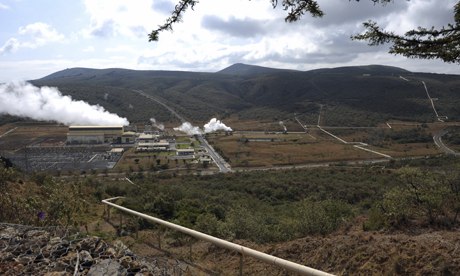
One place geothermal power is thriving is East Africa - The Guardian has an update - Kenya's energy revolution: full steam ahead for geothermal power.

East Africa is undergoing an energy revolution driven by massive offshore natural gas finds in Tanzania and notable oil discoveries in Kenya and Uganda, all in the past three years. Energy from these hydrocarbons is yet to be realised, however. The domestic shortfall is a major hindrance to growth, leaving millions of people literally living in the dark.

About 16% of Kenya's population has access to electricity, according to World Bank data, and demand is outstripping supply. Rationing is a daily reality for many. "The [national grid] service is unreliable and costs business owners large amounts in backup infrastructure and fuel," says Harrison Leaf, managing director of access:energy.

Several private companies like Leaf's are developing off-grid micro-solutions to supplement national supply. But geothermal has become the darling of on-grid solutions for Kenya, and plenty of other countries are keen to benefit.

Kenya's state-owned power producer, Kengen, has been asked to provide consultancy services to Sudan, Rwanda and Tanzania. According to the Geothermal Energy Association, Kenya will become the world leader if its planned projects are completed on time.

The country has set the ambitious target of producing 5,000 megawatts (MW) by 2030, which will power millions of homes: all energy generated is fed into the national grid to increase the percentage of households served. The World Bank estimates that geothermal from east Africa's Rift Valley could power 150m homes.

Progress is steaming ahead at the country's largest geothermal site, 80km north-west of Nairobi. Kirimi has lost count of how many wells he has drilled. His eight rigs with giant cylindrical shafts and diamond teeth are drilling wells at a rate of more than 40 a year. One well has the power to produce 18MW annually; by July 2014, Kirimi hopes to be generating 280MW – and working towards the site's next target of 560MW.
Is East Africa the Next Frontier for Oil ?  

Posted by Big Gav in , , , ,

Time has an article on the (long rumoured) presence of substantial amounts of oil in East Africa - Is East Africa the Next Frontier for Oil?.

According to local lore, Portuguese travelers as far back as the late 19th century suspected that oil might lie beneath parts of East Africa after noticing a thick, greasy sediment wash up on the shores of Mozambique. More interested in finding cheap labor, though, the explorers had little use for oil.

A century later, it turns out that the Portuguese were right. Seismic tests over the past 50 years have shown that countries up the coast of East Africa have natural gas in abundance. Early data compiled by industry consultants also suggest the presence of massive offshore oil deposits. Those finds have spurred oil explorers to start dropping more wells in East Africa, a region they say is an oil and gas bonanza just waiting to be tapped, one of the last great frontiers in the hunt for hydrocarbons. "I and a lot of other people in oil companies working in East Africa have long been convinced that it's the last real high-potential area in the world that hasn't been fully explored," says Richard Schmitt, chief executive of Black Marlin Energy, a Dubai-based East Africa oil prospector. "It seems, for a variety of geopolitical reasons, that more than anything else, it's been neglected over the last several decades. Most of those barriers are currently being lowered or [have] disappeared altogether."

Few have wanted to pay the cost of searching for oil or gas in the region, or risk drilling wells in volatile countries such as Uganda, Mozambique or Somalia. But better technology, lower risk in some of the countries and higher oil prices in recent years have changed the equation. Wildcatters and majors such as Italy's Eni, Petronas of Malaysia and China National Offshore Oil Corporation (CNOOC) have all moved on East Africa in the past few years.

They're hoping to mimic London-based Tullow Oil, which discovered some 2 billion bbl. of oil in landlocked Uganda over the past four years. Last month, Texas-based oil company Anadarko Petroleum Corp. announced that it had tapped a giant reservoir of natural gas off the coast of Mozambique. "Anadarko's find went off like a bomb here in Houston," says Robert Bertagne, a Texas-based oil wildcatter. "It was, 'Wow, we are finding large quantities of gas, and that means we have hydrocarbons in the area.' Once you have a discovery, more people are going to go in there." (See pictures of oil fires.)

Much of East Africa's hopes are focused on a fault line running from Somalia to Madagascar known as the Davie Fracture Zone. It's there that Bertagne's analysis — using Cold War–era sea-floor mapping originally intended for use by Soviet submarines — has prompted speculation about oil deposits rivaling those of the North Sea or Middle East. There's still a lot that's unknown: North Africa has seen 20,000 wells sunk over the past few decades, while drillers have sunk 14,000 wells in and off West Africa. In East Africa, the total is about 500 wells.

Statistics

Locations of visitors to this page

blogspot visitor
Stat Counter

Total Pageviews

Ads

Books

Followers

Blog Archive

Labels

australia (619) global warming (423) solar power (397) peak oil (355) renewable energy (302) electric vehicles (250) wind power (194) ocean energy (165) csp (159) solar thermal power (145) geothermal energy (144) energy storage (142) smart grids (140) oil (139) solar pv (138) tidal power (137) coal seam gas (131) nuclear power (129) china (120) lng (117) iraq (113) geothermal power (112) green buildings (110) natural gas (110) agriculture (91) oil price (80) biofuel (78) wave power (73) smart meters (72) coal (70) uk (69) electricity grid (67) energy efficiency (64) google (58) internet (50) surveillance (50) bicycle (49) big brother (49) shale gas (49) food prices (48) tesla (46) thin film solar (42) biomimicry (40) canada (40) scotland (38) ocean power (37) politics (37) shale oil (37) new zealand (35) air transport (34) algae (34) water (34) arctic ice (33) concentrating solar power (33) saudi arabia (33) queensland (32) california (31) credit crunch (31) bioplastic (30) offshore wind power (30) population (30) cogeneration (28) geoengineering (28) batteries (26) drought (26) resource wars (26) woodside (26) censorship (25) cleantech (25) bruce sterling (24) ctl (23) limits to growth (23) carbon tax (22) economics (22) exxon (22) lithium (22) buckminster fuller (21) distributed manufacturing (21) iraq oil law (21) coal to liquids (20) indonesia (20) origin energy (20) brightsource (19) rail transport (19) ultracapacitor (19) santos (18) ausra (17) collapse (17) electric bikes (17) michael klare (17) atlantis (16) cellulosic ethanol (16) iceland (16) lithium ion batteries (16) mapping (16) ucg (16) bees (15) concentrating solar thermal power (15) ethanol (15) geodynamics (15) psychology (15) al gore (14) brazil (14) bucky fuller (14) carbon emissions (14) fertiliser (14) matthew simmons (14) ambient energy (13) biodiesel (13) investment (13) kenya (13) public transport (13) big oil (12) biochar (12) chile (12) cities (12) desertec (12) internet of things (12) otec (12) texas (12) victoria (12) antarctica (11) cradle to cradle (11) energy policy (11) hybrid car (11) terra preta (11) tinfoil (11) toyota (11) amory lovins (10) fabber (10) gazprom (10) goldman sachs (10) gtl (10) severn estuary (10) volt (10) afghanistan (9) alaska (9) biomass (9) carbon trading (9) distributed generation (9) esolar (9) four day week (9) fuel cells (9) jeremy leggett (9) methane hydrates (9) pge (9) sweden (9) arrow energy (8) bolivia (8) eroei (8) fish (8) floating offshore wind power (8) guerilla gardening (8) linc energy (8) methane (8) nanosolar (8) natural gas pipelines (8) pentland firth (8) saul griffith (8) stirling engine (8) us elections (8) western australia (8) airborne wind turbines (7) bloom energy (7) boeing (7) chp (7) climategate (7) copenhagen (7) scenario planning (7) vinod khosla (7) apocaphilia (6) ceramic fuel cells (6) cigs (6) futurism (6) jatropha (6) nigeria (6) ocean acidification (6) relocalisation (6) somalia (6) t boone pickens (6) local currencies (5) space based solar power (5) varanus island (5) garbage (4) global energy grid (4) kevin kelly (4) low temperature geothermal power (4) oled (4) tim flannery (4) v2g (4) club of rome (3) norman borlaug (2) peak oil portfolio (1)