Posted
by Big Gav
in
energy efficiency,
ge,
monitoring,
natural gas,
rise of the machines
GigaOm has an article on GE's efforts to make turbines for power generation using natural gas more efficient - Putting data centers on turbines to save billions of dollars.
“We’re almost putting a data center on a gas turbine,” Ruh said during a session at GigaOM’s Mobilize conference on Wednesday morning, referencing the hundreds of sensors the company is placing on those machines to capture data. If those sensors, combined with GE’s (or anyone’s) software for managing and analyzing the data, is able to improve efficiency by just 1 percent, that could save nearly $6 billion a year.
Or think about air travel. Forty-one percent of unplanned downtime for airlines is caused by mechanical errors, Ruh explained, so GE wants to be able to predict when its engines or other airline systems will fail. With this knowledge, carriers can fix problems during scheduled downtime and save everyone precious time.
Speaking of jet engines, Ruh noted just how much potentially predictive data they’re generating. If someone captured everything coming off of a jet engine, he said, “We’re talking several hundred terabytes a day.”
However, he acknowledged, the macro effects of the industrial internet — cost savings, carbon-footprint reductions and efficiency gains — will come with shifts in the employment sector that might not be good for everyone involved. “There will be new kinds of jobs that get created that don’t exist today,” Ruh said. But, he added, “Some things people used to do will be done more efficiently through these machines.”
Posted
by Big Gav
in
ge,
wind power
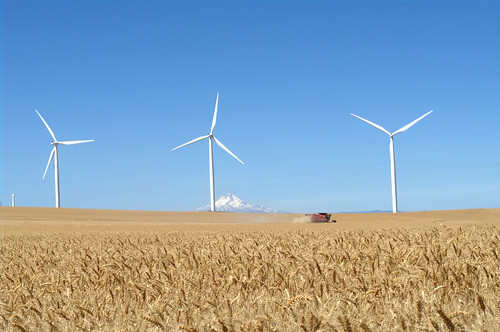
Energy Matters has a post on designing quieter, more efficient wind turbines - Quieter Wind Turbines = More Power.
GE has been conducting research into new low-noise wind turbine blade design. It's not about addressing infrasound - which has already been shown not to be an issue in areas surrounding wind farms - it’s all about producing more power.
“There’s no question, aerodynamic noise is a key constraint in wind turbine blade design today”, says Mark Jonkhof, Wind Technology Platform Leader at GE Global Research. “By using high-performance computing (HPC) to advance current engineering models that are used to predict blade noise, we can build quieter rotors with greater blade tip velocity that produce more power. This not only means lower energy costs for consumers, but also a significant reduction in greenhouse gas emissions.”
Aerodynamic noise refers to the “swooshing” sound created as the leading edge of a turbine blade moves through the air. GE predicts that a mere one decibel drop in this sound would lead to an annual two percent increase in power per turbine. With an estimated 240 gigawatts of wind power to come online globally over the next five years, GE says this would be the equivalent of 5 gigawatts of added wind energy capacity.
Posted
by Big Gav
in
energy storage,
flow battery,
ge
CleanTechnica has an article on new flow battery technology from GE - GE Flow Battery Aims For 240-Mile EV Range… And Beyond.
We were just fooling around with the notion that new fuel cell technology could shake up the electric vehicle market, when here comes GE with another alternative: a flow battery that combines with a fuel cell to push EV range up to the Department of Energy’s goal of 240 miles, and even farther. The official rated range of Tesla Motors’ highly regarded but highly costly Model S is already 265 miles on a lithium-ion battery pack, so the big factor here is going to be affordability. With that in mind let’s take a look at that GE flow battery and see what’s doing.
Read more at http://cleantechnica.com/2013/08/29/new-ge-flow-battery-aims-for-240-mile-ev-range/#wQQwrHS1wJ9DHwP6.99
Posted
by Big Gav
in
ge,
wind power
Think progress has an article on new wind power turbines from GE - Gamechanger: Next Generation Wind Turbines With Storage Are Cheap, Reliable And Brilliant.
Wind companies are always trying to making their next turbine spin more efficiently and generate more power than the last, just as car companies are looking for better fuel efficiency and engine power. Advances usually come in small jumps in both cases, with a single percentage improvement cause for celebration.
GE announced a new line of wind turbines in May that generate between 20 and 24 percent more power than the previous best turbine in its class. It does this through traditional improvements in turbine design, but also through innovations that address one of the main issues that critics of wind power raise: intermittency.
The wind does not blow all the time, and the electric grid needs a regular supply of electricity. Wind has been a critical and climate-friendly addition to the grid portfolio, but as the industry continues to expand, people have started to think about what happens when more and more of our electricity is generated from intermittent renewable sources like wind and solar. Fossil fuel advocates try to make the case that coal and gas (and oil) can be burned constantly, but this is becoming less and less tenable. Rising carbon emissions are triggering extreme weather and sea level rise that endanger the very reliability of the electric grid.
Can advances in technology allow renewable energy sources to be reliable for second-to-second grid use? It’s already happening. In 2011, a concentrated solar plant produced power for 24 hours straight. A huge array of mirrors heated up a huge molten-salt battery system that permitted the solar plant to supply power when the sun was down. Reliable, steady wind energy is also becoming a real thing.
GE’s Brilliant 1.6-100 and 1.7-100 wind turbines are different from previous efforts because they use a short-term, grid-scale battery storage system paired with an “industrial internet” — a sophisticated system that is able to predict when power will be needed and when the wind will be blowing. It’s also bigger. All of this increases efficiency and capacity factor, or how much energy a turbine actually can produce. ...
So where are these cutting-edge turbines headed? Sixty-seven of them will be built for installation in the mountains of New South Wales in Australia in the fall of 2013, with power expected to be flowing into the grid by the end of 2014. Fifty-nine of them are headed to the “thumb” region of Michigan as part of a wind farm planned by NextEra Energy Resources. And Invenergy Wind is building a farm in Mills County, Texas that will feature three 2.5 MW GE Brilliant turbines.
Posted
by Big Gav
in
australia,
ge,
recycling,
water
GE's "Imagination Network" has a new video on water recycling from an Australian viewpoint - The Water Recycle".
The video can't be reduced in size and my blogger template isn't really compatible with large width embeds, so you might want to go to the link to watch it...
Posted
by Big Gav
in
air transport,
australia,
biofuel,
ge,
virgin blue
The SMH reports that Virgin Australia, looking to escape the squeeze from scarcer fossil fuels, is partnering with a consortium including GE to produce biofuel for aviation from eucalypts - Plane biofuel to be made from eucalypt.
A consortium of companies is taking action by using eucalypt trees to develop a commercial biofuel for the Australian aviation industry.
"Innovation and creativity will play enormous roles as part of the transition to a low carbon future," said Ben Waters, director of ecomagination, GE Australia and New Zealand.
GE on Thursday announced it was joining Virgin Australia and other partners to research and develop the commercial biofuel.
The focus will be on using a thermochemical decomposition of organic material - at elevated temperatures in the absence of oxygen - to covert mallee eucalypt trees to the biofuel.
Mr Waters said a pilot biofuel production unit would be opened in Australia next year. ...
A recent CSIRO report estimated the aviation industry could cut greenhouse gas emissions by 17 per cent, generate more than 12,000 jobs and reduce Australia's reliance on aviation fuel imports by $2 billion per annum over the next 20 years through the adoption of biofuels.
Other members of the consortium include Renewable Oil Corporation, the Future Farm Industries CRC, and Canadian biofuels company, Dynamotive Energy Systems Corporation.

Posted
by Big Gav
in
australia,
ge,
smart grids
GE's "Imagination Network" has an interesting video on smart grids from an Australian viewpoint - The Smart Grid".
The video can't be reduced in size and my blogger template isn't really compatible with large width embeds, so you might want to go to the link to watch it...
Posted
by Big Gav
in
ge,
general electric,
renewable energy,
solar thermal power
While the “Gas Age" won’t last forever, gas fired power looks like being used as a way of kick-starting the transition to 100% renewable energy, with hybrid plants like this one being proposed by GE enabling solar thermal, wind and gas fired power generation to share generation and transmission infrastructure. Technology Review says - “The hybrid plant could be the cheapest and easiest way to add renewable energy to the grid" - GE Combines Natural Gas, Wind, and Solar. Alstom are moving in a similar direction, but not as fast - Building bridges.
GE has announced the first power plant to integrate wind and solar power with natural gas—a 530-megawatt plant that will start operating in Turkey in 2015. The power plant is made practical by a flexible, high-efficiency natural-gas system the company announced two weeks ago and a solar thermal power system created by eSolar, a Burbank, California-based startup that GE recently invested in.
Such hybrid plants may become the dominant type of new power plant in some parts of the world, GE says. The new technology is aimed at countries that use 50 hertz electricity (the United States uses 60 hertz). In particular, it could make it easier for China and the European Union to meet their renewable energy targets.
Adding solar power to natural gas plants isn't a new idea, but it hasn't been economical without government subsidies. GE says that because of its new turbines and related equipment, these hybrid plants can, for utilities with the right combination of sunlight and natural gas prices, be competitive even without government support.
While combining solar thermal power and natural-gas turbines is not new, adding wind power to such a system is, GE says. Pairing wind with the natural gas plant helps shave some of the cost of the wind power—the wind farm can share some of the natural gas plant's control systems and its connection to the grid. The natural gas plant also smooths out variations from the wind turbines.
Solar thermal power involves the use of an array of mirrors to concentrate sunlight and the resulting heat to produce steam. That steam can be fed into the steam turbine at a natural gas combined cycle plant to boost its power output.
The solar concentrator array from eSolar helps lower costs in two ways—its modular concentrator system is easy to install and easy to modify for the needs of specific plants. It also produces higher temperature steam than some previous solar thermal systems, increasing power output. GE has also developed a natural gas power plant that is highly efficient, and whose power output can easily be adjusted to make up for variations in power output from solar power.
Connecting a solar thermal system to a natural gas power plant, and thus eliminating the need to buy a separate steam turbine and related equipment, can cut the cost of a solar thermal system by up to 50 percent, says Jon Van Scoter, CEO and president of eSolar. Paul Browning, vice president of thermal products at GE, calls it "the most cost-effective form of solar energy available today."
Posted
by Big Gav
in
ge,
solar pv,
thin film solar,
wind power
Climate Progress notes that wind power is now cost competitive with gas fired power in the US - Wind now on even playing field with gas; GE to build nation’s largest solar panel factory. Romm's post also notes that General Electric plan to build the largest solar panel factory in the US - producing 400 MW per year of Cadmium Telluride thin film solar PV panels (producing some snark from SP at TOD ANZ).
Though the U.S. wind industry installed half as much capacity last year as it did in 2009, production streamlining and efficiency improvements mean wind can compete evenly with cheap natural gas, wind industry executives said today.
There was 5,116 megawatts of new capacity installed across the nation in 2010, down sharply from nearly 10,000 MW the year before. But the industry grew by about 15 percent as new equipment manufacturing facilities sprouted in almost every state.
And heated competition has driven prices down much more quickly than anticipated, the American Wind Energy Association (AWEA) told investors at a wind finance workshop now under way.
As a result, wind power generators say they can now offer utilities long-term purchase power agreements (PPAs) at the same price as natural gas-fired power plants….
Projections of future growth in the industry and claims that grid parity with natural gas has largely been achieved have upended earlier fears that record low gas prices would punish the wind sector for years to come.
AWEA figures show that the average wind PPAs are now being priced at about 6 cents per kilowatt-hour, the same price for energy procurements from a combined cycle natural gas plant. The group says wind is actually about 2 cents cheaper than coal-fired electricity, and more projects were financed through debt arrangements than tax equity structures last year, a possible sign that wind deals are winning more mainstream acceptance from Wall Street’s banks….
[AWEA chief economist Elizabeth] Salerno credits the breakthrough in cost to improved turbine design and performance, higher towers and longer blades, which have boosted the reliability and performance of wind power generation. Equipment makers can also deliver products in the same year that they are ordered instead of waiting up to three years as was the case in previous cycles, she said, calling it a sign of a mature supply chain.
Figures suggest the industry could be set to explode in size this year in terms of new installations.
The group estimates that 5,600 MW of new installed capacity is under construction in the United States, more than double the number at this point in 2010. Thirty-five percent of all new power generation built in the United States since 2005 has come from wind, more than new gas and coal plants combined, as power providers are increasingly enticed to wind as a convenient hedge against unpredictable commodity price moves, AWEA said.
Posted
by Big Gav
in
ge,
general electric,
smart grids
CNet has an article about GE's new smart home energy use monitor and electric vehicle charging station devices - GE brings smart grid home with energy monitor, EV charger.
The industrial giant on Tuesday introduced two products--a home energy management system and electric vehicle charger--which are some of the most tangible aspects of what GE CEO Jeff Immelt on Tuesday called digital energy. The products were announced in tandem with a $200 million award competition to spur smart-grid technology ideas.
The Nucleus home energy monitor and energy management system is a small device, about the same size and shape as a mobile phone charger, which can monitor and control connected appliances. It will only work with a smart meter that uses the Zigbee wireless protocol, which means it will only be available to consumers who are customers of utilities that have installed and activated smart meters.
With Nucleus, people can see their energy usage in real time through a PC or a smartphone application. Studies have shown people reduce electricity use by about 10 percent with more detailed and regular information. The device, which connects into an Internet broadband router with an Ethernet cable, will be able to store up to three years' worth of energy data; future models will have a removable data storage option.
By communicating with a smart meter, Nucleus will let people program appliances to take advantage of off-peak pricing plans offered by utilities that have time-of-use electricity plans. GE is making a line of networked appliances that can go into energy-saving mode when a utility sends a request to lower usage. The peak-time modes can be manually overridden.
There are dozens of companies already making home energy management systems, which typically use a home network to communicate with devices and the utility. GE has the a familiar brand and Zigbee-aware appliances, but its biggest advantage may be its relationship with utilities, which could recommend the device as part of smart-meter programs.
The WattStation electric vehicle charging pedestal is made for charging electric vehicles for use in cities, university campuses, or businesses' office parks.
Industrial designer Yves Behar designed the WattStation so that it would fit into well in cities and stand in contrast to gas filling pumps.

Posted
by Big Gav
in
ecoimagination,
ge,
general electric,
smart grids
Todd Woody at Grist has an article on GE's interest in new smart grid ideas - Got a killer smart grid idea? General Electric’s got $200 million to spend on it .
Jeff Immelt, chief executive of General Electric, flew into San Francisco to announce on Tuesday that GE was hooking up with prominent venture capital firms from Silicon Valley, the East Coast, and Europe to offer a supersized version of the X Prize for smart grid innovation. (GE and the participating venture capitalists are each contributing $100 million to the challenge.)
"We really believe this digital energy space is going to move fast and big as an economic proposition," Immelt said before a hundred or so of Silicon Valley's green tech elite who gathered for a lavish press event at the neo-classical Bently Reserve building in downtown San Francisco. "It also lays the groundwork for everything that needs to be done in an energy future, from nuclear to renewables."
"GE can offer 50 to 60 percent of the solutions," he added. "But the only way we can grow is by partnering with the venture community."
And you too, Grist reader. GE will essentially crowdsource ideas, business plans, and potential startup acquisitions at a new site called Ecomagination Challenge: Powering the Grid. ("Ecomagination" is how GE brands its various environmental and green technology ventures and initiatives.)
Between now and September 30 you can submit ideas and vote on the best ones -- the one scoring the most reader votes, and GE's approval, wins $50,000. The company and its venture partners will award five other entries $100,000 each, which could lead to further equity investment.
A day into the smart grid challenge, ideas submitted from around the world range from wind farms on the Great Lakes to a proposal to "harness the energy from the Earth's rotation."
Now it's doubtful that any startup entrepreneur worth her seed funding will risk floating a potential multimillion-dollar idea for all to see. But GE's partnership with venture capital firms such as Kleiner Perkins Caufield & Byers and Rockport Capital Partners -- not to mention its use of social media to troll for innovative ideas -- speaks to the challenges of building a smart grid.
First we need to define what a smart grid is. Comparing it to the Internet is a favored analogy. The current power transmission system is patchwork of early-to-mid 20th century technology that sends electricity from power plants to homes, offices, and factories. It's essentially a one-way, analog system.
What Immelt calls "digital energy" will transform the power grid into a two-way, interactive system through the use of software, sensors, and other devices that allow utilities and grid operators to control and monitor energy use from the household level up, as well as get real-time data on electricity demand and supply. The various parts of the grid -- transformers, substations, power lines -- will communicate digitally, alerting operators, for instance, when a component has failed.
The ability to collect and analyze such grid data is crucial for the mass expansion of renewable energy. Most forms of green energy -- solar and wind, for instance -- are intermittent and increasingly decentralized; there are more than 31,000 rooftop solar installations in California alone.
To maximize renewable energy production and minimize greenhouse gas emissions, utilities and grid operators must be able to balance electricity being fed into the grid from tens of thousands of such sources along with energy from centralized fossil fuel power stations.
And in the coming years, utilities will need to know the location and charging status of tens of thousands of electric cars, each one automobile battery both a consumer and a potential provider of electricity. (If 100,000 cars plug in at 9 p.m. in California just as wind farms hit peak production, a utility will want to use that emission-free electricity to charge up emission-free vehicles rather than rely on, say, natural gas-fired power plants.)
That also means giving consumers data about their electricity use so they can manage their own personal grid to reduce and balance their energy consumption.
The Internet analogy only goes so far, however. Digitalizing the grid is infinitely more complicated than building and commercializing the Net. The power grid is controlled and owned by thousands of utilities and operators, subject to state and federal regulation.
Posted
by Big Gav
in
ge,
general electric,
smart grids,
smart meters
BusinessWeek has a report on GE's interest in the smart meter / smart grid market - GE to Tap Demand for Smart Meters in $200 Billion Global Market.
General Electric Co. is poised to tap the $200 billion smart-meter market as nations upgrade more power meters to improve electricity use and lower costs.
More than a billion electricity measuring units may be changed to “smart meters” in the next two decades, said Luke Clemente, general manager for GE Energy’s digital energy business. A smart meter system may cost $100 to $200 a unit, depending on the technology used, and the business may be worth as much as $200 billion excluding add-on systems and devices, based on calculations from GE data. ...
The company is targeting U.K., Portugal, Spain, Germany and France as the European Union plans to replace 80 percent of their meters by 2020, the Atlanta-based GE official said. Smart grid installations may grow at “double digits” every year, he said, without giving details.
The U.S., which announced an $8 billion upgrade to the nation’s grid in October, plans to replace about 40 million of its 120 million meters with smart ones over three years. ...
China, where GE built a smart grid demonstration center in Yangzhou, plans to replace 400 million meters in five years, Clemente said. South Korea, Asia’s fourth-largest energy user, said in January that it may spend about 27.5 trillion won ($24.5 billion) by 2030 building so-called smart power grids.
Posted
by Big Gav
in
ge,
siemens,
wind power
Technology Review has an article on GE and Siemens adopting direct drive wind turbines - Wind Turbines Shed Their Gears.
Wind turbine manufacturers are turning away from the industry-standard gearboxes and generators in a bid to boost the reliability and reduce the cost of wind power.
Siemens, the world's largest turbine manufacturer by volume, has begun selling a three-megawatt turbine using a so-called direct-drive system that replaces the conventional high-speed generator with a low-speed generator that eliminates the need for a gearbox. And last month, General Electric announced an investment of 340 million euros in manufacturing facilities to build its own four-megawatt direct-drive turbines for offshore wind farms.
Most observers say the industry's shift to direct-drive is a response to highly publicized gearbox failures. But Henrik Stiesdal, chief technology officer of Siemens's wind power unit, says that gearbox problems are overblown. He says Siemens is adopting direct-drive as a means of generating more energy at lower cost. "Turbines can be made more competitive through direct-drive," says Stiesdal.
Siemens's plans hinge on a new design that reduces the weight of the system's generator. In conventional wind turbines, the gearbox increases the speed of the wind-driven rotor several hundred fold, which radically reduces the size of the generator required. Direct-drive generators operate at the same speed as the turbine's blades and must therefore be much bigger--over four meters in diameter for Siemens's three-megawatt turbine. Yet Siemens claims that the turbine's entire nacelle weighs just 73 metric tons--12 tons less than that on its less powerful, gear-driven 2.3-megawatt turbines.
Posted
by Big Gav
in
ge,
general electric,
wind power
Inhabitat has a post on new offshore wind turbines from GE - GE’s Gigantic Offshore Wind Turbine is 25% More Efficient.
The next gen wind turbine by GE will only be 4 MW, which isn’t too big compared to the 10 MW turbine Norway is building, but it will have two significant design changes: a simpler and more efficient drive train as well as longer blades. A direct-drive mechanism will do away with the gear box, which is used to ramp up the RPMs to generate more electricity. Doing away with the gear box simplifies the system greatly, reducing need for maintenance and oil, both costly during the lifetime of the turbine. Additionally, permanent magnets will replace the electromagnets, which require starter brushes, coils and power from the grid every time the turbine starts up. The new drive train and generator are currently being tested in Norway.
Meanwhile the blades, which are being tested in the Netherlands, have been lengthened by 40%, and made even more aerodynamic and lightweight, all in order to capture more of wind. These new 176-foot long blades are also designed to twist as they are bent from the force of the wind, which means they’ll bear less of the gusts’ brunt yet still be able to capture a large part of the energy. With the help of the new drive train and more efficient blades, the wind turbine will be able to create more power when it is turning at slower wind speeds, which means that the turbine will be able to operate more often at its max 4 MW potential and power up to 1,000 homes with renewable energy.

Posted
by Big Gav
in
ge,
wind power
Technology Review has an article on "new direct-drive turbines promise to lower the cost of offshore wind energy" - GE Grabs Gearless Wind Turbines.
With a new purchase, GE is betting on an early-stage turbine technology that could make offshore wind farms cheaper to maintain. The acquisition of ScanWind, based in Trondheim, Norway, has also secured GE a foothold in the growing offshore wind energy market. ...
In conventional wind turbines, the blades spin a shaft that is connected through a gearbox to the generator. The gearbox converts the turning speed of the blades--15 to 20 rotations per minute for a large, one-megawatt turbine--into the faster 1,800 rotations per minute that the generator needs to generate electricity. "Wind turbines are very different than any other gearbox application," says Sandy Butterfield, chief engineer of the wind program at the National Renewable Energy Laboratory in Golden, CO. "You're going from a very low speed to a high speed." Typically it's the opposite.
The multiple wheels and bearings in a wind turbine gearbox suffer tremendous stress because of wind turbulence, and a small defect in any one component can bring the turbine to a halt. This makes the gearbox the most high-maintenance part of a turbine. Gearboxes in offshore turbines, which face higher wind speeds, are even more vulnerable than those in onshore turbines. Butterfield is leading a gearbox-reliability study with turbine makers to identify design weaknesses that could be avoided.
Posted
by Big Gav
in
ge,
green buildings,
smart appliances,
smart grids,
smart meters,
solar power
This news item is a little old, but I thought I'd post it anyway as its interesting to see GE promoting the idea of energy neutral buildings (though their vision is a long way from that of the Passivhaus folks, heavy on technology on low on insulation and design) - GE: Smart grid yields net-zero energy home.
General Electric unveiled a project at its research labs that will let homeowners cut annual energy consumption to zero by 2015.
These "net-zero energy homes" will combine on-site power generation through solar panels or wind turbines with energy-efficient appliances and on-site storage. Consumers will get detailed energy data and potentially control appliances with Home Energy Manager, a device that is expected to cost between $200 and $250, according to GE executives at a smart grid media day.
GE is piloting the in-home products this year and expects to have the appliances and energy display available next year. The premium for the more efficient, networked appliances will be about $10 more, GE executives said. A net-zero energy home would cost about 10 percent more by 2015, executives said.
Studies show that when consumers have more detailed information on their energy use, they can find ways to reduce consumption by 5 to 10 percent. When utilities have variable, or time-of-use, pricing, consumers could cut electricity use by 15 percent at on-peak times, typically in the morning and early evening.
GE appliances have been converted to have electronic controls and will have a small module in the back that will allow it to communicate with a home's smart meter. With that communication link in place, consumers can find out how much electricity individual appliances use and program them to take advantage of off-peak rates.
The idea behind the smart grid, which encompasses a range of technologies, is to make the electricity grid more efficient and reliable by applying information technologies and controls to the existing grid.
In addition to networked appliances, GE's Net Zero Home Project calls for on-site power generation through solar panels or wind turbines. GE produces solar panels and has invested in residential wind turbine maker Southwest Windpower. A 3,000-watt solar panel array, which costs roughly $30,000 to install, would be enough to supply all of a home's consumption, according to GE executives.
Plug-in electric vehicles and home batteries could be used to store electricity for peak-time power or back-up. Plug-in vehicles could also be charged during the middle of the night to take advantage of off-peak rates.
GE's Home Energy Manager control unit, which consumers access through a dedicated display, provides information to consumers but also is designed to optimize one-site energy generation and consumption.
For example, the control unit could evaluate electricity rates and see that running a dishwasher when the solar panels are producing is cheaper than running the load at off-peak times, explained Beyerle. Or a clothes drier can go into "conservation" mode during peak times where it will operate at a lower temperature and take longer to run.

Greentech Media has more -
GE Unveils Net Zero Energy Home Strategy.
General Electric wants to combine its energy efficient appliances, solar and wind power generation systems, energy storage systems and "smart home" networks to offer homebuilders a complete package to achieve the holy grail of energy efficiency – the "net zero energy home."
But that goal – a home that, over the course of a year, generates more energy than it uses – is "only possible with the full deployment of the smart grid," Steve Fludder, vice president of GE's Ecomagination division, said Tuesday at GE's Niskayuna, N.Y. research center.
That's the idea behind GE's new push into homes, the "end-points" of the electricity grid that GE is already briskly engaged in making smarter through technologies meant to provide digital data and two-way communications between utilities and their customers.
Adding to its line of devices like smart meters, grid sensors, wind power systems and energy storage systems, GE said Tuesday that it will release its own "home energy manager" early next year – a device to link appliances including a "smart" thermostat that it is developing.
"That will be the cybernetic brain that will interface between the grid and all these devices in the home," Fludder said. Combining the device with appliances, air conditioners and other devices that can adjust power use to save energy, and adding a 3-kilowatt solar panel array on the roof, should allow a typical home to make more energy than it uses over the course of a year according to GE's calculations, he said.
The home energy manager will likely cost $200 to $250 and is now being tested in pilot projects, said Kevin Nolan, vice president of technology for GE’s consumer and industrial division. As for new “smart” appliances, they’re also being tested in pilot projects and are expected to be about $10 more than traditional appliances, but rollout will depend on how quickly utilities can support them with time-of-use pricing schemes that can be digitally communicated to homeowners, he said.
Tuesday's news puts GE firmly in the smart home field, a space occupied not only by startups such as Tendril Networks, Energate, Control4, Greenbox Technology and Onzo but also by IT giants including Google, Microsoft and Cisco.


 Posts
Posts