Showing posts with label shipping. Show all posts

Bangladesh - Where ships go to die  

Posted by Big Gav in , ,

The Economist has a photo essay on recycling of old ships in Bangladesh - Ship-breaking in Bangladesh: Where ships go to die.

IN BANGLADESH, ship-breaking turns a stretch of beach into a vision of hell and a parable of globalisation. Some 700 ocean-going vessels are scrapped each year, and about 100 of them are ripped apart in Bangladesh.

Cargill Propelling Meat Across the Ocean With Kites  

Posted by Big Gav in , , ,

Fast Company has an article on the use of SkySails kite technology for making shipping ore energy efficient - Cargill Propelling Meat Across the Ocean With Kites .

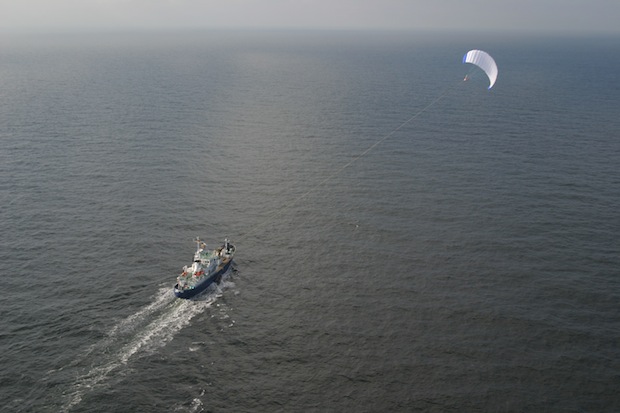
Your next beef patty may be propelled across the ocean by a kite-powered ship. Cargill, purveyor of grain, livestock, and fats for processed foods, signed an agreement this week with SkySails to install a giant kite on one of its long-term chartered ships.

Cargill's kite-powered vessel comes courtesy of SkySails's patented technology, which involves connecting giant parasail-like kites to ships via rope and allowing them to generate enough propulsion to cut down on fuel use (by 35%, in ideal conditions). The kites are controlled by computers that steer their flight path for maximum wind benefits.

In Cargill's case, a 320-square meter kite will be attached to a ship that carries a load of up to 30,000 deadweight tons. The kite-propelled ship will be the largest of its kind when it is ready to go in early 2012.

Cargill isn't the first major company to take advantage of SkySails's kite technology. Last year, GE chartered a SkySails-powered cargo vessel to transport power-generating equipment.

But now that GE and agricultural giant Cargill are both on board with kite-powered ships, SkySails's business will probably take off. And that's a good thing for the shipping industry, which is set to spew up to 18% of global greenhouse gas emissions by 2050 if no action is taken.

Green Ships  

Posted by Big Gav in ,

The Climate Spectator reports that Maersk is looking to increase the energy efficiency of its shipping fleet - Green Ships.

Danish shipping company Maersk has signed an order for 10 new freighters from Daewoo Shipping that it expects will be the most energy-efficient and environmentally friendly container ships in the world. The so called “Triple-E” vessels will cot $190 million, or which $30 million would be spent on cutting the vessel’s energy consumption and carbon output to around half of the industry average for vessels serving Asia-European trade. The company expects the investment to deliver significant long-term savings, given rising oil prices, and the possibility that shipping will be brought into the ET emissions trading scheme.

Maersk has committed to reducing its overall CO2 emissions per container moved by a quarter by 2020 from 2007 levels. "International trade will continue to play a key role in the development of the global economy, but, for the health of the planet, we must continue to reduce our CO2 emissions," said CEO Kolding. "It is not only a top priority for us, but also for our customers, who depend on us in their supply chain, and also for a growing number of consumers who base their purchasing decisions on this type of information."

Russia 1, Icebergs 0 as supertanker takes short cut to China  

Posted by Big Gav in , , ,

The SMH has an article on another crossing of the arctic by a commercial vessel, this time one carrying a shipment of gas - Russia 1, Icebergs 0 as supertanker takes short cut to China.

FOR 500 years, commodity traders have been trying to conquer the treacherous waters of the Russian Arctic passage - aware of its potential as a lucrative short-cut shipping route.

The path is blocked all winter and only smaller cargo vessels manage to navigate through the icebergs for two to three months each northern summer.

But this week, the first commercial supertanker has succeeded in traversing the strait. Carrying 70,000 tonnes of gas from Murmansk in Russia destined for Ningbo in China, it has moved the difficult Northern Sea Route a step closer to rivalling the Suez Canal in the south.

At the most dangerous stretch of the journey - the Vilkitsky Strait - sailors aboard the Baltica threw flowers into the water in memory of all the men who had died in pursuit of a quicker trade route.

Russian traders have been navigating their northern coast since 1934, transporting fuel, supplies and other goods to remote Arctic settlements. But only recently, as the polar ice increasingly diminishes each summer, has it again been considered a possible commercially viable route for shipping goods from Europe round the northern coast of Russia to China, Japan and Korea.

Last year, two German vessels became the first European cargo ships to use the passage as a route to the Far East with a modest 3500 tonnes of construction parts.

But the latest little-noticed news is far more significant: that a giant Russian tanker carrying a huge cargo of gas has managed to cross the passage in just 11 days - half the time it would take to go through the Suez Canal.

The giant Baltica will have to travel only 13,000 kilometres rather than the 22,000 it would take to go through the Suez Canal.

''Never before has a ship of this size passed via the north-east sea passage,'' Captain Alexander Nikiforov said in an interview with Russian television.

Experts estimate that it could be four times cheaper in terms of fuel and charter time than the conventional route to China and the rest of Asia through the Middle East.

Modern cargo ships slow to the speed of the sailing clippers  

Posted by Big Gav in ,

The Guardian reports that cargo shipping now travels slower than the Clipper ships of 2 centuries ago did, as owners seek maximum fuel efficiency - Modern cargo ships slow to the speed of the sailing clippers.

The world's largest cargo ships are travelling at lower speeds today than sailing clippers such as the Cutty Sark did more than 130 years ago.

A combination of the recession and growing awareness in the shipping industry about climate change emissions encouraged many ship owners to adopt "slow steaming" to save fuel two years ago. This lowered speeds from the standard 25 knots to 20 knots, but many major companies have now taken this a stage further by adopting "super-slow steaming" at speeds of 12 knots (about 14mph).

Travel times between the US and China, or between Australia and Europe, are now comparable to those of the great age of sail in the 19th century. American clippers reached 14 to 17 knots in the 1850s, with the fastest recording speeds of 22 knots or more.

Maersk, the world's largest shipping line, with more than 600 ships, has adapted its giant marine diesel engines to travel at super-slow speeds without suffering damage. This reduces fuel consumption and greenhouse gas emissions by 30%. It is believed that the company has saved more than £65m on fuel since it began its go-slow.

Ship engines are traditionally profligate and polluting. Designed to run at high speeds, they burn the cheapest "bunker" oil and are not subject to the same air quality rules as cars. In the boom before 2007, the Emma Maersk, one of the world's largest container ships, would burn around 300 tonnes of fuel a day, emitting as much as 1,000 tonnes of CO2 a day – roughly as much as the 30 lowest emitting countries in the world.

Maersk spokesman Bo Cerup-Simonsen said: "The cost benefits are clear. When speed is reduced by 20%, fuel consumption is reduced by 40% per nautical mile. Slow steaming is here to stay. Its introduction has been the most important factor in reducing our CO2 emissions in recent years, and we have not yet realised the full potential. Our goal is to reducing CO2 emissions by 25%."

The Royal Navy and BP, meanwhile, are among those adopting different ways to reduce fuel use and cut carbon emissions. The Ark Royal light aircraft carrier, the new Queen Mary 2 cruise liner and 350 other large commercial ships have had their hulls coated with special anti-fouling paint. This has been shown to cut around 9% from CO2 emissions by keeping their bottoms free from barnacles and other sea life.

Some ships have been fitted with kite-like "skysails", or systems that force compressed air out of hulls to allow them to "ride" on a cushion of bubbles. These measures can cut fuel consumption by up to 20%.

Environmentalists say that a reduction in speeds makes sense but warn that there is no guarantee that ships would not revert back to full throttle once economic conditions improve.

How Can Technology Reduce Global Shipping's Fuel Consumption ?  

Posted by Big Gav in , ,

TreeHugger has a post on the post oil world, looking at energy efficient shipping, including kite sails - How Can Technology Reduce Global Shipping's Fuel Consumption?.

If we're going to start this great transition off of oil we really need to start thinking hard about how we're going to move ourselves and our goods around the globe. Part of that is thinking conceptually about it--how to change our habits and usage patterns for long-distance travel. The other part is how technology can change this. Let's deal with shipping and aviation separately. Shipping is up first.

Though it doesn't get as much coverage as other issues under the broad banner of transportation, TreeHugger has covered many ways to make shipping more environmentally friendly and reduce its fuel consumption a number of times. Here are some of those highlights:

Slowing Down Saves Tons of Fuel

As I suggested in a previous post, simply slowing down can have a great impact on the amount of fuel consumed. Known as 'super-slow-steaming' container ships traveling at speeds of 12 knots (14 mph) are going half of the top speed modern ships of this size can attain. This is in fact slower than the speeds which merchant ships sailing by wind power alone achieved over 100 years ago during the height of the golden age of sail.

The advantage is great fuel, and therefore cost and environmental, savings. A spokesperson for Maersk says that reducing speeds by 20% below the previous norm results in reducing fuel consumption by 40% per nautical mile (a nautical mile is equal to 1.15 regular miles).

When you consider that the fuel used by container ships and other modern ships is quite a bit more polluting than the fuel you use in your car--the bunker fuel that powers ships has 2,000 times the sulphur content of diesel fuel--this savings is doubly significant.

Since about 70% of global shipping's pollution occurs with 250 miles of land, global regulations to specify cleaner fuel be used could have serious implications for improving air quality and human health, in addition to reducing fuel usage and lowering global greenhouse gas emissions. In total, shipping is responsible for about 4% of total climate change emissions.

Kite Sails Reduce Fuel Usage Too

Another method to reduce fuel consumption which seems to capture the imagination, as it uses very old technology to augment modern methods, is deploying kites sails on cargo ships.

For a number of years now, tests have been underway--showing great promise--demonstrating how even on cargo ships powered by fossil fuels, if you deploy a kite sail significant savings in fuel consumption can be achieved. Even the smaller-scale kite sails used to prove the concept can substitute for 20% of the ships engines' power.

Part of that is because these kite sails are deployed far higher than even the tallest mast could go. In fact diagrams from German manufacturer SkySails show them deployed up to 200 meters above the ocean surface. ...

A Fossil Fuel Free Cargo Ship  

Posted by Big Gav in ,

Ecogeek has a post on a sail powered cargo ship - Fossil Fuel Free Cargo Ship.

Cargo ships are a very efficient means of shipping cargo in terms of cost and energy per ton of freight moved. But the ships use some of the dirtiest fuel, and global shipping is responsible for 3-4% of all greenhouse gas emissions. So, while cleaning up ocean freight isn't the sole solution to atmospheric greenhouse gasses, it's an area that could stand some improvement.

One solution may come from B9 Energy, the largest independent operator of wind farms in the UK. B9 is now venturing into shipping with a carbon neutral cargo ship that is due to set sail in 2012. At only 3,000 tons, this ship will be considerably smaller than a typical bulk freighter, which tends to be in the range of 15,000 to 30,000 tons. But, unlike a typical freighter, it will be carbon neutral. 60% of the ship's energy is to be provided by sails, just like the clipper ships of the 1800s. The remaining 40% of the ship's energy will be provided by engines running on liquefied methane produced from biogas sources. If demand for biofuel outstips supply, the ship can also be run on liquefied natural gas.

The prototype vessel is expected to cost about $24.4 million. If the ship proves successful, as many as 50 more might be built.

How to reduce pollution and fuel consumption by container ships  

Posted by Big Gav in , ,

Slideshare has an interesting presentation on how to reduce pollution (and fuel consumption) by the global shipping industry (estimating almost 3 million barrels per day of oil could be saved - Container Ship - How to reduce effect on Climate and Pollution.

A Solar Powered Cargo Ship ?  

Posted by Big Gav in , ,

Fast Company has a post on an experiment using solar power to help power a cargo ship carrying Toyota Prius' - Cargo Ship Propelled by Solar Panels Docks in L.A..

Like it or not, we still get most of our goods from overseas. And the cargo ships that transport our products use massive amounts of energy--on average, a 1,000-foot ship carrying 8,000 cargo containers sucks up as much as six megawatts of power, or enough electricity to power 4,000 homes. Now Tokyo-based shipping company NYK Line is trying to cut down on diesel power with the 665 foot long car carrier ship, the M/V Auriga Leader.

The ship has 328 solar panels on its top deck that provide 40 kilowatts of power. The Auriga set sail in Japan last year, but docked at the Port of Long Beach--the second busiest port in the U.S.--for the first time last week. Other ships have put solar panels on cargo ships before, but only to provide auxiliary power. The Auriga's panels will direct power into the main electrical grid to power everything from the ship's thrusters to hydraulics for the steering gear.

NYK hasn't yet made concrete plans to mass produce the Auriga Leader. For the next few years, NYK will conduct field experiments to check the ship's endurance against saltwater damage, wind pressure, constant vibrations, and more. During that time, Toyota will use the ship to transport cars between the U.S. and Japan. NYK has also shown off other carbon-cutting shipping ideas. The NYK Super Eco Ship 2030 concept uses liquified natural gas-powered hydrogen fuel cells to reduce greenhouse gas emissions by 69%.


The LA Times notes that the panels only generate a small proportion of the power required to power the ship when docked, let alone to propel it - Solar energy helps to power huge ship at Port of Long Beach (however, combined with something like SkySails at sea, it would still provide a handy improvement in overall fuel efficiency).
The huge car carrier ship called the M/V Auriga Leader idled at the Port of Long Beach, burning through enough electricity to power 100 homes as workers loaded and unloaded a fleet of Toyotas.

But unlike any of the diesel-spewing, power-draining vessels that travel here, the Auriga Leader sports 328 solar panels on its top deck -- a small array that provides 10% of the energy used by the giant ship while she is docked.

The ship -- part of a demonstration project by the Port of Long Beach, Toyota and Tokyo-based shipping company NYK Line -- is the first to use solar energy to help fill all of the vessel's power needs, rather than to run auxiliary lights or serve other small functions.

"This is the first ship to direct the solar power into the ship's main electrical grid," said Brian Mason, national manager of marine logistics and export for Toyota Motor Sales U.S.A. Inc. "It's helping all of the time, and its helping with everything, like the ship's thrusters and the hydraulics for the steering gear."

The practical effect is that the ship is burning less diesel fuel as its engines idle to power the ship's electrical systems. The ship's solar array can generate about 40 kilowatts or about enough power to run 10 average homes.

Gas 2.0 reports that Toyota are considering adding more space-efficient panels to the ship to generate a more useful amount of power - Toyota Tests Solar Power Cargo Ship; It’s Seaworthy.
Toyota’s 60,000-ton, seven story cargo ship can carry more than 6,200 cars at a time and regularly does so, transporting Toyota, Lexus and Scion vehicles from Toyota Motor Co. factories in Japan to Toyota’s 144-acre spread at this port in Los Angeles.

Normally, the eco-saintly Priuses onboard are heralded into port by the noxious fumes of climate-unfriendly fossils as they slide into the Golden State.

But seven months ago, (Wow. That places this decision right around the time of the financial apocalypse last Fall!) Toyota installed this test array, comprising 328 solar panels, on the top deck as an experiment to see if such a system would work effectively aboard a car carrier. So far, so good, State said, adding that not a single problem had arisen since the panels were installed last December. “She may be the first of her kind,” he said, “for sure, she will not be the last.”

And additionally, now that their attention is on it; electrical engineers at Toyota’s headquarters in Japan have found solar modules that are three times more efficient than the ones used here. (”More efficient” just means it takes less space to make the same power; but, where space is an issue, as on a ship deck, efficiency just means that you can install more power in less space than you could before.)

Taciuc Dorin; the ship’s mechanical engineer said the ship could have been equipped with enough solar to supply a quarter of its demand - a 500 KW solar system. But this initial test installation was more to determine if sea conditions were too dangerous for making their own electricity on board. Even this smaller system and accompanying equipment cost $1.8 million.

Shippers Taking It Slow in Bad Times  

Posted by Big Gav in ,

The WSJ has an article on efforts to cut fuel consumption by large shipping companies as part of cost cutting initiatives - Shippers Taking It Slow in Bad Times.

ABOARD THE EUGEN MAERSK, IN THE NORTH SEA -- On an early afternoon last month, the Eugen Maersk has left Rotterdam, the Netherlands, on the tail end of a journey from Shanghai. But the giant freighter is cruising at 10 knots, well shy of her 26-knot top speed.

At about half speed, fuel consumption drops to 100-150 tons of fuel a day from 350 tons, saving as much as $5,000 an hour. "The strategy now is to slow steam as much as possible," said Christian Hagart, the Eugen's chief officer.

That strategy is a key element in plans by AP Moeller-Maersk AS to cut $1 billion in costs this year, scaling back on everything from fuel to paper napkins. Analysts say the cuts should keep the whole company out of the red in 2009, since Maersk's container unit is expected to lose between $1 billion and $2 billion.

Maersk's moves come as shipping companies are struggling to survive the worst collapse of global trade since World War II. Analysts predict that at least one of the world's 20 biggest shipping companies will go bust this year, caught by the global economy's sudden downturn as the industry was ramping up capacity. Global trade is expected to fall 9% in value this year, according to the World Trade Organization.

Other shipping companies are taking similar cost-cutting measures to Maersk's. CMA-CGM SA of Marseille, France, the world's third-biggest shipping company by sales, is slowing ships, canceling certain routes and ordering that new ships be made more fuel efficient.

Like many recession-conscious families, the crew of the world's largest container ship is looking for ways to cut costs. Take a tour aboard the Eugen Maersk. John Miller reports.

At Maersk, the world's biggest shipping company, the situation is particularly stark. Though the Copenhagen-based company isn't at risk of going belly up, its container volume fell 12.8% last month from a year earlier.

A Breath Of Fresh Air For Shipping  

Posted by Big Gav in ,

The NY Times' "Green Inc" blog has a post on one boom area for shipping - moving wind turbines around - Ports Welcome Wind Shipments.

Ports, like most businesses, have suffered badly in the recent downturn. At the Port of Long Beach, shipping volume is off 10 percent from last year – and unwanted cars are stacking up on the docks, as my colleague Matt Richtel reported last week.

For some ports, there is a bright spot: wind turbines. The wind business, although slowed by the credit crisis and economic gloom, is continuing to expand. That guarantees a steady stream of imports, since many wind-turbine parts are still manufactured abroad, despite the recent proliferation of factories here.

The Port of Duluth has had nearly a ninefold increase in wind-related freight shipments (by weight) since 2005, according to a story from The Star Tribune in Minneapolis. The Sacramento Bee notes that the Port of Sacramento, too, experienced a wind boom this summer. The port manager says that some visitors mistake the turbines for missiles.

Which are the luckiest ports? According to a wind industry newsletter published in March, ports at Longview and Vancouver in Washington, as well as in Stockton, Calif., are among the “busiest with importing wind industry products” on the West Coast.

On the Gulf, Corpus Christi and Beaumont, Tex., are seeing a good deal of activity, as are ports along the Great Lakes.

Solar Sails  

Posted by Big Gav in , ,

TreeHugger has a post on an unusual plan by an Australian company to provide solar powered sails to a Chinese shipping company - Solar Sailor Sun Sails To Be Fitted to Chinese Cargo Ships. I wonder if anyone will try to combine these with a Skysails type of arrangement ?

At least that is what the media releases are saying. Late last month, the Australian Solar Sailor company announced they’d signed a deal with China's biggest shipping line, COSCO, to fit some of their jumbo jet sized solar-powered sails to a tanker and bulk carrier.

The 30 metre long sails, festooned in photovoltaic panels are expected to catch enough wind to reduce fuel costs by between 20% and 40%, whilst those PV cells will provide the ships with 5% of their electricity. A computer automatically angles the sails for maximum wind and solar efficiency, and if all goes to plan the sails will have recovered their initial cost within four years.

We mentioned this solar sail technology years ago when it was suggested that drought stricken regions would require massive water tankers bringing them water under such sails.

Mapping a Connected World  

Posted by Big Gav in ,

Mapping the world and the stuff that moves around it is one of the levers for building an energy efficient future, and I've always been a fan of maps, so I liked this roundup of various maps of our interconnected world that Ethan Zuckermann has posted at WorldChanging - Mapping a Connected World.

I’m fascinated by container ships. They’re my favorite metaphor for a connected world. When I visit port cities, I often try to drag friends with me to watch cranes load and unload stacks of interchangeable red, blue and grey boxes. For some reason, they’re often less enthusiastic than I am about sitting in a parked car in a bad part of town, watching the mundane aspects of global trade take place through a chain-link fence, one metal box at a time. (Then again, there are people who don’t find watching the blinking lights in a large datacenter fascinating either. I guess it takes all kinds.)

So, needless to say, I’m looking forward to the BBC’s new project, “The Box“. The folks at the Beeb have started a project with shipping line NYK designed to allow readers to track the movements of a single container over the course of a year. The container has been painted with a BBC URL and fitted with a GPS transponder, but otherwise will function as an ordinary container, carrying loads from one port to another. Its voyage will be visualized on a web map, giving viewers a sense for the vagaries of international trade. (Depending on whether BBC stacks the deck or not, this could also be a stunningly boring voyage, if the container simply cycles between Southhampton and Bruges.)

BBC says that the project was inspired by Marc Levinson’s excellent book, The Box. (My review of the book is here.) It could just have easily been inspired by William Gibson’s newest novel, Spook Country, which centers on the movements of a specific Maersk shipping container around the world. (Not his strongest recent book, but includes some excellent port scenes, so worthwhile for containerphiles.) Or by Brian Cudahy’s “Box Boats“, a useful complement to Levinson’s epic, focusing more on the evolution of ships and shipping lines and less on the containers themselves.

One of the goals of the BBC project is likely to help viewers visualize the complex networks that characterize our global world. It’s not hard to find examples of objects that seem to defy logic, but make perfect sense in a globalized world - Fiji water, for instance. But it’s harder to find good visualizations of the networks that underpin the connections between our different nations and economies. If we could map the travels of every container for a year, we’d likely learn a great deal about what countries are tightly connected to one another, about who exports to whom, when and how often. I’ve found it surprisingly difficult to find maps that show me where containers are going, either because construction of such a map would require cooperation of dozens of firms and hundreds of port authorities, or perhaps because such network maps would reveal vulnerabilities in global shipping networks. (If your goal is to get materials for a dirty bomb into the US, it would be useful to know what ports that regularly ship to Long Beach, CA are insecure. Fortunately, ABC already did this work for you - reporter Brian Ross packed 15 pounds of depleted uranium - very difficult to distinguish in terms of density and chemical properties than more dangerous forms of uranium - into a shipping container in Jakarta and sent it to Los Angeles. No problems with port security until ABC ran the story…)

I’m surprised at how few maps of networks I’ve been able to find, both in a daylong internet crawl, and in a pleasant though frustrating morning at the local university library....


One of my favourite maps sites, Strange Maps, only posts blog entries occasionally but its worth checking up on from time to time to see what the author's latest explorations have discovered. One recent entry is this map of Holland, showing how Dutch cities have warmed over the past decade by comparing them to French cities with the same average temperature - Holland Warms To France.

Solar Powered Ships And Planes  

Posted by Big Gav in , , , , ,

Reuters has a report on a Japanese plant o increase shipping fuel efficiency by installing solar panels on board - Japan firms to work on solar-powered ship.

The race to go green has taken to the high seas with two Japanese companies saying they would begin work on the world's first ship to have propulsion engines partially powered by solar energy.

Japan's biggest shipping line Nippon Yusen KK and Nippon Oil Corp said solar panels capable of generating 40 kilowatts of electricity would be placed on top of a 60,000 tonne car carrier to be used by Toyota Motor Corp.

The solar panels would help conserve up to 6.5 percent of fuel oil used in powering diesel engines that generate electricity at any given moment.

The BBC has an article (and video) on a solar power plane - unfortunately it seems to be destined for the service of big brother - Solar plane makes record flight. Interestingly the craft uses lithium sulphur batteries.
A UK-built solar-powered plane has set an unofficial world endurance record for a flight by an unmanned aircraft. The Zephyr-6, as it is known, stayed aloft for more than three days, running through the night on batteries it had recharged in sunlight.

The flight was a demonstration for the US military, which is looking for new types of technology to support its troops on the ground. Craft like Zephyr might make ideal platforms for reconnaissance. They could also be used to relay battlefield communications.

Chris Kelleher, from UK defence and research firm QinetiQ, said Unmanned Aerial Vehicles (UAVs) offer advantages over traditional aircraft and even satellites. "The principal advantage is persistence - that you would be there all the time," he told BBC News. "A satellite goes over the same part of the Earth twice a day - and one of those is at night - so it's only really getting a snapshot of activity. Zephyr would be watching all day." ...

At first sight, the propeller-driven Zephyr looks to be just another model aircraft, and it is even launched by hand. But this "pilotless" vehicle with its 18-metre wingspan incorporates world-leading technologies.

Its structure uses ultra-lightweight carbon-fibre material; and the plane flies on solar power generated by amorphous silicon solar arrays no thicker than sheets of paper. These are glued over the aircraft's wings.

To get through the night, the propellers are powered from lithium-sulphur batteries which are topped up during the day.

"A lot of effort has gone into power storage and light-weighting the systems," explained Mr Kelleher. "Lithium sulphur is more than double the energy density of the best alternative technology which is lithium polymer batteries. "They are an exceptional performer. We've worked with the Sion Corporation. They've had them in development for years. We're actually the first application in the world for them."


How to Travel by Cargo Ship  

Posted by Big Gav in ,

I've long been of the opinion that shipping is likely to remain the dominant form of freight transport, even in a world that is far past peak oil. The future of the airlines is a little less clear though, so there may be a case for the idea that we might see a rejuvenation of sea travel - one form of which is hitching a ride on a cargo ship, in which case this article might come in handy - How to Travel by Cargo Ship (via Idleworm).

I have always wanted a collection of brown leather trunks with brightly colored stickers from all the world’s corners. They remind me of travelers in the early 1900s who spent days on the ocean in order to reach their destinations. Back then, arriving at the destination was as much a part of the trip as the destination itself.

So when I needed to get from Guadeloupe in the Caribbean to France I asked myself, “is it still possible to travel by boat?” A few months later I was on a CMA-CGM cargo ship headed from Pointe-à-Pitre to Dunkerque.

My nine days on the Atlantic included gourmet French food, duty-free Porto and hours spent mesmerized by the blinking lights of the GPS. Yes, you can definitely still travel to many locations in the world by boat.

Here are some pointers for researching and planning your own adventure on the high seas:

1. What exactly is traveling by Cargo Ship?

Most of the major global shipping lines CMA-CGM, Canada Maritime, and Bank Line offer paying passengers to hop on one of their lines. As a paying passenger you are accommodated in guest cabins and have access to most areas of the ship.

Captains and crew spend a lot of time on the water, and they are usually happy to have a fresh face walking around their workplace, meaning that they may even invite you to eat with them, give you tours of the ship and maybe even have you over for an Officer’s happy hour.

2. Where can I go?

You can travel almost anywhere by cargo ship.

The global shipping industry is huge, and many ports like New York, Shanghai, Los Angeles, and Sydney welcome several ships everyday.
Just think: anywhere global commodities are shipped are places that you can disembark and spend time soaking up the local culture before re-boarding.

Shipping companies have certain lines covering specific routes, and many of them will allow you to buy a ticket for one of these lines and disembark and board as you please as long as there is a ship leaving on your chosen day.

This is often how round the world routes work: book your freighter ticket and then plan in a few weeks in every major port. With freighters, the possibilities for your adventure are almost endless. Just think: anywhere global commodities are shipped are places that you can disembark and spend time soaking up the local culture before re-boarding.

3. What will it cost?

A common misconception is that if you are willing to spend an extended amount of time on open water you can score an inexpensive mode of transportation to your next travel destination.

Although there are possibilities to work on boats, traveling as a passenger is in fact more expensive than your average airfare. But before you scoff at the price – plan on an average price of $80-140/day – consider this: your ticket pays for room, meals, and a plethora of experiences that cannot be had anywhere else.

4. Life on a ship

As a passenger you are surrounded by the everyday life of the vessel and her crew. Schedules revolve around mealtimes, which can be extravagant events depending on the chef.

If you are a gourmet traveler, consider traveling with one of the French companies which are known for their high quality cuisine and table wine. ...

Putting Tall Ships Back To Work  

Posted by Big Gav in , ,

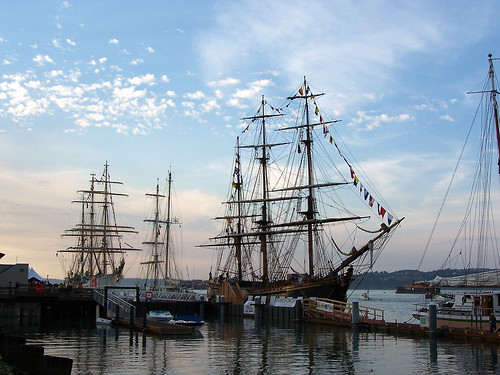
CleanTechnica has a post on the revival of a wind powered ship, now used to transport wine from France to Ireland - Wind-Powered Tall Ships Are Once Again Important As Oil Prices Hurt Trade. I'm not sure we'll see a huge resurgence of tall ships in future (hybrid schemes like SkySails seem more likely to see widespread acceptance), but it is one oil free alternative for shipping.

Sometimes it takes an energy crisis to make us realize the value of old technology. As oil prices soar, tall wind-powered ships are looking like an increasingly viable alternative.

The first commercial cargo of French wine to be transported by sailboat in the modern era is due to arrive in Dublin this week after a six-day trip. The 108 year-old boat, chartered by French shipping company Compagnie de Transport Maritime a la Voile (CMTV), is carrying 30,000 bottles of wine.

Though the ship travels at a top speed of eight knots— half the speed of a modern cargo vessel—it is completely pollution-free. The 50,000 other merchant ships traveling the world emit 800 million tons of carbon dioxide each year.

The Kathleen & May spent most of its life transporting coal and clay. It was taken out of commercial service in 1960. Now it’s once again hard at work, as CMTV has contracted for 80 vineyard owners from southern France to carry their wine bottles to Ireland on the ship. The company is also working on another deal to bring Irish whiskey and scotch to France using the boat, and it eventually plans on building its own tall ships for transport.

CMTV may be on to something; according to the French Association of Shipowners, wind-powered boats could capture .5% of the commercial shipping market. This may not sound like much—until you consider that 90% of the world’s traded goods are transported via boat.

Tall ships may move a bit slower than fossil-fuel powered ships, but their minimal environmental impact could make them sea trade’s best hope for the future.

Ships, Whales and LNG  

Posted by Big Gav in ,

Technology Review has an article on using technology to help ships avoid colliding with whales - particularly LNG tankers.

By listening for the calls of right whales in the waters of New England, researchers are helping ships avoid the endangered animals.

Ten whale detection buoys are now in place in the busy shipping lanes leading into Boston Harbor, a hot spot for ship strikes. When the buoys pick up the calls of North Atlantic right whales, warnings are sent to ships in the area so that they slow down. It's the first time that a listening system has been coupled with real-time warnings.

"I have been just immeasurably excited and impressed about how well it's worked," says Christopher Clark, a senior scientist at Cornell University, who helped develop the system. Spring is the busiest season for right whales in the waters of New England. "For the last couple of months, it's just been bonkers," Clark says. "There's a lot more going on out here in the shipping lanes than we ever thought."

The buoys were installed at the beginning of the year in Massachusetts Bay as part of the licensing requirements for a liquefied natural gas (LNG) import facility 13 miles east of Boston. The area is both a popular hangout for right whales and part of the route for LNG tankers and ships headed to and from Boston. LNG tankers are required to slow to 10 knots if right whales are detected in the area.

Only about 400 North Atlantic right whales remain on the planet. Ship strikes are a major source of mortality because the whales spend a lot of time feeding at the surface. "The whales are very docile," says Don Peters, a senior engineer atWoods Hole Oceanographic Institution, who worked on the project. "They tend not to be very shy of boats. They won't spook and swim away if a boat is coming toward them."

Within the past three years, at least two North Atlantic right whales have been killed by ships in the area, says Leila Hatch, regional marine bioacoustic coordinator for the sanctuary. "This is in a population where we cannot lose one," she adds.

Alternative Wind Power Experiments - SkySails and Airborne Wind Turbines  

Posted by Big Gav in , , , , , , ,


Wind power is currently the fastest growing renewable energy source (in terms of capacity - solar has a faster percentage growth rate), and looks like remaining so into the next decade. While most attention is focussed on the mainstream approach of generating power using large wind turbines - both onshore and, as Jerome recently looked at, offshore - there are a wide range of alternatives being considered for harvesting energy from the winds. In this post I'll look at 2 approaches that have received some attention in the press recently - attaching kite sails to ships and airborne wind turbines.

SkySails and KiteShips - Using Wind Power To Make Shipping More Fuel Efficient

Shipping is the most energy efficient way of transporting goods around, and it therefore likely to be increasingly important for trade as the availability of fossil fuels decreases and the cost of these increases. According to the Financial Times, it often now costs more to ship a container by road 100km from a port to its final destination than it does to move the container by sea from China to Europe.

One way of increasing the energy efficiency of shipping is to increase the size of the vessel, which big shipping operators like Maersk are already pursuing. Another way to reduce fuel consumption for shipping is being promoted by German company SkySails - attaching a kite the size of a football field to a vessel and using wind power to help save fuel costs.


The SkySails apparatus consists of a towing kite with rope, a launch and recovery system and an automatic control system. Autopilot software monitors data from the sail and makes adjustments to ensure the sail is set at its optimal position. The company also offers a weather-based routing system to help ships sail in optimal wind conditions. The kites usually fly around 1000 feet above sea level where winds can be up to 50% stronger than at deck level.

The first ship using the system, the Beluga Skysail, is expected to set off from Germany this month (The Guardian says it is bound for Venezuela while The Times says it will, fittingly, be hauling windmills from Esbjerg, Denmark to Houston, Texas). Once it is well clear of the land, it will launch a 160 sq metre kite, which wind tunnel tests and sea trials suggest will tug it along and save 10-15% of the oil it would normally burn. In time it will be fitted with a larger kite, possibly saving 30-35% on fuel. One estimate predicts this could save around US$10 million over the lifetime of a vessel.

The Guardian quotes Christine Bornkessel from the Beluga shipping line, which has 52 merchant vessels, as saying "This is a serious attempt to reduce bunker [fuel] costs and polluting emissions. The kite will be used whenever it is possible on the voyage, and we are convinced it will revolutionise cargo shipping. We would consider fitting them to all our ships".

The SkySails company has ambitions to roll out the kites quite rapidly - “About 1100 of the 1900 newly built vessels joining the world’s merchant fleet each year are destined to be outfitted with SkySails propulsion”.
If the Beluga performs well on wind power and if the high-flying kites dramatically cut its fuel consumption, then the age of sail will be back.

“It marks the beginning of a revolution in the way that ships are powered,” said Stephan Wrage, the inventor of the SkySails idea. “We calculate that the sails can reduce fuel consumption by between 30 and 50 per cent, depending on the wind conditions. “The system could be applied to about 60,000 vessels out of the 100,000 or so listed in the Lloyd’s register. Bulk carriers, tankers — they could all benefit from the flying sails.”

Orders are already coming in, ranging from trawlers to a super-yacht. If he realises his dream of re-equipping the world fleet, Mr Wrage calculates that his sails could save 142 million tonnes of CO2 a year, equivalent to about 15 per cent of Germany’s total emissions.

The 35-year-old engineer, who came up with the idea as a teenager when he found himself being dragged by a kite along a blustery North Sea beach, is not the only person brooding about how exactly to reduce the gases released by the world’s shipping fleets.

The problem is huge. Merchant ships, which carry 90 per cent of the world’s merchandise, produce more sulphur dioxide than all the cars and lorries on the planet. And, according to the International Council on Clean Transportation, they also generate about 27 per cent of the world’s nitrogen oxide emissions.

Wallenius Wilhelmsen Logistics, the Norwegian fleet management company, has designed a green flagship, the Orcelle, which will use rigid, rotating sails to capture the strongest winds. When the wind drops the sails can be used as solar panels. But the company admits that it could take 15 years before the ship is developed.

The most straightforward way of reducing sea-borne pollution would be to impose a speed limit on the oceans. Carbon emissions would drop by 23 per cent if ships cut their speed by 10 per cent — but shipping experts say that slower cargo movements would lead to more vessels being deployed, and pollution would return to its former levels. ...

The sails, made of an ultralight synthetic fibre, are shot up as much as 300m (984ft) into the sky. ... Mr Wrage calculates that most ship owners should be able to recoup their £290,000 investment in the kite sails within three years.


Drawbacks associated with this scheme include the additional costs associated with the kites - both with buying, installing and maintaining them, and with training and rostering crew members to tend them.

Skysail isn't the only company investigating the kite sail idea - US company KiteShip is building large kites, mostly for yachts, and plans to expand into the larger cargo and cruise ship markets.

Flying Wind Farms

Airborne wind turbines are an idea that I've always found myself somewhat bemused by - "surely they can't be serious ?" I think to myself, whenever I come across another tale of a company trying to fly kites with wind turbines attached to them.

These sorts of stories have continued to appear with monotonous regularity however, and not just out on the alternative energy fringes - in recent months I've seen articles in places like The New York Times, The Economist, PBS' I, Cringely, The Energy Blog, TreeHugger and WorldChanging - many prompted by Google.org's investment in airborne wind company Makani Power (part of their program to make "Renewable Energy Cheaper Than Coal").

The driver for these schemes is that the intermittency issue which reduces the effectiveness of wind turbines operating at ground level is asserted to be much less of a problem at 1000 feet, where the winds tend to blow steadily. Proponents of airborne wind power like Ken Caldeira at the Carnegie Institution's department of global ecology at Stanford University say that if we could tap into 1 percent of the energy in high-altitude winds it would be sufficient to provide all our power needs.

The company that has garnered the most attention in this field is Ottawa-based Magenn Power. Magenn's system is a lighter-than-air wind turbine capable of powering a rural village - the 30 metre wide, helium-filled "Air Rotor System" contains a turbine that spins around a horizontal axis and can produce 10 kilowatts of energy as it floats above the ground while attached to a copper tether. Larger models — ones that might power a skyscraper — are also reportedly in the works. The company claims the governments of India and Pakistan have expressed interest in the first version. Magenn is planning to launch a 1kw prototype (costing around C$1 million) into the air above Ottawa this (northern) spring.


The entrepreneur behind Makani Power is Saul Griffith, originally from my hometown of Sydney but now based in San Francisco. This company is the least transparent of the airborne wind power companies, with very little known about what they are up to.

Another Californian high altitude wind power company is Sky WindPower. This company seems to be the farthest along in its efforts to commercialise their technology and is again directed by an Australian - ex-mechanical engineering professor Bryan Roberts. Jim Fraser at The Energy Blog has a fairly detailed look at what they are proposing:
Sky WindPower is proposing [to] use clusters of Flying Electric Generators (FEGs), on the end of a current carrying tether, in the jet stream at 15,000 to 30,000 feet. The company has done wind tunnel tests and low altitude tests to prove their idea. They are hoping to build a 200 kw model, flying at 15,000 ft, somewhere in a remote area of the U.S. They envision a commercial FEG will have four or eight rotors each generating 2.5 MW. Clusters of FEG's could provide as much power as need for a given site.

The FEG would fly up into the sky, with its rotors powered by electricity off the grid, pulling up its tether. Once it at its desired altitude it would change the pitch on its rotors and start generating power from the wind. GPS technology would be used to assure that the rotorcraft stays within a few feet both horizontally and vertically of where it is programed to be and a computer would control the rotorcraft's attitude, i.e. pitch, roll and yaw.

The amount of power that you can produce in a wind turbine varies as the cube of the velocity and linearly as the density. So although the density decreases with an increase in altitude, the increase in velocity that you gain with higher altitudes more than makes up for the decrease in density. This further explains the advantage that FEG's have flying at high altitudes and allows the rotors to be smaller in diameter. The wind speed, in addition to being higher, is more uniform.

It is much more steady, blowing at high, useful velocities a much greater percent of the time than do winds at ground level. This gives FEGs the advantage of having a higher capacity factor. Capacity factor is the percentage of energy actually captured relative to what would be captured if the wind turbines were operating at full capacity all the time. Ground based sites that can produce a capacity factor of 35% are hard to find. Capacity factors in the jet stream range from about 70% in the southern parts of the U.S to over 90% in the north. At a capacity factor of 90%, FEGs could become the nation's cheapest source of electricity, with an estimated cost per kilowatt hour of less than 2 cents, about half the price of coal.

Also the wind tends to blow from one direction and when it changes direction it changes slowly. The air is free from turbulence caused by friction and ground protuberances, but is subject to high altitude turbulence. This is moderated by the ability of the FEG to sway on its tether rather than being attached to a ridged tower. The FEG can move up and down on its tether the same way an airplane does to avoid turbulence.

The use of tethers to position objects in the sky is not unknown. Balloons tethered at altitudes up to 15,000 feet exist now at fifteen sites along the southern borders of the United States carrying radar equipment to detect illegal flights from the south trying to smuggle drugs. These sites are shown on all aeronautical charts, as restricted spaces, and are well known to pilots. By reserving less than one four hundredth (0.4%) of U.S. air space, located at relatively remote locations, not on airway routes, all the nations electrical energy needs could be met. The strength to weight ratio of new tether materials has improved over time so much that tethers now available are no longer too heavy to be held up by flying energy generating devices at the needed high altitudes. Tether technology is not simple, but a number of vendors now compete in this field selling primarily to the military and NASA. The FEG would be able to moved up or down on its tether to seek the best wind conditions or to move out of excessively turbulent air space.


WorldChanging has some more details on SkyWindPower, noting some of the main drawbacks with these schemes.
Output would also be less dependent on location than it is on the ground, simply because terrain doesn't matter much when you're at 35,000ft; however, since the jetstream and other "geostrophic" winds don't blow much at latitudes near the equator, it would be useful primarily for middle- and higher-latitudes.

They can't promise uninterrupted power all the time, however. In an electrical storm, the power-carrying tether becomes the biggest lightning rod you've ever seen. (Move over, Ben Franklin!) Their website says this problem is "frequently brought to our attention, and must be addressed." Their plan is to take the flyers down to land before a storm gets bad, and wait for it to end.

The flying windmills would initially get in position under their own power, using their motors to drive the propeller blades and helicopter upwards until they reached altitude. Then the motors would turn off and become generators as wind pushes the propeller blades, and the whirligig would float instead of fall because when tethered, the lift generated by the wind would overcome the craft's weight as it also generates power.

The obvious question is safety. What happens if one of these things falls out of the sky? The proposed design has quadruple-redundancy in the propellers used to hold it up and generate power, and the units could be located away from population centers, so that seems reasonable. What about planes running into them, or more likely, their tethers? They would fly in restricted airspace. Sky Windpower points out that there are already many high-altitude tethered balloons in the US that have not had problems, and that enough installations to generate 100% of the US's power needs could fit in 1/400th of the nation's airspace. What about birds getting killed? They say that the flying windmills could make noise that would keep birds away; this would be prohibitive for ground-based turbines, but at high altitude no people will be around to be annoyed by it.

The prototypes Roberts has been making for the last 25 years have gone from wind tunnel to field trial, and they apparently work, with no new technologies required. However, they have been stalled seeking funding for the last three years. The text on their website shows a woeful lack of marketing savvy, leaning towards crackpottyness, so they may not be getting funding anytime soon. But hopefully they will find someone willing to give them a shot, since they seem the most promising of the three [companies looked at here].

Robert Cringely of "I, Cringely" explains some of the history behind these schemes in "Oh, and We Also Saved the World: Google's Energy Plan".
What's cool about these tethered tensile wings, he explained, is that they can be designed in such a way that no aircraft fuselage is needed and yet they can lift (vertically, straight from the ground, no runway even required!) enormous weights. And I mean ENORMOUS weights, like a thousand tons. A fully loaded Boeing 747-400 weighs about 400 tons, so a THOUSAND tons would change the nature of airfreight.

But there's an even better application for this technology than airfreight, he explained, electric power generation. Build a gigantic tethered tension wing and power it with electric motors mounted in the leading edge of the wing. Send the electricity to run these motors up the tether, itself. The wing will take off vertically and once it is at the end of its rope, so to speak, can be made to circle thousands, or even tens of thousands, of feet off the ground without a pilot or any sort of crew.

Remember from your ground school days that wind tends to increase with altitude. Once aloft, circling in the stiff breeze a few thousand feet in the air, it should be possible during most daylight hours to just turn off the electric motors and get them running as generators, taking energy out of the wind. This would be regenerative air braking.

To my knowledge this idea of using a tethered kite to generate power was first put forth back in 2003 by Pete Lynn, a mechanical engineer and second-generation kite designer from New Zealand. He described his work back then in an extensive post on Google Groups as well as on his own web page. (That page is no longer directly available online, but in this week's links we've managed to recover that page thanks to the Internet Archive's WayBack Machine.)

Lynn's explanations in 2003 and 2004 were very clear and the implications of his work even clearer: this was probably the best way yet to extract energy from the wind — far better than more traditional windmills. ...

The problem with wind power is that much of the time there isn't enough of it available to even justify energizing the alternators attached to the large windmills used in wind farms. Unless the wind speed is over, say, 10 miles per hour, it isn't worth running the windmills at all. And above some speed on the order of 40 mph, it again isn't worth the effort, this time because of fear that high winds will damage the windmills — windmills sometimes costing hundreds of thousands of dollars each.

But power-generating tension kites are different, as Lynn so ably explained: "the numbers strongly infer that such a wind turbine system can produce power for around a fifth to a tenth the cost of current generation systems, depending on site costs. This is roughly US 0.5 cents a kilowatt hour, with the likelihood that this will reduce further with mass production."

Five tenths of a cent per kilowatt-hour is VASTLY cheaper than the average retail price was for electricity anywhere in the U.S. in 2005, where electricity costs ran as high as 12 cents per kilowatt-hour in California and 14 cents per kilowatt-hour in the state of New York. So even though the kits would have to be all new construction and the old coal, gas, and oil-fired power plants mothballed or dismantled, the payback period for doing so would be measured in months, not years or decades as most such capital expenses are today. Today, with energy costs even higher, the payback would be even quicker.

Getting the cost of wind-power production so low depends on a couple of factors — building kites that cost very little for the power they generate and allowing them to harvest energy from a larger slug of airspace than is used by the big ground-based windmills employed in most wind farms.

"The trick is that the propeller is operating at the speed of the airplane, which is many times greater than that of the true wind speed," wrote Lynn. "At an overall lift to drag ratio of ten the air plane speed is ten times that of the true wind, with power proportional to wind speed cubed, the propeller can have a thousandth the swept area of a comparable wind turbine for the same power. This makes for a very compact and effective unit, it is important to exploit this apparent wind directly as it allows for much higher specific speed of the propeller and generating unit, (no gearing)... Line length can actually scale with size, somewhat, a 100MW unit might optimally have around a 1000m line. "

Such wind kites would be cheaper to build than current windmills because their structural efficiency is so high, according to Lynn. In fact the weight of such a kite turbine might be only one percent that of a comparable windmill.

According to Lynn's figures, then, to completely replace the one million megawatts of electricity generated in the U.S. annually by a total of 16,000 generators of various types would require 10,000 of those 100-megawatt tethered flying wings. ...

Pete Lynn no longer works in New Zealand. Today he works in Emeryville, CA at a company called Makani Power, which is developing exactly the sort of power-generating kites Lynn envisioned six years ago. Go to the people section of Makani's website and you'll see the healthiest bunch of windsurfer/engineers imaginable, including Pete Lynn, who actually seems to play a minor role in the company.

The only other initiative in this area is a Dutch effort out of the Delft University of Technology, described by The Economist:
Wubbo Ockels of the Delft University of Technology in the Netherlands has been developing another approach to airborne wind generation at lower altitude, with backing from Royal Dutch Shell and Nederlandse Gasunie, a natural-gas company. Dr Ockels’s idea is that a kite (without rotor blades) be launched from a ground station, turning a generator as it rises to an altitude of several hundred metres. When it reaches its full height, it alters its shape to catch less wind, and can thus be reeled back in using much less power than it produced when it was being paid out.

An arrangement of two or more of these kites could act together to produce a steady supply of power. When one kite was being released, part of the electricity produced would reel the other kite back in, and vice versa. The whole system would thus remain in surplus, and if well designed could deliver a constant current. This system has the advantage that it requires only simple parts—generators, kites and cables—and should thus be much cheaper to build than a conventional turbine.

Controlling it, however, would be a different matter. Dr Ockels is working on kites with wings and rudders, which look much more like a plane than anything you might see flying in the park. The wings and rudders themselves would be under computer control—a technology already well established for flying aircraft without too much interference from a human pilot.

To test the idea, Dr Ockels’s team is building a 100kW prototype. He hopes to start testing a full-scale device, which would generate 10MW, within five years. That would be large enough to power around 10,000 homes. He believes the system should be capable of generating electricity at a cost of just 1 cent a kilowatt hour.

Any promise of such cheap energy has to be treated with scepticism, and all these projects are still a long way from the full-scale test rigs needed to prove they will succeed. No-one denies that it will be hard to build a flying generator that can make money. However, the political impetus behind renewable energy is growing and space is limited at ground level. Perhaps it is time for the wind power industry to reach for the sky.

Statistics

Locations of visitors to this page

blogspot visitor
Stat Counter

Total Pageviews

Ads

Books

Followers

Blog Archive

Labels

australia (619) global warming (423) solar power (397) peak oil (355) renewable energy (302) electric vehicles (250) wind power (194) ocean energy (165) csp (159) solar thermal power (145) geothermal energy (144) energy storage (142) smart grids (140) oil (139) solar pv (138) tidal power (137) coal seam gas (131) nuclear power (129) china (120) lng (117) iraq (113) geothermal power (112) green buildings (110) natural gas (110) agriculture (91) oil price (80) biofuel (78) wave power (73) smart meters (72) coal (70) uk (69) electricity grid (67) energy efficiency (64) google (58) internet (50) surveillance (50) bicycle (49) big brother (49) shale gas (49) food prices (48) tesla (46) thin film solar (42) biomimicry (40) canada (40) scotland (38) ocean power (37) politics (37) shale oil (37) new zealand (35) air transport (34) algae (34) water (34) arctic ice (33) concentrating solar power (33) saudi arabia (33) queensland (32) california (31) credit crunch (31) bioplastic (30) offshore wind power (30) population (30) cogeneration (28) geoengineering (28) batteries (26) drought (26) resource wars (26) woodside (26) censorship (25) cleantech (25) bruce sterling (24) ctl (23) limits to growth (23) carbon tax (22) economics (22) exxon (22) lithium (22) buckminster fuller (21) distributed manufacturing (21) iraq oil law (21) coal to liquids (20) indonesia (20) origin energy (20) brightsource (19) rail transport (19) ultracapacitor (19) santos (18) ausra (17) collapse (17) electric bikes (17) michael klare (17) atlantis (16) cellulosic ethanol (16) iceland (16) lithium ion batteries (16) mapping (16) ucg (16) bees (15) concentrating solar thermal power (15) ethanol (15) geodynamics (15) psychology (15) al gore (14) brazil (14) bucky fuller (14) carbon emissions (14) fertiliser (14) matthew simmons (14) ambient energy (13) biodiesel (13) investment (13) kenya (13) public transport (13) big oil (12) biochar (12) chile (12) cities (12) desertec (12) internet of things (12) otec (12) texas (12) victoria (12) antarctica (11) cradle to cradle (11) energy policy (11) hybrid car (11) terra preta (11) tinfoil (11) toyota (11) amory lovins (10) fabber (10) gazprom (10) goldman sachs (10) gtl (10) severn estuary (10) volt (10) afghanistan (9) alaska (9) biomass (9) carbon trading (9) distributed generation (9) esolar (9) four day week (9) fuel cells (9) jeremy leggett (9) methane hydrates (9) pge (9) sweden (9) arrow energy (8) bolivia (8) eroei (8) fish (8) floating offshore wind power (8) guerilla gardening (8) linc energy (8) methane (8) nanosolar (8) natural gas pipelines (8) pentland firth (8) saul griffith (8) stirling engine (8) us elections (8) western australia (8) airborne wind turbines (7) bloom energy (7) boeing (7) chp (7) climategate (7) copenhagen (7) scenario planning (7) vinod khosla (7) apocaphilia (6) ceramic fuel cells (6) cigs (6) futurism (6) jatropha (6) nigeria (6) ocean acidification (6) relocalisation (6) somalia (6) t boone pickens (6) local currencies (5) space based solar power (5) varanus island (5) garbage (4) global energy grid (4) kevin kelly (4) low temperature geothermal power (4) oled (4) tim flannery (4) v2g (4) club of rome (3) norman borlaug (2) peak oil portfolio (1)