Showing posts with label transport. Show all posts

GPS Data on Beijing Cabs Reveals the Cause of Traffic Jams  

Posted by Big Gav in , ,

Technology Review has an article on using data from taxi GPS units to try to optimise road design to reduce traffic jams - GPS Data on Beijing Cabs Reveals the Cause of Traffic Jams.

Beijing is a city famous for traffic jams. In 2006, rush hour reportedly lasted 11 hours a day, and the city has been called a "virtual car park" during daylight hours. As in most major cities, urban planners have been trying for years to relieve the pressure by adding new roads or public transit lines, or providing better enforcement for traffic laws.

Now a group working at Microsoft Research Asia has shown that tracking the location of taxicabs could be a better way to identify the underlying problems with a city's transportation network, helping officials determine how to best ease congestion.

The researchers used GPS data from more than 33,000 Beijing taxicabs. That data was collected in 2009 and 2010. The researchers were not just looking for bottlenecks—trouble spots that regular commuters may know only too well. "[Congested] road segments are only the appearance—they're not the problem," says Yu Zheng, who led the research. "We try to identify the true source of the problem in our work."

The researchers presented their work last week at the 13th International Conference on Ubiquitous Computing, which took place in Beijing.

To get at underlying causes of traffic problems, the researchers needed to get information about the trips people are taking—where journeys start, finish, and how a commuter travels in between. The researchers divided Beijing into regions and analyzed the taxi data to find places where two regions weren't properly connected.

Goodbye gasoline? GM gives natural gas cars a boost  

Posted by Big Gav in , , ,

Reuters has a report on interest in the US in natural gas powered vehicles (fuelled by the optimistic belief that there is over a century of gas available from shale) - Goodbye gasoline? GM gives natural gas cars a boost.

General Motors Corp (GM.N) announced plans this week to develop its first natural gas-powered engine, overcoming its long aversion to alternative fuels and joining a host of smaller players working to put natural gas in car engines.

In Indianapolis, Marlon Kirby has built a new supercar that looks much like all the others - sleek, curvy, low to the ground - but which differs from its gasoline-guzzling counterparts in one major way: it runs on liquid natural gas. After 21,000 man hours, the $1 million Maxximus LNG 2000 is ready for speed trials and Kirby expects it to top 200 miles per hour.

GM (GM.N), the automobile powerhouse and Kirby, the niche mechanic, are at opposite ends of the same movement; to make car engines that use the country's abundant, cheap supplies of natural gas.

The United States has more natural gas than it knows what to do with - up to 100 years of supply, experts say - thanks to a new drilling technique called hydraulic fracturing which releases huge reserves of natural gas trapped in shale rock.

Natural gas is used mainly in electricity generation and for industry, but with just 120,000 natural gas vehicles on the road and only 900 filling stations, transport remains a tiny fraction of total demand. However, assuming production forecasts are correct, natural gas will likely remain cheap for years and could help cut U.S. reliance on oil.

While crude prices soared above $110 a barrel this year due to unrest in the Middle East, U.S. natural gas prices, impervious to international influence, remained low as there was no shortage of natural gas at home. Drivers who fill up with natural gas at the pump saved up to $2 per gallon when gasoline prices hit $4 a gallon.

Car makers, manufacturers and fleet owners are quietly scrambling to run their engines on the cleaner-burning fossil fuel which was formerly the preserve of trash trucks and city buses. "With all the activity in shale gas, the natural gas price is decoupled from diesel. Natural gas is a lot more attractive given the situation in the market," said Ian Scott, president of Westport Innovations (WPT.TO) Light-Duty Division.

Vancouver-based Westport, which develops technologies to convert engines to run on natural gas, is working with GM on the multimillion-dollar project to develop a natural gas vehicle.

The Long Bet on Peak Travel  

Posted by Big Gav in , , ,

The Long Now has a post noting that the Long Bet about peak travel in the US has been won by Glen Raphael, who bet that there would be more passenger miles travelled in 2010 than there were in 2005 - Long Bet on Peak Travel.

The challenger - me - appears to have won the bet. But it was a real squeaker! The total was roughly 3 trillion miles for both years and there was a period of decline (associated with war and financial crash) in between that gave me a scare but 2010 finished slightly ahead.

http://www.fhwa.dot.gov/ohim/tvtw/10dectvt/page2.cfm (the december 2010 report) gives total vehicle miles traveled for the year as:

2005: 2,989,395
2010: 2,999,634

So 2010 was more, but it was very very close. See also this press release:

http://www.dot.gov/affairs/2011/fhwa0311.html

"Nation’s Highway Traffic Reaches Highest Level Since 2007"

Why The Car Isn't Going Away: What Makes Us Tick  

Posted by Big Gav in , , , ,

I read Hugh Mackay's book "What Makes Us Tick?: The Ten Desires That Drive Us over the Christmas break and found it to be a reasonably entertaining piece of pop psychology.

Mackay identifies 10 driving "desires" that guide our lives (some good, some often bad):

- the desire to be taken seriously (which he identifies as the "primary" desire)
- the desire for 'my place'
- the desire for something to believe in
- the desire to connect
- the desire to be useful
- the desire to belong
- the desire for more
- the desire for control
- the desire for something to happen
- the desire for love

The section on "the desire for 'my place'" includes an interesting take on the role of the car in western society today:

The western world is characterised by speed, restlessness and motion (look at any major airport at almost any hour of day or night), so its hardly surprising that for many people in modern urban settings, 'my place' is neither a building nor a piece of the Earth's surface, but that somewhat ubiquitous mobile enclosure we call the car.
My very own space ? I'll tell you where that is - behind the wheel of my car. It's the only place I ever have to myself and it's the only place where I seem to get any real peace.

I've lost count of the number of times I've heard people say the car is the most comfortable place they ever inhabit; the place where they feel totally in control (helped immeasurably by the symbolism of the steering wheel in their hands and an accelerator pedal under their foot); the place that feels more like a personal space than anywhere else they spend their time...

Cars are for escaping into, for meditation, for thinking, for praying, for courting, for sex, for conversation, for eating and drinking, for sleep, for letting off steam and for generating unrivaled - and positively dangerous - feelings of power. Oh, and for driving too: cars are our most flexible and efficient means of transport, though at enormous cost to life and limb - to say nothing of the cost to the quality of the air we breathe and the health of the planet.

The role the car now performs seems (in my mind at least) to guarantee the success of electric vehicles in a post oil wold - for all the benefits of public transport, transit oriented development and walkable neighbourhoods, none of them offer a personalised space that people can take with them when they are on the move.

BOC plans gas route for trucks in Australia  

Posted by Big Gav in , , , ,

The Australian reports that there are efforts to build out infrastructure for gas powered transport along the main Australian east coast trucking route - Germany's BOC plans gas route for trucks (which is a medium term solution for reducing Australia's oil dependency, but is really just a distraction from the central task of electrifying the transport system and powering it with renewable energy sources).

GERMAN gas company BOC has unveiled a $465 million plan for a series of fuel stops for LNG -powered trucks up the east coast from Melbourne to Brisbane.

The company yesterday said it would spend $265m on expanding its small liquefied natural gas plant at Dandenong, southeast of Melbourne, and installing eight LNG refuelling stations up the east coast. It also struck a deal with APA Group for the sale of gas over 17 years to supply the scheme.

Industry sources estimated the deal was worth about $200m. Missing from the equation, however, is a transport company willing to trial LNG-powered trucks.

BOC South Pacific managing director Colin Isaac said the response from transport companies had been warm, but they were keen to see infrastructure developed before they would commit to using the new LNG highway. He said LNG would produce up to 20 per cent less greenhouse gas emissions than diesel and would be more cost efficient.

Prices of domestic natural gas, from which the LNG would be made, are also more stable than the international oil prices that serve as a benchmark for diesel fuel prices.

The LNG highway will be sourced with LNG from the Dandenong plant and another in Chinchilla, Queensland, that was flagged last month. The Chinchilla plant is to be supplied by coal-seam gas from BG Group.

Federal Resources Minister Martin Ferguson, who attended the launch of the project, said LNG was a logical and clean alternative for the heavy transport industry. "LNG is really the first alternative to diesel for the heavy transport sector," Mr Ferguson said.

He also said it was one way Australia could improve its energy security, with the nation's crude oil and petrol deficit expected to grow from about $16 billion now to $30bn in 2015.
>

QGC to produce CNG for transport ?  

Posted by Big Gav in , , , ,

The SMH has a good example of the stunningly poor level of professional journalism when it comes to energy. In the article below you could probably substitute CNG (compressed natural gas) for LNG (liquefied natural gas) and get something that may make sense - Major gas agreement signed in Chinchilla.

Two major companies have signed a $100 million agreement that will see the construction of a multimillion dollar liquefied natural gas plant northwest of Brisbane.

Gas company BOC and coal seam gas exporter QGC announced the contract in Chinchilla on Thursday morning. The companies said the new plant is on track to be the first in Australia to produce liquefied natural gas (LNG) from coal seam gas to fuel trucks.

Premier Anna Bligh flew to Chinchilla for the announcement. She said the agreement heralded the start of a new industry for Queensland which would see heavy vehicles switch to LNG - an environmentally cleaner fuel than current alternatives.

"LNG produces up to 25 per cent fewer emissions than diesel and is a proven safe alternative to other fossil fuels," Ms Bligh said. "Through this agreement, Queensland will join the rest of Australia, as BOC develops a network of fuelling stations across the country for vehicles converted to run on LNG."

She says QCG has agreed to supply gas to BOC from July 2011 and if the companies meet that deadline, Queensland will become the first in Australia to produce LNG from coal seam gas.

A sustainable Sydney needs bikes and trams  

Posted by Big Gav in ,

Sydney Lord Mayor Clover Moore has an opinion piece in the SMH on the need to reduce traffic and create an integrated transport system - A sustainable Sydney needs bikes and trams.

Around the world, smart cities are remaking themselves. They are investing in sustainable public transport and creating pedestrian-friendly environments, reducing their greenhouse emissions, cleaning the air, and providing places for people to meet and congregate.

Professor Peter Newman, one of Australia's most eminent urban thinkers, said at a recent CityTalk that traffic congestion and rising petrol costs make creating more space in cities for pedestrians an economic necessity.

If the City of Sydney Council had its way, an integrated transport plan would properly mesh light and heavy rail with ferries and buses, and do much more for pedestrians and cyclists.

Improving transport, streets and the public realm is not simply about aesthetics or congeniality, nor is it driven solely by the economic costs of congestion or the health costs of respiratory diseases. Those matter, but above all, it is about creating a more sustainable future for our city, which helps our state, our nation, and, ultimately, our planet. The financial crisis has grabbed headlines from climate change, but the two are interlinked.

I would like to see part of the massive economic stimulus packages around the world directed to developing green infrastructure, laying the foundation for a restructuring of the economy to allow for a low-carbon future. Cities are critical to this shift. More than half the world's population lives and works in cities, which are the major source of greenhouse gas emissions. They are where we must make the biggest and most urgent changes.

In Sydney, we need to ease car and bus congestion by improving public transport. In the city centre in particular, we need to move workers and residents more quickly, cleanly and efficiently.


Image credit flickr/liboni

Choosing What Our Cities Will Look Like in a World Without Oil  

Posted by Big Gav in ,

WorldChanging has a post on a Peter Newman talk about the future of cities in the post-peak world - Choosing What Our Cities Will Look Like in a World Without Oil.

As we draw nearer to reaching the point of Peak Oil, it benefits us to imagine what our cities will look like in a world without oil. Does this conjure up images of cities turned into urban farms just to produce enough food for us all? Do we devote all our energy to growing, bartering and trading the food we grow? Or will the city become divided, with the wealthy moving to the center while higher costs of living force lower-income families to the outer-ring suburbs, where access to goods, services and transport will be limited?

If we start now, we can choose what we want our cities to look like in the future. We can make them the resilient, sustainable centers of culture, justice, art and creativity that we hope they will become.

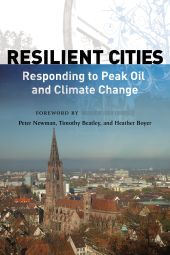
Author and Professor Peter Newman is asking us to imagine and then get to work building these urban centers. His book and talk, both titled Resilient Cities: Responding to Peak Oil and Climate Change, ask audiences to honestly look at what will happen to our cities when we reach Peak Oil. During his 90 minute presentation last night at Seattle's City Hall, Newman explained to the full house how peak oil will soon change reality as we know it; and how if we choose to make it so, we can take this challenge as our opportunity to create a functional, just and sustainable world.

Picturing a future where we do nothing resulted in some frightening scenarios: ones where we are barely getting by and injustice is running rampant. But, as Newman explained, picturing a future in which we respond to the challenge by building resilient cities results in images of a flexible and supportive, flourishing society.
So, in 2001, under the direction of Seoul's Mayor Lee Myung-bak, a plan was developed to tear down the freeway and to restore the river. The project was completed in 2005 .

In order to build the new resilient city of the future, Newman said that “we need to stop building extra urban road capacity and urban scatter; we need to start building electric renewable cities with much greater localism in the economy and infrastructure.”

“We need both at the same time," Newman said. "Or they will undermine what we need to do together.”

Here are a few exceptional points, summarized from Newman's worldchanging presentation:

End Agglomeration Diseconomies

The freeway is a failed technology. Freeways don’t actually ultimately help people get where they want to go any faster; they simply scatter people and economies. Freeways fail as public spaces; as infrastructure, they are dinosaurs. Their impact on cities is not good for economics or people. So we should stop building them. We should instead organize and advocate for rail systems so we can reclaim and rehabilitate our open spaces. Car-dependent cities can begin to reclaim freeways by investing in rail transit and building up local economies around station hubs.

Density, Walkability and Affordable Housing

High quality, high rise developments in the city will increase walkability, and decrease the number of trips taken by car. These developments will function best if developers work in partnership with land use planners. To end the division and disagreements that high density development creates, we have to require all developments to allot 15 percent of space to social housing, and require 5 percent of the value of a development to go toward social infrastructure, like landscaped open-to-the-public space, public art, community centers, schools, arts facilities.

Complete Streets, Smart Grids

Cars won’t go away completely, even though the oil we currently use to power them will. The cars of the future will run on alternatively produced electricity. We can link the extra energy produced from solar and wind production systems to the batteries in our cars with Smart Grids. These energy linking systems help buildings and transportation power each other.

Eco-villages colonizing the fringe

Build eco-villages on the outskirts of the urban ring. Built with their own water, power and sewage systems, we can turn the crumbling suburbs into self sustaining eco-communities of the future.

What We Need to do Now

Newman gave vibrant examples of each of these ideas happening in cities all over the world, from Seoul to London, Copenhagen to Vancouver, B.C., these cities are proving that this is possible. All we need now, said Newman, is imagination, post oil strategies, partnerships and demonstrations, and above all HOPE!

Also at WorldChanging, Alex Steffen has a post on the disappointing choice Obama has made to head up the Department of Transportation - Ray LaHood and Changing our Thinking About Transportation.
Today, the U.S. Senate will hold a confirmation hearing on the president-elect's choice of Ray LaHood for Secretary of Transportation. No one expects that hearing to be anything but easy for LaHood. That's too bad, because it shows that when it comes to greening the stimulus, we're not only missing the forest for the trees, we're not even seeing the trees right.

In case you haven't been following the news, LaHood is a conservative Illinois Republican with little transportation expertise and almost no administrative experience, who has earned a LCV lifetime voting score on critical environmental issues of 27 percent, and who maintains deep financial connections to the very industries he's now supposed to regulate. He may be no worse than most of those who've lead the Department of Transportation, but his appointment is a profoundly uninspiring vote for business as usual at a time when we need change, and an strong indication that the administration doesn't get that energy policy, technological innovation, urban planning, environmental sustainability and transportation are all bound up together, and no solution to our problems can be had without tackling them all together.

LaHood's appointment is so disappointing to transportation advocates who've been waiting eight years for change, that they're boiling with indignant disbelief, branding him "an unbelievably disastrous pick," "Status quo we can believe in" and "same.gov" (a dig at the Obama transition site, change.gov). As one insider summed it up: "It's a real read-it-and-weep moment."

LaHood supporters point out that the president-elect promised to appoint Republicans, and LaHood is trusted by White House Chief of Staff Rahm Emanuel. Obama had to throw Republicans a bone somewhere, they argue: why not Transportation?

Because given the crises we face, the U.S. Department of Transportation is not a minor agency. This year it had a $58 billion budget and employed almost 60,000 people. What's more, the Secretary of Transportation will guide the spending of vast amounts of stimulus spending, oversee the auto industry bailout and be responsible for a raft of critical policy decisions that will dictate the shape of our cities and the choices we have for getting around for decades -- and thus indirectly our energy policies as well, since transportation is where much of our energy use goes. In fact, in an era of climate change, energy crisis and economic distress, Transportation may be one of the most important posts in the president's cabinet. ...

Since the economy is sagging so severely, some argue that much of the stimulus package needs to go to "shovel-ready" infrastructure: existing projects or plans that can be quickly completed and approved and undertaken. All those who have gotten rich off the status quo -- the Highway Lobby, suburban developers, state transportation agencies, even the Teamsters -- are saying that "shovel ready" can only mean "roads." They're wrong.

We're ready to run with all sorts of better alternatives. Transportation for America, a new national coalition of smart growth, transit and good government groups, has already put forward an alternative list of $33 billion worth of shovel-ready but environmentally-friendly transportation infrastructure projects, and is lobbying for $100 billion in total investment in transit and other climate-friendly solutions.

What's more, we should be more worried about spending the money right than spending it quickly: as Paul Krugman said in a recent column, "Why does the time frame have to be short? ...Right now the investment portion of the Obama plan is limited by a shortage of 'shovel ready' projects, projects ready to go on short notice. A lot more investment can be under way by late 2010 or 2011 if Mr. Obama gives the go-ahead now..."

So, while Transportation for America is doing critical work (their platform is well worth a read), their proposals do not go nearly far enough, when measured against our need for change or our opportunity to use this change to solve multiple problems at once by doing the right thing instead of the expedient thing.

This administration's combination of new politics and new funding sources is a one-time shot, and it's coming at a moment when we can't afford to lose another decade if we want to stave off climate change, make the U.S. energy independent, revitalize our communities and create the bright green economy of the future.

At this critical juncture, nothing could be a worse investment than building more highways. New highways are simply a catastrophic choice. Even highway expansion is a waste of money: you can't build your way out of a traffic jam. As you pave more lanes, more drivers crowd on to them -- for instance, after spending $15 billion on its Big Dig highway expansion Boston's traffic is worse, overall. Building more highways just means more people driving, more cars stuck in traffic, more people killed in accidents, and more pollution.

The last part -- pollution -- is critical. A highway-focused federal transportation agenda can't be reconciled with the incoming administration's promise to take on climate change. Building new highways to provide mobility is the transportation equivalent of building new coal plants to provide energy.

Transportation generates more than a quarter of U.S. greenhouse gases, according to the E.P.A.. A portion of that comes from moving freight around (mostly on highways), but more than 20 percent is personal transportation, and almost all of that is auto-related. Even if we actually get them (and, again, LaHood does not inspire confidence that the auto bailout will actually lead to green vehicles), driving cleaner cars on those proposed new freeways won't do much good, because many of greenhouse gases pumped into the atmosphere by our transportation system don't come out of the tailpipes of those cars: manufacturing, building highways and so on all contribute mightily to our climate problems. Auto dependence is in-and-of-itself a critical contributor to climate change. No technofix is available to change that and building new highways will only make it worse.

The alternative is not just transit, it's cities that work. There is a direct relationship between the kinds of places we live, the transportation choices we have, and how much we drive. We ought to be doing everything in our power to stop sprawl, grow compact communities, and make better transportation investments to help us leave our cars at home -- something we can only do if more of what we want is close at hand, and other transportation choices are convenient and cheap.

This one-time wave of funding will do one of two things: it will further entrench a broken system, or it will begin to build a new and better one. In the next six years, we'll either dump hundreds of billions of dollars into highways, roads and bridges or we'll begin to revitalize our communities and transform our economy. Sprawl or urban renaissance? That's ultimately the choice we have.

We need to insist that at least half of the stimulus goes to climate-friendly transportation projects that will create green jobs: a massive investment in light rail and other urban transit, commuter rail, inter-city high-speed trains, bike paths, pedestrian improvements (including, simply, sidewalks), support for the planning and development of transit-oriented communities and the deployment of new technologies to facilitate innovations like congestion pricing, dynamic parking and smarter commutes. These are the kinds of transportation infrastructure our kids will be glad we invested in, the kinds 21st century cities demand. Furthermore, we ought to insist that the first year's worth of "shovel-ready" auto-oriented projects be limited to much-needed repairs of existing infrastructure and demand that subsequent investments meet smart growth standards. We can be even more sure that our transportation dollars support compact development rather than sprawl by sending the money directly to cities, bypassing the state governments and their often corrupt and outdated bureaucracies.

Voters are already coming to understand that there's a link between climate change, land use and transportation. With effective leadership, I think we Americans are ready now to choose a new path forward: bright green, thriving cities instead of more boom-bust sprawl.

We need a Secretary of Transportation who sees the choice, can articulate it to the American people, and can lead the fight for change. Without that change, none of Obama's promises on climate, on cities, on energy independence or on green jobs can be fulfilled.

And to get that Secretary, we're going to need a citizen's movement that pushes the Obama administration and Congress to demand new transportation priorities in this stimulus package. That fight has barely even begun.

Tom Whipple's latest peak oil article at the FCNP is also looking at post peak suburbia and urban design - The Peak Oil Crisis: Renovating Suburbia.
ot everything about the suburbs will be a downside when the era of cheap fossil fuel comes to an end. Nearly all suburban dwellings have broad roofs and yards that are suitable for collecting some form of solar or in some places wind energy. In many cases, suburban yards are suitable for growing food or perhaps even raising poultry or other small livestock. Most have yards allowing for easy access to subsurface geothermal energy. They are clean and have adequate sources of water and a means to handle sewage. These are not inconsequential assets when trying to maintain large numbers of people in some form of civilization in the face of dwindling supplies of energy. There are already places in Asia that are facing life-threatening water and sanitation problems due to the lack of electricity to run the pumps.

For the immediate future, an unappreciated aspect of suburban homes is easy access to a source of electricity for recharging electric vehicles. Wiring of urban streets and parking areas for recharging plug-in electric cars will cost billions and likely take decades. This week's Detroit automobile show stands as a monument to the closing era of the internal combustion engine. Nearly every automobile manufacturer is showing some form of electric powered vehicle that should be available, for those that can still afford them, in three or four years.

Some, with good reason, doubt that there will be enough resources, energy, and money to replace the 250 million passenger cars and trucks that we have in America so that we can continue motoring with electricity rather than gasoline. These skeptics are probably right if one assumes that the motor vehicles of the future will be electric clones of the of the 3-6,000 pound behemoths that are clogging the roads today.

Transportation to, from and around suburbia ten or 20 years from now will have to be markedly different than today. While some will have plug-in electric cars, it is unlikely that electricity will continue to be cheap in an era of dwindling fossil fuel supplies, carbon caps and emission taxes. Wasting energy will become a thing of the past. Driving to work or the store in a 4,000 pound electric car will simply become too expensive for most. In place of today's ubiquitous automobile will be a variety of light electric vehicles, ranging from electric bicycles, tricycles, and scooters, to very small cars that will be inexpensive to produce, use minimal amounts of electric energy and provide much of the mobility that will be required for everyday life.

An important part of suburbia's future will be far more efficient systems for distributing goods and services than driving many miles to stores and shopping centers in 6,000 pound vehicles to pick up a few pounds of whatever is required. Suburbs need to be modified with the addition of numerous small neighborhood commercial centers so that people can walk, bicycle, or at most take a short light vehicle trip to obtain whatever goods and services they need. Existing housing could be converted into neighborhood centers so that neighborhood centers would not even have to look like stores. Neighborhood centers which would be transfer places for mail, packages, food orders could provide very efficient ways to move essential goods to and from suburban residences without requiring lengthy energy consuming trips.

To maximize efficiency, the concept of a "store" that contains a large inventory could be replaced by warehouses for goods ordered over the internet and delivered to neighborhood centers. These centers could serve as starting points for public transit vehicles that could provide frequent service to move people as well goods to and from the neighborhood centers. They could even supply personal services such as haircuts and dentists. By combining the movement of mail, people and goods on one frequent-service, efficient electric vehicle great energy efficiencies could be achieved.

Renovating the suburban housing stock for optimum energy efficiency will be a long and difficult process taking many decades. With cheap energy, most houses in America were built to very low efficiency standards in order to save on capital costs. It will soon be recognized that using natural gas and oil for residential heating is a massive waste of a valuable resource that should be used for making things and essential vehicles. Residences will have to be modified to all-electricity and renovated to consume the minimum amount of energy for lighting, appliances, heating and cooling that is possible and affordable.

Doing this on a nationwide scale will likely take some form of government intervention. This could be in the form of considerably higher building standards including retrofits of existing buildings, higher energy taxes and even renovation loans to jump start the process. For nearly every existing building there are a variety of steps that need to taken from better insulation and more efficient lighting to replacing windows and heating systems. All of this will be expensive but there is no other choice because staying on in suburbia with greatly reduced sources of energy renovation will be the only option.

The New York Times is also pondering the future of suburbia, with a post looking at some of the uses the exurbs could be put to - What Will Save the Suburbs?.
In urban areas, there’s rich precedent for the transformation or reuse of abandoned lots or buildings. Vacant lots have been converted into pocket parks, community gardens and pop-up stores (or they remain vacant, anxiously awaiting recovery and subsequent conversion into high-end office space condos). Old homes get divided into apartments, old factories into lofts, old warehouses into retail.

Projects like Manhattan’s High Line show that even derelict train tracks can be turned into something as valuable to citizens as a vibrant public park. A brownfield site in San Francisco has been cleaned up and will house an eco-literacy center for the city’s youth. Hey, even a dump (Fresh Kills, on Staten Island) is undergoing a remarkable metamorphosis into a recreation area.

But similar transformation within the carefully delineated form of a subdivision is not so simple. These insta-neighborhoods were not designed or built for flexibility or change.

So what to do with the abandoned houses, the houses that were never completed or the land that was razed for building and now sits empty?

Take as an analogous example their symbiotic partner, the big box store. As I learned in artist Julia Christensen’s new book, “Big Box Reuse,” when a big box store like Wal-mart or Kmart outgrows its space, it is shut down. It is, apparently, cheaper to start from scratch than to close for renovation and expansion, let alone decide at the outset to design a store that can easily be expanded (or contracted, as the case may be).

So not only does a community get a newer, bigger big box, it is also left with quite an economic and environmental eyesore: a vacant shell of a retail operation, tons of wasted building material and a changed landscape that can’t be changed back.

The silver lining in Christensen’s study are the communities she’s discovered that have proactively addressed the massive empty shells they’ve been left with, turning structures of anywhere from 20,000 to 280,000 square feet into something useful: a charter school, a health center, a chapel, a library. (And, in Austin, Minn., a new Spam Museum.)

The repurposing of abandoned big-box stores is easier to wrap one’s head around: one can envision within a single volume (albeit a massive one) the potential to become something else.

But exurban communities are a unique challenge. The houses within them are big, but not generally as big as, say, Victorian mansions in San Francisco that can be subdivided into apartments. So they’re not great candidates for transformation into multi-family rental housing.

I did visit a housing development last year that offered “quartets,” McMansions subdivided into four units with four separate entrances. These promised potential buyers the status of a McMansion with the convenience of a condominium, but the concept felt like it was created more to preserve the property values of larger neighboring homes than to serve the needs of the community’s residents.

There has been a nationwide shift toward de-construction (led by companies like Planet Reuse and Buffalo Reuse, the surgical taking-apart of homes to salvage the building materials for reuse, but often the building materials used in these developments aren’t of good enough quality to warrant salvaging.

I don’t have the perfect solution for how to transform these broad swaths of subdivisions, and while I’ve heard much talk of the foreclosure tragedy, I’ve heard nary a peep about what to do about it.

A recent article in The Times spotted an emerging trend of kids usurping the abandoned pools of foreclosed homes for use as temporary skate parks. (Interestingly, this was big in the ‘70s, as you can see by watching the rad skate documentary “Dogtown and Z-Boys.”) It’s a great short-term strategy for adolescent recreation (and for ridding neighborhoods of fetid pools, which often harbor West Nile virus), though it’s not a comprehensive solution to the problem of increasingly abandoned, ill-maintained and more dangerous streetscapes.

But there are some interesting avenues to be pursued. Part of President-elect Obama’s proposed massive public works program, for example, is to be dedicated to clean tech infrastructure. Included in this is the intent to weatherize (that is, make energy-efficient) one million low-income homes a year.

One can already see how those in the construction industry can begin to make the shift from new construction to home retrofitting. It’s the centerpiece of “The Green Collar Economy: How One Solution Can Fix Our Two Biggest Problems,” the best-selling, Al Gore- and Nancy Pelosi-endorsed book by environmental activist Van Jones. Though we hear a lot in the news about new LEED (Leadership in Energy and Environmental Design/) buildings and incentives for implementing the latest green technology, it’s often the case that fixing leaks and insulation are just as effective in reducing the carbon footprint of single-family homes (which account for about 18 percent of the country’s carbon footprint).

As people increasingly stay put — and re-sell homes less — this retrofit strategy makes sense. Millions of homes, not just low-income ones, are in need of the sort of weatherization the Obama plan describes. The non-profit Architecture 2030, established in 2002 in response to the global warming crisis, is leading a major effort in this arena with the goal of dramatically reducing greenhouse gas (GHG) emissions of the building sector by changing the way buildings and developments are planned, designed and constructed.

And after decades of renovation-obsession that has simply gotten out of hand, it seems a prudent time to swap Viking ranges for double-paned windows and high-efficiency furnaces. It’s the perfect moment to fix what we’ve got. Despite their currently low numbers, green homes typically re-sell for more money than their conventional counterparts.

I still dream that some major overhaul can occur: that a self-sufficient mixed-use neighborhood can emerge. That three-car-garaged McMansions can be subdivided into rental units with streetfront cafés, shops and other local businesses.

In short, that creative ways are found not just to rehabilitate these homes and communities, but to keep people in them.

Carrying Copenhagen: the wonders of the cargo bike  

Posted by Big Gav in , , , ,

The LA Times has a post on cargo bikes in Denmark - Carrying Copenhagen: the wonders of the cargo bike.

The transportation of goods and children through an urban landscape is a universal need. In Copenhagen many our of citizens choose the self-propelled transport option and cycle to work, school and on errands.

On any given day you'll see people moving things about on their bikes. A ladder, a newly-purchased bean bag for the living room, heavy bags of groceries dangling from the handlebars. It's what we do.

In Copenhagen, however, we have our own version of the SUV. We call it 'ladcyklen' or 'the cargo bike'. Often there are goods too large or cumbersome for convenient bicycle transport and if you have a child or two or three, they have places to go and things to do and you are the one who has to get them there.

In Denmark the three-wheeled cargo bike is the vehicle of choice for moving things about and the cargo bike market here continues to enjoy steady growth. A cargo bike is a generic term for any bicycle that is designed to carry 'stuff,' whether it has two wheels or three.

The necessity for cargo bikes is as old as bike culture itself. Since the early part of the last century, cargo bikes have moved things around the city. A little sub-cultural group formed rather quickly in cities, namely 'svejerne'. They muscled their heavily-laden cargo bikes through the streets and were known for their rowdy tone and for whistling at girls. Half a century before the modern bike messengers.

My Dad was a messenger boy during World War II, fetching fruit and vegetables from the market and transporting them back to the green grocer's where he worked. The two most widespread bikes were the Long John and the Short John - or Chimney Sweep bike. Both designs are almost a century old.

Since then, the Danes have expanded their fleet of cargo bikes and there are currently a dozen or so different brands competing for a market share and Denmark has rightfully become the Cargo Bike Capital of the world.

It was in the early 1970's that the first cargo bike of the modern era was developed. It is called the Christiania Bike and named after an abandoned military area which became Europe's largest anarchist town. Large, chunky and functional, with a big box placed in front of the cyclist, the Christiania bike quickly became a generic name for cargo bikes in Denmark.

Inevitably, other brands started to pop up and today the list is long and it includes; Nihola, Sorte Jernhest [Black Iron Horse], Bellabike, Triobike, Esimex, Larry vs. Harry, Long John, Short John and Kangaroo Bike.

At any daycare in the city you'll see parents dropping off and picking up their kids in cargo bikes, with the cargo bays equipped with small benches to sit on. There's room for groceries, too. Deejays and musicians use cargo bikes for transporting gear, kindergartens have them for taking kids on outings and companies use them for moving goods about.

Amazingly, only about 40 percent of Copenhageners own cars, even though this is the capital city of one of the richest countries in the world. Sure, vehicles are taxed heavily but the reason is simply because we have the infrastructure in place for bicycles and we have a rather good public transport system. Even 50 percent of the citizens of Berlin do not own a vehicle, for the same reasons. Fifty eight percent of Copenhageners, when polled, say that they ride their bike because it is easy and fast. Only one percent say they do in order to help the environment. Basically, we're not environmentalists. We're just people who need to get around the city, like anywhere else.

Peak Oil On The Campaign Trail: The Black Hole Of Rail Funding  

Posted by Big Gav in , , ,

It's election time in New Zealand and Finance Minister Michael Cullen has mentioned Peak Oil in a campaign speech he gave on Wednesday, decrying the state of funding for rail transport and declaring "a new era in the rail industry".

Given the energy challenge we face in coming years, the so-called black hole of rail funding looks more like a pot-hole that urgently needs filling.

In 1908 our predecessors built the North Island Main Trunk line because they had a vision for a much more populous New Zealand and for opening up the North Island to settlement and economic development. The Main Trunk justified the faith of the settlers for more than 50 years, before the rise of road and air transport – helped by cheap oil prices – diminished its role as a carrier of both freight and passengers.

Today we have to come to terms with a new set of circumstances – the emerging reality of Peak Oil and the impact rising fuel prices have on our economy. Rail's energy efficiency has a new relevance and a new importance.

Apparently this is the first time he has publicly made any statement on Peak Oil.

The NZ Green Party followed this up with the following press release.
Peak oil and public transport: Cullen's revelation

The Green Party have challenged Labour to redirect the billions of dollars earmarked for New Zealand's largest ever roading programme into public transport, following Dr Cullen's admission yesterday that people will choose public transport if it is provided and that Peak Oil is real.

In a speech yesterday, Dr Cullen admitted both that "we have to come to terms with a new set of circumstances - the emerging reality of Peak Oil," and that "we can get people out of cars and onto public transport."

Green Party Co-Leader Jeanette Fitzsimons says: "This is a significant turnaround from Cullen's comments to me in the House just last year that "One thing I do not share with the member, I suspect, is a view that higher oil prices will lead to an
abandonment of the private motorcar".

"The Greens - and most of New Zealand - welcome the extra $121 million for rail, but this figure is peanuts compared to $2 billion going on a single tunnel in Auckland, and the $1 billion going on a new motorway in Wellington - as Dr Cullen himself admitted yesterday.

"I challenge Dr Cullen to be consistent in his views and actions on transport. He must redirect the billions about to be flushed away on new roads into the affordable, reliable public transport system people desperately need, and which he now admits will alleviate the traffic problems around the country.

"It is a significant breakthrough for Dr Cullen to admit that expensive new motorways won't be needed in an oil-scarce world, and that better public transport and rail will.

On a personal note I think the view that personal (car based) transport is doomed and the future will only consist of rail and other forms of public transport is rather misguided.

We are already seeing the beginnings of a switch to hybrid and electric cars, and this is a trend that will get stronger and stronger in the coming years.

What we will see is an increase in the importance of mass transit, changes to urban design that increase the use of walking and cycling and a switch to electric vehicles.

It isn't an either/or choice - we need to promote all worthwhile strategies, not insist on a "one size fits all" approach.

Hat tip to Blair for the links.

Cross-posted from TOD ANZ.

Ride, baby, ride  

Posted by Big Gav in ,

John Rynn has a post at Grist promoting public (and electric) transport, noting "Expanded transit can lead to energy independence" - Ride, baby, ride.

While the Republicans were busy chanting "drill, baby, drill" at their convention, they ignored a much better alternative: riding on buses and trains. As Diane Carman put it in The Rocky Mountain News:
The irony was almost creepy. Thousands of Republicans were gleefully chanting "Drill, baby, drill" inside a convention hall in St. Paul, Minn., some 43 years nearly to the day after the infamous Watts riots when the original chant, "Burn, baby, burn" was coined by mobs determined to incinerate Los Angeles in a fit of rage.

The delegates' apparent appetite for destruction is similarly insatiable, only unlike the burning of city buildings in 1965, the damage from rampant oil drilling and continued runaway consumption of fossil fuels now would be permanent.

Meanwhile, back in the real world, transit usage has been skyrocketing, and Andy Darrell of Environmental Defense Fund presented testimony to the Senate about the ability of public transit to cut our dependence on foreign oil:
The transportation sector accounts for 30% of the nation's greenhouse gas emissions, and in many large metropolitan areas, over 70% of the added air cancer risk comes from traffic ... More than 30 peer-reviewed scientific studies confirm that exposure to traffic pollution is linked to a wide range of disease, from asthma attacks to heart disease, stunted childhood lung development, cancer, and even lowered IQ in children ...

Expanding transit is essential to reducing dependence on foreign oil. Two-thirds of oil in the United States goes to transportation, with the largest share consumed by cars and trucks. Overall, the typical public transit rider consumes on average one half of the oil consumed by an automobile rider, mainly because they can integrate transit use into their daily routine. Nationwide, public transportation saves our country over four billion gallons of fuel each year, which translates into billions of dollars in avoided gasoline costs.

Expanding transit is also a wise economic investment. It brings jobs, from construction to installation, equipment manufacturing and operation. And it relieves congestion on the streets, making for a better business climate.

And if Obama is elected, we'll have someone in the White House who has a long standing commitment to Amtrak, at least -- and I'm not talking about the top of the ticket who's transportation policy paper [PDF] barely mentions public transit -- Joe Biden uses Amtrak almost everyday and is a strong supporter of Amtrak.

However, most of the households in the United States don't even have access to public transit; according to Table 962 [PDF] in the Statistical Abstract. Out of over 108 million households in the U.S. in 2005, only about 59 million have access, and of those that have access, 40 million don't even use transit. In fact, only about 11 million, or about 10 percent of all households, use public transit at least once a week.

A plan to increase energy independence will require three real actions: electrifying cars, fossil-fuel-based buses, and trains; increasing the numbers of riders among households that have access by increasing the quality and quantity of service; and increasing access to public transit by building new rail and bus lines.

Obama is not making this a major part of his platform now because it would require too much education of the voting public. It's a shame, because a program of "ride, ride, ride" would also be a way to improve the economy by rebuilding the manufacturing sector and creating millions of good jobs. It would also counter the cynical idea of "drill, drill, drill."

Interest In CNG Powered Vehices Increasing  

Posted by Big Gav in ,

Grist reports that interest in CNG fuelled vehicles in the US is increasing - Revolution by 'Natural' Selection. This isn't really a sane response to peak oil, but no doubt it will last as long as the current shale gas boom continues - I think oil services (drilling) businesses may have a very bright future for the next decade or two...

High oil prices, increased domestic natural-gas production, and a well-publicized push from a former oil man have all boosted interest in natural-gas vehicles in the United States lately. This spring, the natural-gas equivalent of a gallon of gasoline was selling for about $1.50 less than gasoline on average nationwide. And in some places like Utah, where vertical integration of natural-gas utilities keeps prices unusually low, the difference is even larger. Energy independence enthusiasts in and out of Congress are (naturally) gassed about the possibilities.

Right now, the U.S. only imports some 2 percent of its natural-gas supply and new drilling techniques that extract natural gas from shale deposits have analysts predicting a sustained boom in domestic production for years to come. However, a dearth of natural-gas pumps at gas stations is a major hurdle to increased use of the cleaner cars; less than 1 percent of U.S. gas stations carry natural-gas pumps for vehicles. Another infrastructure problem is the lack of commercially available natural-gas vehicles. Honda's Civic GX is the only model currently available, though GM has said it might also get into the biz.

Solar Powered Ships And Planes  

Posted by Big Gav in , , , , ,

Reuters has a report on a Japanese plant o increase shipping fuel efficiency by installing solar panels on board - Japan firms to work on solar-powered ship.

The race to go green has taken to the high seas with two Japanese companies saying they would begin work on the world's first ship to have propulsion engines partially powered by solar energy.

Japan's biggest shipping line Nippon Yusen KK and Nippon Oil Corp said solar panels capable of generating 40 kilowatts of electricity would be placed on top of a 60,000 tonne car carrier to be used by Toyota Motor Corp.

The solar panels would help conserve up to 6.5 percent of fuel oil used in powering diesel engines that generate electricity at any given moment.

The BBC has an article (and video) on a solar power plane - unfortunately it seems to be destined for the service of big brother - Solar plane makes record flight. Interestingly the craft uses lithium sulphur batteries.
A UK-built solar-powered plane has set an unofficial world endurance record for a flight by an unmanned aircraft. The Zephyr-6, as it is known, stayed aloft for more than three days, running through the night on batteries it had recharged in sunlight.

The flight was a demonstration for the US military, which is looking for new types of technology to support its troops on the ground. Craft like Zephyr might make ideal platforms for reconnaissance. They could also be used to relay battlefield communications.

Chris Kelleher, from UK defence and research firm QinetiQ, said Unmanned Aerial Vehicles (UAVs) offer advantages over traditional aircraft and even satellites. "The principal advantage is persistence - that you would be there all the time," he told BBC News. "A satellite goes over the same part of the Earth twice a day - and one of those is at night - so it's only really getting a snapshot of activity. Zephyr would be watching all day." ...

At first sight, the propeller-driven Zephyr looks to be just another model aircraft, and it is even launched by hand. But this "pilotless" vehicle with its 18-metre wingspan incorporates world-leading technologies.

Its structure uses ultra-lightweight carbon-fibre material; and the plane flies on solar power generated by amorphous silicon solar arrays no thicker than sheets of paper. These are glued over the aircraft's wings.

To get through the night, the propellers are powered from lithium-sulphur batteries which are topped up during the day.

"A lot of effort has gone into power storage and light-weighting the systems," explained Mr Kelleher. "Lithium sulphur is more than double the energy density of the best alternative technology which is lithium polymer batteries. "They are an exceptional performer. We've worked with the Sion Corporation. They've had them in development for years. We're actually the first application in the world for them."


A Desire Named Streetcars  

Posted by Big Gav in ,

The New York Times on a resurgence of interest in streetcars in the US - Downtowns Across the U.S. See Streetcars in Their Future.

Cincinnati officials are assembling financing for a $132 million system that would connect the city’s riverfront stadiums, downtown business district and Uptown neighborhoods, which include six hospitals and the University of Cincinnati, in a six- to eight-mile loop. Depending on the final financing package, fares may be free, 50 cents or $1.

The city plans to pay for the system with existing tax revenue and $30 million in private investment. The plan requires the approval of Mayor Mark Mallory, a proponent, and the City Council.

At least 40 other cities are exploring streetcar plans to spur economic development, ease traffic congestion and draw young professionals and empty-nest baby boomers back from the suburbs, according to the Community Streetcar Coalition, which includes city officials, transit authorities and engineers who advocate streetcar construction.

More than a dozen have existing lines, including New Orleans, which is restoring a system devastated by Hurricane Katrina. And Denver, Houston, Salt Lake City and Charlotte, N.C., have introduced or are planning to introduce streetcars.

“They serve to coalesce a neighborhood,” said Jim Graebner, chairman of the American Public Transportation Association’s streetcar and vintage trolley committee. “That’s very evident in places like San Francisco, which never got rid of its streetcar system.”

Modern streetcars, like those Cincinnati plans to use, cost about $3 million each, run on an overhead electrical wire and carry up to 130 passengers per car on rails that are flush with the pavement. And since streetcars can pick up passengers on either side, they can make shorter stops than buses.

Streetcar advocates point to Portland, Ore., which built the first major modern streetcar system in the United States, in 2001, and has since added new lines interlaced with a growing light rail system. Since Portland announced plans for the system, more than 10,000 residential units have been built and $3.5 billion has been invested in property within two blocks of the line, according to Portland Streetcar Inc., which operates the system.

The Hydrogen Economy and Peak Platinum  

Posted by Big Gav in , , , , , , , , , ,

One Bullroarer at TOD ANZ a week or two ago featured an article from the ABC on the possibility of mining low grade Australian platinum reserves to supply rising demand for catalytic converters and hydrogen fuel cells - World 'needs Australia's platinum to build cleaner cars'.

An Australian researcher has warned that the drive to put cleaner, hydrogen-fuelled cars on the road will stall unless new reserves of platinum are found. Platinum is one of the key components of catalytic converters, catalysing carbon monoxide from exhaust fumes. It is also a critical component of fuel cells for hydrogen-powered cars. However 80 per cent of the world's reserves come from just three mines.

John Mavrogenes says a team of geochemists from the Australian National University has identified new methods to detect platinum deposits. They are simulating the intense heat and pressure of the Earth's magma to discover whether platinum can be extracted from other minerals. "This work may help geologists find new reserves around the world in places that haven't been searched before," he said. Professor Mavrogenes says if the platinum price remains at its current high, Australia could mine lower-grade deposits. ...

The three major mines that produce platinum are in South Africa, Siberia and the United States. "If we go to more and more uses of platinum we're going to need more than they can produce," Professor Mavrogenes said. "Existing reserves would meet less than 20 per cent of the world's platinum demand if all cars went hydrogen."

The Hydrogen Economy

The dream of the hydrogen economy is one that has been around since the 1970's, and has been heavily hyped by sources ranging from Wired (as a key component to their long boom vision), the European Hydrogen Association and Jeremy Rifkin to George W Bush (who seemed primarily interested in supporting the gas and nuclear industries).

The term was originally coined by chemistry professor John Bockris (also an alchemist, cold fusion researcher and winner of the Ig Nobel prize).

The basic vision is that hydrogen is used to fuel vehicles containing hydrogen fuel cells, rather than internal combustion engines, creating no pollution other than water.


Global hydrogen production is currently derived from natural gas (48%), oil (30%), coal (18%) and electrolysis of water (4%). Given that hydrogen is currently largely derived from fossil fuels, the first obstacle facing the "hydrogen economy" dream is shifting away from these sources to extracting hydrogen from water.

Hydrogen is also used for producing ammonia and cracking heavier grades of oil, which means that peak oil and gas pose a number of problems to the hydrogen dream - the primary sources of present day hydrogen become less plentiful, and demand for hydrogen increases as we resort to heavier grades of oil (and coal to liquids) to keep the habit going.

Criticisms of the hydrogen economy

Critics of the hydrogen economy aren't hard to find, with frequently raised objections including:

* The use of natural gas (both from a global warming point of view and a depletion point of view)
* The inefficiency of electrolysis techniques in converting other forms of energy into hydrogen
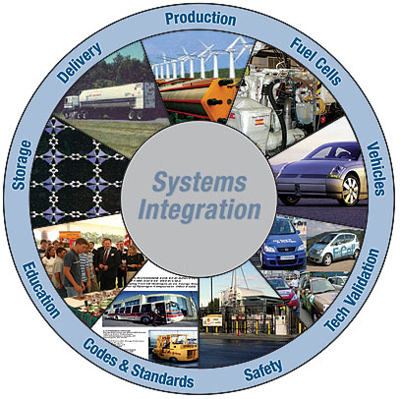
* The difficulty of distributing and storing hydrogen
* The cost of setting up a hydrogen based infrastructure to replace the existing oil based infrastructure
* Safety concerns about storing hydrogen on board vehicles
* The cost and complexity of hydrogen fuel cells
* Availability of platinum for large scale use in fuel cells

Amory Lovins' Rocky Mountain Institute (pdf) argues that many of these objections are either myths or can be overcome.

Fuel cell expert Ulf Bossel and energy commentator Joe Romm (author of The Hype About Hydrogen) are probably the most frequently cited critics, arguing that the inefficiency of the hydrogen conversion process is wasteful and compares unfavourably to alternatives - specifically the "electron economy" where electricity is the energy carrier of choice.

Bossel says "In a sustainable energy future, electricity will become the prime energy carrier. We now have to focus our research on electricity storage, electric cars and the modernization of the existing electricity infrastructure".


The diagram above shows that both the efficiency of electrolysis and the efficiency of fuel cells are key factors in making hydrogen as a transport fuel less attractive than the electric transport option.

Peak Platinum

If we assumed that hydrogen fuel cells could be made significantly more efficient, and thus more competitive with the electric vehicle option, we still have the issue of the scarcity (and thus the cost) of platinum to deal with, as platinum is the material traditionally used as the catalyst in cells.


In 2005, South Africa was the top producer of platinum, accounting for around 80% of world production, followed by Russia and Canada. Significant deposits are also found in Zimbabwe, the United States and, as noted in the introduction, Australia. South Africa has been expanding production rapidly to take advantage of soaring prices - causing some controversy in affected townships.

When discussing rare metals, the subject of peak minerals is usually quick to arise. The idea has been covered at a number of venues in recent years - including The Oil Drum, New Scientist (with some good graphics here and here) and WorldChanging.

The New Scientist article estimated that there are 360 years of platinum reserves available if we continue to extract it at the current rate of production - however this drops to 15 years if predicted growth in demand is taken into account.

One analyst at Resource Investor has predicted that we may have already reached "peak platinum" production, though this seems to be predicated on the belief that production of hybrid and electric vehicles will remove the demand for both fuel cells and catalytic converters in future years, rather than a firm belief in supply constraints.

Another analyst at the UK Department For Transport, looked at the platinum supply situation for fuel cell vehicles and concluded:
The above projections, coupled with the statements from Cawthorn (1999) about accessible platinum reserves in South Africa, suggest that platinum availability should not be a constraint to the introduction of hydrogen fuel cell cars. If South Africa alone can deliver up to 5% per year additional platinum supply between 2000 and 2050, this equates to an additional 13.6 million oz in 2030, 24.8 million oz in 2040 and 42.9 million oz in 2050, which is sufficient to meet demand under any of the scenarios considered.

However there are many important assumptions and uncertainties built into this model. For example, this additional South African platinum supply would be insufficient to meet worldwide platinum demand by 2040 under Scenario 2 (realistic penetration) if any one of the following alternative assumptions is made:

* South African supply can only be increased by 4% per annum instead of 5%.
* Jewellery demand grows at more than 2% per annum - it is currently assumed to remain constant but grew by an average of 6% per annum between 1994 and 2001.
* Fuel cell stacks require more than 0.3 oz of platinum per car in 2040 - it is currently assumed that only 0.2 oz will be required but this is a factor of 10 less than current stack technology.
* The demand for cars grows by more than 55% per decade - it is currently assumed to increase by 45% per decade based on USDOE projections.

The platinum loading for fuel cell stacks is an important factor in determining the commercial viability of fuel cell cars as well as determining potential platinum demand constraints. The price of platinum is not likely to be a constraint to the introduction of fuel cell vehicles if the expected reductions in platinum loadings are achieved. At current platinum prices and the target platinum loading of 0.2 oz per car, the platinum required for a single car would cost about $90 or $1.5/kW, compared to a cost target of $50/kW for the whole fuel cell engine.

In the wake of the New Scientist article, the Wall Street Journal noted that if the most dire predictions are true, recycling of rare metals will be the only way to manufacture some types of machinery. Hazel Prichard, a geologist at the University of Cardiff in the UK, is developing ways to extract platinum from the dust and grime of city streets - apparently, urban grit contains 1.5 parts per million of platinum.

Its worth noting the contrarian view of metals depletion, expressed by Herman Kahn in his book "The Next 200 Years", which points out that reserves data for minerals is often very dubious when there is sufficient known supply available to meet hundreds of years of demand - and that recycling can change the picture dramatically in any case.

Either way, the platinum supply concern may not be an insoluble problem, as recent reports from Japan claim Nisshinbo Industries and the Tokyo Institute of Technology have developed a platinum-free, carbon-based catalyst for fuel cells which they hope to commercialise in 2009 (first for home use, later for use in vehicles). Their catalyst is made from nanospheres of carbon. While 10 times as much carbon is required compared to the platinum equivalent, the cost is one 10th of using platinum. Diahatsu also claims to have a platinum free catalyst, using cobalt or nickel.

Another platinum free alternative being pursued is being researched at Monash University, where chemist Bjorn Winther-Jensen is looking at layering an active conducting polymer onto Gore-tex to make a cheap catalyst.

Alternative Methods For Producing Hydrogen

The discussion following the Australian platinum supply article at TOD ANZ noted the recent, highly publicised, research into a new catalyst for electrolysis at room temperature using cobalt and phosphate which MIT modestly described as a
"'Major discovery' from MIT primed to unleash solar revolution". The process also requires platinum, which seems to limit the potential for cheap and universal application of the technique.

The news was covered extensively pretty much everywhere - see Technology Review, Green Car Congress, The Guardian, The Press Association, Wired, Renewable Energy World, EE Times and Scientific American, with much of the coverage being heavy on hype and short on facts and accuracy.

Joules Burn at The Oil Drum was less impressed, cynically commenting on the story in Local Scientist Splits Water, Saves World, Gets On TV. Bruce Sterling didn't see what the big deal was either, and nor did Joe Romm, who was positively scathing about the news.


There are other schemes for generating hydrogen that don't require electrolysis, at various stages of maturity.

A group at the University of Birmingham in England is looking at using microbes to produce "biohydrogen" from waste, and claim their technology has an added bonus - leftover enzymes can be used to scavenge precious metals from spent automotive catalysts that can then be used to make fuel cells.

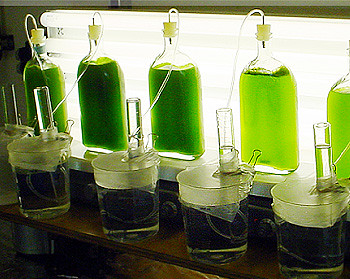
Another biotechnology based approach to hydrogen generation is being pursued at the University of Queensland and Berkeley University, in this case using algae.


So Is Hydrogen Worth Pursuing At All ?

Whether or not the MIT discovery, or any of the other alternatives, really does lead to cheap, abundant hydrogen seems open for debate for the time being.

If we assume for a moment that it is possible to generate hydrogen on a large scale in a reasonably cost effective manner, the issues around distribution, storage and fuel cells still remain - particularly when comparing a hydrogen fueled transport system to one using electric cars.

The car industry, apart from BMW and Honda, seems to have pretty much given up on using hydrogen for vehicles, but enthusiasm remains for using fuel cells in some niche applications where problems are minimised, such as buses, which are refueled at a central location and have fewer concerns about weight and storage size.

Another niche where distributed hydrogen generation may be applicable is cogeneration (CHP) at home, something Jamais Cascio noted in his comment on the MIT announcement. Japan would seem a likely candidate for proving this on a large scale given that they seem to be the most enthusiastic about using hydrogen at home.


The other likely candidate for using hydrogen is energy storage in renewable energy generation - though perhaps not for home scale PV the way Nocera has been suggesting. An Australian company called WHL (previously Wind Hydrogen) has been looking at building wind farms which store excess energy in the form of hydrogen and use it to generate power later, when the wind isn't blowing. The Lolland Hydrogen Community in Denmark has been experimenting with a similar concept, as has a ship called the Hydrogen Challenger.

Melbourne based company Solar Systems is also looking to combine hydrogen energy storage with a solar power plant, using excess heat to improve the efficiency of electrolysis.

On The Towpath Back To The Future  

Posted by Big Gav in , ,

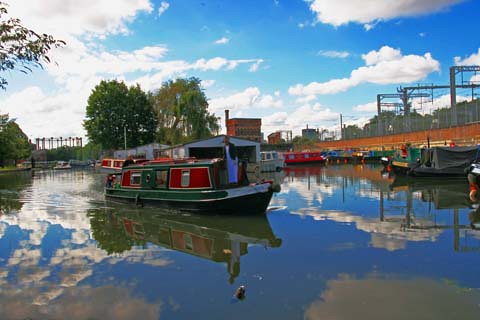
The Independent has a report on some forward thinking reversalism in Britain, looking at the revival of the canal network for freight transport - Soaring fuel prices and green pressures herald comeback for Britain's waterways.

Britain's waterways are on the brink of an astonishing revival – and some of the UK's biggest trucking firms are leading the way. The UK's long-neglected latticework of canals and rivers, which once helped to jump-start the industrial revolution, are poised for a renaissance.

Growing traffic jams, rising fuel prices and environmental pressures are driving the boom, according to industry experts, to such an extent that many shipping and barge companies say they have received more inquiries about transporting goods by water in the past 18 months than they have had in 20 years. Some companies that have traditionally used roads are now appointing managers to mastermind their expansion on to water.

Eddie Stobart, one of the country's biggest road-haulage firms, has invested in a port on the Manchester Ship Canal and plans to expand its waterways routes. "It might seem odd that one of the goals of Britain's biggest branded truck company is to get trucks off the road, but that is exactly what we are trying to do," Julie Gaskell, a spokeswoman for the firm, said. "It seems ironic that we are now looking to revive more traditional modes of transport, but new pressures such as congestion, rising fuel prices and the environment mean the old methods are becoming viable again," she added.

Several major companies, including Tesco and Sainsbury's, have already switched thousands of tons of freight on to ships and barges, while the international courier firm DHL is looking to move urgent mail from central London to Heathrow by speedboat to avoid congestion in the capital. Tesco transports new world wine by sea and water to its bottling plant at Irlam on the Manchester Ship Canal. The scheme, which involves three journeys a week and moves an estimated 600,000 litres of wine along a 40-mile stretch of the canal from Liverpool to Manchester, takes 50 lorries off the roads each week. Tesco says it plans to expand the scheme, saving an estimated 3,500 lorry movements by the year's end.

How to Travel by Cargo Ship  

Posted by Big Gav in ,

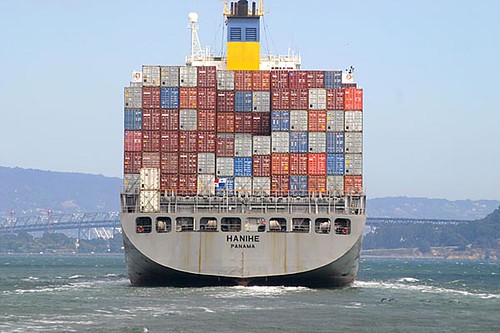
I've long been of the opinion that shipping is likely to remain the dominant form of freight transport, even in a world that is far past peak oil. The future of the airlines is a little less clear though, so there may be a case for the idea that we might see a rejuvenation of sea travel - one form of which is hitching a ride on a cargo ship, in which case this article might come in handy - How to Travel by Cargo Ship (via Idleworm).

I have always wanted a collection of brown leather trunks with brightly colored stickers from all the world’s corners. They remind me of travelers in the early 1900s who spent days on the ocean in order to reach their destinations. Back then, arriving at the destination was as much a part of the trip as the destination itself.

So when I needed to get from Guadeloupe in the Caribbean to France I asked myself, “is it still possible to travel by boat?” A few months later I was on a CMA-CGM cargo ship headed from Pointe-à-Pitre to Dunkerque.

My nine days on the Atlantic included gourmet French food, duty-free Porto and hours spent mesmerized by the blinking lights of the GPS. Yes, you can definitely still travel to many locations in the world by boat.

Here are some pointers for researching and planning your own adventure on the high seas:

1. What exactly is traveling by Cargo Ship?

Most of the major global shipping lines CMA-CGM, Canada Maritime, and Bank Line offer paying passengers to hop on one of their lines. As a paying passenger you are accommodated in guest cabins and have access to most areas of the ship.

Captains and crew spend a lot of time on the water, and they are usually happy to have a fresh face walking around their workplace, meaning that they may even invite you to eat with them, give you tours of the ship and maybe even have you over for an Officer’s happy hour.

2. Where can I go?

You can travel almost anywhere by cargo ship.

The global shipping industry is huge, and many ports like New York, Shanghai, Los Angeles, and Sydney welcome several ships everyday.
Just think: anywhere global commodities are shipped are places that you can disembark and spend time soaking up the local culture before re-boarding.

Shipping companies have certain lines covering specific routes, and many of them will allow you to buy a ticket for one of these lines and disembark and board as you please as long as there is a ship leaving on your chosen day.

This is often how round the world routes work: book your freighter ticket and then plan in a few weeks in every major port. With freighters, the possibilities for your adventure are almost endless. Just think: anywhere global commodities are shipped are places that you can disembark and spend time soaking up the local culture before re-boarding.

3. What will it cost?

A common misconception is that if you are willing to spend an extended amount of time on open water you can score an inexpensive mode of transportation to your next travel destination.

Although there are possibilities to work on boats, traveling as a passenger is in fact more expensive than your average airfare. But before you scoff at the price – plan on an average price of $80-140/day – consider this: your ticket pays for room, meals, and a plethora of experiences that cannot be had anywhere else.

4. Life on a ship

As a passenger you are surrounded by the everyday life of the vessel and her crew. Schedules revolve around mealtimes, which can be extravagant events depending on the chef.

If you are a gourmet traveler, consider traveling with one of the French companies which are known for their high quality cuisine and table wine. ...

The Big Green Bus  

Posted by Big Gav in , ,

PhysOrg has an article on a new, more efficient hybrid bus made using a lightweight nitrogen-strengthened stainless steel - Revolutionary green technology bus.

Insight from Oak Ridge National Laboratory, commitment from two Michigan companies and funding from the Department of Energy have led to the commercialization of a lightweight urban transit bus with double the fuel efficiency of conventional hybrid buses.

This new green technology 40-foot bus features a high-strength stainless steel body and chassis and a hybrid power system that drives the bus primarily with stored electrical energy. This approach reverses the paradigm of conventional parallel hybrid designs that use electric energy only to supplement the acceleration and torque requirements of a diesel engine.

At the heart of the bus is a chassis made of Nitronic 30, a nitrogen-strengthened stainless steel that is stronger and stiffer than conventional steel. These attributes translate into less material required for a chassis, resulting in reduced weight.

"Nitronic stainless steel is incredibly durable and enables our chassis designs to have significantly longer service life vs. ordinary steel vehicles," said Bruce Emmons, president of Autokinetics (http://www.autokinetics.com/) of Rochester, Mich., which developed the bus. "The fact that stainless is also 100 percent recyclable and more environmentally friendly to produce than aluminum makes this an ideal green raw material for vehicle structures."

Hybrid Buses In Maryland  

Posted by Big Gav in ,

The Washington Post reports that the US state of Maryland is to convert its bus fleet to hybrids.

Gov. Martin O'Malley wants Maryland's entire fleet of transit buses to be diesel-electric hybrids. O'Malley announced Tuesday that he has directed the Maryland Transit Administration to purchase only hybrid buses in the future as older buses powered only by diesel fuel are taken out of service.

The state says hybrid buses use up to 20 percent less fuel and are up to 40 percent quieter. They're also more reliable, going 6,200 miles between service calls, compared with 3,000 miles for diesel models.

There are currently 653 buses in the MTA fleet, and 10 are hybrids. MTA spokeswoman Jauwana Greene says the agency has been given approval to buy up to 100 hybrids a year starting next year. She says if buses are replaced at the usual rate, there should be about 500 hybrids in the fleet by 2014.

We Don't Have an Energy Crisis, We Have a Transportation Crisis  

Posted by Big Gav in ,

Its always worth re-iterating this one, especially to Olduvai Gorge doomers, first that we mostly use oil for transport, second that there are alternative fuels. From TreeHugger - We Don't Have an Energy Crisis, We Have a Transportation Crisis.

Benjamin J. Turon writes an op-ed in the Schenectady Daily Gazette and makes a very good point about how the Kunstlers and Peak Oil Survivalists "forget history and underestimate the technology available to sustain our technological civilization."

Turon points out that oil is used primarily for transport, whereas electricity powers everything else. While his argument is not without problems, (like the need for a lot more electricity generation from all kinds of sources) his main point is crucial- there are lots of alternatives to gasoline if you realize that the problem lies almost entirely with transport.

"First, much of technology is based on electricity, not oil! Computers, telecommunications, lights, industrial machinery, household appliances are electric; electricity can also cook our food and heat our homes. While the power grid needs to be expanded and modernized, North America has abundant energy resources — including coal, nuclear, hydro, tidal, wind, solar and geothermal — to keep us in electricity without depending on oil-run power plants."

“There is no substitute for oil [or liquid fuels] in transport” is a canard that is frequently uttered in the media by so-called experts. While true for airplanes, it is demonstratively false for transport on land and sea. Maritime transport is very fuel-efficient and could once again run on coal via steam engines or gas turbines. Ships could also utilize sails or kites to save fuel. Europe, with its excellent system of inland waterways, moves more than 40 percent of its freight by water. Perhaps there is a future for the New York State Barge Canal beyond recreational boating."

"Electric trolley buses and trucks can receive electricity directly from the grid by overhead wires. There are globally 353 cities with electric trolley bus systems, including Boston, Dayton, Seattle and San Francisco. Large cities could electrify major thoroughfares for use by streetcars, transit buses and delivery trucks. Eventually even the interstate highway system could be electrified, saving long-distant trucking.

Statistics

Locations of visitors to this page

blogspot visitor
Stat Counter

Total Pageviews

Ads

Books

Followers

Blog Archive

Labels

australia (619) global warming (423) solar power (397) peak oil (355) renewable energy (302) electric vehicles (250) wind power (194) ocean energy (165) csp (159) solar thermal power (145) geothermal energy (144) energy storage (142) smart grids (140) oil (139) solar pv (138) tidal power (137) coal seam gas (131) nuclear power (129) china (120) lng (117) iraq (113) geothermal power (112) green buildings (110) natural gas (110) agriculture (91) oil price (80) biofuel (78) wave power (73) smart meters (72) coal (70) uk (69) electricity grid (67) energy efficiency (64) google (58) internet (50) surveillance (50) bicycle (49) big brother (49) shale gas (49) food prices (48) tesla (46) thin film solar (42) biomimicry (40) canada (40) scotland (38) ocean power (37) politics (37) shale oil (37) new zealand (35) air transport (34) algae (34) water (34) arctic ice (33) concentrating solar power (33) saudi arabia (33) queensland (32) california (31) credit crunch (31) bioplastic (30) offshore wind power (30) population (30) cogeneration (28) geoengineering (28) batteries (26) drought (26) resource wars (26) woodside (26) censorship (25) cleantech (25) bruce sterling (24) ctl (23) limits to growth (23) carbon tax (22) economics (22) exxon (22) lithium (22) buckminster fuller (21) distributed manufacturing (21) iraq oil law (21) coal to liquids (20) indonesia (20) origin energy (20) brightsource (19) rail transport (19) ultracapacitor (19) santos (18) ausra (17) collapse (17) electric bikes (17) michael klare (17) atlantis (16) cellulosic ethanol (16) iceland (16) lithium ion batteries (16) mapping (16) ucg (16) bees (15) concentrating solar thermal power (15) ethanol (15) geodynamics (15) psychology (15) al gore (14) brazil (14) bucky fuller (14) carbon emissions (14) fertiliser (14) matthew simmons (14) ambient energy (13) biodiesel (13) investment (13) kenya (13) public transport (13) big oil (12) biochar (12) chile (12) cities (12) desertec (12) internet of things (12) otec (12) texas (12) victoria (12) antarctica (11) cradle to cradle (11) energy policy (11) hybrid car (11) terra preta (11) tinfoil (11) toyota (11) amory lovins (10) fabber (10) gazprom (10) goldman sachs (10) gtl (10) severn estuary (10) volt (10) afghanistan (9) alaska (9) biomass (9) carbon trading (9) distributed generation (9) esolar (9) four day week (9) fuel cells (9) jeremy leggett (9) methane hydrates (9) pge (9) sweden (9) arrow energy (8) bolivia (8) eroei (8) fish (8) floating offshore wind power (8) guerilla gardening (8) linc energy (8) methane (8) nanosolar (8) natural gas pipelines (8) pentland firth (8) saul griffith (8) stirling engine (8) us elections (8) western australia (8) airborne wind turbines (7) bloom energy (7) boeing (7) chp (7) climategate (7) copenhagen (7) scenario planning (7) vinod khosla (7) apocaphilia (6) ceramic fuel cells (6) cigs (6) futurism (6) jatropha (6) nigeria (6) ocean acidification (6) relocalisation (6) somalia (6) t boone pickens (6) local currencies (5) space based solar power (5) varanus island (5) garbage (4) global energy grid (4) kevin kelly (4) low temperature geothermal power (4) oled (4) tim flannery (4) v2g (4) club of rome (3) norman borlaug (2) peak oil portfolio (1)