Showing posts with label peak minerals. Show all posts

Peak Metals - What happens when we run out ?  

Posted by Big Gav in ,

SBS has a report on peak metals (a subject that I don't find particularly worrisome) and peak oil - Peak Metals - What happens when we run out?.

In the 1950's, an American geoscientist came up with the term 'peak oil', to describe the moment when the maximum rate of petrol extraction from the earth would be hit - and academics in Australia are starting to talk about the very same problems faced by our metal mining industry.

Marion King Hubbert claimed that oil production in US mainland states would peak between 1965 and 1970. In the end, production in most US states is widely agreed to have peaked in 1971.

But in his native Texas, the year was 1972. And half a world away that same year, the young Club of Rome think tank was gathering attention with The Limits to Growth, a book causing a stir by confronting the issue of finite resources.

The Club of Rome is widely held as one of the kick-starters in the debate over minerals sustainability.

And while many metals can be recycled, whereas oil cannot, scientists are using the concept to deliver an understanding of the impacts of mining to the wider public.

Put simply, the extraction of virgin ores from the earth's crust will peak - indeed, it already has for many.

Although the theory is not without its detractors, there is no doubt that the metals that drive our society are finite resources - and extracting them from the earth has to end.

The question is what countries like Australia, who have a gross domestic product so linked to mining, will do in such a scenario.

'Peak oil' theory itself, in operation, will directly influence the mining and minerals industry through rising fuel costs, each increase edging away at the sustainability of the process.

World faces hi-tech crunch as China eyes ban on rare metal exports ?  

Posted by Big Gav in , , ,

The dodgy Ambrose Evans-Pritchard in the UK Daily telegraph has an article on the possibility of China's ceasing to export rare earths required for clean technologies - World faces hi-tech crunch as China eyes ban on rare metal exports.

A draft report by China’s Ministry of Industry and Information Technology has called for a total ban on foreign shipments of terbium, dysprosium, yttrium, thulium, and lutetium. Other metals such as neodymium, europium, cerium, and lanthanum will be restricted to a combined export quota of 35,000 tonnes a year, far below global needs.

China mines over 95pc of the world’s rare earth minerals, mostly in Inner Mongolia. The move to hoard reserves is the clearest sign to date that the global struggle for diminishing resources is shifting into a new phase. Countries may find it hard to obtain key materials at any price.

Alistair Stephens, from Australia’s rare metals group Arafura, said his contacts in China had been shown a copy of the draft -- `Rare Earths Industry Devlopment Plan 2009-2015’. Any decision will be made by China’s State Council.

“This isn’t about the China holding the world to ransom. They are saying we need these resources to develop our own economy and achieve energy efficiency, so go find your own supplies”, he said.

Mr Stephens said China had put global competitors out of business in the early 1990s by flooding the market, leading to the closure of the biggest US rare earth mine at Mountain Pass in California - now being revived by Molycorp Minerals.

New technologies have since increased the value and strategic importance of these metals, but it will take years for fresh supply to come on stream from deposits in Australia, North America, and South Africa. The rare earth family are hard to find, and harder to extract.

Mr Stephens said Arafura’s project in Western Australia produces terbium, which sells for $800,000 a tonne. It is a key ingredient in low-energy light-bulbs. China needs all the terbium it produces as the country switches wholesale from tungsten bulbs to the latest low-wattage bulbs that cut power costs by 40pc.

No replacement has been found for neodymium that enhances the power of magnets at high heat and is crucial for hard-disk drives, wind turbines, and the electric motors of hybrid cars. Each Toyota Prius uses 25 pounds of rare earth elements. Cerium and lanthanum are used in catalytic converters for diesel engines. Europium is used in lasers.

Blackberries, iPods, mobile phones, plams TVs, navigation systems, and air defence missiles all use a sprinkling of rare earth metals. They are used to filter viruses and bacteria from water, and cleaning up Sarin gas and VX nerve agents.
Arafura, Mountain Pass, and Lynas Corp in Australia, will be able to produce some 50,000 tonnes of rare earth metals by the mid-decade but that is not enough to meet surging world demand.


Reuters has an article in a similar vein, talking about demand for rarer earths in Prius production - As hybrid cars gobble rare metals, shortage looms.
The Prius hybrid automobile is popular for its fuel efficiency, but its electric motor and battery guzzle rare earth metals, a little-known class of elements found in a wide range of gadgets and consumer goods.

That makes Toyota's market-leading gasoline-electric hybrid car and other similar vehicles vulnerable to a supply crunch predicted by experts as China, the world's dominant rare earths producer, limits exports while global demand swells.

Worldwide demand for rare earths, covering 15 entries on the periodic table of elements, is expected to exceed supply by some 40,000 tonnes annually in several years unless major new production sources are developed. One promising U.S. source is a rare earths mine slated to reopen in California by 2012.

Among the rare earths that would be most affected in a shortage is neodymium, the key component of an alloy used to make the high-power, lightweight magnets for electric motors of hybrid cars, such as the Prius, Honda Insight and Ford Focus, as well as in generators for wind turbines.

Close cousins terbium and dysprosium are added in smaller amounts to the alloy to preserve neodymium's magnetic properties at high temperatures. Yet another rare earth metal, lanthanum, is a major ingredient for hybrid car batteries.

Production of both hybrids cars and wind turbines is expected to climb sharply amid the clamor for cleaner transportation and energy alternatives that reduce dependence on fossil fuels blamed for global climate change.

Toyota has 70 percent of the U.S. market for vehicles powered by a combination of an internal-combustion engine and electric motor. The Prius is its No. 1 hybrid seller.

Jack Lifton, an independent commodities consultant and strategic metals expert, calls the Prius "the biggest user of rare earths of any object in the world."

Each electric Prius motor requires 1 kilogram (2.2 lb) of neodymium, and each battery uses 10 to 15 kg (22-33 lb) of lanthanum. That number will nearly double under Toyota's plans to boost the car's fuel economy, he said.

Toyota plans to sell 100,000 Prius cars in the United States alone for 2009, and 180,000 next year. The company forecasts sales of 1 million units per year starting in 2010.

As China's industries begin to consume most of its own rare earth production, Toyota and other companies are seeking to secure reliable reserves for themselves.

Reuters reported last year that Japanese firms are showing strong interest in a Canadian rare earth site under development at Thor Lake in the Northwest Territories.

Jack Lifton (mentioned above) has a related article at Seeking Alpha - Is China Planning to Restrict or Eliminate Export of 'Heavy' Rare Earth Metals?.
The Chinese economy is a "command" economy, not a free market economy. This means that the state sets, among other things, manufacturing goals and resource allocations. The Chinese central government decides what is important to the economy and makes certain that money and credit flow to those sectors of the economy it has chosen. At the beginning of each five-year economic planning cycle the central government adopts a "five-year plan" to be followed rigorously. Individual and business success in China means meeting the goals of the five year plan as it applies to your sector of the economy.

Thus it is, and can be, no surprise at all to any informed observer of the Chinese economy that various, official, industry-specific planning commissions are now submitting their ideas to the China State Council in Beijing, which will review those ideas and adopt or modify them for political as well as economic reasons and then discard or include them, as the China State Council wishes, in the official listing of goals of the next Five-Year Plan for the period 2010-15.

It is amazing to me that anyone could believe that a "draft" plan for a segment of the economy is a final plan and that in addition it would be released, unofficially, to a foreigner with a vested financial interest in construing and misrepresenting a draft as a final plan. Nonetheless, this is what ill-informed or compromised reporters for Mineweb apparently believe.

Anyone who is following the news about the market fundamentals of the rare earths in order to judge their potential as investments should read the article on Mineweb.com with extreme skepticism both for what it reports and for what is gets very wrong about the Chinese rare earth mining industry.

First of all, the article purports to point to a "draft" report supposed to be an internal document from a Chinese study group commissioned for and addressed to the China State Council. The Mineweb article says
the Chinese draft report, entitled Rare Earths Industry development Plan 2009‐2015, has been submitted to the China State Council for review and implementation in 2010, and outlines plans to restrict Chinese administration of rare earth quotas, totally banning the export of some rare earths and consolidating a large number of Chinese rare earth facilities.

We are supposed to believe that the China State Council is just waiting around for the rare earth industry to tell it what to do, so it can "implement" those recommendations. We are also supposed to believe that the words
…outlines plans to restrict Chinese administration of rare earth quotas, totally banning the export of some rare earths and consolidating a large number of Chinese rare earth facilities

are intended to have meaning in the English language. The author or editor probably means to say that Chinese rare earth quotas are to continue to decline, as they have been doing for several years, but that some exports of specific rare earths will be immediately banned. Further, the author or editor may be trying to say that the central Chinese government is pressuring the rare earth industry to consolidate to become more efficient and less polluting-as we have read elsewhere recently more coherently. I can’t help asking if any of you who believe that the rare earth industry is telling the Chinese State Council what to do might want to also buy a bridge connecting Manhattan to Brooklyn?

The Mineweb article further on lets us know that it is the “heavy rare earths” the export of which is to be immediately banned. ...

There is actually just one single solitary deposit of REEs today being worked and processed to recover the HREEs commercially. These are the so-called ionic clays of Szechuan, China, in which nature performed some ancient ion exchange chemistry for us.

Why does any of this matter?

It is because two of the HREEs have unique properties that greatly influence the properties of permanent magnets made with the LREEs.

The HREE's dysprosium and terbium, when added to the neodymium-iron-boron permanent magnet alloys that are today essential components of the electric motors and generators used in cleantech and military applications, raise the temperature at which the magnetic strength of the permanent magnets diminishes or vanishes (The temperature at which a permanent magnet loses its magnetism is called the "curie" point after its discoverer-the brilliant physicist whose fame was eclipsed historically by his much more famous wife, Madame Curie).

It is extremely important that an electric motor or electric generator be able to operate at as high a temperature as possible in places such as under the hood of a car or in an aircraft or ship. It is also important that transport dependent on electric motors or generators be able to run in the desert.

The People's Republic of China today is the world's sole producer of the HREEs.

For the last five years China has been systematically reducing its export allocation of all of the rare earths. Just at the end of last June (2009) the Chinese government announced that the rare earth allocation for 2009 would be around 32,000 metric tons; For 2008 the total export allocation had been around 38,000 tons. Just for comparison it should be well noted that Japan’s projected total usage of rare earths for 2008, before the economic slowdown, was 40,000 metric tons.

Those who view China’s continuous reduction of its export allocation of rare earth metals over the last five years as an economic ploy to maintain the prices of the rare earths do not understand that the rate of growth of China’s domestic demand for rare earths has exceeded the rate of growth of China’s domestic production for every year of the twenty-first century. Thus it is certain that China’s domestic demand for rare earth metals will exceed its domestic production in the near future. This, in fact, is the main driver for China’s reduced allocation of exports of rare earths. The most optimistic of projections of Chinese production and demand now show that Chinese domestic demand will extinguish its ability to produce before 2014, at the latest.

Therefore unless there is substantial non Chinese production of rare earths in the very near future there will be shortages of rare earths for production outside of China followed by an end to such exports.

The critical period will have begun when and if China suspends exports of the HREEs, dysprosium and terbium. These two HREEs are first and foremost indispensable and irreplaceable in military applications where performance, not cost, is the key. The militaries of the world’s great powers today know only too well that increased weight and decreased performance are the wrong way to go with smart weapons, aircraft, satellites, and spacecraft.

Designers of wind turbines, full hybrid, plug-in hybrid, and battery powered cars know that performance is dependent on temperature range for peak efficiency, and that for all permanent magnet using DC motors and generators substituting ferrite magnets for rare earth magnets adds weight and decreases performance and that without HREEs rare earth permanent magnets are temperature limited.

The USA, Australia, Canada, Greenland, South Africa, and India have a variety of rare earth deposits and projects in various stages of development all the way from exploration to one in actual, limited, production (Molycorp’s Mountain Pass, California, mine is being readied to resume mining, the company says, after a so-far seven year hiatus. Mountain Pass is now producing 2 mt/day of neodymium/praseodymium oxide and 4 mt/day of lanthanum oxide from concentrates above ground mined and beneficiated prior to 2002).

The free market has not been kind to the rare earth mining industry. Australia’s world class REE deposits, Lynas Corp (LYSCF.PK), and Arafura Resources [ARU:SYD], have been on the edge of LREE concentrates production for several years but have had a steady stream of financing problems that have resulted today in Chinese financing being in place or on the table for both while political battles hold up both from going forward. Even if either or both were to go forward there is today no refinery outside of China prepared to process the ores from either-to be fair the Lynas business plan includes such a refinery to be built in Malaysia, but that is held up for financing today also. ...

Canada has two rare earth deposits under development. One is in Saskatchewan at Hoidas Lake and is being developed by Great Western Minerals Group, [GWG:TSXV], which also has several other rare earth deposits in the USA, Canada, and the Republic of South Africa. The other Canadian rare earth project is in the Northwest Territories at Thor Lake and is owned by Avalon Rare Metals [AVL:TSX)] [AVARF: OTCGX] . Thor Lake is well under way in its pre-feasibility study, and I urge you to look at the detailed data on Avalon’s web site.

No deposits outside of China other than Lynas, Arafura, Mountain Pass, Hoidas lake, or Thor Lake can be developed in time to stave off a supply interruption crisis.

But no matter which of the above deposits outside of China is developed it will have to include the parallel development of Avalon’s Thor Lake if the rare earth end user industry outside of China is to remain independent and even continue.

Thor Lake’s very large deposit of rare earth ores is unique in that it has a great deal of fergusonite, which is unusually rich in the HREEs. No other accessible economically mineable deposit of REEs in the world outside of China’s ionic clays has anywhere near the potential of supplying the HREEs necessary for the production of high performance rare earth magnets capable of operating at high temperatures.

The only solution to the high probability of the west being cut off from China’s REEs in the first half of the next decade is the development of Molycorp’s Mountain Pass mine, or Lynas’ Mt. Weld, or Arafura’s Nolan’s Bore, or Thorium Energy’s Lemhi Pass, or one of Great Western’s North American deposits AND Avalon’s Thor Lake deposit. Then and only then will there be a complete supply of REEs available from sources outside of China.

Chinese, now joined by Japanese, economic nationalism is moving to close off several of the above avenues by taking control of one of the major LREE deposits named above. Japan’s Toyota (TM) has even agreed to finance the development of a potentially very large and high grade rare earth deposit in Vietnam, but that is many years off. Chinese mining companies are aggressively moving into Australia and have already bought a substantial portion of Arafura and have offered to buy control of Lynas. These Chinese investments are not however to develop REEs for the world market but to insure the continued dynamic growth of the Chinese domestic end-using REE based industry, so in fact such investments by China will only reduce the number of candidates for the supply of the LREEs outside of China. Industry in the west won't fare much better if the Japanese gain control of any portion of the non-Chinese supply of REEs. In either case the interruption of supply to North America and Europe of the REEs will mean a decrease in high tech and clean tech manufacturing jobs and a further erosion of technological leadership.

The pros and cons of economic nationalism are not up for debate any longer in Asia or even Europe. If Americans wish to continue to have the capability to produce wealth in the twenty-first century age of technology that is upon us we need to improve our supply of and our control over the critical resources of rare metals that are slipping away from us. America can only remain competitive in high tech and clean tech by being self sufficient in the raw materials. It's up to you.

The Hydrogen Economy and Peak Platinum  

Posted by Big Gav in , , , , , , , , , ,

One Bullroarer at TOD ANZ a week or two ago featured an article from the ABC on the possibility of mining low grade Australian platinum reserves to supply rising demand for catalytic converters and hydrogen fuel cells - World 'needs Australia's platinum to build cleaner cars'.

An Australian researcher has warned that the drive to put cleaner, hydrogen-fuelled cars on the road will stall unless new reserves of platinum are found. Platinum is one of the key components of catalytic converters, catalysing carbon monoxide from exhaust fumes. It is also a critical component of fuel cells for hydrogen-powered cars. However 80 per cent of the world's reserves come from just three mines.

John Mavrogenes says a team of geochemists from the Australian National University has identified new methods to detect platinum deposits. They are simulating the intense heat and pressure of the Earth's magma to discover whether platinum can be extracted from other minerals. "This work may help geologists find new reserves around the world in places that haven't been searched before," he said. Professor Mavrogenes says if the platinum price remains at its current high, Australia could mine lower-grade deposits. ...

The three major mines that produce platinum are in South Africa, Siberia and the United States. "If we go to more and more uses of platinum we're going to need more than they can produce," Professor Mavrogenes said. "Existing reserves would meet less than 20 per cent of the world's platinum demand if all cars went hydrogen."

The Hydrogen Economy

The dream of the hydrogen economy is one that has been around since the 1970's, and has been heavily hyped by sources ranging from Wired (as a key component to their long boom vision), the European Hydrogen Association and Jeremy Rifkin to George W Bush (who seemed primarily interested in supporting the gas and nuclear industries).

The term was originally coined by chemistry professor John Bockris (also an alchemist, cold fusion researcher and winner of the Ig Nobel prize).

The basic vision is that hydrogen is used to fuel vehicles containing hydrogen fuel cells, rather than internal combustion engines, creating no pollution other than water.


Global hydrogen production is currently derived from natural gas (48%), oil (30%), coal (18%) and electrolysis of water (4%). Given that hydrogen is currently largely derived from fossil fuels, the first obstacle facing the "hydrogen economy" dream is shifting away from these sources to extracting hydrogen from water.

Hydrogen is also used for producing ammonia and cracking heavier grades of oil, which means that peak oil and gas pose a number of problems to the hydrogen dream - the primary sources of present day hydrogen become less plentiful, and demand for hydrogen increases as we resort to heavier grades of oil (and coal to liquids) to keep the habit going.

Criticisms of the hydrogen economy

Critics of the hydrogen economy aren't hard to find, with frequently raised objections including:

* The use of natural gas (both from a global warming point of view and a depletion point of view)
* The inefficiency of electrolysis techniques in converting other forms of energy into hydrogen
* The difficulty of distributing and storing hydrogen
* The cost of setting up a hydrogen based infrastructure to replace the existing oil based infrastructure
* Safety concerns about storing hydrogen on board vehicles
* The cost and complexity of hydrogen fuel cells
* Availability of platinum for large scale use in fuel cells

Amory Lovins' Rocky Mountain Institute (pdf) argues that many of these objections are either myths or can be overcome.

Fuel cell expert Ulf Bossel and energy commentator Joe Romm (author of The Hype About Hydrogen) are probably the most frequently cited critics, arguing that the inefficiency of the hydrogen conversion process is wasteful and compares unfavourably to alternatives - specifically the "electron economy" where electricity is the energy carrier of choice.

Bossel says "In a sustainable energy future, electricity will become the prime energy carrier. We now have to focus our research on electricity storage, electric cars and the modernization of the existing electricity infrastructure".


The diagram above shows that both the efficiency of electrolysis and the efficiency of fuel cells are key factors in making hydrogen as a transport fuel less attractive than the electric transport option.

Peak Platinum

If we assumed that hydrogen fuel cells could be made significantly more efficient, and thus more competitive with the electric vehicle option, we still have the issue of the scarcity (and thus the cost) of platinum to deal with, as platinum is the material traditionally used as the catalyst in cells.


In 2005, South Africa was the top producer of platinum, accounting for around 80% of world production, followed by Russia and Canada. Significant deposits are also found in Zimbabwe, the United States and, as noted in the introduction, Australia. South Africa has been expanding production rapidly to take advantage of soaring prices - causing some controversy in affected townships.

When discussing rare metals, the subject of peak minerals is usually quick to arise. The idea has been covered at a number of venues in recent years - including The Oil Drum, New Scientist (with some good graphics here and here) and WorldChanging.

The New Scientist article estimated that there are 360 years of platinum reserves available if we continue to extract it at the current rate of production - however this drops to 15 years if predicted growth in demand is taken into account.

One analyst at Resource Investor has predicted that we may have already reached "peak platinum" production, though this seems to be predicated on the belief that production of hybrid and electric vehicles will remove the demand for both fuel cells and catalytic converters in future years, rather than a firm belief in supply constraints.

Another analyst at the UK Department For Transport, looked at the platinum supply situation for fuel cell vehicles and concluded:
The above projections, coupled with the statements from Cawthorn (1999) about accessible platinum reserves in South Africa, suggest that platinum availability should not be a constraint to the introduction of hydrogen fuel cell cars. If South Africa alone can deliver up to 5% per year additional platinum supply between 2000 and 2050, this equates to an additional 13.6 million oz in 2030, 24.8 million oz in 2040 and 42.9 million oz in 2050, which is sufficient to meet demand under any of the scenarios considered.

However there are many important assumptions and uncertainties built into this model. For example, this additional South African platinum supply would be insufficient to meet worldwide platinum demand by 2040 under Scenario 2 (realistic penetration) if any one of the following alternative assumptions is made:

* South African supply can only be increased by 4% per annum instead of 5%.
* Jewellery demand grows at more than 2% per annum - it is currently assumed to remain constant but grew by an average of 6% per annum between 1994 and 2001.
* Fuel cell stacks require more than 0.3 oz of platinum per car in 2040 - it is currently assumed that only 0.2 oz will be required but this is a factor of 10 less than current stack technology.
* The demand for cars grows by more than 55% per decade - it is currently assumed to increase by 45% per decade based on USDOE projections.

The platinum loading for fuel cell stacks is an important factor in determining the commercial viability of fuel cell cars as well as determining potential platinum demand constraints. The price of platinum is not likely to be a constraint to the introduction of fuel cell vehicles if the expected reductions in platinum loadings are achieved. At current platinum prices and the target platinum loading of 0.2 oz per car, the platinum required for a single car would cost about $90 or $1.5/kW, compared to a cost target of $50/kW for the whole fuel cell engine.

In the wake of the New Scientist article, the Wall Street Journal noted that if the most dire predictions are true, recycling of rare metals will be the only way to manufacture some types of machinery. Hazel Prichard, a geologist at the University of Cardiff in the UK, is developing ways to extract platinum from the dust and grime of city streets - apparently, urban grit contains 1.5 parts per million of platinum.

Its worth noting the contrarian view of metals depletion, expressed by Herman Kahn in his book "The Next 200 Years", which points out that reserves data for minerals is often very dubious when there is sufficient known supply available to meet hundreds of years of demand - and that recycling can change the picture dramatically in any case.

Either way, the platinum supply concern may not be an insoluble problem, as recent reports from Japan claim Nisshinbo Industries and the Tokyo Institute of Technology have developed a platinum-free, carbon-based catalyst for fuel cells which they hope to commercialise in 2009 (first for home use, later for use in vehicles). Their catalyst is made from nanospheres of carbon. While 10 times as much carbon is required compared to the platinum equivalent, the cost is one 10th of using platinum. Diahatsu also claims to have a platinum free catalyst, using cobalt or nickel.

Another platinum free alternative being pursued is being researched at Monash University, where chemist Bjorn Winther-Jensen is looking at layering an active conducting polymer onto Gore-tex to make a cheap catalyst.

Alternative Methods For Producing Hydrogen

The discussion following the Australian platinum supply article at TOD ANZ noted the recent, highly publicised, research into a new catalyst for electrolysis at room temperature using cobalt and phosphate which MIT modestly described as a
"'Major discovery' from MIT primed to unleash solar revolution". The process also requires platinum, which seems to limit the potential for cheap and universal application of the technique.

The news was covered extensively pretty much everywhere - see Technology Review, Green Car Congress, The Guardian, The Press Association, Wired, Renewable Energy World, EE Times and Scientific American, with much of the coverage being heavy on hype and short on facts and accuracy.

Joules Burn at The Oil Drum was less impressed, cynically commenting on the story in Local Scientist Splits Water, Saves World, Gets On TV. Bruce Sterling didn't see what the big deal was either, and nor did Joe Romm, who was positively scathing about the news.


There are other schemes for generating hydrogen that don't require electrolysis, at various stages of maturity.

A group at the University of Birmingham in England is looking at using microbes to produce "biohydrogen" from waste, and claim their technology has an added bonus - leftover enzymes can be used to scavenge precious metals from spent automotive catalysts that can then be used to make fuel cells.

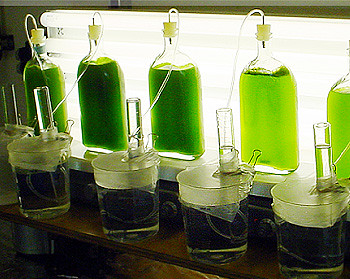
Another biotechnology based approach to hydrogen generation is being pursued at the University of Queensland and Berkeley University, in this case using algae.


So Is Hydrogen Worth Pursuing At All ?

Whether or not the MIT discovery, or any of the other alternatives, really does lead to cheap, abundant hydrogen seems open for debate for the time being.

If we assume for a moment that it is possible to generate hydrogen on a large scale in a reasonably cost effective manner, the issues around distribution, storage and fuel cells still remain - particularly when comparing a hydrogen fueled transport system to one using electric cars.

The car industry, apart from BMW and Honda, seems to have pretty much given up on using hydrogen for vehicles, but enthusiasm remains for using fuel cells in some niche applications where problems are minimised, such as buses, which are refueled at a central location and have fewer concerns about weight and storage size.

Another niche where distributed hydrogen generation may be applicable is cogeneration (CHP) at home, something Jamais Cascio noted in his comment on the MIT announcement. Japan would seem a likely candidate for proving this on a large scale given that they seem to be the most enthusiastic about using hydrogen at home.


The other likely candidate for using hydrogen is energy storage in renewable energy generation - though perhaps not for home scale PV the way Nocera has been suggesting. An Australian company called WHL (previously Wind Hydrogen) has been looking at building wind farms which store excess energy in the form of hydrogen and use it to generate power later, when the wind isn't blowing. The Lolland Hydrogen Community in Denmark has been experimenting with a similar concept, as has a ship called the Hydrogen Challenger.

Melbourne based company Solar Systems is also looking to combine hydrogen energy storage with a solar power plant, using excess heat to improve the efficiency of electrolysis.

Statistics

Locations of visitors to this page

blogspot visitor
Stat Counter

Total Pageviews

Ads

Books

Followers

Blog Archive

Labels

australia (619) global warming (423) solar power (397) peak oil (355) renewable energy (302) electric vehicles (250) wind power (194) ocean energy (165) csp (159) solar thermal power (145) geothermal energy (144) energy storage (142) smart grids (140) oil (139) solar pv (138) tidal power (137) coal seam gas (131) nuclear power (129) china (120) lng (117) iraq (113) geothermal power (112) green buildings (110) natural gas (110) agriculture (91) oil price (80) biofuel (78) wave power (73) smart meters (72) coal (70) uk (69) electricity grid (67) energy efficiency (64) google (58) internet (50) surveillance (50) bicycle (49) big brother (49) shale gas (49) food prices (48) tesla (46) thin film solar (42) biomimicry (40) canada (40) scotland (38) ocean power (37) politics (37) shale oil (37) new zealand (35) air transport (34) algae (34) water (34) arctic ice (33) concentrating solar power (33) saudi arabia (33) queensland (32) california (31) credit crunch (31) bioplastic (30) offshore wind power (30) population (30) cogeneration (28) geoengineering (28) batteries (26) drought (26) resource wars (26) woodside (26) censorship (25) cleantech (25) bruce sterling (24) ctl (23) limits to growth (23) carbon tax (22) economics (22) exxon (22) lithium (22) buckminster fuller (21) distributed manufacturing (21) iraq oil law (21) coal to liquids (20) indonesia (20) origin energy (20) brightsource (19) rail transport (19) ultracapacitor (19) santos (18) ausra (17) collapse (17) electric bikes (17) michael klare (17) atlantis (16) cellulosic ethanol (16) iceland (16) lithium ion batteries (16) mapping (16) ucg (16) bees (15) concentrating solar thermal power (15) ethanol (15) geodynamics (15) psychology (15) al gore (14) brazil (14) bucky fuller (14) carbon emissions (14) fertiliser (14) matthew simmons (14) ambient energy (13) biodiesel (13) investment (13) kenya (13) public transport (13) big oil (12) biochar (12) chile (12) cities (12) desertec (12) internet of things (12) otec (12) texas (12) victoria (12) antarctica (11) cradle to cradle (11) energy policy (11) hybrid car (11) terra preta (11) tinfoil (11) toyota (11) amory lovins (10) fabber (10) gazprom (10) goldman sachs (10) gtl (10) severn estuary (10) volt (10) afghanistan (9) alaska (9) biomass (9) carbon trading (9) distributed generation (9) esolar (9) four day week (9) fuel cells (9) jeremy leggett (9) methane hydrates (9) pge (9) sweden (9) arrow energy (8) bolivia (8) eroei (8) fish (8) floating offshore wind power (8) guerilla gardening (8) linc energy (8) methane (8) nanosolar (8) natural gas pipelines (8) pentland firth (8) saul griffith (8) stirling engine (8) us elections (8) western australia (8) airborne wind turbines (7) bloom energy (7) boeing (7) chp (7) climategate (7) copenhagen (7) scenario planning (7) vinod khosla (7) apocaphilia (6) ceramic fuel cells (6) cigs (6) futurism (6) jatropha (6) nigeria (6) ocean acidification (6) relocalisation (6) somalia (6) t boone pickens (6) local currencies (5) space based solar power (5) varanus island (5) garbage (4) global energy grid (4) kevin kelly (4) low temperature geothermal power (4) oled (4) tim flannery (4) v2g (4) club of rome (3) norman borlaug (2) peak oil portfolio (1)