Technology: The Most Powerful Force in the World
Posted by Big Gav in kevin kelly, technium, technology
Kevin Kelly is continuing to put out material for his forthcoming book on "The Technium" fairly regularly - the latest in stall looks at the power of technology - The Most Powerful Force in the World.
Even counting vast tracks of agriculture, the technium entails fewer than one percent of the atoms on the Earth's land surface. Yet the impact which this minute fraction of technological mass and energy has on the planet is in far disproportion to its size. Measured by impact per gram or calorie, there is nothing comparable to things we invent. Technology is the most powerful force in the world.
From the moment Sapiens emerged from Africa to colonize every inhabitable watershed on this planet, their inventions began to alter their environment. Sapien's hunting tools and techniques had far reaching affects: their technology enabled them to kill off key herbivores (mammoths, giant elk, etc.) whose extinctions altered the ecology of entire grassland biomes forever. Once dominant grazers were eliminated, their absence cascaded through the ecosystem, enabling the rise of new predators, new plant species, and all their competitors and allies, surfacing a modified ecosystem. Thus a few clans of people shifted the destiny of thousands of other species. When Sapiens gained control of fire, this technology further modified the natural terrain on a massive scale. Such a tiny trick — burning grasslands, controlling it with backfires, and summoning flames to cook grains — disrupted vast regions of the continents.
Later the repeated inventions and spread of agriculture around the planet affected not only the surface of the Earth, but its 100 km (60-mile) wide atmosphere as well. Farming disturbed the soil and increased CO2. Some climatologists believe that this early anthropogenic warming, starting 8,000 years ago, kept the next ice age at bay. Widespread adoption of farming disrupted a natural climate cycle which would have ordinarily refrozen the northern most portions of the planet by now. In other words, agriculture made (and still makes) the world safe for more agriculture. Like most complex technologies, agriculture — the integrated system of domesticated crops and animals, irrigation infrastructure and soil management — is self-sustaining and will alter its environment to further its own benefit.
Of course, once humans invented machines that ate concentrated old plants (coal) instead of fresh plants, the mechanical exhalations of CO2 furthered altered the balance of the atmosphere as the number of machines multiplied. The technium bloomed as machines harnessed this source of abundant energy. Petroleum eating machines not only transformed the ease, productivity, and spread of agriculture (accelerating an old trend), machines also drilled for more oil faster (a new trend), accelerating the rate of acceleration. Today the CO2 exhalation of all machines greatly exceeds the exhalation of all animals, and even approaches the volume generated by geological forces. Alan Weisman, writing in the World Without Us, suggest that the modern technium is the geological equivalent to a series of ceaseless volcanoes: "by tapping the [fuels of the] Carboniferous Formation and spewing it up into the sky, we've become a volcano that hasn't stopped erupting since the 1700s." And this impact is not only global, but extremely persistent: "Among the human-crafted artifacts that will last the longest after we're gone is our redesigned atmosphere." Climatologist Tyler Volk estimates that a natural geological cycle — with no technological mitigation — would take 100,000 years to return the agricultural and industrial induced CO2 atmosphere to pre-technium levels.
Each year the technium consumes more than 40 trillion pounds of coal, 1.6 trillion pounds of iron, 200 billion pounds of gypsum, and 1.2 trillion pounds of wheat, just four inputs among thousands of others needed to appease its appetite, and all those totals grow more than 5% per year. On average the technium must process twenty tons of atoms per year to support each man, women and child in the modern world.
The technium gains its immense power not from its scale but from its self-amplifying nature. One breakthrough invention, such as the alphabet, the steam pump, or electricity, can lead to further breakthrough inventions, like books, coal mines, and telephones. These advances in turn lead to other breakthrough inventions, such as libraries, power generators, and the internet. Each step adds further powers while retaining most of the virtues of the previous inventions. Someone has an idea (a spinning wheel!) which can hop to other minds, mutate into a derivative idea (place the spinning wheel beneath a sled to make it easy to haul) which disrupts the prevailing balance, causing a shift. That shift will often suggest another idea to someone else (use a cow to pull the wheeled sled), which in turn produces yet another disturbance, another rebalancing, another shift. Once started the teetering continues for many generations. As one ideas sparks two new ones and two ideas spark four, and four eight, this chain reaction of technology reverberates through the society, always gaining in accumulating energy and ceaseless movement. Efficient machines enable industry to make even more efficient machines. Smart chips assist humans in making even smarter chips. These virtuous circles are like rubbing the genie's lamp and getting three more wishes for the last wish. Magical self-amplification is a story retold in every domain of technology.
But not all changes induced by technology are magically positive. Industrial scale slavery, like that imposed upon Africa, was enabled by sailing ships which transported captives across oceans, and encouraged by the mechanical cotton gin which could cheaply process the fibers the slaves planted and harvested. Without technology, slavery at this massive scale would have been unknown. Thousands of synthetic persistent toxins have caused mass disruptions of natural cycles in both humans and other species, a huge unwanted downside from small inventions. War is a particularly serious amplifier of the great negative powers brought by technology. Horrific weapons of destruction, capable of inflicting entirely new atrocities upon society, spring directly from the most powerful force in the world.
On the other hand, the remedies and offsets to the negative consequences also stem from this most powerful force. Local ethnic slavery was practiced by most earlier civilizations, and probably in prehistoric times as well, and still continues in sporadic remote areas; it's overall diminishment globally is due to the technological tools of communication, law, and education. Technologies of detection, and substitution, can remove the routine use of synthetic toxins. The technologies of monitoring, law, treaties, policing, courts, citizen media and economic globalism can temper, dampen, and in the long run diminish the vicious cycles of war.
All change in society can be traced back to the products of our minds. The history of civilization is an ever up-cascading sequence of social organization that we invent. Societies begin as leaderless bands of hunter-gatherers, and over generational time acquire chiefs, put down roots (literally) with farms, land and water rights adjudicated by authorities, hatch cities, and eventually become states and nations. Each step in civilization is characterized by more social organization, more different kinds connections between people (beyond family relations), more webs of interdependence, producing more of what Robert Wright, author of Non Zero, calls "non-zero-sumness," that is, self-reinforcing mutual benefit. Each emergent organization in the evolution of society serves as a platform for citizens to birth yet more new ways to organize. This self-improving recursive "3-more-wishes" loop goes round and round, amplifying its original force.
The power of cooperation is not new, but this virtuous circle is more than ordinary altruism, because participants are often not consciously cooperating, and may in fact compete, or even be parasitic. A merchant in Athens selling a barrel of raisins is not cooperating with the grower of grapes in Macedonia, or the speculator in Corinth hoarding stock, but the three form a system (an emergent market) that expands all their interests. It's a win-win condition. This kind of accumulating social organization exhibits an almost mathematical flavor that transcends neighborly kindness. Rather than happy camaraderie, this increasing structure is built on information flows that tighten both trust and rivalries into a web of interdependence. As these links increase, so does the power of amplification and acceleration.
Progress, even moral progress, is ultimately a human invention. It is a product of our wills and minds, and thus a technology. We can decide slavery is not a good idea. We can decide that evenly applied laws, rather than nepotic favoritism, is a good idea. We can outlaw certain punishments with treaties. We can encourage accountability with the invention of writing. We can consciously expand our circle of empathy. These are all inventions and as much products of our minds as light bulbs and telegraphs.
The larger point is that this cyclotron of social betterment is not propelled by ethics or religion, but by technology. Society is evolved by injecting it with incremental doses of that most powerful force in the world; each rise in social organization throughout history is driven by an insertion of a new technology. ...
Name a disruption in culture today, either positive or negative, and if you press far enough back you'll find an tangible invention that sets off the imbalance. Globalism? Cheap, ubiquitous global communications. Social Security overhang? Medical advances for increasing longevity and decreasing fertility. Obesity epidemic? Cheap monoculture food system combined with passive entertainment technology. Gay rights? Emboldened by science showing gender preferences are biological. Celebrity obsessions? Broadcast media. Militant jihadism? Islam has been around 1500 years. But an imbalance between a medically enabled population explosion without a corresponding explosion in economic or political progress disrupts the former social equilibrium.
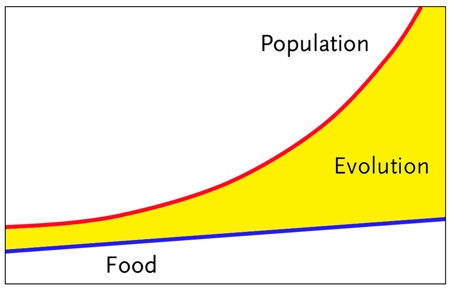
Charles Darwin and Alfred Wallace both realized from reading Malthus's work on population that natural selection is propelled by the difference between two growth patterns in the wild: population versus food. The greater propulsion of population growth could not be contained in the lesser geometric gains of its food production. This tension between the overwhelming multiplication of population and the slower expansion of its material container is the drive behind evolution.
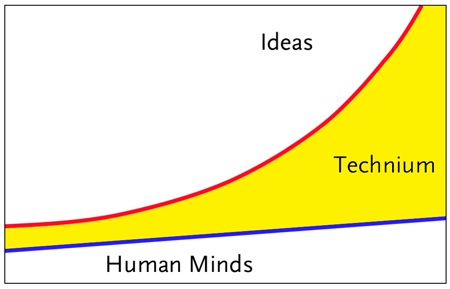
The evolution of the technium likewise gains its unmatched power from the difference between two growth rates. The number of ideas and their transmission via computers, books, telephone lines, patents, and so on increases in an exponential fashion. Information is, in fact, the fastest growing thing on this planet. Information is especially conducive to amplification and compounding. As the number of facts increase, the connections between facts increases exponentially faster. Because the mathematical law of combinations, the number of links between pages explodes faster than the number of pages increases. New inventions in certain fields like communication, which are powered by increasing combinations of connections, can increase the speed of invention overall, revving the engines of creation. Everywhere we look, the technium is wired with self-amplifying loops ballooning up the scale of change. Fundamentally, discoveries in the science of how to discover, and inventions in how to invent (the genie process we call science) accelerate the rate of discovery and invention everywhere.
But our human ability to absorb or process this explosion of ideas increases only linearly at best. Despite years spent in education, or bathed in the best nutrition, our brains are not doubling in speed, memory, and insight every 18 months, as computers do. In fact, biologically speaking, our brains are remarkably similar to the brains of the first Sapiens 50,000 years ago. The smartest humans are not exponentially smarter than the average ones, and the average IQ of a human is only slowly increasing over time by the most minute amount (a few percent per decade in modern times). Even collectively, unaided human intelligence is only growing in tandem with the number of humans. The gap between the escalating growth of information generated by us and our machines, and our tiny marginal improvements in being able to understand the oceans of information and make meaning from it is the driver behind the rapid evolution of the technium.
The work of understanding all this information is migrating from humans to the technium. We can no longer keep up with our own creations, and so we are constructing an apparatus to structure what we think, in the same manner that we first used writing on paper to extend our memory. Now we are offloading other mental functions. The technium contains an elaborate knowledge processing system consisting of encyclopedias, classification indexes, cross references, search engines, footnotes, citations, hypertext, and the web. These technologies organize the output of our collective minds — both intangible ideas and tangible inventions — into a semantic structure, much like an ecosystem. This incredibly complicated mesh of connections, interdependencies, associations, and emergent structure gives the technium a "meaning" that is outside our of understanding.
It's reasonable to figure that since the technium is simply "that which the mind produces" then at its root the most powerful force in the world must not be technology but the human mind. If this were so we'd have to recalibrate the equation above to state that the origin of all change in our lives lays in the mysterious force of intelligence and consciousness hiding between our ears. (That assertion reminds me of a joke I heard from a friend who said "whenever I get the idea that human mind is the most powerful thing in world I just remember what it is that is telling me this.") But the claim that the human mind is foremost power is not valid. No matter how much we use our biological mind's awareness to reflect upon our mind's workings, this type of mental introspection and self-improvement leads to extremely limited improvement at best, and usually none at all. Contemplation (even in a zen position) to optimize our own mind just doesn't scale up. Unaided, the mind makes very little headway in amplifying itself.
However, the technium, which is a product of our brain, can alter the circuits that produced it. People who grow up immersed in the technologies of writing and reading think differently. I don't mean humans think differently while reading. Reading and writing are cognitive tools that, once acquired, change the way in which the brain memorizes facts and conceptualizes ideas, and these changes stimulate abstract thinking. When psychologists use neuroimaging technology, like MRI, to compare the brains of literates and illiterates working on a task, they find many differences in how their brains work whether or not they are reading. Researcher Alexandre Castro-Caldas discovered that processing between the hemispheres of the brain was different between those who could read and those who could not. A key part of the corpus callosum was thicker in literates, and "the occipital lobe processed information more slowly in individuals who learned to read as adults compared to those who learned at the usual age." Psychologists Ostrosky-Solis, Garcia and Perez tested literates and illiterates with a battery of cognitive tests while measuring their brain waves and concluded that "the acquisition of reading and writing skills has changed the brain organization of cognitive activity in general… not only in language but also in visual perception, logical reasoning, remembering strategies, and formal operational thinking." Literacy — a human invention — rewires the human mind.
It is not just writing. Music, another invention, also alters the brain in a sustainable way. Many studies have shown how listening to music strengthens the communication wiring between brain hemispheres. Beside fostering an expected growth in auditory regions of the brain, regularly playing musical instruments significantly strengthens the thickness of the corpus callosum fibers and activates the cerebral cortex. Our mind makes a drum and flute, and the drum and flute remakes our mind.
0
comments »

 Posts
Posts