Showing posts with label iea. Show all posts

IEA Predictions Of Solar Power Capacity Growth  

Posted by Big Gav in , , , ,

Stunningly wrong, year after year...

IEA Global EV Outlook 2016  

Posted by Big Gav in ,

The IEA has freed their 2016 report on the EV market - Global EV Outlook 2016.

This report aims to provide an update on recent EV developments, providing detailed information on the recent evolution of EV registrations (vehicle sales), the number of EVs on the road, their modal coverage across the most relevant global vehicle markets. The analysis also looks at the availability and characteristics of Electric Vehicle Supply Equipment (EVSE), reporting on the evolution of deployment rates. The report includes a review and a discussion of key elements on policy support, both for EVs and EVSE. The analysis is also providing insights on the encouraging signs that characterized the recent evolution of battery costs and energy density.

IEA World Energy Outlook 2016  

Posted by Big Gav in , , ,

The IEA has released the 2016 version of their annual world energy outlook report - World Energy Outlook 2016.

The report has prompted a spate of articles about "peak oil demand" (with earlier reports from the Economist and WSJ being joined this week by Forbes, Bloomberg and The FT).

Other than speculation about when demand-driven peak oil production will occur, attention concentrated on:

1. Chinese coal use peaking in 2013 - China's coal use likely peaked in 2013 amid rapid shift to renewables, global energy report says (ABC).

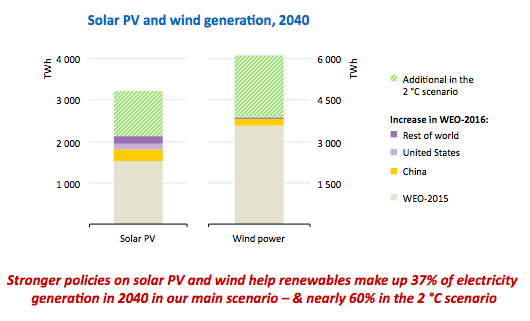
2. Wind and solar will contribute will become the dominant source of energy in most major economies within two decades - IEA makes mockery of Turnbull’s renewable energy scare campaign (RNE).

3. Oil production from conventional non-OPEC fields and oil sands will drop by 6.1 million barrels a day by 2040 (although they still predict overall production will rise) - How Big Oil Loses Even Without Peak Demand (Bloomberg).

4. Fatih Birol says"We see clear winners for the next 25 years — natural gas but especially wind and solar — replacing the champion of the previous 25 years, coal" - Renewables & Natural Gas Win Out In World Energy Outlook, But Investors Must Not Misread Oil Demand (Cleantechnica).

5. A combination of efficiency and deployment of renewables has decoupled economic growth from carbon emissions - Massive report details the energy economy that limits warming to 2°C (Ars Technica).

IEA still low-balling solar growth, says Energy Watch Group  

Posted by Big Gav in , ,

The recent IEA medium term renewable energy report has come in for some criticism from the Energy Watch Group - - IEA still low-balling solar growth, says Energy Watch Group.

All the major energy forecasts seem to underestimate renewable energy growth. Whether or not this is do do bias in favour of legacy energy sources or simply because they don't recognise the rate at which technology is improving and prices are dropping isn't clear - it would be interesting to have a look at the trends in the under-estimations over time...

The report found that last year saw 153 GW of new renewable capacity installed, while the headline figure picked up by many leading media outlets was that 500,000 solar panels were fitted every single day in 2015. However, the Energy Watch Group (EWG) – a long-term critic of the IEA’s calculations – has reported that the IEA has once again heavily underestimated the growth of wind and solar PV.

Despite a 13% increase in the IEA’s mid-term projections, the EWG’s analysis argues that these new calculations still suggest that wind and solar installations will peak in 2015 and 2016 respectively, with the five years between now and 2021 likely to see a slowing of the growth seen these past two years.

EWG chairman Christian Breyer calls these projections misleading, and remarked that the IEA is “playing a dangerous game” in relying on assumptions that err on the side of conservatism. Rather, the EWG analysis shows, solar growth between now and 2021 is likely to far exceed the projections laid out in the IEA report. As an example, India’s plan to install 90 GW of additional PV capacity to 2022 is off-handedly dismissed, with the IEA forecasting total PV growth in the whole of Asia Pacific will amount to 85 GW by 2021. “We would like to know why the IEA assumes that this policy target in India will not be achieved,” mused Breyer. “We have found no valid arguments in the report.”

There are accusations, too, of erroneous cost assumptions in the report, with EWG claiming that the IEA has overestimated the price of solar PV in major markets for 2016 by at least 20%. For example, PV power plants in India are currently averaging a cost of around $750/kWp, argues the EWG, whereas the IEA report says that “PV prices in leading markets should not be lower than $1,150 – $1,300/kWp”. The reality is that costs are already around 35% lower than that in China and Germany, the EWG analysis argues.

IEA: Renewables largest source of installed power capacity in the world  

Posted by Big Gav in , ,

The IEA has released their Medium-Term Renewable Market Report - IEA raises its five-year renewable growth forecast as 2015 marks record year.

The International Energy Agency said today that it was significantly increasing its five-year growth forecast for renewables thanks to strong policy support in key countries and sharp cost reductions. Renewables have surpassed coal last year to become the largest source of installed power capacity in the world.

The latest edition of the IEA’s Medium-Term Renewable Market Report now sees renewables growing 13% more between 2015 and 2021 than it did in last year’s forecast, due mostly to stronger policy backing in the United States, China, India and Mexico. Over the forecast period, costs are expected to drop by a quarter in solar PV and 15 percent for onshore wind.

Last year marked a turning point for renewables. Led by wind and solar, renewables represented more than half the new power capacity around the world, reaching a record 153 Gigawatt (GW), 15% more than the previous year. Most of these gains were driven by record-level wind additions of 66 GW and solar PV additions of 49 GW.

World Energy Reports, 2014  

Posted by Big Gav in , , , , , , ,

All of this year's major energy reports are now out :

Euan at Energy Matters has a summary of the BP report - Global Energy Trends – BP Statistical Review 2014.

  • Global primary energy supply has continued to grow, mainly fossil fuels (FF), mainly coal. FF supply was up 183 million tonnes oil equivalent (mtoe) in 2013 while new renewable supply was up 42 mtoe from 2012.
  • In 2003, FF accounted for 87% of global primary energy consumption. In 2013, FF accounted for 87% of global primary energy consumption. This is testimony to the absolute failure of energy policies aimed at reducing CO2 emissions.
  • In 2003, new renewables (wind, solar, geothermal, biofuels etc) accounted for 0.82% of total primary energy and by 2013 this had grown to 2.69%. In 2003, nuclear power accounted for 6.01% and this fell to 4.40% in 2013. The 1.87% growth in share of new renewables almost matches the 1.61% fall in the share of nuclear power. On the CO2 account, low emissions nuclear power has been replaced by low emissions renewable energy. The actual energy substitutions are a little more complex.
  • Oil consumption has been on a gently rising plateau since 2005 (Figure 1) and oil is declining in importance in the global energy mix (Figure 2). The fall in oil’s share has been picked up by coal and the only simple way for this substitution to occur is for oil fired power generation to close. Once all oil fired generation has been closed, expect severe upwards pressure on the oil price.

Robert Rapier also has some articles on the BP report - World Sets New Oil Production and Consumption Records and The US and Russia are Gas Giants.

First a note about BP’s definitions. “Oil” in the BP Statistical Review (BPSR) is defined as ”crude oil, tight oil, oil sands and natural gas liquids”, but excludes biofuels and liquid fuels produced from coal or natural gas. Consumption numbers do include all liquid fuels, so consumption numbers are always greater than production numbers, but this is merely an artifact of BP’s definitions.

Global oil production advanced in 2013 by 557,000 barrels per day (bpd), reaching a new all-time high of 86.8 million bpd (an increase of 0.6 percent over 2012). After declining in 2009, global crude oil production has now increased 4 years in a row. But as I noted in last month’s short article, while global oil production did indeed set a new record, the US production increase alone was 1.1 million bpd. Thus, outside the US global production actually declined by 554,000 bpd. ...

In 2013 global natural gas production advanced 1.1% to a new all-time high of 328 billion cubic feet per day (Bcfd). Except for a one-year decline in 2008-2009, global gas production has risen fairly steadily for about three decades, and production has more than doubled during that time span.

Power magazine also has a look at the BP report - Above-Average Growth Reported for Renewables in 2013.

According to the report, world power generation grew 2.5% in 2013, slightly up over 2012 (which saw 2.2% growth over 2011) but below the 10-year trend (3.3%). And while electricity generation fell for the third year in a row in member countries of the Organisation for Economic Co-operation and Development (OECD), it surged 4.8% in non-OECD countries. China, followed by the U.S., was the world’s largest power generator (Figure 1). Meanwhile, India overtook Japan to take third place. ...

Nuclear saw its first increase since 2010, climbing 0.9%. Nuclear consumption grew in the U.S., China, and Canada, but was offset by declines in South Korea, Ukraine, Spain, Russia, and Japan—whose nuclear output has fallen 95% since 2010 with nearly all of its reactors still offline after the Fukushima disaster.

Renewables generation, on the other hand, soared 16.3% and accounted for a record 5.3% share of global power generation, said the report. Globally, wind energy (up 20.7%) again accounted for more than half of renewable power generation growth, and solar power generation grew even more rapidly (33%).

The BS has a snippet from the IEA report looking at shifts in oil consumption - World oil's pivot to Asia.

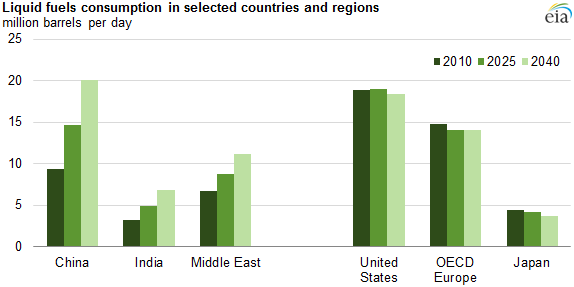
In the Reference case projection, world liquid fuels consumption increases 38 per cent from 87 million barrels per day in 2010 to 119 MMbbl/d in 2040. China, India, and other developing countries in Asia account for 72 per cent of the net world increase in liquid fuels consumption, with Middle East consumers accounting for another 13 per cent. Most liquid fuel demand is for industrial uses and transportation.

In the United States, Europe, Japan, and other mature industrialised economies, liquid fuel demand has leveled off and is projected to slowly decline. The combined effects of several factors have slowed or even reversed the growth in liquid fuels use. These factors include sustained high oil prices, efficiency standards for vehicles and equipment together with high taxation of motor fuels, price-driven fuel switching towards non-oil fuels outside of transportation, vehicle saturation, as well as structural changes in factors such as demographics and consumer behavior.

The BS also has an update on geothermal power in the US - Geothermal expands out of California.

EGS plants are currently being developed in several countries, and the first commercial-scale plant in the United States, the Desert Peak East pilot project in Nevada, began operating in 2013.

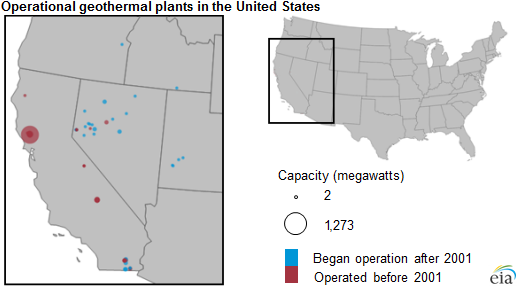
There are currently 64 operating conventional geothermal power plants in the United States, accounting for nearly 2700 megawatts of total capacity at the end o 2013. Over three-fourths of US geothermal power generation in 2013 was in California, largely because of favourable geothermal resources, policy, and market conditions in the state. The largest group of geothermal power plants in the world, a complex called the Geysers, located in Northern California, has more than 700 MW of capacity.

Since 2001, only seven of 30 new plants exceeding 1 MW have been built in California, where most available low-cost geothermal resources have previously been developed. Sixteen of those 30 plants built after 2001 are in Nevada, with the remainder in Oregon, Idaho, Utah, and Hawaii. Most of the newer plants are relatively small, and while geothermal generation rose 11 per cent between 2008 and 2013, the geothermal share of total US electricity generation has remained consistently around 0.4 per cent since 2001

ReNew Economy has a post on the IEA reports' comments on solar power and renewable energy - Only solar PV is exceeding expectations for clean energy

The main message in the new Medium-Term Renewable Energy Market Report from IEA is that sustained growth in renewable energy is at risk. Governments, therefore, need to strengthen efforts to facilitate growth of renewables in all energy sectors. In the power sector, both hydropower, wind and bioenergy fall short of the deployment speed consistent with IEAs 2 Degree Scenario. Solar PV, says IEA, is «the only source expected to exceed global 2DS targets by 2020, boosted by cost declines and an increasingly rapid scale-up in non-OECD markets.»

This is troublesome news for renewables in general, but encouraging news for solar energy. And having studied the underlying assumptions in the report, I am tempted to add: This is just the beginning of the solar awakening of IEA; be ready for better news next year.

IEA says fossil fuels must be replaced by renewables  

Posted by Big Gav in ,

ReNew Economy has a look at this year's "Energy Technology Perspective" report from the IEA - IEA says fossil fuels must be replaced by renewables.

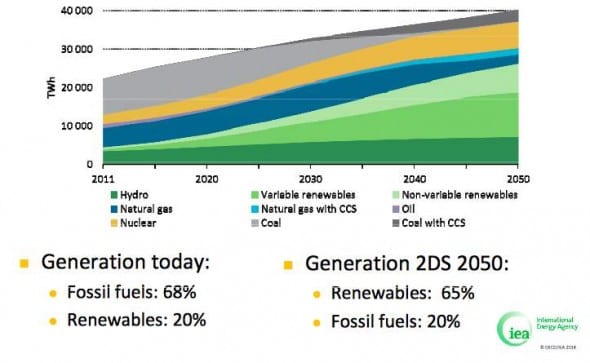
In its biannual Energy Technology Perspective report, the traditionally conservative IEA (of which Australia is a member) says the energy mix for the world’s electricity supply needs to be flipped within a few decades, from 68 per cent fossil fuels now to at least 65 per cent renewables by 2050.

And it argues that action is needed now,or it will get more costly. Already, the delays in action in the last few years has increased the bill to $44 trillion from $36 trillion. While that sounds like a big number, the IEA says it is a small percentage of globa GDP over the next three decades, and would be more than offset by $115 trillion in fuel savings.

RNE also has a companion piece on solar power - Baseload to be marginalised as solar takes pole position.

The International Energy Agency says solar energy – a combination of solar PV and concentrated solar thermal with storage – is likely to become the dominant source of energy across the world, accounting for more than 27 per cent of all electricity produced by 2050.

The IEA says its core scenarios for reaching climate targets by 2050 call for 68 per cent of generation to be sourced from renewable energy, but in the (increasingly likely) event that carbon capture and storage and nuclear cannot take up their imagined shares, then the IEA has painted a “high renewables” scenario where solar takes an even greater role. ...

Solar PV, for instance, is likely to expand way behind even the IEA’s most bullish scenarios, as a result of widespread deployment and continuing cost cuts. The IEA suggests that solar PV could account for 16 per cent of global generation by 2050, although this would require an average of more than 116GW of solar PV to be deployed over that time.

Its estimates, however, seem conservative given that most private forecasters suggest that the solar industry will reach 100GW installation a year anyway by 2017 or 2018, and capacity is likely to grow further beyond that. Its “vanilla” scenario for reaching its climate goals require just an average of 67GW of solar PV to be installed a year. The solar market is likely to reach that figure in 2015.

In any case, the IEA says that solar thermal with storage, the kind of facility that has been deployed in Spain, and is now being constructed in the US, and in South Africa and Chile, will also play a critical role, accounting for 11 per cent of global electricity supply in 2050 because of its ability to switch on production, and switch off, at any time of day.

IEA World Energy Outlook 2013  

Posted by Big Gav in ,

This year's World Energy Outlook from the IEA has been released, prompting a flood of press reports. Most of them are headlining that the US is predicted to become the world's top producer in 2015 on the back of the shale oil boom, but that this won't last - with the middle east soon returning back to the top. Others note the (pessimistic and inaccurate) forecast for renewable energy growth.

National Geographic has a summary - IEA World Outlook: Six Key Trends Shaping the Energy Future.

Thanks to "fracking," the United States is reaching the top spot among world oil producers sooner than expected, and is "well on its way to realizing the American dream" of energy independence, the International Energy Agency (IEA) said Tuesday. "But this does not mean that the world is on the cusp of a new era of oil abundance," the IEA warned in its closely watched annual World Energy Outlook. Instead, the agency predicted that no other country will replicate the United States' success with hydraulic fracturing and other unconventional technologies that have led to the North American boom in oil and natural gas production. (See related "Interactive: Breaking Fuel From Rock," "The Great Shale Gas Rush," and "The New Oil Landscape.") And by the mid-2020s, the Middle East—the world's only source of low-cost oil—will again be unchallenged as the most important and influential source of oil supply on the globe. The Paris-based IEA was established after the oil crisis of the early 1970s in a move by oil-consuming nations to keep better track of trends and improve energy security. Its annual World Energy Outlook, with hundreds of pages of analysis and charts, is considered the industry bible. Here's a rundown of key trends IEA identified as shaping the world outlook this year ...

1. U.S. energy boom is unique, has risks. ...

2. Fossil fuels will still dominate the scene.

IEA expects renewable energy generation to double by 2035 under existing policies. But solar, wind, and hydropower are not on track to catch up with oil or coal, and world primary energy demand is on track to increase 43 percent.

Today's share of fossil fuels in the world energy mix—82 percent—is the same as it was 25 years ago. And by 2035, the IEA forecasts that fossil fuels will barely give up ground, providing 75 percent of global energy.

Governments around the world subsidized consumption of fossil fuel to the tune of $544 billion last year—more than five times greater than supports for renewable energy, which totaled $101 billion in 2012. IEA expects subsidies for renewables to more than double to $220 billion by 2035, but they will still be overshadowed by government supports for fossil fuels without reform.

Unsurprisingly, given the expected energy mix, carbon dioxide emissions from energy are expected to continue their upward movement, jumping 20 percent by 2035. This leaves the world on a trajectory consistent with a long-term average temperature increase of 3.6°C (6.5°F), far above the internationally agreed 2°C (3.6°F) target.

3. India will edge China as "engine" of energy demand. ...

4. Move over, automobiles. The age of trucks is here. ...

4. Renewable energy giant Brazil set to be major oil exporter. ...

6. Reliance on costly imports means long-term hurt for Europe. ...

IEA Sankey Diagrams  

Posted by Big Gav in , ,

The Oil Drum has almost worked through the backlog of "farewell" posts - JoulesBurn chose somewhat surprisingly to give the IEA a pat on the back (which they were apparently delighted by) - IEA Sankey Diagrams.

The International Energy Agency has taken its share of abuse from The Oil Drum over the years for its rather optimistic forecasts. But it deserves a hearty shout-out for an invaluable resource it has on its web site: Interactive Sankey Diagrams for the World.

Fracking: A new dawn for misplaced optimism  

Posted by Big Gav in , ,

The Independent has a jaundiced look at the shale gas boom in the US - Fracking: A new dawn for misplaced optimism.

You would think we were swimming in oil. The International Energy Agency's (IEA) latest World Energy Outlook forecasts that the United States will outstrip Saudi Arabia as the world's largest producer by 2017, becoming "all but self-sufficient in net terms" in energy production. While the "peak oil" pessimists are clearly wrong, so is a simplistic picture of fossil fuel abundance.

When the IEA predicts an increase in "oil production" from 84 million barrels a day in 2011 to 97 in 2035, it is talking about "natural gas liquids and unconventional sources", which includes a big reliance on "fracking" for shale gas. Conventional oil output will stay largely flat, or fall.

The IEA has been exposed before as having, under US pressure, artificially inflated official reserve figures. And now US energy consultants Ruud Weijermars and Crispian McCredie say there is strong "basis for reasonable doubts about the reliability and durability of US shale gas reserves". The New York Times found that state geologists, industry lawyers and market analysts privately questioned "whether companies are intentionally, and even illegally, overstating the productivity of their wells and the size of their reserves." And former UK chief government scientist Sir David King has concluded that the industry had overstated world oil reserves by about a third. In Nature, he dismissed notions that a shale gas boom would avert an energy crisis, noting that production at wells drops by as much as 90 per cent within the first year.

The rapid decline rates make shale gas distinctly unprofitable. Arthur Berman, a former Amoco petroleum geologist, cites the Eagle Ford shale, Texas, where the decline rate is so high that simply to keep production flat, they will have to drill "almost 1,000 wells" a year, requiring "about $10bn or $12bn a year just to replace supply". In all, "it starts to approach the amount of money needed to bail out the banking industry. Where is that money to come from?"

In September, the leader of the US shale gas revolution, Chesapeake Energy, sold $6.9bn of gas fields and pipelines to stave off collapse. Four months ago Exxon's CEO, Rex Tillerson, told a private meeting: "We're making no money. It's all in the red." The worst-case scenario is that several large oil companies at once face financial distress. Then, says Berman, "you may have a couple of big bankruptcies or takeovers and everybody pulls back, all the money evaporates, all the capital goes away."

Deutsche Bank: Don’t bet on the IEA's prediction of U.S. oil dominance  

Posted by Big Gav in , ,

Reading the pages of the Business Spectator in recent months I've noticed a seemingly endless stream of articles by Robert Gottliebsen claiming the US "shale gas revolution" will result in US energy independence, a resurgence in US domestic manufacturing and the demise of Australia's LNG export industry (unless the unions are crushed and construction costs dramatically lowered).

I usually just write these sort of crazed ramblings off as some sort of PR campaign on behalf of BHP in particular (someone needs to give Marius Kloppers some good press) and the mining and energy industries in general, as they fight the endless battle of capital against labour.

Maybe I'm missing something but from my high level understanding of the US gas industry, the natural gas "cliff" predicted by the likes of Julian Darley never eventuated courtesy of the shale gas boom - however US gas production isn't making new highs (so where is the glut people keep claiming exists ?) - instead the price collapsed due to a combination of manufacturing moving offshore (particularly gas intensive industries like fertiliser and chemicals) and the recession in the US causing demand to slump. Should the US return to growth and industry return based on the lure of cheap gas I think we'll find gas prices climbing rapidly again.

The IEA gave this sort of delusional thinking (US energy independence ahoy !) more momentum recently with the new World Energy Outlook report echoing Citibank's claims earlier this year that the US will soon be the world's leading oil producer (again, thanks to shale oil). Its probably worthwhile remembering that 10 years ago the IEA was claiming global oil production would now be over 100 million barrels per day (currently it stands at 90 million barrels per day, with significant contributions from biofuels and natural gas liquids).

Technology Review has a look at the report - Shale Oil Will Boost U.S. Production, But It Won’t Bring Energy Independence.

The idea that the U.S. could overtake Saudi Arabia, even temporarily, is a stunning development after years of seemingly inexorable declines in domestic oil production. U.S. production had fallen from 10 million barrels a day in the 1980s to 6.9 barrels per day in 2008, even as consumption increased from 15.7 million barrels per day in 1985 to 19.5 million barrels per day in 2008. The IEA estimates that production could reach 11.1 million barrels per day by 2020, almost entirely because of increases in the production of shale oil, which is extracted using the same horizontal drilling and fracking techniques that have flooded the U.S. with cheap natural gas.

As of the end of 2011, production had already increased to 8.1 million barrels per day, almost entirely because of shale oil. Production from two major shale resources in the U.S.—the Bakken formation in North Dakota and Montana and the Eagle Ford shale in Texas, now total about 900,000 barrels per day. In comparison, Saudi Arabia is expected to produce 10.6 million barrels per day in 2020.The shale oil resource, however, is limited. The IEA expects production to start gradually declining by the mid-2020s, at which time Saudi Arabia will reclaim the top spot. ...

The other potential issue is whether opposition to fracking in local communities might put the brakes on shale oil development, Sears says. Concerns that fracking will contaminate drinking water have led to objections in some areas, as have concerns that shale oil requires far more drilling wells than conventional oil production. Even if the U.S. is able to quickly develop its shale oil resource, it isn’t likely to be enough to completely eliminate oil imports. The IEA expects that the U.S. will still import 3.4 million barrels per day in 2035. The U.S. consumes nearly 19 million barrels per day, leaving a gap of more than 7 million even at the expected peak in shale oil production in the mid-2020s. However, the IEA expects the gap will be reduced partly by increased use of biofuels and natural gas in transportation, as well as improved vehicle efficiency, which could lower demand for oil.

The IEA does conclude that the United States will nearly be energy self-sufficient by 2035, but that’s after offsetting oil imports with exports of coal and natural gas. To be truly energy independent, the United States would have to invest in technology for converting natural gas and coal into the liquid fuels needed for transportation, or have other technical breakthroughs, such as improved batteries or biofuels, that would quickly reduce the demand for oil.

The Globe and Mail reports that Deutsche Bank analysts aren't convinced by the IEA's predictions for US oil production - Don’t bet on U.S. oil dominance.
An influential report arguing that the U.S. will soon become the world’s largest oil producer made a lot of headlines, especially in Canada where the implications are huge.

Too bad its findings are wrong, argue the energy analysts at Deutsche Bank.

It’s not that the oil isn’t there, but the conditions needed to develop it are lacking, Deutsche Bank analysts Paul Sankey, David Clark and Silvio Micheloto write in a note entitled ‘Why the U.S. WON"T surpass Saudi Arabia as Number 1 oil producer.’ (The emphasis is the authors’. And if you’re wondering if these guys know what they are talking about, Mr. Sankey has been ranked No. 1 for the last two years by Institutional Investor for coverage of integrated oil companies.)

A combination of U.S. policy restricting exports and sagging domestic U.S. demand for oil products will keep prices soft relative to the rest of the world, making the projects needed to create the huge U.S. supply growth uneconomical, they wrote Thursday in their critique of the report by the International Energy Agency which pointed to a huge shift toward North America in oil production.

“We don’t think the U.S. can become the largest oil producer in the world. Why not? Price, cost and returns. None are really dealt with by the IEA.”

OilPrice.com has an interview with longtime shale gas critic Arthur Berman - Shale Gas Will be the Next Bubble to Pop - An Interview with Arthur Berman.
The “shale revolution” has been grabbing a great deal of headlines for some time now. A favourite topic of investors, sector commentators and analysts – many of whom claim we are about to enter a new energy era with cheap and abundant shale gas leading the charge. But on closer examination the incredible claims and figures behind many of the plays just don’t add up. To help us to look past the hype and take a critical look at whether shale really is the golden goose many believe it to be or just another over-hyped bubble that is about to pop, we were fortunate to speak with energy expert Arthur Berman.

Arthur is a geological consultant with thirty-four years of experience in petroleum exploration and production. He is currently consulting for several E&P companies and capital groups in the energy sector. ...

Oilprice.com: How do you see the shale boom impacting U.S. foreign policy?

Arthur Berman: Well, not very much is my simple answer.

A lot of investors from other parts of the world, particularly the oil-rich parts have been making somewhat high-risk investments in the United States for many years and, for a long time, those investments were in real estate.

Now these people have shifted their focus and are putting cash into shale. There are two important things going on here, one is that the capital isn't going to last forever, especially since shale gas is a commercial failure. Shale gas has lost hundreds of billions of dollars and investors will not keep on pumping money into something that doesn’t generate a return.

The second thing that nobody thinks very much about is the decline rates shale reservoirs experience. Well, I've looked at this. The decline rates are incredibly high. In the Eagleford shale, which is supposed to be the mother of all shale oil plays, the annual decline rate is higher than 42%.

They're going to have to drill hundreds, almost 1000 wells in the Eagleford shale, every year, to keep production flat. Just for one play, we're talking about $10 or $12 billion a year just to replace supply. I add all these things up and it starts to approach the amount of money needed to bail out the banking industry. Where is that money going to come from? Do you see what I'm saying?

Oilprice.com: You've been noted suggesting that shale gas will be the next bubble to collapse. How do you think this will occur and what will the effects be?

Arthur Berman: Well, it depends, as with all collapses, on how quickly the collapse occurs. I guess the worst-case scenario would be that several large companies find themselves in financial distress.

Chesapeake Energy recently had a very close call. They had to sell, I don't know how many, billions of dollars worth of assets just to maintain paying their obligations, and that's the kind of scenario I'm talking about. You may have a couple of big bankruptcies or takeovers and everybody pulls back, all the money evaporates, all the capital goes away. That's the worst-case scenario.

Oilprice.com: Energy became a big part of the election race, but what did you make of the energy policies and promises that were being made by both candidates?

Arthur Berman: Mitt Romney, particularly, talked about how the United States would be able to achieve energy independence in five years. Well, that's garbage.

The Oil Drum also has some cynical words about the potential of shale gas - Tech Talk - Global Oil Supply .
One of the headlines this week from the IEA Report suggests that the United States will be the top global oil producer in five years. Yet back in DeSoto Parish in Louisiana, where the Haynesville Shale discovery in 2008 started the bonanza, revenues are now falling and school board budgets are strapped as the end of the glory days are beginning to appear.

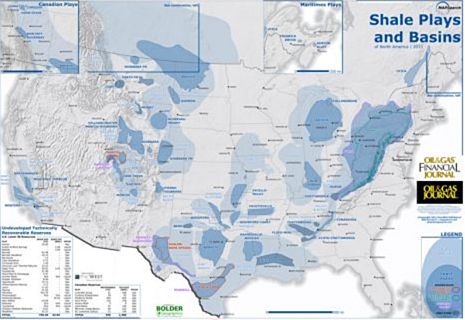
Just this week Aubrey McClendon said that Chesapeake’s prospects for oil in Ohio, where Chesapeake had high hopes for the Utica Shale, are now dim. It is easy to look at one of the large maps showing all the shale deposits in the United States that the Oil and Gas Journal include in their print editions, and to be carried away (as the IEA apparently are) with the vast acreage that is shaded on the map. Unfortunately, as we can see, reality tells another story. The size of the resources have been measured in the past, and with the best plays being given preference, the recognition of decline rates and unprofitable wells have not yet been given the prominence in the popular press that they will ultimately draw.

It seems unrealistic to anticipate the levels now being projected for future North American production of oil. Nevertheless, these projections do tend to crowd conflicting stories on the subject out of the spotlight. Further, if the predictions for American production gains, even in the short term, turn out to be optimistic, then the impacts may be even more exaggerated than is currently appreciated. Consider that OPEC now expects that North America will continue to provide the greatest y-o-y increase in supply over other nations, and there are in fact, few other nations that will contribute much more in the next year.
Stuart at Early Warning also has a post on the IEA report - IEA: US To Be World's Largest Oil Producer. Plus Energy Bulletin has a set of links to commentary too - Commentaries on the IEA WEO 2012 - peak postponed? - Nov 14.
I am less persuaded myself that using a thousand oil rigs to generate an extra one million barrels per day of oil is necessarily a sign of a large and long-term sustainable increase in US oil production (as opposed to, say, frenzied scraping of the bottom of the barrel). But, still, I'm not certain beyond a reasonable doubt just how deep this particular barrel can be scraped.

At any rate, one thing that is interesting is that the chart above shows the US second peak just reaching 10mbd of oil, and yet the US will be the largest producer of oil. Since the IEA says Saudi production is currently at 9.5mbd and Russia at 10.75mbd, the implication is that neither Russia or Saudi Arabian production will increase at all between now and 2020 when the US will surpass them.

Apparently, the strategy of massed hordes of drilling rigs fracking for shale oil can only be of benefit in the United States.

It used to be Saudi Arabia that was used to fill in the wedge between desired supply and expected demand in official energy projections. Apparently the agencies have now accepted that Saudi Arabia cannot or will not increase production and the US is now being assigned the role of supplier of last resort for future energy projections.

IEA sees a world run on solar  

Posted by Big Gav in ,

The Climate Spectator has a look at a recent IEA report on solar energy - IEA sees a world run on solar

The International Energy Agency has outlined, in detail, its vision of how solar energy technologies could form the backbone of the world’s electricity network, providing half its electricity needs by 2060.

The scenario, outlined in the IEA’s Solar Energy Perspectives, released last week, was first canvassed in late August. Essentially, it looks at the options available to the world if it took decisive, but belated action, on climate change, and alternative technologies such as nuclear and carbon capture and storage failed to deliver as promised.

And, for the first time, it also recognises a future where baseload power may no longer provide the bedrock of the world’s energy needs, as it has done for a century or more, but is replaced by a system of flexible and inflexible energy sources, where intermittent sources such as wind and solar PV are complemented by “dispatchable" and flexible sources such as solar thermal with storage, hydro, and gas.

The IEA has been canvassing a range of scenarios over how the energy systems of the future may look under various climate and energy policy responses. Under its 450 scenario, where the world holds true to its political target of limiting global warming to an average 2°C by capping greenhouse gas emissions at 450 parts per million, solar accounts for less than 20 per cent of total generation by 2050, rising to 25 per cent of generation in its “high renewable" scenario, where renewables need to account for 75 per cent of the world’s generation to make up for the lack of nuclear or CCS.

However, in its “Testing the Limits" scenario, the IEA considers what would happen if the world made a belated but sharper change in its energy policy – whether for security, economic or climate reasons, as seems increasingly likely given the nature of the international climate talks – and if many countries decided to abandon nuclear power and carbon capture and storage was found to be costlier, more limited or not as safe as hoped, which it concedes is quite possible.

In this scenario, the IEA says, solar energy could become the backbone of a largely renewable energy system worldwide. The make-up of energy sources varies from region to region, thanks to climate variations, but most of the estimated nine billion people will live in warmer climates, and areas with strong solar radiation (such as north Africa and the Middle East to Europe, and Australia to Indonesia), and become net exporters of solar energy. In colder climates such as Europe, wind and solar PV match the seasonal demand peaks.

Globally, the IEA scenario has solar thermal accounting for 28 per cent of total electricity generation by 2060, with some 6,000GW of capacity with storage (it has around 1GW now). Solar PV accounts for 20 per cent of generation, with 12,000GW of installed capacity (about 40GW now), and solar fuels add a further 2 per cent of generation.

Of the other technologies, wind power also makes up 28 per cent of generation, with 10,000GW of capacity, hydropower provides 10 per cent, and baseload – a mixture of geothermal, nuclear and biomass with CCS – provides 11 per cent of generation with around 1,200GW of capacity. Natural gas has capacity of around 3000GW, but is used sparingly as a balancing fuel and accounts for just 1 per cent of total generation.

The IEA does not break down the energy contributions in individual regions, but it should be noted that in its “high renewable" 450 scenario, the IEA says 40 per cent of the energy in regions such as Australia, central Asia, parts of India and south-western US, and the Middle East, could come from solar thermal alone.

As for costs, the IEA says, it is simply a matter of planning ahead. “Renewables in general, and solar energy in particular, may not always offer the lowest cost options to meet our energy needs, nor even the cheapest way of doing so while reducing global carbon emissions," it notes. But because of the risk that other options may fall short, solar technologies offering “indigenous, inexhaustible resources", are more secure, less likely to experience price volatility once the technologies are mature, are environmentally sustainable, and “the cheapest known antidote to catastrophic climate change, even if they are or appear to be higher-cost options in other ways."

It says that by 2060, the world is four times richer, but only consuming 50 per cent more energy because of energy efficiency measures. “Even if the cost of one energy unit were twice as much as today, the total energy expenditure would be proportionally smaller than today. It is thus conceivable to prefer an energy future that provides security, economic stability and preserves the sustainability of ecosystems and the environment, even if it is not the least-cost option when such considerations are ignored."

But it may not be that expensive. The IEA notes that solar PV is already competitive with “bulk power" in many areas, particularly islands, off-grid locations, and where PV is competing with oil. Solar thermal is also likely to fall substantially – a recent tender for a 50MW solar thermal plant in Mongolia was bid at $140/MWh. It says that solar thermal will be competitive with intermediate and peaking plant by 2020, and by 2030, solar costs will range from $50/MWh in the best solar regions, to $150/MWh in the worst. Other technologies will be grouped north or south of $100/MWh. It notes that, in the case of building integrated solar PV, where solar will be crucial to the value, “the cost of PV would almost vanish in the market segment where it currently costs the most."

BusinessGreen reports that South Africa has approved a raft of renewable energy projects, including 2 solar thermal power plants - South Africa green lights 1.4GW of new wind and solar power projects
Plans to build more than 3.5GW of renewable energy capacity in South Africa have taken a major step forward after 28 wind and solar power projects were approved as part of a government tender round that should serve to burnish the host country's green credentials as the Durban Summit enters its final few days.

The government yesterday awarded preferred bidder status to projects totalling 1,416MW of capacity, split between wind power, solar photovoltaic and concentrated solar power projects.
The 28 winners were selected from a total of 53 bids and now have until June 2012 to secure financial close and then begin construction.

The government awarded preferred bidder status to 18 solar PV projects totalling 632MW, and eight wind power projects, totalling 634MW. Two concentrated solar projects totalling 150MW, including the 100MW Abengoa-led KaXu Solar One also got the green light.

Climate Progress has a post looking at Interview of David Crane, CEO of US utility NRG Energy - Utility CEO on Solar: In “3 to 5 Years You’ll Be Able to Get Power Cheaper from the Roof of Your House Than From the Grid”.
David Crane, CEO of NRG Energy: The fundamental issue of our day [is] climate change…. The people who were opposed to climate change legislation used one of two tactics. They either said, “Well, we don’t believe it’s happening.” Which, of course, is just a bald-faced lie.

Or the second part of the one/two punch is, “We can’t afford to do anything about it because a synonym for the word “green” is “expensive.” But looking forward, electric vehicles will be far cheaper to operate than internal combustion engine vehicles. And solar panels on the roof will provide power more cheaply than taking power from the grid.

That’s from a Yale Environment 360 Interview of David Crane, the CEO of one of America’s’s largest electric utilities. It produces power for some 20 million U.S. households, and over 90% of NRG’s power comes from natural gas and coal. But Crane says the future — the near future — will be different.

Climate Progress has written a number of articles on the sharply declining cost of solar photovoltaics (see “Solar is Ready Now: ‘Ferocious Cost Reductions’ Make Solar PV Competitive“). It’s good to hear from a leading utility executive that the facts on the ground bear our analyses out.

Here are more excerpts from this remarkable interview, including his discussion of “democratization of customer choice” and the key role of electric vehicles:


e360: What can you do as a major power generator to nudge the country toward a renewable energy future?

Crane:I think the most important thing is to make the American public aware that now they have energy choices in a way that they never really did. You don’t just have to settle for using electricity in your house that is supplied by coal-fired power plants on the grid. And you don’t just have to put oil that comes from the Middle East in your gas tank. You can buy an electric car. You can put solar panels on your roof. You have choices now…..

e360: Could you talk about NRG’s move into utility-scale solar, and also your vision long-term of large-scale solar, versus distributed [smaller-scale] solar power?

Crane: So far most of our business has been utility-scale solar — gigantic plants in the desert. The biggest solar [project] we have is 295 megawatts. That’s something like 6 million solar panels. Those projects are really dependent on two things, because they cost over a billion dollars: the Department of Energy (DOE) Loan Guarantee Program and California’s 33 percent Renewable Portfolio Standard, and the fact that the two largest California utilities have been willing to sign long-term agreements in order to meet their requirements [to obtain 33 percent of their electricity from renewables by 2020] under the Renewable Portfolio Standards. We have over 800 megawatts of projects out there, which is a huge number for solar. But our view is that because the DOE Loan Guarantee Program is going away and the California utilities are coming close to putting themselves in a position to satisfy the requirement, there will be fewer of those projects in the future.

We expect to continue to pursue that business and to do well, but that’s not going to be the explosive-growth part of the industry. The explosive-growth part will be between distributed solar power, which is like 1 to 10 megawatt size, and then residential, which is measured in kilowatts. We have so many parking lots and warehouse rooftops and residential locations where people want to reduce their monthly electric bills and that is just an enormous area of growth….

e360: Can you explain your three-pronged approach to transforming the country’s electricity system.

Crane: Democratization of customer choice in our sector begins with two things. One is the electric car and the other is the solar panel on the roof. I think it actually starts with the electric car. You put the electric car in your garage and you really have a mini power plant because these batteries that drive electric cars are quite substantial pieces of equipment. The average car in the United States is sitting still about 22 hours a day. Those are hours where the car can either be accepting power from the grid or selling power through the grid in a phenomenon we refer to as V2G, vehicle-to-grid. That leads to the third leg of the trilogy, which is the smart meter, because between a smart meter in your house, combined with time and use pricing, you essentially want that electric car to be charging between midnight and four in the morning. And you want to have it available to basically drain itself a little between 2 and 6 o’clock in the afternoon. But someone has to tell it what’s going on with the grid at that point. And that’s what the smart meter does.

Right now around the country people are trying to introduce smart meters as just another information device. In our view, no one wants to pay for another information device, particularly when the information being given is about something that people don’t care about, which is their electricity use. So smart meters will only be accepted by the American public when they do something of value. And the first thing that they’ll do of value is they will sense when it’s expensive to run electricity and they’ll turn appliances off around the house. But the next thing they’ll do, which is the most valuable thing that will actually put dollars in your pocketbook, is that when the smart meter recognizes that the wholesale system is getting tight and there is good pricing, it will actually sell into the grid from the car battery. Or if power from the grid is getting really expensive, the smart meter might just turn the house off from the grid and then run the key appliances in the house off the electric car in the garage.

Then you have the solar panels on the roof. If you tie in a rooftop solar panel with a smart meter, then it’s exactly analogous to the electric car battery. The smart meter could turn off the house from the grid at 3 in the afternoon and rely exclusively on the power that’s coming from the solar panels on the roof, saving the customer a lot of money on their bill from the grid. And if the person puts a big solar panel on their roof, they could sell power from that. ...

IEA World Energy Outlook: “If we don’t change direction soon, we’ll end up where we’re heading”  

Posted by Big Gav in ,

SP at TOD ANZ has a look at the latest IEA report - “If we don’t change direction soon, we’ll end up where we’re heading”.

That is the prominent quote headlining the English language executive summary of the World Energy Outlook Report of the International Energy Agency released Wednesday.

The following are selected passages from the projections made by the IEA. Bolding is as in the original, underlining and [text ] added.

There are few signs that the urgently needed change in direction in global energy trends is underway. Although the recovery in the world economy since 2009 has been uneven, and future economic prospects remain uncertain, global primary energy demand rebounded by a remarkable 5% in 2010, pushing CO2 emissions to a new high. Subsidies that encourage wasteful consumption of fossil fuels jumped to over $400 billion.

Despite the priority in many countries to increase energy efficiency, global energy intensity worsened for the second straight year. Against this unpromising background, events such as those at the Fukushima Daiichi nuclear power plant and the turmoil in parts of the Middle East and North Africa (MENA) have cast doubts on the reliability of energy supply, while concerns about sovereign financial integrity have shifted the focus of government attention away from energy policy and limited their means of policy intervention, boding ill for agreed global climate change objectives.
The assumptions of a global population that increases by 1.7 billion people and 3.5% annual average growth in the global economy generate ever-higher demand for energy
services and mobility. A lower rate of global GDP growth in the short-term than assumed in this Outlook would make only a marginal difference to longer-term trends.
The age of fossil fuels is far from over, but their dominance declines. Demand for all fuels rises, but the share of fossil fuels in global primary energy consumption falls slightly from 81% in 2010 to 75% in 2035; natural gas is the only fossil fuel to increase its share in the global mix over the period to 2035. In the power sector, renewable energy technoogies, led by hydro-power and wind, account for half of the new capacity installed to meet growing demand.
We cannot afford to delay further action to tackle climate change if the long-term target of limiting the global average temperature increase to 2°C, as analysed in the 450 Scenario, is to be achieved at reasonable cost. In the New Policies Scenario, the world is on a trajectory that results in a level of emissions consistent with a long-term average temperature increase of more than 3.5°C. Without these new policies, we are on an even more dangerous track, for a temperature increase of 6°C or more.
image
Four-fifths of the total energy-related CO2 emissions permissible by 2035 in the 450 Scenario are already “locked-in” by our existing capital stock (power plants,  buildings, factories, etc.). If stringent new action is not forthcoming by 2017, the energy-related infrastructure then in place will generate all the CO2 emissions allowed in the 450 Scenario up to 2035, leaving no room for additional power plants, factories and other infrastructure unless they are zero-carbon…  Delaying action is a false economy: for every $1 of investment avoided in the power sector before 2020 an additional $4.3 would need to be spent after 2020 to compensate for the increased emissions.
In the 450 Scenario, we need to achieve an even higher pace of change, with efficiency improvements accounting for half of the additional reduction in emissions. The most important contribution to reaching energy security and climate goals comes from the energy that we do not consume.
Rising transport demand and upstream costs reconfirm the end of cheap oil. All of the net increase in oil demand comes from the transport sector in emerging economies, as economic growth pushes up demand for personal mobility and freight.
Four-fifths of oil consumed in non-OECD Asia comes from imports in 2035, compared with just over half in 2010. Globally, reliance grows on a relatively small number of producers, mainly in the MENA region, with oil shipped along vulnerable supply
Coal has met almost half of the increase in global energy demand over the last decade. Whether this trend alters and how quickly is among the most important questions for the future of the global energy economy. Maintaining current policies would see coal use rise by a further 65% by 2035, overtaking oil as the largest fuel in the global energy mix.
image
China’s consumption of coal is almost half of global demand and its Five-Year Plan for 2011 to 2015, which aims to reduce the energy and carbon intensity of the economy, will be a determining factor for world coal markets. China’s emergence as a net coal importer in 2009 led to rising prices and new investment in exporting countries, including Australia, Indonesia, Russia and Mongolia.
India’s coal use doubles in the New Policies Scenario, so that India displaces the United States as the world’s second-largest coal consumer and becomes the largest coal importer in the 2020s.
If the average efficiency of all coal-fired power plants were to be five percentage points higher than in the New Policies Scenario in 2035 … CO2 emissions from the power sector [would be lower] by 8%
…CCS plays a role only towards the end of the projection period…
…If CCS is not [or can not be] widely deployed in the 2020s, an extraordinary burden would rest on other low-carbon technologies…
image
 For further detail go to the website. There is a 6 page factsheet ...

The top five coolest ways to integrate renewable energy into the grid  

Posted by Big Gav in , , ,

Grist has a post on a recent IEA report into enabling grids powered by renewables - The top five coolest ways to integrate renewable energy into the grid.

Intermittent renewables at high penetrations will bring new challenges for the grid. But how big will they be? And is it true that wind and solar will necessarily need storage or natural gas back-up at high levels?

The International Energy Agency (IEA) wanted to know, so it modeled a variety of high-penetration scenarios in eight geographic regions around the world. Hugo Chandler, a senior policy analyst with the IEA, explains the organization's findings to Climate Progress:
Variability is not just some new phenomenon in grid management. What we found is that renewable energy is not fundamentally different. The criticisms of renewables often neglect the complementarities between different technologies and the way they can balance each other out if spread over certain regions and energy types.

Grid operators are constantly working to balance available supply with demand -- it's what they do. There are always natural variations that cause spikes in demand, reductions in supply, or create disturbances in frequency and voltage. Once you see there are a variety of ways to properly manage that variability, you start whittling away at the argument that you always need storage or a megawatt of natural gas backup for every megawatt of renewable energy.

Theoretical modeling is important. But what companies are doing in reality?

Here's five of the top methods for integrating renewable energy into the grid -- proving that intermittency isn't the showstopper that critics make it out to be. Explanations of each of these with videos are below.

1. Intelligent demand response
2. Microinverters and maximum power point trackers
3. Wind energy management tools
4. The virtual power plant
5. The hybrid solar-gas power plant

...

To categorically claim that intermittent renewables can't scale without hurting the grid ignores the very real innovations that are evolving today.

As the IEA's Hugo Chandler explains: "We want to explode the myth that there's a technological limit."

IEA sees oil supply peak looming, ups price view  

Posted by Big Gav in ,

Reuters has a report on the latest IEA world energy outlook, which is starting to accept that the peak of crude oil production could have already occurred as a real possibility - IEA sees oil supply peak looming, ups price view. The Oil Drum has a summary of questionable assumptions an omissions - .

Global oil supplies will come close to a peak by 2035 when oil prices will exceed $200 a barrel, the International Energy Agency said on Tuesday, as China and other emerging economies drive demand higher.

The IEA, in its 2010 World Energy Outlook, said conventional crude oil output had already peaked and would flatten out in the next 10 years, boosting reliance on costlier and more polluting unconventional sources such as oil sands.

"Production in total does not peak before 2035, though it comes close to doing so," the IEA said in the executive summary of the report. That projection was according to the report's central case, the New Policies scenario.

The Paris-based IEA, which advises 28 industrialised countries, also raised its mid- and long-term oil price forecasts, despite slashing oil demand estimates by 2035, citing growing supply uncertainty.

Oil prices would rise even further if governments did not act to curb consumption, the IEA's chief economist and lead author of the report, Fatih Birol, told Reuters in an interview.

"The message is clear, the price will go up, especially if consuming countries do not make changes in the way they consume oil, especially in the transport sector," Birol said.

Oil hit $87.63 a barrel on Tuesday, the highest since October 2008, after hovering around $70-80 most of the year.

The world needed higher oil prices to change consuming habits substantially and spur investment as markets were becoming less sensitive to price changes, Birol said.

A key passage from page 125 of the report itself :
Public debate about the future of oil tends to focus on when conventional crude oil production is likely to peak and how quickly it will decline as resource depletion passes a certain point. Those who argue that an oil peak is imminent base their arguments largely on the indisputable fact that the resource base is finite. It is held that once we have depleted half of all the oil that can ever be recovered, technically and economically, production will enter a period of long-term decline.

What is often missing from the debate is the other side of the story — demand — and the key variable in the middle — price. How much capacity is available to produce oil at any given moment depends on past investment. Decisions by oil companies on how much and where to invest are influenced by a host of factors, but one of the most important is price (at least relative to cost). And price is ultimately the result of the balance between demand and supply (setting aside short-term fluctuations that may have as much to do with financial markets than with oil-market fundamentals). In short, if demand rises relative to supply capacity, prices typically rise, bringing forth more investment and an expansion of capacity, albeit usually with a lag of several years.

Another misconception is that the amount of recoverable oil is fixed. The amount of oil that was ever in the ground — oil originally in place, to use the industry term — certainly is a fixed quantity, but we have only a fairly vague notion of just how big that number is. But, critically, how much of that volume will eventually prove to be recoverable is also uncertain, as it depends on technology, which will certainly improve, and price, which is likely to rise: the higher the price, the more oil can be recovered profitably. An increase of just 1% in the average recovery factor at existing fields would add more than 80 billion barrels to recoverable resources (IEA, 2008). So, the chances are that the volume of resources that prove to be recoverable will be bigger than the mean estimate we use to project production, especially since that estimate does not include all areas of the world. Even if conventional crude oil
production does peak in the near future, resources of NGLs and unconventional oil are, in principle, large enough to keep total oil production rising for several decades.

Clearly, global oil production will peak one day. But that peak will be determined by factors on both the demand and supply sides. We project a peak before 2020 in the 450 Scenario. In the New Policies Scenario, production in total does not peak before 2035, though it comes close to doing so, conventional crude oil production in that scenario holding steady at 68-69 mb/d over the entire projection period and never attaining its all-time peak of 70 mb/d in 2006. In other words, if governments put in place the energy and climate policies to which they have committed themselves, as we assume in this scenario, then our analysis suggests that crude oil production has probably already peaked.

If governments act vigorously now to encourage more efficient use of oil and the development of alternatives, then demand for oil might begin to ease quite soon and we might see a fairly early peak in oil production. That peak would not be caused by any resource constraint. But if governments do nothing or little more than at present, then demand will continue to increase, the economic burden of oil use will grow, vulnerability to supply disruptions will increase and the global environment will suffer serious damage. The peak in oil production will come then not as an invited guest, but as the spectre at the feast.

China setting the world’s oil price ?  

Posted by Big Gav in , , ,

The FT has a post pointing to a Goldman Sachs report on the oil market, noting the drop in US demand has been entirely offset by a rise in Chinese demand - China, setting the world’s oil prices .

They also point to a report from the IEA, pointing out that some Saudi Aramco grades are no longer available to European customers, "in favour of Asian markets and domestic power consumption".

International Energy Agency 'blocking global switch to renewables'  

Posted by Big Gav in

The Guardian reports that the IEA is being (rightly) accused by the Energy Watch Group of "consistently underestimating the potential of wind, solar and sea power while promoting oil, coal and nuclear as 'irreplaceable' technologies" - International Energy Agency 'blocking global switch to renewables'.

The international body that advises most major governments across the world on energy policy is obstructing a global switch to renewable power because of its ties to the oil, gas and nuclear sectors, a group of politicians and scientists claims today.

The experts, from the Energy Watch group, say the International Energy Agency (IEA) publishes misleading data on renewables, and that it has consistently underestimated the amount of electricity generated by wind power in its advice to governments. They say the IEA shows "ignorance and contempt" towards wind energy, while promoting oil, coal and nuclear as "irreplaceable" technologies.

In a report to be published today, the Energy Watch experts say wind-power capacity has rocketed since the early 90s and that if current trends continue, wind and solar power-generation combined are on track to match conventional generation by 2025.

Rudolf Rechsteiner, a member of the Swiss parliament who sits on its energy and environment committee, and wrote today's report, said the IEA suffered from "institutional blindness" on renewable energy. He said: "They are delaying the change to a renewable world. They continue touting nuclear and carbon-capture-and-storage, classical central solutions, instead of a more neutral approach, which would favour new solutions."

Today's report compares past predictions about the growth of wind power, made by the IEA and others, with the capacity of wind turbines actually installed.

It says: "By comparing historic forecasts on wind power with reality, we find that all official forecasts were much too low."

In 1998, the IEA predicted that global wind electricity generation would total 47.4GW by 2020. This figure was reached in December 2004, the report says. In 2002, the IEA revised its estimate to 104GW wind by 2020 – a capacity that had been exceeded by last summer.

In 2007, net additions of wind power across the world were more than four-fold the average IEA estimate from its 1995-2004 predictions, the report says. "The IEA numbers were neither empirically nor theoretically based," it says.

The IEA's most recent forecast, in its 2008 World Energy Outlook, predicts a fivefold increase in wind energy from 2006-2015, but then assumes a rapid slowdown in deployment over the following decade. The Energy Watch report calls this a "virtual stagnation" and says "no arguments are given why the wind sector should suffer such a crisis by 2015 and after".

The report concludes: "The IEA outlook remains attached to oil, gas, coal and nuclear, and renewables seem to have no chance to reverse this trend. This organisation… has been deploying misleading data on renewables for many years [and is still doing so]."

It adds: "One has to ask if the ignorance and contempt of IEA toward wind power and renewables in general is done within a structure of intent."

Mr Rechsteiner, who says he has investments in a handful of wind turbines, said the IEA routinely drew senior staff from the fossil-fuel industry. "The oil business is very skilful in keeping its energy access exclusive," he says.

The IEA describes itself as an "intergovernmental organisation which acts as energy policy advisor to 28 member countries in their effort to ensure reliable, affordable and clean energy for their citizens". It refused to comment on today's report. The Energy Watch group is run by the Ludwig Bölkow Foundation in Germany.

John Hemming, the Liberal Democrat MP for Birmingham Yardley and a member of the Energy Watch group, said: "The IEA has been complacent, and part of the conventional wisdom that the solution is more oil and gas. The British government relies on the IEA. In the land of the blind, the one-eyed man is king — but the IEA's one eye has a cataract."

Today's report says the number of wind turbines installed over the last decade has grown by 30% annually, and total windpower capacity is more than 90GW – the equivalent of 90 conventional coal or nuclear power stations. It adds that the boom in wind energy is "so far barely touched by any sign of recession or financial crisis".

If current trends continue, the report claims wind capacity could reach 7,500GW by 2025 – making half of all new power projects wind or solar. Conventional power stations could be phased out completely by 2037, it claims.

Werner Zittel of the Energy Watch group, said: "It is time to realise that the many detractors of wind energy have got it wrong. We have seen more than 10 years of unprecedented growth in this sector… This is not about morals or environment but the commercial reality that wind, coupled with hydro, solar, biomass and geothermal energy is not only a rapid and cost-effective alternative, but one that could deliver all our energy requirements within the first half of the century."

Fatih Birol On The IEA World Energy Outlook  

Posted by Big Gav in ,

For those who haven't seen it, a CFR discussion featuring the IEA's chief economist, Fatih Birol:

If  

Posted by Big Gav in , , ,

Energy Bulletin has a report by Sally Odland on a recent talk to the CFR by the IEA's Fatih Birol - Gleanings from Fatih Birol’s presentation of the WEO 2008 to the Council on Foreign Relations. Note all the "ifs" required to keep the IEA's supply projections intact.

Last week, Fatih Birol, chief economist to the International Energy Agency, presented the IEA’s World Energy Outlook 2008 to the Council on Foreign Relations in New York City. In an unusual gesture, this CFR session was opened to invited guests, which is how I cleared its thick oak doors.

As the program noted, ‘The World Energy Outlook series is widely recognized as the most authoritative source for forward-looking energy market analysis.”

The one-hour session was held ‘on the record’. Fatih had 15 minutes to present the 569-page report, followed by a 15-minute dialog with host Edward Morse (Managing Director, Louis Capital Markets, former publisher of Petroleum Intelligence Weekly, co-founder PFC Energy), followed by 30 minutes Q&A. (The CFR runs their sessions as strictly as the ASPO conference!) ...

The IEA recently realized how critical the decline of the existing oil production base is to future oil production rates. That prompted an in-depth field-by-field study of decline rates. Birol warned that the equivalent of 4 new Saudi Arabias must come on line by 2030 just to offset expected decline, 2 more on top of that if we are to ‘grow’ production to the Reference Scenario. I’m not sure the audience fully appreciated the enormity of those statements.

By now, everyone who follows energy has seen the IEA’s Reference Scenario production growth to 2030 (attached below). Imagine my shock when this slide flashed on the screen, without the gaping, scary red triangle of yet-to-be-discovered crude oil. Unless I was hallucinating, it had been colored light blue along with the oil that has already been reported as discovered-awaiting-development. This resulted in a nice growth wedge of enhanced oil recovery (EOR), unconventional oil and natural gas liquids built atop a reassuring plateau of conventional oil production through 2030.

A full 1/3 of the talk and questions concerned climate: CO2 emissions and carbon policy, the need for cap-and-trade carbon market, China buy-in, investment in carbon capture/sequestration (CCS), etc. The handouts were a CFR flyer and their Independent Task Force Report on the climate change crisis and strategies for U.S. foreign policy to address it.

For an agency whose original mandate was to assure continuity of oil supply to its 28 OECD member nations, the IEA is banking mighty heavily on an energy fix through climate policy. Birol expressed strong hopes for a proactive outcome to the 2009 Copenhagen climate meeting. He commented that the solutions for the climate problem will also be the solutions to the energy problem.

Tellingly, when asked what actions he thought were most critical he said “1) efficiency, 2) efficiency, and 3) efficiency”.

There were surprisingly few questions for Birol, mostly concerning climate policy and oil pricing. I gave my affiliation as Columbia University AND the Association for the Study of Peak Oil and launched in:

Q: This year’s WEO report represents a radical departure from 30 years of optimistic, demand-driven consumption projections. In the past, the IEA always relied on the ‘Call on OPEC’ to make production rise to the level of projected demand. Your new bottoms-up, field-by-field analysis of supply and depletion rates is a major improvement and we commend you for it. Yet this report still relies on the Call on OPEC to fill the production gap. Do you, personally, believe that it will be remotely possible to keep supply flat in the next 5-10 years, given the current economic and geopolitical situation?

A: If you read the report carefully, or run a word search on it, you will see that two words occur more frequently than any others. The first word is “oil”. The second word is “if”.

This got a rumbling chuckle from the audience. But no one publicly connected the dots that in order for the IEA’s supply projections to work out, ALL of the non-trivial IFs mentioned in his talk must materialize:

* IF the current low oil prices rise back above the $75-$95/bbl marginal cost needed to bring on new non-OPEC supply in time to offset the declining production base
* IF oil-producing countries and China stop subsidizing petrol prices to their own populations
* IF OPEC gives the International Oil Companies access to explore and develop their national reserves
* IF $26 Trillion in exploration and infrastructure capital is invested
* IF OPEC decides to invest seriously in capacity increases
* IF EOR can really increase the recovery rate to the extent hoped
* IF the unaudited reserves reported by OPEC and Russia are really there
* IF the optimistic USGS 2000 predictions of Yet-to-Find oil are correct
* IF the Saudis are capable of reaching and sustaining 15 mbd, and willing to do so (Ok, he didn’t mention these last three)
* IF, IF, IF, etc.

AND virtually all of these IFs are outside the control of any policies that might be set by the oil-importing OECD.

Someone asked Birol if he would have changed anything in the report had he known the financial and oil price meltdowns would occur before it went to the printers. He said “No.”

No one made the obvious peak oil/climate connection.

I got the impression that, within the halls of policy, climate change mitigation is considered the only politically expedient cover for curtailing fossil energy use.

The Asia Times has an article on the IEA report, pointing to Phil Hart's expert analysis at TOD ANZ - Cheap-oil era is over. I'm not sure talking about "cheap oil" disappearing is all that effective at the moment (with oil getting cheaper by the day) but I suspect the oil price will be below the cost of p[oduction for many producers now and we'll see supply start to fall away in the coming months as depletion and economics take their toll (for the time being).
The International Energy Association (IEA) was formed in 1974 at the initiation of then United States secretary of state Henry Kissinger. It was established in reaction to the 1973 oil embargo. Its initial charge was to establish surplus oil reserves in the US, Europe and Japan, so these oil-importing nations would not be vulnerable to embargoes or other sudden changes in global oil supplies. Over the past 35 years, IEA has evolved into one of the major sources of information on the global oil industry; that is an extremely problematic role.

Now, just as the world economy slows and oil drops below US$50 a barrel, the IEA has released the most important report in its three-decade history, World Energy Outlook 2008. This report does something both very important and most amazingly unprecedented. It takes an extensive inventory of global oil supplies.

It would seem fairly logical that an organization responsible for tracking the global oil industry would as a matter of course, indeed of its very nature, take a close look at actual oil supplies every year, but this in fact has not been the case. For almost its entire existence, the IEA has quite unbelievably looked at demand and assumed supply would be there to meet it.

So after their first real inventory of global oil supplies, extrapolated from 800 largest oil fields, the IEA's conclusion? Mr Tanaka put it quite succinctly, "The era of cheap oil is over." And despite some of the report's optimistically shaded opinions, a closer look at the World Energy Outlook 2008 leaves a rather more ominous conclusion. Not only is the era of cheap oil over, but the era of oil as a yoke on future economic growth has begun.

The report states that current field production is declining 9% a year. Even with the most advance technology, this decline will only be stemmed to 6.7% a year. Mr Tanaka adds, "Even if oil demand was to remain flat to 2030, 45 million barrels per day of gross capacity - roughly four times the current capacity of Saudi Arabia - would need to be built by 2030 just to offset the effect of oil-field decline." In 20 years, to just run in place, we have to replace almost 60% of the oil we're currently producing. ...

What the IEA is admitting here is in a open secret in the oil industry. In the mid-80s, many OPEC nations doubled their oil reserve numbers in order to beat quota limits imposed in reaction to the collapse of oil prices
in the last global recession. Nonetheless, the IEA did not change their figures. It kept the doubled reserve numbers, and most alarming, further in the report claims, "The bulk of the increase in world oil output is expected to come from OPEC countries, their collective share rising from 44% in 2007 to 51% in 2030."

In addition, respected oil industry investment banker Matt Simmons writes, "Sadad al Husseini, former head of E&P [exploration and production] in Saudi Aramco, has said the Saudis should not produce more than 12 mbpd (million barrels per day) if they want to avoid damaging their reservoirs. He has also said that Middle East OPEC will never produce more than 25 mbpd. Yet IEA projects that these countries will produce 37.1 mbpd by 2030." So, the two areas IEA claims will make up over 50% of global oil supply in the next 20 years are at very best problematic, and most realistically fairly useless.

The next area, shaded red, is an estimation of undiscovered oil, which IEA claims will, "account for about a third of the remaining recoverable oil." Simmons reveals that IEA's estimate is based in great parts on a United States Geological Survey from 2000, which has since proven wildly optimistic, or more accurately, quite wrong. The USGS estimation of new reserves has been off to date by over two-thirds. ...

The struggle to control oil, even when it was plentiful, was one of the great sources of tragedy in the 20th century. It needn't be in the 21st. The world can rip itself apart fighting for remaining reserves, or we can begin to change our ways and usher in a new and vibrant era.

The 2008 IEA World Energy Outlook  

Posted by Big Gav in ,

The IEA report is out now and generating vast amounts of coverage. I'm going offline for a few days, but you can find good writeups at the links below:

The Oil Drum - The 2008 IEA WEO - The Oil Drum Initial Review (Part 1 of a Series) (part of a large, ongoing series for the next week or two)

Energy Bulletin - IEA report released - Nov 12

Energy Bulletin - IEA report - Nov 13

SMH - Energy revolution vital

AP - Energy agency warns of supply crunch

Statistics

Locations of visitors to this page

blogspot visitor
Stat Counter

Total Pageviews

Ads

Books

Followers

Blog Archive

Labels

australia (619) global warming (423) solar power (397) peak oil (355) renewable energy (302) electric vehicles (250) wind power (194) ocean energy (165) csp (159) solar thermal power (145) geothermal energy (144) energy storage (142) smart grids (140) oil (139) solar pv (138) tidal power (137) coal seam gas (131) nuclear power (129) china (120) lng (117) iraq (113) geothermal power (112) green buildings (110) natural gas (110) agriculture (91) oil price (80) biofuel (78) wave power (73) smart meters (72) coal (70) uk (69) electricity grid (67) energy efficiency (64) google (58) internet (50) surveillance (50) bicycle (49) big brother (49) shale gas (49) food prices (48) tesla (46) thin film solar (42) biomimicry (40) canada (40) scotland (38) ocean power (37) politics (37) shale oil (37) new zealand (35) air transport (34) algae (34) water (34) arctic ice (33) concentrating solar power (33) saudi arabia (33) queensland (32) california (31) credit crunch (31) bioplastic (30) offshore wind power (30) population (30) cogeneration (28) geoengineering (28) batteries (26) drought (26) resource wars (26) woodside (26) censorship (25) cleantech (25) bruce sterling (24) ctl (23) limits to growth (23) carbon tax (22) economics (22) exxon (22) lithium (22) buckminster fuller (21) distributed manufacturing (21) iraq oil law (21) coal to liquids (20) indonesia (20) origin energy (20) brightsource (19) rail transport (19) ultracapacitor (19) santos (18) ausra (17) collapse (17) electric bikes (17) michael klare (17) atlantis (16) cellulosic ethanol (16) iceland (16) lithium ion batteries (16) mapping (16) ucg (16) bees (15) concentrating solar thermal power (15) ethanol (15) geodynamics (15) psychology (15) al gore (14) brazil (14) bucky fuller (14) carbon emissions (14) fertiliser (14) matthew simmons (14) ambient energy (13) biodiesel (13) investment (13) kenya (13) public transport (13) big oil (12) biochar (12) chile (12) cities (12) desertec (12) internet of things (12) otec (12) texas (12) victoria (12) antarctica (11) cradle to cradle (11) energy policy (11) hybrid car (11) terra preta (11) tinfoil (11) toyota (11) amory lovins (10) fabber (10) gazprom (10) goldman sachs (10) gtl (10) severn estuary (10) volt (10) afghanistan (9) alaska (9) biomass (9) carbon trading (9) distributed generation (9) esolar (9) four day week (9) fuel cells (9) jeremy leggett (9) methane hydrates (9) pge (9) sweden (9) arrow energy (8) bolivia (8) eroei (8) fish (8) floating offshore wind power (8) guerilla gardening (8) linc energy (8) methane (8) nanosolar (8) natural gas pipelines (8) pentland firth (8) saul griffith (8) stirling engine (8) us elections (8) western australia (8) airborne wind turbines (7) bloom energy (7) boeing (7) chp (7) climategate (7) copenhagen (7) scenario planning (7) vinod khosla (7) apocaphilia (6) ceramic fuel cells (6) cigs (6) futurism (6) jatropha (6) nigeria (6) ocean acidification (6) relocalisation (6) somalia (6) t boone pickens (6) local currencies (5) space based solar power (5) varanus island (5) garbage (4) global energy grid (4) kevin kelly (4) low temperature geothermal power (4) oled (4) tim flannery (4) v2g (4) club of rome (3) norman borlaug (2) peak oil portfolio (1)