Posted
by Big Gav
in
matthew simmons,
michael lynch,
peak oil,
stuart staniford
Forbes has an article from long time peak oil skeptic Michael Lynch, in which he appears quite chuffed at the demise of the peak oil doomers - Saudi Oil Confounds The Skeptics (Who Remain Unrepentant).
Lynch concentrates on the non-peaking of Saudi oil production (dissing Matt Simmons, James Hamilton and Stuart Staniford along the way) and note that the peak oil pessimists all assumed that inaccurate oil reserve data was over-estimated - however in the case of he large oil producers like Saudi and Iraq it has seemingly been under-estimated...
Simmons is probably rolling in his grave when Lynch quotes one of his many dire predictions - "
[Simmons] said the previous peak of 144 thousand barrels per day in 1981 for the Khurais field was “likely Khurais’ all-time peak output.” It restarted five years later at 1.2 million barrels a day."
Ouch.
Posted
by Big Gav
in
iraq,
oil,
stuart staniford
Stuart Staniford has followed up his recent post on Iraqi oil with a spate of follow up posts. First up, a look at the role water plays in increasing production - The Water Constraint In Iraq.
I emailed a few people with links to yesterday's Iraq post. One person who responded (and gave me permission to post his response) was Matt Simmons, who wrote:
At last fall’s Oil and Money conference, the EIG advisory board discussed BP’s just announced service contract. It was the opinion of both Sadad al-Husseini and Issham Chalabi, former Iraq Oil Minister, that the likelihood of these companies ramping up these oil targets is remote at best and if they happen, it will be like Cantarell, doomed for over production and subsequent rapid collapse. A big problem never addressed is the lack of quality water from the shrinking Iraq rivers to due water injection for creating artificial reservoir pressure.
Hope this helps shed some truth into these great hypes.
The other points I'll respond to at some future time, but the water issue I hadn't thought about at all, and seemed quite interesting and important. Matt is alluding to the fact that it's common practice to inject water into oilfields to help drive the oil through the rock to the producing wells, and this water has to come from somewhere.
So this morning I'd like to present a few back-of-the-envelope calculations of how much water might be involved. First, it's helpful to have a picture of the geography in question. Therefore, here's a map which I'm borrowing from the Library at the University of Texas. It shows the major oilfields in question, as well as the Tigris and Euphrates, Iraq's major rivers, and the access to the Persian Gulf. You can click for a larger version. It's worth noting in passing how many oilfields were not in the table of contracts yesterday.
As you can see, the Southern fields are fairly close to both rivers, as well as the Persian gulf, but water to be injected into the northern fields would most conveniently come from the Tigris.

Stuart continues with more at
Does al-Shahristani Really Think Six Years? and
How Long Do Mega-mega-projects Take?.
The al-Shahrastani plan in Iraq raises a number of interesting questions. I think there are generally two directions that scepticism could go in. One is scepticism over the reserves and/or plateaus - is there really enough oil in Iraq and in the auctioned fields specifically, to produce 12mbd at any point in the future?
The second set of questions is around the timing. Is it really realistic that this can be done in six or seven years as the oil minister is claiming?
To me, the second set of questions seems the more urgent to answer. While the exact amount of oil in Iraq is highly debatable, there's not much doubt that there's a heck of a lot of it.
One way to think about the timing issues is that each of these field contracts is basically a huge megaproject. What al-Shahrastani is proposing, and what Big Oil is signing up to deliver, is a huge set of megaprojects, conducted in parallel, in a country that was a war zone until fairly recently. The potential for chaos is considerable. The potential for some folks to make an awful lot of money is also considerable.
Consider, for each field, the following things are necessary:
* Drilling of the oil wells and injector wells
* Pipelines to bring injection water from somewhere.
* A water treatment plant to make sure nothing in the injected water will clog the pores in the reservoir rocks and to process any water produced from the field.
* A GOSP facility to separate out the water, oil, and gas brought to the surface
* Pipelines to take the oil from the field somewhere
* A share in export facilities of some kind
Until all these are present, oil production cannot go too much above the scale it is currently at. So if the al-Shahrastani plan really goes ahead according to the current schedule, we are about to see a sizeable fraction of the world's oil and gas engineering capabilities, of all kinds, moved to Iraq, as the global oil industry spends over a hundred billion dollars there. By comparison, the GDP of Iraq in 2008 was, on a purchasing power parity basis, 105$b according to the IMF. It seems to me that the best guide to how long these things will take is the set of megaprojects recently conducted in Saudi Arabia. These projects represent similar operating conditions (flat deserts in the Middle East) in neighboring countries. Saudi Aramco is a technically competent operation, as are the big western oil companies that will be developing the Iraqi fields. The projects were generally conducted in a hurry with a desire to restore/enhance Saudi oil production capacity as quickly as possible. The major differences were,
* Saudi Arabia started with a lot more oil production infrastructure than Iraq has.
* Saudi Aramco and the Saudi oil ministry had more experience than the Iraqi oil ministry has.
* Saudi Arabia has had no political instability that would affect oilfield development.
* The Saudi projects were all smaller than the largest Iraqi megaprojects.
So Saudi megaprojects probably represent a best case estimate for what could be achieved in Iraq.
Posted
by Big Gav
in
peak oil,
russia,
stuart staniford
Stuart Staniford has returned to the blogging world with a new blog called "Early Warning", with this post on Russian oil production being one example of his new style - Inelastic Russian Oil.
It's interesting to look at a few of the larger producer countries through the lens of these price/supply scatterplots (introduced on Tuesday, following this week's main post). In 2008, according to BP, the largest oil producers were as follows:
In general, oil supply is a long-tailed thing, with many countries in the world contributing to the overall supply. However, Saudi Arabia and Russia are the twin largest suppliers, contributing a bit less than a quarter of the global supply between them. Then comes the US quite a distance behind.
In this post, we look quickly at Russia - the graph is above and pretty much speaks for itself. After the "Russian Revival" of the late 1990s and early 2000s, production is now not increasing with higher prices (and indeed not decreasing at lower prices either - Russia lately behaves like it pretty much produces what it can regardless of price, which seems to be in the 9.5-10mbd range).
Posted
by Big Gav
in
agriculture,
erosion,
fertiliser,
food,
peak oil,
soil,
stuart staniford
Stuart Staniford (often known simply as "Staniford") has another one of his excellent "2050" series of posts up at The Oil Drum, this one looking at trends in global food production (one of my favourite topics).
In Powering Civilization to 2050 I argued it was potentially feasible to transition to power civilization with a mix of solar, wind, and nuclear energy, with the transition well on the way to completion by 2050. (Luis de Sousa made a broadly similar argument in Olduvai Revisited 2008). This would require a period of belt tightening and conservation in the next couple of decades, but once the transition had overcome the critical threshold (as solar energy in particular became cheap), I suggested energy in general would get cheap again. I adopted the UN medium population projection which has population at about 9 billion by 2050, with growth slowing sharply. Making plausible assumptions for economic growth between now and 2050 if energy was available, we got to a world GDP of about $350 trillion in 2050 (in 2006 purchasing power parity dollars), versus about $70 trillion in 2007
If the average global citizen was significantly wealthier in 2050, they would undoubtedly want to drive more. The switch to primarily electrical energy sources for civilization would preclude doing this with all liquid fuels. In Four Billion Cars in 2050? I argued that, given that the average citizen will be living in a dense third world city by 2050, we can assume rates of ownership typical of the most car-free corners of western Europe at the moment (Holland), which gives rise to a few billion cars in 2050. I further argued that it seems feasible that this many plugin-hybrids could be built - there appears to be enough lithium for the batteries - and run on less than 10mbd of liquid fuels.
In this piece I want to look at another area that many people think is likely to be a critical bottleneck to civilization continuing - the area of food, agriculture, and soil. I am of course not an expert in these areas, but happily there is a lot of excellent scholarship and scenario building that I can lean on. My task is reduced to reporting of the existing science, with some modest adjustments to reflect where my assumptions differ from those of published scenarios (most especially the assumption of a near-term peak in oil supply, and a full-speed effort to convert society to carbon-free energy sources.)
Let's begin with two very helpful UN Food and Agriculture Organization reports: World agriculture: towards 2015/2030, and the sequel World Agriculture: Towards 2030/2050. What these reports do is basically look at projections for population and economic growth and then estimate how much food people would want in the future, and what quantity of agricultural commodities would be required to fulfill that demand. The first report focuses a lot more on the supply-side factors of how this could be done, while the second report extends the analysis out further in time but confines itself much more to demand side considerations.
The input assumptions about population and world GDP are slightly different than mine, but close enough that I am just going to adopt their food scenario wholesale, rather than trying to construct my own from first principles. The differences would be small - much smaller than the other uncertainties in the problem. Let me first summarize their scenario, and then we will start to explore the potential bottlenecks that might prevent achievement of this much food production. (However, I strongly encourage readers that care about where their food is going to be coming from in the future to take the time and read the FAO reports themselves.)
Let's start with a look at what the FAO scenario has for average nutrition. This next graph shows both history and projections to 2050 for daily dietary energy (in Kilocalories/day/person) in various regions of the world, as well as the global average. ...
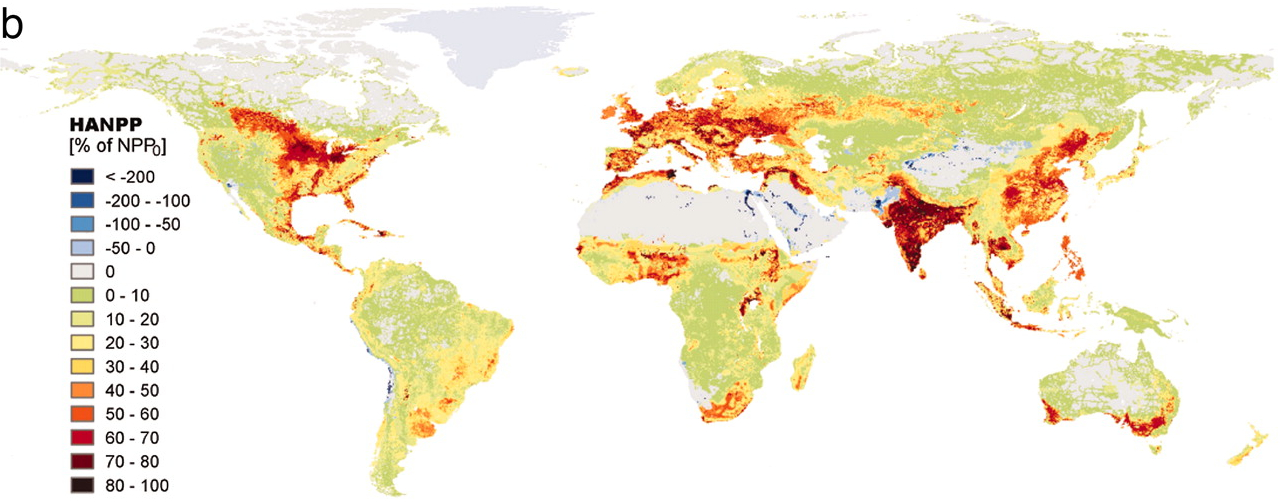
Another way to try to get at the issue is to look at how current yields compare to the theoretical potential of photosynthesis. This is generally expressed as net primary productivity (NPP) - the amount of carbon that plants can fix, exclusive of that used to power their own respiration. The net primary productivity is the photosynthetic product that is available to be eaten by people and other animals, rot into the soil, etc. Here is a map of the fraction of net primary productivity appropriated by humans published by Haberl et al last year in the Proceedings of the National Academy of Sciences, which I take to be a decent representative of the state-of-the-art in this kind of calculation:
You might look at the red - 60%-80% appropriation of NPP in many of the world's key crop growing areas, and think there wasn't enough head room for another 50%+ increase in yield in those areas. However, it's important to understand exactly how the accounting in these calculations is done. Let's consider a piece of the US midwest that used to be tall-grass prairie and is now under corn. What Haberl et al would do is first use a vegetation model (specifically, this one) to establish that it would be a prairie there absent human intervention, and figure out how much carbon the prairie would have fixed as NPP. ...
The key things to note are these:
* Rates of soil production and erosion under native vegetation are roughly similar, suggesting soil depths are naturally in equilibrium.
* Rates of "agricultural" erosion are a couple of orders of magnitude higher, suggesting that ploughing is not a long-term proposition.
* Rates of "Conservation" erosion are roughly comparable to to natural erosion rates under native vegetation. This covers more sustainable management regimes such as terracing and no-till agriculture.
This suggests that the long-term sustainability of industrial agriculture requires the use of no-till farming systems in which ploughing is not done, crop residues are left on the field, and weeds are managed another way (primarily via herbicides today).
Fertilizer
The three major fertilizer nutrients applied in industrial agriculture are Nitrogen (N), Phosphorus (P), and Potassium (K). None appear to be a critical constraint on agriculture to the 2050 timeframe, though there are significant issues with nitrogen in the short term.
Nitrogen fertilizer is manufactured via the Haber-Bosch process in which nitrogen gas (which forms almost 80% of the atmosphere) is heated with hydrogen over an iron catalyst at high temperatures and pressures to form ammonia (NH3) which is subsequently reacted with other compounds to form urea, ammonium sulphate, and other compounds used as fertilizer. Presently, almost all the hydrogen input to this process is produced by steam reformation of natural gas, and this is the cause of the short term problem since natural gas supplies are problematic, and likely to worsen with both Europe and North America probably at or past peak natural gas. Fertilizer manufacture is exiting these regions and moving to the Middle East, Trinidad, and other places with more natural gas.
However, in the long term, there's no reason nitrogen fertilizer has to be made from natural gas. In my scenario in which energy production is dominated by renewable/nuclear electricity by 2050, the natural source of hydrogen for Haber-Bosch is by electrolyzing water. Producing nitrogen fertilizer is unproblematic as long as society has ample energy.
The reserves and reserve-base for phosphorus are enormous. According to the USGS, 2006 global production of phosphate rock was 145 million tons, while reserves were 18 billion tons, and the reserve base was 50 billion tons. For the 2050 timeframe, I consider reserve base to be the more appropriate number for the same reasons discussed under lithium. The reserve base for phosphate rock is 350 times larger than 2006 production, so there is no evidence of a problem at present.
Some bloggers are concerned that the Hubbert linearization suggests peak phosphorus has already past. However, Hubbert linearization is not very reliable if there is no independent evidence to suggest peak is at hand, due to the problem of dual peak structures giving rise to misleading linear regions (eg see the UK oil linearization). In this case, with enormous reserves, and stable phosphorus prices (they haven't varied outside the range of $27-$28/ton from 2002-2006), it seems very unlikely that phosphorus is in trouble. JD has made a similar point (snark warning).
Potassium comes from the mining of potash. The USGS estimates the global reserve base to be 550 times larger than current usage. So potassium is unlikely to limit civilization any time soon. ...
Shipping is extremely energy efficient - two orders of magnitude better per ton-mile than air freight. Thus, long-haul shipping of food will be cost effective long after oil has peaked. Ships can also be run on nuclear power, as the US navy has been demonstrating for decades.
In Conclusion
There seems to be reason for cautious optimism that if other global problems can be solved, food production will not be a critical constraint on civilization to 2050. If industrial agricultural yields maintain their historical trajectory, there will be enough food without needing much more land. In case yields fail to continue increasing, more land is potentially available globally, though likely of poor quality. Soil erosion is an important problem, but not a critical emergency, and can seemingly be solved permanently with no-till farming methods. Fertilizer does not appear to be seriously constrained in the long-term, though nitrogen fertilizer needs to be transitioned away from reliance on natural gas. Agriculture only needs a tiny fraction of global liquid fuel use to operate, and this can be maintained for a long time, since food production is a critical infrastructure.
However, if we were to keep growing the conversion of food into biofuels, all bets would be off.



 Posts
Posts