In Louisiana, Cool Planet Energy Systems CEO Howard Janzen, flanked by Louisiana Gov. Bobby Jindal, announced the company will build three bio-refineries in Louisiana with a capital investment of $168 million. The project will consist of modular biomass-to-gasoline refineries in Alexandria, Natchitoches and a site to be determined. ...
Its not hard to see why everyone has been excited — sometimes laced with skepticism — about Cool Planet. With claimed operating costs of $1.00 to $1.15 per gallon, and adding another 13 cents or so for the capital costs (amortized over 15 years) – well, you get the picture. It’s drop-in, renewable gasoline, in prospect, for about half the price of the incumbent fossil fuels.
Now those claims were built around – to some extent, an emerging feedstock, miscanthus. That was the secret sauce in reports of 4,000 gallons per acre yields for production of renewable gasoline, Ahem, there’s been a change.
Now, Cool Planet will harvest wood waste and forest byproducts to make gasoline at its initial commercial-scale facilities in Louisiana. Each bio-refinery will be capable of producing 10 million gallons of high-octane, low-vapor pressure gasoline for strategic distribution through existing market channels and for blending at Louisiana refineries.
Walnuts, like those grown on Russ Lester’s Dixon Ridge Farms in Winters, California, are some of agriculture’s most energy-intensive crops given the amount of product you get from them. The inedible shell constitutes 50 to 60 per cent of each nut, and has conventionally just been discarded. On Dixon Ridge’s 400 acres, that translates into about 2.5 million pounds (more than 1200 tons) of shell waste annually. But rather than pay someone to dispose of these shells, Lester instead converts them into syngas using a cadre of downdraft gasifiers built by the Community Power Corporation of Englewood, CO.
Known as the BioMax, these machines can transmogrify a variety of woody biomass, and even some plastics, into nitrogen-diluted syngas. This includes everything from wood chips and pellets to orange and grape skins, cardboard and product packaging to kitchen waste and plastic utensils. Anything with less than 25 per cent moisture can undergo gasification.
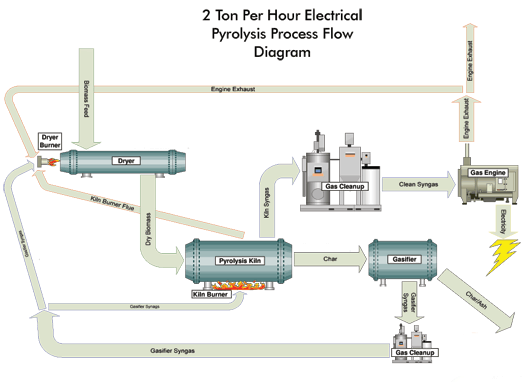
The BioMax system relies on pyrolysis (greek for “fire separation”) to convert biomass into syngas, the same process used to make charcoal. Organic material is placed in an anaerobic environment and heated to a minimum of 200C — 300C. This causes the material to separate into gas and liquid components, leaving a solid residue of char. In the BioMax system, the resulting gas is a mix of ~17 per cent hydrogen, 20 per cent carbon monoxide, 8 per cent carbon dioxide, 2 per cent methane and the remainder nitrogen (all of which can be separated, bottled, and either used on-site or sold). It also leaves behind char-ash, a carbon-rich fertiliser. What’s more, this char-ash is created from some of the CO2 produced by the process, resulting in a net-loss of carbon.
The Climate Spectator has a report on a company looking to exploit biochar production for carbon credits - Landfill listing.
Landfill energy and biochar specialist Pacific Pyrolysis has decided to push the go button on its backdoor listing on the ASX less than a week after the federal government got its Carbon Farming Initiative through parliament. ...
The company has developed technology that uses a process of slow pyrolysis to convert low value, non-food biomass, such as municipal green waste and industrial sludges into renewable energy and biochar, and says it has an extensive pipeline of projects with major corporations and councils. It has a demonstration plant north of Sydney and expects its business to be able to generate renewable energy certificates and also be included in the CFI, which will allow farmers and others to generate credits for carbon abatement initiatives.
PacPyro hopes to tap into the $10 billion landfill market, exploit rising landfill costs and energy prices to deliver its technology as a cheaper and more profitable option. It expects to deploy its first commercial scale plants from 2012, depending on its ability to strike commercial partnerships, and to potentially tap government funding, as well as its ability to generate renewable energy and carbon credits.
SHARES in Perth-based tiddler Eden Energy rocketed more than 250 per cent under heavy trade this morning after announcing a non-binding deal with Indian giant Indian Oil Corporation.
Under a term sheet signed in India this week, the Delhi-based company will farm-in to the development of a new pyrolysis technology jointly conceived by Eden and the University of Queensland.
Eden said the research will focus on the “commercial potential of a form of carbon believed to be the strongest structural material known to man”. ...
Under the arrangement, Eden will purchase the University of Queensland’s 50 per cent stake in the patents and intellectual property developed by the project in exchange for shares in the energy company.
Eden will then transfer this interest to India Oil after it has up scaled the technology to a pilot plant stage.
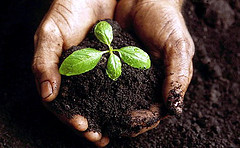
This month's edition of National Geographic has a feature article on "Soil", which looks at the steady degradation of agricultural land and the problem this poses in world where the population is heading for 9+ billion people - effectively calling attention to the "peak dirt" problem (however soil is renewable, so any "peak" should be able to be reversed if sufficient time and effort is put into doing so).
The article uses an acronym I've never come across before to describe the problem faced by those trying to draw attention to the issue: MEGO (My Eyes Glaze Over) - a phenomenon which should be familiar to anyone who has ever talked about peak oil, global warming or any of the other "limits to growth".
This year food shortages, caused in part by the diminishing quantity and quality of the world's soil, have led to riots in Asia, Africa, and Latin America. By 2030, when today's toddlers have toddlers of their own, 8.3 billion people will walk the Earth; to feed them, the UN Food and Agriculture Organization estimates, farmers will have to grow almost 30 percent more grain than they do now. Connoisseurs of human fecklessness will appreciate that even as humankind is ratchetting up its demands on soil, we are destroying it faster than ever before. "Taking the long view, we are running out of dirt," says David R. Montgomery, a geologist at the University of Washington in Seattle.
Journalists sometimes describe unsexy subjects as MEGO: My eyes glaze over. Alas, soil degradation is the essence of MEGO.
One subject that features in the article is soil restoration, including a look at "terra preta" - rich, fertile artificial soils found in the Amazon. In this post I'll have a look at modern day techniques to produce terra preta (often called biochar or agrichar) which have the potential to increase soil fertility, generate energy and sequester carbon all at the same time.
The History Of Terra Preta
Terra Preta ("dark earth") was discovered by Dutch soil scientist Wim Sombroek in the 1950's, when he discovered pockets of rich, fertile soil amidst the Amazon rainforest (otherwise known for its poor, thin soils), which he documented in a 1966 book "Amazon Soils". Similar pockets have since been found in other sites in Ecuador and Peru, and also in Western Africa (Benin and Liberia) and the Savannas of South Africa. Carbon dating has shown them to date back between 1,780 and 2,260 years.
Terra preta is found only where people lived - it is an artificial, human-made soil, which originated before the arrival of Europeans in South America. The soil is rich in minerals including phosphorus, calcium, zinc, and manganese - however its most important ingredient is charcoal, the source of terra preta's color.
It isn't entirely clear if the Amazon Indians whose old settlements terra preta is found at deliberately created the soils or if they were an accidental by-product of "slash and smoulder" farming techniques, though the emerging consensus seems to be that the Indians deliberately created the material, with some early European accounts in the area noting the practice still being performed.
The key ingredient is apparently the activated carbon in the charocal. Activated carbon has a complex, spongelike molecular structure - a single gram can have a surface area of 500 to 1,500 square meters (or about the equivalent of one to three basketball courts). Having this material in the soil has several beneficial effects, including a 20% increase in water retention, increased mineral retention, increased mineral availability to plant roots, and increased microbial activity.
It has also been shown to be particularly beneficial to arbuscular mycorrhizal fungi, which form a symbiotic relationship with plant root fibers, allowing for greater nutrient uptake by plants. There is speculation that the mycorrhizal fungi may play a part in terra preta’s ability to seemingly regenerate itself.
Pyrolysis and Eprida
Modern day producers of biochar (agrichar) take dry biomass and bake it in a kiln to produce charcoal. Biochar is the term not for what is left over after the energy is removed: a charcoal-based soil amendment - this process is called pyrolysis. Various gases and oils are driven off the material during the process and then used to generate energy. The charcoal is buried in the ground, sequestering the carbon that the growing plants had pulled out of the atmosphere. The end result is increased soil fertility and an energy source with negative carbon emissions.
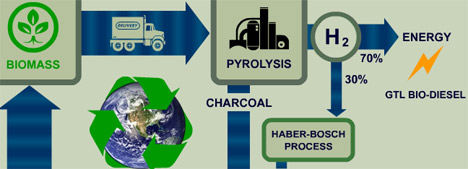
Eprida is a company founded by Danny Day, which is attempting to commercialise the idea by building systems that turn farm waste into hydrogen, biofuel, and biochar (see here for a short movie explaining their process).
The Eprida technology uses agricultural waste biomass to produce hydrogen-rich bio-fuels and a new restorative high-carbon fertilizer (ECOSS) ...In tropical or depleted soils ECOSS fertilizer sustainably improves soil fertility, water holding and plant yield far beyond what is possible with nitrogen fertilizers alone. The hydrogen produced from biomass can be used to make ethanol, or a Fischer-Troupsch gas-to-liquids diesel (BTL diesel), as well as the ammonia used to enrich the carbon to make ECOSS fertilizer.
We don't maximize for hydrogen; we don't maximize for biodisel; we don't maximize for char...By being a little bit inefficient in each, we approximate nature and get a completely efficient cycle.
The potential power of biochar lies in this closed loop production process , where agricultural practices involving biochar production see increasing returns of crop yields, energy and soil fertility over time.
Biochar also has potential to address problems such as waste disposal and rural development. A significant proportion of the world's population relies on charcoal as a cooking fuel, the production of which drives deforestation in Africa and other places.
Replacing traditional charcoal kilns with modern pyrolysis units could reduce the demand for wood from forests by increasing the efficiency of energy production and adding the ability to use any source of biomass, including agricultural waste products. This would also help to reduce respiratory diseases in the developing world, particularly amongst children.
There has also been speculation that pyrolysis could be a useful technique for dealing with the huge swathes of Canadian forests that have been killed by pine beetles recently.
Some industry participants believe that energy, rather than agriculture, will be the key driver for adopting biomass pyrolysis. Desmond Radlein of Dynamotive Energy Systems has been quoted as saying "It is wishful thinking that people will switch to renewable fuels unless it is cheaper. All of this is tied to the price of oil; as it goes up, many more things are possible."
Another company active in the pyrolysis sector is Best Energies. Technical Manager Adriana Downey recently had an interview with Beyond Zero Emissions, talking about some of the pilot programs they have been running and plans to build the first fully commercial scale pyrolysis plant in Australia.
Lukas's program with the NSW DPI (Department of Primary Industries) in Northern NSW have basically taken some of the agrichar material that we've made here at Best Energies and they've been trialling that material in different agronomic applications to see how the agrichar, when its applied, can help crop-productivity and improve the sustainability of agriculture as well as, and what you guys are more interested in, sequester carbon long-term in soils and also decrease the potent greenhouse gas nitrous oxide emissions from soil. ...
The agrichar when it's applied to the soil has a good effect on the general physical structure of the soil. Because the agrichar has a really high surface area, it means that there's lots of pores in the soil which can then retain moisture and act as little reservoirs for the water to be retained in the soil. As well as this, all of the surface area helps to bind nutrients in the soil and also provides a microhabitat for micro organisms in the soil which are essential for the natural processes in the soil which allow micro organisms to flourish.
Carbon Capture Potential
There is a large difference between terra preta and ordinary soils - a hectare of meter-deep terra preta can contain 250 tonnes of carbon, as opposed to 100 tonnes in unimproved soils from similar parent material, according to Bruno Glaser, of the University of Bayreuth, Germany. The difference in the carbon between these soils matches all of the carbon contained in the vegetation on top of them.
It is not yet clear what the limits are to how much biochar can be added to the soils using these techniques, however some fairly extravagant claims about biochar's capacity to capture carbon have been made. Soil scientist and author of "Amazonian Dark Earths: Origin, Properties, Management" Johannes Lehmann believes that a strategy combining biochar with biofuels could ultimately offset 9.5 billion tons of carbon per year - an amount equal to the total current fossil fuel emissions. Lehmann also notes that unlike biodiesel and corn ethanol, biochar doesn’t take land away from food production.
If true, this would be an interesting form of geoengineering to try and reverse the effects of global warming (and one far less risky than some of the alternatives proposed) but I would still question our ability to turn all the world's oil, coal and gas reserves back into rich soil via burn - atmosphere - pyrolysis loop.
* The technology to implement the process is still immature. * Scientists don’t know how much charcoal farmers should use, how they should apply it, or which feedstocks work best. * Farmers are reluctant to spread unproven products on their fields, so the few companies manufacturing biochar have struggled to find buyers. * Charcoal production can generate toxic waste if performed incorrectly. * The energy needed to produce, transport, and bury biochar could outweigh the carbon savings. * Some analysts say the economics of the process will not be acceptable until carbon markets are established, allowing farmers to earn carbon credits for applying biochar to their fields. * Some environmental activists claim that applying the process on a large scale would result in further rainforest clearing which would actually degrade soil quality and increase global warming.
Rhizome In The Amazon
Jeff Vail recently had a post on a "Rhizome Template in the Amazon ?", which looked at a paper by Mark Heckenberger suggesting that a dense civilization of networked villages once existed in the Amazon, which Jeff noted was interesting because it "appears to show a form of organization that permits density without significant hierarchy".
The paper shows that the Xingu region of the Amazon was once populated by a grid-like pattern or villages, each connected by a precisely aligned network of roadways (the Xingu river is the Amazon's second longest tributary, with the region currently experiencing tension over plans to dam the river).
Here's an alternate mode of organization--a networked "grid," "lattice," or "peer-to-peer" structure of small, minimally self-sufficient villages, or "rhizome" as proposed in my article The Hamlet Economy. The Xingu settlement structure seems to consicously model itself in the latter pattern. Heckenberger even notes that each village was surrounded by a buffer zone of "managed parkland," exactly the kind of fall-back, resiliency-enhancing production zone that I recommended for rhizome. Here's a link to a satellite image of one section fo Xingu settlement.
Did this Xingu civilization really develop a dense, ecologically sustainable civilization without hierarchal structure? Or did they simply find a new way to impose hierarchy without developing the signatures of "central places"? Was this a conscious reaction to prior abuses of hierarchy, or simply an expedient to survival in the dense forrests and poor agricultural soils of the Amazon? We don't know the answers to these questions at this time, but the research of Heckenberger and his colleagues suggests that there is still a great deal for us to learn from the past about how we can best live in the future
Heckenberger also examined the terra preta pockets in the region, which is described briefly in an interesting article by Charles Mann in The Atlantic Monthly called "1491".
Scientific American also notes the correlation between the lost cities of the Amazon and terra preta in "Ancient Amazon Actually Highly Urbanized", as does The Vermont Quarterly in "Pay Dirt".
Terra preta, Woods guesses, covers at least 10 percent of Amazonia, an area the size of France. It has amazing properties, he says. Tropical rain doesn't leach nutrients from terra preta fields; instead the soil, so to speak, fights back. Not far from Painted Rock Cave is a 300-acre area with a two-foot layer of terra preta quarried by locals for potting soil. The bottom third of the layer is never removed, workers there explain, because over time it will re-create the original soil layer in its initial thickness. The reason, scientists suspect, is that terra preta is generated by a special suite of microorganisms that resists depletion. "Apparently," Woods and the Wisconsin geographer Joseph M. McCann argued in a presentation last summer, "at some threshold level ... dark earth attains the capacity to perpetuate—even regenerate itself—thus behaving more like a living 'super'-organism than an inert material."
In as yet unpublished research the archaeologists Eduardo Neves, of the University of São Paulo; Michael Heckenberger, of the University of Florida; and their colleagues examined terra preta in the upper Xingu, a huge southern tributary of the Amazon. Not all Xingu cultures left behind this living earth, they discovered. But the ones that did generated it rapidly—suggesting to Woods that terra preta was created deliberately. In a process reminiscent of dropping microorganism-rich starter into plain dough to create sourdough bread, Amazonian peoples, he believes, inoculated bad soil with a transforming bacterial charge. Not every group of Indians there did this, but quite a few did, and over an extended period of time.
When Woods told me this, I was so amazed that I almost dropped the phone. I ceased to be articulate for a moment and said things like "wow" and "gosh." Woods chuckled at my reaction, probably because he understood what was passing through my mind. Faced with an ecological problem, I was thinking, the Indians fixed it. They were in the process of terraforming the Amazon when Columbus showed up and ruined everything.
Scientists should study the microorganisms in terra preta, Woods told me, to find out how they work. If that could be learned, maybe some version of Amazonian dark earth could be used to improve the vast expanses of bad soil that cripple agriculture in Africa—a final gift from the people who brought us tomatoes, corn, and the immense grasslands of the Great Plains.
All in all I think biochar is worth exploring further in some depth.
The Guardian has an essay from Tim Flannery on the current state of play for global warming - Words Of Warming.
A sophisticated understanding of the great climatic cycles has permitted a new approach to the climate problem that finds its closest parallel in the "wiggle matching" used by stock-market analysis. William Ruddiman is a climatic historian whose book Ploughs, Plagues and Petroleum, published by Princeton in 2005, uses this approach to identify evidence of human impact on the climate system, by identifying precisely where we are in the current cycle and comparing the trend with earlier ones. We are, he explains, 12,000 years into a cooling phase which, judging from previous cycles, should continue for tens of thousands of years more. Instead the world is warming. But what is most remarkable about Ruddiman's work is the evidence it provides for an initial disruption to the climate system that occurred long before the industrial revolution - around 8,000 years ago.
It was then, at the dawn of agriculture, that the "wiggle" of the current cycle first departed from earlier patterns - for instead of cooling, Earth's average temperature remained remarkably stable. Ruddiman thinks that this was caused by carbon and methane being released into the atmosphere from early agriculture and the destruction of forests. In his account, human activity and the great cycles struck a delicate balance that allowed the flowering of civilisations. He also sees evidence in the ice cores for the consequences of the Black Death (a drop of around two parts per million of CO2 as forests grew over abandoned fields, absorbing carbon from the atmosphere), as well as other historic events. Aspects of his work remain highly contentious, yet I believe that Ruddiman's realisation that the gaseous composition of Earth's atmosphere is an exquisitely sensitive barometer of changes to life itself represents a great breakthrough.
Now that the majority of politicians, industry leaders and the public are convinced there is a climate problem, the focus is on what to do. The most influential assessments of the problem's scale are doubtless those of the IPCC, whose projections of various outcomes form the basis of global negotiations and national action plans. One of the most influential of these projections concerns the extent to which Earth's surface will warm over the next century. The lower bound is 1.4°C; the upper bound is 5.8°C. This is an extraordinary range of possible impacts - 1.4°C poses some threat, but 5.8°C is widely recognised as sufficient to induce a Lovelockian Ragnarok. The chance of either outcome, according to the IPCC, is small - less than 10%, and so political dialogue has come to concentrate on the mid-range of the projections.
The moment of truth will arrive in December 2009, in Copenhagen, when the world's political leaders will come together to decide the basis of a new global treaty to replace the Kyoto protocol. It's no overstatement to say that the Copenhagen protocol, as it may well come to be known, will play a large role in deciding the fate of humanity. It will come into force in 2012, and if it fails to deliver we'll have to wait until 2020 for a replacement. That will be too late. ...
In his analysis, Nordhaus does identify one economically effective strategy worth pursuing. Called the "low-cost backstop", it revolves around identifying and developing some as yet unknown technology to combat the problem. Possible candidates include "low-cost solar power, geothermal energy, some non-intrusive climatic engineering or genetically engineered carbon-eating trees".
Writing in the New York Review of Books, Freeman Dyson has explored the unappealing option of such trees. The graph that first alerted humanity to the climate problem - drawn up by Charles David Keeling to show the CO2 increase from 1956 to the present - might, Dyson argues, hold the key to the solution. The graph has a generally rising line, with jags, like saw teeth, along it, which indicate a spike in CO2 each autumn in the northern hemisphere and a dip each spring. The difference between the minimum and maximum each year is around six parts per million, and it is due to the growth, then leaf fall, of the forests that grow across North America, Europe and Asia. It turns out, Dyson says, "that about 8% of the carbon dioxide in the atmosphere is absorbed by vegetation and returned to the atmosphere every year".
If only a way could be found, he muses, to permanently sequester that carbon, we would go a long way towards solving the climate crisis - hence the genetically modified trees. But the truth is that all trees are carbon eaters. They grow from the air by drawing CO2 into their leaves, and there solidifying it to build their wood, bark and leaf tissues. Trees are congealed CO2. What we need is a way of transforming the carbon they capture into an inert state. It turns out that humanity has had the capacity to do this for thousands of years, and is now on the brink of doing it on a very large scale.
The process of charcoal-making is called pyrolysis, and involves the heating of any biological matter in the absence of oxygen. The result is the generation of a synthetic gas, or a crude-oil like material, and charcoal. If the gas or oily matter is captured, it can be used to generate electricity or power transport. The charcoal is largely carbon (representing one-third to half of the carbon in the biomass) and it is inert. Indeed, the tenacity with which charcoal resists rotting, even when buried in the soil, is clear from C14-dating, which uses ancient charcoal from hearths or fires as much as 60,000 years old.
Modern pyrolysis involves machinery that captures flue gas or oil, and needs no external inputs to run the machine (some of the gas being used to heat the biomass). It's already being used on a small scale on farms, for urban garbage disposal (where 1,000-tonne units are deployed) and in forestry. On farms it has multiple benefits, for the charcoal can be ploughed back into the soil, where it balances acid soils, aids soil moisture retention, adds nutrients and acts as a habitat for soil fungi and bacteria. A farmer pyrolysing crop waste gains four benefits: 1) as usual, he gets to sell the commercial part of his crop; 2) he gets to generate electricity or transport fuel; 3) where carbon is traded, he can potentially sell the carbon he sequesters; and 4) by adding charcoal to his soil, he will increase the chances of getting a better crop the following year.
With so many benefits, why is pyrolysis not more widely used? Because pyrolysis machines are expensive, and farms are mostly still family businesses. If farmers are ever to be able to afford the machines, they'll need to be paid around $37 per tonne for the carbon they create. They'll also need to be living in areas with carbon trading schemes that allow charcoal as a recognised method of carbon sequestration.


 This month's edition of National Geographic has a feature article on "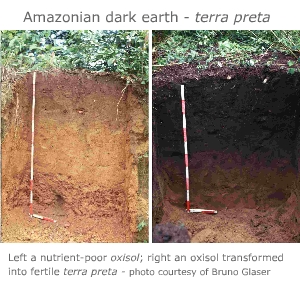



 Posts
Posts