Showing posts with label alex steffen. Show all posts

Alex Steffen on carbon-free cities  

Posted by Big Gav in , , ,

Dave Roberts at Grist has a pointer to a new TED talk from Alex Steffen - Alex Steffen on carbon-free cities.

I hope that everyone will watch this short, excellent presentation on the promise of sustainable cities from Alex Steffen, proprietor of the late, lamented Worldchanging and all-around smart dude. If it sounds reminiscent of my great places series, it's only because I stole most of that from Alex.

U.S. national politics is extraordinarily depressing right now. My refuge right now is keeping in mind the lede of this recent Foreign Policy feature story:
The 21st century will not be dominated by America or China, Brazil or India, but by the city. In an age that appears increasingly unmanageable, cities rather than states are becoming the islands of governance on which the future world order will be built.

If we want to accommodate 10 billion people on this planet and provide them all with some measure of security and dignity, we have to master cities. That is, or should be, a central axiom of 21st century politics, economics, environmentalism, and humanism.


TreeHugger has a post comparing Steffen's vision to that of James Kunstler and Kaid Benfield - Three Views of Urbanism: Alex Steffen, Kaid Benfield and Jim Kunstler.
Three important urban theorists are making the rounds this week, with Alex Steffen delivering a TED talk on the Sharable Future of Cities. He starts of with our "clean energy problem"- that we cannot possibly generate enough to replace the fossil fuels we use in our cars.

Steffen uses the famous UNEP graph to demonstrate that our energy use is predestined by the kind of city we live in, that there is a direct correlation of energy consumption to density. The talk is really a summary of much of what he had written and promoted on Worldchanging, starting with what I think i probably the best post he ever wrote, 2008's My Other Car is a Bright Green City, in which he wrote
The best car-related innovation we have is not to improve the car, but eliminate the need to drive it everywhere we go.

or, as he puts it in the TED talk,
The most sustainable trip is the one you never had to take in the first place.

It is a terrific summary of everything Alex has been saying, and writing about for years. If you have followed Alex and Worldchanging you will be familiar with it, but it never hurts to hear it again. More at TED.

But the problem with that UNEP graph, and the position developed by David Owen in the Green Metropolis and Edward Glaeser in The Triumph of the City is that while those extremely dense cities like Hong Kong and New York use less energy per capita, they still use a hell of a lot of energy and the back of house required to support it, the food supplies, the water and electricity infrastructure, are all huge and not particularly efficient. Nor are they necessarily terrific places to live.

Kaid Benfield of the NRDC writes in Seeing cities as the environmental solution, not the problem that while Owen and Glaeser
are sometimes excessive in extolling the virtues of urban density without giving attention to the other things that make cities attractive and successful, they are absolutely right that city living reduces energy consumption, carbon emissions and other environmental impacts.

But he doesn't see it all happening in forty storey towers, but in a rebuilding of our existing inner cities and towns.
For our cities and towns to function as successful people habitat, they must be communities where people want to live, work and play. We must make them great, but always within a decidedly urban, nonsprawling form. As it turns out, compact living - in communities of streets, homes, shops, workplaces, schools and the like assembled at a walkable scale - not only helps to save the landscape; it also reduces pollution and consumption of resources. We don't drive as far or as often; we share infrastructure.


Alex Steffen: Worldchanging II  

Posted by Big Gav in , ,

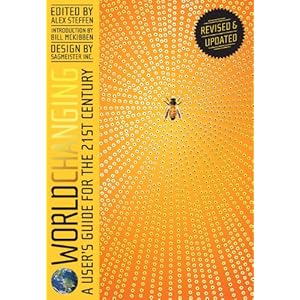
WorldChanging is no more but the new WorldChanging book arrived in my letter box this week. It looks to be a substantial update to the first edition - well worth a read, particularly if you didn't get the first one.


Change Observer has an interview with Alex Steffen about the book - Alex Steffen: Worldchanging II.
Change Observer: How has the world changed in the five years since you published the first edition of Worldchanging?

Alex Steffen: The biggest change is that sustainability and the awareness of the need for sustainability are mainstream in ways they’re weren’t five years ago. Then, outside of specialized conversations, it was hard to find many ideas about sustainable design or green buildings or sustainable urbanism. In the intervening years, we have not only seen a lot of really dire news that convinced many mainstream, credible people that these were important issues that deserved attention, but also social and cultural movements that have really taken off: the food movement, the trend towards walkable neighborhoods. Green building has rapidly moved from a hot topic to the way things are done.

In trying to think through a new edition of Worldchanging, we had an opportunity to stop and consider, “What do people really need to know now that the basics are largely familiar? What couldn’t we have told them five years ago?” In this edition, we left out almost all of the small-scale personal incremental actions you could take precisely because they’re readily accessible; thousands of websites will tell you how to do these things [e.g., buy ecologically responsible clothing]. We tried to include more of the innovative approaches to sustainability that are involved in making leaps.

CO: Such as?

AS: A key message we tried to bring forward was that the degree of scope, scale and speed of these problems demands that we look at systemic answers: how an entire system works for everybody, not just what we could do for ourselves. Of course, individual actions that help us connect are important. But we need to look more deeply at how things are designed and built. What our role is. What the parts of a system are that we don’t see. How to live into our capacity to be citizen designers of those systems.

CO: Who is your reader? Has that person changed over time?

AS: There are two completely different groups of readers. Some start at the beginning of the book, and read through it cover to cover and take it as an overview of how people address problems. It’s used in college classrooms that way. A lot of other people consult it as an occasional spur for inspiration. They’ll pick it up, glance through it, find something interesting. We tried to make this edition accessible in both ways, so if you start at the beginning you’ll get a thought-out presentation of one way of looking at the world’s problems and how they interconnect, but you can also read a chapter and explore something when you have a question. It’s a really good book to have at hand. ...

CO: You sound more than cautiously optimistic.

AS: I think that the big open secret about sustainability work and innovation is not how bad things are. The real secret is how good things can get. There’s more and more evidence that many of the changes we need to make not only can be done but would vastly improve our lives. They would make us more money, provide us more jobs, make us healthier and happier. Our cities and energy would be cleaner and more affordable, our goods would be manufactured more sustainably. There’s still a bit of reticence to talk about how good things could get. It’s too bad. Buckminster Fuller had it right when he said people never leave a sinking ship until they see the lights of another ship approaching. Another ship is approaching, but we haven’t turned on the lights. If the book is doing a good thing it’s shining a light on what’s happening.

Andrew Revkin at "Dot Earth" also has a look at the book and an interview with Alex - Alex Steffen, a Designing Optimist.
Anyone following this blog is aware that there are smart, informed people in this world with completely divergent views of the sources of human progress and problems and the best route forward as populations and appetites crest in coming decades.

One nearly universal thread I’ve found, though, is a conviction that, without conscious attention, there will be substantial, avoidable and regrettable human and biological losses.

There’s no better introduction to the options for designing our way forward, as opposed to just letting business as usual unfold, than Worldchanging. This initiative, for lack of a better word, started as a Web site seven years ago but was crystallized in a book, Worldchanging: A User’s Guide for the 21st Century, that was first published in 2006 and now is out in a substantially updated edition.

The Web effort, which ( sadly) ended recently, had two founding fathers, Alex Steffen and Jamais Cascio. Steffen is the editor of the new book (with Carissa Bluestone). ...

If I had to label Steffen, I’d call him the “designing optimist,” placing him somewhere in the general vicinity (but a bit to the left) of the “ despairing optimist,” RenĂ© Dubos, and “ The Rational Optimist,” Matt Ridley. ...

As I said above, the book, despite being nearly 600 pages long, is unavoidably just a sketch of what could lie ahead. It’s the printed equivalent of a long hallway of marked doors, each giving an appealing glimpse of an issue — “density done right,” “ending violence,” “reinventing the workplace” — that is the equivalent of a trailer for a movie that’s still in production.

Steffen told me he sees that structure as useful in two ways:

The book is designed to be read either cover to cover, as an overview of efforts to tackle the planet’s most pressing problems, or consulted at random, as a way to find unexpected solutions and inspiration.

Landscape Urbanism, New Urbanism and the Future of Cities  

Posted by Big Gav in ,

Alex Steffen has emerged from his post-WorldChanging hibernation with a new blog called "Planetary Thinking". One new post of interest looks at the future of our cities - Landscape Urbanism, New Urbanism and the Future of Cities.

I think that any attempt to see the systems around us more clearly adds value. That said, one of our biggest problems is that in the developed world (but most especially in North America) we have a tendency to mistake the wrapping for the mechanism. We tend to think too much about how a place looks and feels, and far too little about what actually drives the systems within it.

American cities, especially, are the apices of vast networks of material and energy flows that reach literally around the entire planet. The impacts of our every day lives radiate out in all directions, from the atmosphere to the ocean depths, from distant forests to melting ice caps. Those impacts are planetary, gigantic in aggregate and unsustainable in nearly every particular. Most of those impacts we will never see. And the biggest impacts of all are generated by our auto-dependence, our over-consumption, our sprawling land-use and our bloated and poorly designed homes.

Walkability, transit-orientation and green building all reduce those invisible impacts. In discussing these, New Urbanism is excellent. The problem I have with New Urbanism is a lack of ambition — something that feels like an unwillingness to face the actual scope, scale and speed of the changes we need, and to really push the boundaries of urban form. Too much New Urbanist rhetoric feels to me to be locked in a debate from the 80s that assumes suburbanization is the norm, is here to stay and needs only modification.

If we take planetary boundaries seriously, we need to be reducing the unseen impacts of our lives by something like 95% in the next couple decades. That’s a big task, and it’s made more important by the economic and social vulnerability built into our current systems and their reliance on long, complicated supply chains, limited nonrenewable resources and a stable climate.

Bright green cities — able to offer prosperity with 5% of the impact using far more rugged systems — will not be had by tinkering. We need serious changes in land use, big investments in infrastructure, new innovations in design and technology, and new approaches to how urban life is lived. We simply can’t get there with home retrofits, electric cars and backyard gardening. The physics don’t pencil.

Some of changes needed will take, I believe, weaving biomimetic systems into the city: making our infrastructure and places work in such a way that they demand less from nature. But we’re never going to make car-dependent suburban sprawl sustainable through changes in landscape: the amount of good we can do within the boundaries of those places will never eliminate, much less make up for, the damage done elsewhere to support them. No amount of permaculture in the backyard will fix the melting of the ice caps caused by a lifetime of driving and dwelling in extremely inefficient low-density systems.

The future of cities, I think, involves high-density, high-innovation cities meshed through with extranatural systems, systems that reduce the need for inputs and decrease the toxicity and wastefulness of outputs, helping to stabilize natural systems around cities. Those systems and the landscapes they define may look nothing like natural rivers, forests, farms — but that’s okay.

Because one of the biggest problems with urban debates these days — and it’s a problem I fear Landscape Urbanism contributes to, rather than addresses — is that we continue to mistake that which looks green for that which is sustainable. We dress up disastrous land-use and voraciously wasteful urban systems in gardens and greenery, and end up with a Potemkin sustainability.

New Urbanism, more hardcore urbanists have long charged, can end up being just “sprawl in drag.” Landscape Urbanism, unless it addresses the physics of underlying systems (transportation, housing, manufacturing), threatens to be just “sprawl in a pretty green dress”.

I’d like to see a whole different approach, one which starts from the scope, scale and speed of the changes we know we need to make, and backcasts from that transformation as the basis of any sound urban thinking. Planetary urbanism.

That’s a task that will take all the smarts we have, in every discipline.

Statistics

Locations of visitors to this page

blogspot visitor
Stat Counter

Total Pageviews

Ads

Books

Followers

Blog Archive

Labels

australia (619) global warming (423) solar power (397) peak oil (355) renewable energy (302) electric vehicles (250) wind power (194) ocean energy (165) csp (159) solar thermal power (145) geothermal energy (144) energy storage (142) smart grids (140) oil (139) solar pv (138) tidal power (137) coal seam gas (131) nuclear power (129) china (120) lng (117) iraq (113) geothermal power (112) green buildings (110) natural gas (110) agriculture (91) oil price (80) biofuel (78) wave power (73) smart meters (72) coal (70) uk (69) electricity grid (67) energy efficiency (64) google (58) internet (50) surveillance (50) bicycle (49) big brother (49) shale gas (49) food prices (48) tesla (46) thin film solar (42) biomimicry (40) canada (40) scotland (38) ocean power (37) politics (37) shale oil (37) new zealand (35) air transport (34) algae (34) water (34) arctic ice (33) concentrating solar power (33) saudi arabia (33) queensland (32) california (31) credit crunch (31) bioplastic (30) offshore wind power (30) population (30) cogeneration (28) geoengineering (28) batteries (26) drought (26) resource wars (26) woodside (26) censorship (25) cleantech (25) bruce sterling (24) ctl (23) limits to growth (23) carbon tax (22) economics (22) exxon (22) lithium (22) buckminster fuller (21) distributed manufacturing (21) iraq oil law (21) coal to liquids (20) indonesia (20) origin energy (20) brightsource (19) rail transport (19) ultracapacitor (19) santos (18) ausra (17) collapse (17) electric bikes (17) michael klare (17) atlantis (16) cellulosic ethanol (16) iceland (16) lithium ion batteries (16) mapping (16) ucg (16) bees (15) concentrating solar thermal power (15) ethanol (15) geodynamics (15) psychology (15) al gore (14) brazil (14) bucky fuller (14) carbon emissions (14) fertiliser (14) matthew simmons (14) ambient energy (13) biodiesel (13) investment (13) kenya (13) public transport (13) big oil (12) biochar (12) chile (12) cities (12) desertec (12) internet of things (12) otec (12) texas (12) victoria (12) antarctica (11) cradle to cradle (11) energy policy (11) hybrid car (11) terra preta (11) tinfoil (11) toyota (11) amory lovins (10) fabber (10) gazprom (10) goldman sachs (10) gtl (10) severn estuary (10) volt (10) afghanistan (9) alaska (9) biomass (9) carbon trading (9) distributed generation (9) esolar (9) four day week (9) fuel cells (9) jeremy leggett (9) methane hydrates (9) pge (9) sweden (9) arrow energy (8) bolivia (8) eroei (8) fish (8) floating offshore wind power (8) guerilla gardening (8) linc energy (8) methane (8) nanosolar (8) natural gas pipelines (8) pentland firth (8) saul griffith (8) stirling engine (8) us elections (8) western australia (8) airborne wind turbines (7) bloom energy (7) boeing (7) chp (7) climategate (7) copenhagen (7) scenario planning (7) vinod khosla (7) apocaphilia (6) ceramic fuel cells (6) cigs (6) futurism (6) jatropha (6) nigeria (6) ocean acidification (6) relocalisation (6) somalia (6) t boone pickens (6) local currencies (5) space based solar power (5) varanus island (5) garbage (4) global energy grid (4) kevin kelly (4) low temperature geothermal power (4) oled (4) tim flannery (4) v2g (4) club of rome (3) norman borlaug (2) peak oil portfolio (1)