Posted
by Big Gav
in
fishing
At The Movies has a review of a new documentary on the state of the world's fish stocks - The End of the Line.
THE END OF THE LINE is a documentary based on journalist Charles Clover's book of the same name. He has become an impassioned crusader to save the world's fish stock in our oceans after accidentally stumbling into a Press Conference in The Hague about the issue.
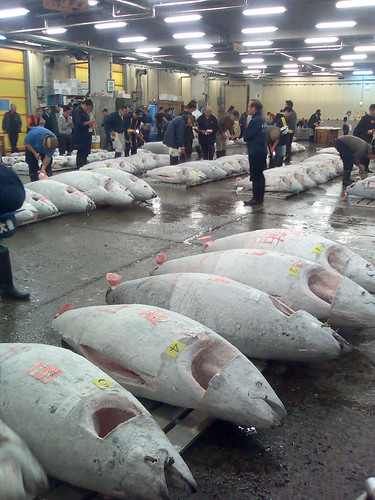
The decimation of the cod industry in Newfoundland, the vast overfishing of blue fin tuna and other species are the result of technology enabling corporations to enter the game for vast profit...
The lack of action on the part of governments, illegally fishing over quotas and inadequate surveillance, plus a lack of ocean sanctuaries have scientists predicting all fish will be gone by the middle of this century, a social and ecological disaster of huge impact...
The first hour of this film is a litany of disasters from Newfoundland to the Mediterranean, from the west coast of Africa to Japan.
The last half hour contains some hope. And that's the importance of this film, because with knowledge comes power.
We can control what we eat; making sure it comes from a sustainable source. One restaurant now informs diners that the blue fin tuna they serve is an endangered species. Jamie Oliver has reportedly taken recipes for blue fin tuna out of his cookbooks.
Instead of having less than one percent of the world's oceans devoted to fish sanctuaries, we ought to have 30%.The director is Rupert Murray, the narrator Ted Danson. There are an irritating number of fish and ocean montages with plaintive music which makes the film longer than it need be, but there's no denying the impact of its content.
Posted
by Big Gav
in
fishing,
global warming,
ocean
The ABC reports on a scientific study on the impact of global warming on fisheries - Climate change to cause dark night of the shoal.
Climate change will cause key species of fish to migrate towards the poles, badly depleting many commercial fisheries, scientists say. "The impact of climate change on marine biodiversity and fisheries is going to be huge," said study lead author William Cheung, of the School of Environmental Sciences at the University of East Anglia, eastern England.
The research team used a high-powered computer model, based on knowledge of 1,066 species of fish, their habitat and climate change, to predict what might happen by 2050 according to three scenarios for global warming.
Warmer water will lead to "large-scale redistribution" of these species, with most of them moving towards the poles, shifting on average by more than 40 kilometres per decade, they said.
Arctic Norway will benefit from an increased catch, but in sub-polar regions, the tropics and semi-enclosed seas, "climate change may lead to numerous local extinction," hitting developing countries most of all, the paper warned.
Part of this trend will be offset by colder-water species that venture into a warmer habitat.
In the North Sea, for instance, stocks of Atlantic cod may fall by more than a fifth as the species heads towards chillier waters. On the other hand, the European plaice, a more southerly fish, could increase in the North Sea by more than 10 per cent.
In the United States, there would be a fall of up to 50 per cent in today's cod fisheries on the east coast. Some species will face a high risk of extinction, including the striped rock cod in the Antarctic and the St Paul rock lobster in the Southern Ocean.
The Australian reports that we are likely to see more alarming predictions about the impact of global warming in future, as carbon emissions accelerate -
Warming 'much more rapid' than climate panel predicted.
DIRE warnings of future devastation sparked by global warming have not been dire enough, climate scientists warn.
Just over a year ago, the Nobel-winning Intergovernmental Panel on Climate Change published a report warning of rising sea levels, expanding deserts, more intense storms and extinction of up to 30 per cent of plant and animal species.
But recent studies suggested the report significantly underestimated the potential severity of global warming over the next 100 years, a senior member of the panel warned yesterday.
"We are basically looking now at a future climate that is beyond anything that we've considered seriously in climate policy," said Chris Field, a co-ordinating lead author of the report.
Fresh data showed that greenhouse gas emissions had grown by an average of 3.5 per cent a year from 2000 to 2007, Professor Field said at a meeting of the American Association for the Advancement of Science.
That was "far more rapid than we expected" and more than three times the 0.9 per cent growth rate in the 1990s, he said.
Professor Field, of Stanford University, said it appeared that most the growth was "because developing countries like China and India saw a huge upsurge in electric power generation, almost all of it based on coal".
Complicating the problem was that higher temperatures could thaw the Arctic tundra, releasing nitrous oxide, which was 300 times more potent as a greenhouse gas than carbon dioxide. ...
Recent studies have shown that global warming is reducing the ocean's ability to absorb carbon by altering wind patterns in the Southern Ocean. Faster winds blow surface water away, causing water with higher concentrations of carbon dioxide to rise to the surface.
Posted
by Big Gav
in
fishing,
piracy,
somalia
The Independent has a report on the standoff offshore Somalia between a group of irates (who blame over-fishing for their having to resort to harvesting other forms of wealth from the sea) and the US and Russian navies - Cold War stand-off over pirates' weapons ship. Chatham House is speculating piracy may drive shipping away from the red Sea, increasing the price of oil and other goods in Europe and North America.
Russia has dispatched a frigate to the scene of an increasingly tense stand-off between the US Navy and pirates who have seized a tanker laden with tanks and weapons in the Indian Ocean off Somalia.
The tussle over the fate of the Soviet-designed tanks captured off a failed African state has developed into an international incident worthy of a James Bond novel. Pirates are demanding a $20m (£11m) ransom and governments in the region are denying any knowledge of the arms shipment, amid fears of a new civil war in Sudan.
Russia has seized upon the crisis to send the missile frigate The Intrepid, prompting speculation that it might attempt to free hostages in another public projection of its military power.
American helicopters and warships from the 5th Fleet have surrounded the Ukraine-flagged Faina after Somali pirates boarded her six days ago and seized a cargo which includes 33 T-72 battle tanks, ammunition and heavy weapons such as rocket launchers.
The US squadron has sent helicopters low over the deck of the seized tanker and has made it clear they will not allow the pirates to land their haul, which it is feared would be handed over to Islamic insurgents that Washington believes are linked to al-Qa'ida. The pirates have said they will fight to the death if the ship is boarded. ...
The pirates blame overfishing by foreign trawlers for destroying their livelihoods, forcing them into hijacking ships and demanding ransoms.
The most dramatic seizure yet, with its lethal cargo, has underlined a surge in piracy in the Gulf of Aden, one of the world's busiest shipping routes. The problem has spread south to the Indian Ocean coastal waters off Somalia with 62 ships attacked this year. The International Maritime Board's piracy monitors say there are at least 10 vessels and 221 crew members held hostage in ports such as Eyl, east Somalia.
Pirates, many operating out of former fishing ports such as Eyl and Bosaso, are deploying increasingly sophisticated methods, including high speed launches, GPS trackers, and satellite communications, to target shipping. They have captured some of the biggest vessels on the seas and extracted multimillion-pound ransoms from multinational companies and even the government of Spain. France sent in special forces to track pirates who took a luxury yacht in April and captured six of them. They will face trial in France.
The London-based think-tank Chatham House says piracy could see shipping forced away from the Gulf and into the longer route to Europe and North America, producing a drastic effect on oil and commodities prices.
Posted
by Big Gav
in
fish,
fishing,
ocean
GOOD Magazine has a look at the world's dwindling fish stocks - Fin: The Last Days of Fish.
The first to suffer were the fishermen of Newfoundland, who saw their industry collapse in the early 1990s. Later it was the fishing communities further south, along the Gulf of Maine. Fishermen of the southern Cape, like Ligenza, could still find enough cod even five or six years ago to make a decent living, but that, too, has changed. Today, cod populations in the Georges Bank, off Cape Cod, hover near the brink, at levels 10 percent of what scientists consider healthy. Large areas of the Bank are losed entirely to groundfishing.
By now, the collapse is a well-known story in New England, chronicled in books like Mark Kurlansky’s Cod and in newspaper accounts of riotous fishery meetings and bank foreclosures in port towns. But it is only part of the story. Less appreciated is what else is missing from the New England coast. The number of overfished or threatened species makes for a sobering list: Atlantic halibut, yellowtail flounder, haddock, wolffish, river herring, Atlantic salmon. Shark populations in the North Atlantic have dropped by half since 1986, in the same time that bluefin tuna, which once swept past the Cape in schools a hundred thick, have been brought near commercial collapse. The astonishing fecundity of the New England coast has been reduced to a memory—one that haunts a generation of fishermen. In Harwich, on the Cape, a fisherman points me to a map of the coastal channels he once fished and covers it with a big, callused hand. “You can’t find anything there anymore,” he says.
What has transpired off the shores of Cape Cod is not unique. The same has occurred on coasts throughout the world. In 1988, at the peak of the output of the world’s fisheries, boats around the globe landed something on the order of 80 million tons of fish. Since then, depending upon which numbers you believe, the world’s annual catch has either plateaued or fallen by as much as 500,000 tons a year.
The rise of industrial fishing in the latter half of the 20th century, coupled with a growing world population, has overmatched the ocean’s supply. And while the history of New England fishing might seem a stark example—and it is—American fisheries are actually among the most enlightened in the world (though that is not saying much), with stringent management plans and some notable fish recoveries. In Europe, by contrast, nearly half of fish stocks are considered seriously depleted, and the North Sea has become a relatively barren body of water (to fill their nets, the “distant water” fleets of Europe now sail the west coast of Africa). And while fish stocks dwindle worldwide, an estimated 90 percent of large predatory fish—tuna, swordfish, cod, halibut—have disappeared since the mid-20th century. One study, published almost two years ago in Science, predicted a worldwide collapse of commercial fish stocks in just 40 years, if the present pace of fishing continues.
The demise of commercial fishing is beyond the limits of even our darkest environmental imaginations. And yet the evidence of the ocean’s diminishment is everywhere. Leaving aside the legitimate concerns of conservationists, the possibility of a broad fish collapse is harrowing for other reasons. At a time when we are mired in a global food crisis, nearly 1.5 billion people depend upon the sea as a source of food or income. The destabilizing effect of such a collapse would be tremendous, bringing communities and countries into conflict over a resource we once considered boundless. It is fair to say that the endgame has begun.
Posted
by Big Gav
in
fishing,
japan,
oil price
CNN has an article on the problem high fuel prices are causing Japan's fishing fleet - Japan's fishermen: 'We're dying'.
Two hundred thousand boats sat idle in Japan, as fishermen across the nation took to the streets on Tuesday to protest skyrocketing fuel prices.
The strike -- the first ever by the country's fishermen -- hopes to convince the government that without its intervention, rising fuel costs will kill the fishermen's businesses. Across Japan's fishing ports, fishermen simultaneously blew their whistles in a symbol of solidarity, and operations ground to a halt.
Thousands of others rallied in downtown Tokyo, marching in circles around the fisheries ministry and chanting, "We're dying," through bullhorns. The protesting fishing unions say fuel once accounted for 10 percent of a business' operating cost. It now accounts for 30 to 50 percent.
George Monbiot notes that the fish are dying too, so the Japanese fisherfolk may be out of luck even if they do get subsidised fuel -
Trawlermen cling on as oceans empty of fish - and the ecosystem is gasping.
All over the world, protesters are engaged in a heroic battle with reality. They block roads, picket fuel depots, throw missiles and turn over cars in an effort to hold it at bay. The oil is running out and governments, they insist, must do something about it. When they've sorted it out, what about the fact that the days are getting shorter? What do we pay our taxes for?
The latest people to join these surreal protests are the world's fishermen. They are on strike in Italy, Spain, Portugal, France and Japan, and demonstrating in scores of maritime countries. Last month in Brussels they threw rocks and flares at the police, who have been conspiring with the world's sedimentary basins to keep the price of oil high. The fishermen warn that if something isn't done to help them, thousands could be forced to scrap their boats and hang up their nets. It's an appalling prospect, which we should greet with heartfelt indifference.
Just as the oil price now seems to be all that stands between us and runaway climate change, it is also the only factor which offers a glimmer of hope to the world's marine ecosystems. No east Asian government was prepared to conserve the stocks of tuna; now one-third of the tuna boats in Japan, China, Taiwan and South Korea will stay in dock for the next few months because they can't afford to sail. The unsustainable quotas set on the US Pacific seaboard won't be met this year, because the price of oil is rising faster than the price of fish. The indefinite strike called by Spanish fishermen is the best news European fisheries have had for years. Beam trawlermen - who trash the seafloor and scoop up a massive bycatch of unwanted species - warn that their industry could collapse within a year. Hurray to that too.
Posted
by Big Gav
in
fishing,
indonesia,
oil price
Al Jazeerah has a report on the impact of rising oil prices on one-time OPEC member Indonesia. Fuel is still relatively cheap in the country, but is starting to become unaffordable in some sectors like fishing. No mention of supply constraints - under-investment instead gets the blame.
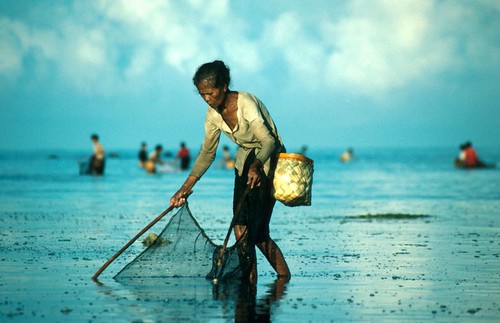
For the fishing boats of Indonesia, going to sea has become an expensive business. As global oil prices surge, fishermen are paying more to run their boats, but the fish they catch still sells for the same price.
I don't know what to do if the price keeps going up like this," says Sunada, a fisherman who makes his living in the waters off Java. "If we stop working we can't eat at all, but if we go on like this we don't make any profit."
Depending on highly subsidised fuel these fishermen could always make ends meet. But late last month the Indonesian government scrapped the subsidies, pushing the price of fuel up by 30 per cent overnight. The move triggered street protests across Indonesia, and many of Sunada's fellow fishermen decided to stop working in the hope of better times to come.
It is just one example of how the high oil price is slowly strangling Indonesia’s economy. At around $0.60 a litre, Indonesian petrol is still among the cheapest in the region, but even that is too big a jump for many Indonesians. The government says it has no choice.
As oil prices soared, the government's subsidy bill ballooned to more than $12bn a year – money, it says, could otherwise be spent on education and health care.
The government says it too is a victim of high oil prices and in a sign of the times it has decided to quit OPEC, the oil producer's cartel, of which it was a founding member.
Sri Mulyani Indrawati, Indonesia's finance minister, said the withdrawal is an indication of the government's concern over frustration with soaring commodity prices. "It is more that we want to voice our concern - not only over oil, now we are also concerned about food," she says. "If food is priced at a level that is not justified economically and is driven more by speculation and by narrow political interest, it's going to be damaging the global interest, damaging many countries and poor countries especially are going to suffer first."
Five years ago, Indonesia was still an oil exporter, but lack of investment has seen oil wells dry up and Indonesia's oil output plunge.


 Posts
Posts




