Perth-based Carnegie Clean Energy says it will consider a 20MW wave farm off the cost of Albany in West Australia if Labor wins the state poll and delivers on a commitment to provide $19.5 million of funding. Carnegie, which is currently preparing its first full-size wave farm off the coast of Fremantle, helping to supply Garden Island naval base with a mixture of wave and solar energy and battery storage, says the Albany plant could be upgraded to 100MW. ...
Carnegie CEO Michael Ottaviano said the Albany wave farm would be an opportunity to tap into a highly consistent renewable resource; delivering “24/7 clean power” into the electrical grid at a time where recognition of the importance of reliable, clean energy in Australia has never been higher. “Albany has one the most consistent wave energy resources in the world, experiencing greater than 1m swell 99.7 per cent of the time,” he said in a statement.
Cleantechnica has an article / advertisement for a new ocean energy / reverse osmosis company looking for crowd-funding of their technology to develop a pilot plant in Peru - Tapping Wave Energy To Create Fresh Water With Atmocean. High risk and probably low reward, but this sort of technology could be very useful in western coastlines of the southern hemisphere.
Los Alamos National Laboratories estimates that globally there are over 7,000 miles of non-cultivated coastline with sufficient waves to support an Atmocean system. The company estimates that over 13,000 systems could be deployed in Peru and Chile alone, generating billions of gallons of fresh water per year. Sadly, Peru is even now experiencing conflict and social strife as freshwater supplied by melting glaciers becomes less reliable and aquifers are being depleted. ...
Like a blade of grass in the wind, Atmocean’s wave energy array has been designed to move with rather than resist the waves, ocean currents, and tides which together make the ocean a very complex and punishing environment. This key feature reduces our impact and footprint on the seafloor, keeps operating costs down, and allows for ease of maintenance.
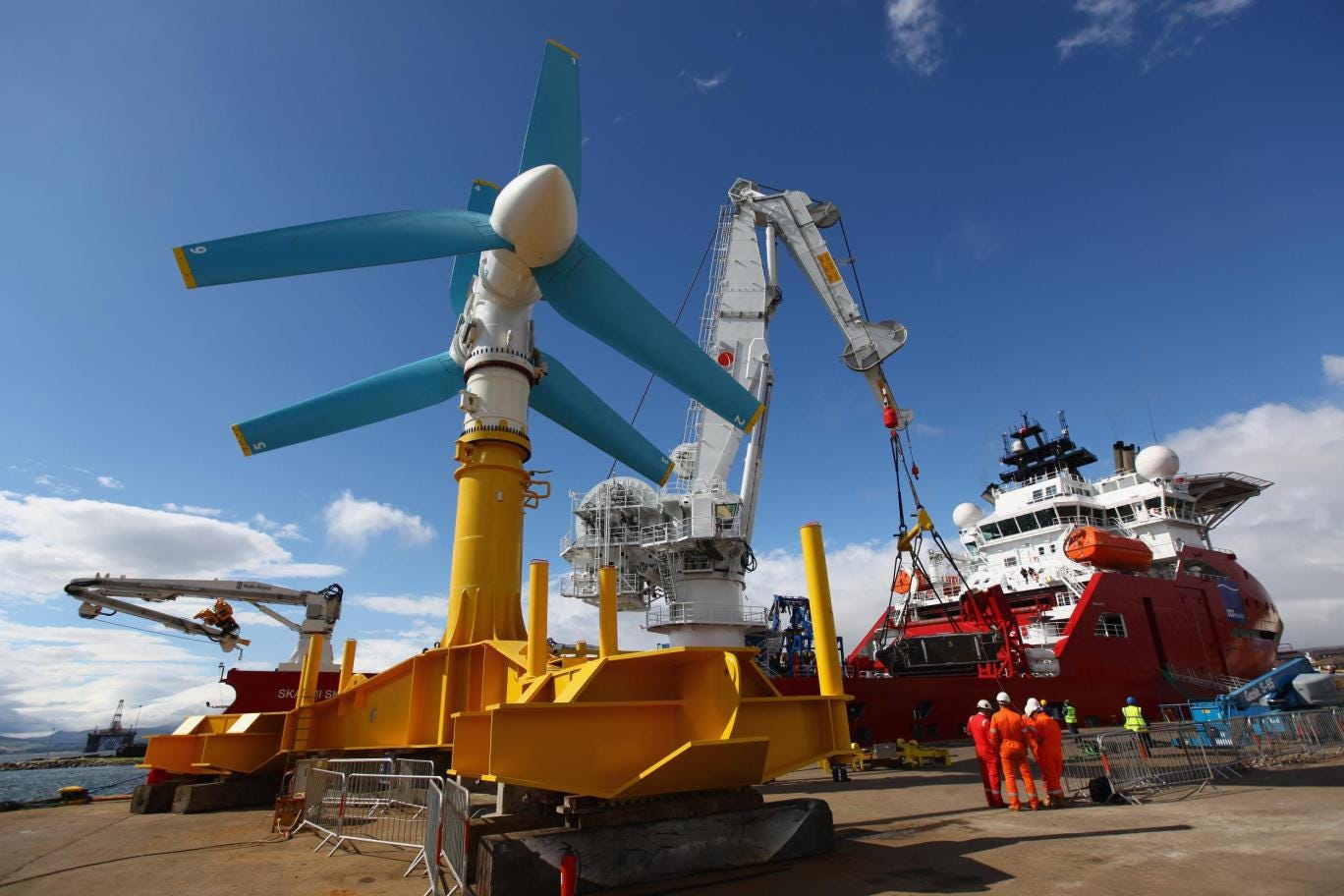
Scotland's mainland has received electricity from tidal power for the first time ever. A 1.5MW tidal stream turbine off the Caithness coast started operating last week, sending power back to the shore. Atlantis, the company behind project MayGen, hopes to eventually deploy up to 269 turbines, which will generate around 400MW of electricity.
Australia-based company Carnegie Wave Energy (CWE) will bring their wave power and desalination technology to Wave Hub in Cornwall, England. The European Regional Development Fund (ERDF) granted 9.6 million pounds (around $11.8 million) to CWE for the first phase of their Wave Hub project. Ultimately CWE aims to install enough of their wave power converter devices to generate 15 megawatts (MW) of clean energy at Wave Hub.
It was an unusual burglary, in which four or five laptops were stolen from a Scottish renewable energy manufacturer in the dead of a March night in 2011. So innovative was the company that it had been been visited by a 60-strong delegation led by China’s then vice-premier only two months before.
Nothing else was taken from the company and the crime, while irritating, went unsolved and forgotten – until a few years later pictures began emerging that showed a remarkably similar project manufactured in the world’s most populous country.
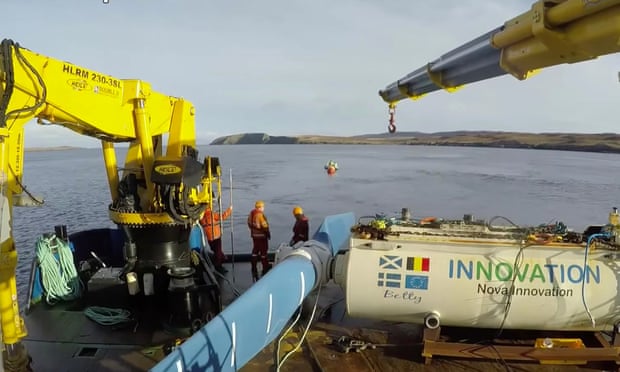
Nova Innovation said it had deployed the world’s first fully operational array of tidal power turbines in the Bluemull Sound between the islands of Unst and Yell in the north of Shetland, where the North Sea meets the Atlantic. It switched on the second of five 100kW turbines due to be installed in the sound this month, sending electricity on a commercial basis into Shetland’s local grid.
Existing tidal schemes use single power plants or installations rather than a chain of separate turbines. A French company, OpenHydro, says it too is very close to linking two tidal machines, off Brittany, to build a more powerful 1MW array.
ReNew Economy has a report on WA company Protean Wave Energy starting phase 2 of their commercialisation process by commencing installation of up to 30 of its wave energy converters at the Port of Bunbury in the state's south west.
The wave energy converters measure about 1 metre across by 1.5 metres high when stacked, with a peak capacity rating of1.5kW.
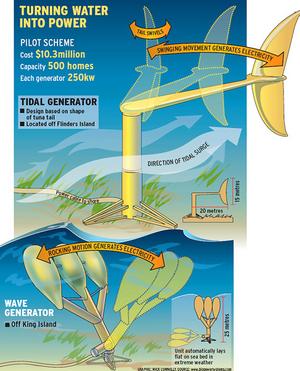
Another Australian-designed wave energy project has been deployed, with the completion this week of the 250kW bioWAVE pilot demonstration unit off the Victorian coast near Port Fairy.
The $21 million project has been in development by Sydney and US-based company, BioPower Systems, for three years, with $11 million funding from the Australian Renewable Energy Agency (ARENA) and $5 million funding from the Victorian Government.
A Digby County tidal energy developer is teaming up with an Ontario company to make a 1.95-megawatt tidal project — and possibly more tidal projects — a reality. ... The company’s other COMFIT approvals include 500 kilowatt projects in Grand Passage, between Brier Island and Long Island, and in Petit Passage, between Long Island and Digby Neck. They have two more in Cape Breton, a 500 kilowatt project in Great Bras d’Or Channel and one for 100 kilowatts in Barra Strait.
Understanding the environmental conditions and strength of the current in the Bay of Fundy is important for four consortia — European companies partnered with local Nova Scotia companies — who have committed to spend $9 million on four berths to test their turbines at the demonstration site.
In 2009, OpenHydro of France tried unsuccessfully to deploy a 10-tonne turbine in the Bay of Fundy, but the ultra-strong tidal flows destroyed the machinery within three weeks. Current speeds have been clocked between 10 and 12 knots.
Instead of waiting months for collected data to be retrieved and processed, the new testing platform is connected to an onshore computer at FORCE in Parrsboro via a three-kilometre-long fibre-optic cable that transmits data in real-time.
The finished facility, which will be only a bit higher in capacity than existing test plants in Japan and South Korea, is quite modest by energy production standards. The plant will be able to produce at most 100 kilowatts of power—enough, when operating continuously, to supply electricity to about 80 average American homes.
The plant and its pumps will consume most of the energy produced. But Makai’s plant is geared toward research, Eldred notes, not energy generation. The facility was built primarily to design and test heat exchangers, which are among the most expensive components of an OTEC plant. With the addition of a turbine, Eldred says, Makai will be able to design an automatic control system and improve both performance and cost predictions for its commercial plant designs. The company also hopes to get a sense of how fluctuations in the temperature and pressure of ocean water will alter power output, a factor that might prove significant for wave-tossed offshore plants.
That’s likely to be where OTEC energy production winds up. A 10-megawatt plant, such as one that Lockheed Martin aims to build for China’s Reignwood Group, will require a cold-water pipe that is several meters wide. A plant floating in open water could send a pipe straight to the depth required instead of diagonally, down a long slope extending out from shore. That would make for a shorter and less expensive pipe, reduce the impact on the landscape, and cut down on the energy required to pump the cold water.
The first large-scale plant to make the leap could be New Energy for Martinique and Overseas (NEMO), says Luis Vega of the University of Hawaii’s National Marine Renewable Energy Center. The project, which is a collaboration between renewable energy firm Akuo Energy and naval defense company DCNS, both based in Paris, plans to construct a 16-MW plant about 5 kilometers off the shore of the island of Martinique.
Construction is set to start next year, and the team aims to have the plant operational in four years. When complete, NEMO should be able to supply some 11 MW of energy to the Caribbean island, with the other 5 MW powering the plant and its pumps.
Nearly a decade after the surge of attention in marine energy technologies, the industry has not been able to overcome severe technical and financial challenges. As a result, installations have remained at pilot scale, while financing has been largely limited to government programs for testing and demonstrations.
And new projections from Bloomberg New Energy Finance (BNEF) show that the market for marine energy will be inconsequential for years to come.
According to BNEF, tidal power installations are expected to hit 148 megawatts by 2020, down 11 percent from forecasts made just a year ago. Wave power will be even smaller, with global capacity expected to reach 21 megawatts by the end of the decade -- a 72 percent downward revision from earlier forecasts.
To put that in perspective: SolarCity is installing more solar PV every seventeen days in America than the entire global installed base of wave power through 2020.
The promise of the technology is alluring. The International Energy Agency estimates that wave resources could theoretically provide 29,500 terawatt-hours per year, and tidal could produce more than 1,200 terawatt-hours per year. That's a little bit more than the total primary energy use of the U.S.
But the commercial deployments promised over the last ten years have largely failed to materialize. Between 2007 and 2010, numerous "landmark" projects were scrapped due to faulty equipment and high costs.
Energy trade association RenewableUK calls the UK "the undisputed global leader in marine energy." If plans for a tidal lagoon in Swansea Bay go ahead, that claim will be reinforced. Tidal Lagoon Swansea Bay would be the world’s first man-made energy-generating lagoon and could power over 155,000 homes.
Renewable energy is, of course, an area of huge importance and growth. A 2011 study by researchers at University of California-Davis and Stanford University suggests that the world could be powered completely by clean energy within 20-40 years.
Of the renewable options available, tidal is particularly intriguing. Renewable UK says wave and tidal energy could produce around 20 percent of the UK’s current electricity needs, and that the ongoing reduction in its technology costs will make it increasingly viable from a commercial perspective.
The lagoon would be used for a variety of activities other than energy generation
Swansea Bay has a high tidal range of up to 10.5 m (34 ft), making it an ideal location for tidal power generation. The proposal would see a 9.5 km (6 mi) lagoon wall constructed, halfway round which would be a 550 m (1,804 ft) turbine housing. The turbine housing would provide a means of allowing water to flow in and out of the lagoon as the tide rises and falls. Up to 26 turbines would be contained in the housing and would be driven with the flow of water in and out of the lagoon.
The Tidal Lagoon (Swansea Bay) development group says the lagoon would provide an energy production capacity of 320 MW and would provide sustainable and predictable electricity for 120 years of operation.
Atlantis Resources Corp., a Morgan Stanley-backed maker of tidal turbines, and a unit of Russia’s RusHydro JSC will work together to develop tidal power plants in Australia.
Under the agreement, the companies will identify potential sites in Western Australia to build facilities that will use RusHydro’s tidal range “orthogonal” turbines, Singapore-based Atlantis said today in an e-mailed statement. Atlantis will this year apply for funding for the project to the Clean Energy Finance Corporation in Australia.
ASX-listed wave energy developer Carnegie Wave Energy has won a berth at the world’s largest purpose built wave energy demonstration facility in the south west England, to test its CETO 6 commercial-scale technology.
The berth – and the generous tariff being paid for a demonstration plant – means that Carnegie could have two full scale projects underway with the latest version of its technology. This comes after the Clean Energy Finance Corporation allocated a $20 million loan facility if it built a similar plant in Australia. However, the UK deal provides Carnegie with a ready-made, grid-connected berth at the “Wave Hub” in Cornwall, to deploy and test an array of CETO 6 Units in open water conditions.
Weighing in at 1MW, the CETO 6 array will have a power capacity some four times that of the current CETO 5 generation being deployed in a world first 3 unit array in Carnegie’s Perth Project in Western Australia.
Australia’s Oceanlinx, whose home-grown, commercial-scale wave energy converter technology was unveiled with some fanfare last October, has been placed in receivership after the Sydney-based company hit troubled waters in February.
Rahul Goyal, one of two receivers appointed to the case from KordaMentha, said the company had “suffered financially” after an incident at sea several weeks ago delayed the final installation of its 1MW GreenWave wave energy converter – billed, at the time, as the world’s first such machine to be deployed.
The commercial-scale unit was damaged en route to its destination of Port MacDonnell, in the south-east of South Australia. This caused delays in funding, said Goyal, which was dependent on meeting installation deadlines.
Oceanlinx’s plan had been to install the 24m by 21m, 3,000 tonne unit 3km offshore and transfer the electricity it generated to the grid via a subsea cable. Once operational, the 1MW turbine was expected to produce enough electricity to power 1000 homes. Instead, the commercial-scale unit, which sits on a base of prefabricated reinforced concrete, was towed into shallow waters at Carrickalinga, where it remains.
Formed more than 15 years ago, Oceanlinx was a promising player in Australia’s ocean energy sector, having a number of wave power prototypes, including three units off the NSW coast, and had plans to expand to North America, Asia and Europe.
The wave power idea is closer than the tidal energy one to rollout, with a planned open-water test for this summer. M3 Wave dispenses with all the problems that come with buoys or other above-and-below-the-surface designs by mooring a simple device to the ocean floor. The device, pictured above, involves two air chambers: as a wave passes over the top of the first chamber, the pressure inside increases, forcing air through a passageway to the second chamber. Inside the passageway is a turbine, so the passing air is actually what generates the electricity. As the wave continues on, it raises the pressure inside the second chamber, pushing the air back through the turbine—importantly, it is a bidirectional turbine—and back into the first chamber. Another wave, another cycle. Repeat.
The primary selling point here is its simple and small footprint. There is no impact on ocean view, on shipping or fishing traffic, and rough seas above won't endanger the system in any way. M3 is selling it as "expeditionary" wave power, meaning it might be brought along on a ship and deployed for things like disaster relief; the company suggests such a deployment could produce 150 to 500 kilowatts. The system will undergo open-water testing at a U.S. National Guard facility, Camp Rilea in Oregon, in August.
On the other side of the country, a group at Brown University has developed what they call an oscillating hydrofoil, intended to minimize some of the impacts of tidal power devices and increase efficiency. The hydrofoil is mounted on to the sea floor—it resembles a car's spoiler attached to a pole, essentially. As the water flows past that spoiler it oscillates, generating electricity. It is designed so that the pole can actually fold down and out of the way if necessary, allowing for ships or even wildlife (detected with sensors on the device) to pass by without incident. The team received US $750 000 in funding from ARPA-E in 2012, and will soon move to a phase II involving a medium-scale, 10-kw prototype. They have calculated that the device can achieve much better energy conversion efficiencies in tides flowing very slowly than any of the devices that are on or close to market.
A Swedish start-up company is generating electricity from low-velocity tidal currents with a system of underwater kites called “Deep Green.” The kites are equipped with turbines tethered to the ocean floor and move through the current in an 8-shaped trajectory. Based in Gothenburg, Sweden, Nordic marine energy company, Minesto, claims to have developed the only cost-effective tidal power plant capable of operating in low velocity currents. A prototype of Deep Green is currently producing electricity in the waters off Strangford Lough, Northern Ireland.
Work is now set to begin on the largest turbine proposal in Europe, after the Scottish Government gave the consent to begin the 86MW Pentland Firth tidal energy project.
Initially construction will begin on a demonstration array consisting of six turbines, located in the Inner Sound off Pentland Firth, starting in the early months of 2014 with the turbines to be commissioned the following year. The aim is that the demonstration device will provide important data on environmental surroundings, and the future of the development phases to implement the full project.
Eventually it is hoped that the array will produce up to 398MW, this has the potential to power over 40,000 homes.
ASX-listed ocean energy developer Carnegie Wave Energy Limited has completed a capital raising of $4 million, part of which will go towards fast-tracking the design of its CETO 6 project – the WA-based company’s next generation CETO unit, which is expected to have at least twice the capacity of the CETO 5 unit. Carnegie’s CETO 5 is being manufactured for the Perth Wave Energy Project, which once completed will be Australia’s first commercial-scale CETO grid-connected wave energy system.
The Australian-founded and managed tidal energy company Atlantis Resources Corp has bought 100 per cent of the 398MW tidal wave energy project in Scotland, the largest in Europe.
Atlantis, a marine turbine company which was formed in Australia but moved to Singapore to better access finance, bought the outstanding shares from GDF Suez and Morgan Stanley, the investment bank which owns a majority stake in Atlantis. ... MeyGen recently received offshore planning consents from the Scottish government, which aims to be 100 per cent renewable by 2020. The first turbines are expected to be installed in 2015.
As CNET reported Friday, it looks very much like Google has been building a floating data center made from shipping containers on a barge in the middle of San Francisco Bay. But it may not be the only one of its kind.
Google has not responded to multiple requests for comment. But the project in San Francisco Bay appears likely to be the manifestation of a 2009 patent for a "water-based data center," and would likely leverage the fact that wave energy can provide cheap and plentiful power.
Now it seems as though Google may well have built a sister version of the project, and, according to the Portland Press Herald, it recently showed up in the harbor in Portland, Maine.









 Posts




