Showing posts with label lng. Show all posts

World's largest floating LNG factory remains in shutdown  

Posted by Big Gav in , , , ,

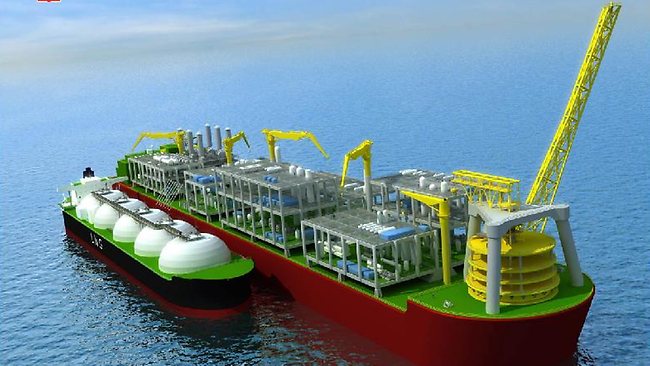
The ABC has an update on the Prelude floating LNG facility, the largest floating object ever built - World's largest floating LNG factory remains in shutdown — at just three years old.

Shell's massive floating LNG factory off the Kimberley coast has been in shutdown since February and industry analysts are divided on whether the $12-17 billion facility has a future. With five times the steel of the Sydney Harbour Bridge and half a kilometre long, it certainly is big. But as it sits idle 400 kilometres north of Broome, it risks becoming the world's biggest white elephant.

LNG: Having spent $200bn to export gas, is Australia about to import it?  

Posted by Big Gav in , , ,

Now the Australian building boom for LNG plants (exporting natural gas from the north west and coal seam gas from the north east) is over, local utility AGL is wondering if the easiest source of gas in future may be LNG imports from elsewhere - LNG: Having spent $200bn to export gas, is Australia about to import it?.

In a 21st century variant of "selling coals to Newcastle", energy supplier AGL has flagged it may need to spend up to $300 million to build an LNG import depot to shield itself from soaring gas prices and increasing difficulty in finding reliable local supplies.

Australian Oil and gas tax may raise no extra revenue for decades  

Posted by Big Gav in , ,

The Age has an article comparing the income generated from natural gas exports by new global production leader Australia over the previous incumbent, Qatar - Turnbull government called on to explain where Australia's offshore gas wealth is going.

By 2021 Australia will eclipse the Persian Gulf state of Qatar to become the world's biggest exporter of liquefied natural gas. In that year, when both countries are forecast to pump and ship roughly 100 billion cubic metres of LNG each, Qatar's government will receive $26.6 billion in royalties from the multinational companies exploiting its offshore gasfields. According to Treasury estimates, Australia will receive just $800 million for the same volume of gas leaving its shores.

Browse Floating LNG Project Shelved  

Posted by Big Gav in , , , ,

The SMH reports that Woodside's Browse project has shelved plans to build a floating LNG plant to exploit the field offshore from Western Australia.

The article notes that the Abadi project in Indonesia has also given up on floating LNG technology for now.

Woodside's reasoning seems to have been based more on the sliding price for LNG and a lack of buyers willing to make long term commitments rather than any perceived problems with the technology.

The article also noted that other FLNG projects are proceeding, such as ENI's Coral venture in Mozambique and Golar LNG's projects in west Africa for Ophir Energy and Perenco.

Shell's Prelude FLNG project in northern Australia is still going ahead as well.

A conspiracy to stiff gas consumers ?  

Posted by Big Gav in , , , ,

Michael West has an article in the SMH posing the question "are rising Australian domestic gas prices the result of a conspiracy" - A conspiracy to stiff gas consumers.

Coal prices have crashed, the carbon tax has gone, yet the cost of electricity continues to rise. Oil prices have halved, yet the price of gas, which is linked to oil, is going up 17 per cent.

This used to be a country which thrived on an abundance of low-cost energy. Now virtually every consumer and every business is shackled by spiralling energy prices. ...

About 34,000 homes had their electricity cut off and there were more than 24,000 who had their gas cut off. There is a vicious circle in this, because the fewer people there are on the grid the more the networks charge each customer to recoup their costs.

And charge they do. Even as inflation has ebbed in recent years, and even as actual demand has receded too, the networks have kept pushing regulators for their 10 per cent returns. ...

The gas lobby has been running the line, talking about a "cliff" in gas supply. Unless new coal seam gas projects were urgently bought on the east coast would literally run out of gas. This scare campaign has been the impetus for the dramatic rise in gas prices.

Yet there is no hard evidence for it, because the gas cartel does not reveal even to the government how much there is in the way of gas reserves or what is actually contracted and at what price.

It is no secret though that, despite Australia's enormous reserves, prices have been driven up by the rush to export the stuff to Asia. Local consumers are being forced to pay international prices and the producers have diverted supply to the Gladstone plants to be turned into LNG and shipped offshore.

That, too, is now unravelling. Credit Suisse sallied forth with a report this week which pointed out gas prices had halved, in line with plunging oil, and that the Gladstone LNG projects were in financial disarray.

Personally I'd find it ard to blame rising gas prices on anything other than the linkage of domestic prices to the international export market - as long as Asian prices are higher than domestic prices once were, we'll have to pay out more. The only real solution to this, as a coalition of manufacturers have argued, is reserving a percentage of gas production for the domestic market and regulating the price (then ignoring the howls from the gas producers about missing profit opportunities). In the longer run solar power will make the issue largely irrelevant, other than for industries that need gas as a feedstock.

The SMH had an earlier article talking about the effect of exports on local prices - Local gas prices set to soar as exports to Asia get under way.

In late December, British energy giant BG Group sent the first ever shipment of liquefied natural gas from Australia's east coast, using gas from the state's booming coal seam gas industry. Granted, it sounds far removed from everyday life for most of us. But this cargo load is the start of a trend that will dramatically increase how much households pay for gas used for hot water, cooking, or heating.

It is predicted to push up many households' utility bills by a similar amount to the carbon tax, but there are no plans for compensation. And as you'd expect with a jump in the cost of living of this size, this one is producing some seriously flimsy economics.

First though, back to that shipment. Not only was it the first time that CSG has been converted into LNG, the exportable form of gas. More importantly for consumers, it was the first time gas has been exported from the east coast of Australia at all, and there is much more to come. Origin Energy and Santos this year also hope to start pumping cargo loads full of the stuff, to be sold to buyers across China, Japan, Korea, Malaysia and other Asian nations.

Economists are keeping an eye on these projects – and others in WA – as there are predictions they could make Australia the world's biggest exporter of LNG by 2018, overtaking Qatar. LNG looks set to become our second biggest export behind iron ore. But what will affect households directly is how this massive new industry transforms the domestic gas market.

Now that the east coast is able to export gas (WA has been doing it since 1989) producers have the option of selling to buyers in Asia, who are willing to pay much, much more for it than we have been.

Historically, the east coast gas market was insulated from the rest of the world, and the domestic wholesale price was stable at about $3 to $4 a gigajoule. Now, there are buyers across Asia prepared to pay $12 or $13, even when energy markets are in turmoil as they are at the moment.

ReNew Economy has an article on the dismal future for natural gas fired power generation - Record low solar prices heralds power shift from fossil fuels.

It should be a little ironic – given the dramatic plunge in the oil price that is said to have been driven by Saudi Arabian supply tactics – that a Saudi company should set two global records for cheap solar power in the past two weeks.

But to energy analysts it is yet another sign of the energy transition taking place across the world, and one that could be accelerated, rather than slowed, by the collapse in the oil price because of the cancellation and deferral of tens of billions of dollars in uneconomic fossil fuel reserves.

ACWA Power, a water and power developer based in the Saudi capital Riyadh, last week won the world’s largest ever solar tender with the cheapest ever price for a large scale solar project.

It will build – with the help of Spanish group TSK and technology from US-based First Solar – a 260MWp solar PV plant at the Mohammed Rashid Al Maktoum Solar Park in Dubai, at a cost of just $US0.058/kwh, of $US58.4/MWh.

That’s how much it will receive as a fixed tariff over 25 years for what will be – for the moment – the largest solar plant in Middle East. The price it bid is 20 per cent cheaper than the previous benchmark for solar tenders. What’s more, it is 30 per cent cheaper than the price of gas that is currently used for nearly all of the electricity generation in the United Arab Emirates.

McKinsey: Capturing value in global gas  

Posted by Big Gav in ,

McKinsey has a look at developments in the global market for natural gas, including some analysis of the impact of potential LNG exports from North America - Capturing value in global gas: Prepare now for an uncertain future.

Liquefied natural gas (LNG), while only accounting for 10 percent of the global gas market currently, will be a key determinant of market prices and eventual value creation, as it is the only supply source mobile enough to plug supply and demand gaps in international markets. At the moment, it is in short supply. But because uncertainty about future prices has made buyers reluctant to sign new long-term contracts under traditional terms that link gas prices to oil prices, developers of gas reserves outside North America have been hesitant to sanction new LNG facilities, particularly as LNG project costs are rising rapidly. ...

Over the past decade, regional gas markets have become much more connected, with the number of LNG or pipe routes carrying over five billion cubic meters per annum (bcma)—more than doubling between 2001 and 2011. Yet despite increased linkages, gas prices in regional markets have diverged (Exhibit 1). Three market disruptions explain this. ...

In North America, rapid growth in shale-gas production has led to four years of oversupply and plummeting gas prices. Between 2008 and 2012, production grew at an annual compound rate of 29 percent. However, gas demand failed to keep pace as consumers were slow to switch from other fuels, energy-efficiency measures offset demand growth, and exports have not been an option, since it can take five years to build an LNG export terminal and acquire the necessary permits. Consequently, gas prices in North America fell from $8.9 per million British thermal units (MMBtu) to $2.8 per MMBtu over the same period.

In Asia, LNG prices have been boosted by economic growth, coupled with Japan’s decision in 2011 to shut down its nuclear capacity following the Fukushima disaster. Japanese gas demand grew by more than 20 percent between 2010 and 2012, from 95 bcma to 117 bcma. As Japan has no domestic gas, this all had to be imported as LNG.

Finally, in Europe, an economic slowdown—combined with energy-efficiency improvements and the availability of cheap coal—contributed to an annual decline in gas demand of 1.6 percent between 2005 and 2012. This is in marked contrast to annual growth of 2.7 percent over the previous 15 years. At the same time, liquidity on traded gas markets rose as buyers who found they had contracted excess capacity sought to sell it on. As a result, prices in Europe have fallen, breaking the traditional link with oil prices. Getting to grips with longer-term uncertainty

The impact of all three developments is likely to persist in the medium term (see sidebar “Why supply will likely remain tight this decade”). But the longer-term outlook is far less clear. Four factors will be major drivers of future market dynamics and prices.

North American gas developers are eager to export their plentiful supply of cheap LNG to higher-priced markets. By the end of 2013, they had applied for export permits for more than 380 bcma—equivalent to all of the world’s current liquefaction capacity. If even one-third of this capacity were built, it would have a significant impact on global LNG prices, threatening the viability of higher-cost capacity additions in countries such as Australia and Russia and in Africa, as shown in Exhibit 2. North American exports could be highly profitable at recent LNG prices of $18 per MMBtu but could still turn a profit even if they fell to as low as $12 per MMBtu

How important is gas to China's energy mix?  

Posted by Big Gav in , , , , , ,

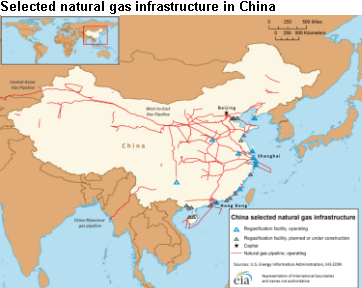
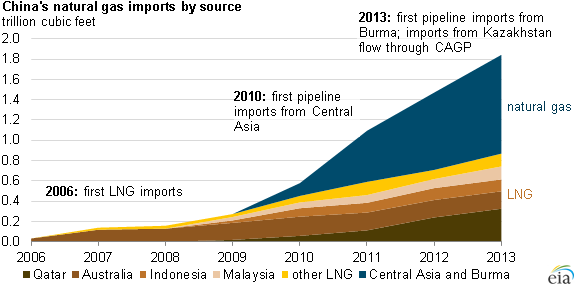
The Climate Spectator has a pair of article on EIA research into China's appetite for natural gas. The first looks at where China currently gets its gas from - How important is gas to China's energy mix?.

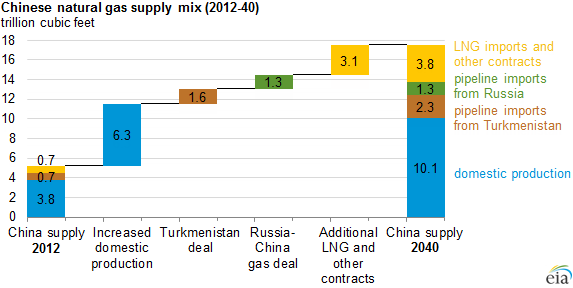
China more than tripled natural gas production since 2003, producing 3.8 trillion cubic feet in 2012, and the government is targeting production to reach about 5.5 Tcf of natural gas per year by the end of 2015. Most of the anticipated production growth is from large onshore fields in the western and north central regions of China as well as from the offshore deepwater regions in the South China Sea. China's natural gas consumption has outstripped domestic supply since 2007, triggering rising imports of both liquefied natural gas and pipeline gas. China's natural gas consumption rose at an average annual rate of 17 per cent from 2003 through 2013, reaching nearly 5.7 Tcf in 2013.

In 2013, China imported nearly 1.8 Tcf of LNG and pipeline gas to fill the growing gap between supply and demand. Imported natural gas met 32 per cent of China's demand in 2013, up from 2 per cent in 2006. China is swiftly developing its LNG import capacity in the urban coastal areas and currently has 10 major regasification terminals with 1.7 Tcf/y of capacity. In 2012, China rose to become the third-largest LNG importer in the world, after Japan and South Korea, and in 2013, the country imported 870 billion cubic feet of LNG. Estimates for the first half of 2014 show LNG imports growing at faster levels than in previous years.

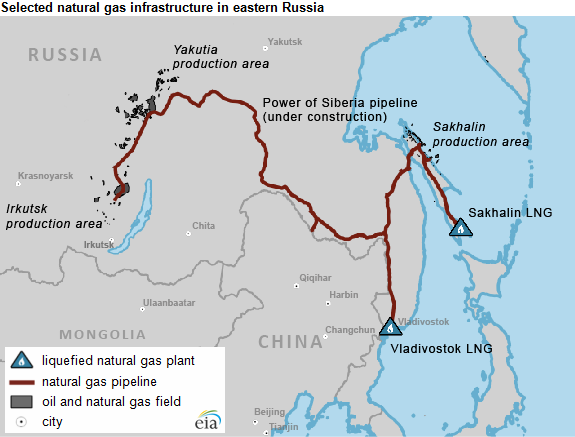
The second article looks at the supply situation from Russia - China's gas equation, post-Gazprom.

Russia's largest natural gas company, Gazprom, finalised a deal with the Chinese National Petroleum Corporation in May. New natural gas production in Russia will mainly come from fields in eastern Siberia, which currently lack export infrastructure. The planned Power of Siberia pipeline will export gas south to China and east to a liquefied natural gas plant on Russia's east coast.

This contract is Gazprom's largest to date. Gazprom has a monopoly on pipeline natural gas export contracts made by Russia. The situation differs from that in LNG markets, where other companies such as Rosneft and Novatek may participate.

China's northern and eastern provinces have growing natural gas demand that cannot be met by existing pipelines or LNG, and the new Russian natural gas will mostly go to meet demand in these regions. China has also committed to purchasing 38 bcm (1.3 Tcf) per year of natural gas from Turkmenistan by 2016, increasing to 65 bcm (2.2Tcf) per year by 2020.

As a footnote, Technology Review has an article on China's problems trying to develop shale gas - China’s Shale Gas Bust.

In 2013 China became the third biggest user of natural gas behind the United States and Russia, consuming 166 billion cubic meters (bcm). By 2019, the International Energy Agency expects China’s annual natural gas consumption to grow 90 percent, to 315 bcm. Half of that increase is expected to be supplied by domestic gas production, which would come from multiple sources, including shale reserves.

That IEA estimate for gas consumption is much lower than the production target China had set for itself: 420 bcm of natural gas annually by 2020, with hydrofracturing, or fracking, being used to get 60 to 80 bcm from shale.

China is estimated to hold the largest technically recoverable reserves of shale gas in the world—nearly twice as much as the U.S. But the shale industry in China has struggled to get off the ground. Most projects are still in the exploration phase. In many cases the formations that hold gas are deeper than in North America and more expensive to reach. Further, Chinese shale tends to have more clay in it, which is an obstacle to extraction (see “China Has Plenty of Shale Gas, But It Will Be Hard to Mine”). These challenges led the government last week to reduce the 2020 shale-gas target to 30 bcm.

Even that would represent a huge increase. Of the 117 bcm of natural gas that China produced in 2013, only 0.2 bcm came from shale.

The high price of gas exports  

Posted by Big Gav in , , ,

The impact of LNG exports, particularly of coal seam gas, on Australian industry continues to be the topic of debate, with one recent report warning that there it will further destroy the local manufacturing industry (already reeling from Dutch disease) - High gas prices threaten thousands of jobs, billions of dollars: industry.

A new report warns the riches promised by exporting Australian gas may have a devastating impact on local industries, particularly manufacturing. A coalition of half-a-dozen industry groups commissioned the report by Deloitte Access Economics.

The report says domestic gas prices are rapidly rising as the market links in with international prices. It warns that, if the rise goes unchecked, the manufacturing sector alone will contract by as much as $118 billion by 2021, with nearly 15,000 jobs lost. The report also finds that mining might contract by $34 billion and agriculture by $4.5 billion.

The ABC has a background piece - The price of gas.

Australians pay close to the highest electricity prices in the world, and we’re about to start paying some of the world’s highest gas prices, too. That’s because we’re about to start exporting gas for the first time from the east coast, and there’s no limit to the amount of gas that can be sent overseas.

That means Australians have to compete with energy-hungry customers in Asia, who are prepared to pay top dollar for our gas. The message from the government is that if we want to use gas, we’re going to have to get used to paying top dollar, too.

‘Gas is now being sold in Australia at an international price. That’s the reality of a world market,’ says the federal minister for industry, Ian Macfarlane. ‘To protect one section of the Australian market to the detriment of those people who want to take the risk, and invest the billions of dollars it takes to develop a CSG (coal seam gas) project simply doesn’t make economic sense, and we’ll just see that investment go somewhere else.’

Australia is about to become the first country in the world to export coal seam gas—without the CSG boom in Queensland, exports on the east coast simply wouldn’t be viable. Equally, coal seam gas mining wouldn’t be feasible in Australia at the old price of $3-4 per gigajoule, because it costs a lot more to extract than conventional gas.

Customers in Asia are prepared to pay up to $18 per gigajoule for our gas. Since there’s no policy to disconnect Australia from these prices, our gas prices are now rising to meet what’s called the ‘netback’ price—the Asian price, minus the cost of processing and shipping.

For big industrial users, this is particularly bad news. ‘We're seeing prices leap from historical averages of sort of $3 to $4 a gigajoule to $9 to $12 a gigajoule or more,’ says Ben Eade, executive director of Manufacturing Australia. He says the impact of rising gas prices will ‘dwarf the impact of the carbon tax’.

A new report commissioned by industry groups and prepared by Deloitte Access Economics says skyrocketing gas prices will damage the Australian manufacturing sector to the tune of $118 billion over the next seven years, and lead to a loss of more than 14,000 jobs. ‘The fact is, high energy costs are killing industry in Australia,’ says Eade, ‘and high gas costs in particular.’

Even the companies who are willing to pay top dollar for gas are having a hard time finding it. That’s because around 80 per cent of Australia’s gas is now controlled by companies who are selling that gas to Asia. In fact, the big gas exporters have overcommitted to customers; according to Citigroup all three LNG hubs are having to buy gas from third parties in order to meet demand.

Santos' Bonaparte gas project on hold  

Posted by Big Gav in , , ,

The BS reports that the Bonaparte LNG export project off Northern Australia may not follow Shell's floating LNG plant example after all - Santos' Bonaparte gas project on hold.

French energy giant GDF Suez says it is reconsidering a huge project for a floating gas liquefaction factory off northern Australia and might opt to build an undersea pipeline to Darwin. The gas fields concerned continue to have "material value", the company said on Thursday. But using a floating liquefaction plant to process the gas does not satisfy business criteria, the group said, in an important announcement for the Australian energy sector.

The overall project, called Bonaparte, involves an ambitious scheme using advanced technology to generate liquefied natural gas from resources off northern Australia. The development of floating liquefaction plants is at the forefront of efforts to turn Australia into a leading supplier of LNG in Asia.

Natural Gas Rolls Into World of Freight Rail  

Posted by Big Gav in , ,

US News and World Report has an article on speculation about the conversion of the US rail system to use LNG - Natural Gas Rolls Into World of Freight Rail

Diesel locomotives may soon go the way of the steam engine.

Liquefied natural gas, or LNG, may soon replace diesel in most of the country’s freight locomotives, the U.S. Energy Information Administration said Monday. “It’s still relatively much cheaper than the diesel-gallon equivalent,” EIA economist Nicholas Chase says. In fact, if LNG prices remain as low as they are, some rail companies believe the conversion could happen as quickly as “the dieselization revolution of the 1940s and ‘50s,” when huge numbers of trains were converted from steam to diesel, Chase says.

Swanbank shut-down a swan song for gas fired power in Australia  

Posted by Big Gav in , , ,

Tristan Edis at the BS has a look at how LNG exports from Queensland are killing gas fired power generation - Swanbank shut-down a swan song for gas.

Queensland government-owned Stanwell has announced it will be mothballing its gas-fired 385 megawatt Swanbank E power station in October for up to three years. Meanwhile, it will restart one of its two mothballed units at the coal-fired Tarong Power station instead but, critically, is yet to give a firm indication on timing.

This announcement marks a pivotal point in the east coast National Electricity Market – the end of gas’ rise and the beginning of a major fall as a source of power generation. According to Stanwell’s chief executive officer Richard Van Breda, “With subdued market conditions and increasing gas prices expected to continue, Stanwell can earn more revenue from selling our gas rather than using it in electricity generation.” ...

As the chart below, from Pitt & Sherry’s Hugh Saddler, shows gas has experienced a steady rise in output from June 2006 to December 2013 while black coal and, more recently, brown coal have suffered.

Back around 2006 it all looked very bright for gas as the low carbon bridging fuel to renewables. It was thought that gas would steadily increase its share of power generation while coal declined on the back of policies to reduce Australia’s greenhouse gas emissions.

Lots of new gas had been discovered within Queensland coal seams that meant there was little risk of the east coast running short. Gas prices at around $3.50 per gigajoule plus power plant construction that was quicker and lower cost meant that there was only a relatively small difference in the economics of a new coal versus a gas power plant. A relatively moderate carbon price of around $20 to $30 was all that was needed for coal to lose out to gas in baseload operation, not to mention coal’s inferior flexibility and larger minimum size that increased its risk profile.

The Queensland 13% Gas Target and NSW’s Greenhouse Gas Abatement Scheme were already in place, providing a clear precedent for what many saw as an inevitable national emissions trading scheme. A dash for gas, like what had been seen in Europe and the US, seemed to be on the horizon. But then Santos announced it planned to build a plant to liquefy Queensland coal seam gas and export it overseas. It changed everything, although at the time the consequences were not entirely clear.

Now they are. Gas contracts are now being struck at prices of $9 per gigajoule rather than the $3.50 price of the past. There is also talk of gas shortages because of a huge surge in demand from a range of LNG plants coming online within short succession.

What Gas shortage? Tapping the bubbling wells of spin and self-interest  

Posted by Big Gav in , , ,

Crikey has a look at the lobbying being done on behalf of the natural gas (particularly coal seam gas) industry to try to demolish opposition to expanded drilling programs - Gas shortage? Tapping the bubbling wells of spin and self-interest. One benefit of Labor losing office is Martin Ferguson no longer being in Parliament - its a shame he didn't retire to obscurity instead of getting paid to do what he was doing before as energy minister - lobbying on behalf of the fossil fuel industry.

New South Wales is about to run out of gas, so says the scare campaign. It’s bully-boy tactics by Australia’s powerful oil and gas industry, designed to pressure the state government into quickly approving contentious coal seam gas projects proposed by Santos at Narrabri and AGL at Gloucester.

Federal Industry Minister Ian Macfarlane is on board, warning last year NSW would “run short of gas by 2016” and moving to knock heads together on the issue straight after the election. For months we have been hearing the same lines trotted out: how NSW is “running on empty”, suddenly needs “energy security”, and how developing its own “indigenous” gas supplies will ease prices.

Former John Howard industrial relations minister Peter Reith — whose recommendation to lift fracking bans was ignored by the Victorian government last year — used his column in Fairfax papers yesterday to accuse the O’Farrell government of abandoning the CSG debate, warning “there is a real prospect Sydney could suffer gas shortages”. Reith failed to disclose his consultancy with construction giant Bechtel, a major contractor to the CSG industry.

Former federal energy minister Martin Ferguson was appointed chair of new advisory group APPEA (“the voice of Australia’s oil and gas industry”) in October, barely six months after he stepped down from his cabinet post and only weeks after retiring from Parliament — flouting the 18-month cooling-off period required of ex-ministers under the lobbying code of conduct. Ferguson had a dig at his erstwhile NSW Labor colleagues for “parroting the lines of the Greens and showing itself to be completely irrelevant to the debate”, urging Premier Barry O’Farrell to break “the impasse preventing the development of the state’s abundant gas resources to put downward pressure on rising prices”.

The ABC’s fact checkers concluded Macfarlane’s alarming claims about a NSW gas shortage were “unverifiable”. They were way too generous. The claims are rubbish, designed to confuse the public. Here’s what they’re not telling you:

* No one is going to run out of gas; * Developing CSG in NSW won’t lower rising gas prices; * It’s too late anyway for NSW CSG to ease the current uncertainty affecting gas markets; and * There are plenty of alternative sources of supply for NSW.

Australia has an incredible amount of gas; we’re about to overtake Qatar to become the world’s largest exporter of liquefied natural gas. Between Western Australia, the Northern Territory and Queensland, seven LNG projects worth more than $200 billion are on the go.

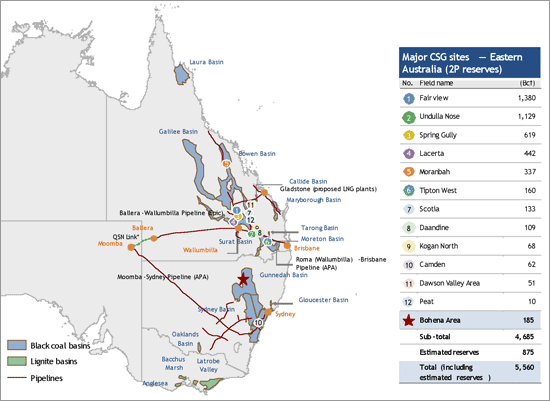
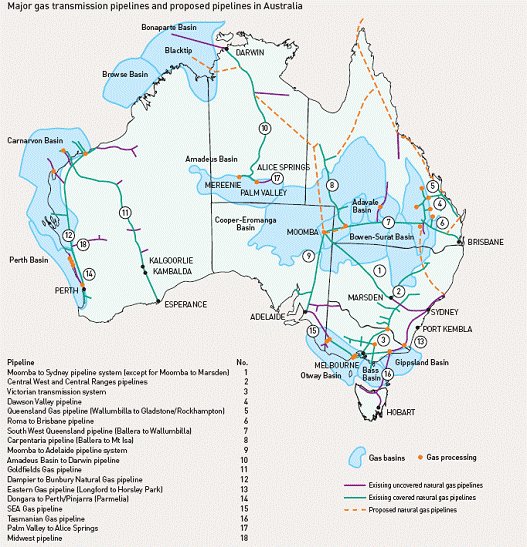
The chart above shows three seriously big gas resources that supply the southern and eastern states: the massive coal seam gas in Queensland’s Bowen and Surat basins (41620PJ), plus conventional gas in the Gippsland Basin (3890PJ) and the Cooper Basin (1835PJ). Not shown but certainly exercising the mind of investors is a vast potential resource of tight and shale gas in the Cooper Basin — which may turn out to be bigger than CSG in Queensland, and which oil majors like Chevron and BG Group are scrambling to invest in. By comparison, the coal seam gas discovered in NSW is significant, but no game-changer: Santos has 1426PJ in the Gunnedah Basin, which accounts for half the state’s known reserves.

Overall, there is no doubt Australia has enough gas in the ground to supply both the domestic and export markets. As a country we can afford to think strategically, pick and choose which gas fields we develop, and in what order.

As the Australian Energy Market Operator found last year, if there’s one place in Australia susceptible to shortage it’s Gladstone in Queensland. That’s where three massive LNG export projects operated by BG, Santos and Origin Energy are about to treble gas demand in eastern Australia — ultimately representing some 80% of total gas demand in the eastern market — once they begin to come online later this year. By exposing the domestic market to higher international LNG prices of around $14-15 a gigajoule (which are geared to the oil price), the LNG projects are going to double domestic wholesale gas prices, from around $3-4/GJ to $8-10/GJ and higher, inevitably pushing up retail prices (as NSW saw last week).

The three big projects in Gladstone were approved quickly in 2010 and 2011 — without any strategic consideration of the impact on the domestic gas market — in a rush to sign lucrative contracts with buyers in Asia. It’s a bold experiment; the world’s first attempt to convert coal seam gas into LNG for export. Nobody knows yet if the thousands of CSG wells required to feed the six big LNG liquefaction units (or “trains”) under construction — each one consuming roughly as much gas each year as say Queensland or Victoria, so adding six new states’ worth of demand to the network — can be drilled fast enough, and will flow enough gas for long enough, to fulfil those contractual commitments.

Exxon pushing for floating LNG for Scarborough field  

Posted by Big Gav in , , , , , , ,

The SMH reports that Exxon is pushing for a floating LNG platform for the Scarborough gas field offshore from Western Australia - Exxon for floating gas.

ExxonMobil insists a floating liquefied natural gas processor is the preferred way to develop the big Scarborough offshore gas project in Western Australia, despite its partner BHP Billiton talking up an alternative model.

ExxonMobil has approval from the government to develop the project using a floating processor, but that did not stop BHP's petroleum chief Tim Cutt suggesting last month that connection to an existing gas processing plant may be preferable. ''Developed capacity … is typically a more cost-effective and value-accretive way to go,'' Mr Cutt said.

The North West Shelf, which is partly owned by BHP, looms as the logical place to process Scarborough gas if the floating option is abandoned, given its proximity and the fact gas production at the shelf will soon plateau.

On the other side of the country it looks unlikely that the Arrow Energy coal seam gas LNG plant will go ahead - Struggling Shell defers Arrow LNG project again.

Royal Dutch Shell has ruled out any commitment this year to the development of its Arrow liquefied natural gas venture in Queensland and signalled a more rigorous approach to other new projects in Australia, where it is also considering big asset sales. ...

Speaking after Shell reported a 70 per cent slump in fourth-quarter profit, the company's new global head named the $20-billion-plus Arrow LNG venture with PetroChina among the next potential wave of LNG investments for the oil giant, alongside the Browse floating venture and others. But he said Shell had deferred the project, deterred by ''the economics and inflation risks''. The delay is the second for the struggling Arrow venture, where at least 250 jobs were cut in January.

Speculation is increasing that Shell and PetroChina will sell their gas to one of the three LNG plants being built in Queensland, either for an expansion, or to supplement initial inadequate supplies.

Woodside looking to join Canadian LNG boom  

Posted by Big Gav in , ,

The SMH has a report on the Canadian LNG boom - Woodside secures a slice of Canadian LNG boom. It will be interesting to see how many of the 10 proposed projects go ahead.

Woodside's proposal is one of more than 10 LNG export ventures proposed on Canada's Pacific coast, where cargoes are expected to target high-priced markets in Asia.

The government is assuming about five of the projects will get built, creating more than 39,000 annual jobs during a nine-year construction period, and 75,000 jobs once the plans are fully operational. Among the most advanced are the Kitimat LNG project between Apache and Chevron, and Shell's LNG Canada venture which involves LNG import giant Korea Gas Corporation, Mitsubishi and PetroChina.

Australian Natural Gas comes off the backburner with soaring exports and prices  

Posted by Big Gav in , ,

The SMH has a summary of the evolution of the Australian natural gas market on the east coast - Gas comes off the backburner with soaring exports and prices.

Natural gas was little more than sideshow when hardy souls first started probing the seabed between Tasmania and the Australian mainland in the 1960s.

Five of the world's biggest oil nations had just formed a restrictive cartel, and Australia's dependence on imported petroleum products was both a concern and an entrepreneurial opportunity for those willing to join the fur seals in the high seas of Bass Strait.

Unable to extract the lucrative black liquid without also bringing up flammable gas, the pioneers struck a deal to hand the gas over to the Victorian government for a pittance as soon as it travelled the 77 kilometres to shore.

But almost 50 years and a few bouts of privatisation later, gas has risen to become very much front of mind in Bass Strait, and is at the centre of a new rush to secure energy supplies before prices soar. ...

Plans to export huge amounts of gas from Queensland to north Asia later this decade are having flow-on effects for the entire eastern seaboard, where a single gas grid connects NSW, Victoria, Tasmania, South Australia and Queensland.

Exporting gas is more attractive for companies because it can be sold for higher prices than the $3 to $4 per gigajoule paid by consumers in the domestic market.

The price pressure has been exacerbated by the growing realisation that some of Queensland's big gas export plants - particularly the one being built by Santos - don't have quite as much coal-seam gas coming down the pipeline as first thought.

That combination of factors is likely to drag domestic consumers into a bidding war with foreign buyers, and UBS energy analyst Nik Burns believes gas prices could triple as a result. ''Our view is that gas prices will peak around the $10 to $12 per gigajoule mark in Queensland from 2015 to 2019. Given the distance from the LNG projects in Queensland, other states will be sheltered from these prices to a certain degree, but we still anticipate gas prices there to nearly double from about $4 to as high as $8 per gigajoule,'' he said.

A squabble for gas would be ironic for a nation heavily endowed with the resource, but that is the likely outcome so long as Australia remains an exporter...

Doubts raised over CSG well capacity to feed Curtis Island LNG plants  

Posted by Big Gav in , ,

Mining News has an article quoting an American drilling services company that claims there are poor results for coal seam gas drilling to support Queensland LNG plants - Doubts raised over CSG well capacity to feed Curtis Island LNG plants. Santos and Origin are rejecting the claims.

Doubts have been raised over whether Queensland’s coal seam gas fields can produce enough to feed Curtis Island’s LNG export plants, with claims that many wells are not meeting production expectations. Houston-based drilling suppler, Superior Energy Services, said it is forecasting growth in the sunshine state on the back of poor well performance. The company, which employs more than 14,000 people worldwide and boasts a turnover of $US4bn says its eastern Australian business is set for a growth spurt, The Australian reported.

"When we are talking to the operators in Queensland, we hear from them that the coal-seam gas (wells) that currently have been drilled are actually not meeting the production expectations," SES head of Asia Pacific, Ruud Boendermaker, told investors last week. "So what they have to do is to drill a lot more CSG wells in the next few years because of the commitments to the LNG trains that they are currently building in the north of Queensland."

Boendermaker said the coal seams are not as homogeneous or permeable as expected, claiming this has led to poor well performance. SES did not say which projects needed more wells, or which areas in the state were experiencing issues, however the company’s Toowoomba office contracts to drillers rather than to the LNG proponents directly.

The calls comes as a former executive for one of the projects told The Australian that the gas fields’ "sweet spots" had not been as large as anticipated.

Australia's LNG nuclear bomb  

Posted by Big Gav in , ,

The BS's Alan Kohler has an article on the repeal of the carbon tax - Australia's LNG nuclear bomb.

The LNG export boom will make it virtually impossible for Australia to meet the government’s carbon emissions reduction target. The high price of gas in Australia has made replacing coal-fired power stations with gas uneconomic and “fugitive emissions” from the LNG plants mean that reducing overall emissions within Australia by 5 per cent by 2020, as government policy states, will require much bigger cuts in other industries.

Tony Abbott will have to either drop the promise to cut emissions by 5 per cent or the promise to repeal the carbon tax – both together will be impossible without massive government spending under the proposed “direct action” policy of paying companies to reduce emissions.

Actually previous government policy was for a 15 per cent reduction in emissions if the rest of the developed world also took action on climate change. That’s happening, so the 15 per cent would have applied. The Coalition said it would match Labor’s emissions reduction target, but the figure of 15 per cent doesn’t seem to appear in its policy – only 5 per cent.

Anyway, not trying to reduce carbon emissions at all would put Australia at odds with the rest of the world, including China and the US, and endanger trade agreements, so the prime minister and Treasurer Joe Hockey will be, or at least should be, desperately hoping that the Senate never allows the repeal of the emission trading scheme legislation, so it’s not exactly a broken promise – at least they tried. ...

The emissions trading scheme currently in place would eventually produce revenues to the government of up to $10 billion a year. It’s understood Treasury has estimated the eventual cost of the Coalition’s direct action plan at $10 billion.

That’s a $20 billion turnaround and makes climate change a “nuclear bomb” in the federal budget, as Professor Ross Garnaut says and as he puts in his book Dog Days, it would end up “distracting the government and the polity from the great economic challenges facing Australia”.

Like Australia, the United States has enjoyed a huge boom in gas supplies by exploiting smaller and tighter reservoirs – in their case in shale, in ours coal seams.

However the US banned LNG exports and is now allowing them on a case-by-case basis, resulting in a collapse in the domestic gas price to about a third of what it was. The result is wholesale replacement of coal-fired power stations – new and existing -- with lower carbon emitting gas.

In Australia, export pricing has led to a huge increase in the domestic gas price despite the big lift in available supply, with the result that gas is still uneconomic as a replacement electricity fuel for coal.

Orica's gas deal could ignite a price surge  

Posted by Big Gav in , , ,

The BS reports that explosives company Orica are looking to avoid manage their exposure to rising natural gas prices by contracting future gas supplies - Orica's gas deal could ignite a price surge. Orica's Ian Smith was on the ABC's Insiders program this morning talking about the deal and noting that while mining services companies that are involved in construction are in trouble with the end of the mining boom, other mining services companies (like Orica) that are involved in ongoing production are actually benefiting from decreasing quality of ore grades, with more explosives being required to extract the same volume of iron.

Ian Smith isn’t relying on governments or a breakthrough in the impasse over exploitation of NSW’s coal seam gas reserves to secure Orica’s gas supplies. Today he added a conventional arrangement with Esso and BHP Billiton to an earlier and rather less conventional deal to get access to gas.

The three-year agreement with Esso and BHP enables Orica to acquire up to 42 petajoules of gas over three years, beginning in 2017, from the Bass Strait partners. There is provision for the agreements to be extended into the next decade.

Earlier this year, Orica unveiled a very different kind of arrangement under which it signed a gas off-take deal with Strike Energy. This enabled it access to 150 petajoules of gas at an ‘’affordable’’ price over the next two decades by making pre-payments of $52.5 million to help fund commercialisation of Strike’s coal seam gas project in the southern Cooper Basin in South Australia.

Smith said today discussions were also underway with a number of parties over the supply of 3.5 petajoules a year to Orica’s Yarwun ammonium nitrate facility in Queensland. The Esso/BHP deal will meet the gas requirements of its Kooragang Island facility in NSW.

Smith has made it very clear that he isn’t going to leave Orica exposed to the outcome of the inconclusive debate about ‘’reserving’’ gas in Australia, nor risk the eventual outcome (if any) of the highly-politicised debate about the development of NSW’s extensive coal seam gas resources.

That determination to lock in his group’s energy requirements flows from the knowledge that the contracts that had under-pinned the access to gas for large domestic customers will fall away over the next couple of years just as the domestic gas market in Australia undergoes fundamental structural changes.

It is the development of the coal seam gas-fed export LNG projects at Gladstone in Queensland that has fundamentally changed the nature of the market. From next year, BG Group will begin exporting LNG, with the other two big facilities owned by the Santos and Origin Energy-led consortia not far behind.

That will divert a lot of gas that might otherwise have been sold into the domestic market offshore and expose domestic gas consumers, used to a market where there was a surplus of gas, to export-related prices for the first time. (In fact, recent gas contracts have reflected the oil-linked LNG prices, less the cost of liquefaction and transport, with the price rising from around $4 per gigajoule into the high single digits.)

Arrow LNG project put on notice  

Posted by Big Gav in , , ,

The BS has an article about the possibility of one one Queensland's coal seam gas LNG projects being cancelled - Arrow LNG project put on notice. I guess this could help limit gas price rises on the east coast for a time, with the excess supply needing to be soaked up somewhere.

The owners of the Arrow coal-seam gas project in Queensland have ordered the project's team to tighten its costs or Arrow will not go ahead, according to The Australian. The ultimatum from Royal Dutch Shell and PetroChina to the project's team casts further uncertainty on the outlook for Australia's liquefied natural gas (LNG) outlook.

East Coast Gas prices to spike: AGL  

Posted by Big Gav in , , ,

The Business Spectator reports that AGL's CEO is predicting east coast gas prices will triple once the coal seam gas LNG plants in Queensland come online in 2015 - Gas prices to spike: AGL.

Mr Fraser said as power generators and industrial users absorb the effects of $70 billion worth of LNG plants being constructed at Gladstone, domestic demand would come under pressure and push gas prices higher. "Everybody talked about there being a surplus of ramp-up gas, now people talk about the wedge gas -- the shortfall in the gas they have in the early years of the project," Mr Fraser said. "Deals are being done at $9-$10 and who knows where it will go when it starts up."

Statistics

Locations of visitors to this page

blogspot visitor
Stat Counter

Total Pageviews

Ads

Books

Followers

Blog Archive

Labels

australia (619) global warming (423) solar power (397) peak oil (355) renewable energy (302) electric vehicles (250) wind power (194) ocean energy (165) csp (159) solar thermal power (145) geothermal energy (144) energy storage (142) smart grids (140) oil (139) solar pv (138) tidal power (137) coal seam gas (131) nuclear power (129) china (120) lng (117) iraq (113) geothermal power (112) green buildings (110) natural gas (110) agriculture (91) oil price (80) biofuel (78) wave power (73) smart meters (72) coal (70) uk (69) electricity grid (67) energy efficiency (64) google (58) internet (50) surveillance (50) bicycle (49) big brother (49) shale gas (49) food prices (48) tesla (46) thin film solar (42) biomimicry (40) canada (40) scotland (38) ocean power (37) politics (37) shale oil (37) new zealand (35) air transport (34) algae (34) water (34) arctic ice (33) concentrating solar power (33) saudi arabia (33) queensland (32) california (31) credit crunch (31) bioplastic (30) offshore wind power (30) population (30) cogeneration (28) geoengineering (28) batteries (26) drought (26) resource wars (26) woodside (26) censorship (25) cleantech (25) bruce sterling (24) ctl (23) limits to growth (23) carbon tax (22) economics (22) exxon (22) lithium (22) buckminster fuller (21) distributed manufacturing (21) iraq oil law (21) coal to liquids (20) indonesia (20) origin energy (20) brightsource (19) rail transport (19) ultracapacitor (19) santos (18) ausra (17) collapse (17) electric bikes (17) michael klare (17) atlantis (16) cellulosic ethanol (16) iceland (16) lithium ion batteries (16) mapping (16) ucg (16) bees (15) concentrating solar thermal power (15) ethanol (15) geodynamics (15) psychology (15) al gore (14) brazil (14) bucky fuller (14) carbon emissions (14) fertiliser (14) matthew simmons (14) ambient energy (13) biodiesel (13) investment (13) kenya (13) public transport (13) big oil (12) biochar (12) chile (12) cities (12) desertec (12) internet of things (12) otec (12) texas (12) victoria (12) antarctica (11) cradle to cradle (11) energy policy (11) hybrid car (11) terra preta (11) tinfoil (11) toyota (11) amory lovins (10) fabber (10) gazprom (10) goldman sachs (10) gtl (10) severn estuary (10) volt (10) afghanistan (9) alaska (9) biomass (9) carbon trading (9) distributed generation (9) esolar (9) four day week (9) fuel cells (9) jeremy leggett (9) methane hydrates (9) pge (9) sweden (9) arrow energy (8) bolivia (8) eroei (8) fish (8) floating offshore wind power (8) guerilla gardening (8) linc energy (8) methane (8) nanosolar (8) natural gas pipelines (8) pentland firth (8) saul griffith (8) stirling engine (8) us elections (8) western australia (8) airborne wind turbines (7) bloom energy (7) boeing (7) chp (7) climategate (7) copenhagen (7) scenario planning (7) vinod khosla (7) apocaphilia (6) ceramic fuel cells (6) cigs (6) futurism (6) jatropha (6) nigeria (6) ocean acidification (6) relocalisation (6) somalia (6) t boone pickens (6) local currencies (5) space based solar power (5) varanus island (5) garbage (4) global energy grid (4) kevin kelly (4) low temperature geothermal power (4) oled (4) tim flannery (4) v2g (4) club of rome (3) norman borlaug (2) peak oil portfolio (1)