Research analysts at Morgan Stanley believe that renewable energy like solar and wind power are hurtling towards a level of ubiquity where not even politics can hinder them. Renewable energy is simply becoming the cheapest option, fast. Basic economics, the analysts say, suggest that the US will exceed its commitments in the Paris agreement regardless of whether or not president Donald Trump withdraws, as he’s stated he will.
“We project that by 2020, renewables will be the cheapest form of new-power generation across the globe,” with the exception of a few countries in Southeast Asia, the Morgan Stanley analysts said in a report published Thursday. “By our forecasts, in most cases favorable renewables economics rather than government policy will be the primary driver of changes to utilities’ carbon emissions levels,” they wrote. “For example, notwithstanding president Trump’s stated intention to withdraw the US from the Paris climate accord, we expect the US to exceed the Paris commitment of a 26-28% reduction in its 2005-level carbon emissions by 2020.”
Michael Simmelsgaard, head of offshore business at Swedish utility Vattenfall, said the industry would cross the 10 MW turbine threshold "faster than many expect now", without being more specific. A 10 W turbine could power about 9,000 homes. "We will definitely see these big turbines," he added.
DONG Energy's wind business, Samuel Leupold, laid out more ambitious plans: "We believe we can utilize (turbines) in the range of 13 to 15 megawatts," he said on the sidelines of an offshore wind conference in London this month - the first time an industry executive has given such a high figure. Previously, companies have only spoken about turbines in the region of 10W.
EnBW also said it was turning to megaturbines. "Size is an important driver of efficiency," said Dirk Guesewell, its head of generation portfolio development. "Bigger rotors mean fewer turbines and foundations are needed to achieve the same capacity."
German turbine maker Senvion said it was developing megaturbines of over 10 MW. While the machines are still in the design stage, it said it was already offering them for future use to wind farm operators.
Texans have long stored oil, natural gas and other forms of energy in underground salt caverns, so it's only natural that a Houston startup wants to store wind energy there, too. The method is in the company's name, Apex-CAES, where CAES stands for compressed air energy storage. The company plans to use electricity at night, when it's cheap, to compress air into an underground cavern. The company then releases the air through turbines to generate electricity when the price is right.
The only thing holding back this 30-year-old technology has been the economics. The difference between the high and low prices in a 24-hour period has not been large enough to generate a reasonable return on the capital investment. Texas' wholesale electricity market and huge nightly wind resource, though, make compressed air energy storage viable, said Jack Farley, CEO of Apex-CAES. Build enough compressed air energy storage, and Texas would never have to burn coal again, and consumers would enjoy even lower electricity prices, he told me.
Agri-business company Nectar Farms has announced a $565 million expansion of its new hydroponics business near Stawell in the Victoria’s western districts, that will include a 196MW wind farm and 20MW of battery storage and make it 100 per cent renewable-powered. ... It is possibly the first time that a major project has relied on the ability to source renewable energy, because without it the cost of fossil fuels would have been too prohibitive.
Nectar Farms had planned to use gas – as the hydroponic farms needs heat and Co2 – but the cost was overwhelming and the gas supply was not guaranteed – so instead of abandoning the project altogether, or moving it elsewhere, it has turned to renewables and decided to completely electrify the process.
As more and more turbines are installed across the country, Southwest Power has become the first North American grid operator to get a majority of its supply from wind. That beats the grid’s prior record of 49.2 percent and the 48 percent that a Texas grid operator reached in March, Derek Wingfield, a spokesman, said in an e-mail.
“Ten years ago we thought hitting even a 25 percent wind-penetration level would be extremely challenging, and any more than that would pose serious threats to reliability,” Bruce Row, Southwest Power Pool’s vice president of operations, said in the statement. “Now we have the ability to reliably manage greater than 50 percent. It’s not even our ceiling.”
The power pool operates 60,000 miles of power grid across 14 states. Texas leads the U.S. wind industry with more than 20 gigawatts installed, followed by Iowa, Oklahoma, California and Kansas, according to the American Wind Energy Association.
A new flapping wind turbine from Tunisia marks a revolutionary breakthrough in the field of mechanics. Until recently, scientists have been limited in their ability to apply new understandings of animal and human motion to machines, according to Tyer Wind. In the wind energy sector, this limitation has resulted in fairly simple and relatively inefficient turbines. Using 3D Aouinian kinematics that he pioneered, Anis Aouini is disrupting that space with a unique wind turbine modeled on articulations of the only bird capable of sustained hovering–the hummingbird.
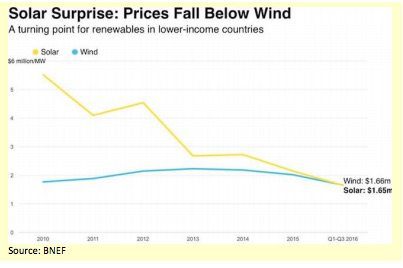
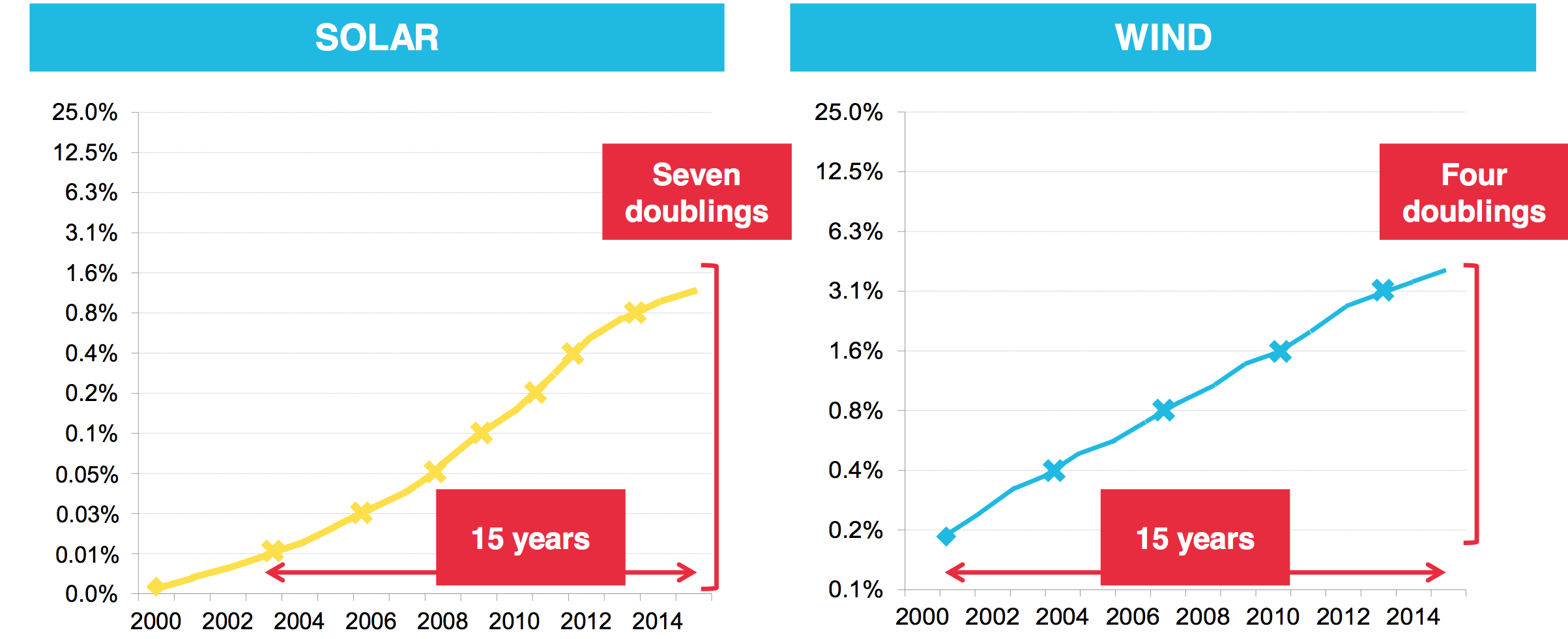
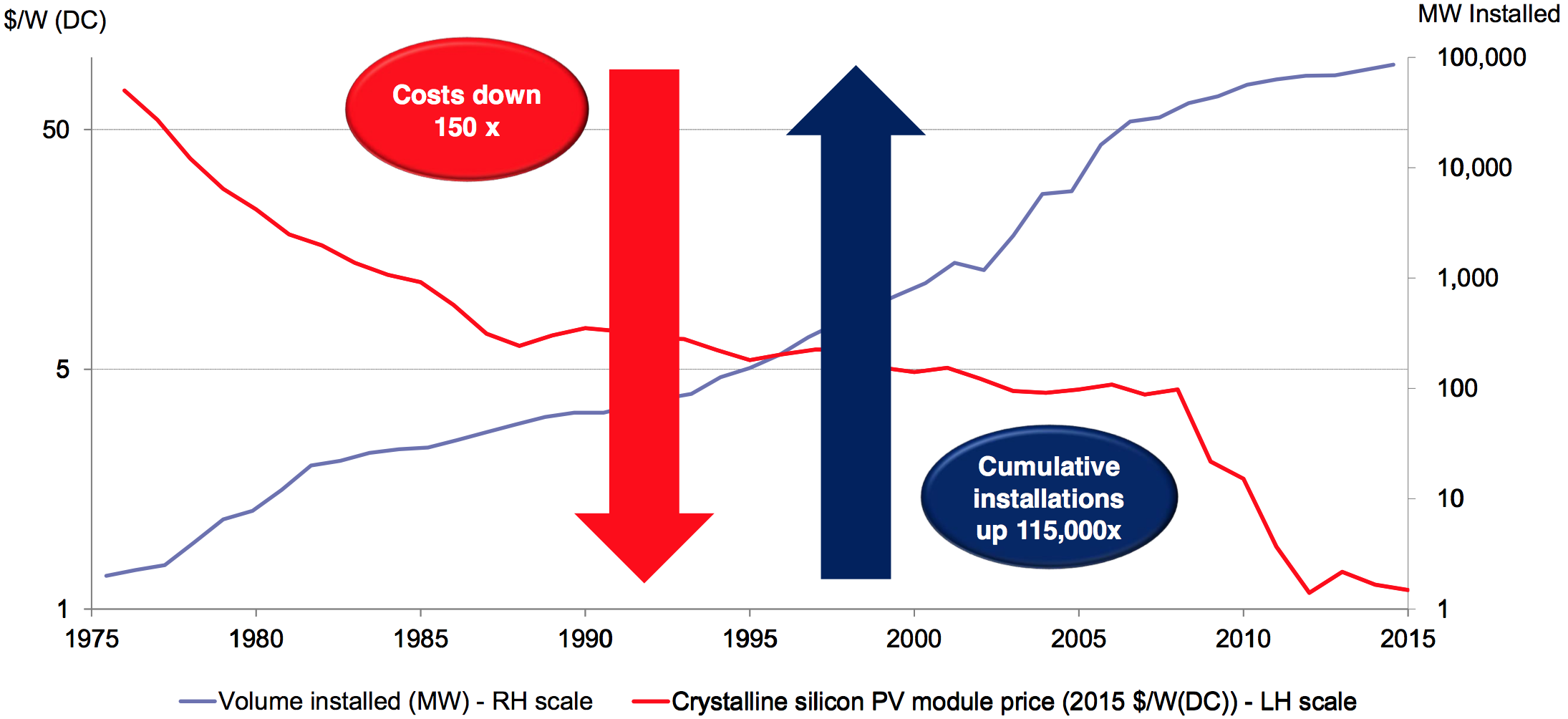
The BNEF’s accompanying chart, which shows the average cost of new wind and solar from 58 recently completed projects and/or auctions in places such as China, India, and Brazil suggests that the solar’s steep price drop since 2010 has caught up with wind – which has more or less held steady in the recent past.
“Solar investment has gone from nothing—literally nothing—like five years ago to quite a lot,” said Ethan Zindler, head of BNEF’s US policy analysis, who attributes “a huge part” of this to China, which has not only been rapidly expanding its own solar capacity but actively promoting and/or financing other countries to do the same. As the biggest manufacturer of solar panels in the world, there is a lot at stake in how fast solar capacity is installed beyond China’s own borders.
Heralding the new age of solar, BNEF’s colorful chairman Michael Liebreich declared, “Renewables are robustly entering the era of undercutting” fossil fuel prices. He said he was basing his statement on numerous solar projects completed in 2016 with more to follow in 2017. When the data are tallied for the year, it’s likely that the total solar PV capacity added globally in 2016 will exceed that of wind for the first time. The latest BNEF projections call for 70 GW of newly installed solar compared to 59 GW of wind for 2016. What is stunning about these figures is that both are significant, but solar appears to have overtaken wind. ...
The BNEF’s Liebreich acknowledges that, “… the overall shift to clean energy can be more expensive in wealthier nations, where electricity demand is flat or falling and new solar must compete with existing billion-dollar coal and gas plants,” adding, “But in countries that are adding new electricity capacity as quickly as possible, renewable energy will beat any other technology in most of the world without subsidies.”
As they got bigger, the units became more efficient, boosting global installations 23 percent last year to a record 63.5 gigawatts, which at full tilt would be about as much as what flows from 63 nuclear reactors. ... “The doubling of turbine size this decade will allow wind farms in 2020 to use half the number of turbines compared to 2010,” said Tom Harries, an industry analyst at Bloomberg New Energy Finance. “This means fewer foundations, less cabling and simpler installation -- all key in slashing costs for the industry.”
The average turbine installed in Europe was 4.1 megawatts last year, 28 percent larger than in 2010, according to the London-based researcher, which expects 6.8 megawatts to be the norm by 2020. Harries said Siemens has hinted it’s working on a 10 megawatt turbine.
This year has seen a remarkable run for solar power. Auctions, where private companies compete for massive contracts to provide electricity, established record after record for cheap solar power. It started with a contract in January to produce electricity for $64 per megawatt-hour in India; then a deal in August pegging $29.10 per megawatt hour in Chile. That’s record-cheap electricity—roughly half the price of competing coal power. “Renewables are robustly entering the era of undercutting” fossil fuel prices, BNEF chairman Michael Liebreich said in a note to clients this week.
Those are new contracts, but there are plenty of projects reaching completion this year, too. When all of the 2016 completions are tallied in coming months, it’s likely that the total amount of solar photovoltaics added globally will exceed that of wind for the first time. The latest BNEF projections call for 70 gigawatts of newly installed solar in 2016 compared with 59 gigawatts of wind.
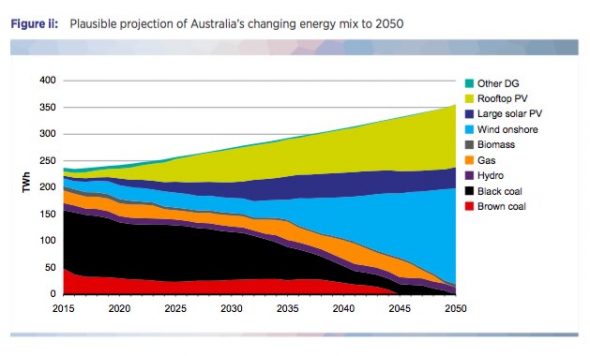
The CSIRO and Australia’s electricity network owners this week released a study that showed the best to deliver reliability, bring down costs and lower emissions in Australia was through a national grid powered almost exclusively by wind and solar. The cost savings over business-as-usual – a grid powered primarily by coal and gas – were significant, with consumer savings of between one-quarter and one-third of their bills.
But it does beg a question: If the grid is powered by “variable renewable energy” (or VRE), such as wind and solar, what will happen when, as the detractors say, the wind don’t blow and the sun don’t shine? The answer, of course, is storage. But not nearly as much as the cynics suggest. And at not nearly the cost.
Wind energy had a good run in Denmark over the weekend, with the nation’s wind farms at times generating enough electricity to meet demand over the course of Saturday, November 26. ...
Denmark – a world leader in both onshore and offshore wind power development – aims to have wind supply 50 per cent of electricity consumption by 2020. In 2015, wind energy supplied 42 per cent of domestic electricity consumption.
Since installing the world’s first offshore wind farm in 1991, the country has installed a total of 1,271MW offshore wind, which combined with its onshore wind capacity amounted to 5,070MW as at January 2016.
North America’s first offshore wind farm, Block Island Wind Farm, started operations last Wednesday and is expected to be in full swing by Thanksgiving. When it is running at full capacity, the farm will generate enough electricity to power 17,000 homes, or about 4 percent of all households in Rhode Island. It’s a modest U.S. launch for an industry that has been booming in Europe. But it’s a big win after 15 years of trying to get offshore wind power off the ground.
Specifically, the report outlined ways in which wind power could reach 2,110 GW by 2030, supplying up to 20% of global electricity while simultaneously creating 2.4 million new jobs, reducing carbon emissions by more than 3.3 billion tonnes per year, and attracting annual investments of €200 billion. ...
“Wind power is the most competitive option for adding new capacity to the grid in a growing number of markets,” Sawyer continued, “but if the Paris agreement targets are to be reached, that means closing fossil fuel fired power plants and replacing them with wind, solar, hydro, geothermal and biomass. That will be the hard part, and governments will have to get serious about it if they are to live up to the commitments to which they have now bound themselves.”
At the widest point of the Greater Thames estuary, 12 miles north of the Kent coast and 12 miles south of Essex, lies the London Array – the largest operational offshore wind farm in the world. Completed in 2013, after 10 years of planning and construction, it covers an area of 40 square miles – roughly the same size of Bristol – and comprises 175 individual turbines laid out in neat rows like an enormous nursery flower bed.
Spanish startup Vortex has an interesting bladeless wind turbine design that generated quite a lot of publicity last year as they went through a crowdfunding phase.
Technology Review explains that the turbines harness "vorticity" - the spinning motion of air or other fluids.
When wind passes one of the cylindrical turbines, it shears off the downwind side of the cylinder in a spinning whirlpool or vortex. That vortex then exerts force on the cylinder, causing it to vibrate. The kinetic energy of the oscillating cylinder is converted to electricity through a linear generator similar to those used to harness wave energy.
The TR author warns that the "turbine looks intriguing, but it may not solve wind power’s challenges".
Wired reports the company founders claim their Vortex Mini, which stands at around 41 feet tall, can capture up to 40 percent of the wind’s power during ideal conditions (this is when the wind is blowing at around 26 miles per hour).
Based on field testing, the Mini ultimately captures 30 percent less than conventional wind turbines, but that shortcoming is compensated by the fact that you can put double the Vortex turbines into the same space as a propeller turbine.
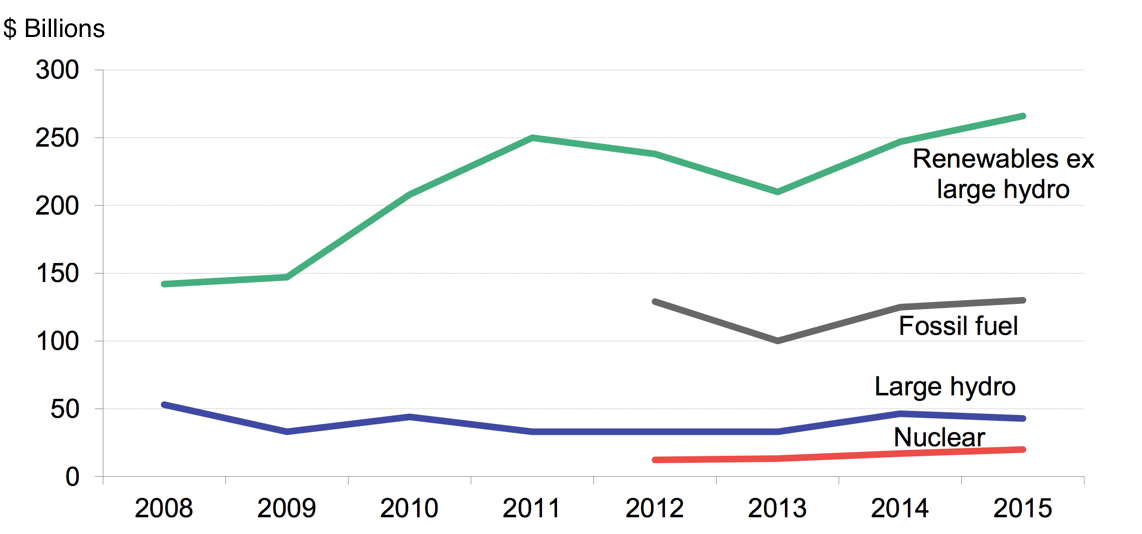
Bloomberg has a report on the massive growth in renewable energy and the steady marginalisation of fossil fuels - Wind and Solar Are Crushing Fossil Fuels. The article notes that even with low oil, gas and coal prices, renewable energy investment has still powered ahead.
One reason is that renewable energy is becoming ever cheaper to produce. Recent solar and wind auctions in Mexico and Morocco ended with winning bids from companies that promised to produce electricity at the cheapest rate, from any source, anywhere in the world
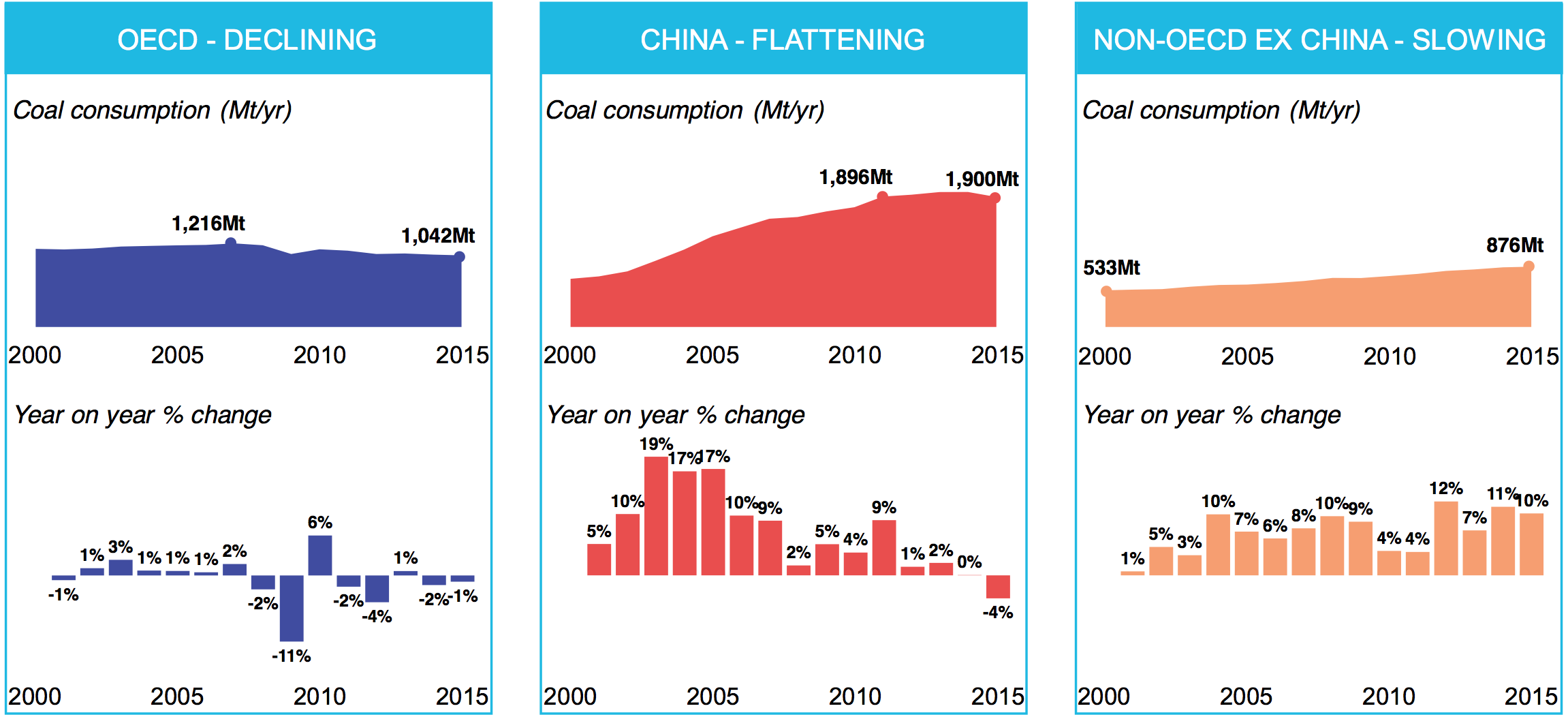
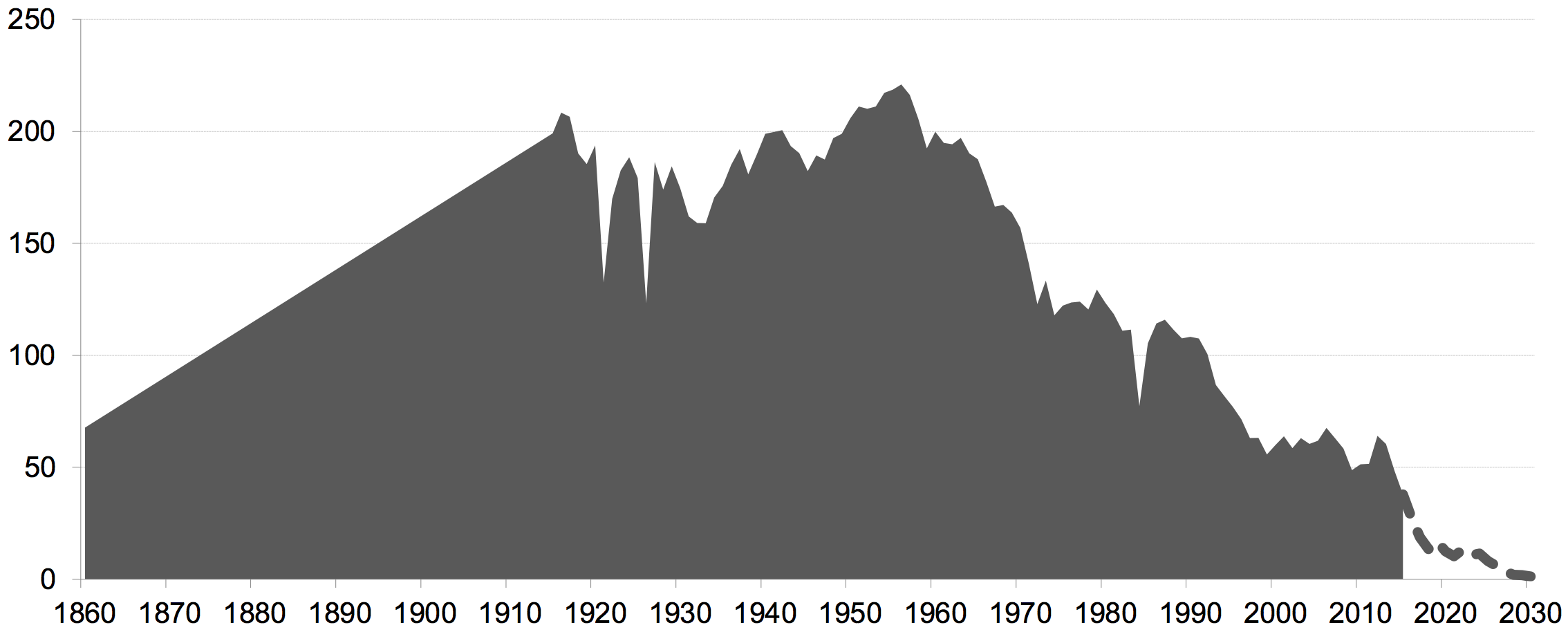
This last graph is interesting, showing how much power is generated in the UK from coal - things are almost back to where they were at the start of the industrial revolution.
In 2015, for the first time ever renewable power sources accounted for more than half of the new energy generation capacity installed (without including big hydro) – beating out coal and gas-fired generation.
I quite like these kinetic art objects from Anthony Howe. I'm not sure if they generate power as well but they'd be a great garden feature if they did.
The article claims each blade would span over 200 metres (far surpassing the largest blades currently in use - around 90 metres). The design would require towers to be half a kilometre tall.











 Posts




