Showing posts with label caes. Show all posts

Houston startup plans to store wind energy underground  

Posted by Big Gav in , , ,

The Houston Chronicle has an article on a compressed air energy storage project in Texas - Houston startup plans to store wind energy underground.

Texans have long stored oil, natural gas and other forms of energy in underground salt caverns, so it's only natural that a Houston startup wants to store wind energy there, too. The method is in the company's name, Apex-CAES, where CAES stands for compressed air energy storage. The company plans to use electricity at night, when it's cheap, to compress air into an underground cavern. The company then releases the air through turbines to generate electricity when the price is right.

The only thing holding back this 30-year-old technology has been the economics. The difference between the high and low prices in a 24-hour period has not been large enough to generate a reasonable return on the capital investment. Texas' wholesale electricity market and huge nightly wind resource, though, make compressed air energy storage viable, said Jack Farley, CEO of Apex-CAES. Build enough compressed air energy storage, and Texas would never have to burn coal again, and consumers would enjoy even lower electricity prices, he told me.

Liquefied Air to Store Energy on U.K. Grid  

Posted by Big Gav in , ,

IEEE Spectrum has an article on a variant of compressd air energy storage being trialled in the UK - Liquefied Air to Store Energy on U.K. Grid.

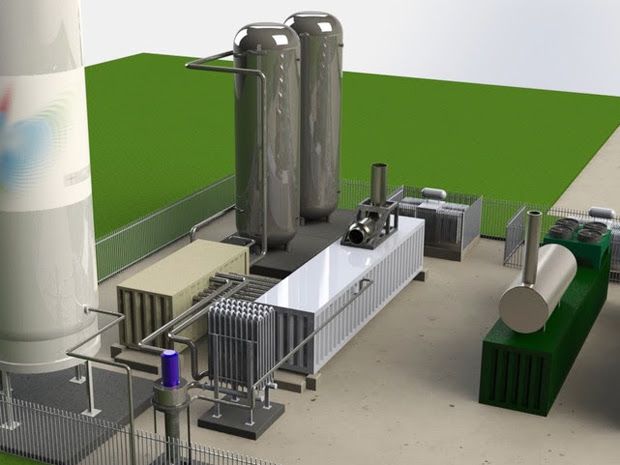
U.K.-based Highview Power Storage last week said that it has been awarded an £8 million grant from the U.K. Department of Energy and Climate Change to build a commercial-scale facility that uses liquified air to store energy. Highview is already running a smaller pilot plant, but the full-scale version will be able to store enough energy to deliver five megawatts of power for three hours. That puts it on a scale that would entice utilities to use the technology, says company CEO Gareth Brett. ...

Liquid air energy storage is similar to compressed air energy storage in that air is compressed and released to store and then generate power. With Highview’s technology, though, ambient air is compressed, then cooled and liquified. That liquefied air, which is almost -200 °C, is stored in large tanks.

When power is needed, the liquid air is released and pumped to high pressure. That causes the liquid to evaporate, turning it into a high-pressure gas which is then run through a turbine to generate power. The planned demonstration plant will be located at a waste processing center. Heat from the waste plant’s gas turbines, which run on captured landfill methane, will be piped in to improve the efficiency of the evaporation process.

One of the advantages of liquid air storage is that it uses off-the-shelf equipment. The tanks for storing liquid air, for instance, are the same as those used in the industrial gas industry.

Compressed Air Energy Storage Makes a Comeback  

Posted by Big Gav in , ,

IEEE Spectrum has an article on a new CAES technique being piloted in the US - Compressed Air Energy Storage Makes a Comeback.

The last time a compressed air energy storage (CAES) plant was commissioned was in 1991. This week, SustainX is bringing the technology back to the U.S. electricity grid, albeit in a vastly different form.

The startup, based in Seabrook, New Hampshire, began operating a full-scale demonstration system that stores energy as compressed air in pipes and supplies 1.65 megawatts of power. The company will use the machine to gather data on performance and and to show off the technology to potential investors and customers. The project was funded by $5.4 million from the Department of Energy and at least that much from SustainX, according to a representative.

Conventional compressed-air energy storage uses a compressor to pressurize air and pump it into underground geological formations. The two plants of this type currently in operation—one in McIntosh, Alabama, and the other in Huntorf, Germany—use salt caverns as storage tanks, pumping compressed air in at night, when energy demand is lowest. During the day, the air is released, heated with natural gas, and forced through a turbine to generate power. The appeal of this technology is that it’s relatively low cost and can store many kilowatt-hours of energy.

SustainX takes a different tack: it uses compressed air as the energy storage medium, but holds the air in large pipes, the same used in natural gas pipelines. That means utilities or even commercial customers could place a storage device in a range of industrial locations, rather than only where there’s an underground formation available.

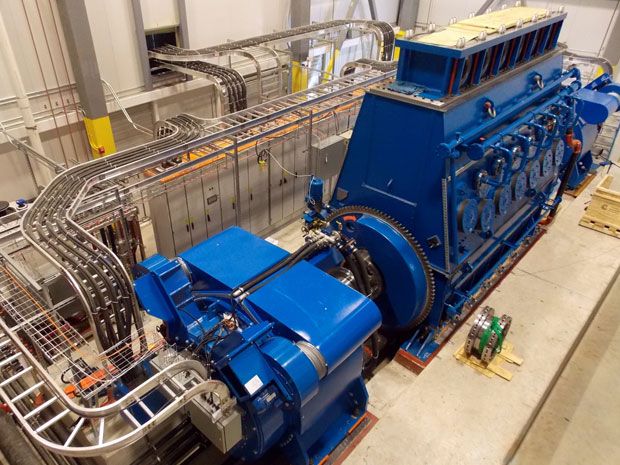
At the base of SustainX’s machine, called the S165, is the bottom half of a diesel engine normally used to propel ships. To store energy, a permanent magnet motor-generator turns the engine's crankshaft, driving six pistons located above it. The pistons, each of which is taller than a full-grown man, compress a combination of air and foamy water, which is then pumped into storage tanks. When power is needed, the air is released, driving the pistons and turning the generator to create a current.

A key difference between SustainX's technique and conventional CAES technology is that the compression and expansion of air are done at near-constant temperature and the process doesn’t require natural gas. And unlike conventional batteries, this system can vary the amount of energy independent of the power output. In other words, you can expand the amount of energy it stores simply by installing bigger pipes. That's different from a battery designed to deliver, say, 1 megawatt for 2 hours. If you wanted four hours of storage, you'd have to buy another battery--a more expensive approach, the company says.
Compressed-Air System Could Aid Wind Power  

Posted by Big Gav in , ,

Technology Review has a look at a new approach to CAES energy storage - Compressed-Air System Could Aid Wind Power.

SustainX, a startup in West Lebanon, New Hampshire, has received $20 million in venture capital to test its compressed-air energy storage technology on a large scale.

The technology could allow for a wider use of compressed-air storage, which in turn could make renewable energy more attractive, since it would allow wind power generated at night to be stored until daylight hours, when demand is higher. If it's successful, the technology could decrease the need to build natural gas plants to supply peak power demand.

The need for storage is increasing as governments mandate the use of more renewable energy. SustainX has demonstrated a 40-kilowatt prototype and is now completing a one-megawatt system, slated to be deployed next year with the power company AES.

In conventional compressed-air storage, electricity is used to compress air, which is stored in underground caverns or aquifers. That air is then released to drive a turbine-generator to produce electricity when needed. Such storage costs roughly a tenth of what battery storage costs, but it isn't used much because in large part because it requires a location with underground storage space. SustainX's system eliminates this problem because it can efficiently use above-ground storage tanks rather than caverns.
Advertisement

Storing compressed air in tanks aboveground is impractical with a conventional turbine-based system because of the large size and cost of the tanks. SustainX's technology reduces the cost of the tanks and other capital costs. "We do aboveground compressed-air energy storage at belowground prices," says cofounder and vice president Dax Kepshire.

The company reduces costs by using pistons, rather than turbines, to generate electricity. Gas turbines can only generate electricity from a narrow range of air pressures. The pistons can operate at a larger range—and because air can be compressed more, the system can store more energy. What's more, the pistons operate well after the pressure in the tank has fallen too low to drive a turbine.

ARPA-E backs compressed air energy storage project -  

Posted by Big Gav in , ,

The New York Times has an article on ARPA-E investing in General Compression's CAES technology for an energy storage pilot project with Duke Energy - ARPA-E Is Poised to Put Products on the Grid.

ARPA-E, the government’s incubator for high-risk energy inventions, has its first graduate in the electricity area — a new energy storage technology — and on Thursday it announced a preliminary agreement to get it tested.

The agency, more formally the Advanced Research Projects Agency – Energy, modeled after the Defense Department’s longstanding program, said it had signed a memorandum of understanding with Duke, the big utility company, and the Electric Power Research Institute, the nonprofit utility consortium, to try out the inventions in the real world.

The agreement will “provide the connective tissue for ARPA-E,’’ said Arun Majumdar, the agency’s director, and “provide the test bed to see how to create value in the actual business.’’

The first candidate will probably be General Compression, a company to which ARPA-E directed $750,000; that advanced the technology enough for the firm to raise $12 million privately, Mr. Majumdar said. The company developed a way to pump air into an underground cavern, using electricity generated at inconvenient hours. When the energy is needed, the air flows back out again through a generator.

An older technology accomplishes this by adding natural gas to the exiting air and burning it to spin a turbine; General Compression uses no fuel at all. Its “round-trip efficiency,” meaning the amount of energy delivered versus the amount it takes in, is 70 to 75 percent, the company says.

Energy storage is considered a crucial complement to wind power and possibly solar power as well, smoothing out production and ensuring that the energy is available when it is most valuable, but today’s systems are expensive and thus are not in wide use.

Mr. Mujamdar said that ARPA-E hoped the air compression technology can be scaled big enough to store a gigawatt-hour, equal to the entire output of a large nuclear plant for an hour. Price is a crucial consideration, and ARPA-E has determined that a utility could probably afford to pay $100 per kilowatt-hour of storage.

Compressed Air Energy Storage (CAES): Part 2  

Posted by Big Gav in ,

GreentechGrid has a post on PG&E’s 300 megawatt Compressed Air Energy Storage (CAES) Project - Compressed Air Energy Storage (CAES): Part 2.

According to EPRI's energy storage expert, Rich Lordan, "CAES (Compressed Air Energy Storage) is going to be important." (EPRI is the Electric Power Research Institute). ...

Hal LaFlash, Pacific Gas & Electric's Director of Emerging Clean Technology Policy, spoke on an energy storage panel last week and added a few more pieces of the storage puzzle as it is seen by a major utility. PG&E is looking forward to exploring the 300 megawatt CAES project in Kern County.

Hal pointed out that we're going to need help managing the 4,500 megawatts of new wind coming online in California in 2012 from the Tehachapi Pass Wind Project.

Mr. LaFlash noted that there is already 1,200 megawatts of pumped hydro storage in the mountains above Fresno and that it is "an essential element of the grid in California."

The U.S. DOE and PG&E are still working on the details and site information on the Kern County project.

According to a recent presentation by PG&E Senior Director Andrew Tang, the 300 megawatt - 10 hour plant is suitable for California’s porous rock formations and has a 5-year development lead time for:

* Economic and geotechnical analysis
* Core drilling
* Siting, permitting and construction

Note the "porous rock formation" remark made by Tang. The few CAES projects to date have used salt domes, but there is now a movement towards storing the compressed air in a porous rock structure. According to LaFlash, "These structures are used every day for natural gas storage." Hal also mentioned that natural gas is only cycled a few times a year, while CAES energy storage will be cycled daily. That could present some technical challenges.

Investigations by EPRI indicate that up to 80 percent of the U.S. has geology suitable for CAES. A single 300 megawatt CAES plant would require 22 million cubic feet of storage space -- enough to store eight hours’ worth of electricity.

More Compressed Air Energy Storage Projects Underway  

Posted by Big Gav in , ,

TreeHugger has a post on a New Jersey initiative to used compressed air energy storage (CAES) for wind power - New Jersey Utility Invests $20 Million Into Compressed Air Energy Storage. CNet's GreenTech blog has some more energy storage examples - Compressed-air storage coming to wind power.

While I’m not convinced that the issue of renewable energy’s intermittency is as great a problem as it is often made out to be—in the sense that it's not a valid argument against deploying as much renewable energy as we can, as is sometimes claimed—storage solutions for renewable energy sources do need to be developed. In New Jersey, utility PSEG is turning to an often overlooked technology to address the problem.

PSEG announced earlier this week that it would be investing $20 million over the next three years into developing underground compressed-air storage systems for wind turbines. Currently there are two Compressed Air Energy Storage (CAES) systems operating in the world, one in Alabama and the other in Huntorf, Germany.

The way it works is this: Air is pumped into underground storage chambers (depleted gas wells, salt caverns, or some other formation). There it can be stored until needed, holding enough air for up to several days worth of stored energy. When it is needed, the pressurized air is released from the chamber and used to drive a turbine to make electricity.

To develop PSEG’s compressed-air storage systems it has formed a joint venture, called Energy Storage and Power, with the designer of the Alabama CAES system, Michael Nakamkhin.

RWE and GE Developing Efficent Compressed Air Energy Storage  

Posted by Big Gav in , , , ,

LiveScience has a report on efforts to develop more efficient compressed air energy storage - a vital cog in a clean energy economy - How Compressed Air Could Power the Future. One of the keys to this storing the heat generated when compressing the air - I wonder if graphite is worth exploring ?

Wind power is unreliable. No one can turn up the wind every time electricity demand peaks. So some utilities are looking at ways to bottle up the wind's energy and store it underground for later use. ...

Compressed air energy storage (CAES) uses off-peak electricity from wind farms or other sources to pump air underground. The high pressure air acts like a huge battery that can be released on demand to turn a gas turbine and make electricity. However, a good portion of the input energy is lost in this process, making CAES one of the least efficient storage technologies available. ...

So, RWE and General Electric (GE) recently announced plans to develop a new type of CAES technology that will be more efficient, as well as having zero greenhouse gas emissions.

Storing off-peak electricity is not new. By far the most common method is to pump water up to an elevated reservoir and then release it to drive an electric generator when demand calls for it. Once "charged," these pumped hydro systems — of which around 300 exist worldwide — can supply 1,000 megawatts of power for several hours. However, there are few places left with available water and the right topography, Marquardt said.

CAES can supply around 100 megawatts of power for several hours, and the needed geological formations (abandoned mines, salt caverns, aquifers) can be found around the world. ...

Currently only two operating CAES facilities exist in Germany and Alabama. They each use salt caverns with several hundreds of thousands of cubic meters of space (roughly the volume of 100 Olympic-sized swimming pools).

Using off-peak electricity, air is compressed to around 1,000 psi (or 70 times atmospheric pressure), which raises its temperature to more than 600 degrees Celsius (1,100 degrees Fahrenheit). This is far too hot to pump underground, so the air is cooled to about 50 degrees Celsius (120 degrees Fahrenheit).

Unfortunately, the air must be reheated on release in order to turn a turbine. This extra reheating energy (usually provided by burning natural gas) means CAES has a relatively low efficiency of about 50 percent: for every kilowatt-hour of energy going in, only 0.5 kilowatt-hour of energy can be taken out. ...

To improve the efficiency, RWE and GE are working on a new design called advanced adiabatic CAES (AA-CAES), in which the heat that is removed from the air during compression is stored and later used to reheat the gas as it is discharged. "In this case, the air is hot enough to drive an air turbine without using combustion gases," Marquardt said.

The efficiency could be increased to 70 percent, and if combined with wind power, an AA-CAES system would release no carbon dioxide, a major driver of global warming.

RWE and GE are currently doing a feasibility study looking in particular at what material would be best for storing the immense heat. Marquardt thinks the likely choice will be ceramic bricks, but a possible alternative solution is a bed of rock pebbles.

Once the technical difficulties are all ironed out, Marquardt expects a first demonstrator project — supplying around 30 megawatts of power — sometime around 2012. The future goal is to have an AA-CAES facility that can supply 10 times that.

In the United States, traditional CAES is being considered by several companies, but only one new project, the Iowa Storage Energy Park (ISEP), is in the design stage. Funded by a group of municipal utilities, ISEP would store enough wind and off-peak energy to supply 270 megawatts of power for 16 hours each day.

Statistics

Locations of visitors to this page

blogspot visitor
Stat Counter

Total Pageviews

Ads

Books

Followers

Blog Archive

Labels

australia (619) global warming (423) solar power (397) peak oil (355) renewable energy (302) electric vehicles (250) wind power (194) ocean energy (165) csp (159) solar thermal power (145) geothermal energy (144) energy storage (142) smart grids (140) oil (139) solar pv (138) tidal power (137) coal seam gas (131) nuclear power (129) china (120) lng (117) iraq (113) geothermal power (112) green buildings (110) natural gas (110) agriculture (91) oil price (80) biofuel (78) wave power (73) smart meters (72) coal (70) uk (69) electricity grid (67) energy efficiency (64) google (58) internet (50) surveillance (50) bicycle (49) big brother (49) shale gas (49) food prices (48) tesla (46) thin film solar (42) biomimicry (40) canada (40) scotland (38) ocean power (37) politics (37) shale oil (37) new zealand (35) air transport (34) algae (34) water (34) arctic ice (33) concentrating solar power (33) saudi arabia (33) queensland (32) california (31) credit crunch (31) bioplastic (30) offshore wind power (30) population (30) cogeneration (28) geoengineering (28) batteries (26) drought (26) resource wars (26) woodside (26) censorship (25) cleantech (25) bruce sterling (24) ctl (23) limits to growth (23) carbon tax (22) economics (22) exxon (22) lithium (22) buckminster fuller (21) distributed manufacturing (21) iraq oil law (21) coal to liquids (20) indonesia (20) origin energy (20) brightsource (19) rail transport (19) ultracapacitor (19) santos (18) ausra (17) collapse (17) electric bikes (17) michael klare (17) atlantis (16) cellulosic ethanol (16) iceland (16) lithium ion batteries (16) mapping (16) ucg (16) bees (15) concentrating solar thermal power (15) ethanol (15) geodynamics (15) psychology (15) al gore (14) brazil (14) bucky fuller (14) carbon emissions (14) fertiliser (14) matthew simmons (14) ambient energy (13) biodiesel (13) investment (13) kenya (13) public transport (13) big oil (12) biochar (12) chile (12) cities (12) desertec (12) internet of things (12) otec (12) texas (12) victoria (12) antarctica (11) cradle to cradle (11) energy policy (11) hybrid car (11) terra preta (11) tinfoil (11) toyota (11) amory lovins (10) fabber (10) gazprom (10) goldman sachs (10) gtl (10) severn estuary (10) volt (10) afghanistan (9) alaska (9) biomass (9) carbon trading (9) distributed generation (9) esolar (9) four day week (9) fuel cells (9) jeremy leggett (9) methane hydrates (9) pge (9) sweden (9) arrow energy (8) bolivia (8) eroei (8) fish (8) floating offshore wind power (8) guerilla gardening (8) linc energy (8) methane (8) nanosolar (8) natural gas pipelines (8) pentland firth (8) saul griffith (8) stirling engine (8) us elections (8) western australia (8) airborne wind turbines (7) bloom energy (7) boeing (7) chp (7) climategate (7) copenhagen (7) scenario planning (7) vinod khosla (7) apocaphilia (6) ceramic fuel cells (6) cigs (6) futurism (6) jatropha (6) nigeria (6) ocean acidification (6) relocalisation (6) somalia (6) t boone pickens (6) local currencies (5) space based solar power (5) varanus island (5) garbage (4) global energy grid (4) kevin kelly (4) low temperature geothermal power (4) oled (4) tim flannery (4) v2g (4) club of rome (3) norman borlaug (2) peak oil portfolio (1)