Showing posts with label jeremy leggett. Show all posts

Leggett:"global market shock" from "oil crash" could hit in 2015  

Posted by Big Gav in ,

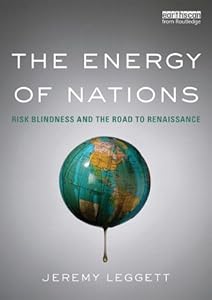
The Guardian has an article on Jeremy Leggett's new book "The Energy of Nations: Risk Blindness and the Road to Renaissance" - Ex govt adviser: "global market shock" from "oil crash" could hit in 2015.

In a new book, former oil geologist and government adviser on renewable energy, Dr. Jeremy Leggett, identifies five "global systemic risks directly connected to energy" which, he says, together "threaten capital markets and hence the global economy" in a way that could trigger a global crash sometime between 2015 and 2020.

According to Leggett, a wide range of experts and insiders "from diverse sectors spanning academia, industry, the military and the oil industry itself, including until recently the International Energy Agency or, at least, key individuals or factions therein" are expecting an oil crunch "within a few years," most likely "within a window from 2015 to 2020."

Despite its serious tone, The Energy of Nations: Risk Blindness and the Road to Renaissance, published by the reputable academic publisher Routledge, makes a compelling and ultimately hopeful case for the prospects of transitioning to a clean energy system in tandem with a new form of sustainable prosperity.

The five risks he highlights cut across oil depletion, carbon emissions, carbon assets, shale gas, and the financial sector:

"A market shock involving any one these would be capable of triggering a tsunami of economic and social problems, and, of course, there is no law of economics that says only one can hit at one time."
At the heart of these risks, Leggett argues, is our dependence on increasingly expensive fossil fuel resources. His wide-ranging analysis pinpoints the possibility of a global oil supply crunch as early as 2015. "Growing numbers of people in and around the oil industry", he says, privately consider such a forecast to be plausible. "If we are correct, and nothing is done to soften the landing, the twenty-first century is almost certainly heading for an early depression."
An oil crash is on its way and we should be ready  

Posted by Big Gav in , ,

New Scientist has a rather pessimistic article by Jeremy Leggett on peak oil and related topics - An oil crash is on its way and we should be ready.

FIVE years ago the world was in the grip of a financial crisis that is still reverberating around the globe. Much of the blame for that can be attributed to weaknesses in human psychology: we have a collective tendency to be blind to the kind of risks that can crash economies and imperil civilisations.

Today, our risk blindness is threatening an even bigger crisis. In my book The Energy of Nations, I argue that the energy industry's leaders are guilty of a risk blindness that, unless action is taken, will lead to a global crash – and not just because of the climate change they fuel.

Let me begin by explaining where I come from. I used to be a creature of the oil and gas industry. As a geologist on the faculty at Imperial College London, I was funded by BP, Shell and others, and worked on oil and gas in shale deposits, among other things. But I became worried about society's overdependency on fossil fuels, and acted on my concerns.

In 1989, I quit Imperial College to become a climate campaigner. A decade later I set up a solar energy business. In 2000 I co-founded a private equity fund investing in renewables.

In these capacities, I have watched captains of the energy and financial industries at work – frequently close to, often behind closed doors – as the financial crisis has played out and the oil price continued its inexorable rise. I have concluded that too many people across the top levels of business and government have found ways to close their eyes and ears to systemic risk-taking. Denial, I believe, has become institutionalised.

As a result of their complacency we face four great risks. The first and biggest is no surprise: climate change. We have way more unburned conventional fossil fuel than is needed to wreck the climate. Yet much of the energy industry is discovering and developing unconventional deposits – shale gas and tar sands, for example – to pile onto the fire, while simultaneously abandoning solar power just as it begins to look promising. It has been vaguely terrifying to watch how CEOs of the big energy companies square that circle.

Second, we risk creating a carbon bubble in the capital markets. If policymakers are to achieve their goal of limiting global warming to 2 °C, 60 to 80 per cent of proved reserves of fossil fuels will have to remain in the ground unburned. If so, the value of oil and gas companies would crash and a lot of people would lose a lot of money. ...

Third, we risk being surprised by the boom in shale gas production. That, too, may prove to be a bubble, maybe even a Ponzi scheme. Production from individual shale wells declines rapidly, and large amounts of capital have to be borrowed to drill replacements. This will surprise many people who make judgement calls based on the received wisdom that limits to shale drilling are few. But I am not alone in these concerns.

Even if the US shale gas drilling isn't a bubble, it remains unprofitable overall and environmental downsides are emerging seemingly by the week. According to the Texas Commission on Environmental Quality, whole towns in Texas are now running out of water, having sold their aquifers for fracking. I doubt that this is a boom that is going to appeal to the rest of the world; many others agree.

Fourth, we court disaster with assumptions about oil depletion. Most of us believe the industry mantra that there will be adequate flows of just-about-affordable oil for decades to come. I am in a minority who don't. Crude oil production peaked in 2005, and oil fields are depleting at more than 6 per cent per year, according to the International Energy Agency. The much-hyped 2 million barrels a day of new US production capacity from shale needs to be put in context: we live in a world that consumes 90 million barrels a day.

It is because of the sheer prevalence of risk blindness, overlain with the pervasiveness of oil dependency in modern economies, that I conclude system collapse is probably inevitable within a few years.

The Energy Of Nations  

Posted by Big Gav in , , ,

Jeremy Leggett has a new book out called "The Energy Of Nations" on "Risk Blindness and the Road to Renaissance". The preface and first chapter are here (pdf).

Jeremy also has some news article posted - Why governments are blind to fossil fuel energy risk and A grim future if our oil-dependent society refuses to change.

Systemic risks of oil supply, climate shock and financial collapse threaten tomorrow’s economies and mean businesses and policy makers face huge challenges in fuelling tomorrow’s world.

Jeremy Leggett gives a personal testimony of the dangers often ignored and incompletely understood – a journey through the human mind, the institutionalization of denial, and the reasons civilizations fail. It is also an account of tantalizing hope, because mobiliizing renewables and redeploying energy funding can soften the crash of modern capitalism and set us on a road to renaissance.

The oil spill and credit crunch were bad. An oil crunch would be worse  

Posted by Big Gav in ,

Jeremey Leggett has an article in The Guardian on the latest BP Statistical Review of World Energy - The oil spill and credit crunch were bad. An oil crunch would be worse.

Big as BP's problems are as a result of failed risk assessments, it will very probably soon become worse. Growing numbers of people doubt its annual review of oil reserves, published today. Society builds its oil dependency on key cultural statements of faith about secure supply, such as BP's annual announcement that there is 40 years of supply or more, and no danger of supply falling short of demand, so ambushing oil-addicted economies.


You would think that BP's risk-assessment failures in the Gulf, and in US refineries, would make the company measured, given the stakes in this particular assessment. The reverse seems true.


After BP's chief economist, Christoph Buhl, finished his presentation launching the annual BP Statistical Review of World Energy this afternoon, I reminded him that last year he had played a question on peak oil for laughs, pouring scorn on the issue. In the interim, I pointed out, more and more people had become worried about the prospect for a premature peak in global oil production, not least the companies in the UK Industry Taskforce on Peak Oil and Energy Security (ITPOES). Given the heightened stakes with risk assessment in BP's world of late, how safe did he feel he that BP is serving its shareholders well by insisting, as he had, that "reserves remain sufficient to meet demand growth" and that "the supply will never peak". As he well knew, growing numbers of people – not least in his own industry – consider this assessment to be dangerously complacent.


"Very safe," he said. The invitation-only audience duly laughed.


I felt as the occasional whistleblowers must have felt when Goldman Sachs and their peers heaped scorn on them as they warned that some complex derivatives might end up not being assets at all, but rather toxic sludge on the global balance sheet.


I scanned my copy of the Statistical Review. At the top of the inside cover I read, in a big, bold font: "The Review is one of the most widely respected and authoritative publications in the field of energy economics, used for reference by the media, academia, world governments and energy companies."


A bible in other words. Journalists base statistics in articles on it, the world over. Students base learned papers upon it. World governments base their energy policies on it. And energy companies echo it, for it most part, to all who will listen.


And in small print at the bottom of the same page I read: "The data series for proved oil and gas reserves … does not necessarily meet the definitions, guidelines and practices used for determining proved reserves at company level, for instance, …. as published by the US Securities and Exchange Commission (SEC), nor does it necessarily represent BP's view of proved reserves by country. Rather, the data series has been compiled using a combination of primary official sources and third-party data."


Let me reword that. "We wouldn't necessarily get the SEC to sign off on this stuff, and to be honest, we don't even necessarily believe it ourselves. But go ahead, use it as a bible if you like. We don't want you to be worried about peak oil. The small print gets us off the hook."


"Primary official sources" includes Opec, of course, as the body of the report makes clear. Here is where the problems start. The ITPOES companies, and many others, fear that Opec have been being – how can I put this politely – "political" about their proved reserves since the 1980s. We fear they are 300bn barrels or more light as a result of political reserves, in a supposedly proved global reserve base of over a 1,300 or so, if we include a slug of the tar sands, and forget for the moment about any constraints on deepwater production.

But that is just the start of the concerns. The main frustration is that no matter how much oil, or tar, exists underground – as reserves or resources to be discovered – what matters is the rate it needs to be extracted at to keep pace with soaring global demand, mostly driven by China, India, and the Middle East. ITPOES fears the rate of extraction will start to fall fast, and soon: by 2015 at the latest.

Jeremy Leggett: caught between low carbon and high-voltage rows  

Posted by Big Gav in , , ,

The Guardian has an article on Jeremey Leggett and the debate in the UK about the value of solar PV - Jeremy Leggett: caught between low carbon and high-voltage rows.

A tiny doorway next to a BetFair shop in south London is the unassuming headquarters of Solarcentury, a company that arguably stands to gain most on 1 April when the feed-in tariff – or "great green rip-off" as some call it – comes into force.

The company, or at least its founder, is at the heart of the next phase of Britain's low-carbon revolution by encouraging homeowners to fix panels on their roofs to generate renewable energy.

But while executive chairman Jeremy Leggett should have been devoting 24 hours a day preparing for the busiest period of his commercial life, he has been forced to spend some of his time fighting off an unexpected assault by environmentalists in the Guardian blogosphere. The irony is that Leggett is an ex-Greenpeace employee and, as a former Imperial College geologist, a powerful and knowledgeable ally to the environment campaigners on a range of issues, including "peak oil" – the point when global demand outstrips supply.

The debate over whether the feed-in tariff costs too much for the expected carbon reductions rumbles on but even this "social entrepreneur", who has always enjoyed a good tussle with more traditional foes, admits he has had enough of swapping increasingly fraught online words with George Monbiot, Chris Goodall and other notable greens.

"It certainly perplexed me," he said. "If I did not know the individuals involved, I'd have presumed that this is the nuclear industry pushing back at a time of imminent possible success for the renewables industries. They [atomic power firms] have declared a form of war, with EDF and E.ON having this line to government that says 'You can have nuclear or you can have renewables, but you can't have both', when previously they argued you could have both.

"But I know the actors [environmentalists] so I know it is not possible [for them to be nuclear lackeys], but George and Chris must know how damaging it is at this time. At the very minimum it is annoying that George has come out with this heady rhetoric, yet as far as I know did not actively engage in the government's long consultation on the issue." ...

Leggett has also crossed swords with Monbiot over the latter's claim that it is an "impossible dream" to build up a proper British renewables products industry given the competition from low-cost areas such as China: "I say that is needless defeatism because the global market is pitifully small. Seven gigawatts of solar was installed last year, the equivalent of seven nuclear power plants, and to think we cannot catch up and have a fully integrated national industry is needless defeatism."

And this is an area where Leggett's scary view about the world running out of oil much faster than anyone expects neatly gels with the need to promote a self-standing renewables sector.

"Security of energy supply is going to be a real issue so should we not be deliberately building a vertically integrated renewables industry on the British Isles? I think the world is going to change dramatically and globalisation, of necessity, is going to be massively set back by the unaffordability of oil, so trade routes are going to shrink and there is going to be an incredible explosion of independent thinking.

"Companies and governments are going to think much more than they do now about this. We need to be making much more stuff at home. We can't be dependent on markets far overseas."

Leggett has pushed the peak oil debate on to the political agenda by getting an increasingly broad church of industrialists – such as Sir Richard Branson, Brian Souter of Stagecoach, and Philip Dilley of Arup – to come on board. The bandwagon seems finally to have made its impact on the UK government, which is softening its former position that peak oil was being over-hyped.

The Oil Crunch  

Posted by Big Gav in ,

Jeremy Leggett's peak oil task force has gathered some interesting participants (ranging from Yahoo to Foster and Partners) and managed to get plenty of attention at their recent press conference. The Independent reports - UK companies urge steps to head off global 'oil crunch'.

The world is facing a dangerous "oil crunch" in as little as five years, and the Government needs to starting working on solutions now to avoid major economic and social problems, a cross-industry group warned yesterday.

"Peak oil" is the point at which the rate of extraction exceeds the discovery of new supplies, with considerable economic and political consequences for energy-hungry countries reliant on oil for everything from energy to pharmaceuticals to agricultural fertilisers.

Timetables vary, but the taskforce of eight companies, including Stagecoach, Virgin and Scottish & Southern Energy, is predicting the end of cheap and easy oil supplies as early as 2012. Even Royal Dutch Shell, commissioned to write a balancing view for the group's report, is forecasting a plateau ofsupply as production moves to more difficult sources such as ultra-deeplayers and tar sands.

"We are going to reach a peak in the early part of the next decade," said Will Whitehorn, the cross-industry group's chairman and president of Virgin Galactic. "If we are going to avoid a crunch we need to invest now." The groupbelieves a national energy plan should urgently implement accelerated energy conservation and more investment in renewable resources.

Jeremy Leggett, executive chairman of taskforce member Solarcentury, said: "The difference between the credit crunch and the oil crunch is that we have five years in which we could try to engineer a soft landing, by beginning the restructuring ahead of time."

The gloomy predictions are supported by the latest data from the International Energy Agency, which suggest that annual oil production worldwide is falling faster than expected.

Energy Independence In The UK  

Posted by Big Gav in , , , ,

Jeremy Leggett has an article in The Guardian on how to make the UK energy independent - Independence from the street up.

The International Energy Agency (IEA) is warning of an oil crunch by 2012, so we have to act immediately if we aren't to add peak oil to our credit-crunch woes. There is also a grave risk of major shortfalls in gas supply in the next few years. North Sea oil and gas production is plunging 7.5% a year at the same time as liquefied natural gas (LNG) projects are being cancelled around the world. Meanwhile, Moscow dangles the prospect of sending most of its gas exports east to China, rather than west to Europe.

Without government help, the global economic crisis may deter investors in climate technology. The UK government talks about building new gas pipes of different kinds – in an expanded national grid, and in import pipelines and regasification plants – but it cannot rely on having gas to put in them. It talks of allowing an expansion of coal burning, knowing carbon capture and storage is more than a decade from proving economic, or even workable. As for nuclear, we don't get one of those new reactors that are so far behind schedule and so over budget in Finland until 2018 at the earliest. Provided, that is, anyone can be found foolish enough to finance it.

We need to make ourselves energy independent from the street up – in transport, electricity and heating – starting today. The good news is that with today's technologies and the right kind of financing and workforce mobilisation, we could surprise ourselves about what we could achieve.

Everything must spring from energy efficiency. We have an ocean of electricity and heating profligacy to mine in this country. British Gas ran an interesting experiment recently. Eight British streets were asked to compete in cutting their fuel bills, using only the easiest of efficiency measures. In no time at all, they cut their CO2 by an average 20% and fuel bills by a third. The Institute of Public Policy Research (IPPR), which monitored the exercise (pdf) for BG, suggests that 10,000 advisers be appointed nationwide, one per 20 streets. The cost would be £500m annually against national energy savings of £4.6bn. The IPPR gives a telling example of what householders, energy-services companies, and government could do could if they worked together. A £524 loan package for cavity wall and lost insulation would give annual savings of £395 per household. A quick payback indeed.

Then there are the new means of energy generation. Silicon Valley is not pouring billions of dollars into 50 families of clean technology (cleantech) for nothing. We were already entering a green industrial revolution as the credit crunch hit panic phase. True, there will be a race against time to create mass markets in cleantech. But these are highly disruptive technologies: they can displace fossil fuels far faster than most people appreciate. Once they really get going, the prize is huge. Consider this example. Modern solar electric and heating tiles, fitted to a maximally energy-efficient home, can take that property's emissions to zero. The whole thing can be put up in a matter of days using modern offsite methods of construction. More than half the UK's greenhouse gas emissions come from buildings; the majority from homes. We can cut greenhouse gas emissions to zero, we can get rid of the need for energy bills of any kind once the capital cost is paid, and we can dump gas, coal and nuclear alike.

Then there is transport. Car manufacturers are aligning behind electricity as the fuel of the future. They are already well into systemic change, even at $100-barrel oil. Renewable energy can charge the plug-in super-efficient vehicles of the near future, even as massive new public transport infrastructure is built by the carbon army.

Long term, we save much more money than we invest making this happen. It is all doable, if we just have the imagination and the will.

Also in the Guardian, an article on bioplastic from the CEO of NatureWorks, contesting some of columnist John Vidal's reservations about the technology - Bioplastics offer a more sustainable future.
As the world's largest producer of plastics made from plants, we wish to clarify John Vidal's claims about bioplastics (Sustainable bioplastic can damage the environment, April 26). While bioplastics are still on a journey to full sustainability, we believe they are the greenest alternative to conventional oil-based plastics.

The advantages of bioplastic start in the manufacturing process. Peer-reviewed studies have found that making Ingeo - known generically as polylactic acid or PLA - generates less than half the greenhouse emissions of making oil-based plastics. New innovations in the manufacturing process mean Ingeo production will soon produce 75% less greenhouse emissions than making petro-plastics.

The environmental benefits continue through the life of the plastic. Unlike conventional plastics, PLA is infinitely recyclable: a PLA bottle can be made into another bottle again and again, whereas oil-based competitors are typically "down-cycled" into products of diminishing value and ultimately destined for landfill. Ingeo is also certified as fully compostable in specific conditions. The Association for Organics Recycling (formerly the UK Composting Association) supports the increased use of biodegradable material as a means of reducing the 4.6m tonnes of packaging disposed of annually in the UK.

Rising food prices are a serious concern today. At full capacity, we would use less than 0.1% of 2007 US corn production (all grown within 50 miles of our Nebraska plant). By contrast, about 30% of that crop went to make ethanol - a 300-fold difference.

Affordable food, reliable energy and a healthy environment are global problems that cannot be solved without fundamental changes in the way we treat limited natural resources. We believe that plants, rather than fossil fuels, are a good place to start.

Peak Oil In Scotland  

Posted by Big Gav in , ,

Jeremy Leggett was one participant in the recent BBC story "Truth, Lies, Oil and Scotland" - but he wasn't too impressed with the outcome, as explained in Seas of plenty?.

A BBC documentary implied that Scotland has plenty of oil and gas in reserve. It should never have been screened.

The peak-oil debate is a high-stakes game. In an economy as oil-addicted as ours, we cannot afford to bet that oil supply will continue to meet demand and be wrong.

This week, BBC Scotland produced a classic example of how the media has (mostly) failed to serve the debate well thus far. In a one-hour TV documentary, Truth, Lies, Oil and Scotland, BBC business correspondent Hayley Millar managed never once to mention that oil production in the North Sea peaked nine years ago and has fallen steeply ever since.

The impression the film sought to give was that there is still plenty of oil offshore, and that the technical advances the oil industry has made since production began in 1979 mean a thriving future for the industry. Viewers would have come away with the impression that plentiful oil supplies are available to Scotland for decades into the future. The headline on the BBC News website reinforces that impression. It reads: "Oil price rise brings industry boom". The long website article by Millar, like the TV programme, does not bring up the fact that North Sea oil has long since peaked, much less that current oil production is almost half the production achieved at the peak in 1999.

"The more I've investigated, the more lies I've laid to rest", said Millar, wrapping up the programme. One lie, presumably, was my prediction – aired early in the programme – that global peak oil would happen in 2010, plus-or-minus two years. The evidence I cited was flow-rate data from reported oil-industry projects. This was laid to rest by an assertion from Peter Odell, an economist, who said that proved reserves hold at least 44 years of supply, and by Malcolm Wicks, the energy minister, who volunteered that he has been told by other energy ministers – from Opec – that oil supply really isn't an issue.

Let us hope that Wicks's trust in Opec proves justified, because many peak oil advocates worry that Opec has overinflated its supposedly proved reserves by at least 300bn barrels, more than a quarter of the global total. If that is correct, it also makes a nonsense of Odell's confident assertion about reserves.

Another point made by Millar involved "following the money". Her thesis here was that if people are investing in the North Sea, there must surely be plenty of oil left. She made much use of a cheerful gentleman from Shell as an interviewee in this regard.

Neither he nor she mentioned that Shell have scaled back their operations in the North Sea considerably of late. BP's retreat from the North Sea wasn't mentioned either. The viewer would have had no idea that investment in the North Sea dropped as a whole last year, according to the industry's own trade association, UK Oil and Gas. Or that the prime minister has recently been pleading with the oil companies to invest more of their profits in the North Sea. Or of a key reason for all this: that the amount of oil and gas produced per pound invested is collapsing. Today it is a third of what it was just five years ago.

The graphic below shows production from the largest North Sea field, known as "Forties". Apache bought this from BP a few years ago and has had great success in increasing production. The graph shows just how relative "great success" really is though.

Shell and "The Economics Of Energy"  

Posted by Big Gav in , ,

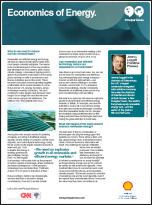
Chris Vernon at TOD Europe has an interesting catch - Jeremy Leggett of SolarCentury featuring in some high profile magazine ads talking about peak oil and the need to switch to renewables - with the ads apparently sponsored by Shell.

Click on the image to the right to download the .pdf of a full page "advert" which appeared in both Time and Fortune magazines over Easter. It was written by Jeremy Leggett, the prominent peak oil and climate change commentator and proponent of renewable energy (also Chairman of Solarcentury).

On peak oil Jeremy doesn't pull any punches:
The bad news is that no combination of technologies can plug the energy gap if the peakists are correct. There will be a third, and last, global energy crisis. It will dwarf previous crises. Profound economic dislocation will result. The challenge for human civilization will be how we rebuild post-peak.

The interesting point here is that that Shell sponsored the thing.

So, what's in it for Shell?

Commenter Robert Marston thinks:
Reasons why this does not surprise me:

1. Peak Oil, true or no, creates the perception of scarcity which helps increase prices. Matthew Simmons -- "Oil is too cheap at 15 cents per cup." This has got to be music to oil execs ears.

2. Peak Oil theory focuses on scarcity which implies we need more. It makes a nice counterpoint to environmentalism which denies the need for oil and pushes instead for alternatives.

3. Shell is positioned very aggressively in the possible solutions to Peak Oil -- synthetic oil and oil shales.

4. Many Peak Oil proponents do not recognize the validity of alternative forms of energy and spread disinformation that negatively skews EROI estimates for all alternative sources.

5. Peak Oil focuses on the economic benefits of oil and shifts focus away from the environmental impacts of oil.

If they succeed in controlling the Peak Oil debate in their favor, it's a win, win, win for the oil industry. That said, Peak Oil is a two edged sword and the same arguments highlighting depletion can be used to attempt to validate new energy sources. So the industry needs to have a hand in the Peak Oil game so that the issues come out in their favor.

While I've got a lot of sympathy for this interpetation, it would make more sense if Jeremy Leggett wasn't the face of the campaign and wasn't talking about the need to switch to renewable energy.

Shell seems to be the weakest of the majors when it comes to conventional oil, and they've always been the pioneer in scenario based planning for what lies ahead for the energy industry. Their latest set of scenarios (Blueprints Or The Scramble) did talk about - and recommend - the need to transition to a sustainable energy future, so maybe they are starting to lean much more towards a gas + sequestration and renewables option than trying to scale up the tar sands (which is a fairly risky approach if a Kyoto successor with teeth emerges).

Statistics

Locations of visitors to this page

blogspot visitor
Stat Counter

Total Pageviews

Ads

Books

Followers

Blog Archive

Labels

australia (619) global warming (423) solar power (397) peak oil (355) renewable energy (302) electric vehicles (250) wind power (194) ocean energy (165) csp (159) solar thermal power (145) geothermal energy (144) energy storage (142) smart grids (140) oil (139) solar pv (138) tidal power (137) coal seam gas (131) nuclear power (129) china (120) lng (117) iraq (113) geothermal power (112) green buildings (110) natural gas (110) agriculture (91) oil price (80) biofuel (78) wave power (73) smart meters (72) coal (70) uk (69) electricity grid (67) energy efficiency (64) google (58) internet (50) surveillance (50) bicycle (49) big brother (49) shale gas (49) food prices (48) tesla (46) thin film solar (42) biomimicry (40) canada (40) scotland (38) ocean power (37) politics (37) shale oil (37) new zealand (35) air transport (34) algae (34) water (34) arctic ice (33) concentrating solar power (33) saudi arabia (33) queensland (32) california (31) credit crunch (31) bioplastic (30) offshore wind power (30) population (30) cogeneration (28) geoengineering (28) batteries (26) drought (26) resource wars (26) woodside (26) censorship (25) cleantech (25) bruce sterling (24) ctl (23) limits to growth (23) carbon tax (22) economics (22) exxon (22) lithium (22) buckminster fuller (21) distributed manufacturing (21) iraq oil law (21) coal to liquids (20) indonesia (20) origin energy (20) brightsource (19) rail transport (19) ultracapacitor (19) santos (18) ausra (17) collapse (17) electric bikes (17) michael klare (17) atlantis (16) cellulosic ethanol (16) iceland (16) lithium ion batteries (16) mapping (16) ucg (16) bees (15) concentrating solar thermal power (15) ethanol (15) geodynamics (15) psychology (15) al gore (14) brazil (14) bucky fuller (14) carbon emissions (14) fertiliser (14) matthew simmons (14) ambient energy (13) biodiesel (13) investment (13) kenya (13) public transport (13) big oil (12) biochar (12) chile (12) cities (12) desertec (12) internet of things (12) otec (12) texas (12) victoria (12) antarctica (11) cradle to cradle (11) energy policy (11) hybrid car (11) terra preta (11) tinfoil (11) toyota (11) amory lovins (10) fabber (10) gazprom (10) goldman sachs (10) gtl (10) severn estuary (10) volt (10) afghanistan (9) alaska (9) biomass (9) carbon trading (9) distributed generation (9) esolar (9) four day week (9) fuel cells (9) jeremy leggett (9) methane hydrates (9) pge (9) sweden (9) arrow energy (8) bolivia (8) eroei (8) fish (8) floating offshore wind power (8) guerilla gardening (8) linc energy (8) methane (8) nanosolar (8) natural gas pipelines (8) pentland firth (8) saul griffith (8) stirling engine (8) us elections (8) western australia (8) airborne wind turbines (7) bloom energy (7) boeing (7) chp (7) climategate (7) copenhagen (7) scenario planning (7) vinod khosla (7) apocaphilia (6) ceramic fuel cells (6) cigs (6) futurism (6) jatropha (6) nigeria (6) ocean acidification (6) relocalisation (6) somalia (6) t boone pickens (6) local currencies (5) space based solar power (5) varanus island (5) garbage (4) global energy grid (4) kevin kelly (4) low temperature geothermal power (4) oled (4) tim flannery (4) v2g (4) club of rome (3) norman borlaug (2) peak oil portfolio (1)