Posted
by Big Gav
in
electricity grid,
global energy grid,
russia
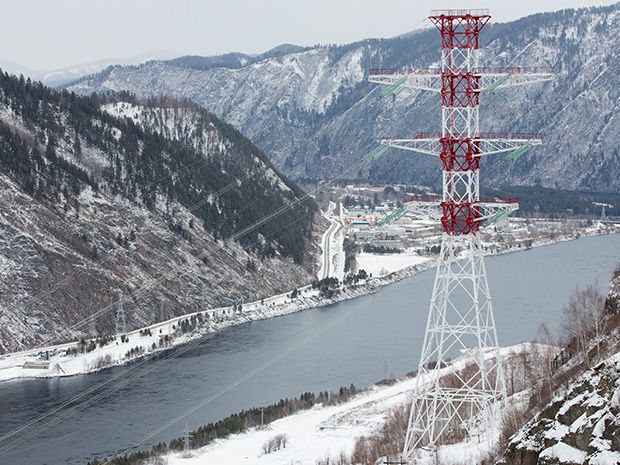
IEEE Spectrum has an article on a report by the Neo-Carbon Energy Research Project in Finland on how to transition Russia and the Central Asian republics to 100% renewable energy at an acceptable cost - A Renewable Supergrid in Russia. They don't view this as remotely likely given the relative lack of interest in renewables in that part of the world but they wanted to show that 100% renewables was feasible throughout Eurasia.
Posted
by Big Gav
in
electricity grid,
global energy grid,
hvdc,
renewable energy
Dave Roberts at Vox has an article on the Plains and Eastern Clean Line, a high-voltage direct-current (HVDC) power line that will extend from western Oklahoma to western Tennessee, enabling abundant wind power to be sent the populated east - This new transmission line will help unleash wind energy in the Great Plains. One down, dozens to go.
Expanding the grid to better interconnect renewable energy rich producing regions with energy poor consuming regions is the aim of
Bucky Fuller's Global Energy Grid proposal, so it's good to see some of these connectors slowly being put in place.
Dave's article includs links to 2 newer global energy grid proposals - one at
Renewable Energy World and another at
IEEE Spectrum.
Posted
by Big Gav
in
asia,
australia,
desertec,
electricity grid,
geni,
global energy grid
ScienceAlert has an article on a DESERTEC Australia proposal to link the Australian gas an electricity grids with east Asia - The benefits of an intercontinental energy grid.
Imagine an Asian electricity grid anchored by China at one end and Australia on the other. The grid would carry and distribute hemispheric solar, geothermal, wind and wave energy. The vision is big. But so's the problem of climate change.
Start by looking at Asia's energy status quo. Fossil fuels dominate. Renewable energy development is sporadic. National grids aren't interconnected. Carbon costs aren't applied. Vision is lacking.
Now, apply sensible economic and technological rationalisation. What pops out is a networked Asian electricity backbone in which efficiency, price and environmental-friendliness count. A regional grid would offer a frictionless exchange of kilowatthours akin to the frictionless exchange of electrons the Internet has brought.
The plan would entail building a 10,000-kilometer long electricity transmission system stretching from Beijing to the Great Australian Bight. Australian concentrating solar power, geothermal, wind and wave energy would flow northward. It would be joined by the harnessed geothermal power of Indonesia's volcanoes. This torrent of Austro-Indonesian low emission energy would then wend its way across a wind farm-lined South China Sea to China. Or the transmission system could go by land through a Southeast Asia regional High Voltage Direct Current (HVDC) power line paralleling existing power lines in Malaysia, Thailand and Laos.
Southeast Asian natural gas and Laotian and Vietnamese hydro power plants could provide 'load balancing' in a regional grid dominated by renewables. Even China's Three Gorges Dam might find a role as hemispheric provider of peaking power. That's because using hydro (and natural gas) for baseload power in an electricity system dominated by renewables makes about as much sense as employing trapeze artists to shovel gravel.
Tibetan and southern Mongolian deserts could be developed for concentrating solar power, wind and geothermal energy. Windfarms stretching from Shenzen to Shanghai off China's east coast could similarly provide huge amounts of power.

Posted
by Big Gav
in
europe,
global energy grid,
north sea,
scotland,
super grid
Earth2Tech reports that England may be left out of Scottish plans to join a European supergrid crossing the north sea - Scotland Snubbing England in Supergrid Plans?.
The Scottish government believes the North Sea could become host to an underwater renewable energy grid, supplying power from wind, wave and tidal power across Europe, but England could be left out in the cold. A new study from Scotland looks at the possibility of a supergrid between Scotland, Norway, Sweden, Denmark, Germany and the Netherlands, but doesn’t mention Scotland’s big neighbor to the south.
Yes, Scotland is still part of the UK, and most of England’s east coast is also on the North Sea, but the word “England” doesn’t even show up once in the 21-page study and “UK” is only used in a couple of footnotes. It might just be an oversight, but the possible snub comes during the same week in which the UK government made a filing with the Commission on Scottish Devolution questioning the Scottish government’s powers covering energy.
Political wrangling aside, there’s a big push for wind and marine power in the UK, not just in Scotland, so the area could become a hub for renewable energy in the region. In October, the UK government said it surpassed Denmark to take the top spot in offshore wind power in the world, boasting 590 megawatts of offshore wind vs. Denmark’s 423 megawatts.
Sweden’s Vattenfall just announced plans to invest in wind power in the UK, teaming up with ScottishPower Renewables to make joint bids on offshore wind development, including areas in the North Sea. The two plan to build 6,000 megawatts of installed wind power capacity.
ScottishPower, part of Spain’s Iberdrola, is also looking at marine power, releasing plans in September to build up to 60 megawatts of tidal power capacity in Scotland and Northern Ireland. The UK’s Crown Estate, which owns the seabed around the country, recently opened up the Pentland Firth off of northern Scotland for commercial wave and tidal projects, aiming to generate more than 700 MW of power by 2020.
There are already big projects going on in England and if there was Scottish-only supergrid, it would lose out on connecting to the planned 1-gigawatt London Array offshore wind farm as well as the Wave Hub project.
A recent plan from Greenpeace for a €20 billion ($25.032 billion) renewable energy grid in the area was much more inclusive, with both England and Scotland making the list, as well as France. However, the environmental group did neglect Sweden, which only has access to the North Sea through the Skagerrak strait.
The Scottish government is still working on its plans for a North Sea supergrid and estimated that it would need £409,200 ($606,475) and about 17 months to do a full study on the project.



 Posts




