Showing posts with label resource wars. Show all posts

In a pure coincidence, Gaddafi impeded U.S. oil interests before the war in Libya  

Posted by Big Gav in , , ,

Glenn Greenwald has a look at progress in the war in Libya - In a pure coincidence, Gaddafi impeded U.S. oil interests before the war.

When the war in Libya began, the U.S. government convinced a large number of war supporters that we were there to achieve the very limited goal of creating a no-fly zone in Benghazi to protect civilians from air attacks, while President Obama specifically vowed that "broadening our military mission to include regime change would be a mistake." This no-fly zone was created in the first week, yet now, almost three months later, the war drags on without any end in sight, and NATO is no longer even hiding what has long been obvious: that its real goal is exactly the one Obama vowed would not be pursued -- regime change through the use of military force. We're in Libya to forcibly remove Gaddafi from power and replace him with a regime that we like better, i.e., one that is more accommodating to the interests of the West. That's not even a debatable proposition at this point.

What I suppose is debatable, in the most generous sense of that term, is our motive in doing this. Why -- at a time when American political leaders feel compelled to advocate politically radioactive budget cuts to reduce the deficit and when polls show Americans solidly and increasingly opposed to the war -- would the U.S. Government continue to spend huge sums of money to fight this war? Why is President Obama willing to endure self-evidently valid accusations -- even from his own Party -- that he's fighting an illegal war by brazenly flouting the requirements for Congressional approval? Why would Defense Secretary Gates risk fissures by so angrily and publicly chiding NATO allies for failing to build more Freedom Bombs to devote to the war? And why would we, to use the President's phrase, "stand idly by" while numerous other regimes -- including our close allies in Bahrain and Yemen and the one in Syria -- engage in attacks on their own people at least as heinous as those threatened by Gaddafi, yet be so devoted to targeting the Libyan leader?

Whatever the answers to those mysteries, no responsible or Serious person, by definition, would suggest that any of this -- from today's Washington Post -- has anything to do with it:
The relationship between Gaddafi and the U.S. oil industry as a whole was odd. In 2004, President George W. Bush unexpectedly lifted economic sanctions on Libya in return for its renunciation of nuclear weapons and terrorism. There was a burst of optimism among American oil executives eager to return to the Libyan oil fields they had been forced to abandon two decades earlier. . . .

Yet even before armed conflict drove the U.S. companies out of Libya this year, their relations with Gaddafi had soured. The Libyan leader demanded tough contract terms. He sought big bonus payments up front. Moreover, upset that he was not getting more U.S. government respect and recognition for his earlier concessions, he pressured the oil companies to influence U.S. policies. . . .

When Gaddafi made his deal with Bush in 2004, he had hoped that returning foreign oil companies would help boost Libya’s output . . . The U.S. government also encouraged American oil companies to go back to Libya. . . .

The companies needed little encouragement. Libya has some of the biggest and most proven oil reserves -- 43.6 billion barrels -- outside Saudi Arabia, and some of the best drilling prospects. . . . Throughout this time, oil prices kept rising, whetting the appetite for greater supplies of Libya's unusually "sweet" and "light," or high-quality, crude oil.

By the time Secretary of State Condoleezza Rice visited in 2008, U.S. joint ventures accounted for 510,000 of Libya's 1.7 million barrels a day of production, a State Department cable said. . . .

But all was not well. By November 2007, a State Department cable noted "growing evidence of Libyan resource nationalism." It noted that in his 2006 speech marking the founding of his regime, Gaddafi said: "Oil companies are controlled by foreigners who have made millions from them. Now, Libyans must take their place to profit from this money." His son made similar remarks in 2007.

Oil companies had been forced to give their local subsidiaries Libyan names, the cable said. . . .

The entire article is worth reading, as it details how Gaddafi has progressively impeded the interests of U.S. and Western oil companies by demanding a greater share of profits and other concessions, to the point where some of those corporations were deciding that it may no longer be profitable or worthwhile to drill for oil there. But now, in a pure coincidence, there is hope on the horizon for these Western oil companies, thanks to the war profoundly humanitarian action being waged by the 2009 Nobel Peace Prize winner and his nation's closest Western allies ...

I have two points to make about all this:

(1) The reason -- the only reason -- we know about any of this is because WikiLeaks (and, allegedly, Bradley Manning) disclosed to the world the diplomatic cables which detail these conflicts. Virtually the entirety of the Post article -- like most significant revelations over the last 12 months, especially in the Middle East and North Africa -- are based exclusively on WikiLeaks disclosures. That's why we know about Gaddafi's increasingly strident demands for the "Libyanization" of his country's resource exploitation. That's how we know about most of the things we've learned about the world's most powerful political and corporate factions over the last 12 months. Is there anything easier to understand than why U.S. Government officials are so eager to punish WikiLeaks and deter future transparency projects of this sort?

(2) Is there anyone -- anywhere -- who actually believes that these aren't the driving considerations in why we're waging this war in Libya? After almost three months of fighting and bombing -- when we're so far from the original justifications and commitments that they're barely a distant memory -- is there anyone who still believes that humanitarian concerns are what brought us and other Western powers to the war in Libya? Is there anything more obvious -- as the world's oil supplies rapidly diminish -- than the fact that our prime objective is to remove Gaddafi and install a regime that is a far more reliable servant to Western oil interests, and that protecting civilians was the justifying pretext for this war, not the purpose? If (as is quite possible) the new regime turns out to be as oppressive as Gaddafi but far more subservient to Western corporations (like, say, our good Saudi friends), does anyone think we're going to care in the slightest or (at most) do anything other than pay occasional lip service to protesting it? Does anyone think we're going to care about The Libyan People if they're being oppressed or brutalized by a reliably pro-Western successor to Gaddafi?

In 2006, George Bush instructed us that there was a "responsible" and an "irresponsible" way for citizens to debate the Iraq War: the "responsible" way was to suggest that there may be better tactics for waging the war more effectively, while the "irresponsible" way was to outrageously insinuate that perhaps oil or Israel or deceit played a role in the invasion. ...

It's certainly possible to contend reasonably that (as was true for Iraq) removing a heinous dictator and other humanitarian outcomes will be the incidental by-product of our war in Libya even if not its purpose (although, as was also true in Iraq, one would need to see the regime that replaces Gaddafi to know if that's true). And it's fine -- or at least candid -- to argue, as Ann Coulter often does, that "of course we should go to war for oil. . . .We need oil. That's a good reason to go to war." But to believe that humanitarianism (protection of Libya civilians) was why we went to war in Libya requires a blindness so willful and complete that it's genuinely difficult to describe.

Iraqi oil production cutback plan adds to global supply fear ?  

Posted by Big Gav in , ,

The battle for control of Iraq's oil seems to be moving into interesting territory, with the US due to remove all troops from the country by the end of the year (something which will never happen of course).

In the lead up to the last Iraqi election there was a spurt of deals done which didn't give the international oil companies particularly good terms - now the election is over and the punters are back in their usual position of having no influence, these deals are looking to be renegotiated - within production levels being reduced and the oil majors getting a bigger cut of the action - another case of history repeating itself.

The Australian has a good example of how this is being reported, focusing on the national production targets being reduced rather than where the money is going - Iraqi oil production cutback plan adds to global supply fear.

IRAQ is preparing to halve its official oil production target, forcing companies including BP and Shell to renegotiate their contracts.

The country's Oil Ministry, with backing from the Prime Minister Nouri al-Maliki, will set a new target to produce between 6.5 million and 7 million barrels per day by 2017, down from original plans to pump 12 million barrels, according to industry insiders.

Iraq, which is a member of the OPEC cartel that pumps 40 per cent of the world's oil, produces about 2.68 million barrels a day, barely higher than under Saddam Hussein.

It had been hoped that with a huge injection of foreign investment, it would be able to challenge Saudi Arabia as the world's biggest oil exporter this decade.

Confirmation it has scrapped the old target will add to fears that global supply will be unable to keep pace with demand in coming years.

It is understood that government negotiations to change the long-term service agreements signed by companies in the past two years based on the old production target will begin soon.

Analysts said companies would seek improved terms to compensate them for losing out on revenue, which at present is earned for each barrel of oil produced above a base target.

Baghdad believes it would not be in its interests to try to achieve the 12 million target by 2017 because boosting global supply would depress prices.

Ministers also argue that there is not sufficient demand for the extra oil, despite soaring prices. Last month, Saudi Arabia cut its output by 800,000 barrels a day after pumping more in response to the political crisis in North Africa, complaining that the extra crude was sitting in tankers with no customers.

High oil prices, which have doubled since the 12 million target was set two years ago, will compensate Iraq for the lower production. ...

Samuel Ciszuk, senior energy analyst for IHS Energy, said an over-ambitious target was politically motivated, being set before elections in 2009. "It was clearly designed to impress the Iraqis ahead of the elections. The oil majors will now seek more attractive terms."

Moon Of Alabama has a cynical view of some of the diplomacy being undertaken in Iraq as the troop withdrawal date looms - The Extortion Of Iraq.
The consigliere was send out to deliver first a threat
Gates: Iraq will face problems if U.S. troops withdraw

"They will not be able to do the kind of job in intelligence fusion. They won't be able to protect their own airspace. They will have problems with logistics and maintenance."

then an offer
Gates: Some US troops may stay if Iraq wants

and making clear that it can not be refused
Gates Presses Iraq to Decide on Extension of U.S. Presence

But the guy in charge of pizza joint says "No!"
Sadr calls for an end to 'US occupation'

Al Jazeera correspondent Jane Arraf, reporting from Baghdad, said that this time Sadr had not only warned US troops but also the contractors.

What will the mafia Don do next?

Secret memos expose link between oil firms and invasion of Iraq  

Posted by Big Gav in , , ,

The Independent has a report on discussions between the British government and BP in the lead up to the Iraq war - Secret memos expose link between oil firms and invasion of Iraq. Hands up if you are surprised by this. More at Empty Wheel and Patrick Cockburn at The Independent - They denied it was about Iraq's resources. But it never rang true, along with another article at The Indy on Iraq's "untapped potential" - Black gold rush was fuelled by enormous untapped potential.

Plans to exploit Iraq's oil reserves were discussed by government ministers and the world's largest oil companies the year before Britain took a leading role in invading Iraq, government documents show.

The papers, revealed here for the first time, raise new questions over Britain's involvement in the war, which had divided Tony Blair's cabinet and was voted through only after his claims that Saddam Hussein had weapons of mass destruction.

The minutes of a series of meetings between ministers and senior oil executives are at odds with the public denials of self-interest from oil companies and Western governments at the time.

The documents were not offered as evidence in the ongoing Chilcot Inquiry into the UK's involvement in the Iraq war. In March 2003, just before Britain went to war, Shell denounced reports that it had held talks with Downing Street about Iraqi oil as "highly inaccurate". BP denied that it had any "strategic interest" in Iraq, while Tony Blair described "the oil conspiracy theory" as "the most absurd".

But documents from October and November the previous year paint a very different picture.

Five months before the March 2003 invasion, Baroness Symons, then the Trade Minister, told BP that the Government believed British energy firms should be given a share of Iraq's enormous oil and gas reserves as a reward for Tony Blair's military commitment to US plans for regime change.

The papers show that Lady Symons agreed to lobby the Bush administration on BP's behalf because the oil giant feared it was being "locked out" of deals that Washington was quietly striking with US, French and Russian governments and their energy firms.

Minutes of a meeting with BP, Shell and BG (formerly British Gas) on 31 October 2002 read: "Baroness Symons agreed that it would be difficult to justify British companies losing out in Iraq in that way if the UK had itself been a conspicuous supporter of the US government throughout the crisis."

The minister then promised to "report back to the companies before Christmas" on her lobbying efforts.

The Foreign Office invited BP in on 6 November 2002 to talk about opportunities in Iraq "post regime change". Its minutes state: "Iraq is the big oil prospect. BP is desperate to get in there and anxious that political deals should not deny them the opportunity."

After another meeting, this one in October 2002, the Foreign Office's Middle East director at the time, Edward Chaplin, noted: "Shell and BP could not afford not to have a stake in [Iraq] for the sake of their long-term future... We were determined to get a fair slice of the action for UK companies in a post-Saddam Iraq."

Whereas BP was insisting in public that it had "no strategic interest" in Iraq, in private it told the Foreign Office that Iraq was "more important than anything we've seen for a long time".

BP was concerned that if Washington allowed TotalFinaElf's existing contact with Saddam Hussein to stand after the invasion it would make the French conglomerate the world's leading oil company. BP told the Government it was willing to take "big risks" to get a share of the Iraqi reserves, the second largest in the world.

Over 1,000 documents were obtained under Freedom of Information over five years by the oil campaigner Greg Muttitt. They reveal that at least five meetings were held between civil servants, ministers and BP and Shell in late 2002.

The 20-year contracts signed in the wake of the invasion were the largest in the history of the oil industry. They covered half of Iraq's reserves – 60 billion barrels of oil, bought up by companies such as BP and CNPC (China National Petroleum Company), whose joint consortium alone stands to make £403m ($658m) profit per year from the Rumaila field in southern Iraq.

Last week, Iraq raised its oil output to the highest level for almost decade, 2.7 million barrels a day – seen as especially important at the moment given the regional volatility and loss of Libyan output. Many opponents of the war suspected that one of Washington's main ambitions in invading Iraq was to secure a cheap and plentiful source of oil.

Egypt and Tunisia usher in the new era of global food revolutions  

Posted by Big Gav in , , , ,

I take everything Ambrose Evans-Pritchard writes with a large grain of salt, so with that in mind, here is a new column at the UK Daily Telegraph looking at the Tunisian and Egyptian crises and declaring "the first food revolutions of our Malthusian era have exposed the weak grip of authoritarian regimes in poor countries that import grain, whether in North Africa today or parts of Asia tomorrow" - Egypt and Tunisia usher in the new era of global food revolutions.

Events have moved briskly since a Tunisian fruit vendor with a handcart set fire to himself six weeks ago, and in doing so lit the fuse that has detonated Egypt and threatens to topple the political order of the Maghreb, Yemen, and beyond.

As we sit glued to Al-Jazeera watching authority crumble in the cultural and political capital of the Arab world, exhilaration can turn quickly to foreboding.

This is nothing like the fall of the Berlin Wall. The triumph of secular democracy was hardly in doubt in central Europe. Whatever the mix of aspirations of those on the streets of Cairo, such uprisings are easy prey for tight-knit organizations – known in the revolutionary lexicon as Leninist vanguard parties.

In Egypt this means the Muslim Brotherhood, whether or not Nobel laureate Mohammed El Baradei ever served as figleaf. The Brotherhood is of course a different kettle of fish from Iran’s Ayatollahs; and Turkey shows that an ‘Islamic leaning’ government can be part of the liberal world – though Turkish premier Recep Tayyip Erdogan once let slip that democracy was a tram “you ride until you arrive at your destination, then you step off." ...

The surge in global food prices since the summer – since Ben Bernanke signalled a fresh dollar blitz, as it happens – is not the underlying cause of Arab revolt, any more than bad harvests in 1788 were the cause of the French Revolution.

Yet they are the trigger, and have set off a vicious circle. Vulnerable governments are scrambling to lock up world supplies of grain while they can. Algeria bought 800,000 tonnes of wheat last week, and Indonesia has ordered 800,000 tonnes of rice, both greatly exceeding their normal pace of purchases. Saudi Arabia, Libya, and Bangladesh, are trying to secure extra grain supplies.

The UN’s Food and Agriculture Organization (FAO) said its global food index has surpassed the all-time high of 2008, both in nominal and real terms. The cereals index has risen 39pc in the last year, the oil and fats index 55pc.

The FAO implored goverments to avoid panic responses that “aggravate the situation”. If you are Hosni Mubarak hanging on in Cairo’s presidential palace, do care about such niceties?

France’s Nicolas Sarkozy blames the commodity spike on hedge funds, speculators, and the derivatives market (largely in London). He vowed to use his G20 presidency to smash the racket, but then Mr Sarkozy has a penchant for witchhunts against easy targets.

Energy Bulletin has an article linking the Tunisian and Egyptian unrest to oil depletion, global warming and food prices - The great unravelling: Tunisia, Egypt and the protracted collapse of the American empire.
In many of these countries, certainly in both Tunisia and Egypt, tensions have simmered for years. The trigger, it seems, came in the form of food shortages caused by the record high global prices reported by the FAO in December 2010. The return of high food prices two to three years after the 2008 global food crisis should not be a surprise. For most of the preceding decade, world grain consumption exceeded production – correlating with agricultural land productivity declining almost by half from 1990-2007, compared to 1950-1990.

This year, global food supply chains were again “stretched to the limit” following poor harvests in Canada, Russia and Ukraine; hotter, drier weather in South America cutting soybean production; flooding in Australia, wiping out its wheat crops; not to mention the colder, stormier, snowier winters experienced in the northern hemisphere, damaging harvests.

Climate Change

So much of the current supply shortages have been inflicted by increasingly erratic weather events and natural disasters, which climate scientists have long warned are symptomatic of anthropogenic global warming. Droughts exacerbated by global warming in key food-basket regions have already led to a 10-20 per cent drop in rice yields over the last decade. By mid-century, world crop yields could fall as much as 20-40 per cent due to climate change alone.

But climate change is likely to do more than generate droughts in some regions. It is also linked to the prospect of colder weather in the eastern US, east Asia and northern Europe — as the rate of Arctic summer sea-ice is accelerating, leading to intensifying warming, the change in atmospheric pressure pushes cold Arctic air to the south. Similarly, even the floods in Australia could be linked to climate change. Scientists agree they were caused by a particularly strong El-Nino/La-Nina oscillation in the Tropical Pacific ocean-atmospheric system. But Michael McPhaden, co-author of a recent scientific study on the issue, suggests that recently stronger El-Ninos are “plausibly the result of global warming.”

Energy Depletion

The global food situation has been compounded by the over-dependence of industrial agriculture on fossil fuels, consuming ten calories of fossil fuel energy for every one calorie of food energy produced. The problem is that global conventional oil production has most likely already peaked, having been on an undulating plateau since 2005 — and forecast to steadily and inexorably decline, leading to higher prices. Although oil prices dropped after the 2008 crash due to recession, the resuscitation of economic activity has pushed up demand, leading fuel prices to creep back up to $95 a barrel.

The fuel price hikes, combining with the predatory activities of financial speculators trying to rake-in profits by investing in the commodity markets, have underpinned worldwide inflation. Just as in 2008, the worst effected have been the poorer populations of the South. Thus, the eruption of political unrest in Egypt and elsewhere cannot be fully understood without acknowledging the context of accelerating ecological, energy and economic crises — inherently interconnected problems which are symptomatic of an Empire in overstretch, a global political economy in breach of the natural limits of its environment.

Post-Peak Egypt

Indeed, Egypt is particularly vulnerable. Its oil production peaked in 1996, and since then has declined by around 26 per cent. Since the 1960s, Egypt has moved from complete food self-sufficiency to excessive dependence on imports, subsidized by oil revenues. But as Egypt’s oil revenues have steadily declined due to increasing domestic consumption of steadily declining oil, so have food subsidies, leading to surging food prices. Simultaneously, Egypt’s debt levels are horrendous — about 80.5 per cent of its GDP, far higher than most other countries in the region. Inequality is also high, intensifying over the last decade in the wake of neoliberal “structural adjustment’ reforms — widely implemented throughout the region since the 1980s with debilitating effects, including contraction of social welfare, reduction of wages, and lack of infrastructure investment. Consequently, today forty per cent of Egyptians live below the UN poverty line of less than 2 dollars a day.

Due to such vulnerabilities, Egypt, as with many of the MENA countries, now lies on the fault-lines of the convergence of global ecological, energy and economic crises — and thus, on the frontlines of deepening global system failure. The Empire is uncrumbling. The guarded official statements put out by the Obama administration only illustrate the disingenuous impotence of the U.S. position.

TomDispatch has a new article by Michael Klare dubbing the unrest "Resource Revolts" (as opposed to "Resource Wars") - Resource Revolts.
Get ready for a rocky year. From now on, rising prices, powerful storms, severe droughts and floods, and other unexpected events are likely to play havoc with the fabric of global society, producing chaos and political unrest. Start with a simple fact: the prices of basic food staples are already approaching or exceeding their 2008 peaks, that year when deadly riots erupted in dozens of countries around the world.

It’s not surprising then that food and energy experts are beginning to warn that 2011 could be the year of living dangerously -- and so could 2012, 2013, and on into the future. Add to the soaring cost of the grains that keep so many impoverished people alive a comparable rise in oil prices -- again nearing levels not seen since the peak months of 2008 -- and you can already hear the first rumblings about the tenuous economic recovery being in danger of imminent collapse. Think of those rising energy prices as adding further fuel to global discontent.

Already, combined with staggering levels of youth unemployment and a deep mistrust of autocratic, repressive governments, food prices have sparked riots in Algeria and mass protests in Tunisia that, to the surprise of the world, ousted long-time dictator President Zine al-Abidine Ben Ali and his corrupt extended family. And many of the social stresses evident in those two countries are present across the Middle East and elsewhere. No one can predict where the next explosion will occur, but with food prices still climbing and other economic pressures mounting, more upheavals appear inevitable. These may be the first resource revolts to catch our attention, but they won’t be the last.

Put simply, global consumption patterns are now beginning to challenge the planet’s natural resource limits. Populations are still on the rise, and from Brazil to India, Turkey to China, new powers are rising as well. With them goes an urge for a more American-style life. Not surprisingly, the demand for basic commodities is significantly on the rise, even as supplies in many instances are shrinking. At the same time, climate change, itself a product of unbridled energy use, is adding to the pressure on supplies, and speculators are betting on a situation trending progressively worse. Add these together and the road ahead appears increasingly rocky.

Joe Rom at Climate Progress says "Food prices were driven up by extreme weather and high oil prices" - Egyptian and Tunisian riots were driven in part by the spike in global food prices.
Political unrest has broken out in Tunisia, Yemen, Egypt and other Arab countries. Social media and governmental policies are getting most of the credit for spurring the turmoil, but there’s another factor at play.

Many of the people protesting are also angry about dramatic price hikes for basic foodstuffs, such as rice, cereals, cooking oil and sugar.

Food priceThat’s from the NPR story today, “Rising Food Prices Can Topple Governments, Too.”

This summer’s extreme global weather raised fears of a “Coming Food Crisis,” as CAP’s John D. Podesta and Jake Caldwell warned in Foreign Policy: “Global food security is stretched to the breaking point, and Russia’s fires and Pakistan’s floods are making a bad situation worse.” Earlier this month I discussed how, in fact, “Extreme weather events helped drive food prices to record highs.” Back then, experts were worried about food riots. Now they are happening.

The anti-science, pro-pollution crowd are going flat-earth over this post because I point out that leading political experts say the Middle East rioting is driven in part by the dramatic rise in food prices, which the agricultural experts say is driven in large part by oil prices and the extreme weather we’ve seen in the last few months. Of course, the climate science experts have been saying for a while now that the extreme weather is driven in large part by human emissions — see Terrific ABC News story: “Raging Waters In Australia and Brazil Product of Global Warming” and Munich Re: “The only plausible explanation for the rise in weather-related catastrophes is climate change.” See also Russian President Medvedev: “What is happening now in our central regions is evidence of this global climate change, because we have never in our history faced such weather conditions in the past.” — NYT: “Russia Bans Grain Exports After Drought Shrivels Crop” I have some more comments on this at the end, but the analysis as written here stands.

The Washington Post reported on the connection between food prices and Tunisian violence in mid-January, in a piece headlined, “Spike in global food prices contributes to Tunisian violence” ...

The question is why specifically now have the Egyptians and Tunisians rioted after decades of anti-democratic rule? Certainly one can ignore the experts and say that it is a complete coincidence that the rioting occurred as food prices hit record levels — in spite of the fact that the last time there was this kind of rioting globally food prices were at record levels, which is precisely why experts were predicting that record hide food prices would lead to riots. Now the question is, why are food prices are at record levels? Again, reality pretty much speaks for itself here. Extreme weather is a major contributing factor — and our top climate scientists say global warming has contributed.

Robert Fisk has a jaundiced look in The Independent at the Tunisian uprising and figures we'll have another dictator in place before too long - The brutal truth about Tunisia.
For I fear this is going to be the same old story. Yes, we would like a democracy in Tunisia – but not too much democracy. Remember how we wanted Algeria to have a democracy back in the early Nineties?

Then when it looked like the Islamists might win the second round of voting, we supported its military-backed government in suspending elections and crushing the Islamists and initiating a civil war in which 150,000 died.

No, in the Arab world, we want law and order and stability. Even in Hosni Mubarak's corrupt and corrupted Egypt, that's what we want. And we will get it.

The truth, of course, is that the Arab world is so dysfunctional, sclerotic, corrupt, humiliated and ruthless – and remember that Mr Ben Ali was calling Tunisian protesters "terrorists" only last week – and so totally incapable of any social or political progress, that the chances of a series of working democracies emerging from the chaos of the Middle East stand at around zero per cent.

The job of the Arab potentates will be what it has always been – to "manage" their people, to control them, to keep the lid on, to love the West and to hate Iran.

Indeed, what was Hillary Clinton doing last week as Tunisia burned? She was telling the corrupted princes of the Gulf that their job was to support sanctions against Iran, to confront the Islamic republic, to prepare for another strike against a Muslim state after the two catastrophes the United States and the UK have already inflicted in the region.

The Muslim world – at least, that bit of it between India and the Mediterranean – is a more than sorry mess. Iraq has a sort-of-government that is now a satrap of Iran, Hamid Karzai is no more than the mayor of Kabul, Pakistan stands on the edge of endless disaster, Egypt has just emerged from another fake election.

And Lebanon... Well, poor old Lebanon hasn't even got a government. Southern Sudan – if the elections are fair – might be a tiny candle, but don't bet on it.

It's the same old problem for us in the West. We mouth the word "democracy" and we are all for fair elections – providing the Arabs vote for whom we want them to vote for.

In Algeria 20 years ago, they didn't. In "Palestine" they didn't. And in Lebanon, because of the so-called Doha accord, they didn't. So we sanction them, threaten them and warn them about Iran and expect them to keep their mouths shut when Israel steals more Palestinian land for its colonies on the West Bank.

There was a fearful irony that the police theft of an ex-student's fruit produce – and his suicide in Tunis – should have started all this off, not least because Mr Ben Ali made a failed attempt to gather public support by visiting the dying youth in hospital.

For years, this wretched man had been talking about a "slow liberalising" of his country. But all dictators know they are in greatest danger when they start freeing their entrapped countrymen from their chains.

And the Arabs behaved accordingly. No sooner had Ben Ali flown off into exile than Arab newspapers which have been stroking his fur and polishing his shoes and receiving his money for so many years were vilifying the man. "Misrule", "corruption", "authoritarian reign", "a total lack of human rights", their journalists are saying now. Rarely have the words of the Lebanese poet Khalil Gibran sounded so painfully accurate: "Pity the nation that welcomes its new ruler with trumpetings, and farewells him with hootings, only to welcome another with trumpetings again." Mohamed Ghannouchi, perhaps?

Of course, everyone is lowering their prices now – or promising to. Cooking oil and bread are the staple of the masses. So prices will come down in Tunisia and Algeria and Egypt. But why should they be so high in the first place?

Algeria should be as rich as Saudi Arabia – it has the oil and gas – but it has one of the worst unemployment rates in the Middle East, no social security, no pensions, nothing for its people because its generals have salted their country's wealth away in Switzerland.

And police brutality. The torture chambers will keep going. We will maintain our good relations with the dictators. We will continue to arm their armies and tell them to seek peace with Israel.

And they will do what we want. Ben Ali has fled. The search is now on for a more pliable dictator in Tunisia – a "benevolent strongman" as the news agencies like to call these ghastly men.

And the shooting will go on – as it did yesterday in Tunisia – until "stability" has been restored.

No, on balance, I don't think the age of the Arab dictators is over. We will see to that.

Kevin at Cryptogon seems to be thinking along the same lines, quoting some Zbigniew Brzezinski for a the big picture - Tunisians Drive Leader from Power in Mass Uprising.
I’m not particularly sure of what actually happened in Tunisia. I’d like to think that the Tunisian people won’t go on to “freely elect” some U.S. puppet in the future, after throwing out the dictator who ran the place for over the last 23 years.

Come on, Kevin, why piss on the parade?

At times like this, it’s generally a good idea to keep a copy of The Grand Chessboard: American Primacy And Its Geostrategic Imperatives by Zbigniew Brzezinski handy:
As the imitation of American ways gradually pervades the world, it creates a more congenial setting for the exercise of the indirect and seemingly consensual American hegemony. And as in the case of the domestic American system, that hegemony involves a complex structure of interlocking institutions and procedures, designed to generate consensus and obscure asymmetries in power and influence. American global supremacy is thus buttressed by an elaborate system of alliances and coalitions that literally span the globe.

…

American supremacy has thus produced a new international order that not only replicates but institutionalizes abroad many of the features of the American system itself.

He writes that two steps are required for the, “Formulation of American geostrategy for the long-term management of America’s Eurasian geopolitical interests.”
First, to identify the geostrategically dynamic Eurasian states that have the power to cause a potentially important shift in the international distribution of power and to decipher the central external goals of their respective political elites and the likely consequences of their seeking to attain them; and to pinpoint the geopolitically critical Eurasian states whose location and/or existence have catalytic effects either on the more active geostrategic players or on regional conditions;

Second, to formulate specific U.S. policies to offset, co-opt, and/or control the above, so as to preserve and promote vital U.S. interests, and to conceptualize a more comprehensive geostrategy that establishes on a global scale the interconnection between the more specific U.S. policies.

In brief, for the United States, Eurasian geostrategy involves the purposeful management of geostrategically dynamic states and the careful handling of geopolitically catalytic states, in keeping with the twin interests of America in the short-term preservation of its unique global power and in the long-run transformation of it into increasingly institutionalized global cooperation. To put it in a terminology that hearkens back to the more brutal age of ancient empires, the three grand imperatives of imperial geostrategy are to prevent collusion and maintain security dependence among the vassals, to keep tributaries pliant and protected, and to keep the barbarians from coming together.

In this context, “democracy” needs to be an insidious sham that serves U.S. national interests. It makes for better public relations than ugly dictatorships.

Toxic legacy of US assault on Fallujah 'worse than Hiroshima'  

Posted by Big Gav in , , ,

The Independent's Patrick Cockburn has a look at the fallout from the American destruction of the Iraqi city of Fallujah in 2004 - Toxic legacy of US assault on Fallujah 'worse than Hiroshima'.

Dramatic increases in infant mortality, cancer and leukaemia in the Iraqi city of Fallujah, which was bombarded by US Marines in 2004, exceed those reported by survivors of the atomic bombs that were dropped on Hiroshima and Nagasaki in 1945, according to a new study.

Iraqi doctors in Fallujah have complained since 2005 of being overwhelmed by the number of babies with serious birth defects, ranging from a girl born with two heads to paralysis of the lower limbs. They said they were also seeing far more cancers than they did before the battle for Fallujah between US troops and insurgents.

Their claims have been supported by a survey showing a four-fold increase in all cancers and a 12-fold increase in childhood cancer in under-14s. Infant mortality in the city is more than four times higher than in neighbouring Jordan and eight times higher than in Kuwait. ...

US Marines first besieged and bombarded Fallujah, 30 miles west of Baghdad, in April 2004 after four employees of the American security company Blackwater were killed and their bodies burned. After an eight-month stand-off, the Marines stormed the city in November using artillery and aerial bombing against rebel positions. US forces later admitted that they had employed white phosphorus as well as other munitions.

In the assault US commanders largely treated Fallujah as a free-fire zone to try to reduce casualties among their own troops. British officers were appalled by the lack of concern for civilian casualties. "During preparatory operations in the November 2004 Fallujah clearance operation, on one night over 40 155mm artillery rounds were fired into a small sector of the city," recalled Brigadier Nigel Aylwin-Foster, a British commander serving with the American forces in Baghdad.

He added that the US commander who ordered this devastating use of firepower did not consider it significant enough to mention it in his daily report to the US general in command. Dr Busby says that while he cannot identify the type of armaments used by the Marines, the extent of genetic damage suffered by inhabitants suggests the use of uranium in some form. He said: "My guess is that they used a new weapon against buildings to break through walls and kill those inside.

British Army to be sued for war crimes over its role in Fallujah attacks  

Posted by Big Gav in ,

The Independent reports that some Iraqis are trying to see justice done over the attack on Fallujah - Army to be sued for war crimes over its role in Fallujah attacks. If the lawsuit is successful you'd assume it would be even more applicable to American troops (and mercenaries like Blackwater / Xie) who were more deeply involved in the destruction.

Allegations that Britain was complicit in the use of chemical weapons linked to an upsurge in child deformity cases in Iraq, are being investigated by the Ministry of Defence.

The case raises serious questions about the UK's role in the American-led offensive against the city of Fallujah in the autumn of 2004 where hundreds of Iraqis died. After the battle, in which it is alleged that a range of illegal weaponry was used, evidence has emerged of large numbers of children being born with severe birth defects.

Iraqi families who believe their children's deformities are caused by the deployment of the weapons have now begun legal proceedings against the UK Government. They accuse the UK Government of breaching international law, war crimes and failing to intervene to prevent a war crime.

Lawyers for the Iraqis have sent a letter before action to the MoD asking the Government to disclose what it knows about the Army's role in the offensive, the presence of prohibited weapons and the legal advice given to Tony Blair, Prime Minister at the time.

Legal actions against America are blocked by US federal immunity laws and the US government's boycott of the International Criminal Court.

Yes, We Could... Get Out!  

Posted by Big Gav in

TomDispatch has an article on the chances of the US withdrawing from Iraq and Afghanistan - Yes, We Could... Get Out! .

Yes, we could. No kidding. We really could withdraw our massive armies, now close to 200,000 troops combined, from Afghanistan and Iraq (and that’s not even counting our similarly large stealth army of private contractors, which helps keep the true size of our double occupations in the shadows). We could undoubtedly withdraw them all reasonably quickly and reasonably painlessly.

Not that you would know it from listening to the debates in Washington or catching the mainstream news. There, withdrawal, when discussed at all, seems like an undertaking beyond the waking imagination. In Iraq alone, all those bases to dismantle and millions of pieces of equipment to send home in a draw-down operation worthy of years of intensive effort, the sort of thing that makes the desperate British evacuation from Dunkirk in World War II look like a Sunday stroll in the park. And that’s only the technical side of the matter.

Then there’s the conviction that anything but a withdrawal that would make molasses in January look like the hare of Aesopian fable -- at least two years in Iraq, five to ten in Afghanistan -- would endanger the planet itself, or at least its most important country: us. Without our eternally steadying hand, the Iraqis and Afghans, it’s taken for granted, would be lost. Without the help of U.S. forces, for example, would the Maliki government ever have been able to announce the death of the head of al-Qaeda in Iraq? Not likely, whereas the U.S. has knocked off its leadership twice, first in 2006, and again, evidently, last week.

Of course, before our troops entered Baghdad in 2003 and the American occupation of that country began, there was no al-Qaeda in Iraq. But that’s a distant past not worth bringing up. And forget as well the fact that our invasions and wars have proven thunderously destructive, bringing chaos, misery, and death in their wake, and turning, for instance, the health care system of Iraq, once considered an advanced country in the Arab world, into a disaster zone(that -- it goes without saying -- only we Americans are now equipped to properly fix). Similarly, while regularly knocking off Afghan civilians at checkpoints on their roads and in their homes, at their celebrations and at work, we ignore the fact that our invasion and occupation opened the way for the transformation of Afghanistan into the first all-drug-crop agricultural nation and so the planet's premier narco-nation. It’s not just that the country now has an almost total monopoly on growing opium poppies (hence heroin), but according to the latest U.N. report, it’s now cornering the hashish market as well. That’s diversification for you.

It’s a record to stand on and, evidently, to stay on, even to expand on. We’re like the famed guest who came to dinner, broke a leg, wouldn’t leave, and promptly took over the lives of the entire household. Only in our case, we arrived, broke someone else’s leg, and then insisted we had to stay and break many more legs, lest the world become a far more terrible place.

It’s known and accepted in Washington that, if we were to leave Afghanistan precipitously, the Taliban would take over, al-Qaeda would be back big time in no time, and then more of our giant buildings would obviously bite the dust. And yet, the longer we’ve stayed and the more we’ve surged, the more resurgent the Taliban has become, the more territory this minority insurgency has spread into. If we stay long enough, we may, in fact, create the majority insurgency we claim to fear.

The Global War on Tribes  

Posted by Big Gav in ,

CounterPunch has an article on modern resource wars being conducted against tribal groups - The Global War on Tribes.

The so-called “Global War on Terror” is quickly growing outside the borders of Iraq and Afghanistan, into new battlegrounds in Pakistan, Yemen, Somalia, and beyond. The Pentagon is vastly increasing missile and gunship attacks, Special Forces raids, and proxy invasions--all in the name of combating “Islamist terrorism.” Yet within all five countries, the main targets of the wars are predominantly “tribal regions,” and the old frontier language of Indian-fighting is becoming the lexicon of 21st-century counterinsurgency. The “Global War on Terror” is fast morphing into a “Global War on Tribes.”

Tribal regions are local areas where tribes are the dominant form of social organization, and tribal identities often trump state, ethnic, and even religious identities. Tribal peoples have a strongly localized orientation, tied to a particular place. Their traditional societies are based on a common culture, dialect, and kinship ties (through single or multiple clans). Although they are tribal peoples, they are not necessarily Indigenous peoples--who generally follow nature-centered spiritual and cultural systems. Nearly all tribal communities in the Middle East and Central Asia have been Islamicized or Christianized, but they still retain their ancient social bonds.

Yet modern counterinsurgency doctrine only views tribal regions as festering cauldrons of lawlessness, and “breeding grounds” for terrorism, unless the tribes themselves are turned against the West’s enemies. The London Times (1/5/10), for example, crudely asserts that Yemen’s “mountainous terrain, poverty and lawless tribal society make it… a close match for Afghanistan as a new terrorist haven.” This threatening view of tribal regions is, of course, as old as European colonialism itself. ...

Whether in Mexico, India, Iraq, or the United States and Canada, the Global War on Tribes has some common characteristics. First, the war is most blatantly being waged to steal the natural resources under tribal lands. The rugged, inaccessible terrain that prevented colonial powers from eliminating tribal societies also made accessing minerals, oil, timber and other resources more difficult--so (acre for acre) more of the resources are now left on tribal lands than on more accessible lands.

Resources are not always the underlying explanation for war, but they’re a pretty good start at an explanation. In the case of Indigenous tribal peoples, their historic attention to biodiversity has also enabled natural areas to be relatively protected until now, as corporations seek out the last remaining pockets of natural resources to extract. Look no further than the Alberta Tar Sands, for instance, to see the exploitation of Native lands by modern oil barons.

Like in Avatar, Native peoples often resist the militarization brought by corporate invaders seeking to mine “unobtainium,” and they don’t need a white messiah riding a red dragon to guide them to victory. In his book Resource Rebels: Native Challenges to Mining and Oil Corporations, Al Gedicks notes, “Up until recently, the tendency in the mass media has been to stereotype native people as fighting a losing battle against the onslaught of industrial civilization. But after two decades of organizing local, national, regional and international alliances, assisted by…the Internet, native voices can no longer be ignored in powerful places” (p. 1).

Second, the Global War on Tribes is a campaign against the very existence of tribal regions that are not under centralized state control. The tribal regions still retain forms of social organization that has not been solely determined by capitalism. In her anthology Paradigm Wars, Victoria Tauli-Corpuz, Chair of the United Nations Permanent Forum on Indigenous Issues, comments that “promoters of economic globalization, the neocolonizers, use the overwhelming pressure of homogenization to teach us that indigenous political, economic and cultural systems are obstacles to their ‘progress.’” (p. 14).

The point is not that all tribal peoples pose an egalitarian alternative to neoliberal capitalism. Some (such as Indigenous peoples) certainly do have strong egalitarian principles, but many other tribal peoples --such as in the new conflict zones--certainly do not (particularly toward women). The salient point is not that all tribal cultures are paradise, but that they are not capitalist, and neoliberal capitalism cannot stand anything other than Total Control.

Third, the collective form of organization enables tribal peoples to fight back against state control and corporate globalization. When I asked Arundhati Roy at a Seattle forum (3/29/10) why counterinsurgency wars seem to be focused on tribal regions, she answered that tribal peoples do not have a “bar-coded” view of the world. Tribes still have the social networks to defend their lands and ways of life—networks of trust anchored in deeply held values that citizens of urban industrial society generally lack.

Speaking of Arundhati Roy, she's in a little trouble over her recent article on the Naxalite rebellion in India - Author investigated over rebel ties.
A Booker Prize-winning author is facing a police investigation over her links with Maoist insurgents behind the massacre of more than 70 soldiers.

Police in Chhattisgarh, central India, confirmed they had ordered an investigation into Arundhati Roy's comments in a magazine article in which she outlines her sympathy for the Maoist insurgency.

Her comments brought an official complaint from a local activist under the Chhattisgarh Special Public Security Act 2005 who claims the article was intended to drum up support for the Maoists. She can be held for several years without bail and jailed for two years if found to have violated the act.

Since her novel The God of Small Things won the Booker Prize in 1997, Roy has campaigned for the rights of India's tribal people who have been ousted from their land to make way for mines, factories, roads and dams. ...

In a statement to an Indian newspaper, Roy denied her article had glorified the Maoists, and said the investigation was an attempt to ''cordon off the theatre of war and choke the flow of critical information coming out of the forests''.

Roy was jailed in New Delhi in 2007 for contempt of court over a protest against a dam project in the Narmada Valley.

Michael Klare, Shopaholic China  

Posted by Big Gav in , ,

TomDispatch has an article by Michael Klare on China's growing appetite for resources - Shopaholic China.

Think of it as a tale of two countries. When it comes to procuring the resources that make industrial societies run, China is now the shopaholic of planet Earth, while the United States is staying at home. Hard-hit by the global recession, the United States has experienced a marked decline in the consumption of oil and other key industrial materials. Not so China. With the recession’s crippling effects expected to linger in the U.S. for many years, analysts foresee a slow recovery when it comes to resource consumption. Not so China.

In fact, the Chinese are already experiencing a sharp increase in the use of oil and other commodities. More than that, anticipating the kind of voracious resource consumption that goes with anticipated future growth, and worried about the availability of adequate supplies, giant Chinese energy and manufacturing firms -- many of them state-owned -- have been on a veritable spending binge when it comes to locking down resource supplies for the twenty-first century. They have acquired oil fields, natural gas reserves, mines, pipelines, refineries, and other resource assets in a global buying spree of almost unprecedented proportions.

Like most other countries, China suffered some ill effects from the Great Recession of 2008. Its exports declined and previously explosive economic growth slowed from record levels. Thanks to a well-crafted $586 billion stimulus package, however, the worst effects proved remarkably short-lived and growth soon returned to its previous high-octane pace. Since the beginning of 2009, China has experienced significant jumps in car ownership and home construction -- along with worries about the creation of a housing bubble -- among signs of returning prosperity. This, in turn, has generated a rising demand for oil, steel, copper, and other primary materials.

Take oil. In the United States, oil consumption actually declined by 9% over the past two years, from 20.7 million barrels per day in 2007 to 18.8 million in 2009. In contrast, China’s oil consumption has risen in this same period, from 7.6 to 8.5 million barrels per day. According to the most recent projections from the U.S. Department of Energy, this is no fluke. The Chinese demand for oil is expected to continue climbing throughout the rest of this year and 2011, even as American consumption remains nearly flat.

Like the United States, China obtains a certain amount of oil from domestic wells, but must acquire a growing share from overseas suppliers. In 2007, the country produced 3.9 million barrels per day and imported 3.7 million barrels, but that proportion is changing rapidly. By 2020, it is projected to produce only 3.3 million barrels, while importing 9.1 million barrels. This situation has “strategic vulnerability” written all over it, and so leaves Chinese leaders exceedingly uneasy. In response, like American officials in decades past, they have moved to gain control over foreign sources of energy -- and similarly many other vital materials, including natural gas, iron, copper, and uranium.

China Binging on Energy

Chinese energy companies initially started buying up foreign firms and drilling ventures (or, at least, shares in them) as the twenty-first century began. Three large state-owned oil companies -- the China National Petroleum Corp. (CNPC), the China National Offshore Oil Corp. (CNOOC), and the China Petroleum & Chemical Corp. (Sinopec) -- took the lead. These firms, or their partially privatized subsidiaries – PetroChina in the case of CNPC, and CNOOC International Ltd. in the case of CNOOC -- began gobbling up foreign energy assets in Angola, Iran, Kazakhstan, Nigeria, Sudan, and Venezuela. On the whole, these acquisitions were still dwarfed by those being made by giant Western firms like ExxonMobil, Chevron, Royal Dutch Shell, and BP. Nonetheless, they represented something new: a growing Chinese presence in a universe once dominated by the Western “majors.”

Then along came the Great Recession. Since 2008, Western firms have, for the most part, been reluctant to make major investments in foreign oil ventures, fearing a prolonged downturn in global sales. The Chinese companies, however, only accelerated their buying efforts. They were urged on by senior government officials, who saw the moment as perfect for acquiring crucial valuable resources for a potentially energy-starved future at bargain-basement prices.

Gandhi, but with guns  

Posted by Big Gav in , ,

Arundhati Roy has a column in The Guardian on the Avatar style Naxalite rebellion underway in India - Gandhi, but with guns.

There are many ways to describe Dantewara. It's an oxymoron. It's a border town smack in the heart of India. It's the epicentre of a war. It's an upside down, inside out town.

In Dantewara the police wear plain clothes and the rebels wear uniforms. The jail-superintendent is in jail. The prisoners are free (300 of them escaped from the old town jail two years ago). Women who have been raped are in police custody. The rapists give speeches in the bazaar.

Across the Indravati river, in the area controlled by the Maoists, is the place the police call 'Pakistan'. There the villages are empty, but the forest is full of people. Children who ought to be in school run wild. In the lovely forest villages, the concrete school buildings have either been blown up and lie in a heap, or they're full of policemen. The deadly war that's unfolding in the jungle is a war that the government of India is both proud and shy of. Operation Green Hunt has been proclaimed as well as denied. P. Chidambaram, India's home minister (and CEO of the war) says it does not exist, that it's a media creation. And yet substantial funds have been allocated to it and tens of thousands of troops are being mobilised. Though the theatre of war is in the jungles of Central India, it will have serious consequences for us all.

If ghosts are the lingering spirits of someone, or something that has ceased to exist, then perhaps the National Mineral Development Corporation's new four-lane highway crashing through the forest is the opposite of a ghost. Perhaps it is the harbinger of what is still to come.

The antagonists in the forest are disparate and unequal in almost every way. On one side is a massive paramilitary force armed with the money, the firepower, the media, and the hubris of an emerging superpower. On the other, ordinary villagers armed with traditional weapons, backed by a superbly organised, hugely motivated Maoist guerilla fighting force with an extraordinary and violent history of armed rebellion. The Maoists and the paramilitary are old adversaries and have fought older avatars of each other several times before: Telengana in the 1950s, West Bengal, Bihar, Srikakulam in Andhra Pradesh in the late 60s and 70s, and then again in Andhra Pradesh, Bihar and Maharashtra from the 80s all the way through to the present. They are familiar with each other's tactics, and have studied each other's combat manuals closely. Each time, it seemed as though the Maoists (or their previous avatars) had been not just defeated, but literally, physically exterminated. Each time, they have re-emerged, more organised, more determined and more influential than ever. Today once again the insurrection has spread through the mineral-rich forests of Chhattisgarh, Jharkhand, Orissa, and West Bengal— homeland to millions of India's tribal people, dreamland to the corporate world.

It's easier on the liberal conscience to believe that the war in the forests is a war between the government of India and the Maoists, who call elections a sham, parliament a pigsty and who have openly declared their intention to overthrow the Indian state. It's convenient to forget that tribal people in Central India have a history of resistance that pre-dates Mao by centuries. (That's a truism of course. If they didn't, they wouldn't exist.) The Ho, the Oraon, the Kols, the Santhals, the Mundas and the Gonds have all rebelled several times – against the British, against zamindars and against moneylenders. The rebellions were cruelly crushed, many thousands killed, but the people were never conquered. Even after independence, tribal people were at the heart of the first uprising that could be described as Maoist, in Naxalbari village in West Bengal (where the word Naxalite – now used interchangeably with "Maoist" – originates). Since then Naxalite politics has been inextricably entwined with tribal uprisings, which says as much about the tribals as it does about Naxalites.

This legacy of rebellion has left behind a furious people who have been deliberately isolated and marginalised by the Indian government. The Indian constitution, the moral underpinning of Indian democracy, was adopted by parliament in 1950. It was a tragic day for tribal people. The constitution ratified colonial policy and made the state custodian of tribal homelands. Overnight, it turned the entire tribal population into squatters on their own land. It denied them their traditional rights to forest produce. It criminalised a whole way of life. In exchange for the right to vote, it snatched away their right to livelihood and dignity.

Having dispossessed them and pushed them into a downward spiral of indigence, in a cruel sleight of hand the government began to use their own penury against them. Each time it needed to displace a large population – for dams, irrigation projects, mines – it talked of "bringing tribals into the mainstream" or of giving them "the fruits of modern development". Of the tens of millions of internally displaced people (more than 30 million by big dams alone) – refugees of India's "progress" – the great majority are tribal people. When the government begins to talk of tribal welfare, it's time to worry. ...

When a country that calls itself a democracy openly declares war within its borders, what does that war look like? Does the resistance stand a chance? Should it? Who are the Maoists? Are they just violent nihilists foisting an outdated ideology on tribal people, goading them into a hopeless insurrection? What lessons have they learned from their past experience? Is armed struggle intrinsically undemocratic? Is the Sandwich Theory – of "ordinary" tribals being caught in the crossfire between the state and the Maoists – an accurate one? Are "Maoists" and "tribals" two entirely discrete categories, as is being made out? Do their interests converge? Have they learned anything from each other? Have they changed each other?

The day before I left, my mother called sounding sleepy. "I've been thinking," she said, with a mother's weird instinct. "What this country needs is revolution."

An article on the internet says that Israel's Mossad is training 30 high-ranking Indian police officers in the techniques of targeted assassinations, to render the Maoist organisation "headless". There's talk in the press about the new hardware that has been bought from Israel: laser range finders, thermal imaging equipment and the unmanned drones so popular with the US army. Perfect weapons to use against the poor.

The Era of Xtreme Energy  

Posted by Big Gav in , ,

TomDispatch has another one of their regular articles from Michael Klare on resource wars, peak oil and "Life After the Age of Oil" - The Era of Xtreme Energy

Talk about roller-coaster rides: the price of a barrel of crude oil, which was still under $20 the week after September 11, 2001, made it to $147 in July 2008, just before the global economic meltdown, only to hit a low of $32.40 early this year. And yet, in recent months, hardly noticed, it's crept back above $70 -- and this with "recovery" barely on the horizon and global industrial demand still muted at best. And that's the good news.

Surely, as economic activity picks up, oil demand will rise and prices will resume their upward march. And don't be fooled by a spate of announcements, as recently in the Gulf of Mexico, of new oil discoveries, as Michael Klare, author of the invaluable book Rising Powers, Shrinking Planet, indicates. If there is a surge in industrial demand globally, recent discoveries will have little impact on the growing supply of energy.

"It's still the one," energy expert Daniel Yergin says of oil in the current issue of Foreign Policy magazine. Yergin, author of a classic history of oil, The Prize, claims that petroleum will dominate the global energy equation for decades to come. Look elsewhere and you can find sprightly scenarios for energy futures based on climate-friendly renewable energy sources. As Klare makes painfully clear, however, there's a third way -- and that is distinctly not good news. We are going to enter an age of Xtreme energy, he suggests, and the last-ditch efforts to keep our world on its normal course are likely to devastate the environment, accelerate climate change, inflict widespread pain, and create global conflict. It's not a pretty picture.

Once Upon A Coup  

Posted by Big Gav in , ,

PBS has an interesting documentary on the contest (between the British and the Chinese) for the control of oil in Central Africa - Once Upon a Coup.

A failed coup attempt…a British mercenary in a notorious African prison…a dictator suspicious of Western powers…and beneath it all, a spectacular underwater oil reserve that the world’s major powers would love to get their hands on.

It may sound like the latest John LeCarré bestseller, but in fact it’s the real-life intrigue of Once Upon a Coup, WIDE ANGLE’s penetrating look at the mysterious goings-on in Equatorial Guinea, a tiny West African nation newly rich with oil and infamous for corruption. The story begins in 2004, when a group of mercenaries, including a British ex-special forces officer named Simon Mann, is arrested in Zimbabwe. Equatorial Guinea’s president, Teodoro Obiang Nguema Mbasogo, accuses them of plotting a coup against him. When Mann is sentenced to 34 years in Equatorial Guinea’s notorious Black Beach prison, he claims to be only one piece of an international plot to control the country’s vast oil resources.

Once Upon a Coup travels the globe to unravel that plot, which stretches from Africa to the U.K., from a prime minister’s son to Zimbabwean arms dealers, from South Africa to Spain.

But as this all plays out, another actor is bidding for a share of the oil: China. The Chinese government has showered the country with glittering new buildings and a new administrative capital. If President Obiang has grown skeptical of Western intentions, he has welcomed China as a new business partner. Starting with a small West African nation and stretching around the globe, Once Upon a Coup sheds light on the uncomfortable realities of oil politics in the 21st century.

Blood Tantalum  

Posted by Big Gav in , ,

The SMH has a report on the long running resource war in the eastern Congo over tantalum - Out of Africa: the blood tantalum in your mobile phone.

Tantalum is a rare metal with unique properties. Chief among these is that with a melting point of 2996 degrees Celsius it's a superlative thermal conductor.

Almost two-thirds of the world's tantalum production ends up in high quality capacitors that are used in devices such as mobile phones and other electronic gadgets.

Only trace quantities are used in each device with a typical Nokia mobile phone, for instance, containing about 40 milligrams of the stuff. But being the golden age of gadgetry, tantalum should be in high demand.

And as the mining company supplying more than 50 per cent of the world's tantalum demand, Australia's Talison Minerals should have been reaping the rewards of its market domination.

Talison - which operates tantalum mines at Wodgina in the Pilbara and Greenbushes, three hours' drive south-east of Perth - has instead spent the past three years scaling down its operations.

That process culminated last December in the mothballing of the second and largest of its mines at Wodgina - a decision that brought a halt to all of its tantalum mining and most of its processing.

With spot prices for tantalum today in the doldrums, high extraction and compliance costs and an unfavourable exchange rate, the company says it's no longer viable to mine the ore in Australia.

As a result, what was a multi-million dollar export market has all but dried up.

Peter Robinson, a veteran mining executive who has been Talison's chief executive since 2006, says it's not just the fault of the prevailing economic climate.

The roots of Talison's problems lie in a conflict that is being fought out 10,000 kilometres away on the other side of the Indian Ocean.

Blood tantalum

For much of the past decade, cheap supplies of tantalum derived from mines under the control of various rebel groups based in the north-eastern regions of the Democratic Republic of Congo (DRC) have flowed into a long and complex supply chain.

Among those groups profiting from this trade are Hutu militia associated with the 1994 Rwandan genocide.

"There doesn't seem to be any shortage of material coming from that area," Robinson says. "People are making money wherever they can."

In central Africa, tantalum is extracted from an ore called coltan, short for columbite-tantalite.

Coltan is found in alluvial deposits or mined in primitive open-cut pits by workers - some of whom are children, enslaved or indentured - using the most basic of tools.

In the same way that the Taliban uses opium to fund its war in Afghanistan, or rebel groups in Colombia thrive off the proceeds of cocaine sales, the civil war in Congo is bankrolled by the sale of illegally mined "conflict resources" such as tantalum.

The International Rescue Committee refugee action group says the conflict has resulted in the death of over 5.4 million Congolese over the past decade.

"The economic dimension of the conflict has always been an important dimension but originally when some of these armed groups were created they weren't necessarily there to exploit the minerals," says Carina Tertsakian, a team leader with Global Witness, a London-based NGO that investigates natural resource exploitation.

"But as they managed to take over territory and found that these territories were very rich in minerals they then took advantage of that - a kind of opportunistic behaviour."

The problem now, she says, is that, having realised that there's money to be made, they've become more difficult to dislodge.

The Merchant of Death

The man who is above all responsible for making the trade in this so-called "blood tantalum" a profitable one is Victor Bout, a 42-year-old former Russian military officer dubbed the Merchant of Death.

Beginning in the mid-'90s, Bout ran a business that was built around his fleet of Soviet-era cargo planes, which he used to conduct his clandestine smuggling operations across sub-Saharan Africa and Afghanistan, busting sanctions, fomenting civil wars and genocide.

He had supplied arms and logistical support to the UNITA rebel group in the Angolan civil war and to the former Liberia president (and now indicted war criminal) Charles Taylor in Sierra Leone. Both operations were funded in part by the sale of blood diamonds.

Bout, who was named in a United Nations report as a part of a "transnational criminal network", simply transplanted the business model into the eastern Congo when the fallout from the Rwandan genocide spilled over into its neighbour's resource-rich regions.

"A UN report from 2002 found that 70 per cent of the coltan exported from DRC was mined by the Rwandan army and that Bout's aircraft were used in flying it out," says André Verløy , who investigated Bout in 2002 during his time at the Washington-based Centre for Public Integrity.

The investigation was part of an online project called Making a Killing: the Business of War, which explored the world of arms traffickers, resources exploiters and corrupt politicians who profited from wars and also developed an interest in perpetuating them. ...

Robinson knows where the blame lies. He says it's the pressure being exerted by manufacturers in the electronic industry supply chain to keep prices low that encourages buyers to seek the cheapest possible sources.

And he's not alone in that assessment.

Two NGOs, Global Witness and The Enough Project, are ramping up separate campaigns to alert equipment and component manufacturers and consumers to the role that conflict minerals such as tantalum (and tin and tungsten) play in Congo's turmoil.

In February, during the Mobile World Congress in Barcelona, Global Witness wrote to major mobile phone manufacturers as well as mineral and metal traders to ask them what due diligence measures they were taking to ensure that their sourcing practices were not fuelling the conflict.

"The main problem is that these foreign companies are not asking serious questions about where products are coming from," says Global Witness's Tertsakian. "They are quite happy to carry on buying minerals from [middle men] knowing that at least some of them may have been produced by or passed through the hands of armed groups."

In the past week, there's finally been some action. The Luxembourg-based metals investor Traxys has announced it will cease buying ore from mines in eastern Congo from June 1.

Traxys was named in UN report last year for purchasing tin and coltan ore from companies with links to mines controlled by a Rwandan Hutu rebel group.

And this may be buttressed by legislation that is being drafted in the United States. Late last month, a Republican US Senator and two Democrat colleagues got the process under way.

West's access to Iraqi oil in doubt  

Posted by Big Gav in , , ,

The SMH reports that the Iraqi parliament is trying to "push Shell" out of the country and reject their planned LNG project in the south of the country (see "Iraq's Oil: The Greatest Prize Of All" for some background) - West's access to Iraqi oil in doubt.

EXPECTATIONS that foreign companies can cash in on Iraq's oil riches are in doubt after a key parliamentary body in Baghdad pledged to "push Shell out" and halt a forthcoming licensing round.

The warning from the secretary of the Iraqi parliament's oil and gas committee, Jabir Khalifa Jabir, was seen by financial analysts yesterday as a serious threat to Western investment opportunities in a country that holds the second-largest oil reserves in the world.

Shell has been considered a front runner in the race to seize control of the Iraqi energy sector after signing a $US4 billion ($5.5 billion) deal to process and market gas from the south and ship it, possibly to Britain, as liquefied natural gas.

But the preliminary agreement - and a subsequent deal with China National Petroleum Corporation - were unconstitutional and detrimental to Iraq's economic interests, said Mr Jabir, who worked for more than 15 years at Iraq's state-run Southern Gas Company.

"We are going to do everything we can to revoke this deal and to push Shell out," he said. "Both these deals are illegal because they didn't go through parliament. The companies and their lawyers knew the old Iraqi oil law very well." Any new deals Baghdad signs in bidding rounds under way with BP and others would also be subject to revocation, he warned.

The Oil Ministry has said it does not need parliament's approval to sign new deals but Mr Jabir argued that Iraqi law 97 clearly states all arrangements of this nature must be passed by parliament.

The committee had studied the preliminary Shell deal for the past six months and all members have concluded that it is illegal, he said.

The deal with Shell and the wider oil licensing round have been controversial because many critics believed they were unduly influenced by the United States and Britain, who occupied the country after toppling Saddam Hussein in 2003. Critics saw the invasion as a "war for oil" and believed it would open the way for US and British oil companies to regain assets seized from them decades earlier through nationalisation.

Analysts at IHS Global Insight, an economic forecasting group, said the latest developments were alarming, especially given Shell was expected to formalise its southern gas deal within the next few weeks. "The Shell deal looks increasingly like a litmus test for progress on all Iraq's oil and gas projects, with any potential failure likely to remove most of the political legitimacy from the Oil Ministry's interpretation of Iraq's constitution and oil law," they argued.

Shell declined to comment on Mr Jabir's comments, with a spokesman at the company's head office in The Hague saying they were a "matter for the Ministry of Oil" in Baghdad. But he said: "We believe our experience in large-scale integrated gas projects and knowledge of Iraq has contributed to the decision to work with Shell."

Coming soon: North Afghan crude  

Posted by Big Gav in , , ,

While I enjoy a bit of tinfoil in recent times its been extremely difficult to find much in the way of quality (especially now Rigorous Intuition seems to have given up the ghost entirely). Robert Gottliebsen at The Business Spectator has stepped bravely into the breach however, with a tale of oil and gas in Iraq and Afghanistan - Coming soon: North Afghan crude.

A few years ago, I vividly remember yarning with three members of the Iraq parliament who explained to me that with a $US40 billion investment, Iraq’s oil fields would generate around half the oil output of Saudi Arabia and solve the world oil crisis.

The problem was that security in the region was terrible and wouldn't support investment and, at that time, the warring factions couldn’t agree on the rules of the game. The conversation helped me understand some of the deeper reasons why the Americans went into Iraq.

The war in Afghanistan has always been dominated by the Afghan involvement in the 9/11 attacks on the US, rather than oil. Or so I thought.

A reader this morning sent me a note showing that Afghanistan last week initiated a process that will lead to a bidding round where exploration and production sharing contracts are awarded for hydrocarbon operations in Northern Afghanistan, covering three main areas – Jangalikalan (gas), Juma-Bashikurd (gas) and Kashkari (oil).

Most of the gas and oil fields were discovered in the 1970s during Soviet-led exploration campaigns, except the Angoat oil field which was discovered in 1967. Angoat is the only oil field which has been in sustained production.

The Kashkari field was reported to produce modest amounts of oil for six months in the late 1980s. The Afghan government sets out some reserve figures in the tender documents, but says the Ministry of Mines is “quite optimistic” that the potential figures will be “much bigger”.

Is this Iraq all over again? Those with tin helmets interested in high risk oil and gas projects should contact Mr Hafizullah Afzaly, executive officer of project management unit, Pashtonistan Watt, across from the Ministry of Finance, Kabul, Afghanistan.

Bidders intending to send the application by way of courier service are advised to, as soon as possible, enquire with their local courier services in order to determine the delivering time for courier services to Kabul, Afghanistan as it may require at least one calendar week. Road shows are also being conducted in Dubai, London, Calgary, Houston and Singapore.

The Oil giants are itching to invade Iraq  

Posted by Big Gav in , , , ,

The Times has an update on the efforts of western oil majors to secure Iraq's oil, noting "The big players have been shut out since nationalisation in 1972. Now they see their chance to get in" - Oil giants are itching to invade Iraq.

Yet since the Iraqi government nationalised the industry in 1972, oil’s main players have been shut out. Years of war and violence have kept them at bay.

That may be about to change. In October the Baghdad government kicked off a round of bidding to allow international oil companies to exploit eight of the country’s largest oil and gasfields. BP, Royal Dutch Shell, Exxon Mobil and Gazprom are among the 35 companies that have put concerns about security to one side and thrown their hats in the ring. The deals would pave the way for the first significant foreign investment in the country’s biggest fields in more than three decades. Some side deals have already been signed — last month Shell announced a $4 billion (£2.7 billion) gas joint venture with the Iraqi government and opened a permanent office in the country.

For Iraq the timing couldn’t be better. As reserves dry up around the world and national governments tighten their grip on what is left, the industry is more desperate than ever to get its hands on the Iraqi honey-pot. The plummeting oil price, from a high of $147 a barrel this summer to a new low of $36 last week, has focused their minds.

Along with Saudi Arabia, Iraq is one of the cheapest countries to extract oil from, costing as little as $4-$5 per barrel thanks to the easy geology and high flow rates.

That is a long way from more exotic endeavours such as Canada’s tar sands, where extraction can cost $50 a barrel or more. Labour is also cheap. Addax, which has made $248m so far this year, pays $15 a day to the manual labourers who work at Taq Taq.

In terms of easily accessible and plentiful oil, Iraq is the final frontier. But if the experience of Addax and the other intrepid few who have ventured into Iraq is anything to go by, getting it out of the ground will be a long, tortuous process. ...

Iraq is still struggling to find its feet. Last week the UN passed a resolution barring companies and governments during the next year from suing the fragile government for damages suffered under Saddam Hussein’s rule. The fear is that a wave of lawsuits, from the likes of Kuwait, would decimate the government’s coffers just when it desperately needs to invest in rebuilding.

Then there is the issue of domestic politics. Outside Kirkuk, an unfinished 25km pipeline is a bleak testament to the role it plays for the few that have ventured into the country. DNO, the Norwegian oil group, stopped construction nearly a year ago with the pipeline just a couple of yards short of the Kirkuk-Ceyhan pipeline. Since then it has been waiting for government approval to lay the final section. Until that happens, the 50,000 barrels-a-day facility it built in Tawke to feed it remains idle. Every day that passes, $2m worth of oil — at today’s price — remains in the ground.

The problem boils down to a long-simmering row between semi-autonomous Kurdistan and the central government. Like Addax and its partner in Taq Taq, Genel Enerji of Turkey, DNO received its permission to drill from the Kurdistan regional government (KRG), not the oil ministry in Baghdad. In total, the KRG has signed a total of 20 so-called production-sharing agreements with western companies. The terms are generous, allowing developers to recoup their full development cost and then share the revenue.

The deals have infuriated Hussein Shahristani, the Iraqi oil minister. He has been trying to finalise an oil law that will govern rights and revenue-sharing for the whole country. Oil accounts for about 95% of the government’s revenue. The draft law proposes more stringent technical service agreements for new foreign entrants, which leaves the ownership of reserves in Iraqi hands and pays the companies a fee.

The KRG’s deals, he has said, are “illegal”. He has threatened to bar any company that deals with the Kurds from bidding for the giant fields in the south. That is why the likes of BP and Shell have kept out of Kurdistan. They are hoping they will now be repaid for their patience.

Oiligarchy  

Posted by Big Gav in , , ,

The Guardian has a post on a new game where you get to play at being an oil mogul called "oiligarchy" - Oiligarchy: A game with a message.

it's been something of a trial to me this week to discover a link that I really do want to send to at least half the people I know: the wonderfully simple, sublimely intelligent little online game Oiligarchy, which I discovered via Metafilter. It combines so many fascinating elements: it's part strategy game, part political statement, part chilling near-future narrative. It's charmingly designed, and yet so slyly educational that I've been thinking a little differently about the world ever since I played it.

The game begins with a familiar-seeming business strategy scenario. It's 1945. You the player are CEO of a large oil company in the US. Your job is to make money, keep the shareholders happy. So you start to drill. First in Texas, that's pretty easy, no one's trying to stop you and the black gold starts flowing. But soon the Texas wells aren't enough to meet consumer demand. So you need to look further afield. But where? If you drill in Nigeria, you might find protesters blowing up your rigs. So you'll probably have to employ local militia to defend them. If you try Alaska, you'll have those pesky environmentalists on your back. And of course Iraq is unstable: to drill there you'll really need the support of US soldiers. But to get that you'd have to have a president sympathetic to your cause. Time to start funding political parties, then.

Oiligarchy makes no claims to be an impartial guide to the oil industry. As the designers say in their fascinating postmortem document, "Software does not constitute … documentary footage or a journalistic report." Instead, their manifesto is to "free videogames from the 'dictatorship of entertainment', using them instead to describe pressing social needs, and to express our feelings or ideas". As the game goes on, past 2008, the future it imagines is increasingly unsettling.

Iraq's Oil: The Greatest Prize Of All  

Posted by Big Gav in , ,

I am saddened that it is politically inconvenient to acknowledge what everyone knows: the Iraq war is largely about oil - Alan Greenspan (2007)

The Guardian had an interesting article recently on the auction of 40 billion barrels of Iraqi oil reserves.
The biggest ever sale of oil assets will take place today, when the Iraqi government puts 40bn barrels of recoverable reserves up for offer in London. BP, Shell and ExxonMobil are all expected to attend a meeting at the Park Lane Hotel in Mayfair with the Iraqi oil minister, Hussein al-Shahristani.

Access is being given to eight fields, representing about 40% of the Middle Eastern nation's reserves, at a time when the country remains under occupation by US and British forces. Two smaller agreements have already been signed with Shell and the China National Petroleum Corporation, but today's sale will ignite arguments over whether the overthrow of Saddam Hussein was a "war for oil" that is now to be consummated by western multinationals seizing control of strategic Iraqi reserves.

The subject of Iraqi oil is one which has fascinated me for a number of years, so in this post I'll outline why I believe that Iraq probably has the world's largest oil reserves - or, as Daniel Yergin once said of the middle east, it is "the greatest single prize in all history" (echoing a similar statement by George Kennan at the end of world war 2).

The Control Of Oil
What people need to hear, loud and clear, is that we're running out of energy in America - George W Bush (2001)

A few years ago I came across a book from the 1970's about the oil industry called "The Control Of Oil". The book was written by John M Blair, an antitrust economist who worked for the Federal Trade Commission and the Senate Subcommittee on Antitrust and Monopoly, paying particular attention to the oil industry. The book draws on his experience and the hearings conducted by Senator Frank Church's Subcommittee on Multinational Corporations into the industry in the wake of the oil price shocks of the early 1970s.

A reviewer at Amazon did a good job of concisely summarising the book, in particular noting that there was no supply shock in the years that the price shock occurred:
"The Control of Oil," By Dr. John M. Blair is a brilliant look at how the price of crude oil was determined by giant petroleum companies (the seven sisters) and a dozen members of the Organization of Petroleum Exporting Countries (OPEC). Blair traces the history of these controls and explains how they recklessly triggered the 1970's global energy crisis.

This 1976 publication is a classic. To this end, Blair spent thirty-two years in the federal government. He started in 1938 as an author of monographs for pre-World War II investigations. Early on, he made his name focusing on the sizable concentrations of economic power in the oil industry by the Rockefeller family and family foundation.

Afterwards he spent nearly a decade with the Federal Trade Commission as an Assistant Chief Economist and finally Blair spent fourteen years as Chief Economist of the Senate Subcommittee on Anti-trust and Monopoly. What makes this book truly special is the author's enormous access to critical government information.

Blair describes the oil industry's principal tax preferences, which worked to the advantage of the major companies and against smaller nonintegrated companies that could have favorably altered the availability and price of oil to consumers. The author also goes into great detail to reveal how the "Arab Embargo" that set the stage for the massive oil price explosion of October 1973 - January 1974 had little impact on supply and that in reality there was no crude oil shortfall. Ultimately, Blair emphasizes the need for developing alternate energy sources in the future.

The introductory section in the book includes an analysis of the lead up to the original Hubberts Peak (of US oil production) and presents a range of estimates for world ultimately recoverable oil reserves - all around the 2 trillion barrel mark still predicted by the ASPO. Unfortunately the author discounted the main oil peak (at that time predicted for around 2000) on the basis that, at the time, this was a full generation away, and that therefore the world will have moved onto a more sustainable and efficient energy model (he uses hydrogen as an example) and will have abandoned gas guzzling cars etc.

I had a good chuckle at that section.

The bulk of the book is divided into 3 parts - "The Control of Foreign Oil", "The Control of Domestic Oil" and "Erosion and Explosion".

The first part looks at the history of how the oil majors (known as "the seven sisters" at the time - Exxon, Mobil, SoCal, Texaco, Gulf, BP and Shell) manoeuvred to control the majority of the non-communist world's oil reserves, particularly in the middle east. In particular this involves examining the structure of the oil companies created in Iraq, Saudi Arabia, Kuwait and Iran, and the measures taken to ensure that the local governments followed the instructions of the oil companies, including the overthrow in the 1950's of Iran's democratically elected government of Mohammed Mossadeq when he tried to nationalise the oil industry.

Middle east oil was important to the oil majors in the days when there was far more supply available than required by the industrial economies of the time. The oil majors put in place a series of byzantine arrangements (such as the Achnacarry agreement) in order to restrict production and control the distribution ("marketing") of oil in order to maintain their desired profit margins and minimise the possibility of competition arising.

There is also a brief section on the attempt of the Italian state owned energy companies under Enrico Mattei to break the hold of the majors on oil refining and distribution in Italy. Mattei was successful for a while, but eventually he began expanding his enterprises outside and elsewhere in Europe and action was taken. Political pressure was applied to put a stop to this (with Exxon even donating money to the Italian Communist party - not a common move by American multinationals during the cold war - in order to get them to support moves against Mattei). Mattei eventually died in a mysterious plane crash, which put an end to the entire experiment.

The second section of the book looks at how oil production and distribution were controlled within the United States. The role of Rockefeller's "Standard Oil" monopoly is only briefly touched on, but the behaviour of the collection of oil companies that resulted from the breakup this organisation is examined at some length, along with the role of the Texas Railroad Commission in restricting production within the US (prorationing), and the import controls put in place by the government to restrict imports of foreign oil. The astounding range of tax breaks and transfers of money from the US Treasury to the oil companies is also examined at some length.

Part 3 discusses the events in the years leading up to the oil price shocks of 1973 and 1974. The oil price shocks were enabled by a range of factors - the arrival of Hubbert's peak for US oil production, and what Blair calls "The Evisceration of the Libyan Independents" (where Colonel Gaddafi's coup somehow resulted in the independent oil producers operating in Libya, who had made major dents in both the oil price and the market share of the majors, suddenly being effectively wiped out) and "The Crippling of the Private Branders" which describes how the majors throttled the supply of oil to the independent petrol retailing chains and refineries in the US.

By the time 1973 arrived, the majors were in a position where they once again controlled the oil coming into the US and the retailing of petrol and other refined oil products. Towards the end of the year, the Arab oil "embargo" was put in place and the price of oil sky-rocketed - as did the profit margins of the oil majors. In spite of the widely held belief that this event restricted the flow of crude, in actual fact the total oil production for the year grew at the customary 10% over the previous year (oil production growth was carefully managed for many years to achieve approximately 10% growth in supply each year - which made for a very smooth "Hubbert curve" up to the mid-1970's) - the "embargo" was preceded by a rapid rise in production for the preceding 6 months.

Some examination of the winers and losers in the whole episode is made - with the oil majors and the OPEC governments coming out ahead the most, the US in general doing fairly well thanks to petro-dollar recycling, but the developing world getting financially wiped out (which much of it still hasn't recovered from).

The History of Iraq's Oil
The Middle East with two thirds of the world's oil and the lowest cost, is still where the prize ultimately lies, even though companies are anxious for greeter access there, progress continues to be slow - Dick Cheney (1999)

The British captured Iraq from the Ottoman Empire during world war 1. A country-wide insurrection began in 1920, and the British spent the next 10 years fighting a "war of pacification" against the insurgents (some things never change) and making heavy use of the fledgling RAF to do so. Winston Churchill was reputedly responsible for the use of gas against the Kurds in Iraq's north during this period, making him the role model for Saddam's later atrocities, though it is not clear if this actually happened (for that matter, Saddam also disputed that he was responsible for the Halabja massacre).

Britain granted independence to Iraq in 1932, leaving the country in the hands of a Sunni monarchy (though it maintained large permanent military bases in the country and maintained an indirect form of colonial control). During world war 2 the country was re-occupied as the British sought to protect the Iraqi oil fields free from German (and American) aspirations, with control being handed back to the monarchy after the war.

In 1958, the monarchy was overthrown by a nationalist military coup. After a period of instability, the Baath party seized power in 1968 and managed to consolidate control over the country, putting down a communist rebellion in the south and a Kurdish rebellion in the north. The 1972, Iraq nationalised its oil reserves and pushed the previous owners of the IPC out of the country.

Saddam Hussein formally assumed control in 1979, embarking on an 8 year war with Iran initially and shortly afterwards invading Kuwait (after accusing them of stealing Iraqi oil) and setting off the first Gulf War. A significant amount of Iraqi oil infrastructure was damaged during Saddam's wars, and the post-war sanctions restricted Iraqi oil production and exports. The second Gulf War and the insurgency that followed caused further damage.

Iraq currently produces around 2.2 million barrels of oil a day - 300,000 b/d less than its average before the US invasion in 2003. Iraq pumped as much as 3.7m b/d before the war with Iran in 1979.

The most interesting (and to this post, relevant) part of "The Control Of Oil" was on Iraq. Iraq was used as the "swing producer" in the middle east for a long period of time, with production throttled back and forth as demand required (Saudi Arabia and Iran were less amenable to this sort of manipulation).

The history of the Iraq Petroleum Company (IPC - a joint venture of BP, Shell and some of the american oil majors, along with "Mr Five per Cent", Calouste Gulbenkian) was examined in some detail, in particular the suppression of oil discoveries in Iraq in order to avoid the Iraqi government forcing the IPC to develop newly discovered oil fields. The chapter concerned can be found here:
Although its original concession of March 14, 1925 covered all of Iraq, the Iraq Petroleum Co., under the ownership of BP (23.75%), Shell (23.75%), CFP (23.75%), Exxon (11.85%), Mobil (11.85%), and Gulbenkian (5.0%), limited its production to fields constituting only one-half of 1 percent of the country’s total area. During the Great Depression, the world was awash with oil and greater output from Iraq would simply have driven the price down to even lower levels. Delaying tactics were employed not only in actual drilling and development, but also in conducting negotiations on such matters as pipeline rights-of-way. While such tactics ensured the limitation of supply, they were not without their dangers. If the Iraqi government learned that IPC was neither actively seeking new fields not exploiting proved and productive areas, it might withdraw or narrow IPC’s concession, or worse, award it to some independent willing and anxious to maximize production.

Suppression of Discoveries

From almost the beginning of its operations IPC not only suppressed production in Iraq (as well as in nearby lands) but went to considerable lengths to conceal that fact from the Iraqi government.

Of the many concession areas exclusively preempted by IPC, none was rapidly developed. IPC had held the area east of the Tigris River in the Mosul and Baghdad vilayets since1931, and by 1950 the only developed field was Kirkuk. Qatar is another illustration of “sitting on” a concession. Fearful that the area would fall to outside interests, Anglo-Iranian in 1932 obtained a two-year exclusive license for a geological examination of this peninsula. These exploration rights were expanded into a concession in 1935, and in 1936 were given to IPC under the terms of the Red Line Agreement. BP and Shell, however, were not anxious to develop more production in the Persian Gulf because of the effect this would have upon production in Iran. Although Mobil wanted more crude from the Persian Gulf, drilling did not start until three years and five months after the signing of the geological survey. A productive well was completed in 1939, and a few others were drilled after the war began; but in 1941, an official (Mr. Sellers) wrote: “….. as there is excess of petroleum products available from AIOC and Cal-Tex in Persian Gulf, it is obvious productive wells in Qatar will not be expedited at present time.” Commercial production in substantial quantities did not begin until 1950- eighteen years after the first exploration of the area. ...

World War II interrupted the operations of IPC in most of its concessions, and political disturbances handicapped its activities since that time. Yet even after allowing for these difficulties, in 1948 production in Iran was seven times larger than in Iraq, while in 1936 production in Iran was a little more than double that in Iraq. In Saudi Arabia commercial production did not begin until 1938, but by 1948 it was almost six times the production of Iraq.

The restrictive policies of the Iraq Petroleum Company during its early years have been summarized as follows:

Following the discovery of oil in Iraq in October, 1927, these three groups (BP, Shell, and Exxon-Mobil) employed a variety of methods to retard developments in Iraq and prolong the period before the entry of Iraq oil into world markets. Among the tactics used to retard the developments of Iraq oil were the requests for an extension of time in which to make the selection plots for IPC’s exclusive exploitation, the delays in constructing a pipeline, the practice of preempting concessions for the sole purpose of preventing them form falling into other hands, the deliberate reductions in drilling and development work, and the drilling of shallow holes without any intention of finding oil.

Restrictive policies were continued even after a pipeline was completed, for in 1935, IPC’s production was a shut back several hundred thousand tons. Moreover, for a time, a sales coordinating committee was established to work out a “common policy regarding the sale of Iraq oil.” Again in 1938 and 1939, the Big Three opposed any “enlargement of the pipeline and the corresponding increase in production” on the ground that additional production would upset the world oil market. Although the Big Three eventually conceded to the demands of the French (CFP) for some expansion, no action was taken until after World War II.

While the restriction of Iraqi production during the 1930’s had its roots in the generally depressed economic conditions of the time, the continued curtailment of Iraq’s output after World War II stemmed from different causes. With the development of Saudi Arabia and Kuwait, the US firms- which owned 100 percent of the former and 50 percent of the latter- gained large-scale sources of supply that were far more attractive to them than Iraq, where their ownership interest was only 23.75 percent. A later complication was the emergence of Libya as an important and largely uncontrollable source of Middle East countries. To the question of whether Libyan output could be accommodated within the limits of the overall growth rate Page answered, “Of course, with Iraq down.” Indeed, keeping Iraq “down” was the only means by which the high growth rates of iran and Saudi Arabia could be sustained in the face of Libya’s expansion without creating a price-reducing surplus.

That the IPC continued its restrictive practices into recent years I corroborated by an excerpt from what Senator Muskie referred to as “this intelligence report,” which he read into the record of the Senate Subcommittee on Multinational Corporations on March 28, 1974. According to the Senator, the report was “dated February 1967 and it has to do with this question of the potential in Iraq.”

In 1966 a study was made of the geological, geographical and other petroleum exploration data of the areas of Iraq relinquished by IPC, Iraq Petroleum Co. The purpose of the study was to help government let new concessions and obtain more advantageous terms from foreign oil firms. The study indicated that the untapped reservoirs of oil in Iraq appear to be fantastic.

There is every evidence that millions of barrels of oil will be found in the new concessions. Some of those new vast oil reservoirs had been discovered previously by IPC but they were not exploited because of the distance to available transportations, the heavy expense of building new pipelines and the fact that IPC has had a surplus of oil in its fields that are already served by existing pipelines.

The files yielded proof that IPC had drilled and found wildcat wells that would have produced 50,000 barrels of oil per day. The firm plugged these wells and did not classify them at all because the availability of such information would have made the companies’ bargaining positions with Iraq more troublesome. Many of these areas had been returned to the Government in settlement of the petroleum concession conflict between the Government and IPC.

So How Much Oil Does Iraq Have ?
The ... difference between North Korea and Iraq is that we had virtually no economic options with Iraq because the country floats on a sea of oil - Paul Wolfowitz (2003)

Estimates of Iraqi oil reserves vary wildly, with the figures below showing the extent of the variation.

SourceEstimated Reserves
(billion barrels)
Colin Campbell (ASPO)61
DOE / IEA112
Oil and Gas Journal115
BP Statistical Review115
USGS145
Petroleum Economist Magazine200
Federation of American Scientists215
Council on Foreign Relations / James A. Baker III Institute300
Center for Global Energy Studies300
Taha Hmud Moussa (Saddam's deputy oil minister)300
Benito Livigni (former manager of ENI and Gulf Oil Company)400


On a more anecdotal note, one poster at peakoil.com referenced a comment about Iraqi reserves in the documentary, "The Power Of Nightmares".
I think it was a segment of the BBC's "The Power of Nightmares"in which the owner of a small British petroleum exploration and development firm spoke about Iraq's true reserve totals. He did not give a total estimate - because it's not known - only that there was an awful lot of oil in Iraq. He said it in such a way as to be more than emphatic - talking about the amount of oil in Iraq in dreamy tones as if he were a conquistador talking about el Dorado.

He had completed making certain arrangements for the development of specific untapped fields with the Iraqi leadership when 911, and the subsequent invasion of Iraq spoiled his plans.

Gal Luft's survey for the Brooking Insitution ("How Much Oil Does Iraq Have?") made the following notes about the uncertainty surrounding estimates.
Given Iraq's poor record of reporting on other issues of international concern, there is every reason to suspect that Saddam Hussein's regime was less than candid in its reports on oil reserve estimates—especially during the past 12 years, when Iraq's oil fields were inaccessible to reputable Western companies.

Even before the 1990-91 Gulf War, it was difficult to assess what still lay beneath the Iraqi sands. Most of the geological data about Iraq's reserves was gathered before the nationalization of the Iraq Petroleum Company in 1972. From then on, data on Iraq's oil reserves was closely guarded by Saddam's regime, which limited the ability of the international community to conduct an external audit. For the most part, Iraq's oil data has been marred with inconsistencies, gross approximations, and, at times, bold exaggerations. In 1987, for example, despite the fact that it was in the midst of war with Iran and its oil industry was mostly static, Iraq claimed to have more than doubled its reported reserves from 47 bbl to 100 bbl. The increase was a lie: it was just creative bookkeeping designed to increase Baghdad's OPEC quota rather than the result of new oil discoveries. Over the last six years, Iraq has claimed that its reserves have remained constant, despite the fact that it produced close to a billion barrels per year through the oil-for-food program and its various smuggling operations via Syria, Jordan, Turkey, and the Persian Gulf.

As for undiscovered reserves, external auditing is even more difficult and Iraq's claims are even more dubious. Issam al-Chalabi, Iraq's oil minister from 1987 to 1990, admitted in the March 24, 2003 issue of the OGJ that Iraq's oil figures are "preliminary in nature since work was often interrupted by political problems, and the technology used is now outdated." Large parts of the country, especially in Iraq's Western Desert and its northwest, are still untapped and need to be explored. This is where the DOE and USGS really part company. According to the DOE-EIA's Iraq web page, deep oil-bearing formations located in the vast Western Desert region could possibly yield as much as 100 bbl. This again contrasts with the detailed data of the USGS, which suggests only a 50 percent possibility of 6.6 bbl in Iraq's Western Desert petroleum system. Even under its most optimistic scenario, the USGS predicts no more than 14 bbl coming from this area.

However, there are some facts that are undisputed. First, Iraq has considerable oil reserves and low production costs. Second, because of Iraq's isolation over the last decade—during which exploration technology has greatly improved—there has been almost no use of the most sophisticated exploration techniques such as seismological surveys, magnetometers, and sniffers in Iraq. Furthermore, most of the fields have not been explored down to the deepest layers of the ground, where plenty of oil can be found. Out of the 74 fields that have been discovered and evaluated, only 15 are actually operating. In addition, there are 526 prospective drilling sites in Iraq today, but just 125 of them have actually been drilled. Of those, 90 have shown potential as oil fields, but only 30 have been even partially developed. This means that once on the ground with sophisticated exploration tools, petrogeologists could establish in relatively short time a far more accurate picture of the scope of Iraq's reserve than the one we have today.

The most recent assessment I've seen comes from Barham Salih (Iraq's Deputy Prime Minister) earlier this year, where he announced the country has the world’s largest proven oil reserves, with "as much as 350 billion barrels".

As Luft noted, Iraq's oil production costs are among the lowest in the world (estimated to be around US$1.50 per barrel), but only about 2,000 oil wells have been drilled in Iraq - compared with about 1 million wells in Texas alone, which underscores just how undeveloped the country is as an oil province.

Some of the few artifacts that surfaced from the secretive "Energy Task Force" conducted by Dick Cheney in 2001 were a map of Iraq's oil, including a number of blocks in the western desert denoted "Earmarked for production sharing" along with a list of "Foreign Suitors for Iraqi Oilfield Contracts".
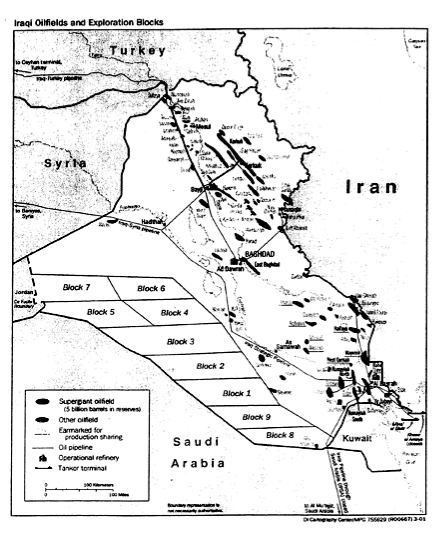


In David Strahan's book "The Last Oil Shock", he notes "the CIA was also well aware of Iraq’s unique value, having secretly paid for new maps of its petroleum geology to be drawn as early as 1998".

The Iraq Oil Law
One of our greatest helpers has been the State Department - John D Rockefeller (1909)

One of the more interesting pieces of political maneuvering in occupied Iraq has been the attempt to pass a law governing how Iraq's oil reserves and oil revenues will be divided and what role international oil companies will play in the country.

There have been persistent claims the law is about to be passed for well over a year, but so far the Iraqi Parliament has managed to avoid doing any such thing.

The proposed law has been the subject of a lot of controversy during that time (with the Bush administration making it one of the primary "benchmarks" it wants the Iraqi government to meet), with this summary of "key facts" from Oil Change International being a good outline of the major complaints:
The proposed Iraq hydrocarbon law would take the majority of Iraq’s oil out of the exclusive hands of the Iraqi government and open it to international oil companies for a generation or more. The law is a dramatic break from the past. Foreign oil companies will have a stake in Iraq’s vast oil wealth for the first time since 1972, when Iraq nationalized the oil industry.

BearingPoint, a Virginia based contractor is being paid $240m for its work in Iraq, winning an initial contract from the US Agency for International Development (USAid) within weeks of the fall of Saddam Hussein in 2003. A BearingPoint employee, based in the US embassy in Baghdad, was hired to advise the Iraqi Ministry of Oil on drawing up a new hydrocarbon law. BearingPoint employees gave $117,000 to the 2000 and 2004 Bush election campaigns, more than any other Iraq contractor.

The process of drafting the oil law has been particularly troubling. The timeline of which entities have seen the draft when suggests that Iraqi interests are not being considered first and foremost:

* Draft shown to US government and major oil companies – July 06
* Draft shown to the International Monetary Fund September 06
* Draft shown to Iraqi Parliament: February 07

The Iraq National Oil Company would have exclusive control of just 17 of Iraq’s 80 known oil fields, leaving two-thirds of known — and all of its as yet undiscovered — reserves open to foreign control.

The law sets no minimum standard for the extent to which foreign companies would not have to invest their earnings in the Iraqi economy, partner with Iraqi companies, hire Iraqi workers or share new technologies.

The international oil companies could also be offered some of the most corporate-friendly contracts in the world, including what are called production sharing agreements. These agreements are the oil industry’s preferred model, but are roundly rejected by all the top oil producing countries in the Middle East because they grant long-term contracts (20 to 30 years in the case of Iraq’s draft law) and greater control, ownership and profits to the companies than other models. In fact, they are used for only approximately 12 percent of the world’s oil.

Iraq’s neighbors Iran, Kuwait and Saudi Arabia maintain nationalized oil systems and have outlawed foreign control over oil development. They all hire international oil companies as contractors to provide specific services as needed, for a limited duration, and without giving the foreign company any direct interest in the oil produced

Iraqis may very well choose to use the expertise and experience of international oil companies. They are most likely to do so in a manner that best serves their own needs if they are freed from the tremendous external pressure being exercised by the Bush administration, the oil corporations — and the presence of 140,000 members of the American military.

The leadership of Iraq’s five trade union federations released a statement opposing the law and rejecting ‘’the handing of control over oil to foreign companies, which would undermine the sovereignty of the state and the dignity of the Iraqi people.’’ They ask for more time, less pressure and a chance at the democracy they have been promised.

When I first read about the proposed law, the point that instantly caught my eye was the handing over of all "undiscovered" oil to possible foreign exploitation - which makes a lot of sense if you consider Professor Blair's stories about suppressed oil discoveries back in the old days (along with large swathes of the country remaining unexplored).

Of course, the Iraqi government may have thwarted this particular tactic with it's announcement this year upping reserves to 350 billion barrels, thus restricting the "undiscovered" category to any amount found beyond this number.
The Iraqi Deputy Prime Minister told The Times that new exploration showed that his country has the world’s largest proven oil reserves, with as much as 350 billion barrels. The figure is triple the country’s present proven reserves and exceeds that of Saudi Arabia’s estimated 264 billion barrels of oil. Barham Salih said that the new estimate had been based on recent geological surveys and seismic data compiled by “reputable, international oil companies . . . This is a serious figure from credible sources.”

In the meantime the Iraqis are perhaps hoping they can dawdle over passing any law for as long as it takes for US troops to leave the country - something the Iraqis are asking to occur by 2011.

Various tactics have been tried by the oil companies as well, ranging from attempts to negotiate contracts directly with the Kurdish regional government in the north, to a range of no bid oil contracts (later cancelled) to the recent sell-off discussions in London that I started the post with (the outcome of which doesn't seem to have been reported anywhere that I can find).
Of course it’s about oil, we can’t really deny that - General John Abizaid (2007)

Conclusion

As we frequently find elsewhere, there is very little in the way of transparent data regarding Iraq's oil reserves, so many interpretations of what are going on seem to be basically political in nature.

However, given the history of Iraq's oil industry and its largely undeveloped state (even when considering well known reserves), I think some of the higher estimates for Iraq's oil reserves are likely true.

The Iraq Oil Ministry is continuing trying to get the oil law passed, and predicting potential production in the 10 million barrel per day range (even the limited sell off currently under consideration could result in an increase in production to 4.5 million barrels per day, according to the Wall Street Journal).

It is numbers like these that make me think the global decline rates we will see post peak won't be as steep as some people fear - however I hope that the Iraqis manage to free themselves from outside influences and get to determine the fate of their own property, rather than an occupying army ensuring that foreign oil firms take the lions share of the income this oil generates.
People say we’re not fighting for oil. Of course we are. They talk about America’s national interest. What the hell do you think they’re talking about? We’re not there for figs - Republican Senator Charles Hagel

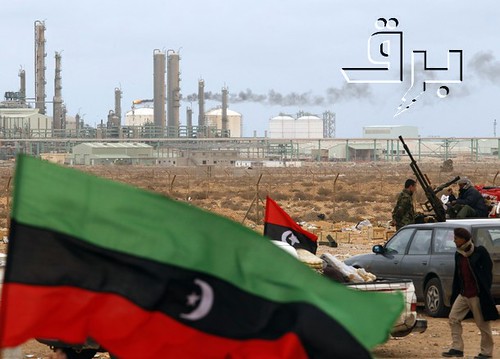
Statistics

Locations of visitors to this page

blogspot visitor
Stat Counter

Total Pageviews

Ads

Books

Followers

Blog Archive

Labels

australia (619) global warming (423) solar power (397) peak oil (355) renewable energy (302) electric vehicles (250) wind power (194) ocean energy (165) csp (159) solar thermal power (145) geothermal energy (144) energy storage (142) smart grids (140) oil (139) solar pv (138) tidal power (137) coal seam gas (131) nuclear power (129) china (120) lng (117) iraq (113) geothermal power (112) green buildings (110) natural gas (110) agriculture (91) oil price (80) biofuel (78) wave power (73) smart meters (72) coal (70) uk (69) electricity grid (67) energy efficiency (64) google (58) internet (50) surveillance (50) bicycle (49) big brother (49) shale gas (49) food prices (48) tesla (46) thin film solar (42) biomimicry (40) canada (40) scotland (38) ocean power (37) politics (37) shale oil (37) new zealand (35) air transport (34) algae (34) water (34) arctic ice (33) concentrating solar power (33) saudi arabia (33) queensland (32) california (31) credit crunch (31) bioplastic (30) offshore wind power (30) population (30) cogeneration (28) geoengineering (28) batteries (26) drought (26) resource wars (26) woodside (26) censorship (25) cleantech (25) bruce sterling (24) ctl (23) limits to growth (23) carbon tax (22) economics (22) exxon (22) lithium (22) buckminster fuller (21) distributed manufacturing (21) iraq oil law (21) coal to liquids (20) indonesia (20) origin energy (20) brightsource (19) rail transport (19) ultracapacitor (19) santos (18) ausra (17) collapse (17) electric bikes (17) michael klare (17) atlantis (16) cellulosic ethanol (16) iceland (16) lithium ion batteries (16) mapping (16) ucg (16) bees (15) concentrating solar thermal power (15) ethanol (15) geodynamics (15) psychology (15) al gore (14) brazil (14) bucky fuller (14) carbon emissions (14) fertiliser (14) matthew simmons (14) ambient energy (13) biodiesel (13) investment (13) kenya (13) public transport (13) big oil (12) biochar (12) chile (12) cities (12) desertec (12) internet of things (12) otec (12) texas (12) victoria (12) antarctica (11) cradle to cradle (11) energy policy (11) hybrid car (11) terra preta (11) tinfoil (11) toyota (11) amory lovins (10) fabber (10) gazprom (10) goldman sachs (10) gtl (10) severn estuary (10) volt (10) afghanistan (9) alaska (9) biomass (9) carbon trading (9) distributed generation (9) esolar (9) four day week (9) fuel cells (9) jeremy leggett (9) methane hydrates (9) pge (9) sweden (9) arrow energy (8) bolivia (8) eroei (8) fish (8) floating offshore wind power (8) guerilla gardening (8) linc energy (8) methane (8) nanosolar (8) natural gas pipelines (8) pentland firth (8) saul griffith (8) stirling engine (8) us elections (8) western australia (8) airborne wind turbines (7) bloom energy (7) boeing (7) chp (7) climategate (7) copenhagen (7) scenario planning (7) vinod khosla (7) apocaphilia (6) ceramic fuel cells (6) cigs (6) futurism (6) jatropha (6) nigeria (6) ocean acidification (6) relocalisation (6) somalia (6) t boone pickens (6) local currencies (5) space based solar power (5) varanus island (5) garbage (4) global energy grid (4) kevin kelly (4) low temperature geothermal power (4) oled (4) tim flannery (4) v2g (4) club of rome (3) norman borlaug (2) peak oil portfolio (1)
