Showing posts with label geoengineering. Show all posts

Al Gore says use of geo-engineering to head off climate disaster is insane  

Posted by Big Gav in , ,

The Guardian has an article on recent comments by Al Gore where he called geoengineering "utterly mad" - Al Gore says use of geo-engineering to head off climate disaster is insane.

The draft climate report of the Intergovernmental Panel on Climate Change, due for release in Germany in April, said governments might have to turn increasingly to technologies for "carbon dioxide removal" to keep warming below the dangerous threshold of 2 degrees. The draft said those technologies might involve capturing and burying emissions from coal-fired power plants, or planting more forests. But there has been debate in the environmental community over other more radical solutions.

On geo-engineering Gore drew a distinction between small-scale interventions, such as white roofs, and large-scale projects meant to extract or neutralise emissions from the air or block the sunlight. Those ideas, he said, carried enormous risks. "The most discussed so-called geo-engineering proposals – like putting sulphur dioxide in the atmosphere to reflect incoming sunlight – that's just insane. Let's just describe that clearly – it is utterly mad," Gore told the conference call.

He warned that such large and untested experiments carried enormous risks while "doing nothing to address other consequences of climate change such as ocean acidification". He said: "We are already engaged in a planet-wide experiment with consequences we can already tell are unpleasant for the future of humanity. So the hubris involved in thinking we can come up with a second planet-wide experiment that would exactly counteract the first experiment is delusional in the extreme."

Gore was also cool on the other quick-fix of nuclear power, advocated by some. ... Gore's re-thinking has apparently gone in the other direction. He told the call he had been an enthusiastic supporter of nuclear energy when he was in Congress. He was not opposed to nuclear energy now, he said. But he said the current state of technology in the nuclear energy industry did not yet warrant a big expansion.
Cryptogon points to a Chinese geoengineering proposal, aimed at neutralizing acid in the air ("Ph conditioning") with giant jellyfish shaped blimp membranes - Atmosphere Processors for Beijing [???].

In the past 30 years, China has suffered from air pollution and heavy haze created by fast industrial growth and economic expansion. An Environmental Chemistry Letter research journal article reviews the techniques for remediation of air pollution. A geoengineering method is proposed for mitigating air pollution and haze in China’s cities by using water to scavenge air pollution. Here, water should be sprayed into the atmosphere like watering garden. The scientific rationale and mechanism for the geoengineering scheme are explained.

The CIA Wants To Control the Climate!!!!  

Posted by Big Gav in

Jamais at Open The Future has a look at the recent Mother Jones report on geoengineering funding - The CIA Wants To Control the Climate!!!!11!.

This is an entirely appropriate use of a very small amount of money (in government terms) and the resources of the intelligence services. As I've gone into multiple times, the global political risks around geoengineering are massive, likely greater than the environmental risks. A better understanding of an emerging complex geopolitical issue is precisely what I'd want an intelligence service to be doing. It's a lot better than operating killer drones and reading our email.

This is an entirely appropriate use of a very small amount of money (in government terms) and the resources of the intelligence services. As I've gone into multiple times, the global political risks around geoengineering are massive, likely greater than the environmental risks. A better understanding of an emerging complex geopolitical issue is precisely what I'd want an intelligence service to be doing. It's a lot better than operating killer drones and reading our email. People who don't want to see geoengineering happen should be glad that the US government is taking this seriously as a potential issue. I had an opportunity a couple of years ago to participate in a "wargame" project run by the CIA Center on Climate Change and National Security -- see souvenir above -- and watched as a climate-focused exercise turned into a geoengineering-focused game. As far as I could tell, this was not the designer's intent, but an organic result of player actions. And over the course of the game it came very close to leading to armed conflict between the US and China, a conflict over uncertain (and unsettling) consequences of a geoengineering effort. [The CIA Center on CCNS is now closed, in part due to climate issues being integrated across the spectrum of CIA research, and in part because House Republicans cut funding. Can't have the government studying climate change as if it were a real thing, you know.]

There's no question that geoengineering needs to be thought of as a potential global political risk. I'm glad to see a project like this. And I hope that the intelligence and strategic risk analysis services of other governments around the world are doing the exact same thing. ...

People who don't want to see geoengineering happen should be glad that the US government is taking this seriously as a potential issue. I had an opportunity a couple of years ago to participate in a "wargame" project run by the CIA Center on Climate Change and National Security -- see souvenir above -- and watched as a climate-focused exercise turned into a geoengineering-focused game. As far as I could tell, this was not the designer's intent, but an organic result of player actions. And over the course of the game it came very close to leading to armed conflict between the US and China, a conflict over uncertain (and unsettling) consequences of a geoengineering effort.

[The CIA Center on CCNS is now closed, in part due to climate issues being integrated across the spectrum of CIA research, and in part because House Republicans cut funding. Can't have the government studying climate change as if it were a real thing, you know.] There's no question that geoengineering needs to be thought of as a potential global political risk. I'm glad to see a project like this. And I hope that the intelligence and strategic risk analysis services of other governments around the world are doing the exact same thing.

CIA Backs Geoengineering Study  

Posted by Big Gav in ,

Mother Jones has an article on geoengineering funding in the US - CIA Backs $630,000 Scientific Study on Controlling Global Climate. I think the title is overstating it a bit - geoengineering (in any of its myriad, crazed forms) isn't really "controlling" the climate.

The Central Intelligence Agency is funding a scientific study that will investigate whether humans could use geoengineering to alter Earth's environment and stop climate change. The National Academy of Sciences (NAS) will run the 21-month project, which is the first NAS geoengineering study financially supported by an intelligence agency. With the spooks' money, scientists will study how humans might influence weather patterns, assess the potential dangers of messing with the climate, and investigate possible national security implications of geoengineering attempts.

The total cost of the project is $630,000, which NAS is splitting with the CIA, the National Oceanic and Atmospheric Administration, and NASA. The NAS website says that "the US intelligence community" is funding the project, and William Kearney, a spokesman for NAS, told Mother Jones that phrase refers to the CIA. Edward Price, a spokesman for the CIA, refused to confirm the agency's role in the study, but said, "It's natural that on a subject like climate change the Agency would work with scientists to better understand the phenomenon and its implications on national security." The CIA reportedly closed its research center on climate change and national security last year, after GOP members of Congress argued that the CIA shouldn't be looking at climate change.

The goal of the CIA-backed NAS study is to conduct a "technical evaluation of a limited number of proposed geoengineering techniques," according to the NAS website. Scientists will attempt to determine which geoengineering techniques are feasible and try to evaluate the impacts and risks of each (including "national security concerns"). One proposed geoengineering method the study will look at is solar radiation management—a fancy term for pumping particles into the stratosphere to reflect incoming sunlight away from the planet. In theory, solar radiation management could lead to a global cooling trend that might reverse, or at least slow down, global warming. The study will also investigate proposals for removing carbon dioxide from the atmosphere.

The National Academies has held two previous workshops on geoengineering, but neither was funded by the intelligence community, says Edward Dunlea, the study director for the latest project. The CIA would not say why it had decided to fund the project at this time, but the US government's apparent interest in altering the climate isn't new. The first big use of weather modification as a military tactic came during the Vietnam War, when the Air Force engaged in a cloud seeding program to try to create rainfall and turn the Ho Chi Minh Trail into muck, and thereby gain tactical advantage. Between 1962 and 1983, other would-be weather engineers tried to change the behavior of hurricanes using silver iodide. That effort, dubbed Project Stormfury, was spearheaded by the Navy and the Commerce Department. China's "Weather Modification Office" also controversially seeded clouds in advance of the 2008 Beijing Olympics, hoping to ensure rain would fall in the Beijing suburbs instead of over the Olympic stadiums.

Although previous efforts to manipulate weather and climate have often been met with mockery, many geoengineering proposals "are fundamentally doable, relatively cheap, and do appear to be able to reduce climate risk significantly, but with risks," explains David Keith, a Harvard researcher and top geoengineering proponent.

But if geoengineering is cheap and "fundamentally doable," as Keith claims, that suggests foreign countries, or even wealthy individuals, could mess with the climate to advance their own ends. "This whole issue of lone actors: Do we need to be concerned about China acting unilaterally? Is that just idle chatter, or is that something the US government should prepare for?" asks Ken Caldeira, a geoengineering researcher at the Carnegie Institution's Department of Global Ecology and a member of the current National Academy of Sciences panel.

At least one individual has already tried modifying the climate. Russ George, the former head of Planktos, a company that works to develop technology to deal with global warming, seeded the Pacific Ocean off western Canada with iron to generate a plankton bloom that, in turn, was supposed to suck up carbon dioxide from the air. George's effort was widely condemned, but at present there's little to stop other individuals or countries from trying it or something similar. That's part of what has the US intelligence community interested.

Who's watching the weather makers ?  

Posted by Big Gav in

The Climate Spectator has a look at the state of the geoengineering debate - Who's watching the weather makers?.

With expectations lower than a snake's armpit for the climate talks currently underway in Durban, there are likely to be renewed calls for geoengineering to be taken seriously as a "Plan B" for avoiding dangerous climate change.

Geoengineering – or, more accurately, climate engineering – was defined by the IPCC in 2009 as "the deliberate, large-scale manipulation of the planetary environment." The three main types are solar radiation management (SRM), carbon dioxide removal (CDR), and weather modification (WM).

The scientists involved in geoengineering research mostly profess to be reluctant converts to the cause, and protest that research does not mean deployment, but rare are the new technologies that have not been eventually applied in the real world. So who will watch those mucking about with our climate?

In last week's article on geoengineering by climate scientist David Karoly, he referred to the importance of "ethical and governance considerations" and the need for "urgent, well-informed, high-level international discussions."

This is already happening. In 2010, scientists working in this field proposed five "Oxford Principles" to govern research: geoengineering to be regulated as a public good; public participation in geoengineering decision-making; disclosure of geoengineering research and open publication of results; independent assessment of impacts; and governance before deployment.

This is all well and good, but these principles carry no legal weight. Fortunately, there are more formal moves afoot to regulate an industry that could turn the skies white and the oceans green, if attempts to produce an artificial "volcano effect" in the atmosphere or for phytoplankton to store carbon on the seabed go horribly wrong.

In Nagoya last year, countries party to the Convention on Biological Diversity (that is, most of the world, with the notable exception of the United States) adopted a de facto moratorium on all geoengineering activities. However, this decision is qualified and open to interpretation, and the legal force of decisions made at COPs (Conventions of Parties) is debatable.

The CBD parties are now involved in a process to determine whether that treaty or other existing or new treaties might be the best way to regulate research and projects. Its secretariat has produced draft studies on the impacts of geoengineering on biological diversity and the regulatory framework, and is inviting public comment.

Led by the Canada-based ETC Group, there are also moves afoot to ensure that geoengineering is on the table at the Rio+20 global environment summit next June. In September, a meeting of the European Parliament adopted a resolution expressing “opposition to proposals for large-scale geoengineering” and aiming to develop a common EU position ahead of Rio+20.

ETC has already had success in stopping a proposed ocean fertilisation experiment by US company Planktos Inc near the Galapagos Islands in 2007. In October, pressure by ETC and other groups led to the suspension of plans by a British scientific consortium called SPICE to erect a one kilometre long hose. Dubbed the "Trojan hose" by opponents, the aim was to test the feasibility of constructing a much longer hose that would pump sulphur dioxide into the stratosphere to reflect solar radiation.

The ETC Group has also proposed a new International Convention for the Evaluation of New Technologies. But (with the notable exception of the 1987 Montreal Protocol on Substances That Deplete the Ozone Layer) new global treaties are usually lengthy to negotiate and only apply directly to countries that choose to sign onto them.

To date, neither the Australian government nor any major Australian environmental group other than Friends of the Earth appears to have expressed any view on geoengineering research. But in 2007, the ABC reported that a small Australian company with research links to the University of Sydney, Ocean Nourishment Corporation, did an ocean fertilisation trial in the Sulu Sea off Philippines in 2007, involving one tonne of nitrogen-rich urea. Although a growing body of research has cast doubt on the potential efficacy of ocean fertilisation, the company is pursuing "ecosystem based modelling" and says it is interested in validating its findings "through third party independent open ocean experimentation." ...

There is, however, one obvious ground rule that could apply while the world works out how best to regulate this emerging plethora of technologies. The International Energy Agency's latest World Energy Outlook gives the world until 2017, at the latest, to start reducing emissions under its most plausible "New Policies" scenario; after this time it becomes prohibitively expensive to keep warming under the 2°C threshold. In view of this, no real world experiments should occur before then that could undermine efforts to reduce global emissions. This would most notably preclude any research ultimately aimed at injecting sulphides into the atmosphere or any form of ocean fertilisation.

On the other hand, purely biological methods of geoengineering that would also assist climate change mitigation efforts, such as reforestation, avoiding deforestation and improving soil health, should be encouraged.

In between these extremes, things get tricky. Recent research suggests that even some of the more benign and promising ideas, like painting rooves white to increase surface albedo and thereby reduce atmospheric heating, may be ineffective. And despite all the money thrown at carbon capture and storage, its prospects for large-scale carbon sequestration look unpromising to date. There are also serious concerns about the side effects of biochar production, which has been widely spruiked as an effective means of terrestrial carbon storage (including, according to Friends of the Earth, the production of "phytotoxic and possible carcinogenic materials... during pyrolysis").

On current indications, after 2017 we may have to reconsider our options. But so far, silver bullets there are none.

Pantheon  

Posted by Big Gav in

Jamais Cascio is pondering what sort of gods humanity are - Pantheon.

"We are as gods and might as well get good at it." -- Stewart Brand, the Whole Earth Catalog, 1968.

Stewart Brand's observation has simultaneously enchanted, terrified, and driven me ever since I first heard it (probably some 20-25 years after he wrote it). It's both an admonition (we're not very good at being gods) and encouragement (...but we could be!); Brand saw that our capabilities as humans (when using the tools devised by human minds) equalled or exceeded most of the capabilities of the gods of myth, and even those abilities not yet in our toolkit would likely be right over the horizon. Brand also saw that our sense of ourselves, and our responsibility to the world, remained firmly rooted in simple humanity.

"We have more power than we think we do," he seemed to be saying, "and we can't use it wisely until we acknowledge that fact."

The statement can be critiqued from a number of perspectives, and has been. (My own push-back against it these days is that it has the equation exactly backwards. Gods are just people who can truly see the extent of their power.) But there's one observation about the "We are as gods..." line that I haven't seen elsewhere -- and it requires a little digression. ...

"We are as gods --" okay, but which gods? In our generally monotheistic age, we tend to lump all "gods" and "godlike powers" into a bucket of Almighty Power. But that's not the way humans have thought of gods until relatively recently; for much of human civilization, gods were seen as individuals, with their own personalities, domains, and entries in an AD&D manual.

We are gods, but we're the gods of an earlier age. Powerful, yes, but petulant; wise yet warlike; arrogant and utterly capricious... and also able to create sublime beauty. The Greek gods were the ones that came to mind last week, but really nearly every mythic pantheon followed a similar pattern.

We are as gods, but we have gotten pretty good at it -- as long as we remember that this means we are as likely to be Loki as Athena.

British to Test Geoengineering Scheme  

Posted by Big Gav in

Technology review has a look at the latest scheme to test a geoengineering approach - British to Test Geoengineering Scheme.

In October, British researchers supported by the U.K. government will attempt to pump water a kilometer into the air using little more than a helium balloon and a rubber hose. The experiment, which will take place at a military airfield along England's east coast, is meant as a test of a proposed geoengineering technique for offsetting the warming effects of greenhouse gases. If the balloon and hose can handle the water's weight and pressure, similar pipes rising 20 kilometers could pump tons of reflective aerosols into the stratosphere.

The scheme, called SPICE (stratospheric particle injection for climate engineering), is one of several proposed geoengineering methods under study. In this case, the idea is that particles injected into the stratosphere would reflect a small percentage of the sun's energy back into space, thereby cooling the planet. The concept seeks to mimic the cooling effect of volcanoes that inject sulfide particles into the stratosphere in large quantity. A 2009 study by the U.K. meteorological office estimated that 10 million metric tons of sulfide particles injected annually into the stratosphere would cool the planet by approximately 2 °C within a few years.

Other methods of geoengineering have also been tested, including fertilizing oceans to encourage algae blooms and pulling carbon dioxide out of the air. But a 2009 report by the U.K.'s Royal Society concluded that reflective aerosol injected into the stratosphere would be the least expensive and most effective way to rapidly cool the planet.

In addition to the pipe tethered to the balloon, airplanes and rockets could be used to deploy the particles. But Hugh Hunt, a senior lecturer in engineering at the University of Cambridge and a member of the SPICE project, says the balloon-and-pipe approach that his group is testing would be significantly less expensive. "Trying to use airplanes or rockets ends up costing 100 or 1,000 times more than a pipe and balloon," Hunt says. "At an altitude of 20 kilometers, an airplane can only carry one, maybe two, tons of payload. That means five to 10 million flights per year, burning roughly 1 percent of global oil production. It seems unlikely to me that that would be economically viable when a few dozen pipes would do just as good a job."

The current pilot program will pump 100 kilograms of water per hour to an altitude of one kilometer. Full-scale designs call for as many as 64 pipes spread around the world, each lifting five kilograms of sulfur dioxide or other reflective particles per second—approximately 160,000 metric tons per year. Each pipe alone would weigh 30 tons and would be held aloft by a balloon 100 meters in diameter, slightly larger than the largest balloons ever built. The biggest challenge of all, however, would be developing a flexible pipe that can withstand ultrahigh pressures.

Australia to host geoengineering conference  

Posted by Big Gav in ,

The Brisbane Times reports that a geoengineering conference will be held in Canberra later this month - Australia to broach radical global warming solutions.

Clouds could be made more reflective and oceans fertilised to increase carbon dioxide absorption under ideas to be discussed at Australia's first high-level climate engineering conference later this month. International interest in climate engineering – also known as geoengineering – is increasing as efforts to curb the world’s emissions of greenhouse gases continue to falter.

Scientists said the event was an important step for Australia into the controversial geoengineering debate but expressed grave concerns some proposed technologies could have dangerous and far-reaching side effects.

The two-day science symposium, starting in Canberra on September 26, is being hosted by the Australian Academy of Science and the Australian Academy of Technological Sciences and Engineering. Among the more controversial ideas being discussed is the injection of sulphur particles into the stratosphere to reflect sunlight and slow global warming.

Other technologies include fertilising oceans to increase uptake of carbon dioxide and spraying aerosols into the atmosphere to increase the reflectiveness of clouds. But the meeting will also cover relatively benign ways to pull greenhouse gases from the atmosphere, including planting more trees and using climate-friendly agricultural techniques.

How China accidentally geoengineered the climate  

Posted by Big Gav in , , ,

Grist has a post discussing the idea that growing Chinese coal consumption over the past decade released enough sulphur to mask global warming during that period - How China accidentally geoengineered the climate.

Between 2003 and 2007, China burned so much coal that it increased global consumption of the stuff 25 percent. That put so much sulfur into the air that it more or less literally (temporarily) blotted out the sun, masking some of the global warming that otherwise would have occurred during the first decade of the 21st century.

Deliberately putting sulfur into the atmosphere has been proposed as a means of “geoengineering” Earth’s climate, in order to cool the planet temporarily while we figure out a way to get off all these carbon-rich fossil fuels. So, in a way, China’s gigantic exercise in coal burning was an unintentional experiment in geoengineering using atmospheric sulfur. The results are in: it worked. A new paper [PDF] in the journal Proceedings of the National Academy of Sciences says that there is little observed warming of the planet from 1998 to 2008 for a number of reasons, but an important one is that all that sulfur helped cool the planet.

Sulfur doesn't stay in the atmosphere long -- on the order of months -- but the carbon dioxide from all that coal we burned has a half life of centuries. This means we're now in for a double whammy: our industrial pollution is actually hiding some of the global warming that's already occurring, plus pumping out greenhouse gases that will keep warming worsening for decades to come. Think of it like getting punched repeatedly in the face, but taking an aspirin every time. It’ll make the bleeding worse, but at least you won’t feel it right away!

Ocean fertilisation - A drop in the ocean  

Posted by Big Gav in , ,

The Climate Spectator has an article on research into the usefulness of ocean fertilisation as a geoengineering technique - A drop in the ocean.

Fertilizing the oceans to boost the growth of tiny plants that soak up greenhouse gases is unlikely to work as a way to slow climate change, a UN-backed study showed on Monday.

Such "geo-engineering" schemes would be hard to monitor and were likely to store away only small amounts of carbon dioxide, the main greenhouse gas, according to a report by the Intergovernmental Oceanographic Commission.

"Geo-engineering schemes involving ocean fertilization to affect climate have a low chance of success," according to the 20-page study by the Commission, part of the UN Education, Scientific and Cultural Organization (UNESCO).

The review, by scientists in seven countries, said 13 experiments in recent years showed faded optimism that iron dust or other nutrients could spur growth of microscopic marine plants and permanently suck carbon dioxide from the atmosphere.

Twenty years ago, scientists had optimistically reckoned that one tonne of iron could make the seas absorb 100,000 tonnes of carbon dioxide, it said. But one recent study suggested that one tonne of iron would only soak up 5,000 tonnes of the gas.

Firms including Climos, Atmocean and the Ocean Nourishment Corp. have been looking into ocean fertilization technology as a way of offsetting emissions of greenhouse gases from factories, power plants and cars.

But the study said that some absorbed carbon simply returns to the atmosphere. Just one to 15 per cent falls as what scientists call "marine snow" – dead plants, animals or their faeces – to be stored on the deep ocean floor.

"At best it can make a small contribution" to storing industrial emissions of carbon dioxide, Doug Wallace, lead author of the report at the Leibniz-Institut fur Meereswissenschaften, told Reuters.

In 2008, the UN's Convention on Biological Diversity imposed a moratorium on ocean fertilization experiments outside coastal waters, awaiting wider scientific evidence.

The study said that some experiments had successfully triggered a bloom of plankton and bacteria – such one in 2002 that produced a patch visible to satellites in the north-east Pacific Ocean.

But it was impossible to say how much of that carbon stayed in the oceans. And the extra plants might help fish grow in some areas by providing more food, but might also rob nutrients from other parts of the ocean.

Monitoring was vital, especially if ocean fertilization were ever to qualify for carbon credits under a UN deal meant to avert more floods, heatwaves, mudslides, or rising sea levels.

But it was far easier to monitor forests, which also soak up carbon as they grow. "A tree might burn next year but then at least you know it didn't work," Wallace said. "In the oceans you have a serious measurement problem."

Ocean Iron Fertilization Could Stimulate Toxic Algae Blooms in Open Ocean  

Posted by Big Gav in

TreeHugger has a post on a potential drawback of one proposed geoengineering strategy - Ocean Iron Fertilization Could Stimulate Toxic Algae Blooms in Open Ocean.

There's no doubt that geoengineering brings out passionate emotions both pro and con, as recent debate on TreeHugger about the sort of-moratorium on some research coming out of the Convention on Biological Diversity amply illustrates. Backing up the caution side (which I admit I'm firmly a part of) is a new piece of research coming from UC Santa Cruz, and published in Proceedings of the National Academy of Sciences, which shows that a toxin-producing algae normally thought limited to coastal waters (and perhaps partial inspiration for The Birds) can be stimulated to grow rapidly in the open ocean when iron from natural or artificial sources is present.

Science Codex sums up the nut of it:
Blooms of diatoms in the genus Pseudo-nitschia, which produce a neurotoxin called domoic acid, are a regular occurrence in coastal waters. During large blooms, the algal toxin enters the food chain, forcing the closure of some fisheries (such as shellfish and sardines) and poisoning marine mammals and birds that feed on contaminated fish. But until now, blooms of these algae in the open ocean have attracted little attention from researchers.

Study lead author, Mary Silver says that normally pseudo-nitschia don't have much effect, but "these species are incredibly responsive to iron, often becoming dominant in algal blooms that result from iron fertilization. Any iron input might cause a bloom of the cells that make the toxin." Silver adds that natural deposits of iron in the open ocean (from volcanic eruptions, dust storms, etc) have occurred for millions of years, but are sporadic occurrences.

"To do iron enrichment on a large scale could be dangerous," Silver notes, "because, if it causes blooms of pseudo-nitschia, the toxin will get into the food chain, as it does in the coastal zone."

Geoengineering Books  

Posted by Big Gav in

WorldChanging has a summary of the now expanding field of books about geoengineering (with Jamais Cascio's "Hacking The Earth" being the first one to look at the topic in depth) - Geoengineering Books.

Geoengineering is fast becoming a mainstream debate.
For some, the most worrisome thing about geoengineering is the idea that, once people know about it, they will think of it as a technological quick fix that makes it unnecessary to control emissions of greenhouse gases, an effort everyone takes pains to point out is by far the most important step to be taken now...Still, if geoengineering is not yet an idea whose time has come, it is definitely gaining traction.

So writes Cornelia Dean in the New York Times. She reports on the new books out on geoengineering, including:

* HACK THE PLANET, by Eli Kintisch
* FIXING THE SKY, by James Rodger Fleming
* COMING CLIMATE CRISIS, by Claire L. Parkinson

Additionally, Dean recounts her experience at the Asilomar International Conference on Climate Intervention Technologies and summarizes some the main, critical, political issues largely unaddressed in the geoengineering debate:
Meanwhile, there has been relatively little discussion so far about who would make geoengineering decisions — would the world accept an American president in charge of the decision to go ahead? Assuming we could tune the Earth to a desirable temperature, who would say what that temperature would be? What side effects would be acceptable? Who would be compensated for suffering them. And so on.

I attended the Cambridge meeting Mr. Kintisch describes at the beginning of his book. Afterward, I talked to participants about what it would take to devise and implement any geoengineering plan the world’s wildly diverse people and governments might buy into. And who would regulate it or police any “rogue state,” nonprofit or commercial venture ready to act on its own?

Participants I spoke with were at a loss. “World government,” one of them, finally, offered. The answer does not inspire confidence either.

All the while, humanity is already engaged in a gigantic geoengineering experiment, one that has been under way, however inadvertently, since people started large-scale burning of fossil fuels 150 years ago. So far, the world’s efforts to act together on the problem have been, to be charitable, unimpressive.

The lesson, as all three authors put it, might therefore lie not in figuring out how to “hack the planet” but rather to change things so that planetary hacking will not be needed at all.

Bill Gates Announces Funding for Seawater-Spraying Cloud Machines  

Posted by Big Gav in

Inhabitat has a post on yet another crackpot geoengineering scheme - people really do waste a lot of time trying to find ways to avoid harnessing renewable energy sources - Bill Gates Announces Funding for Seawater-Spraying Cloud Machines.

Environmentalists have long argued about whether geoengineering (using technology to alter the climate) is a good way to tackle climate change. But the tactic has some heavy hitters on its side, including Bill Gates. The Microsoft founder recently announced plans to invest $300,000 into research at the University of Calgary for unique solutions and responses to climate change. Part of that research included lab tests on machines that suck up seawater and spray it into the air, seeding white clouds that reflect rays of sunlight away from Earth.

The machines, developed by a San Francisco-based research group called Silver Lining, turn seawater into tiny particles that can be shot up over 3,000 feet in the air. The particles increase the density of clouds by increasing the amount of nuclei contained within. Silver Lining’s floating machines can suck up ten tons of water per second.

If all goes well, Silver Lining plans to test the process with 10 ships spread throughout 3800 square miles of ocean. Even if that goes well, the technology has a long way to go before it can significantly alter the climate — a recent study showed that it would it take 1,900 ships at a cost of over $7 billion to stop Earth’s temperature from rising.

Save us, [insert techno-fix here], you’re our only hope !  

Posted by Big Gav in

Grist has an article bagging the belief that geoengineering and genetically modified foods are solutions to some of the problems that face us - Save us, [insert techno-fix here], you’re our only hope! .

Watching SuperFreakonomics author Steve Levitt sitting next to Jon Stewart as they shook their heads in disbelief that everyone wasn’t on the climate change/geo-engineering bandwagon (It’s easy! it’s cheap! We know it works!) depressed me to no end. It seems like every challenge we face now has an “easy” technological silver bullet that will spare us sacrifice or even change. GMOs will end hunger. Geo-engineering will solve climate change. A pill will cure obesity. Cellulosic ethanol will eliminate our dependence on foreign oil. It doesn’t seem to bother anyone that none of these phantasms currently exist. Indeed, if you ask an expert when exactly we’ll get one or the other of these whiz-bang items, the answer is almost always the same: “within ten years.” And so it’s been for decades.

At root, I don’t think this is really about faith in technology. After all, the only plot twist more hackneyed and familiar than the miraculous, world-changing invention (a plot twist the media have a long history of falling for) is the unintended consequences that cause it all to go horribly wrong. Instead, this is, as Ralph Loglisci of the Center for a Livable Future put it regarding GMOs, “about political expediency.” I would also add a healthy dose of denial to that mix. Not necessarily a denial of whatever impending disasters face us. Rather it’s denial of the failure of progress—in other words, an unwillingness to accept that what we’ve been doing in this country more or less since WWII represents anything other than progress. Techno-fixers’ courage and will quails at the thought that we might be heading for dead-ends and not the limitless plains of the future.

SuperFreakonomics: Global Cooling ?  

Posted by Big Gav in , ,

The Stoat has a look at some strange climate skepticism being promoted by the professional contrarians responsible for "Freakonomics" (filed under the heading "genral tripe") - SuperFreakonomics: Global Cooling (and some other stuff)?.

I liked Freakonomics, so I'm a bit sad to see the (inevitable) sequel being so hopelessly wrong. Probably this is a case of the old rule: whenever you see people write about stuff you know, they get it wrong. Joe Romm has a fairly characteristic attack; and just for a change I'll agree with him; though he chooses odd bits to assault. It looks like the "global cooling" junk is just one chapter, but of course it is the only one I'll pay any attention to.

Diagnosis, in brief: (1) they write about stuff they clearly don't understand (2) they pick a catchy reverse-common-wisdom nugget as a headliner without the having the slightest interest in whether it is true or not (mind you, plenty of more respectable folk do the same) (3) they pick an expert to talk to, but since they don't have a clue about the subject they don't know how to pick a good expert, or even understand what the expert says (4) there is a grain of sense in there, but so badly wrapped in trash it is nearly unfindable.

The entire piece is riddled with errors. Reading it all would be tedious. So, before reading it in detail I decided to set myself a target of 10 major errors and then stop. Kindly, Romm has provided a PDF of the offending chapter, so you can play along at home.

The folks at RealClimate are aghast at the pseudo-economists claim that a form of geoengineering (the "sulphates in the upper atmosphere" mad-scientist's experiment) would be the most cost effective way to "solve" global warming - Why Levitt and Dubner like geo-engineering and why they are wrong.
The geo-engineering option that is being talked about here is the addition of SO2 to the stratosphere where it oxidises to SO4 (sulphate) aerosols which, since they are reflective, reduce the amount of sunlight reaching the ground. The zeroth order demonstration of this possibility is shown by the response of the climate to the eruption of Mt. Pinatubo in 1991 which caused a maximum 0.5ºC cooling a year or so later. Under business-as-usual scenarios, the radiative forcing we can expect from increasing CO2 by the end of the century are on the order of 4 to 8 W/m2 – requiring the equivalent to one to two Pinatubo’s every year if this kind of geo-engineering was the only response. And of course, you couldn’t stop until CO2 levels came back down (hundreds, if not thousands of years later) without hugely disruptive and rapid temperature rises. As Deltoid neatly puts it: “What could possibly go wrong?”.

The answer is plenty. Alan Robock discussed some of the issues here the last time this came up (umm… weeks ago). The basic issues over and above the costs of delivering the SO2 to the stratosphere are that a) once started you can’t stop without much more serious consequences so you are setting up a multi-centennial commitment to continually increasing spending (of course, if you want to stop because of huge disruption that geo-engineering might be causing, then you are pretty much toast), b) there would be a huge need for increased monitoring from the ground and space, c) who would be responsible for any unanticipated or anticipated side effects and how much would that cost?, and d) who decides when, where and how much this is used. For point ‘d’, consider how difficult it is now to come up with an international agreement on reducing emissions and then ponder the additional issues involved if India or China are concerned that geo-engineering will cause a persistent failure of the monsoon? None of these issues are trivial or cheap to deal with, and yet few are being accounted for in most popular discussions of the issue (including the chapter we are discussing here).

Tim Lambert also has a few words to say on the topic - Underwhelming response from Superfreakonomics authors.
Myhrvold finishes with:
The point of the chapter in SuperFreakonomics is that geoengineering might be good insurance in case we don't get global warming under control.

No, it isn't. The point they are trying to make is that geoengineering is a more cost-effective solution than mitigation. Which is wrong. It might be cheaper, but you don't get the same result.

Geoengineering Gets A Boost  

Posted by Big Gav in

Next100 has a look at recent events in the world of geoengineering politics - GEOENGINEERING GETS A BOOST.

Geoengineering--the planned alteration of planetary-scale systems--is a highly controversial approach to solving an increasingly desperate problem: global warming. Critics have condemned it "somewhere between a dead end and a hoax," while White House science adviser John Holdren said, "It's got to be looked at." The credibility of this outsized concept got a big boost this week from a major policy pronouncement by the American Meteorological Society.

As covered extensively in NEXT100, geoengineering proposals run the gamut from fostering the growth of carbon-absorbing plankton by fertilizing the oceans, to reflecting more sunlight by seeding clouds, to locking up carbon in the form of biochar.

The AMS notes the wide range of possible risks, including adverse local climate changes that might disrupt some countries and peoples even if geoengineering stabilized the global temperature. And some measures that address symptoms--for example, by increasing solar reflection--"would not diminish the direct effects of elevated CO2 concentrations such as ocean acidification or changes to the structure and function of biological systems."

All that said, given that past greenhouse gas emissions are almost certain to cause "dangerous climate changes," the society recommended stepping up research on climate geoengineering, including the environmental ethical, legal and social implications.

While reducing greenhouse gas emissions is a top priority, geoengineering "could contribute to a comprehensive risk management strategy to slow climate change and alleviate some of its negative impacts," the society declared. "The potential to help society cope with climate change and the risks of adverse consequences imply a need for adequate research, appropriate regulation, and transparent deliberation."

Geoengineering and the New Climate Denialism  

Posted by Big Gav in ,

Alex Steffen has another post at WorldChanging outlining his reasons for opposing geoengineering proposals and looking at the background of one unsavoury set of cheerleaders - Geoengineering and the New Climate Denialism.

Some scientists suggest that certain massive projects -- like creating artificial volcanoes to fill the skies with soot, or seeding the oceans with mountains of iron to produce giant algal blooms -- might in the future be able put the brakes on climate change. These "geoengineering" ideas are hardly shovel-ready. The field at this point consists essentially of little more than a bunch of proposals, simulations and small-scale experiments: describing these hypothetical approaches as "back up options" crazily overstates their current state of development. Indeed, almost all of the scientists working on them believe that the best answer to our climate problem would be a quick, massive reduction in our greenhouse gas emissions.

None of this has stopped geoengineering from becoming part of a new attempt to stall those very reductions, though. The same network of think tanks, pundits and lobbying groups that denied climate change for the last 30 years has seized on geoengineering as a chance to undermine new climate regulations and the U.N. climate negotiations to be held at the end of the year in Copenhagen. They're still using scare tactics about the economic costs of change, but now, instead of just denying the greenhouse effect, they've begun trying to convince the rest of us that hacking the planet with giant space-mirrors or artificial volcanoes is so easy that burning a lot more coal and oil really won't be a problem. ...

Turn over denialist rocks and you'll find political advocates for geoengineering a-plenty. For instance:

*The Cato Institute (denialists), whose senior fellow and director of natural resource studies, Jerry Taylor, says that if we end up forced do something about global warming, "geo-engineering is more cost-effective than emissions controls altogether."

*The Heartland Institute (denialists), whose David Schnare now advocates geoengineering as quicker and less costly to the economy than greenhouse gas reductions:
"In addition to being much less expensive than seeking to stem temperature rise solely through the reduction of greenhouse gas emissions, geo-engineering has the benefit of delivering measurable results in a matter of weeks rather than the decades or centuries required for greenhouse gas reductions to take full effect."

*The Hudson Institute (denialists) advocates geoengineering as substitute for reductions:
"Successful geoengineering would permit Earth's population to make far smaller reductions in carbon use and still achieve the same retarding effect on global warming at a lower cost. The cuts in carbon use proposed by international leaders and presidential candidates would have a drastic effect on the economy, especially since substitutes for fossil fuels will be expensive and limited for a number of years."

*The Hoover Institution (denialists) is home to not only to senior fellow Thomas Gale Moore, author of "Climate of Fear: Why We Shouldn't Worry About Global Warming" but also nuclear weapons engineer and original SDI "Star Wars" proponent Lowell Wood. Wood has become an outspoken geoengineering proponent and co-authored a recent WSJ op-ed in which he warns "But beware. Do not try to sell climate geo-engineering to committed enemies of fossil fuels," thus revealing that the point is to be friendly to fossil fuels.

And, of course, denialists' allies in the media and the blogosphere have been quick to take up the call. Conservative columnist (and climate "contrarian") John Tierney thinks geoengineering makes superfluous emissions reductions ("a futile strategy") and wants "a geoengineering fix for global warming," to provide an alternative to the idea that "the only cure [is] to reduce CO2 emissions." Wayne Crews of the denialist site globalwarming.org (a project of the Carbon-Lobby-funded Competitive Enterprise Institute) likes geoengineering strategies as possible "options apart from carbon constraint," while climate treaty opponent and "delayer" Roger Pielke, Jr. finds it encouraging that geoengineering's getting so much buzz.

It would be easy to go on. But the point is obvious: the Carbon Lobby, no longer able to deny the reality of climate change, is hoping to use the idea of geoengineering to undermine political progress towards reducing climate emissions through sensible, intelligent regulations and international treaties. Big Oil, Big Coal and the auto companies want you to believe that reducing emissions is too expensive to work, climate negotiations are too unrealistic to succeed, but we can keep burning fossil fuels anyways because geoengineering gives us a plan B. If you think that, you've been spun.

How to De-Spin Geoengineering

None of this is to say that megascale geoengineering should be a taboo subject. We need a smart debate here, where we explore the subject honestly and without industry spin. Here are six suggestions for returning reality to the geoengineering debate in these critical months leading up to Copenhagen:

First, Demand that bold emissions reductions be acknowledged as the only sound foundation for any climate action plan. The Carbon Lobby thrives on half-truths and obfuscation. Ethical people -- whether geoengineering proponents, opponents or doubters -- all need to be extremely clear in saying that a strong, rapid movement away from fossil fuels and toward climate neutrality is non-negotiable. Many leading thinkers on geoengineering (such as Paul Crutzen and Ken Caldeira) already make clear that immediate action on reducing greenhouse pollution (on both the national and global levels) is the first step, period. We should follow their lead.

Second, Point out that a climate-neutral world is realistic. One of the public debate's biggest failures is the extent to which we've let people be convinced that a climate-neutral planet is some distant, improbable fantasy world. It's not. We know, already, right now, how to dramatically slash emissions using currently available technologies, and make a profit. Economists (like Lord Nicholas Stern, former Chief Economist at the World Bank) estimate that the total cost of pursuing climate neutrality could be as little as 1% of GDP (far lower than the anticipated costs of allowing climate change to worsen). But there may not even be a cost: a great many of the actions we need to take (like rebuilding our cities and using energy more efficiently) return greater economic benefits than they demand, and when something pays you money, it's not a cost, it's an investment.

Third, Be extremely clear about geoengineering's real possibilities and actual limitations. Journalists tend to sell the planetary engineering sizzle, rather than serve the heavily-caveated steak. Advocates need to continue to emphasize that geoegineering proposals are still extremely early-stage, experimental and surrounded with unknowns. (On the other side, even determined opponents of geoengineering need to acknowledge the good intent and sound reasoning of scientists who are doing their best to add new insight to an extremely important debate.)

Fourth, Get the order right: zero-out first, adapt next, engineer last.. We need to be clear that because of the experimental nature of geoengineering projects, their use should be a last resort, not a primary option. Megascale geoengineering should not yet be part of any national strategies for addressing climate change, or a part of any offset systems in carbon trading regimes. We need first to drive greenhouse gas concentrations down with proven methods, and then begin preparing to adapt to the climate change we know we've already set in motion. We should only turn to megascale geoengineering as a last resort.

Fifth, Keep a wary eye on the Arctic ocean and other tipping points. Last year, scientists conducting research in the Arctic made a startling discovery: what might perhaps be formerly-frozen methane was bubbling to the surface of the warming ocean in alarming amounts. Their work demands corroboration, but if confirmed, this should cause us all to worry. Methane is an incredibly potent greenhouse gas and huge amounts of it are trapped beneath frigid waters and frozen permafrost, waiting perhaps to be released by rising temperatures.That methane could set off runaway climate change. Even if their findings are refuted, though, potential tipping points need to be watched. If we find we've blundered into rapid runaway climate change, some forms of geoengineering, however poorly understood, may quickly move from "last resort" to "needed option."

Sixth and last, Continue outing the Carbon Lobby and its cronies, and reject their intervention in the debate. Legitimate debates about the possible uses of megascale geoengineering should not include people whose institutions have been consistently and intentionally dishonest about science and science policy.

The next two decades will have an almost unparalleled importance in human history, and the decisions we make during this time could have almost unthinkable impacts for millennia. The world in which scores of future generations will live -- its climate, the plants and animals that make up its biosphere, the material possibilities of its cultures -- will to an astonishing degree be influenced by the choices we make in the next score of years.

How we interpret the possibilities of (and understand the limitations to) large-scale geoengineering projects will help shape the clarity and velocity with which we act on reducing emissions and building a new, climate-neutral economy. These questions matter too much to allow them be twisted by a bunch of shills for fossil fuel industries.

We need to reclaim the debate about our planet's future, together.

David Brin popped up in the comments making an interesting proposal:
Alex, to my mind, the issue isn't whether or not geoengineering belongs on the table. It does. Some proposals do seem intrinsically more sane while others appear outrageously lunatic. For example, if, instead of dumping iron, we simply stirred the ocean bottom in a few locations, we would imitate nature's precise method for creating vast fisheries, creating food while sucking carbon out of the air... something inherently less risky than starting up volcanoes. (I illustrate this in EARTH (1989).)

But no, the isue at hand is not the merits of any indvidual geoenginering scheme. It is instead the need to finally diagnose genuine, bona fide insanity when we see it. The climate change denier movement stands esposed for what it has always been, a frenzied quasi-religious cult, bereft of even marginal logic.

In desperate, successive phases, the members of this cult first sneeringly dismissed the notion that warming is occurring at all, as a secular trend.

Then, when forced to admit that it is so, they denied that human-generated activities could possibly affect Earth's climate.

Then, when science came in overwhelmingly against that position, their gambit was to minimize likely effects.

Then, when the US Navy announced plans to deal with an ice-free Arctic, they began promulgating the notion that it all will turn out to be beneficial(!), and/or that "anyway, it's already too late, so don't bother." Many people have unblinkingly gone from one position to the next, without even glancing in the dictionary, under "inconsitency" or "hypocrisy" or "credibility."

Now comes geoengineering, under which they admit that their earlier positions were absolutely and completely wrong in every possible way, and yet continue to insist on their right to sneer at the other side, which proved right on every single count! Such gall! Such Chutzpah!

Why are these jerks doing this? It does not really map on to "conservatism" which used to preach wisdom like "waste not" and "a penny saved" and "cleanliness is next to godliness" and which used to adore efficincy. That THIS is "conservatism would send everyone from Cotton Mather to Barry Goldwater to even Richrd Nixon spinning in their graves. (A possible new energy source?)

Is it really at the behest of a few carbon fuel moguls, the same way that shills also ranted distractions for so long, on behalf of Big Tobacco? Can it really be as simple as that?

I suspect deeper psychology is involved, e.g the trumped-up treason that is called "culture war" - whose effect has been to oversimplify all complex issues and effectively lobotomize the greatest problem-solving nation in history. The same reflex that made this same clade oppose civil rights and every other reform of the last 75 years. In the end, it has nothing to do with "left vs right". (I happen to be a big fan of Adam Smith) Rather, it is about biliously hatred of "smartypants." And anything at all proposed by wiseguys.

There is a solution. Let a consortium be formed with one aim, to collect names and public statements, with an openly stated goal:

"These people clearly have followed a pattern of obstructing humanity's efforts to come to grips, to innovate and to solve a desperate threat to our nation, world, children and planetary survival. Their eagerness to jump from one failed rationalization to another has only one common theme -- a relentless eagerness to block civilization's efforts to become more energy efficient.

"Since there are NO other commen elements to their positions, we shall operate under the assujmption that blocking energy efficiency is their central goal."

This consortium should go on to make a simple declartion:

"From this moment on, we serve notice. All evidence gathered will go toward building a case for civil lawuits, to be filed in future years, holding these people financially responsible for tort damages done to our nation, people, children, civilization and planet, by a conspiracy whose sole aim was to prevent the amelioration of a deadly threat to public health and public welfare. Based upon the utter consistency of their behavior -- similar to that of the tobacco companies, during their own denial and obstruction epoch -- we plan to reduce some of the pain and damages that this conspiracy will have caused, by seeking civil damages plus major punitive penalties.

"Individuals have perfect freedom of speech. But when lies are spread with malicious and selfish intent that results in palpable harm to others, the victims (we and our posterity) do have recourse in court. Participants in this conspiracy are served notice. They should step back and view their relentless campaign against energy efficiency in this light."

Ocean Iron Fertilization Test Fails  

Posted by Big Gav in

TreeHugger reports a small scale geoengineering / carbon sequestration experiment has ended in failure - Ocean Iron Fertilization Test Casts Doubt on Ability of Southern Ocean to Soak Up Excess Carbon Dioxide.

Researchers investigating ocean iron fertilization in the Southern Ocean as part of the Lohafex project have reported back that their results show that the geo-engineering technique could not have a major impact on absorbing excess carbon dioxide from the atmosphere, at least not in that region of the world's oceans:

The BBC quoted Victor Smetacek of the Alfred Wegener Institute as saying,
There's been hope that one could remove some of the excess carbon dioxide—put it back where it came from, in a sense, because the petroleum we're burning was originally made by the algae. But our results show this is going to be a small amount, almost negligible.

What it means is the Southern Ocean cannot sequester the amount of carbon dioxide that one had hoped.

The algal bloom in fact attracted large numbers of zooplankton predators, such as these amphipods, which ate the copepods, which ate the algae....

In the experiment, researchers fertilized a 300 square kilometer patch of the ocean, which saw a burst of algal growth. For long-term sequestration to work, enough of that algae would have to sink to the bottom of the ocean. However, within two weeks the algae were being eaten by copepods, which then were eaten by amphipods. The result being that far less carbon dioxide made its way to the sea floor than had been anticipated.

Geoengineering Megaprojects are Bad Planetary Management  

Posted by Big Gav in ,

Alex Steffen at WorldChanging has a post on geoengineering, declaring large scale geoengineering projects "bad planetary management" given that there are better and less dangerous ways of avoiding global warming - Geoengineering Megaprojects are Bad Planetary Management.

There is some interesting discussion betwen Alex and long-time observer of geoengineering proposals Jamais Cascio in the comments which is worth a read.

Mega-project geoengineering proponents love to set up the following argument:

1) Climate change is real and worse than we thought.
2) Humanity will not or cannot reduce its greenhouse gas emissions, or will not or cannot reduce them enough in time to stave off catastrophe.
3) Therefore, we need to find other approaches to lowering the planet's temperature and/or pulling greenhouse gasses from the atmosphere and the best way to do this is through mega-scale geoengineering.
4) Anyone who opposes this argument is unrealistic and afraid of the adult responsibilities of planetary management and will lead us over the cliff into runaway climate change.

It's a brilliant political argument, raising a threat and then making those who oppose your response to that threat part of the threat itself.

The biggest problem with it as a policy argument is that it's riddled with inconsistencies, false assumptions and half-truths. Let's go through the argument and the bright green response:

1) Climate change is real and worse than we thought.

No disagreement here, though it's worth noting that many of those now calling for a "broader debate" about geoengineering are the same people who spent much of the last two decades denying that climate change was happening and who still seek to benefit from inaction: the sudden interest of coal and oil companies and the American right wing in geoengineering ought to, in and of itself, make us suspicious of the role it's playing in the climate change debate.

2) Humanity will not or cannot reduce its greenhouse gas emissions, or will not or cannot reduce them enough in time to stave off catastrophe.

This, of course, is a classic politics of impossibility argument.

The reality is that we know that zero greenhouse gas emissions ought to be our goal, and that goal is largely achievable already, with technologies and designs that are within our grasp, and that, indeed, many of the kinds of land-use and design changes a climate-neutral society would demand would in fact increase real prosperity and quality of life. We shouldn't discount the massive amount of work involved, but nothing in that work itself is itself impossible, and all of us will benefit greatly (especially compared to the alternatives).

Tackling climate change is a political problem. The question is not can we tackle climate change, but will we, and problems of political will are entirely subject to human intervention.

Indeed, one of the biggest problems with advocating for mega-scale geoengineering is that it is already being used in the debate as an alternative to greenhouse gas reduction targets -- so much so that the U.K. government felt compelled to explicitly declare that geoengineering was not such an alternative.

What is more, the proper deployment of geoengineering megaprojects would have to be executed through precisely such the kind of international political process of which the megaproject crowd despair, and be subject to just as many delays and constraints as any other international negotiation. Unilateral mega-scale geoengineering on the part of any one nation (much less any one corporation) is pretty much as close to an obvious cause for war as I can imagine, and, given the possible consequences, quite likely could legally qualify as a crime against humanity. There's no short-cut through the politics here.

3) Therefore, we need to find other approaches to lowering the planet's temperature and/or pulling greenhouse gasses from the atmosphere and the best way to do this is through mega-scale geoengineering.

Here's where the problems start multiplying.

First, in order for this point to have any validity, geoengineering mega-projects would have to work. So far, we have no proof that any of them actually would work, and numerous reasons to believe that many of them could go disastrously awry.

For instance, various schemes have been proposed to lower the temperature of the planet, by shooting massive clouds of small particulates into the upper atmosphere, or launching orbiting mirrors, or what have you. All of these schemes fail on two basic criteria, which is that they wouldn't reduce the actual amount of greenhouse gasses being pumped into the atmosphere, so not only would they have to be long-term plans (lest we risk a rebound effect) but they would do nothing to prevent other catastrophic consequences of greenhouse gas accumulation, especially ocean acidification.

Second, in order for us to find this point valid, geoengineering megaprojects would have to, in fact, be the best way to lower the planet's temperature and/or pull greenhouse gasses out of the atmosphere. But we already know that the best way to cool the planet, even in the fairly short term, is to reduce emissions, and we have solid reasons to believe that megaprojects are a lousy way to do that.

The best way to lower the concentration of greenhouse gasses is, of course, not to emit them in the first place. This is a point that can't be made often enough. But once they're already in the atmosphere, the best way to remove them is almost certainly through the pursuit of a vast number of small-scale carbon fixing efforts: replanting forests, using adaptive restoration to get ecosystems stable and working again, using biomass to create biochar energy and then plowing the remaining carbon into the soil, and so on. We can become carbon-negative without biohacking kudzu or seeding ocean algae with millions of tons of iron.

Our goal should be to cool the planet in ways that reinforce and restore the resilience of its natural systems.

4) Anyone who opposes this argument is unrealistic and afraid of the adult responsibilities of planetary management and will lead us over the cliff into runaway climate change.

This is where geoengineering advocates seek to tar others with the brush of Luddism.

But the fact is that many of us have been advocating for planetary management for years -- indeed, the very first widely popular book about climate change was called The End of Nature and argued that we were now responsible for managing the planet.

Many of us oppose geoengineering megaprojects, not because we are afraid of science or technology (indeed, most bright green environmentalists believe you can't win this fight without much more science and technology), but because these kinds of megaprojects are bad planetary management.

It's bad planetary management to take big chances with a high probability of "epic fail" outcomes (like emptying the sea of life through ocean acidification). It's bad planetary management to build large, singular and brittle projects when small, multiple and resilient answers exist and will suffice if employed. It's bad planetary management to assume that this time -- unlike essentially every other large-scale intervention in natural systems in recorded history -- we'll get it right and pull it off without unintended consequences.

Geoengineering is bad planetary management. It doesn't make proponents bold, or visionary, or more committed to scientific progress. It just makes them proponents of a set of bad ideas. They are of course welcome to continue to advocate any ideas they choose, but they need to get over the idea that only they are visionary and bold enough to manage the planet.

The real planet managers are already hard at work on the real solutions, from clean energy and urban redesigns to climate adaptive restoration and binding international greenhouse gas agreements. We'd all better get behind the effort to make their success the new realism.

Hacking the Earth  

Posted by Big Gav in ,

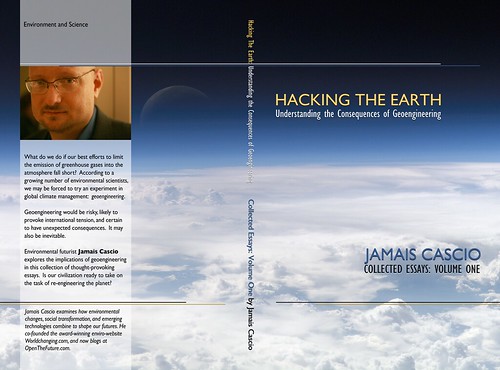
Jamis Cascio has a book of his collected essays on geoengineering out, available at Lulu.com - Hacking the Earth. Jamais also has a post up at Grist summarising the topic for those new to it - Plan B.

Today my collection of essays about geoengineering, Hacking the Earth, goes on sale. It gathers together the major pieces I've written about geoengineering, here and at Worldchanging; I've edited most of them to bring the content up to date, eliminate the bloggier aspects ("such and such just appeared at this link"), and give it a bit more flow.

This is my "have to have a book in print" stake in the ground, at least for now. It's sometimes surprising how important a print publication still is in many knowledge and analysis fields. It doesn't matter if it's widely read, it just needs to exist.

This is also an experiment in publish-on-demand. Rather than go through a traditional publisher, I'm trying out Lulu.com. This gives me a bit more control over the content, and allows me to put something about on a subject that probably won't be generating a lot of mainstream attention for another couple of years.

If you decide to buy a copy, thank you. If not, thank you, too. I'm really curious about how well this model of book publishing works, in terms of both success and failure.

I don't think I have any more geoengineering items lined up right now. Therefore, I declare Terraformingstock over for now.


Image from Flickr.

Global warming 'irreversible' for next 1000 years: study  

Posted by Big Gav in ,

The ABC has a report on a gloomy assessment of global warming from the NOAA - Global warming 'irreversible' for next 1000 years: study.

Climate change is "largely irreversible" for the next 1,000 years even if carbon dioxide (CO2) emissions could be abruptly halted, according to a new study led by the US National Oceanic and Atmospheric Administration (NOAA).

The study's authors said there was "no going back" after the report showed that changes in surface temperature, rainfall and sea level are "largely irreversible for more than 1,000 years after CO2 emissions are completely stopped."

NOAA senior scientist Susan Solomon said the study, published in this week's Proceedings of the National Academy of Sciences journal, showed that current human choices on carbon dioxide emissions are set to "irreversibly change the planet."

Researchers examined the consequences of CO2 building up beyond present-day concentrations of 385 parts per million, and then completely stopping emissions after the peak. Before the industrial age CO2 in Earth's atmosphere amounted to only 280 parts per million.

The study found that CO2 levels are irreversibly impacting climate change, which will contribute to global sea level rise and rainfall changes in certain regions. The authors emphasised that increases in CO2 that occur from 2000 to 2100 are set to "lock in" a sea level rise over the next 1,000 years.

Rising sea levels would cause "irreversible commitments to future changes in the geography of the Earth, since many coastal and island features would ultimately become submerged," the study said.

Decreases in rainfall that last for centuries can be expected to have a range of impacts, said the authors. Regional impacts include - but are not limited to - decreased human water supplies, increased fire frequency, ecosystem change and expanded deserts.

Joe Romm at Grist says maybe we should do some geoengineering research just incase, even if its not the right way to solve the problem - Collecting Dust.
Heck, I say, let's do some geo-engineering research, but let's not be deluded into thinking that pursuing research is the same thing as having any reason to believe that research will lead to anything practical or affordable -- or any more successful than the billions we have flushed down the toilet trying to build a practical and affordable hydrogen car.

If geo-engineering CO2 out of the air is plausible and affordable at a large scale, it is only after serious mitigation, to go from, say, a brief peak at 450 ppm, back to 400 ppm or lower. Going from 1,000 ppm down to below 400 ppm is not only a staggering task to imagine -- where the heck would you put the hundreds of billions of tons of carbon? -- but it would also be too late to save the ocean from becoming one large, acidic dead zone, and, in any case, we probably would have crossed carbon cycle tipping points that unleash the methane in the peatlands and permafrost.

Bottom line: A few decades of prevention is worth 1,000 years of cure misery.

Grist also has a post on another report advocating geoengineering - Sci-Fi Dreamin'?. Playing with fire if you ask me...
Massive, futuristic schemes to spur land and sea into sucking up greenhouse gases may help the fight against global warming but are no substitute for reducing the pollution itself, scientists said Wednesday.

Once dismissed as daft or dangerous, some of these "geoengineering" projects can be of use in fending off the juggernaut of climate change, but only if they go hand-in-hand with cuts in carbon emissions, they warned.

"Geoengineering" describes large-scale schemes such as erecting sunshades or mirrors in space, sowing the stratosphere with white particles or whitewashing building roofs to reflect sunlight, or scattering iron filings in the ocean to promote carbon-gobbling algae. None of these projects has been launched on any significant scale.

Green groups are deeply suspicious of them, saying the most ambitious ventures could wreck ecosystems, carry an astronomical price and postpone tough decisions on reducing emissions of fossil-fuel gases that cause the problem.

But promoters of geoengineering are now getting a closer hearing as political efforts to resolve climate change remain bogged down. They argue that geoengineering, by slightly cooling the planet, would buy time for humans to get their carbon pollution under control.

In a paper published on Wednesday in the journal Atmospheric Chemistry and Physics Discussions, researchers at Britain's University of East Anglia make the first attempt at calculating the effectiveness of these schemes. They do not analyze environmental impact, nor do they estimate the cost.

"We found that some geoengineering options could usefully complement mitigation [of emissions], and together they could cool the climate," said Tim Lenton, a professor of environmental sciences. "But geoengineering alone cannot solve the problem."

The report said:

-- To gain a quick cool by 2050, building a deflector in orbit and sowing the stratosphere with fine sulfur particles are the best bet. But they also carry "a heavy burden of risk." The particles have to be replenished, and the sunshade would need maintenance. Any breakdown would cause temperatures to rise at a stroke.

-- "Fertilizing" the ocean to boost plankton growth has chiefly long-term potential, as it would take centuries or millennia to really get up to speed.

-- Over the shorter term, it makes more sense to plant trees to soak up atmospheric carbon dioxide, and to use energy by burning biomass by pyrolysis so that its residues are returned to the soil as charcoal, a form of carbon that remains stable for centuries or millennia.

-- Painting roofs and roads white and other actions to help land surfaces reflect solar rays is of limited and local value. It could cool cities a little, but globally would be of little effect.

-- The benefits of some geoengineering schemes have been in exaggerated in the past, and calculations about their effectiveness are fraught with errors.

The study comes amid an intensifying debate among climate experts about geoengineering. In its landmark report in 2007, the UN's Intergovernmental Panel on Climate Change (IPCC) blasted geoengineering options as "largely speculative and unproven, and with the risk of unknown side-effects."

In the most controversial experiment to date, scientists aboard a German research vessel, the Polarstern, are in the Southern Ocean where they plan to carry out what they describe as a small-scale test in iron fertilization.

Germany's environment ministry has spoken out against the experiment, but the research ministry has stood by it.

Statistics

Locations of visitors to this page

blogspot visitor
Stat Counter

Total Pageviews

Ads

Books

Followers

Blog Archive

Labels

australia (619) global warming (423) solar power (397) peak oil (355) renewable energy (302) electric vehicles (250) wind power (194) ocean energy (165) csp (159) solar thermal power (145) geothermal energy (144) energy storage (142) smart grids (140) oil (139) solar pv (138) tidal power (137) coal seam gas (131) nuclear power (129) china (120) lng (117) iraq (113) geothermal power (112) green buildings (110) natural gas (110) agriculture (91) oil price (80) biofuel (78) wave power (73) smart meters (72) coal (70) uk (69) electricity grid (67) energy efficiency (64) google (58) internet (50) surveillance (50) bicycle (49) big brother (49) shale gas (49) food prices (48) tesla (46) thin film solar (42) biomimicry (40) canada (40) scotland (38) ocean power (37) politics (37) shale oil (37) new zealand (35) air transport (34) algae (34) water (34) arctic ice (33) concentrating solar power (33) saudi arabia (33) queensland (32) california (31) credit crunch (31) bioplastic (30) offshore wind power (30) population (30) cogeneration (28) geoengineering (28) batteries (26) drought (26) resource wars (26) woodside (26) censorship (25) cleantech (25) bruce sterling (24) ctl (23) limits to growth (23) carbon tax (22) economics (22) exxon (22) lithium (22) buckminster fuller (21) distributed manufacturing (21) iraq oil law (21) coal to liquids (20) indonesia (20) origin energy (20) brightsource (19) rail transport (19) ultracapacitor (19) santos (18) ausra (17) collapse (17) electric bikes (17) michael klare (17) atlantis (16) cellulosic ethanol (16) iceland (16) lithium ion batteries (16) mapping (16) ucg (16) bees (15) concentrating solar thermal power (15) ethanol (15) geodynamics (15) psychology (15) al gore (14) brazil (14) bucky fuller (14) carbon emissions (14) fertiliser (14) matthew simmons (14) ambient energy (13) biodiesel (13) investment (13) kenya (13) public transport (13) big oil (12) biochar (12) chile (12) cities (12) desertec (12) internet of things (12) otec (12) texas (12) victoria (12) antarctica (11) cradle to cradle (11) energy policy (11) hybrid car (11) terra preta (11) tinfoil (11) toyota (11) amory lovins (10) fabber (10) gazprom (10) goldman sachs (10) gtl (10) severn estuary (10) volt (10) afghanistan (9) alaska (9) biomass (9) carbon trading (9) distributed generation (9) esolar (9) four day week (9) fuel cells (9) jeremy leggett (9) methane hydrates (9) pge (9) sweden (9) arrow energy (8) bolivia (8) eroei (8) fish (8) floating offshore wind power (8) guerilla gardening (8) linc energy (8) methane (8) nanosolar (8) natural gas pipelines (8) pentland firth (8) saul griffith (8) stirling engine (8) us elections (8) western australia (8) airborne wind turbines (7) bloom energy (7) boeing (7) chp (7) climategate (7) copenhagen (7) scenario planning (7) vinod khosla (7) apocaphilia (6) ceramic fuel cells (6) cigs (6) futurism (6) jatropha (6) nigeria (6) ocean acidification (6) relocalisation (6) somalia (6) t boone pickens (6) local currencies (5) space based solar power (5) varanus island (5) garbage (4) global energy grid (4) kevin kelly (4) low temperature geothermal power (4) oled (4) tim flannery (4) v2g (4) club of rome (3) norman borlaug (2) peak oil portfolio (1)