Showing posts with label energy forecast. Show all posts

IEA Predictions Of Solar Power Capacity Growth  

Posted by Big Gav in , , , ,

Stunningly wrong, year after year...

REthinking Energy 2017: Accelerating the global energy transformation  

Posted by Big Gav in ,

IRENA has released their annual report on the transition to renewable energy - REthinking Energy 2017: Accelerating the global energy transformation (PDF report).

Renewable energy is a fundamental and growing part of the global energy transformation. Increasingly, renewables have become the first choice for expanding, upgrading and modernising power systems around the world.

REthinking Energy, the flagship report from the International Renewable Energy Agency (IRENA), examines trends and developments in the global quest for a sustainable energy future. As this third edition emphasises, accelerated deployment will fuel economic growth, create new employment opportunities, enhance human welfare and contribute to a climate-safe future.

Renewable Energy: The disruptive impact of technology  

Posted by Big Gav in , , , , ,

Nick Butler at the FT points to this paper from the Grantham Institute and Carbon Tracker on the disruption cheap renewable power and electric vehicles are starting to have on global energy markets, a process which is going to continue to accelerate - Expect the Unexpected: The Disruptive Power of Low-carbon Technology (pdf).

Butler notes of the report:

* Solar will take 23 per cent of the power generation market by 2040 and 29 per cent by 2050.
* Wind power could constitute another 12 per cent of the power market by 2050.
* Electric vehicles will account for around 35 per cent of the road transport market by 2035.
* Hydrocarbons will peak and the authors are bold enough to foresee peak oil and coal demand in 2020

EIA forecast errors for natural gas prices and production  

Posted by Big Gav in , ,

Forbes has a graphic showing the size of the errors in EIA gas production forecasts and actual values. It would be useful to have this sort of data (and some better visualisations) for all energy production forecasts (if nothing else it would bring clarity to which organisations produce useful forecasts and which don't) - Got A Favorite 2017 Energy Forecast? Technology Will Make It Obsolete.

We can take this logic to data, and, fortunately, the EIA has made this exercise easy to do. Since 1996, they have published retrospective analyses of their predictions. In this useful and under-appreciated effort, the EIA compiles 20 years of forecasts into a single report and compares those forecasts to what actually happened. The last of these analyses was published in May 2015, comparing forecasts as far back as 1994 to realized outcomes through 2013. For U.S. natural gas markets, I have extended this data (both forecasted and realized) through 2015 and characterized the forecasting error of each report year, prediction year combination as driven by unexpected shocks to supply or demand. I have plotted this data in the figure below, separating forecasts made before the start of the recent shale boom in 2005 and after.

IEA World Energy Outlook 2016  

Posted by Big Gav in , , ,

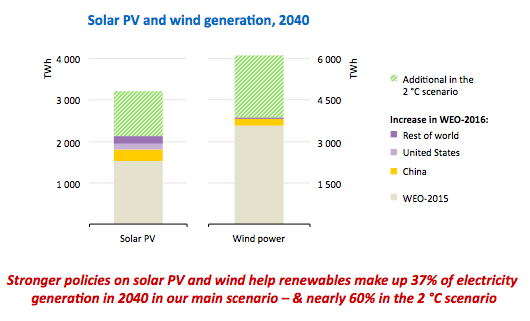
The IEA has released the 2016 version of their annual world energy outlook report - World Energy Outlook 2016.

The report has prompted a spate of articles about "peak oil demand" (with earlier reports from the Economist and WSJ being joined this week by Forbes, Bloomberg and The FT).

Other than speculation about when demand-driven peak oil production will occur, attention concentrated on:

1. Chinese coal use peaking in 2013 - China's coal use likely peaked in 2013 amid rapid shift to renewables, global energy report says (ABC).

2. Wind and solar will contribute will become the dominant source of energy in most major economies within two decades - IEA makes mockery of Turnbull’s renewable energy scare campaign (RNE).

3. Oil production from conventional non-OPEC fields and oil sands will drop by 6.1 million barrels a day by 2040 (although they still predict overall production will rise) - How Big Oil Loses Even Without Peak Demand (Bloomberg).

4. Fatih Birol says"We see clear winners for the next 25 years — natural gas but especially wind and solar — replacing the champion of the previous 25 years, coal" - Renewables & Natural Gas Win Out In World Energy Outlook, But Investors Must Not Misread Oil Demand (Cleantechnica).

5. A combination of efficiency and deployment of renewables has decoupled economic growth from carbon emissions - Massive report details the energy economy that limits warming to 2°C (Ars Technica).

IEA still low-balling solar growth, says Energy Watch Group  

Posted by Big Gav in , ,

The recent IEA medium term renewable energy report has come in for some criticism from the Energy Watch Group - - IEA still low-balling solar growth, says Energy Watch Group.

All the major energy forecasts seem to underestimate renewable energy growth. Whether or not this is do do bias in favour of legacy energy sources or simply because they don't recognise the rate at which technology is improving and prices are dropping isn't clear - it would be interesting to have a look at the trends in the under-estimations over time...

The report found that last year saw 153 GW of new renewable capacity installed, while the headline figure picked up by many leading media outlets was that 500,000 solar panels were fitted every single day in 2015. However, the Energy Watch Group (EWG) – a long-term critic of the IEA’s calculations – has reported that the IEA has once again heavily underestimated the growth of wind and solar PV.

Despite a 13% increase in the IEA’s mid-term projections, the EWG’s analysis argues that these new calculations still suggest that wind and solar installations will peak in 2015 and 2016 respectively, with the five years between now and 2021 likely to see a slowing of the growth seen these past two years.

EWG chairman Christian Breyer calls these projections misleading, and remarked that the IEA is “playing a dangerous game” in relying on assumptions that err on the side of conservatism. Rather, the EWG analysis shows, solar growth between now and 2021 is likely to far exceed the projections laid out in the IEA report. As an example, India’s plan to install 90 GW of additional PV capacity to 2022 is off-handedly dismissed, with the IEA forecasting total PV growth in the whole of Asia Pacific will amount to 85 GW by 2021. “We would like to know why the IEA assumes that this policy target in India will not be achieved,” mused Breyer. “We have found no valid arguments in the report.”

There are accusations, too, of erroneous cost assumptions in the report, with EWG claiming that the IEA has overestimated the price of solar PV in major markets for 2016 by at least 20%. For example, PV power plants in India are currently averaging a cost of around $750/kWp, argues the EWG, whereas the IEA report says that “PV prices in leading markets should not be lower than $1,150 – $1,300/kWp”. The reality is that costs are already around 35% lower than that in China and Germany, the EWG analysis argues.

IEA: Renewables largest source of installed power capacity in the world  

Posted by Big Gav in , ,

The IEA has released their Medium-Term Renewable Market Report - IEA raises its five-year renewable growth forecast as 2015 marks record year.

The International Energy Agency said today that it was significantly increasing its five-year growth forecast for renewables thanks to strong policy support in key countries and sharp cost reductions. Renewables have surpassed coal last year to become the largest source of installed power capacity in the world.

The latest edition of the IEA’s Medium-Term Renewable Market Report now sees renewables growing 13% more between 2015 and 2021 than it did in last year’s forecast, due mostly to stronger policy backing in the United States, China, India and Mexico. Over the forecast period, costs are expected to drop by a quarter in solar PV and 15 percent for onshore wind.

Last year marked a turning point for renewables. Led by wind and solar, renewables represented more than half the new power capacity around the world, reaching a record 153 Gigawatt (GW), 15% more than the previous year. Most of these gains were driven by record-level wind additions of 66 GW and solar PV additions of 49 GW.

Wind Energy Could Supply 20% Of Global Electricity By 2030  

Posted by Big Gav in , ,

Cleantechnica has a post on this year's Global Wind Energy Outlook report - Wind Energy Could Supply 20% Of Global Electricity By 2030. The main obstacle to this is probably the rise of solar power - with solar PV generation doubling every 2 years there might not be enough room left for additional wind power in 2030.

Specifically, the report outlined ways in which wind power could reach 2,110 GW by 2030, supplying up to 20% of global electricity while simultaneously creating 2.4 million new jobs, reducing carbon emissions by more than 3.3 billion tonnes per year, and attracting annual investments of €200 billion. ...

“Wind power is the most competitive option for adding new capacity to the grid in a growing number of markets,” Sawyer continued, “but if the Paris agreement targets are to be reached, that means closing fossil fuel fired power plants and replacing them with wind, solar, hydro, geothermal and biomass. That will be the hard part, and governments will have to get serious about it if they are to live up to the commitments to which they have now bound themselves.”

EIA Annual Energy Outlook: Renewable Energy Growth Blows EIA Forecasts Out of the Water, Again  

Posted by Big Gav in , ,

DeSmogBlog has a (slightly old now) post on the US Energy Information Agency's long standing habit of underestimating growth in renewable energy - Renewable Energy Growth Blows EIA Forecasts Out of the Water, Again.

Another year, another U.S. Energy Information Agency (EIA) assessment report that makes the agency's own forecasters look foolish.

In the latest Electric Power Monthly report, which covers all twelve months of 2015, the EIA revealed that renewable energy sources accounted for nearly 13.5-percent of the nation’s utility-scale electrical output. This is up by more than 2-percent over 2014. But get this: less than three months earlier, in the “Short-Term Energy Outlook,” the agency predicted “total renewables used in the electric power sector to decrease by 1.8% in 2015.”

The EIA’s record for long-term forecasts is no better. In fact, it’s consistently worse. ...

“Just a few years ago EIA had forecast that renewables might provide 15% of the nation's electricity by 2035,” said Bossong. “It now appears that goal could be reached within the next two years and quite possibly sooner!”

This isn’t the rare instance of the EIA getting something wrong. Rather, it’s something of an annual tradition. Consider these examples, taken at random (and culled from links I’ve bookmarked over the past few years under the tag, “EIA wrong”):

“In 2009, the federal government’s Energy Information Administration made a forecast for the next two decades: U.S. wind power would grow modestly, reaching 44 gigawatts of generating capacity in 2030, while solar power would remain scarce, inching up to 12 GW. Just six years later, U.S. wind capacity is already up to 66 GW, and solar has shot up to 21 GW. There's now enough installed wind and solar to power 25 million American homes— more than three times what the EIA expected before President Obama took office.” Michael Grunwald in Politico

“In 2005, EIA forecast that U.S. solar power capacity would hit about 1.2 GW in 2013. Where are we right now [in 2013]? According to Greentech Media, the U.S. is closing in (if it already hasn’t passed) the 10 GW mark in solar PV capacity right about now, and that’s not even counting solar thermal power generating capacity (according to this article, you can add another 1 GW or so of U.S. solar thermal power capacity). In sum, EIA forecast 1.2 GW of U.S. solar power capacity in 2013; the actual figure is around 11 GW – nearly 10 times higher than EIA forecast!” Former EIA employee Lowell Feld, in 2013.

“The report this year [2015] predicts that by 2040, the U. S. will have added only 48 gigawatts of solar generating capacity. The Solar Energy Industries Association (SEIA) expects that the industry will add half of that by the end of 2016. “ Samantha Page in ThinkProgress

In an update on June 2015, the EIA projected that the cheapest solar deployed in 2020 would cost $89 / mwh, after subsidies. That’s 8.9 cents / kwh to most of us. (This assumes that the solar Investment Tax Credit is not extended.)…How has that forecast worked out? Well, in Austin, Greentech Media reports that there are 1.2GW of bids for solar plants at less than $40/mwh, or 4c/kwh. And there are bids on the table for buildouts after the ITC goes away at similar prices. Ramez Naam

Statistics

Locations of visitors to this page

blogspot visitor
Stat Counter

Total Pageviews

Ads

Books

Followers

Blog Archive

Labels

australia (619) global warming (423) solar power (397) peak oil (355) renewable energy (302) electric vehicles (250) wind power (194) ocean energy (165) csp (159) solar thermal power (145) geothermal energy (144) energy storage (142) smart grids (140) oil (139) solar pv (138) tidal power (137) coal seam gas (131) nuclear power (129) china (120) lng (117) iraq (113) geothermal power (112) green buildings (110) natural gas (110) agriculture (91) oil price (80) biofuel (78) wave power (73) smart meters (72) coal (70) uk (69) electricity grid (67) energy efficiency (64) google (58) internet (50) surveillance (50) bicycle (49) big brother (49) shale gas (49) food prices (48) tesla (46) thin film solar (42) biomimicry (40) canada (40) scotland (38) ocean power (37) politics (37) shale oil (37) new zealand (35) air transport (34) algae (34) water (34) arctic ice (33) concentrating solar power (33) saudi arabia (33) queensland (32) california (31) credit crunch (31) bioplastic (30) offshore wind power (30) population (30) cogeneration (28) geoengineering (28) batteries (26) drought (26) resource wars (26) woodside (26) censorship (25) cleantech (25) bruce sterling (24) ctl (23) limits to growth (23) carbon tax (22) economics (22) exxon (22) lithium (22) buckminster fuller (21) distributed manufacturing (21) iraq oil law (21) coal to liquids (20) indonesia (20) origin energy (20) brightsource (19) rail transport (19) ultracapacitor (19) santos (18) ausra (17) collapse (17) electric bikes (17) michael klare (17) atlantis (16) cellulosic ethanol (16) iceland (16) lithium ion batteries (16) mapping (16) ucg (16) bees (15) concentrating solar thermal power (15) ethanol (15) geodynamics (15) psychology (15) al gore (14) brazil (14) bucky fuller (14) carbon emissions (14) fertiliser (14) matthew simmons (14) ambient energy (13) biodiesel (13) investment (13) kenya (13) public transport (13) big oil (12) biochar (12) chile (12) cities (12) desertec (12) internet of things (12) otec (12) texas (12) victoria (12) antarctica (11) cradle to cradle (11) energy policy (11) hybrid car (11) terra preta (11) tinfoil (11) toyota (11) amory lovins (10) fabber (10) gazprom (10) goldman sachs (10) gtl (10) severn estuary (10) volt (10) afghanistan (9) alaska (9) biomass (9) carbon trading (9) distributed generation (9) esolar (9) four day week (9) fuel cells (9) jeremy leggett (9) methane hydrates (9) pge (9) sweden (9) arrow energy (8) bolivia (8) eroei (8) fish (8) floating offshore wind power (8) guerilla gardening (8) linc energy (8) methane (8) nanosolar (8) natural gas pipelines (8) pentland firth (8) saul griffith (8) stirling engine (8) us elections (8) western australia (8) airborne wind turbines (7) bloom energy (7) boeing (7) chp (7) climategate (7) copenhagen (7) scenario planning (7) vinod khosla (7) apocaphilia (6) ceramic fuel cells (6) cigs (6) futurism (6) jatropha (6) nigeria (6) ocean acidification (6) relocalisation (6) somalia (6) t boone pickens (6) local currencies (5) space based solar power (5) varanus island (5) garbage (4) global energy grid (4) kevin kelly (4) low temperature geothermal power (4) oled (4) tim flannery (4) v2g (4) club of rome (3) norman borlaug (2) peak oil portfolio (1)