Lurker Day  

Posted by Big Gav

According to Crooked Timber it is (or was) "Lurker Day", the day where "readers who usually never make comments tell us what they like about our blog, what they don’t like, who they are etc etc. Sounds like a good idea – we have no idea who y’all are, but would like to find out."

I feel the same way - so leave a comment if you never have before and let me know what you think.

Crooked Timber also has an amusing post on the German election (which has nothing to do with peak oil).

Jeffrey Gedmin, director of the Aspen Institute in Berlin, writes a quite jawdropping reductio ad absurdum of this trope for the Financial Times.
Germans know [that they face a fundamental choice over their economy]. But they still love their “social-market” economy and have not yet decided whether allowing more market forces can be in tune with their values. Until now, it has been too easy for Germans to defer painful choices. The country has been doing – simply put – too well. In Berlin, a city with 19 per cent unemployment, the cafes are packed with people ­drinking over-priced café lattes, the employed and unemployed alike happily indulging themselves. Will economic circumstances soon hurt enough to give people the swift kick they apparently need?

I had to read this paragraph twice to be sure that my eyes weren’t deceiving me. The problem with the German economy is that it’s doing too well for people to, like, actually want the cleansing winds of free-market reforms? That the unemployed can sip their café lattes too?

Strangely enough Germany overtook the US as the world's largest exporter recently. And they are way ahead on the move to renewable energy too. Maybe the Germans could actually be doing some things right ?

Rolling Out The Blobject  

Posted by Big Gav

WorldChanging and the BBC recently took a look at a blobject manifestation in Cordoba, Spain.

Alfredo Romeo opens the door of a newly built garage just off one of Cordoba's main streets. He can hardly wait to show off the cars inside. He points to a sleek, curvy little number. "It's a wonderful car, a marvellous car," says Mr Romeo with used-car salesman relish. "It's noiseless. It's very safe. It's reliable. This model is the two-seater. I love the cars."

But Mr Romeo is not selling cars, he is renting them. And he is not talking about Porsches or Lamborghinis. Instead, he is renting Gems, or Global Electric Motorcars. Half a dozen of the vehicles are scattered throughout the garage, plugged into the mains. They are charging up for a day of work on Cordoba's busy streets. One charge is usually good for about 50 miles (80km).

Gems are made in the US by a division of Daimler-Chrysler. They have a flowing, curvilinear design reminiscent of an Apple eMac computer, or a Volkswagen Beetle. Objects with that kind of shape have picked up their own moniker - blobjects.

Alfredo Romeo has been taken with the idea of blobjects ever since he heard technology guru Bruce Sterling discuss them in a speech. "Sterling said something that I really love," says Mr Romeo. "He said, 'Blobjects are going to float our world.'"

Given that transport is by far the largest consumer of oil, dealing with oil depletion inevitably involves making transport much more efficient (or reducing our need for it). The Victorian government is backing car sharing. A slightly different approach is being tried out in Sydney called "SmartPilots" which rents out small, fuel efficient cars in central locations for use over a short period within the city.

Ford has announced plans to increase production of hybrids by a factor of 10 (starting from a very low base) by 2010.
Ford Motor Co. jumped on the hybrid car bandwagon today with a promise to boost production tenfold to 250,000 cars and trucks per year by 2010, the strongest commitment yet by a Detroit automaker to build gas-electric vehicles. Speaking in Dearborn, Mich., Bill Ford Jr., the company's chairman and chief executive, said Ford was acting without prodding from policy makers in the government. He said Ford would choose to be environmentally progressive through hybrid production and "get on with it."

Toyota is to cut prices on hybrid cars, and has announced that it may soon put hybrid engines in all vehicles in future. They have also demonstrated a strange looking concept car called the i-unit. Puegeot also have a weird looking personal mobility unit, in their case, called the "moovie".

Plenty of other car makers are jumping on the hybrid bandwagon, with Jim at The Energy Blog providing a good summary called "Is there a hybrid in your future ?".

Some reports have noted that diesel cars can be more efficient than hybrids, but this does ignore the longer term view - hybrids will eventually be able to be charged by electricity from mostly (or all) renewable sources and use a minimal amont of liquid fuel - whereas diesel engines will always run on diesel. In the meantime diesel hybrids would seem to be the best bet.

Mother Jones has an interview with Green Car Congress's Mike Milliken on "the future of the automobile in the face of global oil shortfalls, about the public's dawning awareness of global warming and the energy crunch, and about the array of promising transportation technologies that could wean us, however gradually, from our dangerous addiction to fossil fuels.".
"The global energy economy is on the brink of a fundamental and forced transformation, with enormous market opportunities for new solutions in energy and transportation." So says Mike Millikin, a former Internet consultant and now publisher of Green Car Congress, a web site dedicated to educating the public on the energy challenges -- and choices -- posed by climate change and our over-dependence on fossil fuels.

With global demand for petroleum pushing the limits of worldwide supply, most experts think the world's oil supply will peak – if it hasn't already – sometime within the next decade. What will happen as that limit nears, gas prices soar, and global competition for oil intensifies? What are the U.S. and the world doing to prepare for this looming crisis?

Finally, the best way to minimise transport related oil usage is to use public transport or ride a bike - the Brompton Bike combines both of these.
The Observer recently interviewed Andrew Ritchie, the man who invented the Brompton portable folding bike. In a previous article, we highlighted the strengths of this bicycle, giving it high marks for its compactness and overall performance. Here's an excerpt from the interview:

...Ritchie, 58, is more than just another cyclist. He is a self-confessed obsessive, someone who has devoted the past 30 years of his life to building the best portable bicycle in the world, a machine that is fun and efficient to ride but can be quickly folded into a package smaller than an average suitcase, carried up and down stairs, tucked behind a train seat or secreted under a desk.


The Triobike is another multi-purpose transportation device.
The trioBike is one very cool and exciting design. And on so many levels. Where to start? Well, it’s a normal bicycle that can convert into a pedal-powered cargo hauler, which could also safely transport 2 children, to a maximum weight of 80 kg (176 lbs). But separate the two and you still have a perfectly functional bike, and a classy push carrier. All these transitions can be accomplished without specialised tools. Imagine the possibilities: load two kids in the front carrier and ride them to school or day-care. Detach the carrier and leave it at the school. Retrieve the bikes front wheel, cleverly located under the base of the carrier and continue on riding to work.

Random Notes  

Posted by Big Gav

The IMF has warned about the hazard another oil price shock poses to the world economy. One could say this is stating the obvious.

Releasing its bi-annual World Economic Outlook overnight, the global organisation downgraded its forecasts for world economic output by 0.1 percentage points to 4.3 per cent next year, warning of "potentially serious adverse effects on the global economy" from any further "substantial" jumps. While the impact of higher prices had so far been "surprisingly moderate", this was mainly because consumers viewed the price movements as temporary. But future movements would be "less benign", the IMF argued.

A fundamental de-coupling of price movements from "long-run market fundamentals" had occurred, the IMF said, meaning oil prices were now at the mercy of unpredictable shifts in confidence about supply, rather than a steady build in demand.

"With recent oil price increases owing less to demand pressures, further price increases could have a less benign impact, especially if they had a significant effect on consumer confidence and therefore spending," it said. And furthermore, "with the market very tight and long-run futures prices increasingly poorly grounded, a substantial further jump in oil prices cannot be ruled out."

There was an almost one in six chance that benchmark crude oil could top $US80 a barrel, the IMF said, based on observations from options markets.

While many observers are looking for prices to remain high, not all of the oil companies are convinced, according to this report from the International Herald Tribune (via Rigzone). The article also takes a brief look at the propsects for tar sands and heavy oil in Canada and Venezuela. Stuart at The Oil Drum also has a post up on "low quality hydro-carbons" (I've cast a jaundiced eye over tar sands, shale and coal-to-liquids in the past).
High prices are changing the economics of marginal oil developments; but oil companies are not betting the prices will last.

With benchmark prices topping $70 a barrel on Aug. 30, and contracts for future delivery holding above $60, the companies are looking again at projects demanding expensive technology and secondary recovery techniques, and at unconventional reserves in Canada and Venezuela. Investment in Canadian oil sands and shale projects topped $6 billion in 2004, while production of extra-heavy crude from Venezuela's Orinoco belt has risen 20 percent in two years. But, while some analysts say high prices are here to stay, and most industry observers expect them to hold at least into 2006, most major oil companies are still basing their long-term plans on an assumption that supply and demand will eventually return prices to historic average levels, said Yasser Elguindi, an industry specialist and senior managing director of Medley Global Advisors, based in New York.

"Oil companies still are not sure that a paradigm shift has occurred in the oil market and are still conservatively pricing a $20 to $30 long-term oil price," Elguindi said in a telephone interview last week.

Royal Dutch Shell is a case in point. "With a $15 billion per year investment program and upward pressures on price and costs, Shell plans for medium term cash neutrality at around $25 per barrel," the company said in its most recent strategy review. At that level, oil from the Persian Gulf, costing $2 to $4 per barrel to produce and accounting for more than 60 percent of global proven reserves, would still be profitable. Unconventional reserves would be far less so. Middle East producers, not surprisingly, are hastening to bring new oil into production.

...

Although usually excluded from the global tally, Canada's sands reserves are impressive. According to the producers' association they contain 315 billion barrels of potential crude bitumen, of which 174 billion barrels are in areas under active development. For comparison, oil reserves in the Middle East total 727 billion barrels.

In Venezuela's Orinoco belt, extra-heavy crude, which is heavier than water and nonfluid in normal conditions, has been under development since the 1980s. Four joint ventures between the state oil company, Petroleos de Venezuela, and foreign partners now extract 600,000 barrels a day of extra-heavy crude and upgrade it into a synthetic light crude that can be marketed and refined internationally. Yet, the technical challenges mean that in both Canada and Venezuela the investment is higher, and must be sustained for longer, than in conventional crude oil developments. Indirect costs may be higher too.

"Investors tend to analyze unconventional oil projects in isolation, but the reality is that there are associated infrastructure development costs that must be factored into the price," Elguindi, of Medley, said.

These costs may be calculable. The future oil price is not. The difference will determine how fast unconventional resources are developed. "While we do not believe that oil prices will stay at $70 for the long term, we must certainly also believe that the long term price is no longer $25," Elguindi said.

The NRMA is asking for the ACCC to be able to control petrol prices. They also note that high prices are likely to be here for good, regardless of opportunistic rises in refiner margins.
Today's summit will include representatives from federal and state governments as well as business, motoring, farming and consumer groups. However, the four big oil companies - Caltex, Shell, BP and ExxonMobil - have refused to attend. The NRMA will push for a fresh inquiry by the Australian Competition and Consumer Commission to examine the pricing practices of oil companies. "The refiners have been engaging in some opportunistic profiteering and they should be required to pull their horns in," Mr Evans said.

The motoring organisation, which has more than 2 million members, will also propose tax incentives for the development and use of alternative fuels as well as state government subsidies to reduce prices. A new poll by the NRMA found 70 per cent of motorists wanted more regulation of oil firms and less than one in four motorists blamed service stations for high fuel costs.

An NRMA summit discussion paper said the price of petrol was likely to "settle around $1.20 per litre, but will be prone to price shocks caused by events such as hurricane damage, large-scale industrial accidents, and terrorism attacks". The paper said the rising price of fuel had "massive implications" for the Australian economy and would affect the whole community.

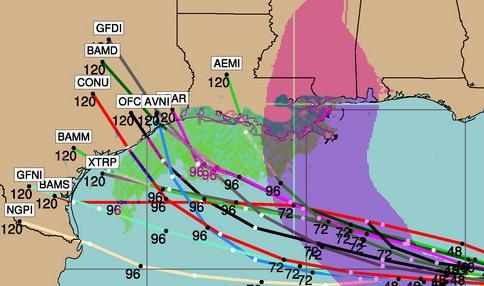
Hurricane Rita is looking very ominous for those in Texas now - The Oil Drum, Rigzone and WorldChanging have commentary and, on the first two, regular updates. Stuart at TOD also has a note on the linkage between global warming and hurricane strength. I hope my regular readers in Texas all come through unscathed - good luck guys.

Mike Ruppert has a characteristically alarming analysis of the fallout in the wake of Rita. I'm surprised it wasn't called "The Wind, It Has Begun".
A Bloomberg article today contains a quotation from a Wall Street energy expert as saying, “‘Rita is developing into our worst-case scenario,’ said John Kilduff, vice president of risk management at Fimat USA in New York. ‘This is headed right into our other major refining center just after all the damage done to facilities in Louisiana. From an energy perspective it doesn't get any worse than this.’”

The Chairman of Valero Energy agrees with the Bloomberg assessment calling Rita a potentially national disaster. His opinion is important because Valero operates more refineries in the US than any other company.

CNN is now predicting $5 per gallon gasoline and this will not likely go away with market manipulations. We had not yet experienced the permanent spikes resulting from Katrina, and the emergency reserves of the United States’ Strategic Petroleum Reserve and the International Energy Agency have already been tapped once and not refilled.

The South Texas Project nuclear plant – one of the largest in the country – is being completely shut down in preparation for Rita’s landfall. It is only 12 miles from the Texas coast and almost dead center in the hurricane’s projected path. Texas has its own power grid but catastrophic electricity shortages could easily ripple throughout the country in a short time. Electricity lost from that that facility will only be added to what is lost from other facilities powered by now critically short supplies of natural gas.

For those of you who expect FEMA to behave any differently in Texas than it did in New Orleans you are in for a crude awakening. FEMA will do what it must now do to preserve even a functioning part of America’s governing and economic infrastructure. Saving lives will be one of the least important functions in its mandate. While I had serious doubts about America’s ability to recover from Katrina, I am certain that – barring divine intervention – the United States is finished; not only as a superpower, but possibly even as a single, unified nation with the arrival of Hurricane Rita.

Woodside is reporting the Chinguetti project off Mauritania is on schedule and will be producing from February 2006 (as did Hardman in their results briefing yesterday). They have also continued drilling the nearby Tevet prospect.


Japan says China is pumping oil and/or gas from the East China Sea. China agrees and says it is happy to discuss this with Japan. Both sides seem to be saying that Chinese drilling is on China's side of the maritime border, albeit near a disputed area, so I'm not sure why the Japanese are making so much fuss about it.

WorldChanging has an introductory article on biodiesel.
let's say you do have a diesel car, live where it's still relatively warm, and want to give this whole biodiesel thing a try. While some truck stops may have biodiesel/petrodiesel mixes available (usually "B5," 5% bio, or "B20," 20% bio), most biodiesel aficionados actually make it themselves. And that remains one serious advantage of biodiesel: it's the only fuel for your car you can make at home in the kitchen.

Instructions for making biodiesel at home aren't too hard to find online, but one of the better recipes comes from a site that's rapidly becoming one of my favorites: inhabitat, a site which mixes innovation, design and sustainability. Inhabitat writer Sarah Rich gives a detailed DIY guide for "brewing biodiesel," using a process that she uses herself. It's a good mix of science and straightforward step-by-step instructions, and makes me long for an as-yet-unavailable diesel hybrid.

WorldChanging also has a post on a conference on CO2.
Through September 29, researchers will present papers on issues such as the future of long-term energy demand, uses of atmospheric sampling, the value of autonomous underwater vehicles for monitoring the ocean, the carbon cycle in Africa, comparisons of climate/carbon models and actual atmospheric measurements, and crafting an effective response to CO2 build-up. (The links here go to abstracts; the proceedings will be available on the ICDC7 website once the event begins.)

Expect some real news to come out of this conference, and expect that the mainstream media in the US will be picking up more of it than they might otherwise (the BBC is likely to have substantive coverage, as well, but this is just the sort of thing they tend to follow closely). Katrina -- and now Rita -- has sensitized the America press to the risks arising from intense weather events. Given the increasingly clear connection between hurricane strength and a warming climate, news about what we can expect from -- and what we can do about -- global warming is likely to draw some attention.

Energy Bulletin has an article on the continuing shortage of solar panels (due to rising demand in all sorts of places). LJ notes this has been going on for some time now.

Finally, the beginnings of a bird flu epidemic may have appeared in Indonesia.

Its been quite a day out there.

Angry Asari  

Posted by Big Gav

I mentioned the Asari militia in Nigeria a while ago - it seems their leader has been arrested and that interruptions to the flow of oil from Nigeria are now being threatened.

I imagine if this happens and there is major damage to oil infrastructure in the Gulf of Mexico from Hurricane Rita then we'll be in for another big spike in the oil price.

A militia with a history of violence in Nigeria's oil-rich south threatened to blow up oil installations if the government did not release its leader, after he was reportedly arrested Tuesday.

Dozens of soldiers and police arrested Moujahid Dokubo-Asari, the main militia leader in Nigeria's south, at his office in the oil city of Port Harcourt, said his lawyer Uche Okwukwu. Nigeria's police spokesman could not immediately be reached for comment.

Dokubo-Asari's deputy in the Niger Delta People's Volunteer Force, Alali Horsefall, said that if the government "doesn't release my president within 24 hours, they will see danger." He said he would "blow up oil installations" if Dokubo-Asari was not released by 2 p.m. local time (1300 GMT) and warned foreign oil workers to leave the area.

Nigeria is the world's eighth largest oil exporter, and the fifth main supplier to the United States. Last year, threats by Dokubo-Asari to unleash a "full-scale war" and target international oil firms helped send world oil prices to then-record levels.

Iraq's Missing Sea Of OIl  

Posted by Big Gav

Iraqi oil is a subject I always find fascinating, and Michael Klare is one of the best writers around on oil politics, so this article is a good combination. It doesn't touch on the great lost (black) gold of the western desert mystery, but hey, can't have everything.

We're guaranteed to see more Pentagon planning and war gaming based on the control of world energy supplies, not to speak of more and ever better military bases planted in far-flung, oil-rich areas of the world. So it's important, as Klare does, to take stock of what actually happened to Iraqi oil and the dreams of global dominance that went with it.

Energy is a strange thing to control militarily. As Iraq showed and Katrina reminded us recently, its flow is remarkably vulnerable, whether to insurgents, terrorists, or hurricanes. It's next to impossible to guard hundreds, not to say thousands, of miles of oil or natural gas pipelines. It's all very well to occupy a country, set up your "enduring camps," and imagine yourself controlling the key energy spigots of the globe, but doing so is another matter. (As the saying went in a previous military age, you can't mine coal with bayonets.) In the case of Iraq, one could simply say that the military conquest and occupation of the country essentially drove Iraq's oil deeper underground and beyond anyone's grasp. Hence, the signs should indeed say: "BLOOD FOR NO OIL." It's the perfect sorry slogan for a sad, brainless war; and even the Pentagon's resource-war planners might consider it a lesson worthy of further study as they think about our energy future.

In the introduction, Tom mentions the fabled "arc of instability".
Forget the fact that a number of the major players in the Bush administration came out of the energy business; that Condoleezza Rice, the national security advisor, had had an oil tanker named after her (when she was still on Chevron's board of directors); that the neocons and their supporters evinced a special interest in the oil heartlands of our planet (a.k.a. "the arc of instability"); or that the Pentagon was staking those heartlands out, base by base.

This arc (or the "gap", as it is known elsewhere) is a concept that has been surfacing quite a lot lately. Mobjectivist described a sighting a little while back, but the view was a bit foggy so the significance of it was lost.


This arc (or gap, or cone) has been around for quite a while, and a cynic may be tempted to believe it exists for a reason. George Orwell, for example, described the gap in 1984 - it has a touch of post World War II thinking, but the essential point is that the arc / gap / cone is an area that is exploited by the 3 main industrial powers, rather than having any control over its own destiny:
All of the disputed territories contain valuable minerals, and some of them yield important vegetable products such as rubber which in colder climates it is necessary to synthesize by comparatively expensive methods. But above all they contain a bottomless reserve of cheap labour. Whichever power controls equatorial Africa, or the countries of the Middle East, or Southern India, or the Indonesian Archipelago, disposes also of the bodies of scores or hundreds of millions of ill-paid and hard-working coolies. The inhabitants of these areas, reduced more or less openly to the status of slaves, pass continually from conqueror to conqueror, and are expended like so much coal or oil in the race to turn out more armaments, to capture more territory, to control more labour power, to turn out more armaments, to capture more territory, and so on indefinitely. It should be noted that the fighting never really moves beyond the edges of the disputed areas. The frontiers of Eurasia flow back and forth between the basin of the Congo and the northern shore of the Mediterranean; the islands of the Indian Ocean and the Pacific are constantly being captured and recaptured by Oceania or by Eastasia; in Mongolia the dividing line between Eurasia and Eastasia is never stable; round the Pole all three powers lay claim to enormous territories which in fact are largely unihabited and unexplored: but the balance of power always remains roughly even, and the territory which forms the heartland of each super-state always remains inviolate. Moreover, the labour of the exploited peoples round the Equator is not really necessary to the world's economy. They add nothing to the wealth of the world, since whatever they produce is used for purposes of war, and the object of waging a war is always to be in a better position in which to wage another war. By their labour the slave populations allow the tempo of continuous warfare to be speeded up. But if they did not exist, the structure of world society, and the process by which it maintains itself, would not be essentially different.

The modern day guru of the gap is Thomas Barnett of the U.S. Naval War College - WorldChanging had an interview with him a while back which irritated me quite a bit, given the large dose of American exceptionalism it embodied, but it does give a different perspective on the subject (even if I don't agree with it).
Alex Steffen: What do you mean when you talk about "the Gap" and "the Core?"

Thomas P.M. Barnett: Let me back up and explain how I got here.

A few years ago, I was doing some simple mapping of where we sent US military forces since the end of the Cold War. We sent soldiers into conflicts almost 150 times, seemingly around the planet, but when you actually plot it out, you realize it's clustered, rather significantly, in a series of regions.

When I drew a line around those regions on the globe, I realized there were certain things about those regions that were similar, and in a burst of bold data-free research I realized there was a pattern: when you look at the area where we've committed our forces, you're seeing the parts of the world that are least connected to the global economy. And I realized the shape I was staring at I'd seen in many, many forms: biodiversity loss, poor soil quality, where the most fundamentalist versions of religions are, where there're no fiber optic cable, where there are no doctors.

And I wanted to describe this split without using a term -- like North and South, say -- which resurrects a whole bunch of old arguments. So I just tried to describe it plainly, calling the connected parts of the world the Functioning Core of Globalization (or the Core)

Across that Core I see integrating economies, the regular and peaceful rotation of leadership, and no real mass violence. All the countries that the Pentagon's been planning for a big war with are all in the Core, but oddly enough, these are all the countries that come to our aid after 9-11, and the countries that find commonality in a struggle against global terrorism.

Meanwhile, when I look at the other areas, what I call the Non-Integrating Gap (or the Gap), I see almost all the negative situations we've faced since the end of the Cold War. Virtually all of Africa, the Middle East, the Caribbean Rim and Andean portion of South America, the Caucauses, Balkans, Central Asia and much of Southeast Asia: in that Gap I found virtually all the wars, civil wars, ethnic cleansings, genocide, use of mass rape as a tool of terror, children forced or lured into combat activities,virtually all the drug exports, all the UN peacekeeping missions and almost 100% of the terrorist groups we're fighting.

It's a simplistic map, of course, but the match-up is profound: show me where globalization and connectivity are thick and I'll show you people living in peace. Show me where globalization hasn't spread, and I'll show you violence and chaos.

In a way, this sort of thinking almost makes some of the theories about the "New World Order" make sense.

A World Turned Upside Down  

Posted by Big Gav

George Monbiot takes a look at the latest twist in global warming politics (along with the unfortunate developments in global warming itself) - corporations trying to get governments to do something about the problem, reversing the usual situation where the likes of Exxon try very hard to achieve the opposite effect.

The insurance industry is one that has a lot of incentive to do something about the problem, and to a certain extent they have been fairly vocal about this (Insurance Australia Group's support with the WWF to produce a report on how to reduce the effects of global warming on Australia being one example). They will inevitably begin to make other businesses aware of the problem, as they start to incorporate future damage costs into premiums.

I do sometimes wonder "what if" the risk management industry (Warren Buffett and Berkshire Hathaway for example) had achieved the ultimate form of regulatory capture instead of the oil and military-industrial complex industries ? Maybe we'd be paying carbon taxes instead of occupying Iraq.

Climate change denial has gone through four stages. First the fossil fuel lobbyists told us that global warming was a myth. Then they agreed that it was happening, but insisted it was a good thing: we could grow wine in the Pennines and take Mediterranean holidays in Skegness. Then they admitted that the bad effects outweighed the good ones, but claimed that it would cost more to tackle than to tolerate. Now they have reached stage 4. They concede that it would be cheaper to address than to neglect, but maintain that it’s now too late. This is their most persuasive argument.

Today the climatologists at the Snow and Ice Data Centre in Colorado will publish the results of the latest satellite survey of Arctic sea ice. It looks as if this month’s coverage will be the lowest ever recorded. The Arctic, they warn, could already have reached tipping point: the moment beyond which the warming becomes irreversible. As ice disappears, the surface of the sea becomes darker, absorbing more heat. Less ice forms, so the sea becomes darker still, and so it goes on.

Last month, New Scientist reported that something similar is happening in Siberia. For the first time on record, the permafrost of western Siberia is melting. As it does so, it releases the methane stored in the peat. Methane has 20 times the greenhouse warming effect of carbon dioxide. The more gas the peat releases, the warmer the world becomes, and the more the permafrost melts.

Two weeks ago, scientists at Cranfield University discovered that the soils in the UK have been losing the carbon they contain: as temperatures rise, the decomposition of organic matter accelarates, which causes more warming, which causes more decomposition. Already the soil in this country has released enough carbon dioxide to counteract the emissions cuts we have made since 1990.

These are examples of positive feedback: self-reinforcing effects which, once started, are hard to stop. They are kicking in long before they were supposed to.

...

So why won’t the government act? Because it is siding with the dirty companies against the clean ones. Deregulation has become the test of its manhood: the sign that it has put the bad old days of economic planning behind it. Sir David Arculus, the man appointed by Blair to run the government’s Better Regulation Task Force, is also deputy chairman of the Confederation of British Industry, the shrillest exponents of the need to put the market ahead of society. It is hard to think of a more blatant conflict of interest.

I don’t believe it is yet too late to minimise climate change. Most of the evidence suggests we could still stop the ecosystem from melting down, but only by cutting greenhouse gases by around 80% by 2030. I’m working on a book showing how this can be done, technically and politically. But it has now become clear to me that the obstacle is not the market but the government, waving a dog-eared treatise which proves some point in a debate the rest of the world has forgotten.

Into The Gloom  

Posted by Big Gav

Neanderthal talk show host Alan Jones (very loosely equivalent to Rush Limbaugh in the northern mirror-world I suppose) has a "2 minutes of hate" style spot (limited to thirty seconds fortunately) on the morning TV news show here. While I can't actually handle watching him any more, apparently this morning he was having one of his rare lucid moments and devoted his high speed rant to denouncing attempts to reduce fuel taxes and said high prices are neccessary to push people onto public transport as we won't be able to deplete a finite resource at the present rate forever.

An NRMA spokesman was on later in the morning when I was watching still pushing the fuel summit idea, and made a point of noting that margins for petrol refiners have tripled in recent months. I foresee the phrases "price gouging" and "windfall taxes" becoming more commonly used in future.

Peter Costello has announced that a planned increase in the fuel excise won't be proceeding after last nights US$4 per barrel jump in oil prices (I'm glad our tax policy is adjusted on a daily basis to cope with the effects of the weather in the Gulf of Mexico - I'm sure it adds to the "certainty" Liberal politicians are so keen to provide).

"The main driver today is Tropical Storm Rita. We really can't afford to lose more production," said Phil Flynn, analyst at Alaron Trading Corporation in Chicago.

Long-range forecasts showed the system moving into the Gulf of Mexico late in the week as a hurricane, then possibly approaching Mexico or Texas. But forecasters warned those across the US southern coast, which is still recovering from the impact of Hurricane Katrina, that long-term predictions are subject to large errors.

If Rita strikes Texas, the biggest oil refiner in the country, it could spell serious disruption to the industry. Texas has 26 petroleum refineries, most of which are located along the coast, with the capacity to pump 4.6 million barrels a day. That's more than a quarter of the US total refining capacity, according to the US Department of Energy.

Chevron Corp and Shell Oil began evacuating workers from offshore oil and gas platforms and drilling rigs in the Gulf on Monday. A total of five rigs were evacuated on Monday, up from two last week, according to MMS.

Natural gas futures also soared Monday, rising $US1.519 to settle at a new high of $US12.663 per million British thermal units.


There are reports from Montana that representatives from SASOL have visited to discuss setting up a coal to liquids plant. TreeHugger had some comments on this recently which I don't think I've linked to previously.

Jerome at DKos has a post on an IEA report on the need to begin conservation and efficiency efforts before we pass over the peak, which includes the following colourful quote:
Oil is like a girlfriend. You know that she will leave you at some point in the future. To avoid a heartbreak, you should leave her behind!

No sooner had I'd opened my big mouth and said that its unfair for Jamais at WorldChanging to characterise the peak oil world as apocaphiliacs, the two most influential daily news sites (Energy Bulletin and The Oil Drum) have gone and posted David "Malthus Was An Optimist" Delaney's latest article on "What to do in a failing civilisation". I know this sort of speculation does have a morbid thrill to it (and almost makes Kunstler look like an optimist), but I'm not sure endlessly dwelling on the Dieoff meme is good for anyone's state of mind. Warning people of possible disaster in the future should be balanced with at least a little hint that there are things that can (or must) be done to avoid this fate, otherwise you might as well just sell up and go and find a nice beach to sit on while you wait for the world to end.

More gloom can be found at Ran Prieur (which includes the great word "collapsist") and Culture Change if you'd like to do some wallowing.

The news from Iraq is continuiung to be horrible, though I haven't been tracking it closely. The TV news this morning showed a mob stoning and petol bombing a British armoured vehicle in Basra, and this report in the Herald would seem to indicate that some unpleasant stuff is going on (no surprise really). The story is a bit murky but, if true, it does seem a little unusual that British troops in Arab dress are shooting at Iraqi police. I imagine your more suspicious type of person could draw the conclusion that civil war is being actively encouraged.
British troops battered down the main doors of Basra's criminal police headquarters and freed two British soldiers detained while on an intelligence mission. The operation, in which the troops reportedly rammed the doors of the building with a vehicle, followed a shooting and riots in which two British armoured vehicles were torched as their crews fled for safety.

An Iraqi defence ministry source indicated that 150 prisoners had fled the police headquarters after the British rammed down the door. "A large force of British troops surrounded the police building, smashed down the main entrance with a vehicle, and freed the two Britons along with 150 prisoners," the source said.

Britain denied the reports that its troops stormed the prison saying the pair were released after negotiations. "We've heard nothing to suggest we stormed the prison," a defence ministry spokesman in London said. "We understand there were negotiations."

An Iraqi interior ministry official earlier said British tanks smashed into a prison in Basra to free two undercover British soldiers seized yesterday by Iraqi forces. The official said British troops using half a dozen "tanks" stormed the jail, allowing dozens of Iraqi prisoners to escape during the raid.

Police in the southern Iraqi city said the men, who were wearing Arab dress, were detained after they opened fire on Iraqi police. An Iraqi interior ministry official said British forces had phoned the ministry in Baghdad to say the two detained soldiers were involved in "an intelligence mission".


Both Past Peak and Middle Earth Journal have posts on the truly staggering amount of corruption going on within the US administered reconstruction and arms purchasing bureaucracies within Iraq. I'm not sure its fair to call Bush, Cheney and Rumsfeld incompetent when they've taken the art of corruption to heights (or depths) probably never before seen on the planet.

Doug Casey also has an interesting article on post-peak collapse up at Casey research, which, amongst other things, takes a look at the book "The 4th Turning". I've seen this referred to by a number of objectionable writers lately, who basically say that the new "hero" generation are going to win the coming war against "Islamofascism" (and anyone else who happens to have their hands on a decent amount of oil) - though the members of this generation may not really understand what they are in for.

One of the more startling items I've come across this week was a post on an energy discussion group which included Chapter 6 ("War Propaganda") of Hitler's "Mein Kampf", which the poster thought might be enlightening in view of the "30 year war" Dick Cheney says we are in, and the fairly incessant stream of propaganda we're being bathed in as a result of this.

I've never read anything by the 20th century's number one right-wing nutjob before, but the section quoted was actually quite informative (albeit tediously long winded) so I'll quote a few bits below which don't contain any anti-semitic nonsense (which regular readers may regard as sinking to a new low - so I'll note that I'm including this for an insight into how some people think, which you may wish to extrapolate into a post-peak world where the energy short masses could be getting a bit angry - Jay Hanson has done this before of course, but I suspect lots of people who are new to peak oil haven't had the dubious pleasure of digesting all of Jay's work).

Hitler seemed to greatly admire the British propaganda effort in World War I (all those stories about Huns bayoneting babies and the like which should be familiar to anyone who has read any World War I history) and partly blamed Germany's defeat on their much less effective campaign to whip the masses into a foaming lather. You can see where Karl Rove's playbook comes from (and I suspect Orwell learned a bit from it as well).
The art of propaganda lies in understanding the emotional ideas of the great masses and finding, through a psychologically correct form, the way to the attention and thence to the heart of the broad masses. The fact that our bright boys do not understand this merely shows how mentally lazy and conceited they are.

Once we understand how necessary it is for propaganda to be adjusted to the broad mass, the following rule results:

The receptivity of the great masses is very limited, their intelligence is small, but their power of forgetting is enormous. In consequence of these facts, all effective propaganda must be limited to a very few points and must harp on these in slogans until the last member of the public understands what you want him to understand by your slogan. As soon as you sacrifice this slogan and try to be many-sided, the effect will piddle away, for the crowd can neither digest nor retain the material offered. In this way the result is weakened and in the end entirely cancelled out.

Thus we see that propaganda must follow a simple line and correspondingly the basic tactics must be psychologically sound. For instance, it was absolutely wrong to make the enemy ridiculous, as the Austrian and German comic papers did. It was absolutely wrong because actual contact with an enemy soldier was bound to arouse an entirely different conviction, and the results were devastating; for now the German soldier, under the direct impression of the enemy's resistance, felt himself swindled by his propaganda service. His desire to fight, or even to stand firm, was not strengthened, but the opposite occurred. His courage flagged.

By contrast, the war propaganda of the English and Americans was psychologically sound. By representing the Germans to their own people as barbarians and Huns, they prepared the individual soldier for the terrors of war, and thus helped to preserve him from disappointments. After this, the most terrible weapon that was used against him seemed only to confirm what his propagandists had told him; it likewise reinforced his faith in the truth of his government's assertions, while on the other hand it increased his rage and hatred against the vile enemy. For the cruel effects of the weapon, whose use by the enemy he now came to know, gradually came to confirm for him the 'Hunnish' brutality of the barbarous enemy, which he had heard all about; and it never dawned on him for a moment that his own weapons possibly, if not probably, might be even more terrible in their effects.

...

"Numerically, the first group is by far the largest. It consists of the great mass of the people and consequently represents the simplest-minded part of the nation. It cannot be listed in terms of professions, but at most in general degrees of intelligence. To it belong all those who have neither been born nor trained to think
independently, and who partly from incapacity and partly from incompetence believe everything that is set before them in black and white. They are not able or willing themselves to examine what is set before them, and as a result their whole attitude toward all the problems of the day can be reduced almost exclusively to the outside influence of others.

The second group is much smaller in number. It is partly composed of elements which previously belonged to the first group, but after long and bitter disappointments shifted to the opposite and no longer believe anything that comes before their eyes in print. They hate every newspaper; either they don't read it at all, or without
exception fly into a rage over the contents, since in their opinion they consist only of lies and falsehoods. These people are very hard to handle, since they are suspicious even in the face of the truth. Consequently, they are lost for all positive, political work.

The third group, finally, is by far the smallest; it consists of the minds with real mental subtlety, whom natural gifts and education have taught to think independently, who try to form their own judgment on all things, and who subject everything they read to a thorough examination and further development of their own. They will not look at a newspaper without always collaborating in their minds, and the writer has no easy time of it. Journalists love such readers with the greatest reserve.

For the members of this third group, it must be admitted, the nonsense that newspaper scribblers can put down is not very dangerous or even very important. Most of them in the course of their lives have learned to regard every journalist as a rascal on principle, who tells the truth only once in a blue moon. Unfortunately, however, the importance of these splendid people lies only in their intelligence and not in their number - a misfortune at a time when wisdom is nothing and the majority is everything! Today, when the ballot of the masses decides, the chief weight lies with the most numerous group, and this is the first: the mob of the simple or credulous."

This week's conspiracy theory (assuming the stuff above doesn't count) is from Jeff Rense - prophesying a "Harvest Moon" attack on Iran. While there is no shortage of paranoia and the paranoid in there (RenseWorld often seems to intersect with the genuine, original tinfoil hat organisation), the war drums are still beating in the background, and the neocons must be in something of a frenzy trying to prevent the Iranian Oil Bourse starting up early next year.

On a more reality based note, Jeff Vail has a quote from Wayne Madsen up, continuing his theme on US efforts to foment revolution in Iran, particularly amongst the Ahwaz in Khuzestan.

Random Notes  

Posted by Big Gav

As any well trained economist could predict, new innovations are occurring due to high petrol prices - notably in the art of petrol stealing, with today's Herald reporting on a "Petrol theft case: giant fuel tank found in van".

The days of centralised wage bargaining here are just about gone (and for some of us they never existed at all) - but it seems right that petrol will be one of the factors included in the ACTU wage claim.

The NRMA is still trying to get the Federal Government to show up to a summit on petrol prices.

Australia's largest motoring organisation has urged the federal government to join its emergency summit this week to try to rein in the inflationary impact of skyrocketing fuel costs. NRMA director Gary Punch says the entire country is already being affected because of the multiplier effect of price hikes and the federal government must contribute to the debate.

"Things are desperate," he said. "The road transport industries are already saying exorbitant petrol prices are going to flow through to groceries and supermarket shelves. You are going to feel it at the grocery counter, you're going to feel it at the store where you buy general merchandise, and you're going to feel it in your general services charges. This is going to have a major inflationary impact on our community and it's hurting the people who can afford it the least."

As one of the perks of being a federal politician is a government car plus chauffeur most of them may not have noticed, having been distrated by all the kerfuffle over Mr Latham's diaries. I've never voted Labor but I quite liked Iron Mark towards the end of his career and I'm probably one of the few who thoroughly approves of his trashing of all and sundry. His thoughts on the US alliance are pretty worthy at the least.
Australia should follow the example of New Zealand which had made itself the safest country on earth through distancing itself from the United States, former opposition leader Mark Latham said.

Speaking ahead of the long-awaited launch of his diary, Mr Latham said he reached the conclusion that Australia needed to renegotiate the alliance with the US after dining with then US Ambassador Thomas Schieffer, who he referred to in his diary as Brains ("Schieffer brains").

"We should have a look at how New Zealand has made itself the safest country in the world," he told ABC radio. "There is no terrorist threat to New Zealand that has been identified but (there is) one here. If you go supporting bad American policy you make yourself a bigger target and you stir dissent in your own country," he said. "If the Americans continue with Bush's policies they will never win the war against terror. They are bogged down in this for the rest of our lifetime.

"If Iraq is an example of how they are going about their work, they are never going to win that. They are just going to maximise dissent and aggression against them and nations that join in bad foreign policy as a neo-colonial partner of the US are obviously going to run into a lot of strife.

Labor has slightly redeemed itself by trying to mitigate our "Patriot Act Lite" abandonment of traditional freedoms, by trying to force the inclusion of a sunset clause in the new "detention without charge" proposals.

Moving back to oil related news, the Herald has a report on rising Australian oil exports (which ignores the fact that we are a net oil importer).
Soaring demand will push up Australian oil exports to $9 billion this financial year, the nation's chief commodities forecaster said.

The Australian Bureau of Agricultural and Resource Economics, in its latest commodities report, said crude oil production in Australia would grow seven per cent to 26.1 gigalitres. Of that, around 18 gigalitres will be sent to overseas markets, reaping $9 billion - an increase of 43 per cent.

But in a sign of the falling levels of oil production in Australia, total exports will be 25 per cent lower than they were at the start of the century when 24 gigalitres of oil were overseas. The bureau said this year's increase in production would come from key West Australian fields.

"This forecast increase largely reflects the ramping up of production from the Mutineer/Exeter field and smaller contributions from the Basker and Manter and Cliff Head developments in the second half of 2005-06," it said. "With close proximity to Asian markets, it is assumed that additional production from Mutineer/Exeter and Cliff Head will be exported, while production from Basker and Manter (Gippsland basin) is assumed to be consumed domestically."

The bureau is tipping the world trade weighted average price of oil to come back from the current $US63 a barrel to a shade under $US52 a barrel.

One energy source we do have a large trade surplus in is coal, with revenue continuing to soar.

The natural gas pipeline from Papua New guinea continues to get closer to be a reality, with aluminium producer Comalco being the latest to sign up.
Participants in the $US3 billion-plus ($A3.94 billion) Papua New Guinea-Australia gas pipeline project have struck an agreement with Comalco Ltd to sell it gas for use at facilities at Gladstone and Weipa in Queensland.

A conditional agreement reached with the aluminium producer covers the direct sale of 14 to 50.5 petajoules per annum over 20 years and supercedes a deal with Energex announced in July 2003, under which gas was on sold to Comalco.

ExxonMobil Corp, whose subsidiary Esso Highlands Ltd operates the PNG gas project's facilities and infrastructure in PNG and markets the gas in Australia, said the new agreement did not involve any new volumes of gas. But ExxonMobil said the PNG gas project was pleased that Comalco had committed to taking a substantial quantity of natural gas.

India has announced plans to build an oil refinery in Nigeria.

China is going to spend US$240 billion on rail projects by 2015. Rail projects here are few and far between - the Greens in NSW are fighting to keep one disused rail corridor reserved for future rail transport rather than having it parcelled up for property development.

In a rather black piece of irony fuel shortages are restricting UN food airdrops to people in southern Sudan, who have been displaced in the ongoing civil (oil) war. Further south, shortages of diesel are biting in Uganda. Zambia is also suffering diesel shortages.


Weekend Roundup  

Posted by Big Gav

The Herald has a good article this weekend called "Energy To Burn", which includes some revealing quotes from the liberator of the Northern Territory's uranium, Ian McFarlane. Energy Bulletin notes "The reporter seems to be getting it, even if the Federal government isn't; that last quote from the Federal Minister Macfarlane is priceless". The solution to running out of oil ? Finding more oil !

The noise over high fuel costs, dirtier air and a trade deficit blowout is getting louder. But the people who matter don't seem to be listening, writes Christopher Kremmer.

This week the Government stonewalled public concern about high fuel costs, its belief in market forces transcending its populism. Even those who agree that cutting fuel excise is not the answer say there's a lot the Government should be doing but isn't.

The former president of BP Australasia, Greg Bourne, who is now head of World Wildlife Fund-Australia, said rigid free-market orthodoxy could be dangerous if it inhibited policies aimed at reducing dependence on expensive imports and building energy security.

"Greater energy security and resilience to oil shocks requires political leadership," Bourne said. "We need tax and other incentives to make people use more gas at home and in our cars. Bringing North-West Shelf gas onshore for domestic use is probably the most important option we have to rapidly build resilience."

Yet we're shipping our gas abroad as fast as the freighters will carry it, while domestic oil production is in free fall. On current estimates, Bass Strait supply will be exhausted in nine years.

In February a report to the United States Department of Energy outlined how messy the consequences of not properly managing the transition to a post-oil future could be. "Waiting until world oil production peaks before taking crash program action would leave the world with a significant liquid fuel deficit for more than two decades," an analyst, Robert Hirsch, told the Bush Administration in his report.

"Intervention by governments will be required, because the economic and social implications of oil peaking would otherwise be chaotic."

Within the Howard Government there seems little sense of urgency about the cost or security of our energy supplies. Beyond meeting the International Energy Agency's requirement that countries maintain a 90-day oil reserve, Canberra has no plans to build a stockpile, like the kind that acted as a buffer to the Hurricane Katrina-struck US.

"At this stage Australia's fuel security is still good," Macfarlane said. "Do we need to find more oil? Yes we do. But short of finding more oil I don't know what the solution is."

Independently minded Nationals Senator Barnaby Joyce even weighed in with some sensible words on nuclear power in the article, noting that if you haven't solved the waste disposal problem you shouldn't be trying to raise the issue at all.
despite the recent flurry of statements by Government ministers calling for nuclear energy to be considered for Australia, Macfarlane said it's at least 20 years away. Opponents such as the Greens' Senator Christine Milne -"You can't escape the weapons and waste" - find themselves with strange bedfellows, including the Nationals maverick Senator Barnaby Joyce, who said: "We should work out what to do with the nuclear waste we've got stored in Sydney, before moving deeper into the nuclear fuel cycle."

Bourne describes Canberra's leadership in preparing for an oil-scarce, carbon-constrained economy as "abysmal", but also says environmentalists and "flat-earthers" need to get real. "It's no use pointing to nirvana if you can't show in practical terms how an advanced economy like Australia can get there," he said. "Greens will typically say, 'No nuclear. Oh, and by the way, switch off all hydrocarbons tomorrow and install solar cells immediately.' Flat-earthers just deny there's a problem."

The first oil shock of the 21st century has begun. As The Economist recently pointed out, oil prices are at an all-time high relative to global export prices - the key indicator for oil importing economies.

Australian Investors Review has a report out on the local uranium industry which goes into some detail on current uranium production and locations of prospective new mines.

Deputy PM Mark Vaile has followed in John Anderson's footsteps in more ways than one, saying that the age of cheap oil is ending.

In a ironic twist, warmer than normal temperatures are impacting production on Alaska's North Slope. Maybe the Earth eventually acts as a self correcting system (before the ultimate self correction the hardcore apocaphiliacs are predicting that is) - with high temperatures slowing down polar production and hurricanes destroying tropical production and refineries.

On the other hand, global warming may open up more polar offshore areas for drilling - with some reports already tipping that there may be some big fields to be found in the Barents sea (there is plenty of activity on Sakhalin Island already).

In other global warming related news, Past Peak has a post up on an article in The Independent that asks if the Northern Hemisphere is past the "Point Of No Return".
More and more often now, we read reports that global warming is accelerating faster than scientists had ever anticipated as feedback loops kick in. Here's another such story. This is the sort of thing that ought to be in the foreground of everyone's awareness, but won't be. We just don't have the attention span. Not yet anyway. The Independent:
A record loss of sea ice in the Arctic this summer has convinced scientists that the northern hemisphere may have crossed a critical threshold beyond which the climate may never recover. Scientists fear that the Arctic has now entered an irreversible phase of warming which will accelerate the loss of the polar sea ice that has helped to keep the climate stable for thousands of years.

They believe global warming is melting Arctic ice so rapidly that the region is beginning to absorb more heat from the sun, causing the ice to melt still further and so reinforcing a vicious cycle of melting and heating.

The greatest fear is that the Arctic has reached a "tipping point" beyond which nothing can reverse the continual loss of sea ice and with it the massive land glaciers of Greenland, which will raise sea levels dramatically.

You just have to marvel at the perversity of a society (ours) putting a bunch of greedy, ignorant, immature, anti-science know-nothings (Bush, DeLay, et al) in charge at a time like this, when our very survival is going to depend on mature, visionary, science-based cooperative action.

Most of us tend to think of problems like global warming and the end of cheap oil as being somewhere off in the distant future. But these problems are upon us — right now. It's time to wake up, grow up, and get busy. Denial and delay will be deadly.

There has been a swathe of reports in the past few days about the linkage between global warming and increased strength of tropical cyclones - the Herald's effort is called "As the world warms the tempests rage harder".

WorldChanging has been following the "Clinton Global Initiative" in some detail, and has a report on European insurance industry efforts to drive adoption of renewable energy (maybe the airline industry should be contributing to this too) - "Swiss Re Invests Millions in European Clean Energy".
Swiss Re's announced a commitment to launch a European Clean Energy Fund that'll attract institutional investment money into clean energy and low carbon investments in Europe. The fund is expected to reach $300 million (250 million Euros) -- Swiss Re itself commits up to 20 million Euros to the fund, which will be a joint venture other asset managment firms. The fund will target wind, biomass, co-generation, combined heat and power, energy efficiency, geothermal, and hydro power.

Even the one environmental disaster in the making that we have taken action on is still not improving, with reports are saying that the hole in the ozone layer over Antarctica is near record size.

Rigzone has a report called "100-Year Storm Standards for Platform Criteria May Be Revised" which includes the following quote from a Unocal representative "We're seeing more 100-year events happening more often, even every few years", which would be almost funny if there weren't so many casualties in New Orleans as a result of this effect.
Around the world, offshore oil and natural gas platforms are generally built to survive without serious damage a so-called 100- year storm a hurricane so powerful that it typically occurs only once every 100 years.

Hurricane Ivan roared through the Gulf of Mexico a year ago, generating the highest waves ever recorded there in a storm considered likely to occur only once every 2,500 years. Given the scale of the hurricane, it was inevitable that it would wreak havoc on the Gulf Coast, the biggest U.S. energy-producing region, uprooting long stretches of underwater pipelines, wrecking seven platforms and crimping production for six months.

But when industry executives, engineers and oceanographers gathered at an American Petroleum Institute conference in Houston in July to discuss how to improve the gulf's infrastructure, they expected to have plenty of time to work on the problems. Then Hurricane Katrina struck, just before the end of August.

On the subject of New Orleans, TomDispatch has a couple of good articles out - one on the disaster industry feasting on the ruins ("The Reconstruction of New Oraq") and one on the environmental policies that contributed to the disaster ("Bush's Holy War on Nature").
When Katrina hit, it blew away yet another administration-managed scrim of irreality. First for scores of reporters and then for millions of Americans, it connected so many things (including what was happening in Iraq and here) that might otherwise have remained unlinked for months or years more. It suddenly revealed, at an extreme, the world Bush has made for us. New Orleans is now a vast toxic dump (and, as at Ground Zero in New York after 9/11, a toxic cover-up is sure to follow, endangering relief workers today and returning residents tomorrow); the city's embattled wetlands are in dismal shape; a superfund toxic waste site remains underwater; the whole area may prove an "underwater Love Canal"; parts of the Gulf of Mexico are now covered with huge, if unacknowledged, oil slicks; and much of the damage, long and short-term, had a human hand associated with it.

A Chinese delegation has met with Hugo Chavez in Caracas, with Venezuelan oil exports to China to predicted to grow up to 100 million barrels per year (for a while anyway). Since then, Hugo has apparently been putting Bush to shame at the UN summit in New York. Apparently Hugo has an hour long interview up at "Democracy Now" as well.
Taking the U.N. by storm, a successful oilman from Venezuela berates an unsuccessful one from Texas.

Hugo Chávez, speaking at the U.N. Thursday, showed George W. Bush how to use a bully pulpit. Following Bush by a day, the Venezuelan president generated the loudest applause at the biggest gathering of world leaders in Planet Earth's 4.55-billion-year-history.

The Miami Herald's Pablo Bachelet wrote that Chávez "used his fiery oratory to blast his way into New York's limelight." (The Times was apparently too blinded by the glare to run anything.) Bachelet added that Chávez, who was allotted five minutes to speak, clearly had more to say:
When a diplomat handed [Chávez] a note telling him he had gone over the allotted time, Chávez tossed it away, saying that if Bush could speak for 20 minutes, he could too. He spoke for 22 minutes.

Bloomberg has a report saying that global demand for oil is now falling, but some analysts are still predicting that oil prices will hit US$100 a barrel in 2007.
Oil may average $84 a barrel next year, $93 in 2007, and $100 in the fourth quarter of 2007, as demand outpaces supply, Canadian Imperial Bank of Commerce's chief economist said, jumping ahead of other analysts who are trying to catch up with surging prices.

Rising consumption in China is straining supplies, and damage from Hurricane Katrina to Gulf of Mexico facilities will delay new oil projects in addition to cutting output now, Canadian Imperial's Jeffrey Rubin wrote in a Sept. 7 report. Global supply will be as much as 2.4 million barrels below projected demand by 2007, and the gap will only be closed as rising prices slow demand growth, Rubin wrote.

Chinese Demand

``About 42 percent of the growth in global demand is coming from China, where there is virtually no price sensitivity to demand,'' Rubin said in a separate phone interview. ``There's a huge relationship to income growth there, but a very uncertain relationship to price at all.''

The International Energy Agency today said oil demand is being reduced by record prices. The agency cut its estimate of 2005 world oil demand growth for a third month, citing slower fuel sales in China, Thailand and other Asian countries.

Chinese demand for oil to fuel the fastest-growing major economy in the world is expected to rise 3.4 percent this year, down from 15 percent last year, agency said in a report today. The country's appetite for crude is forecast to expand 7.5 percent in 2006, according to the agency, which advises 26 industrialized nations.

Lack of Supply

The supply needed to meet rising global oil needs will not be coming, according to the CIBC economists. Members of the Organization of Petroleum Exporting Countries have ``limited'' opportunities to boost output, and increases in Russian production appear to have reached a plateau, Buchanan said. OPEC pumps about 40 percent of the world's crude oil.

Hurricane Katrina exacerbated the supply crunch by damaging platforms and delaying output from fields such as Thunder Horse, Atlantis and Tahiti, the report said. The Gulf accounts for about 30 percent of daily U.S. oil output and 24 percent of gas production.

Royal Dutch Shell Plc, the biggest oil producer in the Gulf of Mexico's deeper waters, today said output from the Mars field and nearby sites may be shut for the rest of the year because of Katrina.

Jeff Vail has a post up explaining why "High Oil Prices are Good for Bush". His book "A Theory Of Power" has also been posted in PDF format.

Energy Bulletin picked up a good bit of analysis (pdf) by the RAND corporation that notes that it will take 20 years before oil production from oil shales will exceed 1 million barrels per day (even if we ignore all the environmental devastation this would cause). They also have some excerpts from a report by the Canadian Club Of Rome on "The Age of Oil".

Indonesia and ExxonMobil have finally concluded negotiations on development of the Cepu field in Java.

"Toward Freedom" has an interview with Mike Ruppert on peak oil which is rather gloomy.
RW: You’ve suggested, in your writings and talks, that American political culture is more and more resembling fascism. What recent evidence do you see?

MR: The list of things happening within the U.S. is truly frightening, in terms of both volume and speed. Congress is moving to throw out the 25th Amendment, which imposes a two-term limit on sitting presidents; the FBI can now issue its own subpoenas, without court involvement; It has just been proposed that U.S. military intelligence should work with local law enforcement agencies to weaken "posse comitatus"; Congressman James Sensebrenner has now introduced legislation—HR 1528—to impose a mandatory five-year prison sentence for failing to inform on family members or friends guilty of marijuana possession or minor drug use; I predict we will soon see a national draft, and Canada will not harbor U.S. deserters as it did during Vietnam, as it is now a virtual U.S. colony. The list goes on and on.

RW: Paint a picture of our near-term future.

MR: We’ll see major blackouts, the dollar will collapse, we’ll experience massive unemployment, the housing market will tank, and there will be a national "fire sale" as people and businesses are stripped of their assets. My best financial advice, acknowledging that there is no "one size fits all" plan, is to stay liquid, get out of debt while you still can, and decide if your most valuable assets, including your own home, are worth hanging on to. If your home is on a few acres with running water and rich soil, then sit on it. If it’s a condo in downtown Manhattan, you might consider moving.

Iran seems to be ready to cross a Rubicon of its own, with the Herald reporting "Iran throws down gauntlet in nuclear row". It appears the Iranians are feeling confident that the US won't be able to manage an invasion now - which is probably partly due to the evidence of US military overstretch that has been manifested lately in both Iraq and New Orleans, along with fairly obvious Chinese backing - Iranian energy sales to China and India could almost be considered a form of protection payment.

Australian journalist John Pilger (one of those old-school lefties whose media profile has almost completely disappeared over the past 20 years) has an interesting article out called "News from Behind The Facade" which includes some references to the always educational "Grand Chessboard" by Zbigniew Brzezinski.
Behind The Facade, the destruction of democracy has been a long-term project. The millions of poor, like most of the people of New Orleans, have no place in the American system, which is why they don't vote. The same is happening under Blair, who has achieved the lowest voter turnouts since the franchise. As with Bush, this is not his concern, for his horizons stretch far. Selling weapons and privatization deals to India one day, preparing the ground for attacking Iran the next. Under Blair, the Secret Intelligence Service, MI6, ran Operation Mass Appeal, a campaign to plant stories in the media about Saddam Hussein's weapons of mass destruction. Under Blair, young Pakistanis living in Britain were trained as jihadi fighters and recruited for the first of his wars - the dismemberment of Yugoslavia in 1999. According to the Delhi-based Observer Research Foundation, they joined this terrorist network "with the full knowledge and complicity of the British and American intelligence agencies."

In his classic work, The Grand Chessboard, Zbigniew Brzezinski, the godfather of American policies and actions in Afghanistan and Iraq, writes that for America to dominate the world, it cannot sustain a genuine, popular democracy because "the pursuit of power is not a goal that commands popular passion... Democracy is inimical to imperial mobilization". He describes how he secretly persuaded President Carter in 1976 to bankroll and arm the jihadis in Pakistan and Afghanistan as a means of ensuring America's Cold War dominance. When I asked him in Washington, two years ago, if he regretted that the consequences were al-Qaeda and the attacks of 11 September, he became very angry and did not reply; and a crack in The Facade closed. It is time those of us paid to keep the record straight tore it down completely.

Finally, here's a peak oil denier conspiracy theory which is probably the best I've seen so far (I generally not prefer to give oxygen to this sort of thing though). Once again, it rests on the very soggy foundation of "abiotic oil" theory, and also includes the more plausible idea that peak oil is a conspiracy orchestrated by the oil companies. A lot of the points it argues are rather weak (even if we ignore the abiotic oil craziness), especially the idea that peak oil theorists support waging energy wars on the premise that "we need the oil" (I don't think I've seen a single peak oil site say this). In any case, even in the unlikely event these guys are right and peak oil is an oil company driven conspiracy (with us peak oil bloggers being unwitting dupes), I still think the same course of action is warranted - remove our dependency on fossil fuels (or "abiotic" fuels, for believers in this conspiracy). That'll teach the oil companies - and help solve the global warming problem to boot. And if it turns out us peak people are right, then we'll all be happy anyway.

The Long Argument  

Posted by Big Gav

WorldChanging has unfortunately resurrected the Viridian vs Kunstlerite argument in "Apocaphilia, Peak Oil and Sustainability" - hopefully this is the last flogging this particular dead horse receives.

Of course, Jamais' point is still a good one to keep in mind if we put the divisiveness aspect to one side. Plus its hard to pass on excuse to use words "apocaphilia" and "terriblisma" again, let alone include an image from "Apocalypse Now".

Doomsaying is, ironically, self-defeating. Although some people will be discouraged by proclamations that our fate is sealed, many more will be alerted to the depths of the problems we face, and will muster the creativity and social will to bring about the necessary solutions. We saw this with Y2K, and while the peak oil scenario differs from Y2K in many fundamental ways, there's a core similarity: voices in the wilderness, telling us that it's too late, unintentionally acting as catalysts for action.

I should reiterate that not all peak oil aficionados see themselves as Cassandras, revealing our fated destruction. Some -- a growing number, in my observation -- are willing to think about what practical measures can be adopted to avoid disaster. One example, and the proximate trigger for this short essay, is a new post by "peakguy" at the indispensable peak oil website, The Oil Drum. "From Peak Oilers to Citizens for Sustainable Living." looks at what kinds of choices we can make as citizens (as well as consumers) in order to reduce our consumption of oil. Some are practical steps, some are more philosophical, and all should be familiar to WorldChanging readers.

It's interesting to see how the interests of those who wish to avoid an oil depletion-triggered collapse and those who wish to avoid a climate-disruption disaster coincide. At one level, such a correlation is obvious: oil consumption is one of the major causes of global warming, so efforts to reduce such consumption will have positive climate effects, regardless of the motivation. At another level, however, it points to one of the possible engines for greater political and social change: the need to move to a non-oil economy is so great, and covers so many arenas, that alliances are almost inevitable. There's little doubt that the political perspectives of many peak oilers will differ from those of hardcore sustainability advocates, but on this fundamental issue, they stand shoulder-to-shoulder.

WorldChanging also has a look at Kim Stanley Robinson's "Fifty Degrees Below" which I posted on earlier in the week, along with a new non-fiction essay he has released.
Leading up to the release of the new book, Robinson has been talking about the impact of climate disruption and its utility as the kernel of a novel. His interview with the UK's Guardian newspaper is definitely worth reading, and pulls no punches; it will come as little surprise that he's no fan of the current US administration, and it's clear that this has influenced the nature of the fictional Washington DC of his current novels. But more interesting to me is a new short essay he's published entitled Imagining Abrupt Climate Change: Terraforming Earth.

Imagining Abrupt Climate Change is an "Amazon Short," meaning that it's a digital document available for purchase at a relatively low price (49¢, in this case). For that, you get an 18 page essay in PDF; as Robinson appears not to have a website of his own, I suppose this is a way to get short non-fiction pieces out and even make a little money on them.

The essay is interesting more for its discussion of how climatologists came to understand abrupt climate change than in its discussion of "terraforming Earth." There's a lot that can be said about the latter subject (and I've tried to say a bit of it in my own Terraforming Earth essay series), but Robinson uses it primarily as a jumping-off metaphor.

The Get-Ready Men  

Posted by Big Gav

MIT Technology Review has a look at peak oil. Say what you like about Kunstler's vision of the future, but at least he has done a good job of raising awareness.

We will run out of cheap oil, either now or later. The most pessimistic disciples of the late geologist M. King Hubbert believe that production will peak somewhere between 2000 and 2010. Others suggest that production may top out a few decades after that.

What will happen next is unknown, but an increasing number of the peak-oil handicappers share the dark beliefs of James Howard Kunstler, who predicts that alternative energy sources will never meet our needs and that we are in for a "rough ride through uncharted territory," which will take us "off the edge of a cliff" and thence into "an abyss of economic and political disorder on a scale that no one has ever seen before." The sprawl of metaphors is characteristic of Kunstler, who in The Long Emergency: Surviving the Converging Catastrophes of the Twenty-First Century adds a relentless, scary, and entertaining voice to the rising alarm about life after the cheap oil is gone.

Prophets have been warning Americans of the terrible things in store for decades, but Kunstler joins a fresh corps whose numbers seem to have been increasing as quickly as the price of gas. The past two years have seen books with titles like Paul Roberts's The End of Oil, Richard Heinberg's The Party's Over, Tom Mast's Over a Barrel, and David Goodstein's Out of Gas and a film called The End of Suburbia by Gregory Greene, to name a few, and to leave out their long and unsettling subtitles, most of which approximate Roberts's choice, which is On the Edge of a Perilous New World. These authors may someday join the ranks of the dated alarmists--Jeremy Rifkin, among countless others, issued similar warnings in Entropy in 1980--but then again, they may be right. One may demonstrate that the alarm rings too often and too soon, but that does not mean that danger will never come.

I particularly dislike Kunstler's vision of the future down under. As I also dislike our present government's pathetic and obseqious sucking up to the US in a desperate attempt to guarantee our future security, I'll add a hawkish note that I think we should follow the Indian example and go nuclear - its not like we're short of the raw materials. And as for the idea of desperate Asians raiding the Pacific Northwest, lets just say that seems rather fanciful.
The suburbs--which Kunstler calls "the greatest misallocation of resources in the history of the world," and for which he seems to reserve a special contempt--will become particularly miserable places, devolving into wastelands of abandoned McMansions, empty Wal-Marts, and disintegrating asphalt. We will not be able to heat our 5,000-square-foot houses, if we can get to them, and we will not be able to fill the box stores with Chinese goods, or to resurface the roads, which we won't be using much in any case.

As for the rest of the world, Europe may fare slightly better, having to some extent preserved the small, agriculture-friendly, locally focused communities that Kunstler believes will dominate the post-oil world. But overall, the strife will be biblical: "Australia and New Zealand may fall victim to desperate Chinese adventuring....The coastlines of all nations may become prey to a new species of stateless freebooting raiders....The Pacific coast of North America will be especially vulnerable to raids emanating from the disintegrating nations of Asia." Poor nations will never develop but will seem unexceptional among "the hardship and chaos that will become common elsewhere."

Unfortunately the article to fails to go beyond simply echoing Kunstler's foretelling of doom, which is a shame, as I would have thought Tech Review could do a decent job of putting together a summary of the most promising alternative fuels and other replacements for oil.

Peak Oil In Guatemala  

Posted by Big Gav

Global Public Media looks at how Guatemala is coping with the approaching peak and contrasts it with the US. While the third world has been hit first by the approach of the peak, this article (like Matt Simmons yesterday) notes that some third world countries may adapt better as they don't have so far to fall.

Personally I'd rather we didn't fall at all but watching our collective Dear Leaders in action lately makes me increasingly unsure that nothing short of actual disaster is going to make those ignorant clowns change course.

Each nation on earth has been transformed to varying degrees by the general abundance of energy from fossil fuels, and each will face many fundamental challenges as declining global production of petroleum can no longer meet demand. However, there will almost certainly be enormous variation in the changes and reactions on the part of eaach nation. Accordingly, energy problems and their near-future consequences in Guatemala reveal striking differences from those of the United States, and can show a great deal about the global scope of the problem of peak oil and how to respond to it.

In short, as the second-poorest country in the Western Hemisphere, Guatemala is at an extreme economic disadvantage in its ability to withstand and respond to large-scale challenges. Also, with an export-based agricultural economy, Guatemala's already precarious system will be dealt a severe blow by diminished international commerce from vastly higher transportation costs. Crucially, however, there are two interrelated factors which put Guatemala in a far better position than heavily industrialized nations: its meager consumption of fossil-fuels and its status as an agrarian society able to re-localize its base of food production. In stark contrast, the United States by virtue of its wealth and economic power has attained the privilege of being among the very least sustainable societies in terms of energy consumption, resource management, and other related factors. The bigger they come, the harder they fall, as the saying goes.

Oil First  

Posted by Big Gav

Australian Notes  

Posted by Big Gav

The WA Sustainable Transport Coalition is holding a screening of "The End Of Suburbia".

End of Suburbia Screening - 20 September

Are you watching petrol prices rise & rise and wondering how high they can go? The "End of Suburbia: Oil depletion and the collapse of the American Dream will be screened at the Alexander Library, Perth Tuesday 20th September at 6.30pm.

Sydney Peak Oil's Ian McPherson has been interviewed on JJJ's "Hack".

Prof. Kjell Aleklett, ASPO President, will be in Australia for the week 21-25th November 2005, at the invitation of the Sustainable Transport Coalition. He will be available for some limited speaking engagements, mainly in Perth. For more information call bookings on (09) 9384-7409 - press release (Word Doc).

The Anti-Crichton  

Posted by Big Gav

Kim Stanley Robinson's "Forty Signs of Rain" is one of the few fictional books (along with Bruce Sterling's "Heavy Weather") that has looked at our globally warmed future. He now has a follow up called "50 Degrees Below" out - the Guardian has an interview with him about the book. I quote a pretty large section below, but the whole thing is worth reading.

I met Kim (very briefly) at a book signing over a decade ago in possibly the geekiest spot on the planet - the basement of the Forbidden Planet bookshop, under the grim concrete of London's New Oxford Street. If you ever plan to visit Nepal (assuming you aren't frightened of Maoist revolutionaries), I highly recommend reading his book "Escape From Kathmandu", which isn't anywhere near as heavy going as most of his stuff.

The concept of terraforming - transforming the landscape of a planet to acquire the characteristics of Earth - is central to Robinson's Mars trilogy, in which the characters attempt to effect climate change on a massive scale to warm the planet to habitable levels. In his latest books, Robinson turns this concept on its head: rather than shaping an alien landscape until it resembles Earth, he explores the possibility of manipulating our own environment to redress the damage we've done to it. But what seemed relatively straightforward on Mars's vast, uncomplicated canvas is infinitely trickier on a planet that already supports a complex, populous biosphere. Every proposed action (adding salt to the ocean to restart the Gulf Stream, shooting dust into the atmosphere to reflect light and heat back into space) is likely to produce not one but many reactions, most of them entirely unexpected, in what one ecologist in Fifty Degrees Below calls "the law of unintended consequences". The challenge in this trilogy - to which Robinson gleefully rises - is to work out how to operate within the constraints of a land already lived in.

"It seems so easy on Mars, and looks so hard on earth, which is kind of ironic," Robinson agrees. "It's infinitely more difficult when there's already an established ecology. There's no room for error. And also, alas, there are some mistakes that we simply don't have the power to correct."

Such as?

"Reducing the acidity of the ocean. That's a problem I've become more aware of since I finished book two - it will definitely feature in the third volume. Much of the carbon dioxide we're putting into the atmosphere actually ends up in the ocean, increasing its acidity and making it harder for the little creatures to live. They represent the bottom of the food chain and we're at the top of it. Scientists have looked at whether we could de-acidify the oceans after the fact, and the answer is flatly no ...

"But there are things we can do. The kind of terraforming projects we may well have to contemplate in the future are huge, but they're not outside civilisation's industrial ability."

This fundamental belief in the power of science to tip the scales in our favour underpins Robinson's writing, to the extent that, although he is predicting a future in which we will either plunge into an ice age or drown beneath a 7m-tall wave, his tone frequently verges on the upbeat, and his characters refuse to succumb to despair and instead view the world's potentially fatal problems as challenges to be met. But how much faith can we honestly put in humanity's ability to solve the problems it has created? How does Robinson respond to Martin Rees's chilling claim in his recent book, Our Final Century, that we have a 50/50 chance of making it to the end of the century?

"My sense of it," Robinson replies after a meditative pause, "is that the odds are better than that. It's likely that we'll cause a small mass extinction, but I believe that ultimately reason will prevail. If the amount of money going into the war economy were invested in landscape restoration, we would be in a far more positive position. It may get a little dire before we pull together, but I think when the prosperous nations, and in particular the US, realise they're wrecking their own kids' lives, there will be a mass change in value. It will be a difficult century, and ugly, but I don't think that in the end people are so stupid as to kill themselves off."

Ah, the US. Robinson is of course an American himself, and apart from the odd nod to the wider world, his books are set in and deal exclusively with America. As evidence for human-triggered climate change has mounted over the past decade, the US's continued policy of wilful ignorance has earned it considerable disapprobation from the international community. To what extent, I ask him, does he hold his country to blame for current levels of global warming?

"I think the US is in a terrible state of denial," he says firmly. "Worse than that, we seem to be caught in a kind of Gotterdammerung response: we'd rather have the world go down in flames than change our lifestyle or admit we're wrong. Even here in California, 50% of cars on the freeway are SUVs, and they're political statements: they say, we're going to take the rest of the world down with us because we don't give a damn. Essentially they're Republican vehicles: when you see an SUV go by, you know the driver voted for Bush. I do think the world has larger global warming problems, but if the US were actually engaged in dealing with them, there'd be a sense that the worst abuser had seen the light and the whole world was on the same page. There's a really sizeable minority here who back measures to reduce emissions, but the political process is controlled by the Republican administration, which is basically in thrall to the oil industry. So it'll come down to another election - and with the last two elections both in their different ways perhaps having been stolen, we can't even really count on democracy anymore. It's pretty scary here."

Statistics

Locations of visitors to this page

blogspot visitor
Stat Counter

Total Pageviews

Ads

Books

Followers

Blog Archive

Labels

australia (619) global warming (423) solar power (397) peak oil (355) renewable energy (302) electric vehicles (250) wind power (194) ocean energy (165) csp (159) solar thermal power (145) geothermal energy (144) energy storage (142) smart grids (140) oil (139) solar pv (138) tidal power (137) coal seam gas (131) nuclear power (129) china (120) lng (117) iraq (113) geothermal power (112) green buildings (110) natural gas (110) agriculture (91) oil price (80) biofuel (78) wave power (73) smart meters (72) coal (70) uk (69) electricity grid (67) energy efficiency (64) google (58) internet (50) surveillance (50) bicycle (49) big brother (49) shale gas (49) food prices (48) tesla (46) thin film solar (42) biomimicry (40) canada (40) scotland (38) ocean power (37) politics (37) shale oil (37) new zealand (35) air transport (34) algae (34) water (34) arctic ice (33) concentrating solar power (33) saudi arabia (33) queensland (32) california (31) credit crunch (31) bioplastic (30) offshore wind power (30) population (30) cogeneration (28) geoengineering (28) batteries (26) drought (26) resource wars (26) woodside (26) censorship (25) cleantech (25) bruce sterling (24) ctl (23) limits to growth (23) carbon tax (22) economics (22) exxon (22) lithium (22) buckminster fuller (21) distributed manufacturing (21) iraq oil law (21) coal to liquids (20) indonesia (20) origin energy (20) brightsource (19) rail transport (19) ultracapacitor (19) santos (18) ausra (17) collapse (17) electric bikes (17) michael klare (17) atlantis (16) cellulosic ethanol (16) iceland (16) lithium ion batteries (16) mapping (16) ucg (16) bees (15) concentrating solar thermal power (15) ethanol (15) geodynamics (15) psychology (15) al gore (14) brazil (14) bucky fuller (14) carbon emissions (14) fertiliser (14) matthew simmons (14) ambient energy (13) biodiesel (13) investment (13) kenya (13) public transport (13) big oil (12) biochar (12) chile (12) cities (12) desertec (12) internet of things (12) otec (12) texas (12) victoria (12) antarctica (11) cradle to cradle (11) energy policy (11) hybrid car (11) terra preta (11) tinfoil (11) toyota (11) amory lovins (10) fabber (10) gazprom (10) goldman sachs (10) gtl (10) severn estuary (10) volt (10) afghanistan (9) alaska (9) biomass (9) carbon trading (9) distributed generation (9) esolar (9) four day week (9) fuel cells (9) jeremy leggett (9) methane hydrates (9) pge (9) sweden (9) arrow energy (8) bolivia (8) eroei (8) fish (8) floating offshore wind power (8) guerilla gardening (8) linc energy (8) methane (8) nanosolar (8) natural gas pipelines (8) pentland firth (8) saul griffith (8) stirling engine (8) us elections (8) western australia (8) airborne wind turbines (7) bloom energy (7) boeing (7) chp (7) climategate (7) copenhagen (7) scenario planning (7) vinod khosla (7) apocaphilia (6) ceramic fuel cells (6) cigs (6) futurism (6) jatropha (6) nigeria (6) ocean acidification (6) relocalisation (6) somalia (6) t boone pickens (6) local currencies (5) space based solar power (5) varanus island (5) garbage (4) global energy grid (4) kevin kelly (4) low temperature geothermal power (4) oled (4) tim flannery (4) v2g (4) club of rome (3) norman borlaug (2) peak oil portfolio (1)