Waiting For The Lights To Go Out  

Posted by Big Gav

Even "The Times" is starting to give air to the "end is nigh" school of thought in a long, rambling piece. Presumably this is just one of those opposing opinion pieces newspapers sometimes run to annoy their core readership (like the drivel Fairfax let Gerard Henderson and Miranda Devine pump out) - in the Times' case, the core readership is rich luddites who enjoy the Murdoch press party line.

Of course, it could be that the British are both a lot more disposed to gloom than Americans are (losing an empire didn't help matters) and are also a bit more aware of the world around them (I'm generalising of course, using that caricature of a red-state american that most of us foreigners have in mind).

We've taken the past 200 years of prosperity for granted. Humanity's progress is stalling, we are facing a new era of decay, and nobody is clever enough to fix it. Is the future really that black, asks Bryan Appleyard
The greatest getting-and-spending spree in the history of the world is about to end. The 200-year boom that gave citizens of the industrial world levels of wealth, health and longevity beyond anything previously known to humanity is threatened on every side. Oil is running out; the climate is changing at a potentially catastrophic rate; wars over scarce resources are brewing; finally, most shocking of all, we don't seem to be having enough ideas about how to fix any of these things.

It's been said before, of course: people are always saying the world will end and it never does. Maybe it won't this time, either. But, frankly, it's not looking good. Almost daily, new evidence is emerging that progress can no longer be taken for granted, that a new Dark Age is lying in wait for ourselves and our children.

..

Progress, therefore, is faltering but, on aggregate, it moves in the right direction. Hitler was defeated and judicial torture may, in time, defeat terrorism. We just have to accept that three steps forward also involves two steps back. The point is to keep the faith.

But what if it is just faith? What if the very "fact" of progress is ultimately self-destructive? There are many ways in which this might turn out to be true. First, the human population is continuing to rise exponentially. It is currently approaching 6.5 billion, in 1900 it was 1.65 billion, in 1800 it was around a billion, in 1500 it was 500m. The figures show that economic and technological progress is loading the planet with billions more people. By keeping humans alive longer and by feeding them better, progress is continually pushing population levels. With population comes pollution. The overwhelming scientific consensus is that global warming caused by human activity is happening. According to some estimates, we will pass the point of no return within a decade. Weather systems will change, huge flooding will occur, and human civilisation if not existence will be at risk. This can be avoided if the US and China cut their carbon-dioxide emissions by 50% at once. This won't happen, as they are fighting an economic war with progress as the prize. There are many other progress-created threats. Oil is one diminishing resource, and fresh water is another, even more vital one. Wars are virtually certain to be fought to gain control of these precious liquids.

One worrying sign of a new dark age is the rise of Dominionism in the US (and its much weaker offshoots that have been transplanted into the other anglo-saxon nations). While this has been a creeping problem so far any sort of post-peak crunch could turn it completely toxic, as angry people seek an ideology that gives them certainty and someone to blame for their problems.
Dr. James Luther Adams, my ethics professor at Harvard Divinity School , told us that when we were his age, he was then close to 80, we would all be fighting the "Christian fascists."

The warning, given to me 25 years ago, came at the moment Pat Robertson and other radio and televangelists began speaking about a new political religion that would direct its efforts at taking control of all institutions, including mainstream denominations and the government. Its stated goal was to use the United States to create a global, Christian empire. It was hard, at the time, to take such fantastic rhetoric seriously, especially given the buffoonish quality of those who expounded it. But Adams warned us against the blindness caused by intellectual snobbery. The Nazis, he said, were not going to return with swastikas and brown shirts. Their ideological inheritors had found a mask for fascism in the pages of the Bible.

He was not a man to use the word fascist lightly. He was in Germany in 1935 and 1936 and worked with the underground anti-Nazi church, known as The Confessing Church, led by Dietrich Bonhoeffer. Adams was eventually detained and interrogated by the Gestapo, who suggested he might want to consider returning to the United States. It was a suggestion he followed. He left on a night train with framed portraits of Adolph Hitler placed over the contents inside his suitcase to hide the rolls of home movie film he took of the so-called German Christian Church, which was pro-Nazi, and the few individuals who defied them, including the theologians Karl Barth and Albert Schweitzer. The ruse worked when the border police lifted the top of the suitcases, saw the portraits of the Fuhrer and closed them up again. I watched hours of the grainy black and white films as he narrated in his apartment in Cambridge.

He saw in the Christian Right, long before we did, disturbing similarities with the German Christian Church and the Nazi Party, similarities that he said would, in the event of prolonged social instability or a national crisis, see American fascists, under the guise of religion, rise to dismantle the open society. He despaired of liberals, who he said, as in Nazi Germany, mouthed silly platitudes about dialogue and inclusiveness that made them ineffectual and impotent. Liberals, he said, did not understand the power and allure of evil nor the cold reality of how the world worked. The current hand wringing by Democrats in the wake of the election, with many asking how they can reach out to a movement whose leaders brand them "demonic" and "satanic," would not have surprised Adams. Like Bonhoeffer, he did not believe that those who would fight effectively in coming times of turmoil, a fight that for him was an integral part of the Biblical message, would come from the church or the liberal, secular elite.

...

Bush may turn out to be a transition figure, our version of Otto von Bismarck. Bismarck used "values" to energize his base at the end of the 19 th century and launched "Kulturkampt", the word from which we get "culture wars," against Catholics and Jews. Bismarck 's attacks split the country, made the discrediting of whole segments of the society an acceptable part of the civil discourse and paved the way for the more virulent racism of the Nazis. This, I suspect, will be George Bush's contribution to our democracy.

Also in The Times, a reasonably alarmist piece on peak oil that even mentions dieoff - but then goes on to discuss how to reduce energy dependence on an individual basis (along with all sorts of other stuff, finally ending on a 17th century survivalist note).
Not everyone believes we’re doomed. Cheerier prognostications suggest that our future will more closely resemble 1990s Cuba. The US trade embargo, combined with the collapse of Cuba’s communist allies in eastern Europe, suddenly deprived the island of imports. Without oil, public transport shut down and TV broadcasts finished early in the evening to save power. Industrial farms needed fuel and spare parts, pesticides and fertilizer – none of which were available. Consequently the average Cuban diet dropped from 3,000 calories per day in 1989 to 1,900 calories four years later. In effect, Cubans were skipping a meal a day, every day, week after month after year.

Of necessity, the country converted to sustainable farming techniques, replacing artificial fertilizer with ecological alternatives, rotating crops to keep soil rich, and using teams of oxen instead of tractors. There are still problems supplying meat and milk, but over time, Cubans regained the equivalent of that missing meal. And ecologists hailed their achievement in creating the world’s largest working model of largely sustainable agriculture, largely independent of oil.

By drawing attention to the coming oil crisis, can we reduce the worst effects? Can we steer ourselves towards the Cuban ideal? If so, how? Well, let me tell you what I did. First I switched exclusively to wind power as the source of my domestic electricity, through a company called Ecotricity, which promises the price will not differ significantly from what I paid before.

Then I got a man round to give us a quote for installing double-glazed sash windows. The latest, high-spec glass, I was told, traps domestic heat but allows sunlight to pass through, which means you can turn the themostat right down in winter. My wife was not exactly keen, but agreed so long as we didn’t have PVC frames. This meant the price would be high: £5,489.81 including VAT.

I contacted a company that specializes in solar power: Dulas is based in Wales but had already installed panels at the home of London’s mayor, Ken Livingstone. If I acted quickly, Dulas told me, I could get government subsidies of more than 40 per cent. (The funds available are running out fast.) With the smallish roofspace available, I could expect to generate about 750 kilowatt hours – less than a quarter of the energy we used last year. And for even that modest amount, I’d have to spend more than £5,000 – and get planning permission too.

I put my name down for a domestic wind turbine, the first on the market. I worried a little about the noise upsetting my neighbours, but the man who runs Windsave, David Gordon, insisted that traffic at the end of my street makes a greater racket. Again, I would need planning permission, but Gordon believes local authorities have been encouraged to allow this kind of thing. The turbine would cover roughly a third of my electricity needs. The cost: £1,500.

Another possibility is to dig a borehole in my garden and pump energy from the earth. This can produce four units of heat energy for every unit used to power the pump: a good return. But digging a bore hole some 100 feet deep turns out, unsurprisingly, to be rather costly. Additionally, I’d have to scrap my radiators and install a new underfloor heating system. Great technololgy, clearly, but best suited to new buildings. Contractors I spoke to were a bit vague about costs, but one suggested the total might reach above £20,000. “And that wouldn’t be very good value for money,” he added.

In the meantime, I wrote to my supermarket, urging it to make the origin of food even clearer, and to flag seasonal products. That way it would be easy to avoid buying, say, a bag of apples that had been flown all the way from New Zealand. Then I thought, why not produce some of my own food at home? I bought a tray for sprouting seeds (highly nutritious, apparently) and started the long process, as yet unresolved, of persuading my wife that we must dig up our flowerbeds and turn the garden into an allotment.

I even got in touch with a local vicar, who keeps chickens in his garden, and asked how I might do the same. Father Andrew Cain was enthusiastic. “A small garden is fine as long as the chickens have shelter from the sun, and plenty of greenery.” He particularly commended chickens for reducing stress: “Sitting among them at the end of the day is very relaxing. You can even pick them up and give them a cuddle.”

Does this really amount to “saving the world”? I’ve saved the best till last. Remember Nancy’s nursery, and the peculiar car I saw in Connaught Square? After waiting around for the woman driver to return, I started asking questions. Here’s what she told me. The car is called a G-Wiz, it runs entirely on electricity – unlike hybrids such as the Toyota Prius –has four seats and storage in the bonnet and is no bigger than a Smart car.

Why hadn’t I heard of them? “Because to keep the costs down we don’t advertise. We rely on word-of-mouth.” The financial savings seemed amazing. A G-Wiz costs as little as £7,000. It does not incur road tax. It’s in the cheapest insurance bracket, and exempt from the congestion charge. In Westminster, you can park for nothing in pay-and-display spaces, and also in your local car park, with free electricity to charge the batteries.

Revving Up The China Threat  

Posted by Big Gav

Energy Bulletin has the latest article from Michael Klare on increasing tension between the US and China. In a world where peak oil didn't exist this would simply be another case of superpowers jockeying for hegemony and a way for the military-industrial complex to soak money out of us taxpayers.

In a world with peak oil in sight, it presents the horrible spectre of a rather large war if things are mishandled (and mishandling does appear to be a special skill of some of the relevant people unfortunately).

In this new century the injunction to prevent the emergence of a new rival "that poses a threat on the order of that posed formerly by the Soviet Union" can apply only to China, as no other potential adversary possesses a credible capacity to "generate global power." Hence the preservation of American supremacy into "the far realm of the future," as then-Governor George W. Bush put it in a 1999 campaign speech, required the permanent containment of China--and this is what Rice, Rumsfeld and their associates set out to do when they assumed office in early 2001.

This project was well under way when the 9/11 attacks occurred. Those events gave the neoconservatives a green light to implement their ambitious plans to extend US power around the world. However, the shift in emphasis from blocking future rivals to fighting terrorism was troubling to many in the permanent-supremacy crowd who felt that momentum was being lost in the grand campaign to constrain China. Moreover, antiterrorism places a premium on special forces and low-tech infantry, rather than on the costly sophisticated fighters and warships needed for combat against a major military power. For at least some US strategists, not to mention giant military contractors, then, the "war on terror" was seen as a distraction that had to be endured until the time was ripe for a resumption of the anti-Chinese initiatives begun in February 2001. That moment seems to have arrived.

Why now? Several factors explain the timing of this shift. The first, no doubt, is public fatigue with the "war on terror" and a growing sense among the military that the war in Iraq has ground to a stalemate. So long as public attention is focused on the daily setbacks and loss of life in Iraq--and, since late August, on the devastation wrought by Hurricane Katrina--support for the President's military policies will decline. And this, it is feared, could translate into an allergy to costly military operations altogether, akin to the dreaded "Vietnam syndrome" of the 1970s and '80s. It is hardly surprising, then, that senior US officers are talking of plans to reduce US troop strength in Iraq over the coming year even though President Bush has explicitly ruled out such a reduction.

At the same time, China's vast economic expansion has finally begun to translate into improvements in its net military capacity. Although most Chinese weapons are hopelessly obsolete--derived, in many cases, from Soviet models of the 1950s and '60s--Beijing has used some of its newfound wealth to purchase relatively modern arms from Russia, including fighter planes, diesel-electric submarines and destroyers. China has also been expanding its arsenal of short-range ballistic missiles, many capable of striking Taiwan and Japan. None of these systems compare to the most advanced ones in the American arsenal, but their much-publicized acquisition has provided fresh ammunition to those in Washington who advocate stepped-up efforts to neutralize Chinese military capabilities.

Under these circumstances, the possibility of a revved-up military competition with China looks unusually promising to some in the military establishment. No American lives are at risk in such a drive. Any bloodletting, should it occur, lies safely in the future. These moves are supported by a recent surge in anti-Chinese popular sentiment, brought about in part by high gasoline prices (which many blame on China’s oil thirst), the steady loss of American jobs to low-wage Chinese industry, and the (seemingly) brazen effort by China’s leading oil company to acquire Unocal. This appears, then, to be an opportune moment for renewing the drive to constrain China. But the brouhaha over Unocal, together with other Chinese attempts to secure oil and natural gas, also reveals something deeper at work: a growing recognition that the United States and China are now engaged in a high-stakes competition to gain control of the rest of the world's oil supplies.

Just a decade ago, in 1994, China accounted for less than 5 percent of the world's net petroleum consumption and produced virtually all of the oil it burned. True, China was already number four among the world's top oil consumers, after the United States, Japan and Russia, but its daily usage of 3 million barrels represented less than one-fifth of what the United States consumed on an average day. Since then, however, China has jumped to the number-two position (supplanting Japan in 2003), and its current consumption of about 6 million barrels per day is approximately one-third of America's usage. However, domestic oil output in China has remained relatively flat over this period, so it must now import half of its total supply. And with China's economy roaring ahead, its need for imported petroleum is expected to climb much higher in the years to come: According to the Department of Energy (DOE), Chinese oil consumption is projected to reach 12 million barrels per day in 2020, of which 9 million barrels will have to be obtained abroad. With the United States also needing more imports--as much as 16 million barrels per day in 2020—and with no credible research on alternative energy sources approaching conclusion, the stage is being set for an intense struggle over access to the world's petroleum supplies.

This would not be such a worrisome prospect if global petroleum output could expand sufficiently between now and 2020 to satisfy increased demand from both China and the United States--and in fact, the DOE predicts that sufficient oil will be available at that time. But many energy experts believe world oil output, now hovering at about 84 million barrels per day, is nearing its maximum or "peak" sustainable level, and that there is no way that the world will ever reach the 111 million barrels projected by the DOE for 2020. If this proves to be the case, or even if output continues to rise but still falls significantly short of the DOE projection, the competition between the United States and China for whatever oil remains in ever diminishing foreign reservoirs will become even more fierce and contentious.

Is Bush Leading Australia Up The Garden Path On Greenhouse Gases ?  

Posted by Big Gav

Today's Crikey has a snippet from Michael Pascoe of the Eureka Report on the danger for Australia of following the Bush Administration down a blind alley on (trying to avoid) global warming mitigation.

Ex-BHP CEO Paul Anderson thinks carbon taxes are both necessary and inevitable - and we should be preparing for their introduction.

Slavishly following American policy on greenhouse gases could leave Australia feeling very lonely after the next presidential election if Paul Anderson is right about where the US is heading on reducing carbon emissions. The man who turned BHP around and has now done the same thing for one of the world's biggest power companies, Duke Energy, believes global warming will be one of the key areas of debate for the next election.

“There's a groundswell of concern about global warming almost every place except the (US) federal level,” Anderson says in an interview for today's edition of Eureka Report. “In the meantime you've got the rest of the world very intensely focussing on the issue and it's starting to swell up in the American population."

Anderson is pushing for the introduction of a carbon tax in the US as a “no regrets” way of reducing emissions. Six states have already introduced carbon emissions laws – a patchwork outcome that he views as the worst solution. “The debate is starting at the federal level,” he says. “Sometime within the next 3 or 4 years we will see some sort of Federal umbrella over this. “I would imagine it will be a central part of the debate for the next presidential election. It will be one of those pivotal issues people will debate.”

On a non-energy related note, Crikey's "psephologist and philosopher" Charles Richardson also comments on the value of Wikipedia - noting the value of a decentralised, cooperative information accumulation exercise compared to centralised, hierarchically organised competitors (sound familiar ?).
I've been following with great interest the discussion by Crikey readers about the suitability of Wikipedia as a source. I use it all the time; sure, it has to be used with care, but so does any source. There's simply no such thing as 100% reliability; a source is only as good as the person interpreting it.

I would never use Wikipedia as my sole source for important facts, but most research isn't like that anyway: you're looking for a starting point, or corroboration of things you already know or half-remember, or a simple explanation you can refer readers to for things that otherwise would have to come from a bunch of different sources. For something like Crikey, which depends so much on hyperlinks, Wikipedia can come in very handy: Britannica or Encarta may be more trustworthy, but they're not as up-to-date or as comprehensive, and we can't link directly to them.

A good example is the story I wrote a week ago on the UK Conservative Party leadership contest, where I linked to Wikipedia's article to explain the process. I already knew the key facts from other sources, and certainly knew enough to spot deliberate vandalism, but I thought readers would appreciate having the information all in one place.

Another example was these constituency-level maps that I referred readers to for the Japanese election. I don't know for certain that they're right, but realistically, who's going to bother uploading a set of fake Japanese electoral maps? It's no more likely than that the editors of Britannica will go off on a wild frolic of their own.

It shouldn't be surprising that Wikipedia works as well as it does. Most social activity happens by voluntary co-operation: if we had to rely on hierarchical authority all the time, we wouldn't survive past lunchtime. People who have an interest in things working properly vastly outnumber those who want to screw them up.

For those who haven't used it, I would strongly recommend having a browse through Wikipedia and getting your own sense of what it can do. If nothing else, the experience of being able to correct typos when you find them is extraordinarily liberating.

G20 Alarmed About Oil  

Posted by Big Gav

The SMH has an article on the latest G20 meeting and their concerns about oil.

The G20 group of rich and developing nations sounded the alarm over high oil prices but barely touched on the role a stronger yuan could play in easing world economic imbalances. "We are concerned that long-lasting high and volatile oil prices could increase inflationary pressures, slow down growth and cause instability in the global economy," the G20 said in a statement after two days of talks at a sprawling resort near Beijing.

The world's largest oil consumer, the United States, and its biggest oil producer, Saudi Arabia, were among the signatories to the statement, which vowed to promote energy saving and alternative sources of energy as well as to reduce oil subsidies. Saudi officials said they hoped a meeting of energy ministers in Riyadh in November would bring about the greater transparency in world oil markets that Western policy makers say is lacking.

Caio Koch-Weser, Germany's deputy finance minister, said substantial investment was needed in exploration and in refining capacity, while for consumers energy efficiency and conservation was now at the forefront. "What Kyoto may not have done in the US, prices at the pump will," Koch-Weser said, referring to America's failure to curb energy consumption in keeping with the spirit of the Kyoto Protocol on reducing greenhouse gas emissions.

In a further illustration of policy makers' preoccupation with oil prices, Australia will put energy security for fast-growing powers such as China and India at the heart of the G20's agenda when it chairs the group next year. "Those economic powers, naturally, are going to be looking for resources and energy security to drive industrialisation and economic growth," Australia's treasurer, Peter Costello, said. "This will become a key question for the international community."

When Will Peak Oil Arrive ?  

Posted by Big Gav

The Falls Church News Press has another article out in its series on peak oil - this one considering the question of when peak oil will arrive.

Nearly anyone who studies our world oil supply knows that someday production will peak and start its inexorable course downward. Moreover, everybody knows there are many events — hurricanes, wars, terrorism, regime changes, and proliferation squabbles to name a few — that could cause such a large and prolonged downturn in a country's or region's oil. By the time the cause of the interruption is remedied, the rest of the world's oil producing countries would be so far down the depletion curve, resumed production would not matter.

Thus, the issue comes down to one of a.) peak oil coming "naturally" as a result of the simple inability of the world's oil producers to continue to supply an increasing amount of oil, or b.) some outside force stopping a significant amount of production. This issue is hotly debated with some believing we may have already passed the year of peak oil, while others see worldwide production increasing by tens of million of barrels per day beyond the current 85 or so million.

Much of the reasoning behind the debate is political rather than scientific. No politician is eager to deal with the fallout from the widespread perception that we are about to run out of cheap gas. In recent days, the head of the International Energy Agency (IEA) has been running around Europe telling people peak oil is not an immediate problem.

This, in turn, gives cover to political leaders who can point to the IEA as backing the claim that peak oil is not imminent. It is much easier to pretend the issue won't arise for decades when our grandchildren aided by some fortuitous technological breakthroughs, can deal with the unhappy occurrence in an orderly fashion.

The Hirsch Report (pdf) has surfaced again, this time in the "Bulletin of the Atlantic Council of the United States".
It is possible that peaking may not occur for a decade or more, but it is also possible that peaking may be occurring right now. We will not know for certain until after the fact. The world is thus faced with a daunting risk management problem. On the one hand, if peaking is decades away, massive mitigation initiated soon would be premature. On the other hand, if peaking is imminent, failure to quickly initiate mitigation will impose large nearterm economic and social costs on the world. The two risks are asymmetric:

• Mitigation initiated prematurely would result in a relatively modest misallocation of resources.
• Failure to initiate timely mitigation with an appropriate lead-time is certain to result in very severe economic consequences.

The world has never confronted a problem like this. Risk minimization requires the implementation of mitigation measures well prior to peaking. Since it is uncertain when peaking will occur, the challenge for decisionmakers is indeed vexing. Mustering support for an invisible disaster is much more difficult than for one that is obvious to all.

Over the past century, world economic development has been fundamentally shaped by the availability of abundant, low-cost oil. Previous energy transitions (wood to coal, coal to oil, etc.) were gradual and evolutionary; oil peaking will be abrupt and revolutionary.

The world has never faced a problem like this. Without massive mitigation at least a decade before the fact, the problem will be pervasive and long lasting. Oil peaking represents a liquid fuels problem, not an “energy crisis” in the sense that term has been used. Accordingly, mitigation of declining world oil production must be narrowly focused, at least in the near-term.

A number of technologies are currently available for immediate implementation once there is the requisite determination to act. Governments worldwide will have to take the initiative on a timely basis, and it may already be too late to avoid considerable discomfort or worse. Countries that dawdle will suffer from lost opportunities, because in every crisis, there are always opportunities for those that act decisively.


The trailer for the new peak oil movie "Syriana" is out, which looks to be a class above "Oil Storm" and "The Deal" (George Clooney and Matt Damon have the lead roles).

I had the misfortune to check out the "Dieoff Q&A" list this weekend (normally I try not to read too much from the real hard core "we're all going to die" camp as its both demoralising and serves no real purpose unless you are seeking motivation to head for the hills and hide out awaiting imminent disaster). Richard Duncan had one ominous post on possible North American Natural Gas shortages this winter - though not as ominous as Jay who may have gone off the deep end entirely now as he seems to be advocating a military takeover of the US, having seemingly decided democracy is pointless and we may as well get to the end game now. This may be a textbook case of why not to brood on scenarios of future doom too heavily. He is also suggesting people look at his "Society of Sloth" argument a bit more seriously (startlingly coupling this idea wih the military dictatorship suggestion). I think I'd prefer democracy and an efficiency / conservation drive personally...

Readers new to peak oil who think I'm gloomy (as one recent commenter suggested) are encouraged to go off to dieoff.org and read Duncan's "Olduvai Cliff" paper - just so you can see what a genuinely gloomy outlook looks like.
North American NG shortages may bring a sea change this winter -- worldwide. Perhaps you’ve read our paper, “North American Natural Gas: Data Show Supply Problems,” (Youngquist & Duncan, Natural Resources Research, December 2003).

The full paper is available at www.mnforsustain.org. Credit goes to Jay Hanson who in 1995 identified NA NG as “The Trigger Event”.

Triple Pundit has a look at the contrasting marketing strategies of BP and ExxonMobil.
For a few years now, BP has been undertaking a massive green marketing campaign, aggressively showcasing its investment in renewable resources, and going so far as to refer to itself as "Beyond Petroleum". It also showcases environmental issues prominently on its website. ExxonMobile, on the other hand, has made very little effort to brand itself as anything other than a petroleum company, has publicly refused to accept renewables, and maintains a much more basic website with little obvious environmental messaging.

The question: Which marketing strategy will pay off in terms of market share? Is either more honest?

BP is clearly banking that their strategy will differentiate them from other oil companies and assuage people's fears that their motoring is hurting the environment. In the California market, they are up against many other firms, notably ChevronTexaco and Shell who have both stepped up "Green" campaigns of one sort or another. BP wants to be seen as the "Greenest" and despite some calls that they are greenwashing, seems to be at least making a cursory gesture to do a little solar installation here and there. They certainly look green.

On the other side, what is ExxonMoble banking on? Critics say they have their heads in the sand, but could they be marketing themselves toward that segment of the market that takes a more resigned approach to climate change and pollution? - The self described pragmatists that would rather buy their gas at the one company that goes against a marketing tide of debatable authenticity? Perhaps they're just trying to be honest - an oil company is an oil company in some regard, and it's possible that ExxonMobile's frankness on the issue may resonate with some consumers.

Still, it seems like a somewhat high risk decision by ExxonMobile because all the other major gas companies are embarking on some kind of "green" campaign - so they wouldn't have much to lose. Additionally, Exxon (before Mobile) is still suffering the ill effects of the Valdez disaster. Perhaps they just don't see any chance of ever reclaiming the "green" thinking customer at all.

WorldChanging has a short piece on educating drivers of hybrid cars on how to get maximum efficiency from their cars.

The Sydney Morning Herald has an article on the "Saudi king condemns al-Qaeda and high cost of oil" which noted that OPEC quotas have been suspended entirely.

The SMH also has a number of articles on our new laws that try to clone the US "Patriot" act, which are being widely viewed with suspicion. The government is annoyed that ACT Chief minister Jon Stanhope has published the proposed laws (PDF), which are going to be rushed through with only a single day for the Senate to consider them. It seems Mr Stanhope has a better concept of democracy than the federal government (though at least some small-l Liberals are reportedly wavering) - perhaps citizens ashould be allowed to consider new laws and talk to their local MP about them before they are passed ? Whatever happened to genuine debate and consultation ?

Today's "Sunday" program also had a look at the issue, with the journalist asking some pointed questions about the whole affair - at least some people are trying.
According to your point of view, the introduction of these new laws will either give Australia stronger powers to curb the possibility of terrorist attack or be considered the greatest handover of civil liberties this country has seen for 60 years. ACT Chief Minister, Jon Stanhope, went into the meeting with questions about the laws but came out seemingly convinced they were necessary. “I asked the blunt question of the director general of ASIO. Did he believe that the new legislative package that the prime minister had put on the table would assist him in his responsibility in the pursuit of his duties in protecting the people of Australia to the extent that he could and he answered yes. No head of government can turn away from that.”

But since agreeing to the laws Stanhope has had second thoughts: "It was hard and I have thought long and hard since the meeting. I have not had a relaxed week as I’ve pondered what I’ve done, what I could have done better or whether I should have agreed. I have been through it a thousand times in my mind and I continue to be concerned."

Doubts about the legislation have been growing. The government’s rush to push the new laws through Parliament have upset many politicians and former security agents. Lt Colonel Lance Collins saw first-hand how governments use ambiguity to achieve political aims in times of fear when he was serving with military intelligence: "The government does not need to persuade 100 per cent of the population 100 per cent of the time. They only need to inject enough ambiguity into the debate that enough people stop trying to sort it out and give in to the government of the day. That’s the role of ambiguity."

Jon Stanhope recalls that the role of Iraq in fermenting terrorism was not discussed by any of the state and territory leaders or intelligence chiefs: "I'm concerned that the prime minister can rock up to a meeting to discuss enacting tough new laws that erode our civil liberties and our human rights and at the same time not embrace issues that each of us know is fundamental to a resolution of the issues we face."

The SMH notes that objectors to government policy could be locked up and the law council is pointing out that these new laws are wide open to abuse and that we are moving towards a police state. So why no debate and no checks and balances ? I've got no idea so I'll just list the options that occur to me (especially in view of the "ashen" expressions on the faces of the state Premiers noted by Sunday after the secret security briefing that they were given when these laws were announced).

As the Sunday program pointed out, we have had our rights (which are still to be formally codified into a "Bill of Rights" like the US set up when it first became a republic) suspended before - during World War II.

Given Jim Puplava's constant references to the likelihood of an upcoming war in the piece I posted recently, and the statement that "Australia must prepare for a major conflict in Asia within the next 15 years" by the partly Defence-funded think-tank, the Kokoda Foundation I'd say that one possible (frightening) option is that the government genuinely believes we will be fighting in a major war in the near future, and therefore considers rushing through this sort of thing an urgent priority. They are also looking at doubling the size of ASIO over the next 5 years, which I guess supports this theory.

Other options ? The obvious peak oil theory related one is that they view a peak as imminent and want to guard against a breakdown of order during a post-peak crash. Or you could use the "Power of Nightmares" theory that the primary tool of government in the "market state" is the Machiavellian use of fear to motivate the population. And of course there is always the conspiracy theorist option which would say this is all part of a coming takeover by the New World Order.

Of course, I guess it is possible that the government genuinely believes all this "Clash of civilisations" and "Islamofascists under the bed" stuff the neocons go on about, but the terrorist threat hardly seems all that enormous given that we've never had an attack on Australian territory - and the previous head of ASIO did say publically a year or so ago that existing laws were sufficient to prevent them.

None of these options are very palatable and the "Power of nightmares" one actually seems quite benign compared to the others.

I'll close with an article by old-school leftie journalist John Pilger on the recent Winner of the Nobel Prize for Literature, Harold Pinter. I must admit I've never heard of him, but you have to wonder if he (and Mr Pilger) could inadvertently find themselves secretly detained one day for saying something that displeases the government. And we'd probably never know.
In the post-modern, celebrity world of writing, prizes are alloted to those who compete for the emperor's threads; the politically unsafe need not apply. John Keanes, the chairman of the Orwell Prize for Political Writing, once defended the absence of great contemporary political writers among the Orwell prize-winners not by lamenting the fact and asking why, but by attacking those who referred back to 'an imaginary golden past'. He wrote that those who 'hanker' after this illusory past fail to appreciate writers making sense of 'the collapse of the old left-right divide'.

What collapse? The convergence of 'liberal' and 'conservative' parties in western democracies, like the American Democrats with the Republicans, represents a meeting of essentially like minds. Journalists work assiduously to promote a false division between the mainstream parties and to obfuscate the truth that Britain, for example, is now a single ideology state with two competing, almost identical pro-business factions. The real divisons between left and right are to be found outside Parliament and have never been greater. They reflect the unprecedented disparity between the poverty of the majority of humanity and the power and privilege of a corporate and militarist minority, headquartered in Washington, who seek to control the world's resources.

One of the reasons these mighty pirates have such a free reign is that the Anglo-American intelligensia, notably writers, 'the people with voice' as Lord Macauley called them, are quiet or complicit or craven or twittering, and rich as a result. Thought-provokers pop up from time to time, but the English establishment has always been brilliant at de-fanging and absorbing them. Those who resist assimilation are mocked as eccentrics until they conform to their stereotype and its authorised views.

The exception is Harold Pinter. The other day, I sat down to compile a list of other writers remotely like him, those 'with a voice' and an understanding of their wider responsibilites as writers. I scribbled a few names, all of them now engaged in intellectual and moral contortion, or they are asleep. The page was blank save for Pinter. Only he is the unquiet one, the untwitterer, the one with guts, who speaks out. Above all, he understands the problem. Listen to this:

"We are in a terrible dip at the moment, a kind of abyss, because the assumption is that politics are all over. That's what the propaganda says. But I don't believe the propaganda. I believe that politics, our political consciousness and our political intelligence are not all over, because if they are, we are really doomed. I can't myself live like this. I've been told so often that I live in a free country, I'm damn well going to be free. By which I mean I'm going to retain my independence of mind and spirit, and I think that's what's obligatory upon all of us.

Most political systems talk in such vague language, and it's our responsibility and our duty as citizens of our various countries to exercise acts of critical scruntiny upon that use of language. Of course, that means that one does tend to become rather unpopular. But to hell with that."

...

Pinter is not saying the democracies are totalitarian like Nazi Germany, not at all, but that totalitarian actions are taken by impeccably polite democrats and which, in principle and effect, are little different from those taken by fascists. The only difference is distance. Half a millions people were murdered by American bombers sent secretly and illegally to skies above Cambodia by Nixon and Kissinger, igniting an Asian holocaust, which Pol Pot completed.

Critics have hated his political work, often attacking his plays mindlessly and patronising his outspokenness. He, in turn, has mocked their empty derision. He is a truth-teller. His understanding of political language follows Orwell's. He does not, as he would say, give a shit about the propriety of language, only its truest sense. At the end of the cold war in 1989, he wrote, '...for the last forty years, our thought has been trapped in hollow structures of language, a stale, dead but immensely successful rhetoric. This has represented, in my view, a defeat of the intelligence and of the will."

He never accepted this, of course: 'To hell with that!' Thanks in no small measure to him, defeat is far from assured. On the contrary, while other writers have slept or twittered, he has been aware that people are never still, and indeed are stirring again: Harold Pinter has a place of honour among them.

Homeland Security  

Posted by Big Gav

Kenny Ausubel has a look into the future and asks if the end of the Age of Extraction will herald the beginning of an Age of Extinctions or an Age of Restoration ?

He also calls for a "Green Deal" - I wonder if the successor to the crumbling Bush administration will be a new FDR (yes, yes - I know we're more likely to descent into some sort of totalitarian dystopia than to see any dramatic improvement on the political side of things, but it is worth keeping an eye out for positive alternatives) ?

A friend of mine in Texas had a hobby of doing grave rubbings. She favored old, out-of-the-way cemeteries, the final resting places of the notably not rich and famous. She would place a large piece of thin paper over the tombstone and rub it with charcoal to take an impression. My favorite was one that was roughly chiseled, obviously home made. The epitaph said simply, "I told you I was sick."

That's what the Earth is telling us.

Hurricanes Katrina and Rita may have finally sounded alarms loud enough for the country to hear. The message is crystal clear. When we fight nature, we lose. The disconnect between the state of nature and the nature of the state is producing a state of emergency. The first homeland security comes from environmental security. The law of the land must become the law of our land.

Katrina also unmasked the corrosive injustice that poisons us as surely as the pollution unleashed by the storm. It's an open secret that poor people and people of color are consigned to live amid the worst environmental hazards of industrial civilization. As E.L. Doctorow said, "We have two types of citizenship in the United States: common and preferred."

While an inept, cynical government staged damage-control press conferences, a new Underground Railroad provided real damage control. A fiercely compassionate person-to-person daisy chain surged with the loving determination of friends and relations, and the kindness of strangers. It's largely the American people and local heroes who salvaged the disastrous government response from utter disaster.

This extraordinary public response signified a larger trend. Even as our institutions are failing, people of good will everywhere are rising in waves of caring, conscience and kindness. Our true social security is woven in community.

But the choice we face is stark: an Age of Extinctions or an Age of Restoration. Which do we choose?

The mission is daunting. Katrina and Rita are just coming attractions for the new world disorder. The violence of these storms should come as no surprise. Over the past twenty years, the force and duration of hurricanes have doubled as a result of global warming. There is a certain poetic justice that these ill winds souped up on fossil fuels struck right at the matrix of the petrochemical industry.

Meanwhile, half a world away, American troops fight for more oil in a hopeless war that only deepens our dependency and binds our ties to anti-democratic regimes. No wonder they call oil the "devil's tears."

...

What we the American people need, what the land needs and what the world needs is to reclaim democratic governance and restore the public trust. We have a lot of work to do. We need to reinvent our infrastructure to harmonize with nature's infrastructure. We need to align business with biology. We need fairness and equity and good jobs. As Paul Hawken wrote, "If we are to save what is wild, what is irreplaceable and majestic in nature, then ironically we will have to turn to teach other and take care of all the human beings here on earth. There is no boundary that will protect an environment from a suffering humanity."

As those holding power well know, the creation of wealth is largely dependent on public policy and the public purse. We must change public policy to serve the common good. Imagine creating a Green Deal, a green public works program to jump-start the restoration. We can launch it just by shifting the current existing subsidies to speed the transition to renewable energy, ecological agriculture, and a robust public health system based on wellness, disease prevention and the restoration of the ecosystems on which all health depends.

With a Green Deal, we can reboot a flawed domestic economy that the IMF now warns is heading for a "wrenching correction." We can reverse what Warren Buffet calls our "sharecropper society." We can attend immediately to our crumbling, misbegotten infrastructure, to which the American Society of Civil Engineers just gave a near failing grade of "D."

By doing all this, we will dramatically enhance our national and environmental security. We will catalyze a vast jobs-creation program of meaningful, living-wage work. We will spur countless new businesses and technological innovations that can be disseminated worldwide to spread the wealth.

These kinds of favorable government policies have made Germany and Japan the world leaders in wind and solar energy. Toyota and Nissan are posting huge profits while Ford and GM credit ratings have sunk to junk-bond status. Global business is already moving steadily into clean technology investments, which are expanding exponentially. Ironically, a growing sector of the US business community is chafing at our government's retrograde policies while it watches other countries seize the lead.

Ecomodo  

Posted by Big Gav

High traffic gadget site Gizmodo (and believe me, there are a lot of gadget freaks out there - they get about 300,000 visitors a day) has done a little Viridan roundup on the best of TreeHugger. Good to see the Viridian idea of making clean technology cool is working.

This week at Treehugger: The ‘huggers shine a light on a Do-It-Yourself wind-up charger for your iPod; a college student also goes the DIY route, converting his dorm into a solar power station; maybe he could also power up the Canadian built, electric-assist Volta bicycle; or we should leave that to the very curious electricity producing XsunX windows? And just for fun, they dress up with a pair of LED cufflinks...

There Is No Plan "B"  

Posted by Big Gav

Jim Puplava at "Financial Sense" has a long article on the energy crisis (a bit too long if you ask me - however there is plenty of detail and a number of good diagrams). I'd disagree with some of his points (more refineries needed in the US ? is that really the best thing to be investing in to create long term energy security ?) but on the whole it is worth reading.

It also includes the most memorable phrase of the wek - "SOS - Stuck On Stupid".

I believe we are in the first stage of a developing crisis that will lead to further and even larger crises down the road, if not war. The first crisis, which we now find ourselves in, is related to the approaching peak and decline of non-OPEC oil production. This predicament is behind much of today’s high oil prices. Other factors include the combination of growing demand, driven mainly by China and the United States, and restricted output from Iraq.

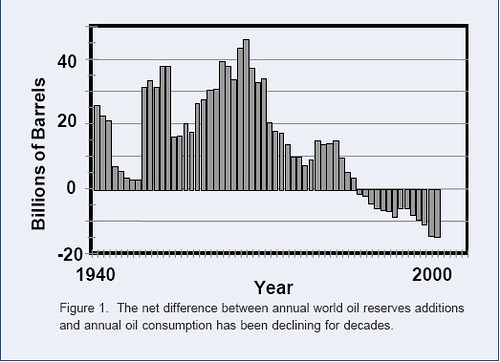
The inability of non-OPEC production to meet incremental demand after its projected peak after 2010 precipitates the second crisis when OPEC spare capacity runs out. As non-OPEC production declines, OPEC capacity will have to increase just to stay even, much less to increase supply. The third crisis arrives when OPEC production peaks. Many expect this to occur in the next decade. Of the eleven members of OPEC, several have already reached their peak—Indonesia, Iran, Kuwait, Nigeria, Iraq, and Venezuela. As mentioned earlier global oil discoveries replaced only half of the oil produced last year. We stopped replacing the oil we consume each year in 1985. We have been running energy deficits since then. This tells me that the second stage of the energy crisis could soon be upon us.

The US now finds itself in an eerie parallel to the energy crises of the 1970s. In viewing the past crises I find similar parallels and list them as follows:

* Political turmoil in producing countries (Iraq, Saudi Arabia, Iran, Nigeria, Venezuela, Indonesia)
* High Import Concentration (Saudi Arabia, Venezuela, Nigeria)
* Declining US oil production
* High dependency on oil imports (58%)
* Low capex spending by oil companies
* Low inventory levels

The US has now left itself vulnerably exposed on the energy front. We are more dependent today than we were during the crises of 1973 and 1979. Oil production in the US has fallen each decade, falling 40% since its peak in 1970. As a result of this decline imports now represent 60% of our energy needs. Even more worrisome is that even if we could import all the oil we need we wouldn’t have the refinery capacity to process it. As demand has increased we now have to import more of our refined energy products due to capacity constraints. The ability to import refined gasoline will be limited by the new environmental standards ,which are unlikely to be adopted by foreign refineries.

What we in the United States have yet to deal with is the fact that the era of high energy and mineral abundance is gone. Whether we will be able to maintain our present standard of living is questionable. At present we are financing that living standard with borrowed money, most of it from overseas. This presents a problem. According to Dr. Walter Youngquist, in order to maintain our standard of living, each person in the US requires 20 tons of mineral resources each year.[8] Since our ability to produce these resources diminishes each year, we have to rely on imports to provide them. This in turn impacts our balance of payments. This cannot go on forever.

...

We need to seriously look at our whole energy infrastructure in transportation, our energy power plants, the electrical power grid and alternative sources of energy. Does it make sense to be building natural gas power plants, if US and Canadian natural gas production is in decline and we’re unwilling to allow natural gas exploration or LNG terminals to be built? We need to be exploring new technologies for developing coal into gasoline as well as sources of electricity. Rethinking nuclear power is another option that should be explored along with wind and solar. With non-OPEC oil production close to peaking the clock is ticking with not a minute, hour, or day to waste. God help us, if Matt Simmons is right. In that case, we move quickly to the second and third stage crisis in energy. And if that happens, then it is war.


We should also be rethinking the transportation of goods in this country. The cost of trucking goods coast-to-coast will be too expensive and impractical as oil prices escalate. The movement of goods by rail and boats is far more energy-efficient. This means it is time to rebuild our rail system which is a shadow of its former self. Our transport sector relies on oil for 97% of its energy needs. It also accounts for 68% of our oil consumption.[10] Alternative forms of transportation such as mass transit in our larger cities and more fuel efficient cars—hybrids and diesel—should also be explored. And to ameliorate the bottlenecks in gasoline we need to agree on only a few varieties of environmental grade gasoline. Do we really need 50 different varieties of gasoline? Does every major city or state need its own version of environmentally clean gasoline? Can’t the experts agree on one formula? A Heinz-57 approach to our environmental needs is not only costly and inefficient, it is also insane.

As Matt Simmons points out in his book “Twilight in the Desert”, the purpose of “Plan B” is to buy time until “Plan C” where a new source of energy is developed or invented. “Plan B’ is essentially a series of bridges that buys us time in the period of transition to a new form of energy. It means doing everything that works. We know that wind and solar work as do coal and nuclear. But none of these sources of energy is a silver bullet. The problem regarding oil is there is no energy replacement on the horizon that can replace it. Creating new forms of energy is no easy task. We’ve only done it twice in the last 1,000 years. Coal replaced firewood and oil replaced coal. As the price of oil and natural gas inexorably rise all other forms of energy become more competitive. Finding a new source of energy to replace fossil fuels may be the most daunting task ever to face mankind but it needs to be done. Otherwise it will be forced upon us. Once the world arrives at peak oil, rationing and conservation will become the norm. This is why “Plan C” is critical. Getting to “Plan C” involves accelerating R&D efforts which should begin immediately and that means today.

...

The ideas expressed in this update may startle and stun but they are real. The US now finds itself facing the first of many energy crises to come. We should have been working on “Plan B” years ago. While a few experts admit we have problems, Washington (especially Congress) and the mainstream media are caught up in denial and the blame game. In the words of General Honore, they are still “stuck on stupid.” Politicians love to point figures at everyone but themselves. In trying to assess blame they avoid dealing with the issues at hand. There are three basic reasons that we have crises:

1. Failure to anticipate a problem before it arises.
2. Failure to perceive the problem once it arrives.
3. The tendency by society’s elites to perceive the wrong problem, which distracts from the real problem at hand.

This failure and avoidance is why we find ourselves stuck in a crisis. Many of the issues ofnew sources of energy, declining refinery capacity, and bottlenecks in the electrical grid system have been evident for decades. It seems it takes a crisis to bring them to the forefront. Let’s hope we can get beyond “stupid”, it could mean the difference between peace and war.


A Suvivor's Guide to the Energy Crisis  

Posted by Big Gav

Jeremy Rifkin comments on the energy crisis in the Boston Globe.

Panic has set in. With the price of oil hovering at more than $60 a barrel on world markets and forecasters predicting that we will soon see oil selling for $100 a barrel or more as worldwide oil reserves dwindle, politicians and business leaders are running scared. The global economy is beginning to slow, and there is talk about a new and sustained long-term global recession -- some economists are even talking about a global depression -- that could last for decades.

We are quickly waking up to the fact that the whole world runs by oil. We are an oil civilization. We grow our food with the help of petrochemical fertilizers and pesticides. Our plastics, pharmaceutical products, and clothes are for the most part derived from oil. Our transport, power, heat, electricity, and light are all dependent on oil.

President Bush has called upon Americans to drive their automobiles less -- more than half of the cars in the country are gas-guzzling SUVs -- to save precious fuel. The White House has also asked federal employees to cut down on all but essential travel, to carpool, and to use public transportation. In addition, the president ordered White House thermostats to be turned to 72 degrees Fahrenheit to save energy.

Incredibly, at the same time Bush was proclaiming his newfound conversion to energy efficiency, the White House and Senate Republicans were working quietly behind the scenes to scuttle the remaining six Department of Energy regional energy efficiency field offices responsible for helping low-income families, the business community, and local, state, and federal government to implement energy efficiency measures.

It appears that the president and his team do not understand the enormity of the energy crisis facing the United States and the world. The White House clearly needs guidance. The president should download the just published European Union Green Paper on Energy Efficiency. The paper lays out a detailed survivor's guide, a roadmap of what every individual, family, community, and country -- including the United States -- can do to cushion the cost shock of rising oil prices.

According to the report, the European member states alone could save at least 20 percent of their present energy consumption for a net savings of 60 billion euros per year, by enacting tough energy conservation programs across European society -- in homes, commercial buildings, factories, and transport. The EU report says the United States could save far more with widespread adoption of energy conservation practices since the United States currently wastes approximately 50 percent more energy than the European Union to produce one unit of GDP.

The EU commission study says the average EU and American household could save as much as $1,200 per year in cost-saving energy efficient practices, thus offsetting much of the increased price of oil. The EU green paper is replete with detailed information on how to overhaul every aspect of our lives to achieve more energy-efficiency.

Proposals include incentives to purchase energy-efficient cars, reducing the national speed limit to 55 miles per hour, making alterations in homes and commercial buildings, like installing special insulation and storm windows, using long-lasting electric light bulbs, introducing software into appliances to save energy, renovating the nation's power grids to be more efficient, and other practices.

Heat Death  

Posted by Big Gav

Alternet looks at the peril of accelerating global warming.

The news of melting Siberian permafrost means, in all likelihood, that global warming is accelerating much faster than climatologists had predicted. The finding from Siberia comes amidst evidence, presented at Tony Blair's special climate change conference last February, that the West Antarctic Ice Sheet could be in danger of disintegrating -- another warming-induced event once thought to be decades or centuries away.

Meanwhile, according to a September 29, 2005 report in the Guardian, scientists at the University of Colorado, Boulder's National Snow and Ice Data Center have measured a drastic shrinking of ice floes in the Arctic Ocean. Arctic waters are now expected to be ice-free well before the end of this century.

How many more milestones will there be? The prospects of a worst case scenario, with a temperature increase approaching or exceeding 5.8 degrees Celsius, are increasing dramatically, with all the attending disasters that would entail -- inundated coastlines, extreme storms and drought, disease pandemics, collapsing agriculture, massive environmental refugee flows.

And how far will it go? Climate forecasts have long noted that every increase in global temperature heightens the odds of runaway global warming, beyond any human control. Continued overheating could unlock more methane from Arctic regions beyond Siberia. It could cripple the vital ability of plants and oceans to absorb CO2 from the atmosphere, turning them into gushing sources of new CO2 that accelerate the superheating even further. The ice caps that help cool the Earth by reflecting sunlight into space could vanish. In the end, the relentless rise in temperature could induce a cataclysmic venting of billions of tons of methane from the oceans.

A paper by British scientists Michael J. Benton and Richard J. Twitchett, published in the July 2003 issue of Trends in Ecology & Evolution, shows how this could happen. 251 million years ago, at the end of the Permian era, a release of carbon dioxide from volcanic eruptions apparently heated the Earth's atmosphere by about 6 degrees Celsius.

This initial increase in temperature triggered, in turn, a massive release of methane from Arctic tundra and the oceans. Research by Jeffrey Kiehl and others at the National Center for Atmospheric Research at University of Colorado, Boulder, tells us what happened next. According to their paper in the September 2005 issue of the journal Geology, the Earth's annual mean surface temperature rose by an additional 10 to 30 degrees Celsius.

The result of this runaway global warming was the greatest mass extinction since life emerged from the sea -- 95 percent of all species in existence died. That from an initial temperature rise only 0.2 degrees Celsius more than what the IPCC says could occur by the end of this century. We now know that human industry is causing in our lifetimes the same kind of methane release that triggered the Permian extinction.

Hot As The Sun  

Posted by Big Gav

Wired News has a report on the booming solar industry.

WorldChanging has a couple of solar posts up - the first, on ""Power Glass" and the Plastic Solar Future" looks at the use of transparent plastic photovoltaic layer laminated onto window glass.

We've written frequently about building-integrated photovoltaics (BIPV), the concept of putting solar power generation capabilities into building materials, rather than as bolt-on additions. While we imagine the potential of "spray-on" photovoltaics to turn every sun-facing surface into a power source, the most common manifestation of BIPV has been "solar shingles" for home rooftops. Now comes word (via Inhabitat and Treehugger) of another BIPV concept, "Power Glass." Manufactured by San Diego-area company XsunX, Power Glass puts a transparent, thin-film polymer photovoltaic layer onto window glass.

Also from WorldChanging, the "$600 solution" on cheap solar solutions at home.
Six hundred dollars -- not pocket change, but not hugely expensive for most folks in the West -- is enough to put together a solar photovoltaic system able to run a variety of useful appliances and electric/electronic devices for a usable amount of time on a week's worth of sunlight. The system encompasses a 32 watt photovoltaic panel, a couple of sealed gel batteries, and a few components to make sure that the pv and the batteries get along with whatever you're plugging in:
...the usable power stored in the two batteries is roughly equal to a week’s output from the single 32-watt PV module, so each week you’ll have around one kilowatt-hour of stored sunlight at your disposal. What can you do with it? One kWh will run a 20-inch tv for 20 hours, a portable stereo for 100 hours, a laptop computer for 40 hours, or a 12-watt compact-fluorescent light bulb for 80 hours.

The 800-watt inverter (with a 2,000-watt surge capacity) will run a small vacuum cleaner, a drill or a small drill press, a sander, a jigsaw or small band saw, but not a large circular saw. It will handle many toasters and coffee makers, but not all. A blender would be child’s play for this inverter, a microwave an impossibility. A hair dryer on low, yes; on high, forget it.

$600 isn't enough to convert one's entire life to off-grid solar living, but it's a functional start. Moreover, it makes an interesting moving target: as organic photovoltaics and other forms of plastic solar come on the market, and as more money goes into making this technology more approachable for non-technical folks, we should start to see what's possible with $600 worth of gear improve in short order. And it's not just improvements in photovoltaic technologies that will make a difference here -- better batteries, cheaper high-capacity inverters, even more efficient "wall warts" would help (after all, many power supplies for consumer electronics only pass along 20-40% of the electricity they draw to the devices they power!).

TreeHugger reports that the Whole Foods chain has "gone biodiesel".
Whole Foods ($4.5 billion in sales last year, biggest retailer of natural and organic food in the world) has made its Midwest distribution center switch to B20 (a blend of 20% biodiesel and 80% regular diesel). The delivery trucks based there service a 5 state area and burn 8,000 gallons of fuel every week. This is only a fraction of the Whole Foods fleet, but the use of biodiesel could eventually propagate to the whole company. "Because Whole Foods operates in a relatively decentralized manner, an initiative such as this starts out regionally and then can propagate, according to a company spokesperson.

Alexander's Gas and Oil has a report on a Greenpeace proposal for the EU to "lead the way into the clean energy future".

PeakOil.com has posts on the possibility of a US led global recession (the Hoston Chronicle has a report saying that US companies haven't been in such bad shape since the Depression and there is widespread speculation about GM going bankrupt) and one from the "smells like 1914" genre on the US being on a collision course with China (the much feared Machiavelli vs Sun Tzu deathmatch). No wonder gold is soaring.

The peak oil meme continues to spread to unusual areas - even the real estate industry has heard of it (the article is a typical beginner piece, but I did find the idea of real estate agents avidly reading the words of Mike Ruppert quite amusing).
...having seen a number of interviews over the past year with Matt Simmons on this subject, I can tell you that he appears to be a man who is very sincere in his concern about what all of this could mean to our world economies. He's been a crusader on this subject for years now along with top petroleum geologists, but until recently they've had a tough time getting anyone including the petroleum companies to listen to them. But people are now beginning to listen to them more and more.

And incidentally, I learned about Matt's quote regarding the potential $10.00 a gallon gasoline prices in the coming months in an article written by Jeanne Klobnak-Ball on the From the Wilderness website. If you're not familiar with From the Wilderness, they've developed such a solid reputation in recent years for uncovering important national and international news stories that their e-newsletter and printed newsletter are now read by both the House and Senate Intelligence Committees of the United States Congress.

...

One thing I find interesting about Matt Simmons mentioning the possibility of us experiencing $10.00 a gallon gasoline prices in the months ahead is the fact that about two years ago he mentioned that he saw the price of gasoline eventually rising up to be about $7.00/gallon, but that it would take a number of years for this to happen.

So I have to believe that for a man of his stature in the petroleum industry to revise his estimate upward by $3.00 a gallon at this time, he must be seeing some very strong indicators in the marketplace that are causing him to do so. People with his reputation don't make predictions like this unless they feel there's a solid reason to do it. And in looking at the price of gasoline, even if it rises up to $4.00 to $5.00 a gallon over the next 12-18 months, the impact this could have on our economy and on our real estate markets could be huge.

And in moving forward, there's a quote I heard from the great hockey player Wayne Gretzky years ago that I've always thought was appropriate to apply to the most successful people in business. When asked what made him so much better than all the other players in the game he replied, "Most players skate to where the puck is. But I skate to where the puck is going to be."

As an expert agent advising your clients, you want to be able to tell them where the puck is going to be in real estate. The future may not always look rosy, but the better you are at recognizing where the market is headed, and the better you are at persuasively communicating this to your clients, the better off your clients will be and the more money you'll make in the process.

So do some Internet searches under the term "Peak Oil" and do your own research. While I certainly hope that these experts are wrong and that we'll be experiencing great economic times for many years to come, I must tell you that the case they're making is very compelling. So much so that I've heard of at least two major real estate investment companies who are now making changes to their portfolios because they see it coming also.

More evidence of the topsy turby political world we have entered has appeared, with one time Reaganite Paul Craig Roberts appearing in the pages of Counterpunch. Is it normal for Lew Rockwell style Libertarians to appear in the journals of the far left (I'm not a regular Counterpunch reader) or is this a new development ? Mr Roberts considers the death of civil liberties in the US (with us colonies tagging along close behind).
Police states are easier to acquire than Americans appreciate.

The hysterical aftermath of September 11 has put into place the main components of a police state.

Habeas corpus is the greatest protection Americans have against a police state. Habeas corpus ensures that Americans can only be detained by law. They must be charged with offenses, given access to attorneys, and brought to trial. Habeas corpus prevents the despotic practice of picking up a person and holding him indefinitely.

President Bush claims the power to set aside habeas corpus and to dispense with warrants for arrest and with procedures that guarantee court appearance and trial without undue delay. Today in the US, the executive branch claims the power to arrest a citizen on its own initiative and hold the citizen indefinitely. Thus, Americans are no longer protected from arbitrary arrest and indefinite detention.

These new "seize and hold" powers strip the accused of the protective aspects of law and give rein to selectivity and arbitrariness. No warrant is required for arrest, no charges have to be presented before a judge, and no case has to be put before a jury. As the police are unaccountable, whoever is selected for arrest is at the mercy of arbitrariness.

The judiciary has to some extent defended habeas corpus against Bush's attack, but the protection that the principle offers against arbitrary seizure and detention has been breeched. Whether courts can fully restore habeas corpus or whether it continues in weakened form or passes by the wayside remains to be determined.

Americans may be unaware of what it means to be stripped of the protection of habeas corpus, or they may think police authorities would never make a mistake or ever use their unbridled power against the innocent. Americans might think that the police state will only use its powers against terrorists or "enemy combatants".

But "terrorist" is an elastic and legally undefined category. When the President of the United States declares: "You are with us or against us," the police may perceive a terrorist in a dissenter from the government's policies. Political opponents may be regarded as "against us" and thereby fall in the suspect category. Or a police officer may simply have his eye on another man's attractive wife or wish to settle some old score. An enemy combatant might simply be an American who happens to be in a foreign country when the US invades. In times before our own when people were properly educated, they understood the injustices that caused the English Parliament to pass the Habeas Corpus Act of 1679 prohibiting the arbitrary powers that are now being claimed for the executive branch in the US.

Some MP's here (both Federal Liberal backbenchers and State Labor backbenchers) are mounting a rearguard action to soften our new detention without charge laws. Good to see some people have a bit of respect for western democratic traditions even if our leaders are determined to abolish them.
The draft legislation, incorporating some stronger safeguards, will go to the states today for approval.

In the meantime, the letter from NSW Government backbenchers Paul Lynch and Paul Pearce has been sent to all state Labor MPs and the issue is expected to be hotly debated at a caucus meeting today.

It calls the proposed introduction of detention without charge for 14 days for terrorist suspects a "fundamental assault upon basic protection for Australian citizens".

The legal profession isn't too keen on these laws either (I never thought I'd say this, but - well done the lawyers).

And to close, some weird news about the recent peace rally in Washington, where traces of a bioweapon were found - tinfoil stuff perhaps, but it did get reported in the Washington Post as well...

The Weather Makers  

Posted by Big Gav

Energy Bulletin has a good roundup of all the latest global warming news, including a summary of excerpts from Tim Flannery's new book "The Weathermakers". The also have links to a great series of articles in The Seattle Times, starting with "The truth about global warming".

Bart comments on the New York Times' (or The New Pravda as Billmon accurately calls it) article on the "bright side" of global warming - being able to drill for oil in the Arctic when the polar ice cap has vanished.

Jon S. rightfully skewers this insane article at Peak Energy (Seattle). Shame on the NY Times for clapping its hands in glee at the rape of the planet. What a contrast to the in-depth, responsible coverage by the Seattle Times (see previous articles). Related article from the Oil and Gas Journal: Arctic melt brings new E&P promise.

Over at Treehugger, they have a post on "North South East West - A 360° View of Climate Change", an exhibition on how people’s lives are affected by climate change.


The Energy Blog notes that "clean coal" isn't climate friendly yet, for a variety of reasons.

In energy news, Dow Chemical is asking for the US government to declare a national Natural Gas emergency.

Malaysia Airlines has raised its fuel surcharges again.

Mobjectvist has continued his modelling binge (now in the optimisation stage) with a look at lower US 48 states production, and also looks back at Jimmy Carter's brave energy vision, now ever-so-slowly being adopted by the present loser incumbent after 30 wasted years.
... to Carter the energy crisis offered an opportunity to regain our sense of hopefulness and national self-confidence. "Energy will be the immediate test of our ability to unite this nation, and it can also be the standard around which we rally," he observed. "On the battlefield of energy we can win for our nation a new confidence, and we can seize control again of our common destiny ... . It can rekindle our sense of unity, our confidence in the future, and give our nation and all of us individually a new sense of purpose."

Carter established a clear goal. "Beginning this moment, this nation will never use more foreign oil than we did in 1977 -- never. From now on, every new addition to our demand for energy will be met from our own production and our own conservation." By the end of the 1980s, the nation would reduce "our dependence on foreign oil by one-half."

To achieve these goals Carter requested of Congress "the most massive peacetime commitment of funds and resources in our nation's history to develop America's own alternative sources of fuel -- from coal, from oil shale, from plant products for gasohol, from unconventional gas, from the sun."

For Carter, fairness was to be an important criterion in shaping energy policy. Since the poor suffer most from rising energy prices, "Our nation must be fair to the poorest among us, so we will increase aid to needy Americans to cope with rising energy prices ... ."

Carter also applied the principle to the other end of the wealth spectrum: the oil companies reaping enormous profits because of OPEC-inspired price hikes.

"Congress must enact the windfall profits tax without delay," Carter insisted. "It will be money well spent. Unlike the billions of dollars that we ship to foreign countries to pay for foreign oil, these funds will be paid by Americans to Americans."

Congress enacted much of what Jimmy Carter proposed. Coupled with the energy-efficiency standards for cars enacted by an earlier Democratic Congress, and the passage in 1978 of five energy bills directed at spurring energy efficiency and renewable energy, the Energy Security Act of 1980 created a comprehensive and coherent energy policy directed toward eliminating our dependence on imported oil.

Why don't we remember this?

BHP is exploring offshore South Africa with another billion barrel field being speculated about.

Uranium miner ERA is in the news, with a number of offshore shareholders looking to offload their minority stakes after a huge share price run up and uncertainty as to whether or not Jabiluka will go ahead when Ranger shuts down in a few years time.

The Oil Drum is continuing to analyze the large projects listed by CERA - this round looks at 2006 starts. Australian investors note how small the Chinguetti project is in comparison with some of the others.


According to IEA chief Claude Mandil the world's oil supply is "Not Peaking" - he claims "current shortage concerns could be addressed by increasing exploration investment in the Middle East and in the countries of the former Soviet Union". What a relief.

WorldChanging has a post on the question of what is more important - producing more energy or using what we have more efficiently.
The UK Design Council's RED group has been working on a variety of projects linking design and energy/climate issues, and the corresponding RED blog is paying attention to new developments in the field. Today, RED linked to an article in the UK's Guardian containing a particularly pithy observation: a call for more power generation -- whether desired by politicians or energy industry executives -- is the answer to the wrong problem.

...

There's a saying that runs something like "people aren't interested in lightbulbs, they're interested in light" -- that is, improvements to a given specific technology must always be in the service of the larger purpose of the technology. Too narrow a focus on improving a given technology (e.g., internal combustion engine cars) can blind one to the rewards of meeting the same needs with entirely different systems (e.g., smart planning and personal mass transit). Alex is fond of remarking that "the solution to the problem of cars won't be found under the hood," and to the extent this means that meeting transportation needs efficiently and sustainably is likely to mean something more than plug-in hybrids and fuel cells, he's right.

WorldChanging also has an intersing little note on Steven Chu on Termite Guts and Global Warming which raises the idea that we should look at "the role of bioengineered bacteria in the shift away from fossil fuels".

Business2 has a look at the relationship between Sun and Google. The energy related hook is that Google is looking to cut power consumption (when you have 250,000 servers, this is an issue) in the face of likely electricity price spikes in (the northern) winter.
So why would Google choose to invest specifically in the Sun Fire line? The newest models, the Sun Fire x4100 and x4200, are designed exactly for the type of computing capabilities Google needs. Also, Sun's servers are built to stay cool and sit on top of each other in sprawling data centers -- exactly the kind of computing environment Google uses.

When you squeeze an extremely high-powered computer into a case designed to fit in a rack (about the size of a pizza box), there are different demands to account for than with a stand-alone desktop computer. It's well documented that minimizing heat production and power consumption are the biggest problems with rack servers. By adapting tricks it has learned from a decade of making 64-bit servers using its own Sparc chips, Sun has pulled off some technical feats that Dell, Hewlett-Packard, and IBM have yet to match. The x4100, for example, manages 50 percent more performance, according to Sun, while consuming a third of the power and a quarter of the space of a comparable Dell server. It does this primarily by using the latest dual-core chips from AMD, while Dell uses less-efficient single-core chips from Intel.

Few companies have computing demands on the scale of Google's, of course. But space in data centers is getting tight across the United States, according to commercial real estate brokerage CB Richard Ellis, which helps locate available data centers for its customers. Also, electricity prices could spike this winter, making power consumption even more of a concern than it already is.

It appears the French are paying their citizens to have more babies - though they still have a way to go before they reach the $5000 per baby the Australian government will be paying next year. This one is also via Energy Bulletin, which noted "This article on encouraging population growth belongs in an "anti-solutions" category.".

Millenialism is on the rise, with gloomy pronouncements all around lately. Lunatic preacher Pat Robertson is gleefully looking forward to the end times.

Perennial bear Steve Roach from Morgan Stanely has issued another declaration that the end is nigh for the US dollar. he has joined the gold bug camp it seems.
Alas, liquidity-driven markets always seem to have a knack of creating a false sense of confidence that long outlasts underlying fundamentals. Most still believe that this year’s under-performance of dollar-denominated assets is an aberration that is about to be reversed. My guess is that dollar-overweight investors are now moving into the final phase of denial. In my view, the biggest anomalies in world financial markets remain the US dollar, US bonds, spreads on risky assets (emerging-market debt and high-yield corporates), and energy prices. And who wouldn’t like gold in this climate?

Yes, I, too, am getting sick and tired of droning on endlessly about the coming rebalancing of an unbalanced world. The wait is always most painful at the end. Remember the early months of 2000? George Eliot put it best in Silas Marner: “The sense of security more frequently springs from habit than from conviction, and for this reason it often subsists after such a change in the conditions as might have been expected to suggest alarm. The lapse of time during which a given event has not happened is, in this logic of habit, constantly alleged as a reason why the event should never happen, even when the lapse of time is precisely the added condition which makes the event imminent.”

Past Peak also has a dose of economic bearishness from John Hussman.
There has to be a lot wrong with market action to provoke me to increase hedges when the market is down rather than up. There was a lot wrong on Wednesday — it was singularly the worst technical showing I can recall in years.

Other veteran market-watchers had similar comments. The Dow was down 123 points, which wasn't in itself so unusual, but the internal action was terrible. Richard Russell commented after the close that the action was "a really mean mark today, with my PTI [Power Trend Index] close to a bear signal, and Lowry's also close to a major sell signal. I still get the feeling that complacency rules. Today was what I call a semi-crash day." On the subject of complacency, Investors Intelligence reports that the majority of investment advisors have been bullish now for 154 weeks, which is the longest bullish stretch in the 42 years the figures have been tracked. Joe Granville described Wednesday as having "the most bearish reversal patterns that I have ever seen in one day," which is an interesting statement even for a perennial bear. [...]

At least these guys aren't seeing the fabled "Hindenburg Omen" that some people were freaking out about last week. Not to say that things don't appear on thin ice - I'm somewhat surprised at how bearish non-peak oil obsessed (or even aware) some of my acquantainces have become lately - that 1914 feeling must be affecting everyone.

Zbigniew Brzezinski (try saying that quickly 3 times in a row) has a column in the LA Times excoriating the Bush administration's actions in the middle east. The points are mostly well made, but might sound more convincing coming from someone who hadn't drawn up the blueprint for this stuff 25 years ago. What game is being played here ?
Some 60 years ago Arnold Toynbee concluded, in his monumental "Study of History," that the ultimate cause of imperial collapse was "suicidal statecraft." Sadly for George W. Bush's place in history and — much more important — ominously for America's future, that adroit phrase increasingly seems applicable to the policies pursued by the United States since the cataclysm of 9/11.

Though there have been some hints that the Bush administration may be beginning to reassess the goals, so far defined largely by slogans, of its unsuccessful military intervention in Iraq, President Bush's speech Thursday was a throwback to the demagogic formulations he employed during the 2004 presidential campaign to justify a war that he himself started.

That war, advocated by a narrow circle of decision-makers for motives still not fully exposed, propagated publicly by rhetoric reliant on false assertions, has turned out to be much more costly in blood and money than anticipated. It has precipitated worldwide criticism. In the Middle East it has stamped the United States as the imperialistic successor to Britain and as a partner of Israel in the military repression of the Arabs. Fair or not, that perception has become widespread throughout the world of Islam.

...

Compounding such political dilemmas is the degradation of America's moral standing in the world. The country that has for decades stood tall in opposition to political repression, torture and other violations of human rights has been exposed as sanctioning practices that hardly qualify as respect for human dignity. Even more reprehensible is the fact that the shameful abuse and/or torture in Guantanamo and Abu Ghraib was exposed not by an outraged administration but by the U.S. media. In response, the administration confined itself to punishing a few low-level perpetrators; none of the top civilian and military decision-makers in the Department of Defense and on the National Security Council who sanctioned "stress interrogations" (a.k.a. torture) were publicly disgraced, prosecuted or forced to resign. The administration's opposition to the International Criminal Court now seems quite self-serving.

Finally, complicating this sorry foreign policy record are war-related economic trends. The budgets for the departments of Defense and Homeland Security are now larger than the total budget of any nation, and they are likely to continue escalating as budget and trade deficits transform America into the world's No. 1 debtor nation. At the same time, the direct and indirect costs of the war in Iraq are mounting, even beyond the pessimistic prognoses of its early opponents, making a mockery of the administration's initial predictions. Every dollar so committed is a dollar not spent on investment, on scientific innovation or on education, all fundamentally relevant to America's long-term economic primacy in a highly competitive world.

It should be a source of special concern for thoughtful Americans that even nations known for their traditional affection for America have become openly critical of U.S. policy. As a result, large swathes of the world — including nations in East Asia, Europe and Latin America — have been quietly exploring ways of shaping regional associations tied less to the notions of transpacific, or transatlantic, or hemispheric cooperation with the United States. Geopolitical alienation from America could become a lasting and menacing reality.

CNN has a very interesting (but rather alarming, given some of the subtexts) article on he 1918 Flu pandemic.
Historian John Barry, author of "The Great Influenza," said the disease "killed more people in 24 weeks than AIDS has killed in 24 years." The worst-hit U.S. cities were Philadelphia, New York and Boston. Barry said vigilantes patrolled the streets of Albuquerque, New Mexico, making people wear their masks.

President Woodrow Wilson continued sending troop ships to Europe, something Barry describes as "floating coffins." Treatment was limited in 1918 -- Crotty said people tried folk medicine, prayer, anything. "There were no antibiotics, there was just hope that you'd get through, that fate was kind enough that it wouldn't hit you or yours," he said.

Bayer aspirin was just hitting the market. But because it was a German company, and Germany was a foe in World War I, many Americans distrusted it and even believed the new product was a form of germ warfare.

A theory, Barry notes, that was even suggested by U.S. government officials. He said the pandemic caused the United States largely to "grind to a stop." "Fear drove everybody inside," he said. Across the United States, "60 percent absentee rates" and empty city streets were common, Barry said.

He said the climate of fear was brought on by a mistrust of government officials and the press. "People could see while they were being told on the one hand that it's ordinary influenza, on the other hand they are seeing their spouse die in 24 hours or less, bleeding from their eyes, ears, nose and mouth, turning so dark that people thought it was the black death," Barry says said. "People knew that they were being lied to; they knew that this was not ordinary influenza."

Nearly as quickly as it struck, the 1918 flu seemed to disappear.

And to close, here's a water saving device from Kevin Kelly at Cool Tools. Apparently it is functionally robust.

Statistics

Locations of visitors to this page

blogspot visitor
Stat Counter

Total Pageviews

Ads

Books

Followers

Blog Archive

Labels

australia (619) global warming (423) solar power (397) peak oil (355) renewable energy (302) electric vehicles (250) wind power (194) ocean energy (165) csp (159) solar thermal power (145) geothermal energy (144) energy storage (142) smart grids (140) oil (139) solar pv (138) tidal power (137) coal seam gas (131) nuclear power (129) china (120) lng (117) iraq (113) geothermal power (112) green buildings (110) natural gas (110) agriculture (91) oil price (80) biofuel (78) wave power (73) smart meters (72) coal (70) uk (69) electricity grid (67) energy efficiency (64) google (58) internet (50) surveillance (50) bicycle (49) big brother (49) shale gas (49) food prices (48) tesla (46) thin film solar (42) biomimicry (40) canada (40) scotland (38) ocean power (37) politics (37) shale oil (37) new zealand (35) air transport (34) algae (34) water (34) arctic ice (33) concentrating solar power (33) saudi arabia (33) queensland (32) california (31) credit crunch (31) bioplastic (30) offshore wind power (30) population (30) cogeneration (28) geoengineering (28) batteries (26) drought (26) resource wars (26) woodside (26) censorship (25) cleantech (25) bruce sterling (24) ctl (23) limits to growth (23) carbon tax (22) economics (22) exxon (22) lithium (22) buckminster fuller (21) distributed manufacturing (21) iraq oil law (21) coal to liquids (20) indonesia (20) origin energy (20) brightsource (19) rail transport (19) ultracapacitor (19) santos (18) ausra (17) collapse (17) electric bikes (17) michael klare (17) atlantis (16) cellulosic ethanol (16) iceland (16) lithium ion batteries (16) mapping (16) ucg (16) bees (15) concentrating solar thermal power (15) ethanol (15) geodynamics (15) psychology (15) al gore (14) brazil (14) bucky fuller (14) carbon emissions (14) fertiliser (14) matthew simmons (14) ambient energy (13) biodiesel (13) investment (13) kenya (13) public transport (13) big oil (12) biochar (12) chile (12) cities (12) desertec (12) internet of things (12) otec (12) texas (12) victoria (12) antarctica (11) cradle to cradle (11) energy policy (11) hybrid car (11) terra preta (11) tinfoil (11) toyota (11) amory lovins (10) fabber (10) gazprom (10) goldman sachs (10) gtl (10) severn estuary (10) volt (10) afghanistan (9) alaska (9) biomass (9) carbon trading (9) distributed generation (9) esolar (9) four day week (9) fuel cells (9) jeremy leggett (9) methane hydrates (9) pge (9) sweden (9) arrow energy (8) bolivia (8) eroei (8) fish (8) floating offshore wind power (8) guerilla gardening (8) linc energy (8) methane (8) nanosolar (8) natural gas pipelines (8) pentland firth (8) saul griffith (8) stirling engine (8) us elections (8) western australia (8) airborne wind turbines (7) bloom energy (7) boeing (7) chp (7) climategate (7) copenhagen (7) scenario planning (7) vinod khosla (7) apocaphilia (6) ceramic fuel cells (6) cigs (6) futurism (6) jatropha (6) nigeria (6) ocean acidification (6) relocalisation (6) somalia (6) t boone pickens (6) local currencies (5) space based solar power (5) varanus island (5) garbage (4) global energy grid (4) kevin kelly (4) low temperature geothermal power (4) oled (4) tim flannery (4) v2g (4) club of rome (3) norman borlaug (2) peak oil portfolio (1)