One of Australia’s largest meat processors – and a major regional employer, providing 830 jobs – is among the latest recipients of funding from the Clean Energy Finance Corporation, in a deal to co-finance a major on-site energy project at northern NSW-based Bindaree Beef.
The CEFC announced on Tuesday it would provide up to $15 million, together with additional bank finance and an Australian Government Clean Technology Investment Program grant, to fund the installation of a biodigester and energy efficient rendering facilities to improve the efficiency and competitiveness of operations at Bindaree Beef.
As well as the biodigester, the funding will go towards development of an electricity generation facility using biogas (produced by the biodigester) as fuel, and a new more energy efficient rendering plant to replace the existing coal-fired plant and eliminate the use of coal. Screen Shot 2014-07-22 at 10.37.13 AM
The new equipment is expected to halve the company’s power bills and cut its annual carbon emissions by three quarters. The biogas plant will also create a new business revenue stream through sales of organic fertiliser – a by-product of the energy conversion process.
Bindaree Beef Director John Newton said securing finance from the CEFC – a $10 billion Labor government initiative, which remains on the Abbott government’s chopping block – had been integral to securing the interest of additional private finance, which, along with the government grant, would cover the total project cost. ...
In March this year, the CEFC contributed $20 million to a funding deal with Quantum Power Limited – Australia’s leading biogas company – to catalyse up to $40 million in biogas infrastructure aimed at helping farmers and manufacturers cut costs and boost productivity in the face of rising electricity prices.
According to the 2013 Biogas Monitoring Report presented from the Federal Network Agency, 108 biogas power plants fed 413 million m³ of biogas into the German gas grids in 2012, a 50% increase compared with 2011 (77 plants; 275 million m³). However, this represents only 6.9% of the target of feeding 6 billion m3 into the German gas grids by 2020 pursuant to Section 31 Gas Access Ordinance (GasNVZ).
Compared with the target of feeding 10 billion m3 into the German natural gas grids by 2030, only 4.13% had been reached so far, the Federal Network Agency (BNetzA) said. Even if one assumed linear growth of biogas power plants, the targets would probably be missed, the agency added.
The latest proposal is to capture the methane emissions produced by the tonnes of pig poo at the nation’s piggeries. The idea is to cover the open ponds where this poo is usually left, often two metres or more deep, capture the enormous amounts of methane that is created and either flare it or burn it to create heat and electricity.
The pig industry estimates that about 1.25 million tonnes of greenhouse gases from the nation’s 682 enclosed piggeries are emitted in this manner per year, and from other associated emissions from the pig industry.
It is estimated that about one million tonnes a year could be abated by 2020 if the 100-biggest piggeries decided it was worth the cost of investment to harness the methane emitted from the manure. The slumping cost of these technologies, and the ability to cash in on credits generated by the scheme, is likely to make that investment worthwhile, with a payback as short as 12 months or less.
Harvesting pig poo is the latest methodology to be approved by the government’s carbon farming initiative, following on from proposals to cull wild camels – there are more than one million of them and they are each responsible for emitting around one tonne of greenhouse gas a year – as well as various forms of reforestation initiatives.
Future methodologies will include better management of cattle herds, particularly in the far north. If cattle producers can improve their management skills, reduce the rate of still-births and early mortality, encourage richer grazing and get them to grow quicker and “spend less time on planet Earth," then they too could generate carbon credits from reduced emissions.
This was the intention of the carbon farming initiative – to engage farmers in a positive way in the carbon pricing issue, and to provide an incentive to correct practices that are either wasteful, or not environmentally friendly.
But, exotic as it may sound, as far as piggeries go, Australia is just catching up to the rest of the world. In Europe, piggeries receive a feed-in tariff guaranteed for 20 years for the electricity and heat that they generate from the effluent from their farms.
There are only about three farms in Australia that capture their methane, according to Janine Price, the manager of environment and climate change at Pork Australia, the producers’ peak body. But more are expected to embrace the idea, inspired not just by the inclusion of the practice in the carbon farming initiative, but also by the development of bio-gas technologies in New Zealand that dramatically reduce the cost of the practice – the price of scrubbers that remove hydrogen sulphides so the emissions can be used in biogas plants now amount a few hundred dollars, rather than a heavily engineered system costing in the tens of thousands.
If the credits generated by the piggeries qualify under the government’s carbon pricing plan, then they will get the fixed price set by the government. At $20/t, Pork Australia estimates the returns will be around $3 a pig, and up to $4.50 a pig at $30/t. If it is not included, the credits will be sold on the voluntary market, at a price more likely to be around $5/t.
Still, the technology changes means that farms with as few as 400 sows should be able to make money from the investment, and pay back within four years, even without carbon credits and renewable energy certificates.
Bigger farms could get pay-back within 12 months, because they will be able to install systems to generate heat and electricity for farm use. The industry as a whole could generate $20-$30 million of credits by 2020, depending on the uptake and, of course, the carbon price.
In the impoverished Nairobi neighborhood of Kibera, often called "Africa's biggest slum," the lack of toilets and sewer systems leaves hundreds of thousands of people vulnerable to the diseases that thrive amid poor sanitation. But an innovative program is helping turn one of the area's biggest health problems into a solution to one of the community's most crucial economic -- and environmental -- concerns.
Poor households in Kibera are struggling to meet rising costs for kerosene, paraffin, charcoal, firewood, and other fuel sources, many of which also contribute to indoor air pollution and the myriad ailments that go along with it, IPS News reports.
At the Katwekera Tosha Bio Centre set up with the help of the Umande Trust, however, Kibera residents can safely and cheaply cook food using biogas generated from the center's toilets:
The centre has toilets and bathrooms on the ground floor -- the toilets are connected to a bio-digester, with a dome-shaped holding tank in which biogas is produced. Raw human waste from the toilets flows in, and bacteria break it down, releasing methane gas which collects at the top of the domed tank.
"A pipe is then plumbed into these toilets and connected to the first floor, which is where the cooking area is located," says [center manager David] Kihara. The gas is piped to collective stoves one floor up -- and is usually sufficient for community members to cook on throughout the day.
The idea may sound a bit icky, but it's perfectly safe, helping solve sanitation problems while providing green energy at the same time. Though residents only pay a small fee to use the cooking facilities, the center has become so popular it's even turning a profit -- money that benefits locals who have registered with the community-based organization, IPS writes.
A rapidly growing industry in China—dairy farming—is also a major new source of greenhouse-gas emissions. But Huishan Dairy in northeast China is trying to change this by installing the world's largest system for generating electricity by collecting methane gas emitted by fermenting cow manure.
The Chinese have not, historically, been big milk drinkers, but decreasing costs and aggressive marketing efforts have changed that. Huishan's new system will prevent methane—which is 23 times more potent than carbon dioxide as a greenhouse gas—from reaching the atmosphere. It will also reduce waste and odors, and produce a valuable organic fertilizer that's safer than raw manure.
The operation at Huishan is 10 times the size of the typical systems for generating electricity from cow manure. Its massive scale could help make the project more economical. GE, which is supplying the project's gas-powered generators, also hopes it will act as a showcase for the technology. Methane is not widely harnessed in farming worldwide, largely due to the initial costs, a lack of established economic models, and little government support.
Huishan, one of the biggest dairies in the country, imports 3,000 cows from Australia every month to sustain its massive stock of 250,000 cows—about double the number of dairy cows in the entire state of Florida. Huishan's new electricity generating system will process the waste from 60,000 cows and produce 5.6 megawatts of power. It will generate enough electricity to meet the needs of 3,500 American-size households, which means it will service many more Chinese ones, which use far less energy. Advertisement
What was previously the largest system for generating electricity from manure produced two megawatts. Most such systems still produce only a few hundred kilowatts. Huishan will capture 20 million cubic meters of biogas (which is about 60 percent methane).
Technology for capturing biogas and putting it to use has existed for a long time. In its simplest form, an enclosed digester allows the anaerobic organisms to break down manure and capture the methane produced. The gas is then siphoned off in a pipe for cooking or lighting. The Chinese government estimates that millions of small farms already have such primitive manure digesters.
Generating electricity from biogas is more difficult because constituents of the gas, such as hydrogen sulfide, are particularly corrosive. It is possible to clean up the gas by removing the hydrogen sulfide by exposing it to iron oxide (a process called hydrodesulfurization). The biogas can then be burned to produce electricity in generators such as the GE Jenbacher engines that Huishan uses. These engines have been modified to burn at compression levels particularly suited to biogas, and they have special coatings that resist corrosion.
Less than 1 percent of the dairies in the United States capture methane. Part of the challenge is scale. According to Don Wichert, director of renewable energy programs at Wisconsin Energy Conservation Corporation, producing electricity from biogas at a farm with about 100 cows costs twice as much as producing it at a farm with over 2,000 cows. Huishan is gathering manure from 20 farms located close together near Shenyang, China, to feed into massive digesters. Thomas Elsenbruch, marketing program manager for Jenbacher engines at GE, says larger systems can supply enough gas for a one-plus-megawatt engine. Such engines are more efficient than the 300- to 500-kilowatt systems used in many farms in Europe or the U.S.
Adnams could soon be providing more than beer from its brewery in Suffolk after the company today announced it has completed the construction of the first anaerobic digestion plant in the UK capable of feeding biomethane into the national gas grid.
Adnams Bio Energy Limited, a spin off from the company owned by Cambridge-based Bio Group, said that the new system would being feeding biomethane into the grid later this summer as part of an agreement with British Gas and National Grid.
The technology, which was part funded by grants from the European Regional Development Fund, East of England Development Agency and the Department of Energy and Climate Change, uses three digesters to break down local food waste and waste from the brewery in order to produce biomethane and a liquid organic fertiliser.
Adnams said the plant should produce enough gas each year to heat 235 family homes for a year, although around 40 per cent of the gas generated onsite will be used to power the Adnams brewery and run its fleet of lorries, while the remaining 60 per cent will be injected into the National Grid.
There are over 50 anaerobic digestion plants in the UK, but the Adnams facility is the first to include technology capable of upgrading the quality of the biomethane to meet grid specifications.
National Grid has in the past estimated that biomethane produced from organic waste could ultimately be used for up to 15 per cent of domestic gas consumption. A number of firms, including high profile green energy provider Ecotricity, are now currently racing to develop anaerobic digestion plants that can feed gas into the grid.
Renewable Energy World has an article on expanding the use of biogas in the gas network, taking a detailed look at experience in Germnay - Cleaning up the Gas Grid.
In Germany electricity production from renewable sources is supported at a special rate as set out under the renewable energy law (EEG). This special rate applies to electricity produced from biogas transmitted through the natural gas grid, but is also increased by an additional bonus for use of innovative technology, such as biogas upgrading. In addition, a new law on heating with renewable energies came into effect in 2009, which requires new buildings to be heated with a share of at least 20% of renewable sources or combined heat and power (CHP). Furthermore, there is a negotiated environmental agreement by the gas utilities in Germany to add at least 10% biogas to natural gas for vehicle fuel (LPG) in 2010 and 20% by 2020.
The main operational advantages of biogas feed-in to the natural gas distribution grid are that the biogas can be used at higher energy efficiency where the waste heat can be used. In addition, by using the gas grid for virtual storage, time-decoupling between biogas production and consumption can also be achieved.
In spring 2008 the energy utility Energie Baden-Württemberg (EnBW), together with its gas grid subsidiary Erdgas Südwest (ESW), began operations at a new facility, upgrading biogas and feeding it into to the natural gas grid. The bio-methane is produced in co-operation with an agricultural company of 20 farmers who own and operate the fermentation biogas plant and procure the biomass. The gas is produced by the farmers and sold to EnBW-ESW, which ensures the quality necessary in the gas distribution system, the measurement required for invoicing and deals with transport to the customer. Around 5 million Nm3 of raw biogas is upgraded annually to around 2.8 million Nm3 of biogas at natural gas quality and fed into the gas grid.
In conventional biogas plants in Germany the biogas is burnt in a co-located reciprocating-engine. This is normally in a rural area, where heat demand is very restricted. While some 15%–20% of the exhaust heat is consumed by the fermenter, in most cases the rest is difficult to sell and, as a consequence, the efficiency of biogas plants is limited. However, even under EEG-tariffs for electricity production, without heat sales it is becoming more and more difficult to achieve the economic operation of a biogas plant. Conversely, if biogas can be transported to a heat sink, a CHP plant can utilize the bioenergy much more efficiently and can supply heat at a better value and so at a higher income. If the biogas is to be transported in the wider natural gas grid, it has to be upgraded to meet the quality needed for the grid.
In some parts of the UK anaerobic digesters are already being used to generate electricity from human refuse, but this summer British Gas in a partnership with Thames Water and Scotia Gas Networks will start piping biomethane from the sewage system — which is derived from fecal matter — right back into the homes of 130 customers in Didcot in Oxfordshire. The new gas will take 23 days to complete its waste treatment cycle and when it enters homes will smell just like natural gas.
Using human waste for power is not a new idea. Marco Polo noticed that the Chinese used enclosed sewage tanks to generate power and bath water was said to be heated with biogas in Assyria in the 10th century BC. With populations on the rise and the issue of what to do with sewage becoming an ever present problem, why not bring it back around to electrify our houses? It’s completely renewable — as long as we keep eating — and could be a big part of the no waste holy grail.
After more than 20 years farming onions, Steve Gill still breaks out in tears at his processing facility. Only now he's crying all the way to the bank. ¶ He recently began using juice from his pungent crop to create energy to run his refrigerators and lighting. That's slicing $700,000 annually off the electric bill at his 14-acre plant in Oxnard. He's also saving $400,000 a year on disposal costs. And he has secured more than $3 million in government and power company incentives to do it.
Gill figures the $9.5-million system will pay for itself in less than six years while eliminating up to 30,000 tons of carbon dioxide-equivalent emissions a year. ¶ "It's a great sustainability story, but it was first a business decision to solve a waste problem," said Gill, 59, who co-owns the company with his brother David. "But in doing so, we solved a lot of environmental problems too."
Gills Onions is one of a small but growing cadre of U.S. companies generating their own electricity on site with waste from their production processes. In addition to plant material, firms are using a variety of feedstocks, including animal manure, vegetable oil, whey -- even beer.
The massive upfront costs limit the appeal of these so-called closed-loop systems. But volatile energy prices and the rising cost of waste disposal are compelling more firms to take a look.
Farmers and processors in California's $37-billion agricultural industry in particular are looking for ways to save money and reduce their environmental footprint, said Sonia Salas, science and technology manager for the Western Growers Assn.
"Many growers want technology that helps them handle waste," she said. "This is a concept that other operations can definitely use."
The system at Gills Onions, which will be unveiled to the public today, converts methane from fermented onion juice into energy burned in two on-site fuel cells.
The company has farms throughout California that send onions year-round to the Oxnard plant, where they are skinned, diced, sliced or packaged whole in a numbingly frigid facility by 400 employees. The vegetables are then shipped all over the country to wholesalers and retailers such as Ralphs.
Machines slice off about 40% of each onion. That leaves 150 tons of waste a day. For years, the Gills spread these leavings as fertilizer over their fields or sold them as cattle feed. But the refuse was expensive to handle, and it posed a hazard to the atmosphere and groundwater.
So the brothers decided to turn it into energy instead.
Machines extract about 30,000 gallons of onion juice that is then sent to a 145,000-gallon holding tank kept at a toasty 95 degrees. Inside, bacteria purchased from an Anheuser-Busch beer brewery produce methane gas by feasting on the carbohydrates in the fermenting juice.
"It's like a big stomach," said project manager Bill Deaton.
The gas is purified, dehumidified and compressed, then burned in the fuel cells at temperatures that exceed 1,000 degrees. The 600-kilowatt system produces enough power to operate the plant's refrigeration units and lighting.
The Gills are also looking into installing a battery at the plant that can store excess electricity from the fuel cells. Reserve energy could be used during peak hours in the summer, when electricity is more expensive.
"I didn't want to depend on anyone taking my waste for me," Gill said. "It was my problem, and I had to solve it. It's a relief to find a solution."
Producing biofuel for a single company's closed-loop system is one thing, but integrating the energy into the public grid is still a prohibitively expensive and difficult endeavor.
Republic Services Inc. has converted a landfill cover into a flexible solar power generating system in what could be the first of several projects in the South Texas region.
Republic Services and utility CPS Energy capped part of the Tessman Road Landfill in San Antonio with what they call the first-of-its-kind solar energy cover. It consists of a synthetic geomembrane typically used to seal a landfill that has reached capacity. Adhered to the cover on the landfill's south-facing side slope are more than 1,000 flexible strips with photovolatic silicon cells measuring less than a quarter-inch thick.
"The solar energy cover is easier to inspect, maintain and repair than a traditional clay cap, and is technically superior in terms of odor control and storm water management," said Tony Walker, Republic Services project manager, said in a statement last week.
Landfills are familiar sites for biogas-to-energy power generation, but conventional solar projects at landfills are becoming increasingly common. For example, there's a two megawatt PV array at the Fort Carson, Colo. landfill, while New Jersey's Erie Landfill is slated to become the home of the largest solar energy farm in the state.
Republic Services' solar energy cover spans 5.6 acres of the 680-acre Tessman Road Landfill. Along with a methane gas-to-energy system in operation at the site since 2002, the solar energy cover will generate a combined nine megawatts of electricity. The system began operating last month.
It is available for free in huge quantities, is not owned by Saudi Arabia and it contributes minimally towards climate change. The latest green fuel might seem like the dream answer to climate crisis, but until recently raw sewage has been seen as a waste disposal problem rather than a power source. Now Norway's capital city is proving that its citizens can contribute to the city's green credentials without even realising it.
In Oslo, air pollution from public and private transport has increased by approximately 10% since 2000, contributing to more than 50% of total CO2 emissions in the city. With Norway's ambitious target of being carbon neutral by 2050 Oslo City Council began investigating alternatives to fossil fuel-powered public transport and decided on biomethane.
Biomethane is a by-product of treated sewage. Microbes break down the raw material and release the gas, which can then be used in slightly modified engines. Previously at one of the sewage plants in the city half of the gas was flared off, emitting 17,00 tonnes of CO2. From September 2009, this gas will be trapped and converted into biomethane to run 200 of the city's public buses.
Project leader, Ole Jakob Johansen said: "The city of Oslo has great visions for Oslo as a green capital. Oslo aims to be one of the most environmentally sustainable capitals of the world. Using biomethane makes sense. Not only would the biomethane otherwise be wasted, but the reduction in emissions per bus will go a long way to achieving our carbon-neutral target. What's more, aside from the intial set-up costs, we expect to see an average saving of €0.40 per litre of fuel (based on an average diesel price of €0.67 per litre compared with biomethane at €0.27 per litre)".
The city's diesel public buses will only require minor modifications to their engines to run on methane, which is stored on tanks on top of the vehicles. The only noticeable difference will be how quietly they drive.
"Biogas is popular in Sweden, but they have very few vehicles powered by biomethane. We chose to focus on biomethane as this emits less carbon and is easier and cheaper to produce," said Johansen.
The net emissions from a biomethane operated bus are zero, because the carbon originally came from the atmosphere rather than fossil fuels, but electricity is used at the sewage plant to convert the gas from the waste into fuel for the buses. Oslo city council is taking the electricity used to generate the fuel into consideration and calculate that carbon emissions per bus are 18 tonnes per year, a saving of 44 tonnes of C02 per bus per year.
The city's two sewage plants have enough biomethane to provide fuel for the 80 buses, but if the trial is successful Oslo city council plans to convert all 400 of the public buses to run on biogas. The biogas will be created from a mixture of biomethane and biogas from the incineration of kitchen waste from the capital's restaurants and domestic kitchens. Eventually, the council hopes that cars will also be able to run on biogas sourced locally from biomethane and converted kitchen waste.
Standing atop the 400-acre 1-E landfill, you get a panoramic view of the Meadowlands sports complex to the north and the New York City skyline to the east. You're also standing on a critical part of New Jersey's, and the nation's, energy future.
Decades worth of household trash, construction waste and assorted refuse buried in the landfill is providing electricity to thousands of homes. "It's like you're buying back your own garbage, but in a different form," said Tom Marturano, director of solid waste and natural resources for the New Jersey Meadowlands Commission, which owns and operates the 1-E site.
The Kearny site is among 21 landfills in New Jersey where methane gas produced by decomposing garbage is used as fuel to generate electricity, according to the state Board of Public Utilities. That is almost as many as in the state of Texas, and more than the combined number in Georgia, Mississippi, Louisiana, Arkansas and Oklahoma.
Nationwide, the federal Environmental Protection Agency counts 455 landfills that use their methane to generate electricity and has targeted more than 500 more as potential candidates through its Landfill Methane Outreach Program.
One of New Jersey's leading environmentalists envisions the state's landfills someday making more use of their sites by installing wind and solar power to supplement methane.
"We see landfills as potential New Age energy plants, because you can combine all three and create a steady source of power - and not everybody wants a windmill in their back yard," said Jeff Tittel, executive director of the New Jersey chapter of the Sierra Club.
Marturano cautioned that adding wind farms might take a while since landfill surfaces are constantly shifting, but the Meadowlands Commission already has plans to install 20 acres of solar panels on the southern side of the 1-E landfill.
Gov. Jon S. Corzine's Energy Master Plan for the state touts landfill methane gas as one of the state's key renewable energy sources. It hopes renewable sources will combine to supply 30 percent of New Jersey's electricity consumption by 2020. According to the plan, New Jerseyans produce 6.7 pounds of trash per day, 50 percent more than the national average.
Previously, a high annual fee discouraged apartment dwellers from thinking about owning a garbage disposal - municipal engineers were worried about gas build-up in sewer lines and other blockages from running liquid garbage through regular pipes. So only about 40 apartments in the entire city went through the expensive hassle of getting and owning a garbage disposal. In the U.S. 50 percent of ALL homes have a disposal - it increases a home's water consumption and electricity usage and forms more of a burden to municipal sewage treatment. Why are the Swedes encouraging it, then? They want to mine the waste stream for biogas.
An increase in organic material in Swedish sewage lines is now considered a positive, so the fee for the garbage disposals reduced by more than half to U.S.$65 dollars - purchase and installation of a machine will still cost around $800.
In Sweden there's a national goal of 35 percent of waste material being composted or by 2010. That may be a tough goal to reach as many people toss everything into the trash, knowing that most of it gets burned in large incinerators Sweden invested in in the 70's and 80's. One study showed Swedes tossing 225 pounds of edible food each year.
By using garbage disposals, Stockholm Water reckons they can turn that waste into methane gas. Scores of methane stations dot the Swedish roadsides and methane is used in many city buses - though Volvo discontinued its dual methane/gas powered car two years ago. Stockholm Water has now tested the pipes, so to speak, and determined that the system can absorb a lot more of the waste stream in the municipal system and turn it into methane gas, so that an even larger goal recommended by the Green party could be reached. The Greens say 70 percent of the waste stream could be either composted or turned to biogas by 2015. Today Stockholm Water can produce 8 billion cubic meters of methane, though just half of it goes to vehicles.
Last year demand for methane rose 18 percent, but in Stockholm it rose a full 40 percent. Stockholm can't make enough of its own biogas currently, and imports from nearby municipalities. Sweden's Environmental Protection Agency lists biogas as the most environmentally friendly vehicle fuel - there's even the biogas-powered train.
In my post on biogas a while back, I mentioned the ambitious plans being made in Germany to use biogas in their natural gas network. REW reports that this is now starting to become a reality, with concerns over global warming and Russian dominance of gas supplies sparking the change.
The biggest biogas plant in the world to feed gas directly into the national gas grid is set to go into operation in eastern Germany at the beginning of 2009.
The plant at Konnern will feed 15 million cubic meters (m³) of biomethane into the national grid for use by customers anywhere in Germany. Experts say it is the start of a boom in biogas as the country's energy providers increasingly look to home-produced biogas to reduce their dependence on natural gas imported from Russia.
In 2007, there were 1280 megawatts (MW) of installed biogas capacity and about 3,750 biogas plants in Germany. As much as 20 percent of Germany's natural gas needs could be supplied from biogas by 2020, according to Andrea Horbelt of the German Biogas Association.
Horbelt said that some studies predicted that Germany could even supply its entire natural gas needs using biogas if it were able to tap the agriculture potential of Eastern Europe with sufficient efficiency. But for now the focus is on exploiting the potential in Germany where a well-developed national grid facilitates biogas transport.
"Biogas is the market of the future because it allows energy to be produced and transported economically and in a decentralized way around the country," said Pivi Scamperle of agri.capital, the company that runs Germany's largest existing EU €10 million biogas plant, feeding 6 million m³ of biomethane into the national grid.
The boom in biogas comes thanks to a key technological breakthrough a year ago that allowed biogas to be injected into the natural gas grid and so transported around Germany economically, said Thomas Wilkens of WELtec BioPower, a company that manufactures biogas units.
Until that breakthrough, as much as two-thirds of all the energy produced by combined heat and power biogas plants couldn't be used because there was not enough demand for heat at the point of generation — usually in agricultural areas — and there was no technology available either to put the gas into a pipeline and bring it to customers in other places.
"Biogas from Konnern will go all around Germany through the national grid," Wilkens said. "There is a growing demand for plants like this because energy providers are eager to find a way of reducing Germany's dependence on expensive gas from Russia. Biogas could make a big contribution to energy self-sufficiency as well as to fighting global warming."
On a sunny Saturday afternoon in Salzburg, we took a field trip to a few examples of biomass in rural Austria. The country is over 40 percent forested, and over half of the forest is owned by small farmers with less than 40 hectares (just under 100 acres), so the government has put a priority on encouraging biomass use as a substitute for fossil fuels. It's a stable domestic industry, carefully managed with an eye toward local economic development and, as with just about everything I laid eyes on in Austria, proper aesthetics.
The first place we stopped was a biomass district heating co-op run by 18 farmers. To the right is the enormous pile of wood chips we saw in a huge, beautifully wrought barn.
The chips are continuously and automatically fed into the hyper-efficient furnace to the left, where they are burned at high temperatures. The combustion heats water, which is then fed through a network of pipes underneath the village. A system of heat exchangers uses the water to heat each house.
Obviously the farmers make more money during the cold winters, but the co-op provides a stable, predictable supplemental income throughout the year.
The next place we visited was a biomass digester. Instead of burning pure wood, it feeds a mixture of wood, straw, and godknowswhat from that yellow bin in front (it was stinky!) into the huge tank to the left, where it ferments. The gases released by the fermentation are captured, fed into the building to the far right (not quite visible), and burned to create electricity, which is fed into the grid. The leftover sludgy stuff is distributed as mulch. The hot air created by the generator is piped into a building next door and used to dry wood chips, which are then shredded and used to make compact wood pellets.
Delightful! Both these facilities were so ... I don't want to say low-tech. Analog. They were like fantastic Rube Goldberg machines, squeezing every bit of useful energy out of local, renewable material. This stuff is heavily subsidized by the government, but it has helped (along with tourism) revive several local economies.
Let's keep going! ...
I was taken aback. There was no heat coming off it at all, no noise, not so much as a vibration. But he opened the gray door and sure enough, there was another porthole through which we could see dancing flames.
I came away from the day utterly charmed and impressed. Like so little in day-to-day American life, these systems are simple, resilient, and predictable, locally owned and run, and of appropriate scale and character. They fit.
Please welcome once again, Wes Muir, Director of Communications for Waste Management, Inc. Wes is back with an overview of landfill gas to energy prospects for the USA - a 2,500 megawatt opportunity.
Many Americans are increasingly turning to alternative forms of energy, and one exciting source that has seen recent resurgence in use is landfill gas. This rise in the use of landfill gas can be attributed to a variety of factors. Higher energy prices make landfill gas cost-competitive, especially compared to other sources of renewable energy. Second, utilities are looking for new sources of renewable energy to meet renewable portfolio standards, and landfill gas is especially valuable to them because it provides base load power. There’s also a real demand from consumers for greener energy and many of them are taking part in voluntary programs and are willing to pay more for power derived from renewable sources.
What exactly is landfill gas? Landfill gas is produced when microorganisms break down organic material in the landfill, and is comprised of approximately 50-60 percent methane and 40-50 percent carbon dioxide. At most landfills in the United States, these greenhouse gases are simply burned off, or “flared.” (As pictured.)
However, Waste Management (WM) has over 100 sites that have landfill gas to energy (LFGTE) facilities – and we plan to build another 60 plants by 2012 - that collect methane and use it to fuel onsite engines or turbines, generating electricity to power surrounding homes and neighborhoods. By building LFGTE facilities, WM further reduces greenhouse gases by offsetting the use of fossil fuel at the utility power plants.
According to EPA data, there are currently 425 landfills with LFGTE projects in the U.S. that power more than 1 million homes. They estimate that there are about 570 landfills that have the potential to develop LFGTE projects in the future, more than doubling the current amount of energy produced from 1,180 megawatts to more than 2,500 megawatts. Hence, there is a large supply of renewable energy across the country, literally at our doorstep.
About 45 minutes north of downtown Los Angeles, a machine the size of a small truck flattens tons of food scraps, paper towels and other household rubbish into the side of a growing 90-metre pile. To Waste Management, which operates the landfill, this is more than just a mountain of garbage. Pipes tunnelled deep into the mound extract gas from the rotting waste and send it to a plant that turns it into electricity.
Apart from the huge-wheeled compactor driving over garbage on its surface, it looks like an ordinary hillside. And it doesn't even smell. Yet it produces enough energy to power 2,500 homes in Southern California. Rubbish, trash, whatever you call it, the 1.6 billion tonnes of stuff the world throws away each year - 250 kilograms per person - is being touted as a big potential source of clean energy.
As concerns about climate change escalate and prices on fossil fuels like oil and natural gas soar to record levels, more companies are investing in ways to use methane gas to power homes and vehicles. Around the world, landfills where municipal waste is collected and buried are one of the biggest producers of methane, a gas whose greenhouse effect is 21 times worse than carbon dioxide. If instead that gas is collected and burned to generate electricity, proponents say the resulting emissions of carbon dioxide are less harmful to the environment than the original methane.
SEWAGE that costs large cities tremendous sums each year can be turned into a source of power equivalent to thousands of tons of coal! The waste now dumped into rivers or shipped to sea may be used to run factories or to light buildings!...The apparatus for producing gas from sewage consists of two sludge digestion tanks in which the sewage is allowed to ferment. The gases given off are composed of from 25 to 75 per cent of methane, or marsh gas
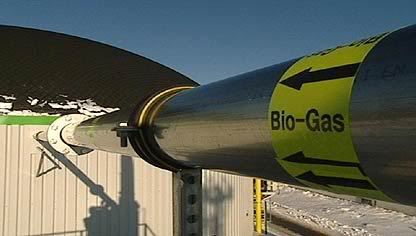
Powering transport using liquid petroleum gas, compressed natural gas or fuel produced by gas-to-liquids processes are options that have received varying amounts of attention in recent years as the oil price climbs ever higher. While shifting dependence from one fossil fuel to another doesn't make a great deal of sense when you take peak oil and gas into account, there is a renewable option for producing gas - biogas.
One recent example of biogas use in Australia is a pilot project by horticulture company Growcom to convert banana waste into biomethane, which will then be used as fuel by cars converted to use compressed natural gas and by a generator for electricity production.
The processing plant uses an anaerobic digester - in trials, the banana waste produced maximum yields of 398 litres of methane per kg of dry banana. With this yield, 1 ton of bananas per day can generate around 7.5 kW of electricity - enough to supply six to eight modern households.
According to research done at the University of Queensland by Associate Professor Bill Clarke, over 310,000 tonnes of bananas are grown in Australia each year (250,000 tonnes in FNQ). Approximately 30% of the bananas are rejected at the packing stage for quality reasons. Gloablly, around 70 million tonnes of bananas are produced each year, 20% of which are traded.
Growcom board member Keith Noble says, "An over-riding principle of the project has been to use locally available materials and expertise wherever possible. The system must also integrate with existing farm practices. If on-farm digesters are to have a commercial future they must add to farm efficiency and be simple to operate."
Given the volume of bananas required to produce the gas, banana power will only ever be a niche solution (something the people involved readily admit), but it is an example of how waste streams can be used to produce biogas - which has the important benefit of not diverting food (or arable land) to fuel production - one of the major criticisms of present day biofuels.
An important additional benefit is that methane is a potent greenhouse gas, and thus capturing it and burning it helps from a global warming point of view.
Of course, Banana waste is just one type of agricultural byproduct that can be diverted to produce biogas - there are a wide variety of other byproducts from farming and the food industry that can be captured and digested in a similar way (wood chips being another example).
Pig Poo Power
Another niche source of biogas that has considered in Australia is from animal manure - specifically pig poo. This seems to be part of a worldwide trend, with countries as far afield as Thailand and South Korea also harnessing the foul odours and putting them to good use.
Famed Kleiner Perkins Caufield and Byers venture capitalist John Doerr is also getting in on the act, looking at pig farms in California's Central Valley for opportunities.
Pig's aren't the only animals producing large amounts of ordure that could be used for biogas production - other animals producing copious quantities of potential feedstock includecows (which could help solve another problem - burning mountains of cattle manure), dogs, chickens, turkeys (whose output is being burnt directly in biomass power generation facilities in the US, which has received criticism for both pollution and for burning material that would be of use for fertiliser) and zoo animals.
It isn't just the animal world that is capable of providing fuel of course, people can too. A Rwandan prison uses waste from the inmates to help power the prison.
An Indian company called Sintex is even marketing an at-home biogas digester, with hopes of solving India's energy and sanitation problems in one hit. These plans have the enthusiastic backing of the WTO (World Toilet Organisation). A one-cubic-meter digester (initially filled with cow dung to provide the bacteria required) can convert the waste from a four-person family into enough gas to cook all its meals and provide sludge for fertilizer for around $425 - paying for itself in energy savings in less than two years.
Another widespread use of biogas is capturing the gas produced in landfills for power generation - Australia already has a number of plants in use, and a large number of developments are underway in the US capable of generating hundreds of megawatts of power, with an estimated 700 sites capable of being used for this purpose.
One heavy user of landfill gas is General Motors, which has reduced its consumption of natural gas by around 25% since 2000 by replacing it with gas from landfills. The University of New Hampshire is getting over 8% of its energy from landfill gas. The city of Sao Paulo in Brazil has a 23 MW landfill gas plant in operation.
Biogas In Europe
Europe seems to be the leader in the production and use of biogas.
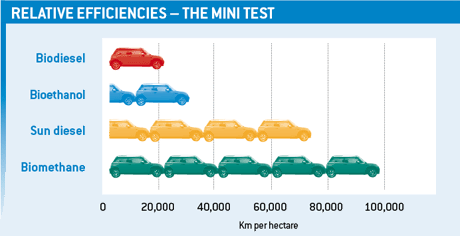
UK studies have shown that biogas is much cleaner and more efficient than biofuels for use in transport - and also allows farmers to become energy generators rather than just commodity producers.
According to an EU well-to-wheel study of more than 70 different (fossil and renewable) fuels and energy paths, biogas is the cleanest and most climate-neutral transport fuel of all.
Some examples of biogas use in Europe include:
* Austrian drivers can fill up their CNG cars using biogas made from grass. * Denmark has more than 50 biogas plants in operation. * The Netherlands is generating biogas from sewage treatment plants and feeding it into the gas grid and to fuel cars. * Sweden is producing biogas from wastewater treatment plants and and using it to generate power and to fuel buses and trains. * Germany is producing biogas from maize and using it in combined-heat-and-power plants (the French have developed a giant maize variety specifically for biogas production).
The German government is considering feeding biogas into the country's natural gas network (ironically, the main obstacle to this has been that biogas is too good for the network - exceeding Germany's upper limit on gas heating value, something the German Greens and farming lobby are trying to have fixed).
According to the government, locally produced biogas could supply up to 10 percent of Germany's total gas consumption by 2030. Germany is the largest producer of biogas in Europe, and biogas is Germany's fastest growing renewable energy sector.
One controversial study last year claimed that the EU could produce enough biogas to replace all natural gas imports from Russia by 2020, which would change Europe's energy security outlook considerably if it proves to be correct. The main findings of the study were:
* Europe's potential for the sustainable production of biomethane is 500 billion cubic meters of natural gas equivalent (17.7 trillion cubic feet) per year. This is roughly the total amount of natural gas currently consumed by the entire European Union. * The entire EU's natural gas needs for the the medium-term future (2020) can be met by biogas; all imports from Russia can be replaced, while the excess can substitute petroleum and coal. * The production of 500 billion cubic meters of biogas, fed into the grid, will result in a reduction of 15% of Europe's CO2 emissions. The Kyoto protocol demands a reduction of 10%. * An efficient biogas-feed-in strategy will be build around the concept of 'biogas corridors': such corridors consist of biomass plantations established alongside the pipelines, so that the green gas can be fed into Europe's main natural gas grid without the need for new pipelines and infrastructures. * A Europe-wide biogas-feed-in strategy will result in the creation of 2.7 million new jobs within the EU. Employment will be generated mainly in agriculture, in the manufacture, construction and management of biogas plants and biogas purification plants.
These sorts of plans will raise the usual questions about the wisdom of "fermenting the food supply" and the like, so at this point it is worth taking these claims with a grain of salt.
One company leading the way in Germany is Schmack Biogas, who are piloting feeding biogas into the grid and claim their super maize crop "reduces the land needed to grow feedstock by up to a third" and "restore degraded land and increase its fertility" - all of which sounds very nice, if true.
A related venture is the Combined power Plant idea being promoted by the University of Kassel, Enercon, SolarWorld and Schmack. This proposed plant "links and controls 36 wind, solar, biomass and hydropower installations spread throughout German", making it the distributed equivalent of a large conventional power plant. The plant uses biogas and hydro power to even out supply when the wind and solar components are generating at reduced capacity.
Forbes has an article on Indian company Sintex and its efforts to "solve India's energy and sanitation problems in one stroke" - with at-home biogas digesters. I'm aiming to do a detailed post on biogas in the next week or two...
Sintex Industries, a plastics and textiles manufacturer in Gujarat, India, is betting it can find profit in human waste. Its new biogas digester turns human excrement, cow dung, or kitchen garbage into fuel that can be used for cooking or generating electricity, simultaneously addressing two of India's major needs: energy and sanitation.
Sintex's digester uses bacteria to break down waste into sludge, much like a septic tank. In the process, the bacteria emit gases, mostly methane. But instead of being vented into the air, they are piped into a storage canister.
A one-cubic-meter digester, primed with cow dung to provide bacteria, can convert the waste generated by a four-person family into enough gas to cook all its meals and provide sludge for fertilizer. A model this size costs about $425 but will pay for itself in energy savings in less than two years. That's still a high price for most Indians, even though the government recently agreed to subsidize about a third of the cost for these family-sized units. "We want to create a new industry for portable sanitation in India that's not available now," says S.B. Dangayach, Sintex's managing director.
Government officials plan to end open defecation by 2012 (hundreds of millions of Indians use railroad tracks or other outdoor locales instead of toilets) and say biogas plants are part of the solution. A.R. Shukla, a scientific advisor in the Ministry of New and Renewable Energy, says India could support 12 million such plants, but only 3.9 million - mostly pricier models big enough to accommodate entire villages - have been installed to date. And last year the government fell far short of its target for new installations.
The future can be glimpsed on a dusty, rutted road in a poor South Delhi neighborhood. Here 1,000 people use an immaculately clean public toilet constructed by a nonprofit foundation, the Sulabh Sanitation Movement. The biogas digester attached to toilets provides cooking gas for a 600-student school and vocational-training program the foundation runs. In the past, nongovernmental organizations like Sulabh were the only ones offering biogas digesters.



 Powering transport using


 An Indian company called Sintex is even marketing an



 Posts




