The SMH reports that Russia has now halted its military campaign in Georgia.
Russia's President Dmitry Medvedev on Tuesday ordered a halt to the military offensive against Georgia after the army staged new strikes against its neighbour.
"I have taken the decision to end the operation to force Georgian authorities into peace," Medvedev told defence chiefs at a meeting on the South Ossetia conflict.
Russian forces moved into Georgian territory on Friday after the Georgian army launched an offensive to bring South Ossetia , which broke away in the early 1990s, back under government control. Russia says 2,000 civilians have been killed.
"The purpose of the operation has been achieved.... The security of our peacekeeping forces and the civilian population has been restored," Medvedev added while insisting any new Georgian attacks would be "liquidated."
While Medvedev is claiming the fighting has stopped because they have given the Georgians a hiding, it is perhaps possible they have been confounded by a sudden lack of navigation, as Google seems to have cleansed
Google Maps of all features on the map of Georgia (along with Azerbaijan and Armenia, just to be safe).
The SMH also notes that this piece of geopolitical instability hasn't resulted in the customary oil price surge -
Oil prices dive despite Russia attacking BTC pipeline.
Crude prices slid further on Tuesday, even as Russia attacked a key strategic oil pipeline in its battle with Georgia and the International Energy Agency forecast a steep drop in energy demand. The IEA, publishing its monthly report, painted a global picture of sharply falling demand for oil because of high prices and economic slowdown, and a cut in the use of cars and increased crude production.
Oil prices also fell as the dollar hit a six-month peak against the euro, traders said. A stronger US currency tends to dampen demand for dollar-denominated commodities as they become more expensive for buyers holding weaker currencies.
London's Brent North Sea crude for September delivery lost 1.56 US dollars to 111.11 US dollars per barrel in electronic trading on Tuesday. New York's main contract, light sweet crude for September delivery sank 1.35 US dollars to 113.10.
The Russian airforce attacked a key oil pipeline running through Georgia on Tuesday but there was no word yet on whether it had been damaged, the secretary of Georgia's National Security Council told AFP. "Russians bombed the BTC pipeline south of the city of Rustavi," said Alexander Lomaia. "We don't know yet whether it was damaged. It's a second attempt to bomb this pipeline since August 10."
A spokesman for British energy giant BP, which operates the pipeline, said the company was unaware that it had been attacked. The BTC pipeline had already been shut last week after a blast occurred in a pump at a section in eastern Turkey. It normally carries up to a million barrels per day of mostly Azeri crude oil to the Turkish port of Ceyhan.
Kiashu at GWAG has a look at
Georgia, Russia, the West: Checkmate.
This article is about the conflict between Georgia and Russia, and how Russia appears to have checkmated the West. Depressingly, it's mostly about oil. I'm going to explain some things about strategy and the like, it's a bit lengthy but not really complicated in its basic principles. Just begin with the thought that you're a leader in a country like the US or Australia, where the people want burgers and SUVs and consume lots of oil. How are you going to make sure they keep getting it?
In the world of oil production and consumption, one of the issues is that the places consuming the most do not produce the most, so we have to transport the oil. This can't be done magically, it must be physically carried about in either tanker ships or pipelines. There are only a few routes. These routes become what are known as "strategic chokepoints" - routes that you simply have to go through, and if someone hostile shuts them off, you're in the shit. ...
What's Russia up to?
Nothing more nor less than asserting and creating its Great Power status. It's not for nothing that last year they resumed patrols of nuclear bombers, flying close to Britain and to Guam.
There are many ethnic and historical issues behind the Georgia-Russia conflict. The Ossetians feel a kinship with Russia more than with Georgia, Georgia was set for NATO membership next year, putting a NATO country directly on Russia's border, and Russia has long held sway over the entire Caucasus. And since the West went to war with a Russian ally in Serbia to secure the independence and self-determination of the Kosovar Albanians, they can hardly complain if Russia goes to war with Georgia to secure the same for the Ossetians. But really that is not important: for the world and for Russia it all comes down to energy, to controlling the flow of it. Russia has chosen an effective means of controlling the flow of oil from the Central Asian republics.
Russia has accomplished a strategic coup de main. The aim of most warfare is to present your enemy with a dilemma. For example, achieve air superiority against his land forces, and his forces can either sit still in bunkers and be encircled by your troops, or move and be bombed - either way they're screwed, it's a dilemma. Russia has presented the West with a dilemma - do nothing to help Georgia and lose BTC, or go to war against Russia and in the course of the conflict lose BTC.
Checkmate.
Jeff Vail's take on the subject is at
Georgia, the New Map, and Oil Pipelines, looking at the tension between market states and nation states.
In a recent diary entry, Jerome a Parils makes a good point that neither side here has any claim to a "moral high ground"--this isn't an issue of principle about supporting territorial integrity or supporting a national group, but rather an issue of realpolitik. It's also been building for quite some time. Stratfor has been screaming about the impending war in Georgia for years (they must be quite pleased to sound less like they've been crying wolf right now). I wrote about Georgia in the context of enveloping Central Asia's resources by the Shanghai Cooperation Organization back in 2006. The US has long maintained a sizable signals intelligence ground station in Georgia, and has been advising Georgia on fighting Islamist rebels in the Pankisi Gorge region. This is something to watch for--one angle the US may use to argue the moral high ground approach is that they need to ensure the "territorial integrity" of Georgia in order to deny a training ground to Islamist "terrorists" in the Pankisi Gorge (sound familiar?).
It's also important to ground what's happening in Georgia in the larger context of the decline of the Nation-State system. I wrote and presented a paper about this at the 2006 Yale Journal of International Law conference which some people may find worth reading, and highly recommend Philip Bobbitt's "Shield of Achilles" for an in-depth look at the topic. The basic issue is not that the "state" is going away, but that the constitutional basis of a "state" in providing for the welfare of a contiguous "nation" is increasingly invalid, leading to the rise of the "market-state" (where the constitutional basis for the state comes from its ability to provide market opportunity to those within its borders) and a growing conflict with disenfranchised and marginalized nations (and other non-state groups) that exist wholly or partially within the borders of the new market-state.
This "market-state"/"nation" conflict is the new lever of choice in the new "great game." Where it serves Russia's interest, they will support a non-state "national" group against the integrity of a "market-state" (Georgia). Where it is against their interest, they will support the "market state" (here, Russia) against separatist "national" groups (e.g. Chechnya, Dagestan, and a dozen other internal problems--Siberia, for example, has some serious separatist problems). Similarly, the US will support the "market-state" where it must (as in Georgia, Iraq, Pakistan, etc.) and will support non-state "national" groups where it serves its interest (Kosovo, the Ahwaz rebels in the Iranian province of Khuzestan where most of Iran's oil is, the Baluch rebels in the East of Iran, but not the same rebels in the SW of Pakistan, etc.). Where this "market-state"/"national" conflict overlaps with key resource production or exportation infrastructure, look for increasing problems, in part because the conflict between nations and state will intensify, and in part because growing resource scarcity will make resource infrastructure an increasingly popular and effective target within the context of these struggles...
Energy Bulletin has Tom Whipple's latest peak oil update, including this section on the
BTC pipeline.
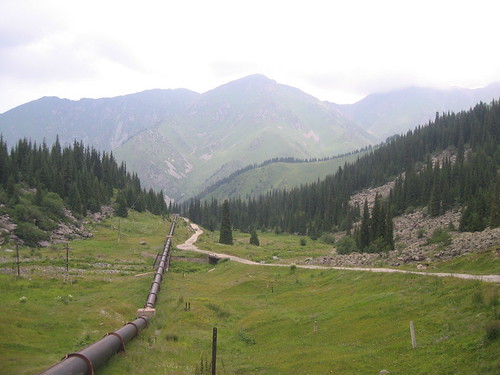
Pipelines, even buried ones, are easy to sabotage as anyone who has followed the situations in Nigeria and Iraq knows. For many months now Kurdish separatists have threatened harm to the 1100 mile Baku-Tbilisi-Ceyhan pipeline that can transport as much as 1 million barrels/day from the Caspian Sea to tankers in the Mediterranean. Last week a fire began in Eastern Turkey closing the BTC pipeline which at the time was pumping about 800,000 b/d.
At first the Turks denied that the line was sabotaged, but after several press releases from the Kurdistan Workers Party (PKK) claiming responsibility for the fire, they now appear to be waiting the results of an investigation.
The fire caused BP to declare force majeure on shipments of Caspian crude from Ceyhan. News of the fire briefly caused a rise in oil prices late last week, but this was soon overshadowed by the rising US dollar.
The BTC pipeline is still on fire with estimates for repairs running anywhere from two to five weeks. The situation was further complicated last week by the fighting in South Ossetia which resulted in Russian air attacks on the BTC pipeline and an oil shipping port inside Georgia.
BP had been redirecting part of its Caspian oil production to the Georgian Black Sea ports of Batumi and Kulevi, but by Saturday these exports were halted due the fighting.
Exports from Ceyhan are of increasing importance to the US and European oil supply. If the pipeline has been sabotaged by the PKK as they claim, it sets an important precedent and once again shows how vulnerable are the world’s oil and gas pipelines. The pipeline from Kirkuk in Northern Iraq has recently reopened after many years of continuous attacks partly because of increased security and partly because it is advantageous to would-be attackers to keep the pipeline open. These situations, however, are constantly in flux and renewed disagreements over the status of Kirkuk could easily lead to more pipeline closures.
Also at Energy Bulletin, high doomer Dmitri Orlov ponders
The trouble with Georgia.
To the conquering Russians, Georgia represented the rich, creamy heart of the incredibly tough nut of the Caucasus region. In contrast to the many small and taciturn mountain tribes, many of them either Moslem or animist, here was an Orthodox Christian nation with great traditions of art, music, architecture, poetry, an unparalleled joie de vivre, and a delicious national cuisine. Georgians easily secured for themselves a pleasant role within the empire. Leaving administrative chores to the Russians and commerce and the trades to the Armenians, they were free to indulge in more pleasant pursuits, such as feasting, falconry, and entertaining foreign visitors. This trend had carried over into Soviet times, making Georgian Soviet Socialist Republic a favored tourist destination, a prosperous place complete with amusing wines, delicious food, an exuberantly friendly population that spoke your language, and majestic mountains for a backdrop. In the interest of maintaining public order, the Russians tried to be even-handed in their treatment of the non-Georgian tribes. Knowing full well just how much trouble they can be, they administered their territories as autonomous units within Georgia. One of the more glaring exceptions to this was the arbitrary administrative inclusion of Abkhazia within Georgia, which was done by Joseph Stalin (Dzhugashvili), who was a Georgian, and which in many ways laid the ground for the current conflict.
Their being so well coddled within the fold of the great empire cultivated in the Georgians a sense of exceptionalism and entitlement vis à vis their smaller and poorer neighbors, which, once the Soviet Union collapsed and the Russians departed, gave rise to a particularly rabid, venomous, and ultimately self-destructive brand of nationalism. The first post-independence Georgian leader, Zviad Gamsakhurdia, was killed rather quickly. Part of his nationalist rhetoric involved labeling other tribes, such as the Abkhaz and the Ossetians, as newcomers and gypsies, who are only welcome as "guests" on Georgian soil.
Next up was Eduard Shevardnadze, who was Foreign Minister of the USSR under Gorbachev, and who was more or less handed Georgia as his personal fiefdom by the West, as his reward for idly standing by and smiling pleasantly while the Berlin wall was being torn down. He was given UN recognition and foreign aid, and told to go ahead and try to preserve "Georgia's territorial integrity." At this he failed miserably, causing a senseless bloodbath and a flood of refugees. Shevardnadze slowly sank into a morass of corruption and national decay, until finally even the West decided that he smelled bad and unceremoniously replaced him with a shiny new face: the American-educated Mikhail Saakashvili.
And this brings us to the current conflict, which he started. It is unclear why he decided to start it, but then his American education might offer a clue: the US doesn't seem to need good reasons to start wars either.
It may be difficult for some people to grasp why it is that the Abkhaz or the Ossetians do not much fancy suddenly becoming Georgian, so let me offer you a precise analogy. Suppose Los Angeles, California, were to collapse as the USSR once did, and East L.A. quickly moved to declare its independence. Suppose, further, that the 88% of its population that is Hispanic/Latino voted that the other 12% were free to stay on as "guests," provided they only spoke Spanish. The teaching of English were to be forbidden. After some bloody skirmishes, East L.A. split up into ethnic enclaves. Then some foreign government (say, Russian, or Chinese) stepped in and started shipping in weapons and providing training to the Latino faction, in support of their efforts to restore East L.A.'s "territorial integrity." As a non-Hispanic resident of East L.A., would you then (1) run and hide, (2) stay and fight, or (3) pick up a copy of "Spanish for Dummies" and start cramming?
The Abkhaz and the South Ossetians have made their preference very clear by applying for and being issued with a Russian passport. That's right, the majority of the present native population of these two "separatist enclaves" are bona fide citizens of the Russian Federation with all the privileges appertaining thereto. Lacking any other options, they are happy to accept protection from Russia, use Russian as their lingua franca, and fight for their right to be rid of Georgians once and for all. One of the privileges of being a Russian citizen at this stage, when Russia has recovered from its political and economic woes following the Soviet collapse, is that if some foreign entity comes and shells a settlement full of Russian citizens, you can be sure that Russia will open one amazingly huge can of whoop-ass on whoever it feels is responsible. Add to that the atrocities allegedly perpetrated by the Georgian forces, such as finishing off wounded Russian peacekeepers, and you can see why the normally shy and reticent Russian army might get behind the idea of making sure Georgia no longer poses a military threat to anyone. The Georgians have really done it to themselves this time, and we should all feel very sorry for them. They are not evil people, just incredibly misguided by their horrible national politicians. The West, and the US in particular, bear responsibility for enabling this bloodbath by providing them with arms, training, and encouraging them to fight for their "territorial integrity."
This, it will no doubt turn out, was the wrong thing to do. The term "Georgia's territorial integrity" has been bantered about and proffered lamely as an excuse for an untenable status quo for almost two decades now, with poor results. In the meantime, the territorial integrity of another semi-defunct state, Serbia has been sacrificed on the altar of geopolitics. Kosovo, which is Serbia's historical homeland, has been cleansed of Serbians, and alienated from Serbia proper. For those who are vague on the details of that conflict, here is a summary. Kosovo became majority-Albanian due to Albanians' higher birth rate. The Albanians then formed Kosovo Liberation Army, which fought Serbians for independence and lost. Albanians then fled en masse to Albania. The US and NATO then intervened, bombed Kosovo and Serbia, repatriated the refugees, and turned Kosovo into a UN protectorate. The next step from the West's point of view is to recognize Kosovo's independence, taking it away from Serbia forever.
If Kosovo is to Serbia as Abkhazia and South Ossetia are to Georgia, what, you might ask, is the key difference that mandates a different outcome for the latter? Well, there are quite a few (neither is Georgia's historical homeland, both fought for independence and won, both are populated by indigenous tribes rather than newcomers from across the border), but the most salient seems to be this one: Serbia, Abkhazia, and South Ossetia are all BAD (aligned with Moscow) while Georgia is GOOD (aligned with the West and US, and wants to join NATO). Morality, which, I am sure, underpins Western and US foreign policy, dictates that the bad be punished, and the good rewarded. I submit to you that such self-serving logic is a political dead end, and that if senseless bloodshed is to be stopped and peace is to be restored to the Caucasus, Western and US leaders will have to activate several additional brain cells, and stop mindlessly repeating the meaningless phrase "Georgia's territorial integrity."
Financial Sense also has a look at the conflict -
Russia Invades Georgia.
A s these words are written, Russian mechanized troops are moving against the Republic of Georgia. The Georgian leadership has been taken by surprise. They did not think the Russians would go this far. So the question has to be asked: Why is Russia invading Georgia now? What would a war between Georgia and Russia accomplish?
Some observers have stated that Russia wouldn’t dare invade Georgia. Such an invasion would bog them down in an endless fight against Georgian guerrillas. From the Kremlin standpoint this wouldn’t necessarily be a bad outcome. First, the suppression of ragtag forces is always possible if the invader is persistent and determined. In Chechnya the Kremlin’s determination has been unwavering and brutal for almost nine years. Nobody thinks Russia has lost the war in Chechnya.
During World War II one of Hitler’s generals fretted about Russian partisans. Hitler corrected the general. Fighting partisans was a sign of victory, he explained. It meant that the enemy’s main forces were defeated. It meant that Germany’s losses would be comparatively minor. Only those who cannot keep the field in regular warfare hide in caves and snipe at convoys from the underbrush. In totalitarian terms, the Russian action is entirely rational.
One thing is certain: the Russian invasion of Georgia, if it continues, will mark a turning point. Why are the Russians acting in such a bold manner? Some may speculate that it’s about the price of oil, as the world’s second-longest oil pipeline passes through Georgia. And this point should be considered. But more than anything, the invasion impacts U.S.-Russian relations in a decisive manner. It changes the political atmosphere in Europe and the Far East, in Washington and London and Tokyo. The Kremlin strategists already know that the global economy is headed for trouble. This means growing political weakness within the democratic countries.
Already America has been weakened on many fronts. In strategic terms, this may be the perfect moment for Russia to break with the United States. There may never be a better moment to paint America as an imperialist aggressor. In Washington D.C., however, there is no desire for a break with Russia. American policy-makers have long assumed that Russia is a friendly country. They have assumed that disagreements can be worked out, and peace will prevail. There has been no real preparation for a renewed Cold War. Western politicians pose the following questions: Why should the Russians shoot themselves in the foot? Why should they damage their own economic chances? But these questions misunderstand the real situation.
The Russians see America’s weakness. First and foremost, the Americans are unwilling to bomb Iran. They have upset the Saudis by building a Shiite democracy in Iraq. The Americans have angered the Turks by supporting the Iraqi Kurds. The Americans have weakened NATO by admitting too many FSB/KGB-influenced countries into the NATO fold. The Russian leadership probably feels it is time to tip everything over. It is time to expose America’s weakness. What will President Bush do? By the time you read these words, the White House will probably have issued a statement denouncing the Russian invasion. But will American troops be sent to Georgia?
As for the moral justifications now being mounted by the Kremlin, a few words are necessary. Moscow’s claim of Georgian ethnic cleansing in Ossetia is as cynical as it is hypocritical. One only has to take a look at Chechnya. Russian atrocities in that part of the world are famous. The real issue is the fact that Georgia’s leadership threw off Moscow’s shackles and aligned itself with the United States. Even though there is no formal alliance between the United States and Georgia, the two countries have become close. There are U.S. military advisors in Georgia. The border of NATO is directly to the south. The Russian attack on Georgia may a way of testing NATO. It may, in fact, lead to the unraveling of NATO.
Would the United States send troops to Georgia?
Anticipating events, the Russians have long accused the Americans of attempting to push Russia out of the Caucasus. Russian propagandists have said that Westerners are greedy for oil (i.e., the Baku oil fields). It has even been alleged that America has fueled the war in Chechnya and seeks to destroy Russia itself. This is ridiculous, of course, but Russian nationalism is stirred by such allegations.
Noting the proximity of Azerbaijan to Iran, one ought to speculate on the fact that a war has been brewing between Iran and the U.S. for three years. By invading Georgia the Russians are assuring the Iranians of Moscow’s readiness to confront the U.S. By invading Georgia the Russians are exacerbating the global energy crisis by strengthening all anti-American forces in the Middle East.
The price of oil isn’t merely about oil. It is about food, the U.S. dollar and power-politics. Westerners, however, are always “mystified” when the Russians seem to act contrary to their own economic interest (as if economic interests were the only interests). It is true that Russia has benefitted from high energy prices. More significantly, Russia will benefit even more when the U.S. dollar collapses.
And to close, one from
The Daily Mail -
The Pipeline War: Russian bear goes for West's jugular.
The war in Georgia escalated dangerously last night after Russian jets reportedly bombed a vital pipeline that supplies oil to the West.
After a day of heightening international tensions, Georgian leaders claimed that the Baku-Tbilisi-Ceyhan pipeline, which transports oil from the Caspian Sea to Turkey, had been attacked. But it is thought the bombs missed their target.
Their claims came after Russian jets struck deep into the territory of its tiny neighbour, killing civilians and ‘completely devastating’ the strategic Black Sea port of Poti, a staging post for oil and other energy supplies.
Reports last night also said that Russia had bombed the international airport in Tbilisi.
Georgian economic development minister Ekaterina Sharashidzne said: ‘This clearly shows that Russia has targeted not just Georgian economic outlets but international economic outlets as well.’
The pipeline is 30 per cent owned by BP and supplies 1 per cent of the world’s oil needs, pumping up to a million barrels of crude per day to Turkey.



 Posts




