Showing posts with label csiro. Show all posts

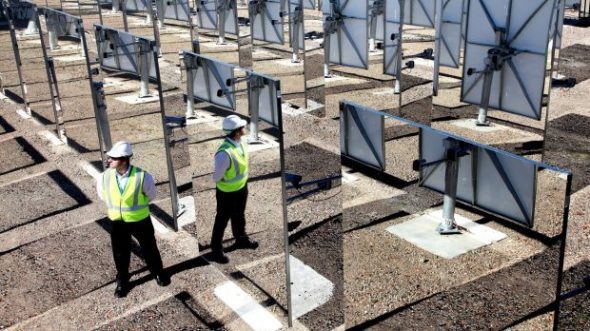
CSIRO inks major China solar thermal power deal  

Posted by Big Gav in , , , ,

RNE reports that Australia's CSIRO agency is licencing its solar thermal power technology to the Chinese- CSIRO inks major China solar thermal deal, but home market remains stalled.

Australia’s top science and research organisation, the CSIRO, has inked a deal with Chinese company Thermal Focus to make, sell and install its patented concentrating solar thermal generation technology in China. The partnership is a major coup for the CSIRO, particularly considering the potential market for CST in China, which just last month was named by the IEA as one of the countries most likely to lead the world in a solar

China’s plans for CST – to build 1.4GW of capacity 2018, and 5GW by 2020 – will double the world’s installed CST plants, and the CSIRO deal puts its proven solar heliostat technology in a prime position to bid for a piece of this action.

Australian ocean energy could power Melbourne by 2050: CSIRO study  

Posted by Big Gav in , , , ,

ReNew Economy points to a new study from the CSIRO on ocean power potential in Australia - Australian ocean energy could power Melbourne by 2050: study.

Did you know that wave energy has the potential to supply about 11 per cent of Australia’s electricity – the equivalent to powering a city the size of Melbourne – by 2050?

If the results of yesterday’s Climate Institute’s “Climate of the Nation 2012″ report are anything to go by, you probably didn’t. Because while that study found overwhelming support among Australians for the development of renewables, most of this was directed towards solar, wind and hydro, with only 25 per cent of respondents nominating wave energy as their most preferred option (although this number still beat out nuclear and coal).

The fact is, not nearly enough is known about ocean renewable energy in Australia – a situation the CSIRO hopes to redress with its new report, “Ocean renewable energy: 2015-2050.” The report, released today – and from which the above fact was gleaned – is the result of the CSIRO’s efforts to understand the potential of this clean energy source, and to inform the ocean energy industry, government and investors about the challenges and potential for the technology.

“Given the potential of ocean energy and the fact that it’s a very new technology, CSIRO wanted to understand what is the sustainable level at which this resource could be used for energy supply and whether it could be competitive with other energy technologies,” said Ian Cresswell, acting director of the CSIRO Wealth from Oceans Flagship. “Assessing the opportunities and challenges from resource to the market is a first for ocean renewable energy in Australia.”

The study was carried out by the Wealth from Oceans and Energy Transformed Flagships and included an analysis of the resource, cost to market, technologies and future take-up projections by oceanographers, engineers, economists. It also engaged the ocean energy industry and related sectors.

As the report – which can now be viewed online – points out, wave energy converters are still an emerging technology. CSIRO’s research uncovered at least 200 devices around the world in various stages of testing and demonstration, but found that relatively few had publicly available data on deployments at sea in full operational mode. ...

Nonetheless, the study identified 16 Australian companies that are either actively developing ORE projects, have received significant government and/or private funding, or have announced ORE plans; and it pointed to some home-grown technologies being offered to the market – the most advanced being the CETO submerged buoy system, and the OceanLinx oscillating water column system.

The largest ORE project in Australia (recipient of a $66 million grant from the federal government) was identified as the construction of a wave farm off the coast of Victoria by Ocean Power Technologies Australasia (OPTA), a company with a US-based parent.

As for Australia’s ocean energy potential, the report found that Australia has an abundant wave energy resource and could produce 24-hour power, either from the tides, currents or waves. The nation’s best resource was found to be concentrated along the southern coastline, as well as a consistent, yet smaller, contribution on the east coast – although the report said characterisation of this resource area required further attention.

The areas the report says could benefit most from wave energy technology include Perth, the southern coastline, and (less-so) the east coast of Australia (see chart below). It also found that tidal technology could supply niche areas such as north east Tasmania and WA’s Kimberley region and ocean thermal energy off the coast of far north Queensland.

CSIRO Solar field construction timelapse video  

Posted by Big Gav in , ,

The CSIRO has some video of the construction of a solar thermal power R&D facility - Solar field construction timelapse.

For your viewing pleasure: the construction of CSIRO Solar Field 2, in just over a minute.

A chilled future for solar power ?  

Posted by Big Gav in , , , ,

The Climate Spectator has an article on research into a solar powered air cooling system which could help reduce the spiralling cost of network transmission expansion required to meet the growing summer peak loads created by air conditioning units - A chilling future for solar power.

Everyone seems pretty comfortable with the idea that the energy from the sun can be captured to heat stuff and create electricity. But what if we were able to use it to address one of Australia’s greatest needs: how to cool things down, particularly the air inside your home; and one of its greatest challenges – reducing peak loads on the network?

This is one of the ideas being developed by the CSIRO at its Energy Research Centre in Newcastle. And the technology – known as Solar Cooling – is now at the point of commercialisation. And it is so simple it can be bolted on to the solar hot water systems that are already so prevalent in suburbia – and add space heating in winter and cooling in summer to the hot water that is already delivered by the solar collectors.

The irony of this development is that it offers the opportunity for a renewable energy source to provide a solution for a problem it is often blamed for creating – rising electricity costs.
The reality is that the greatest component of rising energy bills is the cost of network upgrades, and the biggest reason for these is the growth in peak energy demand, driven largely by the rush to install household air conditioning systems, which now account for around 50 per cent of peak demand on some networks.

Indeed, such is the scale of the rollout of domestic air-con, and its impact on networks, that it now qualifies as the most heavily subsidised sector of the electricity grid – far greater than rooftop solar, or large-scale wind farms.

For every $1000 invested in an air-conditioning system, it is estimated that another $3000 is required to upgrade the network. That translates into an added cost of $100 per year on the electricity bills of those who either choose not to have air-con in their home, or who can’t afford it.

Reducing peak demand is one of the biggest challenges facing energy market operators. In Australia, it is estimated that one quarter of the nation’s electricity costs go to catering for around 40 hours of peak demand – those occasions of extreme temperatures when everyone turns on their air-con at the same time and when the electricity demand is nearly doubled. If this technology based around solar panels on the roof can be rolled out at scale, it could offer one of the best opportunities to significantly lower those peak loads and reduce the need to upgrade and expand networks and help flatten the anticipated spikes in domestic electricity bills.

The principle behind Solar Cooling systems being developed by the CSIRO is simply to integrate technologies that are already understood – the rooftop panels on the roof that heat the water, and which can then be used to heat air; a desiccant wheel to dry the air; and evaporative systems to cool the air.

Stephen White, the manager of the CSIRO’s Energy for Buildings division, says the advantage of this system is that it can operate at relatively low temperatures – 50°C to 70°C – which are common for solar hot water systems.

Incoming hot, moist, humid air is dehumidified using a desiccant such as a silica gel on a rotating wheel to create a dry air stream which is then cooled using an evaporative cooler. The desiccant absorbs the moisture from the air. This material is then stripped of moisture (regenerated) using solar heat.

The CSIRO believes that electricity costs could be reduced by half – and would be a much more efficient use of resources, because the solar collectors would be in use all year round, while a conventional air conditioner system might be in use for just 7 per cent of the time.
“We see it as three in one solar thermal product for the home – a solar hot water system, and space heating in winter, and cooling in summer when the sun is shining the hardest," Dr White says. “It matches very nicely." It is likely that these systems will be able to bolt on to already installed solar hot water systems.

The CSIRO has already developed a prototype called REDEcool which can be used in households and is now looking for a manufacturing partner to help refine the design, and the costs, for mass production. Dr White says the capital cost of the system will be more than the $1000 that people pay for the air-con systems they buy from shops, but it should be cheaper than the $4000 network cost.

Wave Power Potential In Australia  

Posted by Big Gav in , , , ,

The CSIRO recently released a report on the potential for wave power in Australia. Australia's southern coastline has been identified by the World Energy Council as one of the world's best sites for generating wave power.

The report (pdf) shows that if 10 per cent of the energy available from waves was harnessed it would meet half of the nation's current electricity consumption. "Averaged over the whole year, Australia's southern coastline has a sustained wave energy resource of 146 gigawatts (1,329 terawatt-hours/year)" - three times Australia's total installed generation capacity.


The author of the study, Dr Mark Hemer, notes wave power is still a decade or two away from being a real force as an alternative energy. "Wave energy really is a baby at the moment - there's currently only about four megawatts of wave energy generating capacity installed globally. If you compare that to wind energy, there's about 200,000 megawatts of installed capacity, or 50,000 times more, so wave energy is a long way behind on the cost learning curve."

Australia's longest running pilot wave power program has been run by Oceanlinx in Wollongong for number of years, but the latest incarnation recently suffered a setback when it was damaged by a storm. Oceanlinx are also looking to participate in the UK's "wave hub" program in Cornwall.

The other company aggressively pursing wave power opportunities in Australia is Perth based Carnegie Wave Energy, which has a plant operating in WA and is looking to build another in Eden, NSW.

The other major source of ocean energy available to Australia is tidal power.

One major backer of tidal power in northern Australia was Wilson Tuckey (who lost his seat in the recent federal election. While Tuckey's dreams of tidal power in the Kimberly region remain unrealised, NT News has a report on a tidal power project proposed nearby in the northern territory by Tenax Energy in the Clarence Strait.

Another Australian tidal power hopeful, Atlantis Resources, seems to have shifted offshore entirely, recently unveiling the world's largest tidal turbine for testing in Scotland.

Scientists map out Australian wave energy hotspots  

Posted by Big Gav in , , ,

The ABC has a report on the potential of wave power in Australia, noting "Australian scientists have mapped out the best places across the nation's southern coast for generating wave energy, all the way from Geraldton in Western Australia to King Island in Tasmania" - Scientists map out wave energy hotspots.

A new CSIRO energy atlas shows that if just 10 per cent of the energy generated from waves was harnessed it would meet half of the nation's current electricity consumption. Australia's southern coastline has been identified by the World Energy Council as one of the world's best sites for generating wave energy.

The Centre for Australian Weather and Climate Research's Dr Mark Hemer says even the small fraction of energy harnessed from Australia's coast will be enough to meet future government targets. "If we look at the sustained energy resource along the southern coastline - and we're looking between Geraldton in West Australia and southern tip of Tasmania - that has a sustained wave energy resource of about... five times larger than Australia's present day electricity consumption," he said. "It's a small fraction... we figure out that if we could harness just 10 per cent of the wave energy along a 1,000km strip of the southern coast, then that would be enough to meet the Australian Government's renewable energy targets of 20 per cent renewable energy before 2020."

Dr Hemer says wave energy is not a quick fix and it is still a decade or two away from being a real force as an alternative energy. "Wave energy really is a baby at the moment - there's currently only about four megawatts of wave energy generating capacity installed globally," he said. "If you compare that to wind energy, there's about 200,000 megawatts of installed capacity, or 50,000 times more, so wave energy is a long way behind on the cost learning curve."

CSIRO denies censoring climate paper  

Posted by Big Gav in ,

The ABC has a report on the efficiency of Australia's proposed ETS, which one CSIRO scientist (accurately) views as far inferior to a carbon tax - CSIRO denies censoring climate paper.

Dr Clive Spash is an ecological economist who has worked for the CSIRO since 2006, specialising in the interactions between the environment and the economy.

In Dr Spash's paper, which he has not been allowed to publish, he argues that carbon trading - like the emissions trading scheme being promoted by the Federal Government - appears to be ineffective in reducing greenhouse gas emissions.

He says more direct measures such as a carbon tax or new infrastructure would be simpler and more effective.

His paper was submitted for publication in the UK journal New Political Economy earlier this year.

But in July the CSIRO wrote to the editors, telling them the paper was being withdrawn because it had not been approved through internal CSIRO processes.

Oil That Grows On Trees  

Posted by Big Gav in , , ,

The SMH reports that CSIRO scientists have developed a process to make "biocrude" from organic waste (via The Oil Drum ANZ).

AUSTRALIAN scientists have made a biofuels breakthrough, turning waste products like paper and wood trimmings, crop residue and garden clippings into a stable "bio-crude".

If successfully commercialised, the process could massively reduce the amount of waste going into landfills and help the biofuels industry steer clear of the controversial food versus fuel debate. Most of the world's biofuel is made from food crops such as corn and sugar. Many oppose biofuels because they believe they will lead to higher food prices and hunger among the poor.

The great hope is second-generation technology that enables fuel to be made from waste material like the stalks and leaves of food crops. Using the process developed by the CSIRO and Monash University, bio-crude could be made on-site at the likes of timber mills then trucked or piped to a refinery to be turned into a petrol substitute.

Steven Loffler from CSIRO Forest Biosciences said the new process had taken 18 months to develop and the key breakthrough was producing a bio-crude that was stable enough to be stored and transported. Until now, bio-crude made from waste quickly broke down and became useless.

"By making changes to the chemical process, we've been able to create a concentrated bio-crude which is much more stable than that achieved elsewhere in the world," Dr Loffler said. "This makes it practical and economical to produce bio-crude in local areas for transport to a central refinery, overcoming the high costs and greenhouse gas emissions otherwise involved in transporting bulky green wastes over long distances."

In Australia, biofuel production is still very small, accounting for less than 0.5 per cent of transport fuel consumption. NSW has a 2 per cent biofuels mandate and the Federal Government pays a subsidy for biofuel production.

But the Parliamentary Library in Canberra has just produced a report saying there is no evidence to support a mandate. The report noted the subsidised cost of creating jobs in the Australian ethanol industry was already so high that "it would be cheaper to pay each worker average weekly earnings to do nothing".

More at Science Daily and the Herald Sun.
The bio-crude oil can be used to produce high value chemicals and biofuels, including both petrol and diesel replacement fuels. ...

“By using waste, our Furafuel technology overcomes the food versus fuel debate which surrounds biofuels generated from grains, corn and sugar,” says Dr Loffler. “The project forms part of CSIRO’s commitment to delivering cleaner energy and reducing greenhouse gas emissions by improving technologies for converting waste biomass to transport fuels.”

The plant wastes being targeted for conversion into biofuels contain chemicals known as lignocellulose, which is increasingly favoured around the world as a raw material for the next generation of bio-ethanol. Lignocellulose is both renewable and potentially greenhouse gas neutral. It is predominantly found in trees and is made up of cellulose; lignin, a natural plastic; and hemicellulose.

Statistics

Locations of visitors to this page

blogspot visitor
Stat Counter

Total Pageviews

Ads

Books

Followers

Blog Archive

Labels

australia (619) global warming (423) solar power (397) peak oil (355) renewable energy (302) electric vehicles (250) wind power (194) ocean energy (165) csp (159) solar thermal power (145) geothermal energy (144) energy storage (142) smart grids (140) oil (139) solar pv (138) tidal power (137) coal seam gas (131) nuclear power (129) china (120) lng (117) iraq (113) geothermal power (112) green buildings (110) natural gas (110) agriculture (91) oil price (80) biofuel (78) wave power (73) smart meters (72) coal (70) uk (69) electricity grid (67) energy efficiency (64) google (58) internet (50) surveillance (50) bicycle (49) big brother (49) shale gas (49) food prices (48) tesla (46) thin film solar (42) biomimicry (40) canada (40) scotland (38) ocean power (37) politics (37) shale oil (37) new zealand (35) air transport (34) algae (34) water (34) arctic ice (33) concentrating solar power (33) saudi arabia (33) queensland (32) california (31) credit crunch (31) bioplastic (30) offshore wind power (30) population (30) cogeneration (28) geoengineering (28) batteries (26) drought (26) resource wars (26) woodside (26) censorship (25) cleantech (25) bruce sterling (24) ctl (23) limits to growth (23) carbon tax (22) economics (22) exxon (22) lithium (22) buckminster fuller (21) distributed manufacturing (21) iraq oil law (21) coal to liquids (20) indonesia (20) origin energy (20) brightsource (19) rail transport (19) ultracapacitor (19) santos (18) ausra (17) collapse (17) electric bikes (17) michael klare (17) atlantis (16) cellulosic ethanol (16) iceland (16) lithium ion batteries (16) mapping (16) ucg (16) bees (15) concentrating solar thermal power (15) ethanol (15) geodynamics (15) psychology (15) al gore (14) brazil (14) bucky fuller (14) carbon emissions (14) fertiliser (14) matthew simmons (14) ambient energy (13) biodiesel (13) investment (13) kenya (13) public transport (13) big oil (12) biochar (12) chile (12) cities (12) desertec (12) internet of things (12) otec (12) texas (12) victoria (12) antarctica (11) cradle to cradle (11) energy policy (11) hybrid car (11) terra preta (11) tinfoil (11) toyota (11) amory lovins (10) fabber (10) gazprom (10) goldman sachs (10) gtl (10) severn estuary (10) volt (10) afghanistan (9) alaska (9) biomass (9) carbon trading (9) distributed generation (9) esolar (9) four day week (9) fuel cells (9) jeremy leggett (9) methane hydrates (9) pge (9) sweden (9) arrow energy (8) bolivia (8) eroei (8) fish (8) floating offshore wind power (8) guerilla gardening (8) linc energy (8) methane (8) nanosolar (8) natural gas pipelines (8) pentland firth (8) saul griffith (8) stirling engine (8) us elections (8) western australia (8) airborne wind turbines (7) bloom energy (7) boeing (7) chp (7) climategate (7) copenhagen (7) scenario planning (7) vinod khosla (7) apocaphilia (6) ceramic fuel cells (6) cigs (6) futurism (6) jatropha (6) nigeria (6) ocean acidification (6) relocalisation (6) somalia (6) t boone pickens (6) local currencies (5) space based solar power (5) varanus island (5) garbage (4) global energy grid (4) kevin kelly (4) low temperature geothermal power (4) oled (4) tim flannery (4) v2g (4) club of rome (3) norman borlaug (2) peak oil portfolio (1)
