Posted
by Big Gav
in
brightsource,
chevron,
csp,
enhanced oil recovery,
solar thermal power
Bloomberg has an article on enhanced oil recovery using solar thermal energy in California - Chevron Uses Solar-Thermal Steam to Extract Oil in California.
Chevron Corp. (CVX), the second-largest U.S. oil company, began extracting crude from a southern California field using steam produced by a 29-megawatt solar- thermal power plant. BrightSource Energy Inc.’s system uses mirrors to focus sunlight on a boiler at Chevron’s Coalinga, California, enhanced oil recovery project, the solar company said in a statement after extraction began today.
Solar-thermal technology companies such as BrightSource are targeting industrial users in the oil-recovery and food- processing industries as customers as well as power generation. Mining and metals processing are also very promising, especially in remote areas where power can also be generated along with heat, Charlie Ricker, BrightSource senior vice president of business development, said today in an interview. ...
The Coalinga plant consists of 3,822 mirror systems, or heliostats, each with two 10-foot (3-meter) by 7-foot mirrors mounted on a 6-foot steel pole focusing light on a 327-foot solar tower. Steam created by the heat is fed into the oil reservoir, making it easier to bring to the surface. The system began generating steam in August, Kristin Hunter, a spokeswoman for Oakland, California-based BrightSource, said today in an e- mail.
Areva SA’s Areva Solar, Seville, Spain-based Abengoa SA, Erlangen, Germany-based Solar Millennium AG (S2M) and Burbank, California-based eSolar Inc. are competing with BrightSource with their own solar-thermal technology. Glasspoint Solar Inc., based in Fremont, California, makes solar steam generators for the oil and gas industry using mirrored troughs inside of glasshouse enclosures to protect the mirrors.
Enhanced oil recovery, or EOR, fits very well with solar temperatures, Glasspoint Vice President John O’Donnell, said today in an interview.
Some 32 percent of California’s industrial and commercial gas use is for EOR as its use grows in the U.S. and all over the world, O’Donnell said. The state produces about 40% of its oil using EOR and in a few years that will grow to 60%, he said.
The company can produce heat for EOR for about $3 per million British thermal units, compared with about $4 for a comparable natural-gas plant in the U.S. and between $10 to $12 for other conventional solar thermal technologies, O’Donnell said. “We are the only ones below natural gas right now in the U.S.”
Posted
by Big Gav
in
enhanced oil recovery,
thai
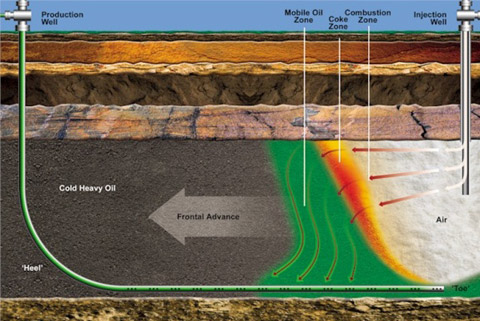
Kurt Cobb has an article at Scitizen on a new enhanced oil recovery technique (saying nothing about the greenhouse gas emissions, which are presumably horrendous) - Will Toe-to-Heel Air Injection Extend the Oil Age?.
Currently, the energy for extracting oil from underground must come from the fuel and equipment on the surface. But what if the main source of energy for extracting oil could come from the oil deposit itself? And, what if the method for doing this could provide us with access to oil not amenable to conventional extraction techniques while minimizing disruption of the surface and any associated pollution? This is what the developers of an oil recovery technique called toe-to-heel air injection or THAI suggest they are able to accomplish. And, the technique could increase appreciably the percentage of the world's vast heavy oil resources that we are able to exploit.
The oil the engineers and scientists at Petrobank, the patent holder, have in mind is so viscous that it is not easily budged from its hiding places below the surface. There are other techniques already in use for extracting this oil. But they typically require copious amounts of both water (usually in the form of steam) and energy to work. The THAI process, however, burns some of the oil in the underground deposit in a way that makes the remaining oil flow to the surface on its own through production wells.
This isn't a bonfire, but rather more like a charcoal fire, very hot (400 to 600 degrees C) without flames. Petrobank claims that THAI burns about 10 percent of the oil in place to accomplish its task. The oil is first heated to about 100 degrees C using steam injection. So far this sounds like conventional steam injection technology. But once this critical temperature is reached, the oil is ignited and only air is injected to keep the oil burning. The burning oil creates additional heat which makes the heavy oil flow more easily, and the combustion gases drive the flowing oil toward and up a set of production wells without any pumping. There are other fire flooding techniques. But the particular methods and well configuration of THAI hold great promise for vastly increasing ultimate recovery while minimizing pollution and well failure.
Petrobank claims recovery of between 70 and 80 percent of original oil in place, a truly astounding number. Even if this result proves to be reproducible on a large scale, it won't mean that all heavy oil deposits will be amenable to the THAI process. Some deposits might be too scattered to be economical. Others might not be sufficiently saturated to allow adequate burning and thus high enough temperatures. Yet others might be too close to the surface in which case the fire might break through. Finally, geology, remote location and poor associated infrastructure might make many potential deposits financially too risky to exploit.


 Posts




