Showing posts with label globalisation. Show all posts

Deglobalisation 2.0 ?  

Posted by Big Gav in ,

The Guardian's Economics Blog is declaring that "globalisation is already dead" and that we are now entering a period of de-globalisation - It's too late for hand-wringing – globalisation is already dead.

Donald Trump and Theresa May are not flagbearers in the distance, they are catapults battering at the walls. Trump’s stated intent to pull the US out of the TPP on his first day in office underlines the new reality we inhabit, as does the European Union’s recent troubles closing a trade agreement with Canada thanks to Wallonia’s obstinance. Today, we have a new meme – deglobalisation – as people turn their backs on an interconnected world economy and societies turn iconoclastic.

It is not for the first time.

Globalisation may be defined as when trade across nations is growing faster than GDP. People interact more, transact more and create more wealth. Deglobalisation is the alternate state where trade grows less than GDP. Countries focus inwards, trade declines as a proportion of GDP and growth shrinks. A clear cycle of the two emerges over history.

Glenn Greenwald at The Intercept is making a number of similar points - Democrats, Trump, and the Ongoing, Dangerous Refusal to Learn the Lesson of Brexit.

The indisputable fact is that prevailing institutions of authority in the West, for decades, have relentlessly and with complete indifference stomped on the economic welfare and social security of hundreds of millions of people. While elite circles gorged themselves on globalism, free trade, Wall Street casino gambling, and endless wars (wars that enriched the perpetrators and sent the poorest and most marginalized to bear all their burdens), they completely ignored the victims of their gluttony, except when those victims piped up a bit too much — when they caused a ruckus — and were then scornfully condemned as troglodytes who were the deserved losers in the glorious, global game of meritocracy.

That message was heard loud and clear. The institutions and elite factions that have spent years mocking, maligning, and pillaging large portions of the population — all while compiling their own long record of failure and corruption and destruction — are now shocked that their dictates and decrees go unheeded. But human beings are not going to follow and obey the exact people they most blame for their suffering. They’re going to do exactly the opposite: purposely defy them and try to impose punishment in retaliation. Their instruments for retaliation are Brexit and Trump. Those are their agents, dispatched on a mission of destruction: aimed at a system and culture they regard — not without reason — as rife with corruption and, above all else, contempt for them and their welfare. ...

That analysis was inspired by a short, incredibly insightful, and now more relevant than ever post-Brexit Facebook note by the Los Angeles Times’s Vincent Bevins, who wrote that “both Brexit and Trumpism are the very, very wrong answers to legitimate questions that urban elites have refused to ask for 30 years.” Bevins went on: “Since the 1980s the elites in rich countries have overplayed their hand, taking all the gains for themselves and just covering their ears when anyone else talks, and now they are watching in horror as voters revolt.”

The Economist: Bolshiness Is Back  

Posted by Big Gav in

The Economist has a look at the slide towards deglobalisation in their "World In 2016" edition - Bolshiness Is Back. I'm not sure raising the spectre of Lenin and communism makes much sense though, given that the global left is basically dead and the threat to the liberal order is coming entirely from right wing authoritarian nationalists.

The global economy has delivered too many of its benefits to the richest: in America, the proportion of after-tax income going to the top 1% doubled from 8% in 1979 to 17% in 2007. And in many ways the future looks worse. Productivity growth has slowed. Unless this can be changed, politics will inevitably become a struggle over dividing up the pie. Tech giants such as Google and Amazon enjoy market shares not seen since the late 19th century, the era of the robber barons.

How can liberals save what is left of the liberal order? Part of the solution lies in being more vigorous in its defence—for example, pointing out that globalisation has lifted millions out of poverty and that reversing it will make today’s economic woes much worse. Part of the solution lies in exposing liberalism’s enemies as the paper tigers that they are: Mr Putin, in particular, presides, by fear and fraud, over a country whose economic power is stalling and whose people are plagued by poverty and illness. Other strongmen around the world are far less tough than they claim.

But liberalism’s champions must do more than just repeat tired mantras. They need to take worries about immigration more seriously and check their instinct to ride roughshod over minorities such as evangelical Christians. They also need to redouble their efforts to fix capitalism’s most obvious problems. High levels of inequality are threatening stability. Economic concentration is allowing companies to extract record profits. Overregulation is driving businesspeople to distraction. The revival of bolshiness has already taken a terrible toll. Liberals need to think more clearly, and act more forcefully, to stop the rot.

The Recovery of 2008 ? What Bloody Recovery ?  

Posted by Big Gav in , ,

Crikey has another column from Guy Rundle expounding his theory that the recession in the West (dubbed by some libertarians “the Great Correction") is permanent unless the economic framework is changed (as there is no tool available to policymakers to revive growth in the west under the neoliberal model of globalisation other than letting wages fall to developing world levels, thus inciting some real class warfare - not the nonsense being peddled by demented Fox News pundits about Obama’s proposed tax increases for higher income earners in the US) - The Recovery of 2008 ? What Bloody Recovery ?.

That may well be a more astute judgment about the world than that of the pro forecasters, and more in accord with the notion of materialist economists such as Robert Brenner and David Harvey — that the West is tapped out, and cannot again grow in the neoliberal framework currently imposed on it. In its existing framework, the argument goes, neither free-market nor Keynesian approaches will work. Apply cuts to clear the balance sheet and restore confidence, and the collapse of demand will be so great that the economy will stall — and, something economists never consider, the social unrest from a new wave of poverty will destroy any nascent confidence anyway.

But they also turn on the Keynsians who believe that higher wages and public spending would refloat demand as it did in the postwar period. True, they say, but the aggregate effect, at national and regional levels, will be nothing like you hope. Local industry will not, of course, restart, the money will flow out of the economy to manufacturing sources in the East, and the endlessly promised growth in new sectors — services, etc — won’t eventuate.

Online shopping, automatic checkouts and myriad other automations (of service jobs — hamburger flippers — that it was once assumed would sop up those for whom manufacturing provided employment), narrow the employment base further, and push the poorly educated permanently out of the sphere of work. No public education or training program is in place to make them employable, and individual firms do not need to provide it.

Why is there such a critical assessment of the notion of boom and bust on the street? I suspect it has something to do with the centrepeiece of the “boom" from the ’90s onwards, discretionary consumer spending. In the postwar Keynesian boom, a sense of forward motion was around because people could see not merely consumption but production increasing. Factories reopened after the Depression and the war, cities grew based on rational lending and so on.

In this “boom", people saw not an increase in production, but its dismantling. This occurred as — via franchising, chains, increased advertising presence — consumption spread into every available area of life. Housing became not more affordable but less so, as property prices became dizzyingly unreal, beyond any notion of merely paying for permanent habitation.

In other words, the boom always looked like what it was, a bubble. Its fantastical character was hiding in plain sight. At some level people knew that they were living through an unreality, and that the best thing to do was grab as much sh-t as you can while you can (the English riots were really a repetition of that, done at high speed and in dell’arte style).

Yet even if people were willing to accept this stasis, it is not possible to do so. The Western economy is boxed in. Slash costs? You would need to drive down pay levels, abolish the legally mandated minimum wage and usher in ever greater levels of inequality — effectively restarting large-scale class conflict. Stimulate production? What would be stimulated? What remains of the economic sectors that could grow fresh roots — only low-employment “services", intellectual property rents and the like.

Stimulate consumption? You would deepen the debt reliance of Western economies whose savings levels are zero — and, culturally, simply extend a set of expectations of consumption that cannot be sustained on a mass basis. Indeed it is the near-total reliance on consumption that tells us how late in the day the ’90s/2000s boom-bubble was, how desperate its attempt to fill in the gap. Capitalism has always lived by holding something back — the fruits of people’s labour, and the promise of satisfaction chief among them. For two hundred years, the system has relied on two techniques — violence and ideology — to create compliance. After violence, the system was sold on the notion that a thrifty, modest life was a sign of virtue, that honest work was its own reward.

From the 1870s onward, Western capitalism had a demand crisis, and the modern science of demand creation — advertising, the shopping arcade/mall — dates from this time. Confined initially to a privileged class, such consumption was made general in the 1950s, and then — in the ’90s — was cut loose of any notion of rational accounting. That is surely, a very late, if not a final stage, of system maintenance by demand creation — and what makes the current era interesting is that we are now out the other side of it, and no one knows what to do about it. And everyone knows it.

The Local / Global Flip  

Posted by Big Gav in ,

Jaron Lanier has an interesting column at Edge Magazine, looking at the phenomenon of companies “flipping” from local to global businesses - The Local / Global Flip.

The Apple idea is that instead of the personal computer model where people own their own information, and everybody can be a creator as well as a consumer, we're moving towards this iPad, iPhone model where it's not as adequate for media creation as the real media creation tools, and even though you can become a seller over the network, you have to pass through Apple's gate to accept what you do, and your chances of doing well are very small, and it's not a person to person thing, it's a business through a hub, through Apple to others, and it doesn't create a middle class, it creates a new kind of upper class. ... Google has done something that might even be more destructive of the middle class, which is they've said, "Well, since Moore's law makes computation really cheap, let's just give away the computation, but keep the data." And that's a disaster.

... If we enter into the kind of world that Google likes, the world that Google wants, it's a world where information is copied so much on the Internet that nobody knows where it came from anymore, so there can't be any rights of authorship. However, you need a big search engine to even figure out what it is or find it. They want a lot of chaos that they can have an ability to undo. ... when you have copying on a network, you throw out information because you lose the provenance, and then you need a search engine to figure it out again. That's part of why Google can exist. Ah, the perversity of it all just gets to me.

... What Wal-Mart recognized is that information is power, and by using network information, you could consolidate extraordinary power, and so have information about what could be made where, when, what could be moved where, when, who would buy what, when for how much? By coalescing all of that, and reducing the unknowns, they were able to globalize their point of view so they were no longer a local player, but they essentially became their own market, and that's what information can do. The use of networks can turn you from a local player in a larger system into your own global system.

... The reason this breaks is that there's a local-global flip that happens. When you start to use an information network to concentrate information and therefore power, you benefit from a first arrival effect, and from some other common network effects that make it very hard for other people to come and grab your position. And this gets a little detailed, but it was very hard for somebody else to copy Wal-Mart once Wal-Mart had gathered all the information, because once they have the whole world aligned by the information in their server, they created essentially an expense or a risk for anybody to jump out of that system. That was very hard. ... In a similar way, once you are a customer of Google's ad network, the moment that you stop bidding for your keyword, you're guaranteeing that your closest competitor will get it. It's no longer just, "Well, I don't know if I want this slot in the abstract, and who knows if a competitor or some entirely unrelated party will get it." Instead, you have to hold on to your ground because suddenly every decision becomes strategic for you, and immediately. It creates a new kind of glue, or a new kind of stickiness.

... It can become such a bizarre system. What you have now is a system in which the Internet user becomes the product that is being sold to others, and what the product is, is the ability to be manipulated. It's an anti-liberty system, and I know that the rhetoric around it is very contrary to that.

... Essentially what happened with finance is a larger scale, albeit more abstract version of what happened with Wal-Mart, where a global system was optimized by being able to build data that could be concentrated locally using a computer network. It tremendously enriched the people who ran the network. It seemed to create savings for people initially who were the end users, the leafs of the network, very much as Google, or Groupon, seem to save them money initially. But then in the long-term it took away more from the income prospects of people than it could offer them in savings, very much as Wal-Mart did. ... This is the pattern that we'll see repeated again and again as new applications of computer networks come up, unless we decide to monetize what people do with their hearts and brains. What we have to do to create liberty in the future is to monetize more and more instead of monetize less and less, and in particular we have to monetize more and more of what ordinary people do, unless we want to make them into wards of the state. That's the stark choice we have in the long-term.

...if you're adding to the network, do you expect anything back from it? And since we've been hypnotized in the last eleven or twelve years into thinking that we shouldn't expect anything for what we do with our hearts or our minds online, we think that our own contributions aren't worth money, very much like we think we shouldn't be paid for parenting, or we shouldn't be paid for raking our own yard. In those cases you are paid in a sense because there's still something that becomes part of you in your life, for all that you did. ... But in this case we have this idea that we put all this stuff out there and what we get back are intangible or abstract benefits of reputation, or ego-boosting. Since we're used to that bargain, we're impoverished compared to the world that could have been and should have been when the Internet was initially conceived. The world that would create a strengthened middle class through what people do, by monetizing more and more instead of less and less. It's possible that that world could have never come about, but that was never tested. If we are absolutely convinced that this third way is impossible, and that we have to choose between "The Matrix" or Marx, if those are our only two choices, it makes the future dismal, and so I hope that a third way is possible, and I'm certainly going to do everything possible to try to push it.

Reality as a failed state  

Posted by Big Gav in , , , ,

Bruce Sterling points to this interesting screed on the impossibility of getting everyone to agree on a set of facts in the modern media / psychological landscape - Reality as failed state.

So maybe what we have today are not problems, but meta-problems.

It is very useful to confirm our understanding with others, to meet with fellow humans – preferably face-to-face – strength flows from this.

However, disquiet remains - no pre-catastrophic change of course seems in any way likely. What we might call ‘Fabian’ environmentalism has failed.

Occasionally a scientist will be so overcome with horror that he will make a radical public pronouncement – like the drunken uncle at a wedding, he may well be saying what everyone knows to be true, pulling the skeletons out of the family closet for all to see, but, well, it just doesn’t do to say that sort of thing out loud at a formal function.

This is all a little bit strange.
We understand the problems. We also, pretty much, understand the solutions. But their real-world application is a whole unpickable, integrated clusterfuck.

I believe part of the meta-problem is this: people no longer inhabit a single reality.

Collectively, there is no longer a single cultural arena of dialogue.

What many techno-scientists fail to understand - and thus find most frustrating - about dealing with climate change deniers is that the denier has no real interest in engaging at the scientist’s level of reality.

The point, for the climate denier, is not that the truth should be sought with open-minded sincerity – it is that he has declared the independence of his corner of reality from control by the overarching, techno-scientific consensus reality. He has withdrawn from the reality forced upon him and has retreated to a more comfortable, human-sized bubble.

In these terms, the denier’s retreat from consensus reality approximates the role of the cellular insurgents in Afghanistan vis-a-vis the American occupying force: this overarching behemoth I rebel against may well represent something larger, more free, more wealthy, more democratic, or more in touch with objective reality, but it has been imposed upon me (or I feel it has), so I am going to withdraw from it into illogic, emotion and superstition and from there I am going to declare war upon it.

So, from this point of view, we can meaningfully refer to deniers, birthers, Tea Partiers and so forth as “reality insurgents”, and thus usefully apply the principles of 4GW to their activities – notably, they are clearly operating on a faster OODA loop than the defenders of mainstream reality, and thus able to respond more quickly, with greater innovation, than the sclerotic bureaucracy of institutionalised reality. [Open source bazaars – media-effective denial memes spread virally through community far quicker than effective strategies of rebuttal do.]

(n.b. There is a problematic tendency with a certain type of intellect – the scientist, the technocrat – which assumes that, because it is prepared to organise and change on the basis of dry statistics and data, then, if only everyone else could be exposed to the same data, there would be instant consensus for change. In fact, of course, the majority of human beings do not work like this.

Indeed, there is a positive, indeed, cognitively vital, aspect to intuitive thinking, and the realm of myths, narratives, paradigms of meaning, purpose and significance underlies even the worldview of the technocrat-scientist. Without an ability to engage with and understand the deep psyche, the techno-scientist is doomed to repeat his statistics into the ether without meaningful effect.)

The deniers are operating from a different ontological platform – an emotional reading of reality where there are forces wishing to control them and restrict their personal power and agency, and there are the forces of freedom, which is the side they believe they are on.

They are wrong, of course, but it is important to demonstrate to them that they are wrong on the level they are operating from – not by citing more climate statistics at them, but by demonstrating that the forces they are serving are actually the most vicious extant representatives of the control they profess to hate.

And all this is but one example of the ways in which the traditional ideological blocs of the Cold War have fragmented into complex multipartite civil reality wars.

Reality, you might say, as failed state; its interior collapsing into permanent conflict under the convergent pressures of deviant globalisation, its coasts predated upon by new mutant forms of memetic pirates.

Adrift on global market currents  

Posted by Big Gav in

Jeffrey Sachs has a column in The Business Spectator noting that a major reason for the economic morass Europe and the US are in is globalisation, and that policy needs to change from tax cuts to tax increases for the rich and increased investment in the future - Adrift on global market currents.

A failure of economic strategy and leadership lies behind the near simultaneous collapse of market confidence in the eurozone and US economies. No need to blame the ratings agencies: governments in Europe and America have been unable to cope with the realities of global capital markets and competition from Asia – and deserve the lion’s share of the blame.

I’ve watched dozens of financial crises up close, and know that success means showing the public a way out that is bold, technically sound and built on social values. Transatlantic leadership is falling short on all counts. Neither the US nor Europe have even properly diagnosed the core problem, namely that both regions are being whipsawed by globalisation.

Jobs for low-skilled workers in manufacturing, and new investments in large swaths of industry, have been lost to international competition. Employment in the US and Europe during the 2000s was held up only by housing construction stoked by low interest rates and reckless deregulation – until the construction bubble collapsed. The path to recovery now lies not in a new housing bubble, but in upgraded skills, increased exports, and public investments in infrastructure and low-carbon energy. Instead, the US and Europe have veered between dead-end, consumption-oriented stimulus packages and austerity without a vision for investment.

Macroeconomic policy has not only failed to create jobs, but also to respond to basic social values too. Let me be clear: good social policy does not mean running big deficits. Public debts are already too large in both Europe and the US. But it does mean a completely different balance between cuts to social services and tax increases on the rich.

The simple fact is that globalisation has not only hit the unskilled hard but has also proved a bonanza for the global super-rich. They have been able to invest in new and highly profitable projects in emerging economies. Meanwhile, as Warren Buffett argued this week, they have been able to convince their home governments to cut tax rates on profits and high incomes in the name of global tax competition. Tax havens have proliferated even as the politicians have occasionally railed against them. In the end the poor are doubly hit, first by global market forces, then by the ability of the rich to park money at low taxes in hideaways around the world.

An improved fiscal policy in the transatlantic economies would therefore be based on three realities. First, it would expand investments in human and infrastructure capital. Second, it would cut wasteful spending, for instance in misguided military engagements in places such as Iraq, Afghanistan, and Yemen. Third, it would balance budgets in the medium-term, in no small part through tax increases on high personal incomes and international corporate profits that are shielded by loopholes and overseas tax havens.

Are we entering an age of reverse-globalization ?  

Posted by Big Gav in , ,

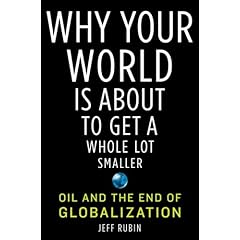
Tyler Hailton at Clean Break has a review of Jeff Rubin's book "Why Your World Is About to Get a Whole Lot Smaller: Oil and the End of Globalization" - Are we entering an age of reverse-globalization ?.

The International Energy Agency is getting a bit worried. It sees that low oil prices — or at least low compared to last summer — have led to under-investment in energy infrastructure, particularly exploration of oil and gas. It also knows that when the economy shifts into recovery mode demand will pick up fast and supply will be slow to respond. It predicts there will be a supply crunch by 2012, and of course that means oil prices will be rocketing back up.

This scenario, of course, may be understating the problem about to hit world economies, says former CIBC chief economist Jeff Rubin, whose new book Why Your World Is Going to Get a Whole Lot Smaller hit the market today. I’ve got a feature book review here, but in a nutshell Rubin believes conventional oil production has already peaked and unconventional production won’t be able to keep up with demand once global economies recover, and not just because of the incredible appetite the Chinese have for oil. Rubin argues that excessive consumption in the Middle East, massive local subsidies there for oil, and the use of oil-fired power plants to run energy-intensive desalination facilities will shrink the amount of oil supply that OPEC puts on the world market. Ultracheap cars to appear in India and likely to spread around the world, thanks to Tata Motors, will mean even more demand for oil products.

Oil prices are destined to once against skyrocket into triple-digit territory, and the impact will be inflation on everything, including our food and the fuel we use to drive our cars and heat/power our homes. In fact, gas prices will become so high that people will be forced to ditch their cars, housing prices in the suburbs will plunge, urban areas will grow more dense, and there will be a renaissance in local agriculture and urban farmers’ markets. The high cost of transporting goods from far-off markets will lead to the re-emergence of domestic manufacturing. High oil will override any labour-cost benefits that countries such as China can offer.

What Rubin is describing is essentially a deathblow to globalization and a return to regional economic trade, similar to what world trading patterns were like in the 1970s. And he’s not describing what the world will look like in 20, or even 10 years. I had a chance to meet Rubin for a quick coffee last week and he told me we’ll begin seeing the pattern emerge within the next 18 months, and that smart businesses and people should begin to adjust their lifestyle now if they hope to minimize the pain and discomfort of adapting to a new world. I told him I’m loving the fact I have a variable interest rate mortgage and am paying 1.35 per cent interest right now. His response: lock in now, cause it will be short-lived. It really got me thinking about my own situation.

Will we all be caught off guard by what’s to come if Rubin is right?

What’s interesting about Rubin is that he left a well-respected, high-paying job after 20 years at a major Canadian bank to focus exclusively on delivering the above message. And he’s not alone in trying to paint a picture of the smaller world to come. Christopher Steiner, a senior staff reporter at Forbes magazine, will be delivering a similar message when his new book, $20 Per Gallon, launches this July. Seems we’ve moved on from talk of reaching peak oil to discussion of how peak oil will impact us now that it’s here.

Rubin isn’t saying we’re going to have to stop using oil or that we’re going to run out. What he’s saying is that it’s going to become so expensive that it will cause inflation everywhere and will force many people, many businesses, to seek alternatives or simply get by with using less. With the exception of using less (i.e. conservation), all other options will be expensive. The oil companies don’t care, of course, because they’ll get top dollar for the barrels they do sell. The rest of us, we’ll just be screwed.

If you do get your hands on Rubin’s book I urge you to read Chapter 7 — “Just How Big Is Cleveland — in which he provides an excellent explanation of how high oil prices last summer caused the recession we are in right now. Rubin says high oil led to inflation, which equals higher interest rates, which caused many U.S. homeowners to default on their mortgages when they came up for renewal. When that started to happen the dominos began to fall and this exposed the underbelly of the mortgage-back securites fiasco that led to the crisis on Wall Street. High oil prices knocked down the house of cards that Wall Street had built over the years.

Statistics

Locations of visitors to this page

blogspot visitor
Stat Counter

Total Pageviews

Ads

Books

Followers

Blog Archive

Labels

australia (619) global warming (423) solar power (397) peak oil (355) renewable energy (302) electric vehicles (250) wind power (194) ocean energy (165) csp (159) solar thermal power (145) geothermal energy (144) energy storage (142) smart grids (140) oil (139) solar pv (138) tidal power (137) coal seam gas (131) nuclear power (129) china (120) lng (117) iraq (113) geothermal power (112) green buildings (110) natural gas (110) agriculture (91) oil price (80) biofuel (78) wave power (73) smart meters (72) coal (70) uk (69) electricity grid (67) energy efficiency (64) google (58) internet (50) surveillance (50) bicycle (49) big brother (49) shale gas (49) food prices (48) tesla (46) thin film solar (42) biomimicry (40) canada (40) scotland (38) ocean power (37) politics (37) shale oil (37) new zealand (35) air transport (34) algae (34) water (34) arctic ice (33) concentrating solar power (33) saudi arabia (33) queensland (32) california (31) credit crunch (31) bioplastic (30) offshore wind power (30) population (30) cogeneration (28) geoengineering (28) batteries (26) drought (26) resource wars (26) woodside (26) censorship (25) cleantech (25) bruce sterling (24) ctl (23) limits to growth (23) carbon tax (22) economics (22) exxon (22) lithium (22) buckminster fuller (21) distributed manufacturing (21) iraq oil law (21) coal to liquids (20) indonesia (20) origin energy (20) brightsource (19) rail transport (19) ultracapacitor (19) santos (18) ausra (17) collapse (17) electric bikes (17) michael klare (17) atlantis (16) cellulosic ethanol (16) iceland (16) lithium ion batteries (16) mapping (16) ucg (16) bees (15) concentrating solar thermal power (15) ethanol (15) geodynamics (15) psychology (15) al gore (14) brazil (14) bucky fuller (14) carbon emissions (14) fertiliser (14) matthew simmons (14) ambient energy (13) biodiesel (13) investment (13) kenya (13) public transport (13) big oil (12) biochar (12) chile (12) cities (12) desertec (12) internet of things (12) otec (12) texas (12) victoria (12) antarctica (11) cradle to cradle (11) energy policy (11) hybrid car (11) terra preta (11) tinfoil (11) toyota (11) amory lovins (10) fabber (10) gazprom (10) goldman sachs (10) gtl (10) severn estuary (10) volt (10) afghanistan (9) alaska (9) biomass (9) carbon trading (9) distributed generation (9) esolar (9) four day week (9) fuel cells (9) jeremy leggett (9) methane hydrates (9) pge (9) sweden (9) arrow energy (8) bolivia (8) eroei (8) fish (8) floating offshore wind power (8) guerilla gardening (8) linc energy (8) methane (8) nanosolar (8) natural gas pipelines (8) pentland firth (8) saul griffith (8) stirling engine (8) us elections (8) western australia (8) airborne wind turbines (7) bloom energy (7) boeing (7) chp (7) climategate (7) copenhagen (7) scenario planning (7) vinod khosla (7) apocaphilia (6) ceramic fuel cells (6) cigs (6) futurism (6) jatropha (6) nigeria (6) ocean acidification (6) relocalisation (6) somalia (6) t boone pickens (6) local currencies (5) space based solar power (5) varanus island (5) garbage (4) global energy grid (4) kevin kelly (4) low temperature geothermal power (4) oled (4) tim flannery (4) v2g (4) club of rome (3) norman borlaug (2) peak oil portfolio (1)
