Showing posts with label gorgon. Show all posts

Boom gathers pace as resource projects surge  

Posted by Big Gav in , , , , , ,

The Australian has a report on the investment boom in resource (particularly natural gas) projects in Australia - Boom gathers pace as resource projects surge.

THE resources boom is gathering strength as companies commit to new mega-projects in Queensland and Western Australia and gear up for a massive surge in investment over the next year.
In the past six months, resource companies have given firm commitments to 33 new projects worth a combined $43.9 billion, led by investments in coal-seam gas, iron ore and new coalmines.

The government's resource industry adviser, ABARE, now has 94 projects worth $173.5bn on its books, a 31 per cent increase since last October. … The biggest new project announced in the past six months was the $16bn coal-seam gas venture in Gladstone, which is being led by Santos. Gas and oil projects account for $101bn, or 60 per cent of the total number of projects under construction.

One major component in the investment boom is Chevron’s Gorgon LNG project in WA - The Australian reports that the WA government is continuing to insist on 15% of the gas being supplied to the domestic market - Chevron close to domestic gas deal on Gorgon project.
CHEVRON says it is close to signing contracts to supply gas to industrial users from its $43 billion Gorgon project in Western Australia after it reached a crucial access agreement with the Dampier-Bunbury Pipeline to transport the fuel.
The US energy giant's Australian operations head, Roy Krzywosinski, said yesterday the access agreement meant all the infrastructure contract arrangements were in place to supply the energy-hungry WA market by 2015.
…

Major industrial users have complained for several years about a lack of cheap gas supplies for mines, alumina plants, fertiliser operations and power stations. The Woodside Petroleum-operated North West Shelf Venture and Apache's Varanus Island are the only suppliers to the domestic gas market.

But Apache's $US1bn Devil Creek project is expected to become the next major domestic gas supplier later this year. The project will inject up to 220 terajoules of extra gas into the state's domestic system every day.

A parliamentary inquiry into gas pricing in WA found that prices were double those in other states, and recommended domestic gas reservation requirements should remain.
The producers have strongly opposed the reservation policy, which stipulates that 15 per cent of a project's output may have to be set aside for domestic needs.

Mr Krzywosinski said work on Chevron's estimated $30bn Wheatstone project would begin before the end of the year, generating 6500 direct jobs at peak construction and $21bn in government revenue.

WA Today reports that the gas industry continues to generate a lot of protest, with the latest round complaining about the proposed Kimberly gas hub - John Butler stands up to Woodside.
WA musician John Butler has led a lunchtime musical protest outside mining giant Woodside's city offices in protest against its proposed Kimberley gas hub.
The multiple ARIA award-winning musician performed on the steps of Woodside’s St George’s Terrace skyscraper as part of a nationwide stance against industrialisation of the Kimberley. Rock stars including Jimmy Barnes and Midnight Oil's Rob Hirst entertained crowds in Sydney while musician Shane Howard hit Melbourne’s Swanston Street.

Woodside, with joint-venture partners Chevron, BP, Shell and BHP, plan to build a multi-million dollar gas processing hub at James Price Point on the Dampier Peninsula, north of Broome. The move has sparked outrage from environmentalists as the area is frequented by migrating humpback whales, untouched beauty and gardens of unique coral.

Gor-gone?  

Posted by Big Gav in , , ,

The SMH has an article pondering how much of the investment being made into the Gorgon gas project will be spent in Australia - Gor-gone?.

It has been dubbed Western Australia's own stimulus package. However, the value of most contracts awarded so far in the $43 billion Gorgon liquefied natural gas juggernaut will either head overseas or cannot be guaranteed to include Australian content and local jobs.

A BusinessDay analysis of the $10 billion or so in contracts awarded to date shows more than a quarter will definitely head overseas, prompting calls by unions to maximise the value of the gas project to benefit its owners, the Australian public.

The Australian Workers Union says it will monitor the flow of contracts. Another $2 billion worth are expected to be announced before Christmas. ''We think projects like Gorgon should not just be beneficial for resources workers in the north-west but for manufacturing workers on the east coast as well,'' said Paul Howes, national secretary of the Australian Workers Union.

''No one is disputing that Gorgon is big, and there will always be things that we don't make here. But, where possible, Australian processes operated by Australian workers should take precedence in delivering this major Australian project.''

The large numbers attached to Australia's largest resource development can make you giddy. The operator, Chevron, and the joint venture partners ExxonMobil and Shell will tap into the 40 trillion cubic feet of gas in the greater Gorgon field off the north-western coast. About 120 million tonnes of greenhouse gas will be pumped into aquifers under Barrow Island, resulting in a saving of 40 per cent in emissions.

A total of 15 million tonnes of LNG will be produced each year at Barrow Island from 2014 for the 30-year life of the project. About 83 per cent of that has already been sold through sales and purchase agreements. Chevron says it will spend $33 billion on local goods and services.

A report by ACIL Tasman on the economic benefits of Gorgon puts its contribution to Australia's gross domestic product at $64 billion and revenue to the state and federal governments at about $40 billion.

At its peak Gorgon is expected to generate 10,000 direct and indirect jobs - figures Chevron says are conservative. It seems unnecessary to pump up the already colossal figures but the Gorgon spin machine, and that of the Federal Government, has been in overdrive.

Take, for instance, the hundreds of billions of dollars attached to the off-take agreements. If those are to believed, then it assumes that LNG prices will rise from current levels of about $400 a tonne to somewhere north of $1100. Analysts forecast the long-term price of LNG to reach about $600 a tonne.

A $50 billion price tag was attached to ExxonMobil's 2.25 million tonnes a year deal with PetroChina, announced in August. But even PetroChina scoffed at whether it would amount to that much over the 20 years of the deal.

''There is no such conception [$50 billion] in the total trade value of the agreement as some media reported'' PetroChina's parent, China National Petroleum, said at the time.

But the question does arise if gas prices were to almost triple. And that price is usually one-sixth of the oil price, so does that mean petrol prices are also set to zoom? Perhaps that is why the Government is reluctant to break down these numbers.

Details of the carbon capture and storage part of the project, set to be a ''world demonstration of CCS technology'' are also sketchy.

Carbon Storage: Why the Gorgon Gas Play Might Be Really Important  

Posted by Big Gav in , , ,

Keith Johnson at The WSJ's Environmental Capital blog has a post on the importance of the gigantic carbon sequestration experiment about to be performed by the Gorgon LNG project on Barrow Island off Western Australia - Carbon Storage: Why the Gorgon Gas Play Might Be Really Important.

Under the terms of the agreement, the companies will be responsible for the storage of the carbon-dioxide resulting from the natural-gas project during its operating lifetime and for 15 years afterward, Bloomberg reports. After that, the Australian national and state governments will be responsible.

There are several ways to read that decision. It could be a supreme vote of confidence in the long-term security of underground storage of carbon dioxide. Companies that have spent years monitoring small carbon-storage operations have indeed found no cause for alarm so far. Australia might also figure that the economic and employment benefits associated with the project outweigh any slight future risk. Or, the Australian government might simply figure it’s a risk-free agreement since nobody in office will be alive in 2069 anyway.

Japan, Korea sign $70b Gorgon gas export deals  

Posted by Big Gav in , , , ,

The SMH reports that Chevron has now sold most of its share of future gas production from the Gorgon field off WA - Japan, Korea sign $70b Gorgon gas export deals. Note the projected income from these sales is based on a much higher oil price than at present.

THE giant Gorgon project in Western Australia has signed a binding agreement worth $70 billion with Japan and Korea to export almost 3 million tonnes of liquefied natural gas a year until 2039.

As the joint venture partners prepare to deliver a final investment decision as early as next week, the project's operator, Chevron, firmed up three in-principle deals negotiated in 2005.

Under the deal, Japan's Osaka Gas will take 1,375,000 tonnes a year over 25 years starting in 2014. The larger Tokyo Gas will take 1.1 million tonnes a year over the same period.

GS Caltex, a major South Korean energy company, will take 500,000 tonnes a year over 20 years, partly from Gorgon and the rest from Chevron's other gas projects.

Chevron, which has a 50 per cent interest in the project - ExxonMobil and Shell each have 25 per cent - will sell down its equity in Gorgon. Osaka Gas will purchase a 1.25 per cent share and Tokyo Gas 1 per cent, leaving Chevron with 47.75 per cent. The equity deals will require the approval of the Foreign Investment Review Board but are not considered to be a concern.

The three deals leave about 2.7 million tonnes a year of LNG for Chevron to sell. Market sources say the company is in talks with China National Offshore Oil Corp and China Petroleum & Chemical Corp (known as Sinopec) to sell the remainder. Chevron expects final sales to be completed ''in the coming months''.

China remains hungry for LNG even after ExxonMobil agreed last month to supply the state-owned PetroChina with 2.25 million tonnes a year from the Gorgon project over 20 years - establishing it as Australia's biggest trade deal.

The Prime Minister, Kevin Rudd, said the $50 billion Gorgon project was on track to become Australia's biggest single infrastructure investment, creating up to 6000 jobs and generating $40 billion in revenue for the Government.

''It has been a great four weeks for Australia's LNG sector,'' he said. ''More than 2250 cargoes of Australian LNG have been delivered to Japan since 1989 and these agreements … mean there will be many more to come.

''Throughout the Asia Pacific, Australian LNG will be increasingly important as a reliable, secure, clean energy source to power continued economic growth.''

Doubts have been raised about the headline figures attached to the Gorgon LNG deals. A recent Goldman Sachs JBWere report gave current LNG prices at $US322 ($374) a tonne. Forecasts for 2014, when the project is expected to start exporting, are about $450 a tonne. This figure values the three deals at about $32 billion. To arrive at a figure more than double that, even allowing for the 2.25 per cent equity interest, would mean the Government is forecasting oil prices, from which the LNG price is calculated, to soar.

Gorgon Again - A $50b gas deal with China  

Posted by Big Gav in , , , , ,

The SMH reports that following the Gorgon consortium's deal with India recently, they have followed up with an even larger Chinese gas supply agreement - Piping hot: $50b gas deal with China.

THE largest single trade deal in the nation's history - a $50 billion contract to sell liquefied natural gas to China - was sealed in Beijing last night, signalling the resources boom is far from over.

The contract, hailed by the Federal Government as an indicator Australia's relationship with Beijing remains sound, will supply China with gas for 20 years.

The gas will come from the Gorgon project off Western Australia. The joint venture between ExxonMobil, Shell and Chevron is expected to start production in five years and contains deposits worth $300 billion.

ExxonMobil signed the deal with the state company PetroChina in Beijing. It is twice the value of the deal the Gorgon partner signed last week with India.

The Resources Minister, Martin Ferguson, flew to China to witness the signing, saying it showed Australia had a future as ''a global energy superpower''. ''This agreement is testimony to the strength of Australia's continuing trade and investment relationship with China,'' he said. ''As China continues to develop as a modern global industrial and commercial powerhouse, Australia is committed to walking with it on its remarkable journey.''

The Business Spectator also has some thoughts on the project - What Gorgon means for Australia.
The $50 billion Gorgon gas deal with China will personally affect every person in Australia. The tremors will be just as great in the eastern states as they are in Western Australia.

In the publicity that goes with the deal, much is made of the construction activity and the on-going revenue that Gorgon will generate. Those benefits are huge but they are dwarfed by the fact that the deal cements in the amazing link between the Australian dollar and the Chinese economy.

And if someone can wake up the Canberra politicians, it is also a signal that renewables alone will not solve our carbon problems. What we need is the combination of gas and renewables and in Queensland we have the combination of low carbon-emitting coal gas reserves of North West Shelf proportions, connected to an eastern states pipeline network (New energy can't wait, July 15).

Gorgon underlines the significant research that has been undertaken by HSBC which shows the Australian dollar has become the mirror image of Chinese economic activity.

Measuring Chinese economic activity is always difficult, but HSBC has isolated Chinese electricity production as the most reliable measure of the Chinese economy. Our dollar and Chinese electricity share the same graph, at least over the past three years.

It is impossible to understate the importance of this development. The Chinese now know that they can invest in Australia and not face a serious currency risk. We are going to see them buy property in the eastern states and they will support our debt markets on a much larger scale.

There is enormous concern in China about the US currency and the fact that there could be huge losses ahead for China if the American dollar falls. The HSBC research shows that China does not face that risk in Australia. Global investors who want to invest in China can do so via Australia with far less risk. Accordingly our share market is set to follow China (Ten steps to a new world order, July 29).

The Business Spectator also has an article on Santos' recent gas deals - Santos' French connection.
The Santos deal with French owned GDF Suez is a reminder to Australians that we have very little understanding of the value the world is putting on gas in politically secure areas. GDF Suez is the biggest gas distributor in Europe and it is very conscious that two thirds of global gas comes from Russia and the Middle East and neither are reliable long term suppliers. That’s why it is looking at what’s available in Australia.

GDF Suez is paying $US200 million up front for 60 per cent of the Petrel Tern and Frigate gas field in the Bonaparte basin – fields that the sharemarket accorded very little value. But most countries in the world – with the notable exception of Australia – see gas as an important ingredient in cutting carbon emissions while maintaining living standards.

The three Santos fields looked to be too small for conventional LNG but Suez’s floating LNG technology made development feasible.

When Santos banks the $US200 million cheque from GDF Suez it will have more than $A3.8 billion in the bank. Borrowings are about $2 billion, so the Santos net cash position is around $A1.8 billion. That will go close to funding the equity required for the group's two massive projects – Queensland coal-seam gas and PNG gas.

Gorgon Awakening At Last ?  

Posted by Big Gav in , , , , , ,

The Age reports that the Exxon has signed up its first customer for LNG from the Gorogn field off WA, with India's Petronet LNG signing a 20-year agreement to take gas from the project (First Australia-India long-term LNG deal reached).

Under the agreement, Exxon will supply about 1.5 million tonnes per annum from its 25% share of LNG from the project over 20 years (the project as a whole will produce 15 million tonnes a year) - the gas will be delivered to Petronet's new LNG terminal under construction at Kochi in southern India.

WA Environment Minister Donna Faragher has given final environmental approval for the proposed development on Barrow Island, removing one of the remaining obstacles to construction (Green light for Gorgon in time for lucrative deal), and the local press is already reporting on some of the activity required to support the construction of the project (Hercules to airlift Gorgon materials).

Federal Environment minister Peter Garrett also needs to approve the project, though given his recent stance on large scale energy developments he seems unlikely to oppose it (Chevron set to go ahead with big gas project). The Australian reports the project partners are aiming to tick off on developing Gorgon in mid-September. If approved, Gorgon will be the largest Australian resources project and, as federal Resources Minister Martin Ferguson has pointed out, will provide a greater investment than the Rudd government's $42bn stimulus package.

Annual sales from Gorgon would be worth around $12.5bn at current prices and would boost the nation's mineral and energy revenues by 10 per cent, based on government export forecasts for this year (as I've noted previously if all of Australia's proposed gas developments proceed - especially if we include coal seam gas - we'll have to be wary of the "dutch disease").

The Gorgon plant will have three 5 million tonnes a year LNG trains and will produce LNG using the 40 trillion cubic feet of gas in the two Greater Gorgon fields.

The fields, Gorgon and Io/Janz, contain Australia's biggest gas reserves and are expected to support the project, which will start production in 2014 and ramp up to full output 18 months later, for more than 40 years.

The strangest and most unsettling aspect of the project is that the federal government and WA state government will bear the costs for any problems related to sequestration of carbon dioxide from the project in future years, which seems like a spectacularly risky bet for taxpayers over the long run - (Gorgon deal on carbon).

In other Australian gas news, Gas Today has a report on the various projects under consideration further north in the Browse Basin (Browsing gas fields).

And the UK Daily Telegraph has a report on Shell's bid the purchase the rest of coal seam gas producer Arrow Energy (Royal Dutch Shell tables £1.5bn bid for Australia's Arrow Energy).

Gas Today also has a look at the wisdom of exporting LNG in such large quantities over the long term and what this means for local gas consumers (Are we exporting our energy future?).

LNG looks good as oil prices continue to fall  

Posted by Big Gav in , , ,

The Australian has an interesting article on Australian LNG developments, reporting that Chevron are making noise about starting work on the Gorgon project after years of delays - LNG looks good as oil prices continue to fall.

FALLING oil prices are raising interest in Australia's liquefied natural gas sector as oil majors look to boost vital reserves they can no longer secure in areas like Canada's oil sands.

Despite the steep drop in global energy prices over the past nine months, Queensland's coal seam gas sector has been strong as global and local Gladstone LNG proponents jostle for the state's reserves.

On the other side of the country, the long-delayed $50 billion Gorgon LNG project, potentially the nation's biggest development yet, is picking up steam, with operator Chevron labelling it the company's top 2009 priority.

Reserve replacement among international oil companies is a key driver of share prices, meaning they will not sit idle if one of the areas they are in dries up.

"Australia is key on the target list for many companies because they are opportunity constrained and that is evidenced by the numbers that are active here," PricewaterhouseCoopers global LNG leader Michael Hurley said. "If you look at other investment opportunities companies have had in the past few years, there's been a big play for oil sands in Canada," he said.

However, oil sands require an oil price exceeding $US70 a barrel, he said, meaning oil price slides from heights of nearly $US150 in July to about $US50 had companies looking elsewhere. Oil at $US50 was a sweet spot for LNG, where it was still profitable but not high enough to attract companies to alternative upstream sources, he said.

Chevron's Perth offices have become increasingly busy of late. In a presentation to analysts earlier this month Chevron chief executive David O'Reilly said he hoped to approve the massive Gorgon project, to be built on Western Australia's Barrow Island, by the end of the year. A decision on the nearby Wheatstone project, which is slightly smaller at 10 million tonnes a year, is planned for 18 months later.

Unlike oil, gas requires linkage to a market and an approved project to be classed as commercial reserves. This was strengthening the incentive to go ahead with LNG projects, Mr Hurley said.

Mr O'Reilly said Gorgon could grow to four or five trains. "Chevron is exhibiting similar characteristics to most of the other large integrated oil companies: an increasing reliance on very large projects to replace the more diverse existing production base," Credit Suisse analyst Mark Flannery said in a report following Mr O'Reilly's comment.

Also underlying the increasing focus on Gorgon, 25 per cent partner Exxon Mobil, which has previously been seen as a potential hurdle to the project going ahead, this month signed a deal to supply 2 million tonnes a year of gas from the project to PetroChina.

Gorgon To Include Domestic Gas Plant  

Posted by Big Gav in , , , ,

The Australian reports that Chevron is now planning to include a domestic gas plant as part of its Gorgon development - Chevron's domestic gas proposal to coincide with LNG plan. Background material on Australian natural gas can be found here, here and here.

CHEVRON plans to include a domestic gas plant as part of its $20 billion Gorgon liquefied natural gas project in Western Australia. The company had planned to submit a proposal to develop a 300 terrajoule per day domestic gas plant by December 31, 2010 but will now accelerate that to coincide with its development proposals for the LNG project.

The importance of securing new sources of domestic gas in WA was underlined recently when Apache Energy's Varanus Island gas processing facility was shut down after a pipeline explosion, slashing the state's supply by 370 terrajoules per day. The state consumes about 1,000 terrajoules per day of domestic gas.

Australian Natural Gas - How Much Do We Have And How Long Will It Last ?  

Posted by Big Gav in , , , , , , ,

Last year I took a look at the question "Should Natural Gas Be Used To Power New Zealand ?", after reading an article from NZ PEPA executive John Pfahlert arguing that New Zealand should be building new gas fired power stations instead of trying to become carbon neutral, and concluded that this seemed a rather risky strategy - depending on continuing offshore exploration success.

The view of the Australian government and gas industry seems to be that our gas supplies are essentially unlimited, with the phrase "more than a century of supplies left" bandied about at every opportunity. x-Prime Minister John Howard used to dream of Australia becoming an "energy superpower", with a vastly expanded gas (LNG) export industry being a cornerstone of this vision, based on Western Australian LNG exports from offshore gas fields.

In the lead up to the Australian election last year, the APPEA (Australian Petroleum Production and Exploration Association) was also arguing that gas should be our fuel of choice for power generation as we transition away from coal to a clean energy future, an idea which received a limited amount of support from Labor during the campaign. Since the election, the APPEA has continued to promote the vision of a gas fuelled power industry, recommending that at least 70 per cent of new electricity generating stations constructed in Australia to be fuelled by natural gas by 2017 and maintaining that "Australia's vast reserves of clean, natural gas are the key to meeting the nation's energy needs while reducing greenhouse gas emissions and maintaining economic wellbeing".

New Energy Minister Martin Ferguson also views natural gas as the key to Australia's energy security for liquid fuels, in the form of gas to liquids (GTL - as well as its more environmentally unfriendly cousin, coal to liquids, or CTL) and compressed natural gas (CNG). The view that CNG is a way to reduce our consumption of foreign oil is quite a common one, judging by some of the comments made on TOD ANZ - and elsewhere - from time to time.

The thing that strikes me as being rather quaint, to put it mildly, is that we pay anywhere from about $8 billion to $25 billion to import the oil and we get a paltry $4 billion for the gas that we sell to overseas countries. It seems odd to me, especially given gas is a superior fuel for many, many purposes including the use in motor vehicles - Ollie Clark, Natural Gas Vehicle Association


Recently Western Australia has announced that it will build a new coal fired power station to meet growing energy demand, ruling out a natural gas fueled plant because of supply shortages. This situation which seems to be at odds with both the APPEA's recommendation and with the notion that we have so much natural gas that we can not only be a large LNG exporter but also use it to fuel both our power plants and our transportation system, along with more traditional domestic and industrial uses.

In this post I'll have a look at how much gas Australia has and how long it will last under a variety of scenarios - from an indefinite continuation of the current rate of production to a pell-mell conversion to use gas for all our energy needs combined with a rapid expansion of LNG exports.

Australian Natural Gas Reserves
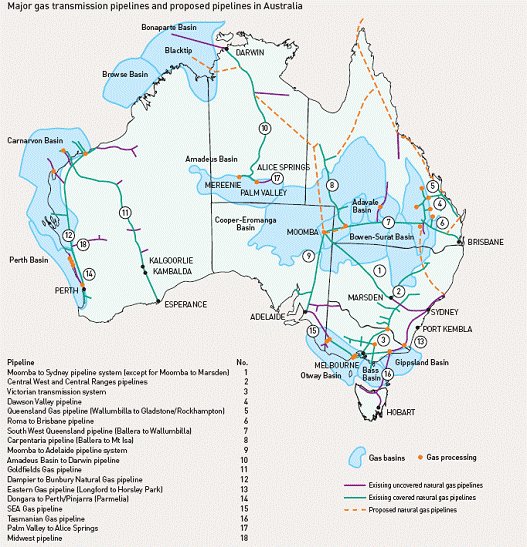


Most of the data in this section was sourced from a paper published earlier this year by Mike Roarty of the Parliamentary Library research section on "Australia’s natural gas: issues and trends", and Brian Fleay's paper "Natural Gas, "Magic Pudding" or Depleting Resource" (pdf), which in turn used data from the Geoscience Australia "Oil & Gas Resources of Australia 2004" (pdf) report. Where newer information has been available I've linked to the source (more often than not either The Australian's Nigel Wilson or Bloomberg's Angela McDonald-Smith, who do the most comprehensive coverage of local energy news).

Cooper Basin - The largest onshore conventional gas reserves occur in the Cooper/Eromanga Basins in north-east South Australia and south-west Queensland. This source currently supplies much of the domestic eastern Australian gas market (South Australia, the Australian Capital Territory, New South Wales, and Queensland), but is mature and now depleting rapidly.

Bass Strait - Victoria and Tasmania are primarily supplied by the Gippsland Basin offshore from south east Victoria, with a newer development in the area, the Kipper field, expected to come online in 2011. There have also been new developments in the Bass and Otway Basins offshore south western Victoria - including the Yolla, Minerva, Casino, Geographe and Thylacine fields. In recent years, BHP have upgraded their estimated of Bass Strait gas reserves, with the Gippsland Basin thought to still contain around 7 tcf of gas.

The older fields in the south east are expected to have run down by 2020, but the newer developments in Bass Strait should extend that date out by another decade.
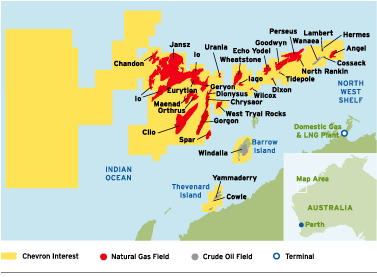
North West WA - Carnarvon and Browse Basins - Over 90 per cent of the reserves are located offshore from northwest Western Australia (Carnarvon and Browse Basins) and in the Timor Sea to the north of Australia (Bonaparte Basin) - far away from the primary domestic gas markets in the south east.

The Carnarvon Basin is home to the existing North West Shelf gas fields - with the Gorgon / Jansz fields being the largest in the country. The area includes a number of fields supplying gas into the domestic gas network, particularly for use by the mining industry. Besides the existing North West Shelf gas project, other planned new LNG projects in the area include the Pluto (at the early stages of construction), Gorgon, Wheatstone and Scarborough fields.

The Browse Basin is the most active new frontier, with the area seeing successful exploration in recent years - reserves figure for Inpex's Ichthys field recently being upgraded by 3.3 tcf to 12.8 tcf of gas, for example. Woodside's planned Browse LNG development is also in this basin.

Northern Territory - Bonaparte Basin / Timor Sea - The area between the Northern Territory and East Timor is the other region currently producing significant amounts of gas (and oil) with an LNG plant recently starting operation in Darwin and other fields being considered for development.

The division of gas revenues from the region between East Timor and Australia has been the subject of a lot of controversy over the years, which has contributed to continuing delays in developing the Greater Sunrise field.

Papua New Guinea - For many years it appeared that a gas pipeline would be built between Papua New Guinea and Australia, enabling east coast gas markets to access the gas reserves held by PNG (estimates range from 14 tcf to 40 tcf). Hopes of this occurring were still flickering as recently as the beginning of the year, however Oil Search and ExxonMobil have now decided to develop an LNG plant instead, making any future pipeline project very unlikely.

How Much Gas Do We Have ?

As at 1 January 2005, Australia’s Category 1 and 2 reserves totalled around 144 trillion cubic feet (tcf), according to the Geoscience Australia report, a slight decline on the previous year.

According to the Financial Times (quoting PFC Energy), Australia has so far produced only about 15 per cent of its gas resources, compared with 25 per cent for Norway and more than 80 per cent for the US’s lower 48 onshore reserves. Whereas US production has peaked (and Norway’s is expected to peak within a matter of years) Australian production is expected to expand until 2030.

BasinReserves (2005)
Carnarvon80.6 tcf
Browse33 tcf
Bonaparte22.9 tcf
Gippsland7 tcf
Otway2.4 tcf
Cooper/ Eromanga1.9 tcf
Others2.5 tcf
Total150 tcf


The table above has been adjusted to include the reserves revisions I've noticed since 2005 - Gippsland Basin from 3.1 to 7 tcf and Browse Basin from 30 tcf to 33 tcf (if you know of any others, please leave a comment).

Since then, based on an annual consumption rate of around 1.8 tcf, we have consumed around 5.4 tcf of gas, which would bring the current reserves number back down to around 144 tcf.

To put the Australian figure in context, proven world gas reserves are estimated to be over 6200 tcf - Australia has around 1.4% of the total.

How do we use the gas ?

In the domestic market, gas is primarily used for :

1. Manufacturing (36% of the total) - smelting, fertilisers, plastics and glass/brick/cement production
2. Power generation (32%)
3. Mining (13%)
4. Residential use (12%) - water heating, space heating and cooking

Obviously these will be joined by transportation if Mr Ferguson's plans for GTL/CNG are put into practice, and power generation will increase in importance if the APPEA's suggestions are implemented.

The fertiliser industry is an interesting one - globally the industry seems to be migrating towards natural gas supplies, particularly in the middle east, but also to Western Australia, where the Burrup plant now produces around 6% of the world's tradeable ammonia.

The rest of our gas goes to the export market, in the form of LNG (plus some condensate).

At present, there are 2 LNG plants in operation - the North West Shelf gas project (operated by Woodside Energy) near Karratha in WA, and the ConocoPhillips Darwin LNG plant in the Northern Territory. The North West Shelf project is the third largest LNG exporter in the world, with its fifth LNG train due to commence operation this year, bringing the capacity of the plant to 16.3 million tonnes (0.85 tcf).

A number of other projects are underway, in planning or actively under consideration - the table below lists all Australian LNG projects (using conventional gas).

ProjectOperatorLocationYearly Capacity FieldsStart Date (Est)
North West ShelfWoodsideKarratha, WA0.85 tcf22 tcfExisting
Bayu UndanConocoPhillipsDarwin, NT0.17 tcf4 tcfExisting
PlutoWoodsideKarratha, WA0.22 tcf5 tcf2010
BrowseWoodsideTBD0.5 tcf18 tcf2015
GorgonChevronBarrow Island0.8 tcf40 tcf2012
IchthysInpexKimberly (TBD)0.3 tcf12.8 tcf2013
SunriseWoodsideFloating0.26 tcf9 tcf2015
ScarboroughBHP BillitonFloating0.3 tcf11 tcf2015
WheatstoneChevronKarratha0.24 tcf4.5 tcfTBD
Evans ShoalMEO AustraliaTassie Shoal0.13 tcf6.6 tcfTBD
Total3.7 tcf132 tcf


Australian LNG exports currently rank in the top 3 globally, however looking at new projects around the world, you can see that Australia's LNG exports will shrink in importance as projects in Qatar, Iran and Russia, in particular, start to deliver large volumes of LNG.

Political Factors

As I noted in the preamble, Western Australia recently opted to build a new coal fired power station instead of using gas as originally planned, due to the shortage of gas in the south of the state.

The WA domestic gas shortage has resulted in a local pressure group called the "DomGas Alliance" being formed to try and force the oil and gas companies holding offshore leases to either develop the fields or relinquish the leases - a move the APPEA oddly claims would "discourage exploration".

Martin Ferguson has also backed the "use it or lose it" idea, though he has apparently already been called in for a "quiet chiding" over this issue by the APPEA.

The APPEA is also unhappy about the state passing a law to force developers of LNG plants to set aside 15% of their reserves for domestic consumption, which is the only sign of the Export Land Model making any form of appearance for Australian energy production - and a pretty feeble one at that.

A planned expansion of the pipeline from Dampier to Bunbury should partly alleviate the gas supply issue by 2010, though in the short term an explosion at Apache Energy's Varanus Island plant has left the state gasping for gas, particularly the mining industry. This outage is expected to take months to repair.

One interesting side effect of the WA law is that BHP is considering building a floating LNG plant for the Scarborough and Thebe fields, partly to avoid these sorts of regulations.

Woodside have also been considering a floating platform for the greater Sunrise project, again in part to avoid any political risks associated with a plant in East Timor.

The only other form of notable state government intervention in the sector is the Queensland government's "smart energy policy" which mandates that 18% of power consumed in the state come from gas by 2020 (up from the earlier 13% target).

The recent federal budget eliminated a tax break for condensate production by the North West Shelf venture, prompting an expression of annoyance from Woodside CEO Don Voelte. At the time it was rumoured the industry would probably see the money returned via incentives for GTL production or faster development of LNG projects.

This has duly happened, with Ferguson kicking off a review of the tax system by Treasury secretary Ken Henry that will "include an assessment of the barriers to investment in large-scale downstream gas processing projects in Australia, the particular hurdles faced by remote gas developers, and consideration of the future policy framework for new sunrise industry development in the gas sector, including new LNG, gas-to-liquids and domestic gas projects".

The point of tax breaks isn't clear to me, given that the primary constraints on development of LNG projects in Australia are firstly finding a customer who will sign up for a long term supply deal and secondly availability of skilled labour and service companies - neither of which will be altered in the slightest.

It may perhaps encourage the development of a GTL project which might otherwise be unviable as a standalone LNG project though, such as Wheatstone.

The most obvious impact of the LNG export industry on the local gas market has been to push gas prices up, as the market is exposed to international supply and demand forces rather than purely local ones. Western Australia has already seen this (Santos CEO David Knox saying prices are headed for "LNG parity") and the same thing seems likely to occur on the east coast.

Another impact of the LNG export industry is that it will further increase the nation's dependence on income from fossil fuel exports.

Coal is currently our major export earner, which has prompted concern about Australia suffering from what is known as "The Dutch Disease" - the theory that an increase in revenues from natural resources will deindustrialise a nation’s economy by raising the exchange rate, which makes the manufacturing sector less competitive. The term was coined in 1977 by The Economist to describe the decline of the manufacturing sector in the Netherlands after the discovery of natural gas in the 1960s.

With the value of gas exports likely to rise to a similar level to that of coal if all the planned LNG projects go ahead, we could see more than a quarter of national GNP coming from these 2 industries.


How long will the gas last ?

According to the Parliamentary Library report, our resources are "capable of sustaining our future production and exports well into and probably throughout the 21st Century". While the paper was published on April 1, it appears to be serious.

Australia’s natural gas consumption for 2005–2006 amounted to 1,184 PJ. Additionally, exports in that year were 12.5 million tonnes (Mt) of LNG equivalent to 685 PJ - a total of 1,869 PJ (equivalent to around 1.77 tcf). Given the reserves and resources figure quoted of 144 tcf, this would mean our gas supplies would last for 81 years at the current rate of consumption.

One complicating factor is the use of biogas. According to the ESAA renewable sources of gas (primarily landfill gas) comprise about 16 per cent of Australia’s domestic gas use - which would equate to around 189 PJ (or 0.18 tcf).

Taking this into account, supplies under this simplistic scenario would last around 90 years - roughly the "end of the century" timeframe mentioned in the Parliamentary Library report.

Of course, neither domestic consumption nor exports are expected to remain static, so let's consider a few additional scenarios.

Note - as these scenarios are just examples, I haven't been particularly rigorous in running the numbers - they should be accurate to within 5% or so. Please bear this in mind if you feel the urge to nitpick - however if you can see any gross errors in the calculations please feel free to derive some alternate figures and explain them in the comments - its entirely possible the conversion factors have gone badly awry in the more complicated scenarios.
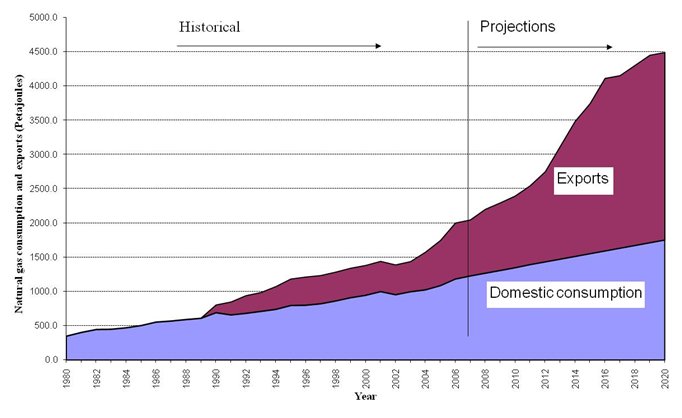


Scenario 1 - Increasing domestic demand and exports until 2020, remaining stable thereafter

The figure above shows the forecast growth in production from ABARE and the ESAA - continuing growth in domestic gas use and a sizeable expansion of LNG export capacity. By 2020, production is expected to reach 4500 PJ per year (or 4.3 tcf).

Allowing for biogas production at the same rate as today, this would mean natural gas supplies would last until 2046 - approximately 38 years.

Scenario 2 - Increasing domestic demand to 2030, static LNG exports from 2020

If domestic gas use continues to expand at the rate shown above, we'd expect to be using 2000 PJ per year for domestic purposes. Assuming no new LNG plants are built after 2020, we would be producing almost 5000 PJ per year (or 4.75 tcf).

Again, allowing for biogas production at the same rate as today, this would mean natural gas supplies would last until 2044 - approximately 36 years.

Scenario 3 - Increasing domestic demand and exports until 2020 (then stable), GTL/CNG for all transportation from 2020

As our energy minister is a strong advocate of using gas for transportation, it is worthwhile considering what would happen if the vehicle fleet was switched over to use CNG and GTL products, combined with scenario 1 for domestic use and exports.

Kiashu was kind enough to try and work out how much gas it would take to replace our current consumption of petrol and diesel, and came up with this set of calculations:
Petrol usually has about 34.6MJ per litre. Natural gas here in Australia is 38.87MJ per cubic metre at atmospheric pressure. Both vary a bit, obviously, but we can use this for some guesstimates. So we see that 1lt petrol is equivalent in energy to 34.6/38.87 = 0.89m3 natural gas.

An ABS survey [pdf- http://www.ausstats.abs.gov.au/ausstats/subscriber.nsf/0/12594B5543CA578CCA2571E2001C705D/$File/9208055005_2006.pdf] tells us that petrol use is a bit uncertain, figures are within about 10% only, but nowadays it's about 20Glt annually [numbered pp78, pdf p13-14].

20Glt petrol is equivalent in energy to 17.8 Gm3 of natural gas.

However, the natural gas must be compressed to 200-220 atmospheres - call it 210. As with the air car, this takes energy. The energy E required to compress air at 25C is,

E = 110,000 x ln (P1/P2) /m3/mol

There are 44.74 moles of methane in 1m3 of natural gas - natural gas is usually about 95% methane, and 5% carbon dioxide, propane, butane, sulphides and so on. Let's assume it's all methane to save ourselves the headaches. We're compressing it to 210 times atmospheric pressure, so P1=210 and P2=1, so the energy required to compress 1m3 of natural gas into CNG will be,

E = 110,000 x ln (210) = 588,181J = 0.59MJ

0.59MJ is 0.59/38.87 = 1.5% of the energy of the natural gas. So turning NG into CNG uses 1.5% of the energy content. Put the other way, you only get 98.5% of the energy from CNG you would from burning NG directly. Thus, 20Glt petrol is equivalent, after compression of NG into CNG, to 18.07Gm3 of NG (not a typo - we don't care about the volume of the CNG, only the NG feedstock)

I don't know about CNG efficiency compared to petrol and diesel. If that's lower or higher it'll obviously affect how much natural gas we need. But we can say that a figure somewhere on the cricket pitch is 18 billion cubic metres of natural gas to replace the 20Glt of petrol we use these days. ...

Hmmm, actually the ABS here says that in 2006 total fuel use was 16.3Glt petrol + 5.74Glt diesel = 22Glt. Must be more than 22Glt by now... but you can take the conversion factor of lt petrol ---> m3 natural gas of 100% --> 90% as being about right. For every 1Glt fuel you replace you want 900M m3 of natural gas.


By my calculations, 900 million m3 of gas equates to 32 billion cubic feet of gas (or 0.032 tcf). So for 22 Glt of fuel, we are looking at 0.7 tcf of gas per year for the present day vehicle fleet.

If we assume the fuel consumption of the national vehicle fleet remains static, and it suddenly switches from petrol and diesel to CNG/GTL in 2020, we'd be consuming 5 tcf per year minus biogas.

This means natural gas supplies would last until 2042 - approximately 34 years (ie. the new gas powered vehicle fleet could be used for just over 20 years before we had to junk it and replace it with electric transportation).

Scenario 4 - Increasing domestic demand and exports until 2020 (then stable), domestic gas use for all new power generation

As noted in the preamble, the APPEA is keen for us to transition to cleaner energy source by using gas for power generation until we get finally around to replacing coal (the dominant source at present) with renewable energy sources.

Doing the numbers (with some input from kiashu again), natural gas contains around 38.8MJ/m3, or 10.78Kwh. Our natural gas reserves of 144 tcf (4077 billion cubic metres) could therefore generate 43,950 billion Kwh (or 3.26 tcf per trillion Kwh) - at 100% efficiency.

Modern natural gas plants manage around 55% efficiency in the turbines, so if we allow for another 5% loss in the system we'll end up with about 23,000 billion Kwh (or 6.26 tcf per trillion Kwh).

National electricity generation in 2006 was 255 billion Kwh. Historically, electricity generation has been increasing at around 3% pa.

Assuming that we generate all new power from gas, natural gas supplies would last until 2043 - approximately 35 years (ie. the new - and old - gas fired generation capacity could be used for just over 30 years before we had to junk it and replace it with renewables as well).

Conclusion

There are a myriad of scenarios that could be applied (try working out one where the export land model applies to our gas exports for example, which would increase the timeframes somewhat, or one where exports keep increasing after 2020, which would significantly decrease the timeframes), but I think its safe to assume that if we start treating natural gas as a silver bullet we will run out in less than 40 years - with gas fired power for new generation being much less intensive in its use of gas than using GTL/CNG for transport.

The X Factors - What Other Sources Of Gas Do We Have ?

In the scenarios outlined above I've used our current known gas reserves as the total supply available.

There are a number of ways of further increasing (or extending the use of) our gas supplies :

1. "Just find more"

Martin Ferguson's preferred approach to oil and gas depletion is apparently to "just find more". This isn't totally out of the question of course - the recent expansion of "Australia" to include all of the continental shelf (see pdf map here) will no doubt include more oil and gas - but how many more years worth is an open question.

The APPEA argues that Australia has 50 sedimentary basins, of which just 12 are producing oil and gas (4 basins have been deemed non-commercial) and that there is still potential for drilling in little explored areas.

How much potential there is depends on your view of exploration programs. If you think that exploration is now a well understood science, and that companies target the most likely areas when exploring, then you'd assume that there isn't a great deal of gas left to be found.

If, on the other hand, you think that exploration is similar to roulette (the cynical view), or that governments and oil companies wish to restrain discovery and production (the conspiratorial view) then there may be much more - maybe twice as much as has currently been discovered.

The safest assumption to make is the first one.

2. Efficiency improvements

There are some obvious areas of improvement that could be made to reduce gas usage on the power generation and domestic use front. A number concentrated solar thermal plants under construction are combined with gas fired power to reduce total gas consumption (though obviously the long term direction for these plants is to burn no fossil fuels at all).

Another mechanism for improving the efficiency of gas usage in power generation is cogeneration (capturing energy from waste heat, which is already done by some large scale industrial users, is another useful technique).

Usage of gas in plastic production could be reduced in some cases by producing bioplastic instead.

Finally, usage of gas for water heating could be reduced or even eliminated using solar hot water heaters.

3. Biogas

As noted earlier, biogas is already providing a proportion of our gas production. Getting a handle on just how much gas could be produced from biomass is quite difficult, but if you consider that methane from waste bananas alone could power a town of around 25,000 people, there is obviously quite a lot of potential. If you read the preceding link you'll see that the German Greens have proposed some incredibly ambitious targets for biogas production in Europe, so it is conceivable that biogas could provide a significant proportion of our energy needs.

Of course, if we produce enough, someone may decide to start turning it into LNG and shipping it offshore, so this wouldn't necessarily be a panacea.

3. "Unconventional" gas sources, Coal Seam Methane and Shale Gas
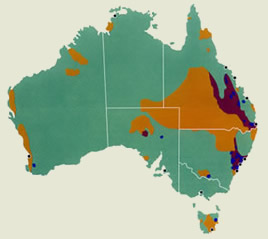
The real X-factor for gas production in Australia is unconventional gas sources, in particular coal seam methane and gas from shale. As both coal and shale are plentiful (and likely to remain so for some time), these are likely to provide significant quantities of gas.

No one seems to be attempting to extract gas from shale in Australia at this point in time, so I won't attempt to quantify how much gas we could possibly obtain from this source (see this post for a discussion of unconventional gas, including from shale, in the US).

Coal seam methane, on the other hand, is now the focus of a boom in Queensland. As there has been so much activity in the area lately (and reserves numbers are so vague) I'll make this the subject of a separate post - and re-run the scenarios based on various estimates of CSM potential.


Use it or lose it  

Posted by Big Gav in , , , ,

The Australian reports that the WA government is looking to force companies sitting on undeveloped gas fields to develop them or lose their rights (along with another comment on the report on natural gas security).

COMPANIES holding undeveloped gas reserves face tougher requirements that could force them to use it or lose it as a result of recommendations published yesterday. A joint working group of officials reporting to two ministerial councils has recommended that existing gas "retention leases" be reviewed and the commercial viability test be re-evaluated.

Under existing legislation, retention leases can be granted over a known gas resource that may not have immediate commercial viability but does have genuine commercial potential in the foreseeable future. The initial term of a retention lease is five years and leases can be renewed for a further five years if lease conditions are met.

Oil and gas companies maintain that after spending scores of millions of dollars on exploration they should not be forced to develop gas reserves in the absence of commercial reasons for doing so. It is also argued, however, that keeping such reserves "in the bank" is not necessarily in the national interest, particularly when energy security is becoming a paramount national issue alongside greenhouse emissions abatement.

The working group, headed by West Australian bureaucrat Jim Limerick, has also recommended that the current exploration acreage management process should be improved to "ensure that processes are transparent and that tests of commerciality are rigorously enforced". The group was established last year on the recommendation of Prime Minister John Howard to consider Western Australia's controversial domestic gas reservation policy in terms of national energy security.

While the report makes no direct reference to the policy, which requires that 15 per cent of gas reserves associated with onshore export LNG development be set aside for future domestic use, it notes that market conditions in Western Australia and the eastern states have changed since the policy was introduced. Gas prices on both west and east coasts have risen and that trend is expected to continue.

The report notes that more work needs to be done to identify the position of natural gas in Australia's energy future for a national emissions trading system, the possibility of east coast LNG plants proposed by Arrow and Santos, and the relative costs of using natural gas for downstream processing or conversion to transport fuel, as proposed by SASOLChevron for the Wheatstone reservoir off the Western Australian coast.

The SMH reports Federal environment minister Malcolm Turnbull has approved the development of the Gorgon gas field (bringing joy to Nyosians everywhere but dismay to Barrow island wildlife) after considering the proposal for a few weeks.
The Federal Government has given the go-ahead to the country's largest resource development - the Gorgon gas development on Barrow Island in Western Australia. In a joint statement, Environment Minister Malcolm Turnbull and Resources Minister Ian Macfarlane said the development had been given the green light with strong measures to protect the environment. "Strict environmental protection measures will be required to protect Commonwealth environment matters, including listed threatened and migratory species and rare vegetation on Barrow Island," Mr Turnbull said.

The measures build on developer Chevron's existing commitment to put in place a suite of environmental protection measures including $60 million by the Gorgon joint venturers to conserve the flatback turtle and other endangered species. Other new measures include the development and implementation of a quarantine management plan, overseen by an expert advisory panel, to protect threatened species on the island. They also include environmental management plans for the operation of the gas field and refining plant and annual environmental performance reports to Mr Turnbull's department.

The ministers said the development will involve recovering gas from the Gorgon field near the North West Shelf gas fields off the West Australian coast and constructing a gas refining and liquid natural gas facility on Barrow Island. Mr Turnbull said the Gorgon project will inject about $20 billion into the national economy, with about 6000 jobs expected to be generated over the life of the project. Mr Macfarlane said the Government has committed $60 million from the low emissions technology demonstration fund to support the capture and storage of carbon dioxide from the gas refining process - the largest in the world.

The Australian notes that even fast cuts in carbon emissions can't halt climate change (but will obviously make it much less bad than not making any cuts at all).
SIGNIFICANT climate change may be inevitable even if the world agrees to cut emissions of greenhouse gases immediately. The worrisome prediction comes from the final report of the UN's Intergovernmental Panel on Climate Change, to be released next month at its meeting in Valencia, Spain.

Figures from the draft final synthesis report, obtained by The Australian, show global cuts of 50-85 per cent are needed by mid-century to contain global temperatures within 2C of pre-industrial levels.

However, Monash University climate scientist and Melbourne-based consultant Graeme Pearman said continuing change could not be avoided as concentrations of greenhouse gases such as carbon dioxide and methane were rising, pushing up the global temperature and triggering changes in the world's climate system. As detailed in IPCC working group reports in April and May and synthesised in the final report, key changes that may be unstoppable include sea-level rise and acidification of the oceans, as well as increased frequency and intensity of hurricanes and droughts.

"We are at a tipping point," Dr Pearman said.

Bureau of Meteorology climate scientist Geoff Love said: "The 2C target is essentially a European target. They say any warming more than 2C causes dangerous climate change. I think they're right."

The Cleantech Blog has a post on the very popular Solar Power 2007 conference.
Like a castle under siege, Solar Power 2007 was such a hot event that registration had to be closed a week prior to the conference opening in Long Beach, California. Over 12,500 people attended last week. There was enthusiasm for high growth and technology advancements in photovoltaics (PV) and in large-scale concentrating solar power (CSP).

In 2006, PV grew over 40% to $20 billion in revenue and over 2,500 MW of new solar power. The European Photovoltaic Industry Association (EPIA), forecasts a €300 billion industry by 2030 which will meet 9.4 per cent of the world's electricity demand. By 2030, solar is forecasted to be the least expensive source of energy in many sunny regions of the world.

In the last 12 months, over 40% of PV installations were in one country – Germany – where high feed-in tariffs make it financially compelling to sell solar power to the electric utility than to buy power from the utility. Some presenters argued that even in select U.S. markets, such as Hawaii, subsidized solar is at price-parity with grid delivered electricity.

PV prices have fallen 90% in the past twenty years; 40% in the past five. This is good news to counter a hot-climate future as solar prices drop and coal prices increase.

The PV growth rate would be higher, but polysilicon will be scarce through 2010 according to most forecasts from the conference’s CEO panel. Polysilicon supply is expected to triple by 2010 from 2006 capacity. The shortage has also been a driver of technology that delivers the required electricity output with less silicon. These technologies include thin film, high efficiency PV, organic, concentrating PV (CPV), and balance of system improvements.

World leader, Sharp (SHCAY) is participating in all these technologies. Sharp continues with market share leadership, despite little growth due to the polysilicon shortage. Sharp plans to bring online new capacity to maintain leadership. Q-Cells (QCEG.F) and Kyocera (KYO) have taken market share from Sharp with their high growth. Suntech (STP) wants to take advantage of China’s low cost structure and vast market to surpass all.

First Solar (FSLR) has the cost to beat with its cadmium telluride (CdTe) alternative to polysilicon. First Solar's (FSLR) production costs are $1.25 per watt of generating power vs. $2.80 for traditional solar systems. In the next few years, First Solar plans to be the first to achieve $1 per watt. This year, First Solar did not have an exhibit at Solar Power 2007. It is backlogged for several years, with contracts for $4 billion through 2012. Other cadmium telluride producers are in early-stage mode.

Public utilities had a record presence at Solar Power 2007. Many are mandated to increase their renewable portfolio. For example, the California RPS program requires that by 2010, 20% of their electricity will be from renewables. By 2020, it must be at least 33%. SB1368 closes California to coal produced electricity unless CO2 sequestration is used. This leaves California utilities highly vulnerable to the price of natural gas, providing an added incentive to diversify to renewables.

Utilities are especially interested in large-scale CSP plants delivering 10 to 600 MW. Four GW of CSP is being installed globally. Southern California Edison and San Diego G&E have contracted for 500MW with Stirling Energy Systems. This large-scale plant will include 20,000 curved dish mirrors each concentrating light on a Stirling engine. Other large-scale plants in Europe will also provide hours of thermal storage so that plant output can match the peak load demands of utilities. This counters the utilities’ concerns about intermittency of PV and wind. CSP costs are projected to drop to 8 cents/kWh, making it competitive where coal and natural gas greenhouse gas producers must buy greenhouse emission credits.

By 2010 major utility PG&E will meet its 20% target of delivered electricity from clean renewable energy. This will include 553 MW of concentrating solar power (CSP) from a new Solel project. When fully operational in 2011, the Mojave Solar Park plant will cover up to 6,000 acres, or nine square miles in the Mojave Desert. The project will rely on 1.2 million mirrors and 317 miles of vacuum tubing to capture the desert sun's heat. It will be the largest CSP project in the world. Solel utilizes parabolic mirrors to concentrate solar energy on to solar thermal receivers. The receivers contain a fluid that is heated and circulated, and the heat is released to generate steam. The steam powers a turbine to produce electricity.

FPL Group announced $2.4 billion investments in CSP and smart-grid technology. The planned investment includes up to $1.5 billion in new solar thermal generating facilities in Florida and California over the next seven years, and up to $500 million to create a smart network for enhanced energy management capabilities. FPL plans to build 300 MW of solar generating capacity in Florida using Ausra http://www.ausra.com/ solar thermal technology. The company recently received a $40 million in funding from Silicon Valley venture capital firms Khosla Ventures and Kleiner, Perkins, Caufield & Byers (KPCB).

Ray Lane, a Managing Partner at Kleiner Perkins gave a compelling opening keynote speech at Solar Power 2007. He declared that there is no energy shortage, because there is no shortage of sunlight. Mr. Lane showed a map of 92 x 92 miles of desert in California and Nevada. Using CSP, that unoccupied area could generate enough solar power to meet all power needs in the U.S. Challenges of such a project include multi-billion dollar investment in high-voltage lines to carry the electricity to remote cities. Storage is another major challenge. Although these investments are significant, the potential will drive strong CSP growth.

Expect solar to continue with its historic 35% growth over the next decade. Forecasts for solar supplying over 9% of the world’s energy needs by 2030 are achievable.

Jamais Cascio is speculating about the uses for a combination of energy storing paper and transparent thin film solar panels.
Researchers in Rensselaer Polytechnic Institute announced in the Proceedings of the National Academies of Sciences the invention of a paper battery. Infused with carbon nanotubes, this material is currently able to hold a reversible charge of >>110mAh/g -- a bit better than the typical alkaline battery, a bit worse than the typical lithium-ion battery.

The difference is that this paper battery -- which can also function as a high-discharge super-capacitor -- is extraordinarily flexible, and can be torn, folded or cut without damaging the energy storage properties.

Given that blood and sweat can serve as an electrolyte for the battery, much of the speculation has focused on biomedical applications. But what struck me was that this was a perfect partner for photovoltaic polymers -- "nano-solar" -- as an integrated, flexible power generation and storage system. Imagine buying power by the square meter: the combination of solar plastic and paper battery means that issues around intermittence can be mitigated, and the flexibility means easy installation by non-specialists.

One likely first use: self-powered animated bumper stickers.

The current production methods are time-consuming and fiddly, but another RPI announcement just a few days later might change that: desktop printing of carbon nanotube "ink" onto paper, using an off-the-shelf ink-jet printer.


Links:

* Andrew Leonard - How global warming will save us from peak oil
* Matt Mushalik and Gail Tverberg, The Oil Drum - "Did Katrina Hide the Real Peak in World Oil Production?" and Other Oil Supply Insights
* The Australian - Queensland invests in rail for coal. Thats one bottleneck we would be better off leaving alone.
* SMH - Greens warn drought may continue for six more years
* Science Alert - Ice age only froze the North
* Futurismic - Southern Californian water cut by 30% next year
* TreeHugger - Al Gore Warns of Crises Facing World's Oceans
* The Australian - Woodside Seismic Testing Raising Fears For Whales
* IHT - Biofuel industry, government experts defend plan to plant sugarcane in Amazon for ethanol
* The Energy Blog - Air Products and Konarka to Work on Transparent Solar Modules for Building Applications
* The Energy Blog - Clipper to Develop 7.5 MW Wind Turbine
* SF Chronicle - Green power a new clean mantra in Silicon Valley
* Inhabitat - UK Tax Breaks for Zero Carbon Homes
* Inhabitat - Solar-powered ‘Energy Bucket’ collects sunshine
* EcoGeek - Funky 300 MPG Car Taking Pre-Orders
* TreeHugger - Brockton, Massachusetts Adopts Solar Initiatives
* SMH - Push To Ban Power hungry Plasma TVs. Its not energy use that counts as much as how clean the energy is - instead of banning devices we would be much better off taxing carbon...
* AlterNet - Will the Military Halt an Iran Attack?
* The Nation - Ron Paul: "This is just war propaganda!"
* Glenn Greenwald - What FISA Capitulations Are Democrats Planning Next?
* Cryptogon - Again: Minot B-52 Nuclear Weapons Story

Statistics

Locations of visitors to this page

blogspot visitor
Stat Counter

Total Pageviews

Ads

Books

Followers

Blog Archive

Labels

australia (619) global warming (423) solar power (397) peak oil (355) renewable energy (302) electric vehicles (250) wind power (194) ocean energy (165) csp (159) solar thermal power (145) geothermal energy (144) energy storage (142) smart grids (140) oil (139) solar pv (138) tidal power (137) coal seam gas (131) nuclear power (129) china (120) lng (117) iraq (113) geothermal power (112) green buildings (110) natural gas (110) agriculture (91) oil price (80) biofuel (78) wave power (73) smart meters (72) coal (70) uk (69) electricity grid (67) energy efficiency (64) google (58) internet (50) surveillance (50) bicycle (49) big brother (49) shale gas (49) food prices (48) tesla (46) thin film solar (42) biomimicry (40) canada (40) scotland (38) ocean power (37) politics (37) shale oil (37) new zealand (35) air transport (34) algae (34) water (34) arctic ice (33) concentrating solar power (33) saudi arabia (33) queensland (32) california (31) credit crunch (31) bioplastic (30) offshore wind power (30) population (30) cogeneration (28) geoengineering (28) batteries (26) drought (26) resource wars (26) woodside (26) censorship (25) cleantech (25) bruce sterling (24) ctl (23) limits to growth (23) carbon tax (22) economics (22) exxon (22) lithium (22) buckminster fuller (21) distributed manufacturing (21) iraq oil law (21) coal to liquids (20) indonesia (20) origin energy (20) brightsource (19) rail transport (19) ultracapacitor (19) santos (18) ausra (17) collapse (17) electric bikes (17) michael klare (17) atlantis (16) cellulosic ethanol (16) iceland (16) lithium ion batteries (16) mapping (16) ucg (16) bees (15) concentrating solar thermal power (15) ethanol (15) geodynamics (15) psychology (15) al gore (14) brazil (14) bucky fuller (14) carbon emissions (14) fertiliser (14) matthew simmons (14) ambient energy (13) biodiesel (13) investment (13) kenya (13) public transport (13) big oil (12) biochar (12) chile (12) cities (12) desertec (12) internet of things (12) otec (12) texas (12) victoria (12) antarctica (11) cradle to cradle (11) energy policy (11) hybrid car (11) terra preta (11) tinfoil (11) toyota (11) amory lovins (10) fabber (10) gazprom (10) goldman sachs (10) gtl (10) severn estuary (10) volt (10) afghanistan (9) alaska (9) biomass (9) carbon trading (9) distributed generation (9) esolar (9) four day week (9) fuel cells (9) jeremy leggett (9) methane hydrates (9) pge (9) sweden (9) arrow energy (8) bolivia (8) eroei (8) fish (8) floating offshore wind power (8) guerilla gardening (8) linc energy (8) methane (8) nanosolar (8) natural gas pipelines (8) pentland firth (8) saul griffith (8) stirling engine (8) us elections (8) western australia (8) airborne wind turbines (7) bloom energy (7) boeing (7) chp (7) climategate (7) copenhagen (7) scenario planning (7) vinod khosla (7) apocaphilia (6) ceramic fuel cells (6) cigs (6) futurism (6) jatropha (6) nigeria (6) ocean acidification (6) relocalisation (6) somalia (6) t boone pickens (6) local currencies (5) space based solar power (5) varanus island (5) garbage (4) global energy grid (4) kevin kelly (4) low temperature geothermal power (4) oled (4) tim flannery (4) v2g (4) club of rome (3) norman borlaug (2) peak oil portfolio (1)
