Showing posts with label green it. Show all posts

Edison’s revenge: DC Power Distribution Via USB  

Posted by Big Gav in , , ,

The Economist has an article on the increasing popularity for using USB connectors for DC power distribution, declaring "The humble USB cable is part of an electrical revolution. It will make power supplies greener and cheaper" - Edison’s revenge.

Most phones and other small gadgets can charge from a simple USB cable plugged into a computer or an adaptor. Some 10 billion of them are already in use. Hotel rooms, aircraft seats, cars and new buildings increasingly come with USB sockets as a standard electrical fitting.

Now a much bigger change is looming. From 2014, a USB cable will be able to provide power to bigger electronic devices. In the long term this could change the way homes and offices use electricity, cutting costs and improving efficiency. ...

The big change next year will be a new USB PD (Power Delivery) standard, which brings much more flexibility and ten times as much oomph: up to 100 watts. In his London office Simon Daniel, founder of Moixa, a technology company, charges his laptop from a prototype souped-up USB socket. The office lighting, which uses low-voltage LED (light-emitting diode) lamps, runs from the same circuit. So do the monitors, printers and (with some fiddling) desktops. Mains power is only for power-thirsty microwaves, kettles and the like.

That could presage a much bigger shift, reviving the cause of direct current (DC) as the preferred way to power the growing number of low-voltage devices in homes and offices. DC has been something of a poor relation in the electrical world since it lost out to alternating current (AC) in a long-ago battle in which its champion Nikola Tesla (pictured, left) trounced Thomas Edison (right). Tesla won, among other reasons, because it was (in those days) easier to shift AC power between different voltages. It was therefore a better system for transmitting and distributing electricity.

But the tide may be turning. Turning AC into the direct current required to power transistors (the heart of all electronic equipment) is a nuisance. The usual way is through a mains adaptor. These ubiquitous little black boxes are now cheap and light. But they are often inefficient, turning power into heat. And they are dumb: they run night and day, regardless of whether the price of electricity is high or low. It would be better to have a DC network, of the kind Mr Daniel has rigged up, for all electronic devices in a home or office.

This is where USB cables come in. They carry direct current and also data. That means they can help set priorities between devices that are providing power and those that are consuming it: for example, a laptop that is charging a mobile phone. “The computer can say ‘I need to start the hard disk now, so no charging for the next ten seconds’,” says Mr Bhatt. The new standard, with variable voltage and greater power, enlarges the possibilities. So does another new feature: that power can flow in any direction.

This chimes with another advantage. A low-voltage DC network works well with solar panels. These produce DC power at variable times and in variable amounts. They are increasingly cheap, and can fit in windows or on roofs. Though solar power is tricky to feed into the AC mains grid, it is ideally suited to a low-voltage local DC network. When the sun is shining, it can help charge all your laptops, phones and other battery-powered devices.

NAB pools data to save power  

Posted by Big Gav in , ,

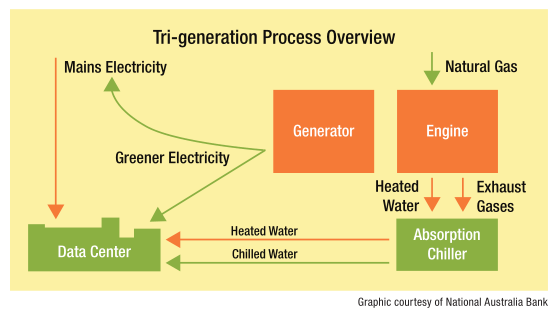
The SMH has an article on NAB's new energy efficient data centre in Melbourne (interestingly the trigeneration setup used at NAB's primary data centre isn't mentioned for this new data centre) - NAB pools data to save power.

National Australia Bank will officially open a new data centre in Melbourne this week, hoping to eventually save the financial institution $22 million over decade. The bank's 23 existing data centres, ranging in size from small broom closets to large computer rooms, will be amalgamated into the new facility at Deer Park, 17 kilometres west of the Melbourne CBD, as well as an existing building across town at Knox. When completed and fully operational in seven years, the downsizing will cut NAB's power usage by 40 per cent, its chief technology officer, Denis McGee, said. ...

The average power usage effectiveness (PUE) of the bank's 20-plus data centres is 2.5. PUE measures the total energy use of a facility divided by the energy used by the ICT equipment within. McGee hopes the Deer Park facility will almost halve the bank's PUE, to less than 1.3, a coveted goal for data centre owners and users. Google claims a PUE of 1.12 across all of its data centres. ...

The scale of the new facility, and the bank's promise to meticulously manage its power usage, allowed it to negotiate near-wholesale rates directly with the electricity supplier, data centre transformation senior manager Tim Palmer said. In the case of a power outage, six diesel generators will provide a back-up source. An underground concrete tank holds enough diesel to fuel the engines for three days. Free cooling will regulate the temperatures at Deer Park for half the year, where ambient air cooler than 30 degrees will be used instead of airconditioning. ...

The bank is also embarking on a virtualisation strategy improve server usage rates from 12 to 60 per cent ... "We have about 10,000 physical and virtuals, and 55 per cent are virtualised, and we have an ongoing program to virtualise more," McGee says.

2011: The Year Data Centers Turned Green  

Posted by Big Gav in ,

Wired has a look at the slow greening of data centres last year - 2011: The Year Data Centers Turned Green.

The amount of data the world stores is on an explosive growth curve. According to research outfit IDC, the digital universe will grow 44 times larger over the course of the decade, thanks to the rise of worldwide obsessions with things like social media and cloud computing. And that means more data centers.

But this data center boom comes at a time of high energy prices and heightened concern about carbon emissions. The days of cramming truck loads of servers into a room and firing up a bunch of industrial air-conditioners to cool them are over.

Data center operators are gaining control of their energy bills and earning green points by increasing data center efficiency, from server processor chips to warehouse-size buildings. There’s no how-to manual on building green data centers. The industry is feeling its way on energy efficiency — and no two data centers are alike.

Out of necessity, the huge Internet players — Google, Facebook, Amazon, Twitter, Yahoo, and Apple — are finding ways to use greener energy and get more out of the energy they use. Google has continued to earn praise for its energy and environmental practices, and Facebook is actually sharing its progress with the rest of the world. This year, it launched the Open Compute Project, encouraging the rest of the industry to exchange technologies and techniques for building efficient data centers.

2011 was a banner year for green data centers, with dozens of state-of-the-art facilities opening for business. Here, Wired takes a look at nine of the more innovative facilities that came online in 2011, rating each by Power Utilization Effectiveness (PUE), the industry standard measure of a facility’s energy-efficiency. PUE is ratio of all electricity a facility consumes to electricity used by the IT equipment it houses.

The ideal — 1.0 — means a facility’s lighting, power, and cooling systems consume no power and its power distribution system is perfectly efficient. Most data centers are in the 2.0 to 3.0 range, meaning ancillary systems and losses consume as much or more energy than the electricity used to run the servers, but the cream of crop have PUE ratings well below this range.

What It Takes to Power Google  

Posted by Big Gav in ,

Technology Review has an article on Google’s (suprisingly low) energy consumption - What It Takes to Power Google.

Google is the first major Web company to reveal exactly how much energy it uses—information that will help researchers and policy makers understand how the massive explosion of Internet usage and cloud computing is contributing to global energy consumption.

Google uses 260 million watts continuously across the globe, the company reported on Wednesday. This is equivalent to the power used by all the homes in Richmond, Virginia, or Irvine, California (around 200,000 homes), and roughly a quarter of the output of a standard nuclear power plant.

By far, the majority of Google's energy use is associated with its data centers, according to Jonathan Koomey, a professor at Stanford University and a researcher who focuses on energy and IT. He says that 80 to 90 percent of those watts are used solely by the company's data centers, based on estimates he made of Google's power use in an August 2011 report. Most of this energy is used in powering the IT equipment in Google's data centers. Google custom builds many data centers, such as a new one in Finland that uses a seawater cooling system, to cut down on electricity costs.

This has enabled Google to be relatively energy efficient, says Koomey, who estimates that the company owns about 3 percent of servers worldwide and uses only 1 percent of electricity for data centers worldwide. "They're operating more efficiently than other data centers," he says.

Other Web giants, including Amazon and Facebook, probably operate their data centers with similar efficiency due to hardware and software customization, and innovative cooling equipment, Koomey says. However, the majority of data center power use comes from non-IT companies running their own data centers less efficiently [which is in turn, far less than that used by equipment in homes and offices].

In its report, Google compares the energy usage of companies' in-house computer systems to the energy used by its cloud servers. It estimates that running Gmail instead of an in-house e-mail system can be almost 80 times more energy efficient. Google says that 25 percent of its energy was supplied by renewable fuels—such as from wind farms—in 2011, and plans to increase that to 30 percent this year.

Making The Internet Greener, By Dunking Servers In Mineral Oil  

Posted by Big Gav in , ,

FastCompany has an article on a new technique for reducing the energy required to cool servers in data centres - Making The Internet Greener, By Dunking Servers In Mineral Oil.

The cloud -- that ubiquitous, invisible home to our email, our photos, our Facebook "Likes" -- is an energy-sucking behemoth the likes of which Planet Earth has never seen. Last I checked, one Google data center in Oregon was expected to consume as much power as every home in a small city combined. And according to Grist, a full third of that juice isn't even used to make your LOLcats searches go faster: it's simply spent on keeping those endless, Matrix-like server racks cool enough not to melt down. What's an eco-conscious internet business to do? According to the geeks at Green Revolution Cooling, you should just plop those babies in a tank of mineral oil. Seriously -- watch:

The company's GreenDEF™ dielectric coolant is an "electrically nonconductive formulation of mineral oil that holds 1200 times more heat by volume than air." Sink your server racks into a bath of this goop, says Green Revolution, and you can radically reduce those cooling-energy margins -- up to 95% in some cases. Plus it'll make your server room look like something out of Battlestar Galactica.

After the mineral oil sops up all that waste heat, it's pumped away to a radiant cooling tower to disperse into the atmosphere. (You didn't think it was going to just magically disappear, did you?) But by slashing those cooling costs -- and the energy costs of running the servers overall -- your data server will be, ideally, less of a burden on Mother Nature.

Should we expect to see Facebook and Google getting on board with this "bobbing for servers" approach to sustainability? Probably not: while Green Revolution's idea and design are ingenious, the physical tradeoffs of cooling enormous distributed data centers this way are probably prohibitive. Then again, if we're going to haul ourselves into the exascale computing era without draining Earth's batteries for good, it might just require kooky-sounding ideas like this.

Greener Computing in the Cloud  

Posted by Big Gav in ,

Technology Review has an article on how "Custom datacenters can help lower energy consumption" (something that is needed given the rapid growth in power consumption by large scale hosting facilities) - Greener Computing in the Cloud.

The issue of surging worldwide IT-related energy consumption is both a bottom-line concern to the companies involved and, increasingly, an environmental worry. Energy consumption from data centers doubled between 2000 and 2005--from 0.5 percent to 1 percent of world total electricity consumption. That figure, which currently stands at around 1.5 percent, is expected to rise further. According to a study published in 2008 by the Uptime Institute, a datacenter consultancy based in Santa Fe, NM, it could quadruple by 2020. ...

Cloud-computing companies hope to offer a solution by focusing on energy efficiency within massive data centers.

Yahoo, for example, broke ground on a data center near Buffalo, NY, last month that will use as little as one-quarter the electricity of older data centers, says Scott Noteboom, senior director of data center engineering at the company. Once finished, the servers inside this data center will be more efficient from a computational standpoint--using less power when they are performing fewer computations--and the building itself will mainly exploit natural air flows to keep hot servers cool. On days above 27° C, managers will switch on air conditioning, which in this case employs evaporative cooling, that should only need to be used 212 hours per year.

Yahoo Serving up greener data centers  

Posted by Big Gav in , , ,

Yahoo has a blog post on their new green data centre - Serving up greener data centers.

This morning, at a press conference in Buffalo, New York, with New York Governor David Paterson and Senator Chuck Schumer, we took another big step forward in addressing climate change. We announced plans to build one of the greenest, most energy-efficient data centers in the world.

This is significant because data centers represent the majority of our energy consumption. Keeping Yahoo! running smoothly for more than 500 million people around the world calls for a lot of server power. So we’ve made it a priority to become a leader in designing and building data centers that are environmentally sustainable, investing millions to design facilities that make the best use of the energy we consume.
Here’s what makes us so proud of our future New York data center plans. First, it will be powered by one of the cleanest utilities in the country – fed predominantly by renewable hydroelectric power from Niagara Falls. And second, a record 90% of that energy will power the servers. To put that in context, the industry average is 50% or lower, with the other half dedicated mostly to keeping the servers cool.

For data center geeks, we expect our Buffalo Lockport, NY, data center design will have an annualized average PUE (power usage effectiveness) of 1.1 or better. To achieve that, we’ve come up with a unique building design that we call the Yahoo! Computing Coop (because it looks like something chickens live in), which is angled to take advantage of Buffalo’s microclimate, using 100% outside air to cool the servers.

We’ve been pushing green data center standards since we started building our own data centers two years ago. For example, our facilities in Washington are powered by zero-carbon wind and hydroelectric sources, and we use free cooling for most of the year, dropping energy consumption by 40-50%. As we build more capacity to meet demand, we’ll continue to focus on innovations and inventions that improve energy efficiency.

And we’ve been sharing best practices to encourage the entire industry to put smarter policies in play.

Using Netbook Chips To Create a Low-Power Cloud  

Posted by Big Gav in

Technology Review has an article on using lots of small processors to reduce energy usage in data centres - Netbook Chips Create a Low-Power Cloud.

A "fast array of wimpy nodes" could replace behemoth server infrastructure.

Using a cluster of the same processors that normally show up in netbooks and similar mobile devices, researchers have created a powerful server architecture that draws less power than a lightbulb.

The architecture, dubbed a "fast array of wimpy nodes," or FAWN, offers a way to decrease by an order of magnitude the amount of power used by the computational infrastructure of Internet giants like Google, Microsoft, Amazon, eBay, Facebook, and others. If the predictions of its inventors are borne out, it could have a significant impact on both the bottom line and the environmental impact of cloud computing.

Power now accounts for up to 50 percent of the cost of operating data centers, and in the United States, its cost per kilowatt-hour is increasing. Even relative newcomers like Facebook use up to $1 million a month in electricity, and the Environmental Protection Agency (EPA) projects that by 2011, data centers in the United States could use up to 100 billion kilowatt-hours of electricity, for a total annual cost of $7.4 billion, with an estimated emissions impact of 59 million metric tons of CO².

Google's Goal: More computing, less power  

Posted by Big Gav in , ,

The Google Blog has some notes on their ongoing efforts to increase the energy efficiency of data centrres, as part of their "Green IT" theme this year - More computing, less power.

In the fall we posted information about the efficiency of Google data centers and promised to update this information every quarter. We've now collected data for the fourth quarter of 2008 and published them to our sustainable computing website. Specifically, we're keeping track of the efficiency of any Google-designed data center with an IT load of at least 5 MW and a time-in-operation of at least 6 months. In Q4 our average power and cooling overhead in these facilities was 16%, bringing the overhead for the trailing 12 months to 19% (down from 21% a quarter earlier). For comparison, a recent EPA report put the overhead of the average enterprise data center at 100% or higher. We're very happy to have further improved our efficiency, and a number of factors contributed to that result.

First, efficiency is affected by seasonal weather patterns — cooler weather is better than hot weather, and several of our facilities benefited from that in Q4. Also, we continually review our efficiency metrics so that we notice, for example, that one of our data centers is not performing consistently with others of similar size and locale. So we'll take a closer look at optimizing that facility. Are we using fans to cool spaces that don't need to be cooled? Is the thermostat at the right set-point? Can we reduce the time the chillers need to run while keeping the machines operational? So we apply lessons we've learned from better-performing data centers to other facilities, and several such improvements took place in Q4. For the nitty-gritty technical details, visit our data center efficiency page.

While we've made a lot of progress in data center efficiency, we're still learning. As we continue to explore ways to use the least amount of power to do the most amount of computing, we'll continue to share our data and best practices with you. In early March we will participate in the CeBIT conference where we plan to disclose more details on our sustainability efforts as part of this year's theme of "Green IT." Stay tuned.

Transforming a dumb network into a smart grid  

Posted by Big Gav in , ,

Tyler Hamilton has a post at the Energy Collective on prospects for smart grids in 2009 - Smart grid destined for role as enabler of renewables, efficiency, and distributed generation.

I’m encouraged by many of the end-of-year stories coming out of the greentech community. Most of them argue that the “smart grid” will be a major story in 2009, and as my own year-end musings show I couldn’t agree more. In fact, my final story of the year is about the smart grid and its inevitable coming into being. Much of my story is through the seasoned eyes of Marzio Pozzuoli, founder and CEO of Woodbridge, Ontario-based RuggedCom Inc., the leading supplier of hardened communications gear to utilities around the world. In other words, RuggedCom sells routers, switches and wireless equipments for electrical substations. As more of this gear is installed we begin to see the grid as an extensive two-way communications network, able to collect and transmit information to where it’s needed.

The next step? Creating the software and setting up the systems that can organize, analyze and ultimately act on the information collected in a way that improves the efficiency, reliability and self-healing capability of our electricity system and makes integration of renewables and distributed generation much easier. No wonder the likes of IBM, Hewlett-Packard, Cisco, Oracle, Microsoft, Google and other giants of the IT sector are beginning to take notice and position themselves in what promises to be a massive market.


From Tyler's article in The Star - Transforming dumb network into smart grid.
Before the Internet there were small private networks that connected PCs, and before these networks were stand-alone computers incapable of sharing information.

And before the computer? We had the trusty old typewriter.

Looking forward, the technological evolution that in three decades moved us from the mechanical typewriter to Internet-connected computer is destined to be repeated in the move to modernize the continent's antiquated electricity system, experts say.

The goal: turn a dumb network of lines and electromechanical devices that is heavily reliant on human intervention into an efficient, two-way, automated "smart grid" that collects, shares and acts on information to manage the flow of electrons.

It's a transition already underway, and for good reason. The transformer devices in a typical electrical substation – that is, a point on the grid where power is converted from a higher to lower voltage (or the reverse) – are designed to last 40 years. The average age of transformers in North America is currently 42.

"You've got this aging infrastructure that isn't going away, and you can't just say you're not going to replace it. There's no choice but to replace it," says Marzio Pozzuoli, founder and CEO of Woodbridge-based RuggedCom Inc.

And that might come sooner than expected. President-elect Barack Obama has promised a major economic stimulus package that includes substantial investment in the U.S. transmission infrastructure, including smart-grid technologies. Similar talk is occurring around the world, including Canada, and companies such as RuggedCom are primed to benefit. "It all looks good for us," Pozzuoli says.


Joel Makower has a post at The Energy Collective on IBM's smart grid aspirations - Behind IBM's Quest for a 'Smarter Planet'.
IBM's recent campaign goes well beyond mere image — and beyond green — to envision a "smarter" world in which problems as wide-ranging as health care costs, energy and resource shortages, government inefficiency, threatened waterways, climate change, and traffic congestion can be addressed by a blend of systems thinking, technological innovation, and computing power. It's an intriguing campaign aimed at helping redefine IBM from its roots as a computer maker to its more recent incarnation as a self-described "global services company."

"Smarter Planet" isn't IBM's first foray into the green scene. In 2007, the company launched a program called Big Green Innovations to mine the company's vast wealth of expertise and technology to create products and services to help address customers' and society's environmental challenges. Big Green, a play on the company's longtime nickname, Big Blue, takes aim at everything from creating carbon dashboards to help lower companies' carbon emissions, to designing energy efficient data centers and more powerful solar cells. But it seemed more of an inward-looking effort, an attempt to collaborate with existing clients, and not a means of communicating with the marketplace. (You can listen to a 2007 interview I did on the topic with Sharon Nunes, who heads the Big Green Innovations program, and Wayne Balta, IBM's VP of Corporate Environmental Affairs.)

Recently, I talked to Rich Lechner, IBM's VP of Energy & Environment, and John Kennedy, its VP of Integrated Marketing Communications, to learn more about the "Smarter Planet" series — what was behind the ads and what the company hopes to accomplish from them. ... Lechner described the many environmental challenges that, he says, could be solved by "smarter" systems:
"In a world in which water, energy, power are severely constrained, you don't have to look far to see, for example, that only 30 percent of the potential electricity that's available at the energy source actually reaches the doorstep of the consumer. Or that significant amounts of traffic congestion are caused just by people circling, looking for empty parking spaces, wasting fuel. You can look at our distribution systems around the world and see that more than 20 percent of all the shipping containers and more than 25 percent of the trucks moving around on a global basis are empty. You look at the way that food is distributed and understand that the average carrot in the United States — the lowly carrot — has traveled 1,600 miles to get to your dinner table, and you say clearly something could be done to improve the efficiency of our food distribution system. And water: We're projecting that over a billion people won't have access to safe drinking water in just ten years time, and yet today, just five food and beverage companies consume enough water on an annual basis to serve the daily needs of everyone on the planet.

"We looked around and we said there's plenty of room for improvement and our expertise in IT [information technology] coupled with our deep industry knowledge and our ability to look at and re-engineer processes gave us a unique vantage point to comment on the need to exploit this growing intelligence and where the first opportunities for exploitation might exist."

The vision for "Smarter Planet" was laid out in a November 17, 2008, speech by IBM chairman and CEO Samuel J. Palmisano. "The world will continue to become smaller, flatter ... and smarter," he said. "We are moving into the age of the globally integrated and intelligent economy, society and planet. The question is, what will we do with that?"

The "Smarter Planet" ads — what Kennedy calls an "op-ad" campaign — are Palmisano's answer. They are designed "to get a reader to think about the world from a systems point of view, and along the way, describe these opportunities for systems," says Kennedy. Each week's ads cover a different topic: energy, traffic, food, infrastructure, retail, banking, and more.

The Green Grid: Energy Efficient Data Centres  

Posted by Big Gav in ,

Business Green has an article on efforts by a group called "The Green Grid" to implement energy efficiency metrics for data centres - Green Grid aiming for "miles per gallon style" data centre energy metric.

The Green Grid, a global consortium of IT firms committed to enhancing the energy efficency of data centres, is hoping to have a new package of standardised metrics in place from next year that will allow firms to compare the energy efficiency of different servers, storage systems and networking equipment in much the same way motorists compare the fuel efficiency of different cars.

Speaking to BusinessGreen.com, Green Grid director Jim Pappas said that having successfully launched a measure for assessing the efficiency of data centre cooling and power supply units in the form of its Power Usage Effectiveness (PUE) metric the consortium is now working on standards for measuring the efficiency of the IT equipment itself.

"The PUE tells how much of the energy going into the facility is used by the IT equipment, but the next step is to try to understand how efficient the IT equipment is itself," he explained, adding that standards for assessing the utilisation of different systems had already been drafted and that the consortium was aiming to deliver draft versions of the completed efficiency metrics some point next year.

Previous attempts to develop standards for measuring the energy efficiency of servers, storage systems and networking equipment have previously faltered with rival IT manufacturers arguing over how to compare products' energy use when handling differing workloads.

However, Pappas expressed confidence that the scale of the Green Grid - it recently signed up its 200th member and counts almost all the world's largest IT companies amongst its ranks - means that it will be able to deliver a metric the industry supports.

"If you take the analogy of the car industry fuel efficiency figures for new cars are published and that helps drive progressm and innovation," he said. " Having these new metrics will ensure that the company's that do innovate on energy efficiency are rewarded - we really do have a who's who of IT vendors signed up and they are behind this initiative."

He added that once the metrics are established it will be possible for IT companies to develop solutions that monitor the energy use of the different software applications being run within the data centre and automatically optimise the facility to ensure it is always running at peak energy efficiency.

Morgan Stanley's Tidal Powered Data Centre  

Posted by Big Gav in , , , ,

Business Green has a report on the latest example of the trend towards clean energy powered data centres - Morgan Stanley eyes up tidal-powered datacentre.

A group of investors, including investment bank Morgan Stanley, are set to fund a £250m off-grid tidal-powered datacentre in the north of Scotland, it was confirmed yesterday. The banking giant said it is to work with tidal power company Atlantic Resources Corporation – in which it holds a stake – to build the site by 2011.

The datacentre would require about 150Mw hours of power and the alliance wants this energy to be sourced entirely from tidal arrays.

The zero-carbon datacentre will seek to tap into increasing demand for greener IT systems and be opened up to third-party companies to hire space. " They will be looking for tenants for the datacentre," said a spokesman for the partnership.

The scheme must still secure planning permission to go ahead, and although the Scottish government has recently signalled its support for marine energy projects, only one commercial-scale tidal energy project has so far gone into operation in the UK – and that took 13 years to come to fruition.

However, the Morgan Stanley project is expected to avoid one of the main technical challenges faced by tidal energy projects, by connecting direct to the datacentre facility and not linking to the national grid.

The project is the latest in a series of innovative proposals designed to tackle datacentres' increasing energy use and associated carbon emissions. Globally, datacentres are responsible for the same amount of emissions as an average European country, according to research by Gartner – accounting for about a quarter of the 580 million tonnes used by IT equipment worldwide.

The Department of Energy and Climate Change estimates server farms are responsible for three per cent of electricity use in the UK, a figure expected to double by 2020.

Consequently, growing numbers of firms are investigating ways to power da tacentres using renewable energy. Earlier this year, submarine cable operator Farice signed a £12m deal with networking company Thus for a high-bandwidth internet connection between UK businesses and datacentres in Iceland that could be powered using emission-free geothermal energy.

Cutting Data Centre Energy Demand  

Posted by Big Gav in , ,

The Wall Street Journal has an article on efforts to redcue energy consumption in large data centres, now being actively promoted by hardware companies like IBM and HP - Cutting Tech's Energy Bill.

International Business Machines Corp., Hewlett-Packard Co. and other big computer makers are spotting opportunity in customers' desire to curb electricity usage in large corporate data centers, where energy use has soared in recent years.

Rising electricity prices, coupled with new computer servers that run hotter and require more power, has corporate technology buyers looking for ways to cut back. Power use in data centers -- the large, climate-controlled rooms that house a company's computer servers, storage devices and communications switches -- doubled from 2000 to 2006 and now accounts for about 1.5% of U.S. electricity consumption, according to the Environmental Protection Agency. A recent McKinsey & Co. report says that world-wide, the centers' carbon emissions exceed those of Argentina.

Somewhat ironically, the companies that designed and sold those computers are now able to capitalize on the higher power bills the machines rack up.

IBM surprised Wall Street this year when it said its new "Green Data-Center Services" business -- which redesigns customers' data centers and sells energy-efficient products -- signed $300 million in orders in the 2007 fourth quarter. The company has declined to release figures for 2008.

IBM Chief Executive Samuel Palmisano recently told analysts that IBM expects more than 70% of the world's biggest companies "will modify their data centers significantly in the next five years" to deal with energy shortfalls and rising costs.

Google's Wave Powered Data Centres  

Posted by Big Gav in , ,

CNet's GreenTech blog is speculating that Google may be thinking about build floating data centre's one day - Google files patent for wave-powered floating data center. Fans of Neal Stephenson's book Cryptonomicon will no doubt recognise the potential for the creation of offshore data havens - or perhaps more than just data.

Google sees the future of computing at sea.

The search giant has filed a patent for a "floating data center" that uses wave motion to power on-board computers and the ocean's water to cool them.

The patent was submitted in February last year but was spotted in the U.S. Patent & Trademark office's electronic filings and posted at Slashdot on Saturday.

The system Google engineers sketch out is a self-powered data center placed three to seven miles offshore, potentially operating off the grid. Standard shipping containers would house racks of computers that could be transported by truck and placed onto a boat by crane.

A wave-power generator would be the primary source of electricity. But wind turbines could be used to, for example, run water pumps and a tidal power generator could be used in rivers.

The patent specifies the use of a so-called Pelamis machine, which uses pontoons with pumps to convert wave motion into electricity. A British company, Pelamis Wave Power, is operating a prototype in Scotland and intends to install one off Portugal.

Google engineers calculate that an array of pontoons spread over a square kilometer (a bit more than a half mile) could produce 30 megawatts of electricity, enough to operate a single system.

Also envisioned is equipment to use the direct current electricity to run DC-capable computers, which some people consider more energy-efficient than using alternating current.

The Distributed Energy Cloud  

Posted by Big Gav in , ,

Earth2Tech has an article on the possibility of data centres following the example of aluminium smelters by chasing renewable energy sources - Data Centers Will Follow the Sun and Chase the Wind (via Politics In The Zeros).

Data centers’ ability to suck up inordinate amounts of electricity is turning them into the Hummers of the computing world. And much like Hummers, their power-guzzling ways means they are becoming increasingly costly to run. We’ve already covered the efforts of companies to reduce heat, increase server utilization and build green data centers. Now Andrew Hopper, head of the Cambridge University Computing Lab, is working on a solution that could help reduce the demand data centers place on the grid.

Hopper’s vision combines cloud computing and renewable energy: He wants to take electrical transmissions costs out of the equation by placing a data center directly at the site of a renewable energy source and use fiber optic cable to link it to the entity that uses it. Hopper is also the co-founder of Level 5 Networks, which was bought by 10 Gigabit chip maker SolarFlare.

Virtualization and fast Ethernet, which enable services such as Amazon’s EC2, will make Hopper’s idea feasible. The ability to separate the hardware from software through virtualization is what enables computing clouds to exist. Those clouds allow companies, developers or anyone with the ability to tap into that resource, to ship its computing jobs over to Amazon’s servers, no matter where they are located in the world.

The challenge is figuring out how to build software that can monitor electrical generation, prioritize compute jobs and then figure out when and where to send those jobs based on whether the wind is blowing or the sun is shining. Hopper believes it would make sense to attach data centers, possibly in a container, directly to a renewable energy source. The source could be located in the middle of a desert, on a platform attached to an ocean wind turbine, or anywhere else where power could be easily generated.

One of the issues with renewable sources of energy, is that the places where it’s most abundant, such as winds blowing across the ocean or solar power in the desert, are inaccessible and thus, expensive to attach to the electrical grid. An example is Texas’ $4.9 billion plan to bring wind energy generated in the barren, western part of the state to the more populous center. Bringing the data center to the power solves that problem as long as the area can be reached via a cheaper fiber optic cable. There are still issues of servicing such remote data centers, but the plan to have multiple ones around the world offers redundancy.

But there are still computing tasks that need to be worked out if this vision is to materialize in the next decade or so. “If it turns out you’re chasing the energy and copying a lot of data, then that’s less attractive,” says Hopper. “But with good caching, and if you’re only moving the data once or twice it, might work. You could design software similar to old-fashioned job scheduling on a mainframe. Back then the scarcity was the computing and today it’s energy.”

Doubling Laptop Battery Life  

Posted by Big Gav in , , ,

Technology review reports that Intel's new integrated power management could dramatically reduce power consumption in laptops - Doubling Laptop Battery Life.

Anyone who uses a laptop on an airplane would love a single battery to last through a trans-American flight. Now researchers at Intel believe that they can double a laptop's battery life without changing the battery itself. Instead, they would optimize power management--system wide--of the operating system, screen, mouse, chips inside the motherboard, and devices attached to USB ports.

To be sure, manufacturers and researchers have been exploring piecemeal ways to make portable computers more energy efficient. Operating systems are designed to deploy power-saving screen savers and put an entire system to sleep if its owner hasn't used it after a while. And Intel's forthcoming Atom, a microprocessor for mobile Internet devices, can be put to sleep at up to six different levels, depending on the types of tasks that it needs to do.

But the problem with these approaches is that they're not coordinated across the entire device. Intel's prototype power-management system is aware of the power that's used by all parts of a laptop, as well as the power requirements of a person's activity, and it shuts down operations accordingly, says Greg Allison, business development manager. The project, called advanced platform power management, was demonstrated on Wednesday at an Intel event in Mountain View, CA.

Statistics

Locations of visitors to this page

blogspot visitor
Stat Counter

Total Pageviews

Ads

Books

Followers

Blog Archive

Labels

australia (619) global warming (423) solar power (397) peak oil (355) renewable energy (302) electric vehicles (250) wind power (194) ocean energy (165) csp (159) solar thermal power (145) geothermal energy (144) energy storage (142) smart grids (140) oil (139) solar pv (138) tidal power (137) coal seam gas (131) nuclear power (129) china (120) lng (117) iraq (113) geothermal power (112) green buildings (110) natural gas (110) agriculture (91) oil price (80) biofuel (78) wave power (73) smart meters (72) coal (70) uk (69) electricity grid (67) energy efficiency (64) google (58) internet (50) surveillance (50) bicycle (49) big brother (49) shale gas (49) food prices (48) tesla (46) thin film solar (42) biomimicry (40) canada (40) scotland (38) ocean power (37) politics (37) shale oil (37) new zealand (35) air transport (34) algae (34) water (34) arctic ice (33) concentrating solar power (33) saudi arabia (33) queensland (32) california (31) credit crunch (31) bioplastic (30) offshore wind power (30) population (30) cogeneration (28) geoengineering (28) batteries (26) drought (26) resource wars (26) woodside (26) censorship (25) cleantech (25) bruce sterling (24) ctl (23) limits to growth (23) carbon tax (22) economics (22) exxon (22) lithium (22) buckminster fuller (21) distributed manufacturing (21) iraq oil law (21) coal to liquids (20) indonesia (20) origin energy (20) brightsource (19) rail transport (19) ultracapacitor (19) santos (18) ausra (17) collapse (17) electric bikes (17) michael klare (17) atlantis (16) cellulosic ethanol (16) iceland (16) lithium ion batteries (16) mapping (16) ucg (16) bees (15) concentrating solar thermal power (15) ethanol (15) geodynamics (15) psychology (15) al gore (14) brazil (14) bucky fuller (14) carbon emissions (14) fertiliser (14) matthew simmons (14) ambient energy (13) biodiesel (13) investment (13) kenya (13) public transport (13) big oil (12) biochar (12) chile (12) cities (12) desertec (12) internet of things (12) otec (12) texas (12) victoria (12) antarctica (11) cradle to cradle (11) energy policy (11) hybrid car (11) terra preta (11) tinfoil (11) toyota (11) amory lovins (10) fabber (10) gazprom (10) goldman sachs (10) gtl (10) severn estuary (10) volt (10) afghanistan (9) alaska (9) biomass (9) carbon trading (9) distributed generation (9) esolar (9) four day week (9) fuel cells (9) jeremy leggett (9) methane hydrates (9) pge (9) sweden (9) arrow energy (8) bolivia (8) eroei (8) fish (8) floating offshore wind power (8) guerilla gardening (8) linc energy (8) methane (8) nanosolar (8) natural gas pipelines (8) pentland firth (8) saul griffith (8) stirling engine (8) us elections (8) western australia (8) airborne wind turbines (7) bloom energy (7) boeing (7) chp (7) climategate (7) copenhagen (7) scenario planning (7) vinod khosla (7) apocaphilia (6) ceramic fuel cells (6) cigs (6) futurism (6) jatropha (6) nigeria (6) ocean acidification (6) relocalisation (6) somalia (6) t boone pickens (6) local currencies (5) space based solar power (5) varanus island (5) garbage (4) global energy grid (4) kevin kelly (4) low temperature geothermal power (4) oled (4) tim flannery (4) v2g (4) club of rome (3) norman borlaug (2) peak oil portfolio (1)
