Showing posts with label new york times. Show all posts

Documents: Leaked Shale Gas Industry E-Mails and Reports  

Posted by Big Gav in ,

The New York Times has a follow up to their recent article on doubts about the financial sustainability of the shale gas rush, quoting their anonymous sources for the article - Documents: Leaked Industry E-Mails and Reports.

Over the past six months, The New York Times reviewed thousands of pages of documents related to shale gas, including hundreds of industry e-mails, internal agency documents and reports by analysts. A selection of these documents is included here; names and identifying information have been redacted to protect the confidentiality of sources, many of whom were not authorized by their employers to communicate with The Times.

Geologist and official from Anglo-European Energy:

After buying production for over 20 years, hopefully I know the characteristics of great wells (flat decline curves, low operating costs, large production), and as you know, the shale plays have none of these. The herd mentality into the shale will eventually end possibly like the sub-prime mortgage did. In the meantime it is very difficult to sell any kind of prospect that is not a shale play.


Analyst from PNC Wealth Management (2011):

Money is pouring in from investors even though shale gas is inherently unprofitable. Reminds you of dot-coms.


Analyst from IHS Drilling Data (2009):

The word in the world of independents is that the shale plays are just giant Ponzi schemes and the economics just do not work.


Retired geologist for major oil and gas company (2011):

As I think you would agree, we are looking at a bubble here with caveats. The caveats are how corporate hubris and bad science have caused a lot of folks to think that gas is nearly too cheap to meter. And now these corporate giants are having an Enron moment, they want to bend light to hide the truth. The bubble will burst, folks will get run over, reason will be restored, if only temporarily.


Official from Bold Minerals LLC (2010):

1. The players never did any careful regional studies before they made serious and irrevocable capital commitments to the various shale plays. Our scouting sources never got calls for logs or cores on the significant old tests, especially in the Haynesville. This was mystifying.

2. The pronouncement that the reservoir was uniform and covered 10 or 20 counties or (in the case of Marcellus) 5 states was absolute heresy in the conventional business. This very extravagant claim was never really debated or contested by the technical community. The downhole data for these broad sweeping conclusions was simply never there.

3. The escalation of lease bonuses to ridiculous heights and the taking of 3 year term leases put the companies in the position of being compelled to drill hundreds of potentially technically unsound wells with insufficient downhole information or face massive impairments by letting incredibly expensive acreage expire undrilled. In previous hot domestic plays, no major company would ever commit itself to lease positions of this scope and scale of expenditure that they could not afford to abandon if the technical picture became negative.

4. The ‘bait and switch’ where one massive set of capital outlays in the ‘best’ shale uncovered was soon to be eclipsed by the recognition of even better shales which required even more outlays before a thorough technical assessment of existing shale positions had been obtained could only be classified as a type of ‘mania’. It has no precedent in financial scale to any of the previous lease plays that experienced a speculative frenzy in domestic onshore petroleum history.


Official at Phoenix Canada Oil Company (2010):

It is my strong view that we will see a near collapse of that play, probably sooner rather than later. Perhaps we will see a repeat of the coal bed methane (CBM) play 'disappearance' -- where that 'exciting' development faded into history 'without a trace'!


Official from Schlumberger (2010):

All about making money. I'm working on a shale gas well that was just drilled in Europe. Looks like crap, but the operator will flip it based on ‘potential’ and make some money on it. Always a greater sucker....

Oil Industry Sets a Brisk Pace of New Discoveries ?  

Posted by Big Gav in , , ,

There have been a few articles in the mainstream media lately expressing skepticism about a near term peaking in oil production - the New York Times (Oil Industry Sets a Brisk Pace of New Discoveries) and Scientific American (Squeezing More Oil From The Ground) being prominent amongst them.

The oil industry has been on a hot streak this year, thanks to a series of major discoveries that have rekindled a sense of excitement across the petroleum sector, despite falling prices and a tough economy.

These discoveries, spanning five continents, are the result of hefty investments that began earlier in the decade when oil prices rose, and of new technologies that allow explorers to drill at greater depths and break tougher rocks.

“That’s the wonderful thing about price signals in a free market — it puts people in a better position to take more exploration risk,” said James T. Hackett, chairman and chief executive of Anadarko Petroleum.

More than 200 discoveries have been reported so far this year in dozens of countries, including northern Iraq’s Kurdish region, Australia, Israel, Iran, Brazil, Norway, Ghana and Russia. They have been made by international giants, like Exxon Mobil, but also by industry minnows, like Tullow Oil.


These claims are being buoyed by various announcements of reasonably large oil discoveries in new offshore locations, such as BP's Tiber find in the Gulf of Mexico, Iran's 8.8 billion barrel claim in Kouzestan, the Anadarko led discovery off West Africa and news that Cairn Energy have commenced production at a 1 billion barrel field in Rajastan, India (I'm not sure what large discoveries have been made in Australia recently however - as claimed in the NYT article - there is lots of news on the natural gas and coal seam gas fronts but little about oil).

Most of the commentary ignores the fact that these discoveries are much smaller than the really large fields discovered in the mid-20th century, and that the new offshore fields are very deep in comparison to earlier offshore oil discoveries, so exploiting them will be both time-consuming and costly - so they could be considered a vindication of peak oil theories rather than a refutation of them.

The flow of news hasn't been entirely one way though, with the FT noting that even with these new discoveries, "the finds may not be enough to ward off a supply crunch as the world economy recovers" - Oil strikes not enough to quench demand and Finding new oil gets ever more expensive - and the Independent having a balanced look at the issue - The Big Question: Does BP's discovery of a giant new field prove we're not running out of oil?.
It is worth bearing in mind not only that giant fields are the lifeblood of the industry, but that the overall rate of discovery is on a downward trend. The 20 largest oil fields – out of around 70,000 around the world – account for a quarter of all production; the largest, Ghawar, discovered in Saudi Arabia in 1948, is only halfway through its 140 billion barrels. But while in the Sixties around 56 billion barrels were being discovered each year, that fell to 13 billion in the Nineties. And most new discoveries are off-shore and under deep waters (where they are much more expensive to extract).

For those worried about recent shocks in the price of oil, and the global economy's extreme over-reliance on oil, the new discoveries are welcome relief. But they cannot disguise the fact that supply is generally declining as demand is generally growing. Their effect is only to delay the inevitable.


Heading Out at Bit Tooth Blog, Kurt Cobb at Energy Bulletin and Gail at The Oil Drum also have some commentary on the NYT and Scientific American articles.


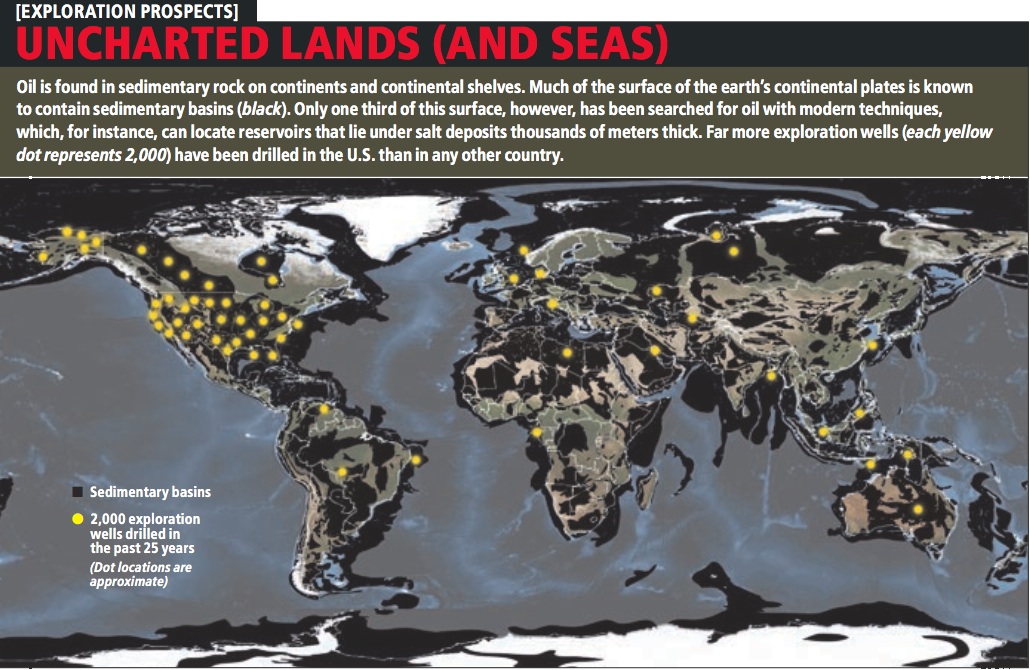
Scientific American article showing areas that have allegedly not been adequately explored for oil


The NYT hasn't become entirely skeptical about near term peak oil - the paper also has a review of Peter Maass’s new book, “Crude World: The Violent Twilight of Oil.” - The End of Oil ?.
Oil is the curse of the modern world; it is “the devil’s excrement,” in the words of the former Venezuelan oil minister Juan Pablo PĂ©rez Alfonzo, who is considered to be the father of OPEC and should know. Our insatiable need for oil has brought us global warming, Islamic fundamentalism and environmental depredation. It has turned the United States and China, the world’s biggest consumers of petroleum, into greedy, irresponsible addicts that can’t see beyond their next fix. With a few exceptions, like Norway and the United Arab Emirates, oil doesn’t even benefit the nations from which it is extracted. On the contrary: Most oil-rich states have been doomed to a seemingly permanent condition of kleptocracy by a few, poverty for the rest, chronic backwardness and, worst of all, the loss of a national soul.

We can’t be rid of the stuff soon enough.

Such is the message of Peter Maass’s slender but powerfully written new book, “Crude World: The Violent Twilight of Oil.” Unquestionably, by fueling better and faster transportation and powering cities and factories, oil has been critical to modern economies. But oil has also made possible the most destructive wars in history, and it has left human society in a historical cul-de-sac. Despite much hue and cry today, Maass argues, we seem unable to move beyond an oil-based global economy, and we are going to hit a wall soon.

Maass, a contributing writer for The New York Times Magazine, tends to endorse the predictions of industry skeptics like Matthew Simmons, who argues the earth is about to surpass “peak oil” supplies. Even with the recent fallback in prices, the petroleum that’s left to discover will be harder and more expensive to extract. Last year’s $147-a-barrel oil was just a “foretaste of what awaits us,” Maass writes.

Maass is less interested in crunching oil-supply numbers, however, than in exposing the cruelty and soullessness of human­kind’s lust for this “violence-­inducing intoxicant,” as he calls it. His book teaches us an old lesson anew: that the true wealth of nations is not discovered in the ground, but created by the ingenuity and sweat of citizens. It’s the same lesson the Spanish learned centuries ago when they discovered gold, the oil of their time, in the New World. They piled up bullion but squandered it on imperial fantasies and failed to build enduring prosperity, while destroying the civilizations from which they seized it.

Statistics

Locations of visitors to this page

blogspot visitor
Stat Counter

Total Pageviews

Ads

Books

Followers

Blog Archive

Labels

australia (619) global warming (423) solar power (397) peak oil (355) renewable energy (302) electric vehicles (250) wind power (194) ocean energy (165) csp (159) solar thermal power (145) geothermal energy (144) energy storage (142) smart grids (140) oil (139) solar pv (138) tidal power (137) coal seam gas (131) nuclear power (129) china (120) lng (117) iraq (113) geothermal power (112) green buildings (110) natural gas (110) agriculture (91) oil price (80) biofuel (78) wave power (73) smart meters (72) coal (70) uk (69) electricity grid (67) energy efficiency (64) google (58) internet (50) surveillance (50) bicycle (49) big brother (49) shale gas (49) food prices (48) tesla (46) thin film solar (42) biomimicry (40) canada (40) scotland (38) ocean power (37) politics (37) shale oil (37) new zealand (35) air transport (34) algae (34) water (34) arctic ice (33) concentrating solar power (33) saudi arabia (33) queensland (32) california (31) credit crunch (31) bioplastic (30) offshore wind power (30) population (30) cogeneration (28) geoengineering (28) batteries (26) drought (26) resource wars (26) woodside (26) censorship (25) cleantech (25) bruce sterling (24) ctl (23) limits to growth (23) carbon tax (22) economics (22) exxon (22) lithium (22) buckminster fuller (21) distributed manufacturing (21) iraq oil law (21) coal to liquids (20) indonesia (20) origin energy (20) brightsource (19) rail transport (19) ultracapacitor (19) santos (18) ausra (17) collapse (17) electric bikes (17) michael klare (17) atlantis (16) cellulosic ethanol (16) iceland (16) lithium ion batteries (16) mapping (16) ucg (16) bees (15) concentrating solar thermal power (15) ethanol (15) geodynamics (15) psychology (15) al gore (14) brazil (14) bucky fuller (14) carbon emissions (14) fertiliser (14) matthew simmons (14) ambient energy (13) biodiesel (13) investment (13) kenya (13) public transport (13) big oil (12) biochar (12) chile (12) cities (12) desertec (12) internet of things (12) otec (12) texas (12) victoria (12) antarctica (11) cradle to cradle (11) energy policy (11) hybrid car (11) terra preta (11) tinfoil (11) toyota (11) amory lovins (10) fabber (10) gazprom (10) goldman sachs (10) gtl (10) severn estuary (10) volt (10) afghanistan (9) alaska (9) biomass (9) carbon trading (9) distributed generation (9) esolar (9) four day week (9) fuel cells (9) jeremy leggett (9) methane hydrates (9) pge (9) sweden (9) arrow energy (8) bolivia (8) eroei (8) fish (8) floating offshore wind power (8) guerilla gardening (8) linc energy (8) methane (8) nanosolar (8) natural gas pipelines (8) pentland firth (8) saul griffith (8) stirling engine (8) us elections (8) western australia (8) airborne wind turbines (7) bloom energy (7) boeing (7) chp (7) climategate (7) copenhagen (7) scenario planning (7) vinod khosla (7) apocaphilia (6) ceramic fuel cells (6) cigs (6) futurism (6) jatropha (6) nigeria (6) ocean acidification (6) relocalisation (6) somalia (6) t boone pickens (6) local currencies (5) space based solar power (5) varanus island (5) garbage (4) global energy grid (4) kevin kelly (4) low temperature geothermal power (4) oled (4) tim flannery (4) v2g (4) club of rome (3) norman borlaug (2) peak oil portfolio (1)