Showing posts with label norway. Show all posts

Floating tidal power plant opened in Norway  

Posted by Big Gav in , ,

Renewable Energy Focus has an update on the trial of a floating tidal power plant in Norway - Floating tidal power plant opened in Norway.

Hydra Tidal’s floating tidal power plant, Morild II, has been officially opened in Gimsøystraumen in Lofoten, Northern Norway.

The opening of the 1.5 MW tidal power plant marks the start of the planned two-year trial period for testing and verification of Morild II and the technology. The tidal turbine blades are made of laminated wood with a diameter of 23 m.

“We know of no comparable floating tidal power plants in the world. There are smaller scale models that have been installed, but Morild II is a full-scale plant. The largest known turbine diameter of other power plants is 18 meters, and the largest installed power known to us is 1 MW. Thus we can imply with a fair amount of certainty that Morild II is the largest tidal power plant of its kind," says the CEO of Hydra Tidal, Eivind Nydal. Morild II is expected to supply power to the grid by the end of 2010.

Gigantic Offshore Wind-turbine Testing in Progress  

Posted by Big Gav in , , ,

Renewable Energy World has an update on efforts to encourage larger wind turbines for offshore wind power (and floating offshore wind power) - Gigantic Offshore Wind-turbine Testing in Progress.

In the course of the next five years, the HiPRWind (High Power, High Reliability Offshore Wind Technology) project will lay the foundations for delivery of a complete, fully functional offshore wind-turbine with a generating capacity of 10 – 20 MW. For comparison, modern wind–turbine capacities lie between 300 kW and 6 MW. ...

Plenty of Power

As well as developing a concept for a 10 – 20 MW turbine, the members of the project are also looking at how the units of a huge floating wind-farm far out to sea can be interconnected, and connected to the electricity grid ashore.

The advantages of locating wind-turbines offshore are well known. A better wind regime is the first of these; it simply blows harder out at sea. Next, larger schemes can be built; a single North Sea block of 60 x 60 km is capable of producing more electricity than all Norway’s hydropower plants combined, while ten blocks could supply enough electric power for the whole of Europe.

The problem is: how to do it? Wind-turbines are already standing in shallow water off the UK and Denmark. But in the future, coastal sites are going to become more crowded, and both environmental and resource considerations will mean that these installations will have to be located further from the coast. ...

Wind Energy in Norway -- Updates

Three potential concepts for wind energy generation are currently under development in Norway: Hywind and Sway are based on turbines mounted on monotowers moored to the seabed, while Wind-Sea has three rotors mounted on a floater in the form of an equilateral triangle. Hywind has been in operation since 2009, while the other two are still at the model stage. Hywind is moored off Karmøy in southwestern Norway, but as it is owned by Statoil it cannot be used for tests by research institutes.

SINTEF has a high level of expertise in wind-power, including offshore, and some ten researchers at SINTEF Energy Research work full-time in this field. When the Research Council of Norway set up eleven centres of research on environmentally friendly energy, SINTEF Energy Research was allocated the management of the Nowitech and Cedren centres. Nowitech focuses on offshore wind technology, while Cedren’s contribution is to the development and dissemination of environmentally friendly designs.

As a result, Nowitech in Trondheim and Norcowe in Bergen were given funding last year to build a floating test turbine that will gather data and test a number of different designs. They will also build a floating station for measurements of wind and waves.

Floating tidal power plant opened in Norway  

Posted by Big Gav in , , ,

Renewable Energy Focus has an article on the launch of Hydra Tidal’s floating tidal power plant, Morild II, in Lofoten, Northern Norway - Floating tidal power plant opened in Norway.

The opening of the 1.5 MW tidal power plant marks the start of the planned two-year trial period for testing and verification of Morild II and the technology.

The tidal turbine blades are made of laminated wood with a diameter of 23 m.

“We know of no comparable floating tidal power plants in the world. There are smaller scale models that have been installed, but Morild II is a full-scale plant. The largest known turbine diameter of other power plants is 18 meters, and the largest installed power known to us is 1 MW. Thus we can imply with a fair amount of certainty that Morild II is the largest tidal power plant of its kind,” says the CEO of Hydra Tidal, Eivind Nydal.

Norway concerned by power supply ahead of winter  

Posted by Big Gav in , ,

Reuters reports that Norway is concerned about a shortfall of hydro power and unreliable nuclear power from Sweden - Norway concerned by power supply ahead of winter.

Norway's oil and energy minister said he was concerned about electricity supply this winter due to lingering troubles at Swedish nuclear reactors and low reservoir levels at hydro power plants.

Last year spot power prices reached all-time highs in the Nordic countries due to lower-than-usual temperatures and unexpected outages at some of Sweden's nuclear reactors.

Terje Riis-Johansen acknowledged that it was a concern that some outages at Swedish reactors occurred unexpectedly or were longer than anticipated. ...

"The Swedish authorities are impatient on the situation around Swedish power stations," he said. "There is a lot of activity at a political level in Sweden about this, so that things happen as quickly as possible."

He added, "It is a real challenge with the coming winter; it is a situation that should be different than it is."

Norway hydro can aid Europe move to renewables: IEA  

Posted by Big Gav in , , , ,

Reuters has a report on interest in using Norwegian hydro power for energy storage as part of a north sea supergrid - Norway hydro can aid Europe move to renewables: IEA

The International Energy Agency said Norwegian hydropower could provide the reliable base Europe needs to invest in solar, wind and other renewable energy forms and urged Norway to expand cable links to other countries.

"Norway can help Europe introduce more volatile renewable energy sources into the market by providing a sustainable backup," said Nobuo Tanaka, the agency's executive director, in an interview on Friday at a renewable energy conference. "To have more renewables, we need more interconnectivity." he said.

In particular, Tanaka threw his weight behind a proposal to lay two sea cables between Norway and the UK, which would let the UK draw on Norwegian hydropower when British windmills go still.

Norway's glacier lakes and roaring rivers already provide electricity for almost every household in the country as well as power companies in other Nordic countries and the Netherlands. When hydro capacity is low, Norway imports power from those same countries.

Christian Rynning-Toennesen, the chief executive officer of Statkraft, a state-owned company that operates more than 100 hydropower plants in Norway, called for the country to become the "battery of Europe."

Tanaka said he approved of the image. "Connecting Norwegian hydropower to the bigger European market would be far better than relying on gas for the same purpose," said Tanaka, whose Paris-based agency advises 28 member countries on energy issues.

Norway's minister of petroleum and energy, Terje Riis-Johansen, said he and the UK's minister of energy, Charles Hendry, agreed earlier this week to support an ongoing feasibility study of connecting the two countries by cable. "There is big interest in the UK in building cables from Norway," he told Reuters. "But we are having similar discussions with Germany and other countries. I think Norway's future in Europe is to be a peak producer that always has power stored. If we do that right, it can neutralize the bad aspect of big windmill projects, which is that their production is inconsistent."

The feasibility study of a 700-km dual-cable link between southwestern Norway and eastern England is to be completed within a few months, said Stewart Larque, a spokesman for the UK National Grid. ... The country is nearing completion of a subsea power link to the Netherlands and considering a second one to France. But Larque said the lure of carbon-free power from Norway is great.

The Statkraft CEO said the cost of a cable link, which is not known, would probably be born by its beneficiaries at both ends. "For the British it would cost a lot less than building new power plants as a back-up for wind," said Rynning-Toennesen.

Norway Plans 10 MW Wind Turbines  

Posted by Big Gav in ,

The Independent has an article on Norwegian plans to set a new record for wind turbine size - Norway plans the world's most powerful wind turbine.

Norway plans to build the world's most powerful wind turbine, hoping the new technology will increase the profitability of costly offhsore wind farms, partners behind the project said Friday.

With a rotor diametre of 145 metres (475 feet), the 10-megawatt protype will be roughly three times more powerful than ordinary wind turbines currently in place, Enova, a public agency owned by Norway's petroleum and oil industry ministry, said.

The world's largest wind turbine, 162.5 metres (533 feet) tall, will be built by Norwegian company Sway with the objective of developing a technology that will result in higher energy generation for offshore wind power.

It will first be tested on land in Oeygarden, southwestern Norway, for two years.

The gain in power over current turbines will be obtained partly by reducing the weight and the number of moving parts in the turbine.

According to the NTB news agency, the prototype will cost 400 million kroner to build and could supply power to 2,000 homes.

"We are aiming to install it in 2011," Enova's head of new technology Kjell Olav Skoelsvik told AFP.

Norway's Hammerfest Strom gets UK tidal power grant  

Posted by Big Gav in , , ,

Reuters has a report on a small tidal power development in the UK - Norway's Hammerfest Strom gets UK tidal power grant.

Hammerfest Strom UK Ltd. has received 3.9 million pounds ($6.2 million) from Britain's Carbon Trust to build and test a one-megawatt (MW) tidal power generator off the Scottish island of Orkney, the company said on Tuesday.

The British arm of Norwegian tidal power developer Hammerfest Strom AS expects the tidal turbine to be fully operational by 2011.

After testing the new HS1000 turbine, the company will work with ScottishPower Renewables (IBE.MC: Quote, Profile, Research) to integrate it into a 10-MW tidal power farm in the Sound of Islay by 2012.

A Norwegian Eco-office  

Posted by Big Gav in ,

Cool green building of the week from Inhabitat is this Norwegian office block - A-Lab Unveils Stunning Eco-Office for Norway.

This stunning energy-efficient office recently won a competition to design the 2012 location for Norway’s oil company StatoilHydro. Conceived by Oslo’s A-lab, the modern and flexible office compound took the winning bid from a pool of some 40 entries. The new site and office center brings together two previously separated buildings, opening up more efficient communication and reducing the need for cross-town travel and courier services. Five separate wings lie on top of each other in the shape of a star, keeping particular offices regionalized while still attached.

The office’s interior was designed to facilitate flexible functions with rooms that can adapt from large meeting centers to multi-person offices. The building’s interior climate will be controlled by district heating and cooling, an energy and cost efficient method that reduces wasted heating power and can reach a large amount of space. Outside, a park and gardens will surround the office leading out to the Oslo waterfront in Fornebu. Some details of the structure have yet to be divulged, however zoning is set to begin shortly. The building will open for business in the fall of 2012.

More seeds for 'doomsday vault'  

Posted by Big Gav in , , ,

The BBC reports the "doomsday valut" of the world's seeds is still being filled - More seeds for 'doomsday vault'.

Almost 90,000 food crop seed samples have arrived at the "doomsday vault" in the Arctic Circle, as part of its first anniversary celebrations.

The four-tonne shipment takes the number of seeds stored in the frozen repository to more than 20 million.

The Svalbard Global Seed Vault, built 130m (426ft) inside a mountain, aims to protect the world's food crop species against natural and human disasters.

The £5m ($7m) facility took 12 months to build and opened in February 2008.

"The vault was opened last year to ensure that, one day, all of humanity's existing food crop varieties would be safely protected," explained Cary Fowler, executive director of the Global Crop Diversity Trust (GCDT).

"It's amazing how far we have come towards accomplishing that goal."

The arrival of the latest consignment of seed samples means that the vault, deep inside a mountain on Norway's Svalbard archipelago, is now storing a third of the planet's most important food crop varieties.

Among the anniversary arrivals are 32 varieties of potatoes from Ireland's national gene banks.

It is thought the lack of diversity in Ireland's potato crops played a major part in the spread of blight through the nation's harvests in the mid-1800s, contributing to the Great Famine.

Floating Offshore Wind Power  

Posted by Big Gav in , , , , , , ,

Matthew Simmons has received quite a bit of press in the past week, after his Ocean Energy Institute floated a proposal to build a $25 billion, 5 GW wind farm in the Gulf of Maine.

Offshore wind farms have a number of advantages over their land based equivalents - they are less hazardous to wildlife, have fewer objections raised on NIMBY concerns and winds are generally stronger over the oceans than they are over land.

Ideally, offshore wind farms will be far enough away from land to avoid being seen from the shoreline, eliminating any residual objections from local residents. Current offshore projects tend to site turbines in waters less than 20 metres deep - going further offshore would mean locating them at depths of 50 meters or more, which is too deep to build supporting towers or trusses down to the sea floor at an affordable cost.

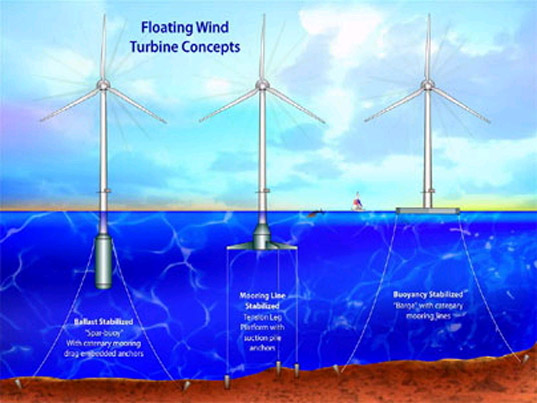
A solution to this problem is floating platforms - one of the key elements of the Ocean Energy Institute proposal. In this post I'll look at some of the work being done to develop floating offshore wind power platforms in order to enable these sorts of schemes to become a reality.

Floating Wind Turbines

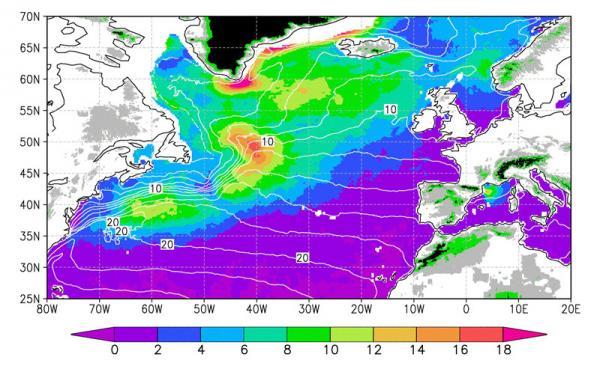
According to a 2006 report by the U.S. Department of Energy, General Electric and the Massachusetts Technology Collaborative, offshore wind resources on the Atlantic and Pacific coasts of the United States exceed the current electricity generation of the entire U.S. power industry. NASA has also been investigating ocean wind strengths worldwide, using the QuikSCAT satellite.


Researchers at MIT and elsewhere have been investigating the feasibility of "tension-leg" platforms for wind turbines, a technology that oil companies have been using for deep-water rigs. The structures would be assembled at a shipyard and placed on large floating cylinders that are ballasted with high-density concrete (to keep the structure from tipping over) and then tugged out to sea. Once in location, steel cables would be attached to the platform, anchoring it to the sea floor.

The MIT researchers claim that large turbines located far offshore could eventually generate cheaper power than both land based wind farms and near-offshore ones (even taking into account the increased cost of longer underground electricity transmission cables). Part of the cost advantage is the higher capacity factor achieved due to more consistent offshore winds - potentially averaging between 40 percent and 50 percent compared with 30 percent or less with land based turbines.

Some offshore wind farms could also have advantages in terms of proximity to large coastal cities compared to wind farms in remote areas, which require grid transmission upgrades to transport the power to places where it is consumed. Floating offshore wind farms also avoid bottlenecks in the supply of marine construction equipment such as pile drivers and cranes that may hamper rapid expansion of shallow offshore wind structures (however they may instead compete for some resources with offshore oil exploration and production, which could be problematical in the short to medium term).

A number of companies are active in the area of floating offshore wind technology - primarily Blue H Technologies, StatOil Hydro and SWAY.

Blue H Technologies

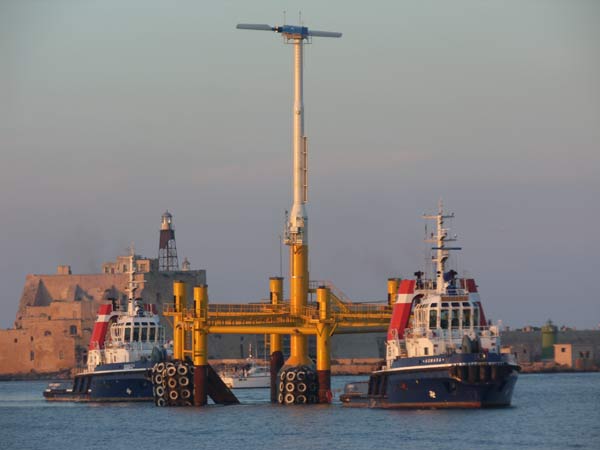
Blue H Technologies is a Dutch company that launched their first test platform at Tricase off Italy's southern coast late last year. The company has also announced plans to install another test turbine off Massachusetts.

The Blue H test platform in Italy is a tension-leg platform - a conventional offshore oil and gas platform design that floats below the surface, held in place by chains running to steel or concrete anchors on the seabed. The platform is located 10 km offshore and hosts an 80-kilowatt wind turbine which is mounted with sensors to record the wave and wind forces experienced by the equipment.

Blue H is now constructing a commercial wind farm for the Tricase site, which will have an installed capacity of 92 MW.

Blue H's design is unusual in that the turbine has a two-bladed rotor rather than the conventional three-blade design used elsewhere in. Technology Review has quoted Martin Jakubowski, Blue H cofounder and chief technology officer, as saying that "the noise and jarringly high rotation speeds that made two-bladers a loser on land are either irrelevant or a plus offshore" and that the fast rotation is "less susceptible to interference from the back-and-forth swing of the platform under wave action" and means less torque, resulting in a lighter structure (Blue H's 2.5-megawatt turbine will weigh 97 tons - 53 tons lighter than the lightest machine of the same power output on the market).

Tech Review also quotes Jakubowski as estimating that Blue H's wind farms will "deliver wind energy for seven to eight cents per kilowatt-hour, roughly matching the current cost of natural gas-fired generation and conventional onshore wind energy".


StatOil Hydro

Norwegian oil and gas producer StatoilHydro and Germany's Siemens (a major wind-turbine producer) are partnering in a project to build a commercial-scale floating wind farm about 10 kilometers offshore from Karmøy on Norway's southwestern tip.

StatoilHydro initially plans to operate a 2.3 MW wind turbine atop a conventional oil and gas platform, and is hoping for this to be operational in late 2009. Unlike the Blue H design, StatOilHydro is using traditional wind turbines.

The company believes floating wind farms are the way of the future, with a company spokesman saying that there are a declining number of sites available onshore and in shallow waters and citing regions without a shallow continental shelf like California, Japan and Norway where traditional offshore wind is not possible.

StatOilHydro says that deepwater wind power will be expensive in the initial stages but that the economics could eventually rival those of conventional wind power.

If deep offshore wind power in the North Sea proves to be successful it would become a major component on the planned European Supergrid, which backers hope will link up the region's power networks and allow a much higher proportion of renewable energy in future (possibly entirely fossil-free, as it will need to become eventually).


SWAY

SWAY, based in Bergen, Norway, plans to field a prototype of its floating wind turbine in 2010. SWAY's platform is basically a spar buoy that can rise and fall gently with wave action, requiring less anchoring than the tension-leg platform. The buoy, mounted on a column nearly 200 meters tall, is held in place by a 2,400-ton gravel ballast. A three-bladed turbine is used, but, unlike conventional onshore turbines, it faces downwind rather upwind to better accommodate heeling of the tower, which may make it more effective in rougher waters than alternative designs.

The Simmons Plan

The cost estimated for Simmons' plan is $5 billion per gigawatt — more than double the amount that T. Boone Pickens’ now delayed wind farm in Texas is supposed to cost.

This seems high if the cost savings expected by the companies mentioned above eventuate, with the StatOilHydro experiment probably being the best guide, with the North Sea facing similar weather challenges to those experienced off New England.

Winter winds in the Gulf of Maine carry as much as eight times more energy as summer breezes, meaning maximum power is available during periods of greatest demand. About 80 percent of Maine residents use oil to heat their homes. The average family uses about 1,000 gallons, or 3,785 liters a year - when prices are around $4 a gallon ($1 a litre) this consumes about one-tenth of the average family's annual income, leading Simmons to declare "If we don't do this, we're [eventually] going to have to evacuate most of Maine".

Seen in that light, even an expensive offshore wind farm is better than the alternative.

As an added bonus, construction and maintenance of the structures will bring valuable job opportunities to a region hard hit by the decline of the fishing industry.

Related Posts :

The Oil Drum - Alternative Wind Power Experiments - SkySails and Airborne Wind Turbines (Peak Energy)

The Oil Drum - Offshore Wind

Cross-posted from Our Clean Energy Future.

Statistics

Locations of visitors to this page

blogspot visitor
Stat Counter

Total Pageviews

Ads

Books

Followers

Blog Archive

Labels

australia (619) global warming (423) solar power (397) peak oil (355) renewable energy (302) electric vehicles (250) wind power (194) ocean energy (165) csp (159) solar thermal power (145) geothermal energy (144) energy storage (142) smart grids (140) oil (139) solar pv (138) tidal power (137) coal seam gas (131) nuclear power (129) china (120) lng (117) iraq (113) geothermal power (112) green buildings (110) natural gas (110) agriculture (91) oil price (80) biofuel (78) wave power (73) smart meters (72) coal (70) uk (69) electricity grid (67) energy efficiency (64) google (58) internet (50) surveillance (50) bicycle (49) big brother (49) shale gas (49) food prices (48) tesla (46) thin film solar (42) biomimicry (40) canada (40) scotland (38) ocean power (37) politics (37) shale oil (37) new zealand (35) air transport (34) algae (34) water (34) arctic ice (33) concentrating solar power (33) saudi arabia (33) queensland (32) california (31) credit crunch (31) bioplastic (30) offshore wind power (30) population (30) cogeneration (28) geoengineering (28) batteries (26) drought (26) resource wars (26) woodside (26) censorship (25) cleantech (25) bruce sterling (24) ctl (23) limits to growth (23) carbon tax (22) economics (22) exxon (22) lithium (22) buckminster fuller (21) distributed manufacturing (21) iraq oil law (21) coal to liquids (20) indonesia (20) origin energy (20) brightsource (19) rail transport (19) ultracapacitor (19) santos (18) ausra (17) collapse (17) electric bikes (17) michael klare (17) atlantis (16) cellulosic ethanol (16) iceland (16) lithium ion batteries (16) mapping (16) ucg (16) bees (15) concentrating solar thermal power (15) ethanol (15) geodynamics (15) psychology (15) al gore (14) brazil (14) bucky fuller (14) carbon emissions (14) fertiliser (14) matthew simmons (14) ambient energy (13) biodiesel (13) investment (13) kenya (13) public transport (13) big oil (12) biochar (12) chile (12) cities (12) desertec (12) internet of things (12) otec (12) texas (12) victoria (12) antarctica (11) cradle to cradle (11) energy policy (11) hybrid car (11) terra preta (11) tinfoil (11) toyota (11) amory lovins (10) fabber (10) gazprom (10) goldman sachs (10) gtl (10) severn estuary (10) volt (10) afghanistan (9) alaska (9) biomass (9) carbon trading (9) distributed generation (9) esolar (9) four day week (9) fuel cells (9) jeremy leggett (9) methane hydrates (9) pge (9) sweden (9) arrow energy (8) bolivia (8) eroei (8) fish (8) floating offshore wind power (8) guerilla gardening (8) linc energy (8) methane (8) nanosolar (8) natural gas pipelines (8) pentland firth (8) saul griffith (8) stirling engine (8) us elections (8) western australia (8) airborne wind turbines (7) bloom energy (7) boeing (7) chp (7) climategate (7) copenhagen (7) scenario planning (7) vinod khosla (7) apocaphilia (6) ceramic fuel cells (6) cigs (6) futurism (6) jatropha (6) nigeria (6) ocean acidification (6) relocalisation (6) somalia (6) t boone pickens (6) local currencies (5) space based solar power (5) varanus island (5) garbage (4) global energy grid (4) kevin kelly (4) low temperature geothermal power (4) oled (4) tim flannery (4) v2g (4) club of rome (3) norman borlaug (2) peak oil portfolio (1)