Posted
by Big Gav
in
global warming,
paul krugman,
us politics
The NYT has a column from Paul Krugman on global warming politics in the US - Who Cooked the Planet?.
Never say that the gods lack a sense of humor. I bet they’re still chuckling on Olympus over the decision to make the first half of 2010 — the year in which all hope of action to limit climate change died — the hottest such stretch on record.
Of course, you can’t infer trends in global temperatures from one year’s experience. But ignoring that fact has long been one of the favorite tricks of climate-change deniers: they point to an unusually warm year in the past, and say “See, the planet has been cooling, not warming, since 1998!” Actually, 2005, not 1998, was the warmest year to date — but the point is that the record-breaking temperatures we’re currently experiencing have made a nonsense argument even more nonsensical; at this point it doesn’t work even on its own terms.
But will any of the deniers say “O.K., I guess I was wrong,” and support climate action? No. And the planet will continue to cook.
So why didn’t climate-change legislation get through the Senate? Let’s talk first about what didn’t cause the failure, because there have been many attempts to blame the wrong people.
First of all, we didn’t fail to act because of legitimate doubts about the science. Every piece of valid evidence — long-term temperature averages that smooth out year-to-year fluctuations, Arctic sea ice volume, melting of glaciers, the ratio of record highs to record lows — points to a continuing, and quite possibly accelerating, rise in global temperatures.
Nor is this evidence tainted by scientific misbehavior. You’ve probably heard about the accusations leveled against climate researchers — allegations of fabricated data, the supposedly damning e-mail messages of “Climategate,” and so on. What you may not have heard, because it has received much less publicity, is that every one of these supposed scandals was eventually unmasked as a fraud concocted by opponents of climate action, then bought into by many in the news media. You don’t believe such things can happen? Think Shirley Sherrod.
Did reasonable concerns about the economic impact of climate legislation block action? No. It has always been funny, in a gallows humor sort of way, to watch conservatives who laud the limitless power and flexibility of markets turn around and insist that the economy would collapse if we were to put a price on carbon. All serious estimates suggest that we could phase in limits on greenhouse gas emissions with at most a small impact on the economy’s growth rate.
So it wasn’t the science, the scientists, or the economics that killed action on climate change. What was it?
The answer is, the usual suspects: greed and cowardice.
If you want to understand opposition to climate action, follow the money. The economy as a whole wouldn’t be significantly hurt if we put a price on carbon, but certain industries — above all, the coal and oil industries — would. And those industries have mounted a huge disinformation campaign to protect their bottom lines.
Look at the scientists who question the consensus on climate change; look at the organizations pushing fake scandals; look at the think tanks claiming that any effort to limit emissions would cripple the economy. Again and again, you’ll find that they’re on the receiving end of a pipeline of funding that starts with big energy companies, like Exxon Mobil, which has spent tens of millions of dollars promoting climate-change denial, or Koch Industries, which has been sponsoring anti-environmental organizations for two decades.
Or look at the politicians who have been most vociferously opposed to climate action. Where do they get much of their campaign money? You already know the answer.
By itself, however, greed wouldn’t have triumphed. It needed the aid of cowardice — above all, the cowardice of politicians who know how big a threat global warming poses, who supported action in the past, but who deserted their posts at the crucial moment.
Posted
by Big Gav
in
economics,
environmental economics,
paul krugman
Paul Krugman has a (long) article in the New York Times on the transition to a clean energy economy - Building a Green Economy.
If you listen to climate scientists — and despite the relentless campaign to discredit their work, you should — it is long past time to do something about emissions of carbon dioxide and other greenhouse gases. If we continue with business as usual, they say, we are facing a rise in global temperatures that will be little short of apocalyptic. And to avoid that apocalypse, we have to wean our economy from the use of fossil fuels, coal above all.
But is it possible to make drastic cuts in greenhouse-gas emissions without destroying our economy?
Like the debate over climate change itself, the debate over climate economics looks very different from the inside than it often does in popular media. The casual reader might have the impression that there are real doubts about whether emissions can be reduced without inflicting severe damage on the economy. In fact, once you filter out the noise generated by special-interest groups, you discover that there is widespread agreement among environmental economists that a market-based program to deal with the threat of climate change — one that limits carbon emissions by putting a price on them — can achieve large results at modest, though not trivial, cost. There is, however, much less agreement on how fast we should move, whether major conservation efforts should start almost immediately or be gradually increased over the course of many decades.
In what follows, I will offer a brief survey of the economics of climate change or, more precisely, the economics of lessening climate change. I’ll try to lay out the areas of broad agreement as well as those that remain in major dispute. First, though, a primer in the basic economics of environmental protection.
Environmental Econ 101
If there’s a single central insight in economics, it’s this: There are mutual gains from transactions between consenting adults. If the going price of widgets is $10 and I buy a widget, it must be because that widget is worth more than $10 to me. If you sell a widget at that price, it must be because it costs you less than $10 to make it. So buying and selling in the widget market works to the benefit of both buyers and sellers. More than that, some careful analysis shows that if there is effective competition in the widget market, so that the price ends up matching the number of widgets people want to buy to the number of widgets other people want to sell, the outcome is to maximize the total gains to producers and consumers. Free markets are “efficient” — which, in economics-speak as opposed to plain English, means that nobody can be made better off without making someone else worse off.
Now, efficiency isn’t everything. In particular, there is no reason to assume that free markets will deliver an outcome that we consider fair or just. So the case for market efficiency says nothing about whether we should have, say, some form of guaranteed health insurance, aid to the poor and so forth. But the logic of basic economics says that we should try to achieve social goals through “aftermarket” interventions. That is, we should let markets do their job, making efficient use of the nation’s resources, then utilize taxes and transfers to help those whom the market passes by.
But what if a deal between consenting adults imposes costs on people who are not part of the exchange? What if you manufacture a widget and I buy it, to our mutual benefit, but the process of producing that widget involves dumping toxic sludge into other people’s drinking water? When there are “negative externalities” — costs that economic actors impose on others without paying a price for their actions — any presumption that the market economy, left to its own devices, will do the right thing goes out the window. So what should we do? Environmental economics is all about answering that question.
One way to deal with negative externalities is to make rules that prohibit or at least limit behavior that imposes especially high costs on others. That’s what we did in the first major wave of environmental legislation in the early 1970s: cars were required to meet emission standards for the chemicals that cause smog, factories were required to limit the volume of effluent they dumped into waterways and so on. And this approach yielded results; America’s air and water became a lot cleaner in the decades that followed. ...

Dave Roberts has a few comments about the article at Grist, in what he dubs "A plea for hippie economics" -
Hey Paul Krugman: How about less econ theory and more econ mechanics?.
Many people, including me and, um, Al Gore, have recommended Paul Krugman's primer on climate economics. It's a top-notch introduction and a welcome antidote to the ignorance and hysteria that characterize most media coverage of climate policy. Read it!
In describing environmental economics, however, Krugman simply passes along many of its flaws. Economist James Barrett identified a few of them. I want to echo and reinforce one of the points he made.
"Not that bad" ain't good
The great sin of conventional economics is the assumption of rationality. According to rational choice theory, individuals act to maximize their self-interest; ergo, markets based on free exchange of goods and services will yield maximally efficient distribution of resources. A free market is, in German philosopher Gottfried Leibniz's terms, the best of all possible worlds. Most of what economists miss about energy can be traced to to the lingering effect of this assumption.
Now, every time I bring this up, people come out of the woodwork to tell me I'm constructing a caricature, and everybody knows about market failures. Which is ironic, since the people who bitch about rational choice theory more than anyone I know are economists. (Again: see James Barrett. Or anything Dean Baker's ever written. Or the entire field of behavioral economics.) What they tell me is that the most common macroeconomic models still rest on the assumption of rational choice; that the most influential names in the field still work with the assumption; that new approaches are still marginal and viewed with skepticism by modelers; and that laypeople's understanding of economics is heavily colored by it.
Anyway, the assumptions of rational choice theory are the only way to explain something like this -- and that's one of a dozen articles I could cite. They are the only way to explain the results of the economic models used by the CBO to score climate legislation. They're the only way to explain the conventional wisdom in D.C. that climate legislation is all about costs. After all, as Barrett says, "with everyone constantly and correctly optimizing their behavior, there is nothing the government can do to make us any better off."
Lamentably, Krugman's article reenforces that conventional wisdom. He concludes that pricing carbon is the Ultimate Climate Policy (maaaybe we can tack on a few performance standards for coal plants). According to mainstream economic modeling, a carbon price will inhibit GDP growth. Krugman's cri de couer is as follows: "Restricting emissions would slow economic growth -- but not by much." Freeeeeedooooom!
"Not as bad as you might have worried" may be a convincing argument to pointy-headed intellectuals, but it hasn't exactly gotten the public fired up. To boot, it's almost certainly incorrect. Krugman simply ignores the panoply of policies proven to boost economic productivity and reduce emissions.
They exist! Long ago, in the Dark Ages (1997), over 2,500 economists, including nine Nobel Laureates, endorsed "The Economists' Statement on Climate Change." The second of three propositions in that statement was:
2. Economic studies have found that there are many potential policies to reduce greenhouse-gas emissions for which the total benefits outweigh the total costs. For the United States in particular, sound economic analysis shows that there are policy options that would slow climate change without harming American living standards, and these measures may in fact improve U.S. productivity in the longer run. ...
But my objection to Krugman's take on climate economics is even more basic. To see what I mean, consider this passage:
If there's a single central insight in economics, it's this: There are mutual gains from transactions between consenting adults. ... Free markets are “efficient” -- which, in economics-speak as opposed to plain English, means that nobody can be made better off without making someone else worse off.
...
But what if a deal between consenting adults imposes costs on people who are not part of the exchange? What if you manufacture a widget and I buy it, to our mutual benefit, but the process of producing that widget involves dumping toxic sludge into other people's drinking water? When there are “negative externalities” -- costs that economic actors impose on others without paying a price for their actions -- any presumption that the market economy, left to its own devices, will do the right thing goes out the window. So what should we do? Environmental economics is all about answering that question.
Perhaps inadvertently, Krugman reveals how environmental economists seem to think of their work. Assume a free market filled with exchanges among "consenting adults." Then introduce a negative externality -- say, CO2 emissions. What's the proper response? Viewed in that light, obviously the right response is to put a price on the externality. Done! That's why the environmental economist's approach to climate policy always seems to be: price carbon and get out of the way.
But ... and this is a gargantuan but (quit snickering) ... why would you assume a free market? Are there free markets in energy anywhere in the world? If so I'm not familiar with them. Everyone involved in energy markets is always and already operating within a skein of existing market distortions. We live in a fallen world.
Posted
by Big Gav
in
paul krugman,
peak oil
Paul Krugman seems to be firmly in the peak oil camp now, though I'm not sure why he thinks it is a largely DFH driven meme (thats just one constituent group from what I can tell) - Oil wells that don’t end well.
One of the defining features of the last 8 years or so has been the way ideas go from crazy stuff that only DFHs believe to stuff everyone knows, without ever going through a stage in which the holders of conventional wisdom acknowledge that they were wrong. Oh, and the people who were right are still considered DFHs; you see, they were right too soon.
It looks as if peak oil may be going that way:
Russian oil production has peaked and may never return to current levels, one of the country’s top energy executives has warned, fuelling concerns that the world’s biggest oil producers cannot keep up with rampant Asian demand.
Posted
by Big Gav
in
paul krugman,
peak oil
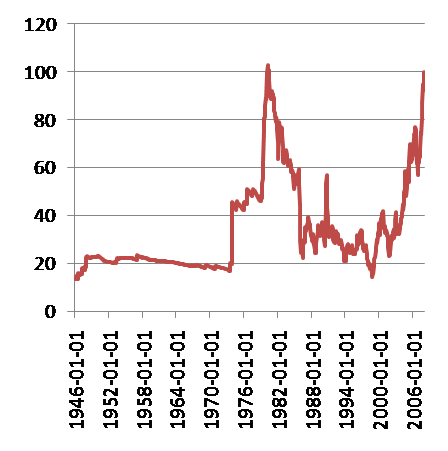
Paul Krugman is feeling a bit peaked.
Peak oil, that is — a dismal theory that keeps getting more plausible.
A curious fact: a couple of years ago the firmly held belief of many right-wing economic commentators (why is this ideological? I’m not sure, but it was) was that the spectacular rise in home prices wasn’t a bubble, but that the rise in oil prices was.
Oil prices are set to crash from this week’s record highs as a speculative market bubble bursts with an impact that could make the hi-tech bust of 2000 ‘look like a picnic’, business publisher Steve Forbes has predicted.
Forbes said the high oil prices currently dampening the US economy, which peaked at more than 70 usd a barrel yesterday as Hurricane Katrina headed for the US Gulf Coast, would fall to 30-35 usd a barrel within a year.
I took oil price and CPI data from FRED, the Federal Reserve Bank of St. Louis database — an incredibly useful resource. I just guessed at 0.3 percent inflation for February, and used an oil price of $100 for the last data point.
Add: Commenter Gufblog asks, “Isn’t it true that at above $40 a barrel Venezuela and Canada can start profitably turning oil sands and other hard-to-get-at sources into petroleum (which together more than double the world’s total supply and elevate Venezuela to the nation holding the greatest reserves)?” Well, people say that — but they’re always saying something like that. My first serious economics work was during the first oil crisis, when I spent many hours with Bureau of Mines publications containing firm estimates of the price of shale oil and oil-from-coal, all of which said that huge alternative supplies should be arriving any day now. Eventually people began talking about “Weitzmann’s Law,” which was that the cost of alternatives to conventional crude is 40% above the current price — whatever the current price is. Seriously, don’t believe the hype: history says that these things always fall short of expectations.
Meanwhile Bloomberg is reporting "
Oil at $100 May Look `Cheap' Within Five Years, Alfa Bank Says ".
Crude oil prices of $100 may look ``cheap'' within five years if OPEC production fails to keep pace with global demand growth, according to Alfa Bank. ``We may hit peak oil in the course of the next three, four or five years, in which case $100 oil will look somewhat quaint,'' Alfa Bank's Moscow-based Head of Research Ronald Smith said in an interview with Bloomberg television.
Peak oil is the theory that global crude production is set to decline as new discoveries fail to make up for falling output from older oilfields. Some forecasts indicate Saudi Arabia, the largest producer in the Organization of Petroleum Exporting Countries, may be unable to reach sustainable output of 15 million barrels a day and fail to meet an annual demand increase of 1.5 million barrels a day, Smith said.
Global oil demand will ``hold up'' in the event of a U.S. slowdown as consumption growth is led by Asian and Middle East importers, while usage within the U.S. itself ``has not shown much sensitivity'' in the past to weaker economic activity.
Over at the BBC the question is "
Who knows why oil prices are so high" ?. What happened to
Adam Porter ?


 Posts




