Posted
by Big Gav
in
agriculture,
peak phosphorus,
phosphorus,
western sahara
Yale Environment 360 has an article on phosphorus depletion - Phosphate: A Critical Resource Misused and Now Running Low.
Phosphate has been essential to feeding the world since the Green Revolution, but its excessive use as a fertilizer has led to widespread pollution and eutrophication. Now, many of the world’s remaining reserves are starting to be depleted.
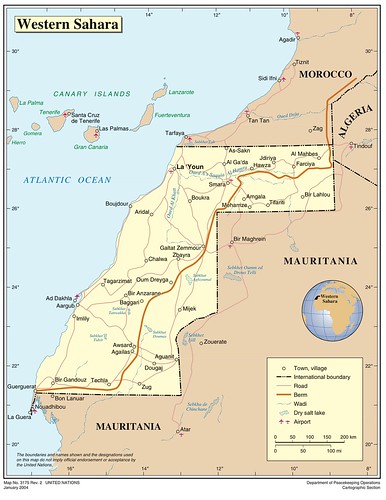
If you wanted to really mess with the world’s food production, a good place to start would be Bou Craa, located in the desert miles from anywhere in the Western Sahara. They don’t grow much here, but Bou Craa is a mine containing one of the world’s largest reserves of phosphate rock. Most of us, most days, will eat some food grown on fields fertilized by phosphate rock from this mine. And there is no substitute.
The Western Sahara is an occupied territory. In 1976, when Spanish colonialists left, its neighbor Morocco invaded, and has held it ever since. Most observers believe the vast phosphate deposits were the major reason that Morocco took an interest. Whatever the truth, the Polisario Front, a rebel movement the UN recognizes as the rightful representatives of the territory, would like it back.
Not many people would call phosphate a critical issue or one with serious environmental consequences. But even leaving aside the resource politics of the Sahara, it is an absolutely vital resource for feeding the world. It is also a resource that could start running low within a couple of decades — and one we grossly misuse, pouring it across the planet and recycling virtually none of it.
The world’s food supplies are alarmingly dependent on the phosphate fertilizer that is hewn from the desert of the Western Sahara. The vast open-cast mine at Bou Craa delivers several million tons of phosphate rock every year down a 150-kilometer-long conveyor belt, the world’s longest, to the Atlantic port of El Ayoun. From there, it is distributed around the world and made into fertilizer.
Morocco’s phosphate reserves are owned by the Office Cherifien des Phosphates, a Moroccan state agency. Given the almost unlimited executive powers of the Moroccan monarch, it might reasonably be said that most of the world's known reserves of phosphate are, in effect, owned by King Mohammed VI and his Alaouite dynasty, which has reigned in Morocco since the 17th century.
If the people of Western Sahara ever resume their war to get their country back — or if the Arab Spring spreads and Morocco goes the way of Libya — then we may be adding phosphate fertilizer to the list of finite resources, such as water and land, that are constraining world food supplies sooner than we think.
Posted
by Big Gav
in
morocco,
peak phosphorus,
phosphate,
phosphorus
BusinessWeek has a look at a key agricultural input commodity, phosphate - Phosphate: Morocco's White Gold.
Miners have been working in Khouribga for almost a century, but only now is the area poised to become central to the global economy. Back in the 1920s pioneers started tunneling through the earth here, digging through layers of sediment formed under an ancient sea, looking for phosphate-rich rock and occasionally plucking out the tooth of a 30-million-year-old shark. The phosphate extracted from the rock, used in fertilizer, detergent, food additives, and more recently lithium-ion batteries, sold for decades in its raw state for less than $40 per metric ton. Those days are gone. It's currently trading at about $130.
This is good news for King Mohammed VI, 47, who owns more than half the world's phosphate reserves. James Prokopanko, chief executive officer of Plymouth (Minn.)-based fertilizer giant Mosaic (MOS), has called Morocco the Saudi Arabia of phosphate, with all that implies about the King's power to influence prices and economies. Mohammed's strategy, by most accounts, is to drive the commodity's price higher yet—which means the cost of making everything from corn syrup to iPads will be going up as well. ...
Phosphate, when used as fertilizer, is the irreplaceable engine powering modern agriculture, and its reserves are in decline almost everywhere except Morocco. Most phosphate mines, including those in the U.S., which produces 17 percent of the global supply, have been in a downward spiral for the last decade, running out of quality rock and hindered by environmental regulation. That has forced companies to look farther afield for additional supplies. Earlier this year, Mosaic spent $385 million for a 35 percent stake in a Peruvian mine to supply rock to its phosphate operations in the U.S. and South America. Meanwhile, Australia's mining giant BHP Billiton (BHP) has been threatening to take over Canada's PotashCorp (POT), a major supplier of both potash and phosphate.
Even a temporary phosphate shortage could affect a range of U.S. industries. Phosphate fertilizer is used on just about every crop, though most in the U.S. goes to the 13 billion bushels of corn grown each year to make everything from corn syrup to cattle feed to ethanol. When prices climbed tenfold in 2007 and 2008, retailers and farmers scrambled to build local fertilizer warehouses as a buffer. Now, according to Dirk Lohry, owner of Nutra-Flo, a crop and animal nutrient manufacturer in Sioux City, Iowa, many of those warehouses stand empty as supplies are being used too quickly to build inventory. The prospect of a shortage has become serious enough that the Office of Intelligence and Counterintelligence at the U.S. Energy Dept. recently assigned an analyst to study the issue; she was not permitted to speak publicly because of "geopolitical sensitivities."
One could look at the 2007-08 food crisis for clues to how a shortage might play out. At that time, rising food prices led to riots across Africa and Asia—the Pakistani Army even stepped in to defend warehouses and farms. Before the crisis was over, China had levied a 135 percent export tariff on its phosphate to protect its domestic food supply; phosphate there is still taxed at 110 percent at the height of the buying season.
The scale of Morocco's phosphate wealth was officially verified in September, when the International Fertilizer Development Center released its long-awaited update on global phosphate resources. Morocco's portion went from the 5.7 billion metric tons still cited in U.S. Geologic Survey reports, to 50 billion metric tons—85 percent of the world's total. Even with 170 million metric tons of concentrated phosphate changing hands each year, the Moroccans likely have at least 300 to 400 years of rock available. Talal Zouaoui, OCP's director of communications, won't agree or disagree with estimates, but says in an e-mail that Morocco has "significant reserves," and notes that reserves denote only those quantities that countries have discovered and deem economically viable to extract.
With a growing world population consuming more grain, more meat, and more biofuels, demand is expected to rise at a rate of 2 to 3 percent per year, according to the International Fertilizer Assn. Some experts, like Dana Cordell, co-founder of the Global Phosphorus Research Initiative, predict that phosphate production will "peak" within the next 50 years.
Not all phosphate becomes fertilizer: About 15 percent is turned into detergents or food additives, such as the tangy phosphoric acid in Coca-Cola (KO), or the moisture-retaining salts in salami. (As U.S. states try to control the use of phosphates, which promote algae blooms in water bodies, Procter & Gamble (PG) and other detergent makers have been experimenting with phosphate-free products, with mixed results.)
OCP controls 30 percent of global phosphate exports, and plans to increase annual production from 30 million metric tons to 54 million metric tons by 2015, investing $5 billion in the process. By that time, Prayon, a Belgian phosphate processor in which OCP owns a 50 percent stake, believes demand for phosphate as a component of the lithium-ion batteries in electric vehicles could exceed demand for it in detergent.

Posted
by Big Gav
in
agriculture,
peak phosphorus,
toilet design
Slate has an article on the "Future of Toilet Design" as people consider ways to recycle phosphorus - Blogging the Periodic Table: Nitrogen and Phosphorus: The Future of Toilet Design Hangs in the Balance.
A diet that lacks even obscure elements like selenium will leave almost any creature on earth sick and hobbled, if not dead. Plants are made of the same basic stuff as animals but have different nutritional needs and need their elements, like nitrogen, in different forms. In fact, the amount of Element 7 available in the soil severely restricts how many plants can grow there. Carnivorous plants, like Venus flytraps, consume bugs mostly to get at their nitrogen.
Fertilizers make plants grow by delivering nitrogen (and other elements, like phosphorus) in high-octane forms. Early farmers fertilized crops with urine or dung, usually scraped from "stables, sheep pens, pigeon houses, caverns, and even peasants' cottages—any place manure and refuse accumulated," as one historian reports. After the Industrial Revolution, the demands of agriculture became too onerous for sheep, pigeons, and peasants to keep up, so European countries began to mine nitrogen fertilizers in South America, especially from deposits of Chile saltpeter. (It was known as Peru saltpeter until Chile wrestled the mines away from Peru in the "Saltpeter War" in the 1880s.) But already by 1900, Chile had depleted its saltpeter stores, and a worldwide food crisis seemed imminent.
Now, some of you who remember your periodic table might have noticed something funny about these claims of scarcity. After all, one fundamental law of matter says you can't "use up" elements like nitrogen—they're conserved, neither created nor destroyed. So an atom of nitrogen can never really disappear. (Radioactive elements do decay and disappear, but the vast majority of atoms are not radioactive.) Besides, there's plenty of nitrogen in the air—four out of every five molecules you breathe. It's hardly in short supply.
That said, the useful form of an element can disappear. Pure nitrogen in the air acts differently than saltpeter nitrogen, which is locked into a molecule called a nitrate. For plants, nitrogen in the air just isn't palatable—it's analogous to dying of thirst in the middle of the ocean. Plants need nitrates or other forms of the element. So even though the world supply of nitrogen atoms hadn't decreased by 1900, the supply of nitrogen that plants can actually use had decreased.
Thankfully, a few years later a German chemist with a pince-nez named Fritz Haber devised a way to derive ammonia (NH3) from nitrogen. Because ammonia converts readily into fertilizer, Haber probably helped avert worldwide famine. (Haber is among the most interesting and disgusting figures in science history, both a Nobel Prize winner for his nitrogen work and an international war criminal for his role in "perfecting" gas warfare during World War I.)
But history repeats itself in scary ways, and some agricultural scientists today fret that we're eating our way into another fertilizer shortage—and with an element we can't conjure out of thin air, phosphorus. They call the threat "peak phosphorus," or for the initiated, peak P. (It's a play on "peak oil," the idea that we've already burned up half or more of the world's oil supply and that we'll use up the remainder frighteningly quickly.)
Plants need phosphorus in a form called phosphate, familiar to many of us from cherry or lime phosphates in old-fashioned soda shops. Living creatures use phosphates as the structural girder for DNA, and also in a molecule called ATP that provides the power to run cells. Human beings are 1 percent phosphorus by weight, and scientists have long known how important an element it is for health. Even with all the other problems of the Great Depression going on, FDR gave a speech warning America about the diminishing phosphorus in our food. Ninety percent of the phosphorus mined today (it's abundant in China, Morocco, Idaho, and Florida) ends up in fertilizer bags.
Unfortunately, erosion and runoff waste half of that phosphorus, as the phosphates end up scattered deep underground or chemically changed. So even though the phosphorus atoms never disappear, they're not available as fertilizer. The world has between 4 billion and 8 billion tons of phosphate reserves, and we extract one-eighth of a billion tons per year. So simple arithmetic says we could "run out" of phosphorus in about 30 years. The end could come even sooner if we ramp up biofuel production, since switchgrass, corn, and other biofuel crops will require loads of phosphorus-rich fertilizer. And unlike nitrogen, there's no other ready source than mining.
What can we do? There's scrimping, of course, but humans almost never do that well, (See peak oil.) We prefer technical solutions. One promising strategy calls for recycling P. And the easiest way to do so is to recycle pee—through a European technology called NoMix toilets, which have separate basins in the porcelain bowl for different kinds of waste. Feces contains some phosphorus, but urine is brimming with the stuff, and it's much easier to recapture phosphorus from urine before it gets mixed in with sewage sludge. The great advantage of NoMix toilets is that they're passive—people install them once, and pipes do the rest.
Posted
by Big Gav
in
agriculture,
ostara,
peak phosphorus,
recycling
Fast Company has an article on phosphorus recycling from municipal waste streams - Ostara Aims to Stave Off Peak Phosphorous.
Forget peak oil. The next big crisis is peak phosphorous--a shortage of mined phosphorous for fertilizer. The problem is so bad that supply won't be able to meet agricultural demand within the next 30 to 40 years. But a Robert F. Kennedy Jr.-backed startup called Ostara thinks it might have the solution: a system that removes nutrients--including phosphorous--from wastewater and turns it into a slow-release commercial fertilizer called Crystal Green. The company's second commercial facility was unveiled this week at the Nansemond Treatment Plant in Suffolk, Virginia.
Ostara's process features a reactor that processes sludge liquid and recovers nutrients that might otherwise have to be disposed of using costly processes. The reactor is so effective that it can extract over 90% of phosphorous from a municipal waste stream. "Our process works very much in complement to existing wastewater treatment technology. There are plants that have advanced processes to remove nutrients from raw sewage, but they need to dispose of them. We can take those concentrated nutrient flows and extract out nutrients," explains Phillip Abrary, the CEO of Ostara, in an interview with FastCompany.com. "The system pays back for itself in five years."
Once nutrients have been extracted, Ostara mixes them with magnesium chloride and caustic to create pellets that can be processed into Crystal Green, the company's slow-release commercial fertilizer. What's unique is that the fertilizer dissolves over a long time," Abrary says. "When you put it in soil, it takes 8 to 9 months to dissolve. Plants are constantly fed using these nutrients."
Municipalities pay for Ostara's technology in one of two ways: a capital-based model that requires municipalities to pay Ostara for construction, with an investment paid back through revenue from Crystal Green sales, reduced operating costs, and increased plant capacity; and a fee-based model where Ostara pays for construction and operating costs while the municipality reimburses Ostara and pays a profit margin from a negotiated fee over a set number of years.
So far, municipalities have embraced the idea. Ostara opened its first commercial plant--a $5 million facility--outside Portland, Oregon last year. It is producing 500,000 pounds of Crystal Green annually. Ostara's second commercial plant, launched this week in Virginia, and the company plans on opening another plant in York, Pennsylvania in September.
Posted
by Big Gav
in
lithium,
peak lithium,
peak phosphorus,
rare earths,
ronald bailey
Ronald Bailey at Reason - a long time skeptic of peak oil - has a new article looking at some other potential resource extraction peaks (peak lithium, peak neodymium, and peak phosphorus), arguing - correctly in my view - that substitution and recycling can overcome these problems - (Peak Everything ?.
Peak Lithium
Lithium is the element at the heart of the electric car revolution that many green energy enthusiasts are trying to foment. For example, the Chevy Volt, scheduled to be at dealers this fall, will be energized by 400 pounds of lithium ion batteries, plus a gasoline engine to produce electricity to extend the car’s range of travel once the batteries are drained. In 2007, William Tahil, an analyst with the France-based consultancy, Meridian International Research, issued a report that alarmingly concluded that there is “insufficient economically recoverable lithium available in the Earth's crust to sustain electric vehicle manufacture in the volumes required.” Tahil added, “Depletion rates would exceed current oil depletion rates and switch dependency from one diminishing resource to another.” Not everyone agrees with Tahil’s peak lithium prognostications. ...
Even Tahil’s original report argued that there were alternative battery technologies in the works using far more common substances that could substitute for lithium. For example, the Swiss company ReVolt is developing rechargeable zinc-air batteries which hold 300 percent more charge than lithium ion batteries and cost half as much. And then there is Fluidic Energy which claims that it can develop a metal air battery that will hold 11 times the charge of the best lithium ion batteries for less than one-third the cost. A car running on such batteries would have a range of 400 to 500 miles on a single charge. These batteries are made from far more available materials which can be fairly easily recycled.
Peak Neodymium
Neodymium is a rare earth metal used extensively to produce permanent magnets found in everything from computer magnetic disks and cell phones to wind turbines and automobiles. For example, the magnets that drive a Prius hybrid’s electric motor use more than two pounds of neodymium. Interestingly, neodymium magnets were invented in the 1980s to overcome the global cobalt supply shock that occurred as the result of internal warfare in Zaire. Because China can more cheaply produce neodymium than any other country in the world, that country is now the source of 95 percent of the world’s neodymium. ...
On the other hand, if neodymium supplies really are a problem, perhaps there is a technical fix. For example, the privately held Chorus Motors has invented and developed an improved AC induction motor that completely eliminates the permanent neodymium magnets to supply the energy needed to accelerate hybrid or electric vehicles. If this technology is widely adopted, it would free up neodymium supplies for other uses and also tend to lower the metal’s price.
Peak Phosphorus
In the 1840s, scientists discovered that plants need the element phosphorus to grow. The phosphorus fertilizer industry grew rapidly, initially by exploiting vast deposits of seabird guano left on oceanic islands. Today phosphate rocks are mined to produce the fertilizer. The Global Phosphorus Research Initiative (GPRI) notes that modern agriculture is dependent on continual inputs of phosphorus fertilizer and that known reserves could be depleted within the next 50 to 100 years. The current issue of Foreign Policy ominously warns that failing to meet the challenge of “peak phosphorus” would mean that “humanity faces a Malthusian trap of widespread famine on a scale that we have not yet experienced.” But unlike petroleum or natural gas, phosphorus, as an element, is not destroyed when it’s used and so could be recovered and recycled.
The folks at the GPRI point out that the phosphorus in just one person’s urine would be close to the amount needed to fertilize the food supply for one person. So why not recycle urine? ...
Stanford University economist Paul Romer has observed, "Every generation has perceived the limits to growth that finite resources and undesirable side effects would pose if no new recipes or ideas were discovered. And every generation has underestimated the potential for finding new recipes and ideas. We consistently fail to grasp how many ideas remain to be discovered. The difficulty is the same one we have with compounding: possibilities do not merely add up; they multiply.” The above examples show that while the production of physical supplies of resources may peak, there is no sign that human creativity is about to peak.


 Posts




