Posted
by Big Gav
in
portugal,
renewable energy
CleanTechnica reports that portugal has produced more renewable energy than it has consumed for an extended run of days - Portugal runs on 100% renewables for 4 days. In April, 80% of Portugal’s electricity came from renewables. The figure is 75% for the first 4 months of 2016.
We're seeing this more and more in the more advanced energy producing countries these days - now it is just a matter of counting down the days until the entire planet uses renewable energy only.
Posted
by Big Gav
in
floating offshore wind power,
floating wind power,
portugal,
wind power
Irish Energy News reports that Portugal is getting in to the floating wind power game - First Offshore Floating Turbine in Portugal.
The first offshore floating wind turbine is now under construction off the coast of Aguçadoura in the north of Portugal. The project involves the construction of a 2MW wind turbine prototype over the next 6 months – one of the first of its kind in southern Europe. Installation and contruction costs are estimated to amount to 4.1 million Euros per MW installed.
The technology is patented by American company Power Principle using the name “WindFloat”. It consists of a triangular floating base. The base is allowed to float through the use of three pillars, one of which houses the tower structure for the wind turbine. The structure is anchored to the seabed through the use of cables and can be installed anywhere between depths of 50 meters to several hundred meters.
The design and size of the WindFloat enables the overall structure to be assembled onshore and towed to its final location. All fabrication and qualification is completed at quayside in a controlled environment. According to Principle Power, cost savings are significant when compared with direct/fixed offshore wind turbine support structures.
Cleandxr has a compilation of some Scandinavian floating wind power designs -
Seven Innovative Floating Windmill Platform Concepts.
Posted
by Big Gav
in
ocean energy,
portugal,
wave power
While the last Portuguese wave power experiment wasn't exactly successful (see Pelamis' ill-fated experiment), people are still trying - Renewable Energy World reports - Orecon Signs Landmark Deal With Eneolica for 4.5-MW Wave Farm in Portugal
Orecon, the Cornish wave energy device developer, has signed an agreement with Portuguese developer Eneólica to establish a Joint Venture company to build and deploy Orecon's first full scale 1.5 MW MRC wave energy buoy. The site will be connected to the Portuguese electricity grid and deliver power for up to 1500 homes.
When the first unit has been connected, two further MRCs will be added to the site, increasing the power output to 4.5 MW making it the world's largest operating wave farm to date and providing power for nearly 5000 homes. The partners intend to develop further multi-megawatt sites in Portugal over the next 10 years.
Posted
by Big Gav
in
grid parity,
nuclear power,
portugal,
renewable energy,
solar power,
us
Reuters reports on the growing anticipation that solar power will reach grid parity with other forms of power generation in the next few years.
After decades on the fringe, solar power is closing in on America's mainstream as surging fossil fuel prices and mounting concern over climate change spur states, businesses and homeowners into a quickening embrace with alternative energy.
Panels bolted to roofs to convert sunlight into electricity are still too expensive in most regions to compete with cheaper, less environmentally friendly fuels like coal without generous subsidies. Solar's high costs have kept the resource out of reach for many residences and businesses,. But not for long, industry analysts and scientists say.
The tipping point at which the world's cleanest, most renewable resource is cost-competitive with other sources of energy on electricity grids could happen within two to five years in some U.S. regions and countries if the price of fossil fuels continues to rise at its current pace, they add.
"In the long run -- as in two to three years -- you should see competitiveness especially with the grid in a number of regions in the world," said Vishal Shah, an analyst who tracks the industry at U.S. investment bank Lehman Brothers.
Tom Werner, chief executive of SunPower Corp, the largest North American solar company by sales, sees such "grid parity" for solar power in the United States and elsewhere happening in about five years, or possibly as soon as 2010.
"That's actually more aggressive than what we would say previously, and that's because the cost of electricity is going up faster than we had ever modeled," Werner said an interview at the Reuters Global Energy Summit on June 3. "It is becoming more and more clear it is a real possibility, and we believe, a reality," he said.
Richard Feldt, chief executive of U.S. solar panel maker Evergreen Solar Inc, calls grid parity the industry's "Holy Grail" and sees it happening in about five years. "It's not far away," he said in an interview.
Suntech Power Holdings Co Ltd, one of the largest of a growing number of Chinese solar companies, sees the same five-year timeline, thanks to increasing supplies of silicon that will help drive down costs. ...
If its subsidies continue, the United States could generate as much power from solar panels as two-and-a-half typical nuclear reactors in four years -- or about 2.55 gigawatts, according to the European Photovoltaic Industry Association's data. That association sees global nuclear capacity reaching 44 gigawatts in four years -- the equivalent to the power capacity of 44 nuclear reactors.
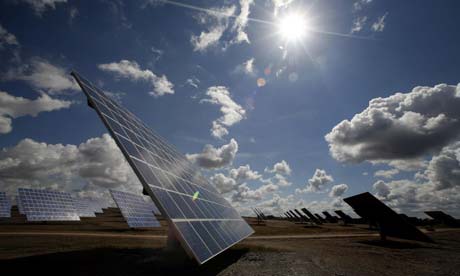
The Guardian has a report on Europe's largest solar PV power plant - at
Moura in Portugal. The Portuguese push for clean energy is moving along with impressive speed.
From a distance the bizarre structures sprouting from the high Alentejo plain in eastern Portugal resemble a field of mechanical sunflowers. Each of the 2,520 giant solar panels is the size of a house and they are as technically sophisticated as a car. Their reflective heads tilt to the sky at a permanent 45 degrees as they track the sun through 240 degrees every day.
The world's largest solar photovoltaic farm, generating electricity straight from sunlight, is taking shape near Moura, a small town in a thinly populated and impoverished region which boasts the most sunshine per square metre a year in Europe.
When fully commissioned later this year, the £250m farm set on abandoned state-owned land will be twice the size of any other similar project in the world, covering an area nearly twice the size of London's Hyde park. It is expected to supply 45MW of electricity each year, enough to power 30,000 homes.
Portugal, without its own oil, coal or gas and with no expertise in nuclear power, is pitching to lead Europe's clean-tech revolution with some of the most ambitious targets and timetables for renewables. Its intention, the economics minister, Manuel Pinho, said, is to wean itself off oil and within a decade set up a low carbon economy in response to high oil prices and climate change.
"We have to reduce our dependence on oil and gas," said Pinho. "What seemed extravagant in 2004 when we decided to go for renewables now seems to have been a very good decision."
He expects Portugal to generate 31% of all its energy from clean sources by 2020. This means lifting its renewable electricity share from 20% in 2005 to 60% in 2020, compared with Britain's target of 15% of all energy by 2020. Having passed its target for 2010 it could soon top the EU renewables league.
In less than three years, Portugal has trebled its hydropower capacity, quadrupled its wind power, and is investing in flagship wave and photovoltaic plants. Encouraged by long-term guarantees of prices by the state, and not delayed by planning laws or government indecision, it has proved a success. Firms are expected to invest £10bn in renewables by 2012 and up to £100bn by 2020.
However, Portugal says it wants to develop a renewables industry to rival Denmark or Japan. When the government invited companies for tenders to supply wind, solar and wave power, it demanded they work with manufacturing companies to establish clusters of industries.
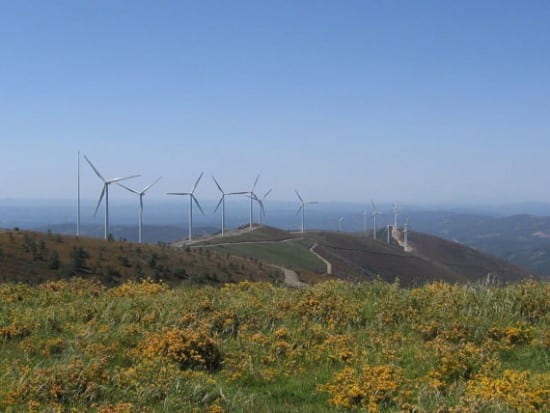
This is a great success, say regional governments. In northern Portugal, where the world's biggest wind farm, with more than 130 turbines, is now being strung across the mountainous Spanish border, a German firm employs more than 1,200 people building 600 40-metre-long fibreglass wind turbine blades a year.
The turbines are earmarked for Portuguese farms first, but orders are being taken from Britain and other countries. Half the workforce are women who once worked in the declining textile industry.
It is Portuguese plans for wave power that are prompting the most interest in Europe. The world's first commercial wave farm is being assembled near Porto. Three "sea snakes", developed by the Edinburgh-based company Pelamis, will shortly be towed out to sea and will start pumping modest amounts of electricity into the grid later this year.
It is the start of a potentially giant global industry with Portuguese firm Enersis planning to invest more than £1bn in a series of farms that together would power 450,000 homes.
Pinho dismisses nuclear power. "When you have a programme like this there is no need for nuclear power. Wind and water are our nuclear power. The relative price of renewables is now much lower, so the incentives are there to invest. My advice to countries like the UK is to move as fast as they can to renewables. With climate change and the increase in oil prices, renewables will become more and more important.



 Posts




