Posted
by Big Gav
in
scenario modelling
The Long Now Blog has a great graphic showing how poor predictions in the 1970's of future energy use in the US were - How good are our predictions of the next 30 years ?. The modellers obviously underestimated how successful energy efficiency programs would be - and perhaps also how much US manufacturing would disappear offshore.
Posted
by Big Gav
in
modelling,
scenario modelling,
simulation
Technology Review has an article on a European plan to build a simulation of the entire planet (maybe they'll call this field of endeavour "psychohistory" - Europe's Plan to Simulate the Entire Planet.
When it comes to global crises, we're not short of complex systems that look close to the edge: the climate, the food supply, energy security, the banking system and so on. Add to this the threat of war in many parts of the world and the possibility of global pandemics and it's a wonder that anybody gets out of bed in the morning.
Science has certainly played an important role in understanding aspects of these systems but could it do more?
Today, Dirk Helbing at the Swiss Federal Institute of Technology in Zurich outlines an ambitious project to go further, much further.
Helbing's idea is to create a kind of Manahattan project to study, understand and tackle these techno-socio-economic-environmental issues. His plan is to gather data about the planet in unheard of detail, use it to simulate the behaviour of entire economies and then to predict and prevent crises from emerging.
Think of it as a kind of Google Earth for society. We've all played with Google's 3D map of the Earth that uses real data to reveal not only the town where you live and work but your home and back garden too.
Imagine a similar model that uses in real time things like financial transactions, health records, travel details, carbon dioxide emissions and so on to build a model of not just the planet but the entire society that populates it. Helbing calls it 'reality mining'.
This model will be capable not only modelling the planet in real time but of simulating the future, rather in the manner of weather forecasters.
Helbing's simulator will look for economic bubbles and collapses, warn of global pandemics and suggest how to tackle them, it will model and predict the outcome of regional conflicts and determine the effect of our behaviour on the climate. He even wants to create 'situation rooms' in which global leaders can view and manage crises as they occur.
This Google-Earth-on-steroids is to be called the Living Earth Simulator and Helbing's plan is to have it working by 2022 at a cost of a cool EUR 1 billion, funded by the European Commission. He's even assembled an impressive team to help, including partners from most of the top universities in Europe.
So what to make of this plan and it's ambition. At first glance, it seems a somewhat worrying, even frightening, vision of the future. A Living Earth Simulator will change how we see ourselves and our planet in ways that are hard to imagine right now.
There's no question that we need to better understand the global nature of the society we live in and the effects that it has on the planet. We also need to know how to leverage the benefits of these global systems while limiting the downsides they can generate.

Posted
by Big Gav
in
future,
global warming,
greenland,
scenario modelling
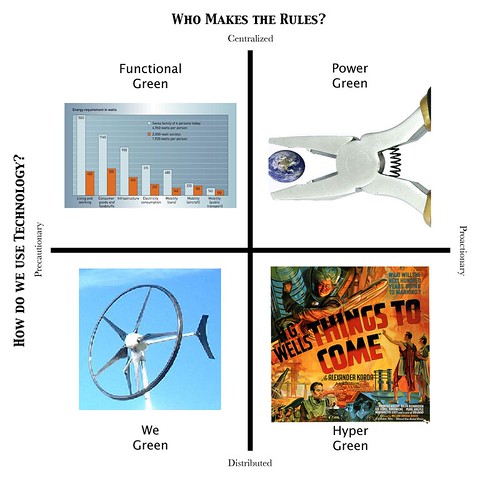
Jamais Cascio at Open The Future has an interesting look at 4 green future scenarios (with one of his customary nifty graphics from his Flickr account) - looking at a set of options similar to the usual 2/2 political map and considering what the green version of each of the quadrants would look like.
... The Drivers
The two critical uncertainties used as scenario axes aren't meant to cover every possible force driving change; rather, they're what I've come to see as issues that are fundamental to how the next few decades play out. ...
The first driver is Who Makes the Rules?, with end-points of Centralized and Distributed. This driver looks at the locus of authority regarding the subject (in this case, climate responses) -- are outcomes dependent upon choices made by top-down, centralized leadership, or made by uncoordinated, distributed decision-making? ...
Although my bias tends towards distributed/collaborative, top-down models are often better-able to respond quickly to rapid developments, and can also offer a more predictable environment for business and organizational planning.
The second driver is How Do We Use Technology?, with end-points of Precautionary and Proactionary. ...
My bias here is towards a limited precautionary approach, but the need for rapid response may end up pushing towards a proactionary world.
The Scenarios
The combination of these two drivers give us four distinct worlds.
"Power Green" -- Centralized and Proactionary: a world where government and corporate entities tend to exert most authority, and where new technologies, systems and response models tend to be tried first and evaluated afterwards. This world is most conducive to geoengineering, but is also one in which we might see environmental militarization (i.e., the use of military power to enforce global environmental regulations) and aggressive government environmental controls. "Green Fascism" is one form of this scenario; "Geoengineering 101" from my Earth Day Essay is another.
"Functional Green" -- Centralized and Precautionary: a world in which top-down efforts emphasize regulation and mandates, while the deployment of new technologies emphasizes improving our capacities to limit disastrous results. Energy efficiency dominates here, along with economic and social innovations like tradable emissions quotas and re-imagined urban designs. The future as envisioned by Shellenberger and Nordhaus could be one form of this scenario; the future as envisioned by folks like Bill McDonough or Amory Lovins could be another. Arguably, this is the default scenario for Europe and Japan.
"We Green" -- Distributed and Precautionary: a world in which collaboration and bottom-up efforts prove decisive, and technological deployments emphasize strengthening local communities, enhancing communication, and improving transparency. This is a world of micro-models and open source platforms, "Earth Witness" environmental sousveillance and locavorous diets. Rainwater capture, energy networks, and carbon labeling all show up here. This world (along with a few elements from the "Functional Green" scenario) is the baseline "bright green" future.
"Hyper Green" -- Distributed and Proactionary: a world in which things get weird. Distributed decisions and ad-hoc collaboration dominate, largely in the development and deployment of potentially transformative technologies and models. This world embraces experimentation and iterated design, albeit not universally; this scenario is likely to include communities and nations that see themselves as disenfranchised and angry. Micro-models and open source platforms thrive here, too, but are as likely to be micro-ecosystem engineering and open source nanotechnology as micro-finance and open source architecture. States and large corporations aren't gone, but find it increasingly hard to keep up. One form of this scenario would end with an open source guerilla movement getting its hands on a knowledge-enabled weapon of mass destruction; another form of this scenario is the "Teaching the World to Sing" story from my Earth Day Essay.
The Choice
Which scenario is most likely? It depends a bit on how fast the truly disastrous manifestations of climate change hit. Climate catastrophe happening earlier than currently projected would push towards the more proactionary worlds. It also depends a bit on whether governments and corporate leaders continue to lag community and activist groups in terms of willingness to embrace big changes to fight environmental risks. Centralized responses may end up being too little, too late if wide-spread bottom-up models take root.
Ultimately, which one of these scenarios comes to dominate depends on the choices we make today. We simply can't go on pretending that we don't have to deal with this problem for awhile yet, that "the market" or "the government" or "new technologies" will fix everything in time, that we aren't responsible. The more we abandon our responsibilities, our agency, the more likely it is that the world that emerges will not pay attention to our interests. Acting now is no guarantee that we'll get the world we want -- but not acting is as close as you'll get to a guarantee that we won't.


 Posts




