Showing posts with label wind. Show all posts

Beluga's Maiden Voyage A Success  

Posted by Big Gav in , ,

Triple Pundit reports that the voyage of the Beluga has completed successfully, showing that the SkySails system can work. More at The Times Of Malta.

We’ve been keeping tabs on the progress of the Beluga SkySails, first modern commercial cargo vessel to harness wind power with a deployable computer controlled kite.

The ship arrived in the Venezuelan port of Guanta on Tuesday, leaving from Germany on January 22nd.

SkySails didn’t deploy the high-tech kite system until reaching the Azores, midway in her voyage. Once fully deployed, the system saved between 10 and 15 percent in fuel consumption, or $1000 to $1500 per day, according to Verena Frank, project manager for the SkySails. This was the first time the system had been tested under the difficult conditions of the mid-Atlantic.

As bugs get ironed out and crews gain expertise with the system, the kite can be deployed for up to half of a typical voyage while fuel conservation is expected to increase another 5 to 10 percent.

While some skeptics insist that the kite system isn’t practical for the largest cargo vessels, SkySails’ innovative approach and application of wind power may just prove the skeptics wrong.

Big Oil lets the sun set on renewables  

Posted by Big Gav in , , , ,

The Guardian has an interesting report noting that Shell and BP (Back to Petroleum) seem to be abandoning the greenwashing approach and concentrating on fossil fuels (though Shell does seem to be keeping fingers in the wind and biofuels pies) - "Big Oil lets sun set on renewables".

Shell, the oil company that recently trumpeted its commitment to a low carbon future by signing a pre-Bali conference communique, has quietly sold off most of its solar business. The move, taken with rival BP's decision last week to invest in the world's dirtiest oil production in Canada's tar sands, indicates that Big Oil might be giving up its flirtation with renewables and going back to its roots.

Shell and BP are among the biggest producers of greenhouse gases in the world, but both have been keen to paint themselves green through a series of clean fuel initiatives. BP, under its former chief executive, John Browne, promised to go "beyond petroleum" while Shell has spent millions advertising its serious interest in the future of the environment.

But at a time when interest in solar power is greater than ever, with the world's first "solar city" being built at Phoenix, Arizona, a small announcement from Environ Energy Global of Singapore revealed that it had bought Shell's photovoltaic operations in India and Sri Lanka, with more than 260 staff and 28 offices, for an undisclosed sum.

The sell-off, to be followed by similar ones in the Philippines and Indonesia, comes after another major disposal executed in a low-key way last year, when Shell hived off its solar module production business. The division, with 600 staff and manufacturing plants in the US, Canada and Germany, went to Munich-based SolarWorld. Shell has however formed a manufacturing link, with Saint-Gobain, and promised to build one plant in Germany.

The Anglo-Dutch oil group confirmed yesterday that it had pulled out of its rural business in India and Sri Lanka, saying it was not making enough money. "It was not bringing in any profit for us there so we transferred it to another operator. The buyer will be able to take it to the next level," said a spokeswoman at Shell headquarters in London.

The oil group said it was continuing to move its renewables interests into a mainstream business and hoped to find one new power source that would "achieve materiality" for it. Shell continues to invest in a number of wind farm schemes, such as the London Array offshore scheme, which has government approval. Shell has also been concentrating its efforts on biofuels, but declined to say whether it had given up on solar power even though many smaller rivals continue to believe the technology has a bright future.

Environmental groups have always accused Shell of using clean energy initiatives as "greenwash" to deflect criticism from its core carbon operations, especially tar sands. The latest pull-out has annoyed rival business leaders at London-based Solar Century and local Indian operation, Orb Energy, who fear the impact of a high-profile company selling off solar business. Jeremy Leggett, chief executive of Solarcentury and a leading voice in renewable energy circles, said Shell was undermining the credibility of the business world in its fight against global warming.

"Shell and Solar Century were among the 150 companies that recently signed up to the hard-hitting Bali Declaration. It is vital that companies act consistently with the rhetoric in such declarations, and as I have told Shell senior management on several occasions, an all-out assault on the Canadian tar sands and extracting oil from coal is completely inconsistent with climate protection.

"This latest evidence of half-heartedness or worse in Shell's renewables activities leaves me even more disappointed. Unless fossil-fuel energy companies evolve their core activities meaningfully, we are in deep trouble," he said.

One area Shell hasn't abandoned is the algae to biofuel market, with construction of a pilot plant about to begin in Hawaii.
The oil giant is teaming with Hawaii's HR BioPetroleum to construct a pilot facility to grow the next-generation feedstock. The Hague, Netherlands-based Royal Dutch Shell (NYSE: RDS.A), one of the world's largest distributors of first-generation biofuels, has made its latest move into next-generation biofuels, this time going green with algae.

The oil giant formed a joint venture with Hawaii startup HR BioPetroleum to build a pilot facility to grow marine algae and produce vegetable oil for conversion into biofuel.

Shell said it holds a majority share in the new venture, called Cellana, but financial terms of the venture were not disclosed. The company said construction of the new facility is starting immediately on the Kona coast of Hawaii Island, at the Natural Energy Laboratory of Hawaii Authority site. But it might be a while before we see commercial-scale production.

"This will depend on milestones at the two and a half hectare demonstration facility," Olga Gorodilina, a Shell spokesperson, told Cleantech.com. That plant is expected to do research for up to two years. "The next step would be construction of a demonstration-scale commercial facility, let's say 1,000 hectares. All being well, the step after that would be the construction of a full-scale commercial facility of about 20,000 hectares."

Offshore Wind at an Affordable Price  

Posted by Big Gav in , , ,

EcoGeek reports that offshore wind farm technology is using a few ideas from the oil industry for building platforms that work far offshore- "Offshore Wind at an Affordable Price".

Offshore wind is a relatively underexploited resource, with obstacles ranging from Cape Wind-like NIMBYism to the high infrastructure costs (and thus total costs) for installing systems out at sea. The idea of going toward floating wind turbines has been around awhile and Blue H Group looks to be one step closer to making that idea a reality.

Blue H offshore wind farms are planned to be far out at sea, virtually invisible to the naked eye from shore. At such locations, the winds are stronger and are more constant, ideal for generating large quantities of clean and inexhaustible electricity.

Rather than installing the wind turbine foundations to literally be built into the seabed, however deep it might be, Blue H is "adapting the concept of submerged tension-legged platforms developed by the oil industry ... and designed a platform large and stable enough to support a tower and a wind turbine."

According to Blue H, the Submerged Deepwater Platform (SDP) technology:

* Reduces the overall weight of the structure (claiming a 60+% total reduction for a 5 mw system, from 2100 to 800 tons)
* Can be built onshore / in a port and towed into place, 10 miles or more offshore in deep waters (more than 50 meters in depth), reducing the specialty requirements for heavy equipment like crane ships.
* Enables placing the wind turbines/farms far enough offshore to minimize NIMBYism and to be able to getting even better wind
* Can be dismantled/moved with little environmental impact

If this works, this suggests a path toward rapid ramping up of offshore wind at affordable costs.

Jerome a Paris also has a post on offshore wind at The Oil Drum.
Just over 900MW of offshore wind had been built by end 2006 (compared to 74,000 MW onshore), but the plan is to get to 40,000 MW of offshore wind in Europe by 2020, with approximately half in the UK, a quarter in Germany and the rest spread across Europe, mostly in the North Sea (which has good winds and shallow waters).

The industry, like others, has suffered from rapidly increasing costs in recent times, from increased commodity prices, overstretched suppliers and, it must be said, still unresolved technical difficulties with some turbine models that have been withdrawn from the market after encountering technical difficulties. There is a lot of focus on reaching a scale sufficient to rationalise and standardise both manufacturing and offshore installation, after the early years of projects designed on a case-by-case basis.

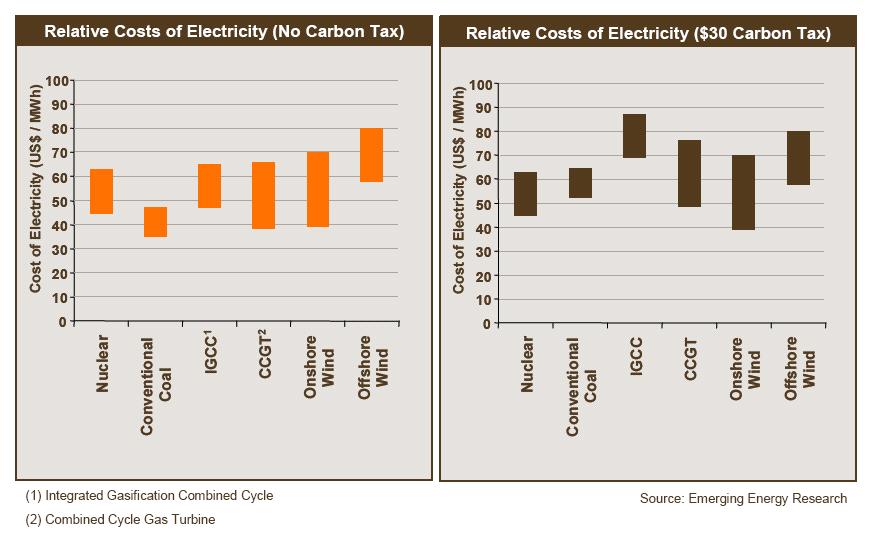
The graph below reflects costs prior to commodity increases - but these apply equally to other sectors, so all technologies are more expensive today. The great advantage of wind in that respect, of course, is that once it is built, the cost is fixed: you only have to repay the initial investment, a fixed amount, and not to buy fuel, whether coal, natural gas or oil, whose prices can also increase - and indeed have. And an other overlooked advantage is that wind's marginal cost (the cost of production of an additional kWh) is close to zero, so whenever wind blows, this takes out more expensive producers and reduces prices for everybody. In fact, a Danish study has demonstrated that the resulting savings for that country are now larger than the subsidies provided to wind...

Even if it is unreliable due to its intermittency, wind still has a real effect on both electricity prices as well as on carbon emissions, as each kWh of wind will usually displace a marginal kWh generated by a gas or oil-fired plant.

Offshore wind is still more expensive than onshore (thus the need for additional support in the early years of this new industry), but it responds to the fact that Europe is quite small and densely packed, and some areas will not be able to take more wind turbines, especially the huge models now available, which tower more than a hundred meters above ground. With winds at sea being stronger and more regular, it is the obvious place to put industrial size wind farms, and the hope is that economies of scale will eventually make it cost effective (it is already competitive compared to gas-fired power, given natural gas prices) - and of course, that production that can be scaled to levels that allow the sector to represent a significant fraction of total energy production. The European goal for 2020, 20% of all energy from renewable sources is quite ambitious, as it means that more than 20% of all electricity should come from wind by then.

Another obvious trend was how the industry is now dominated by the large players, in particular on the investor side - the business is essentially run by the big utilities, with a few independent developers remaining (and those that have good prospects are usually take-over targets for the bigger players right now). On the manufacturing side, the presence in the business of GE (currently absent from offshore as they have no appropriate turbine, their 3.6MW model having shown unsufficiently reliable performance), French nuclear energy giant Areva (via Multibrid, still in the early stages of integration), German engineering group Siemens (the dominant player offshore) shows that concentration is well under way, and the fate of Vestas (still the largest wind turbine manufacturer overall, but a small company compared to the big indistrial groups) and Repower (focused on offshore, but whose main shareholder, Indian-based Suzlon, is itself a pure wind player and thus quite small as well) will certainly become a hot issue in the future.

Offshore wind is heavy industry: a nacelle weights 100-300 tons, a blade is 50 meters long, a tower is 80 meter high, etc... Managing 20-30% p.a. growth rates in heavy industry is extremely hard to do - logistics, supply chains and financial commitments are complex, and a wrong bet on where demand will be (on the high or on the low side) can have devastating consequences.

Offshore wind is less urgent in the US than it is in Europe, as there is still plenty of room onshore to grow (and with a much better wind resource than in Europe) and thus less need to pay the higher cost of offshore, but there could be some projects in areas like the Great Lakes or in the densely populated North-East.

In any case, there is no silver bullet, and wind (and a fortiori offshore wind) is not by any means the only solution. But today, it is the technology with the best prospects to have a real impact on our carbon emissions, at a low economic cost, and with very real positive effects on overall employment, redevelopment of isolated areas, and security of supply.

Wind is free, clean, indigenous, and available today.


The Independent has an article on the European "supergrid" idea (just one component in the future global energy grid) fed by large scale renewable energy sources - "Has Europe Found a Way To Replace Fossil Fuels?".
An audacious proposal to build a 5,000-mile electricity supergrid, stretching from Siberia to Morocco and Egypt to Iceland, would slash Europe's CO2 emissions by a quarter, scientists say.

The scheme would make the use of renewable energy, particularly wind power, so reliable and cheap that it would replace fossil fuels on an unprecedented scale, serving 1.1 billion people in 50 countries. Europe's 1.25bn tons of annual CO2 output from electricity generation would be wiped out. High-voltage direct current (HVDC) lines, up to 100 times as long as the alternating current (AC) cables carried by the National Grid's pylons, would form the system's main arteries. While AC lines are the international standard, they leak energy. HVDC lines are three times as efficient, making them cost effective over distances above 50 miles.

Building the supergrid would require an investment of $80bn (£40bn), plus the cost of the wind turbines -- a fraction of the €1 trillion the EU expects to pay for a 20 percent reduction of its carbon footprint by 2020. The average price of the electricity generated would be just 4.6 euro cents per kWh, competitive with today's rates, which are likely to rise as fossil fuels run out.

Yet while several governments have expressed interest, Britain is not among them, says the scientist behind the proposal. "We have the technical abilities to build such a supergrid within three to five years," said Dr Gregor Czisch, an energy systems expert at the University of Kassel in Germany. "We just need to commit to this big long-term strategy."

Many supporters of renewable energy see it as a small-scale technology, but Dr Gordon Edge of the British Wind Energy Association, said the megaproject was essential. "European policy is only just waking up to this," he said.

The supergrid would draw power from massed turbines in a band of countries to Europe's south and east that have above average wind potential, feeding it to the industrialised centres of Europe. The scale would overcome the biggest obstacle to wind power -- its unreliability. In smaller networks, such as Britain's National Grid, calm weather could cut production to zero. But the supergrid would cover a region so large that the wind would always be blowing somewhere.

TreeHugger has a post ion a new variation of solar PV concentrators - "Inflatable Solar: Coolearth Concentrated Photovoltaics"
Inflatable solar? It’s not the first time we’ve come across the idea. But according to Coolearth Solar, they’ve patented a design for inflatable solar collectors that are supposedly a cheaper way to concentrate sunlight onto photovoltaic cells. The makers claim their design is up to 400 times cheaper than polished aluminum mirrors which, if true, would certainly improve the economics of concentrated photovoltaics. Maybe they can team up with the makers of the inflatable car.

TreeHugger also has a post on efforts to harness ocean currents offshore from the gulf stream - "Gulf Stream's Tidal Energy Could Provide Up to a Third of Florida's Power".
As solar, wind and other renewable energy technologies increasingly become seen as viable alternatives to coal- and fossil fuel-based ones, some scientists are already looking beyond recent breakthroughs in these areas to the vast, largely untapped potential offered by the world's oceans. This follows a recent announcement by Secretary of the Interior Dirk Kempthorne clearing the way for further research and investment into wind, wave and tidal technologies on the U.S.'s Outer Continental Shelf.

Rick Driscoll, director of Florida Atlantic University's Center of Excellence in Ocean Energy Technology (CEOET), and his colleagues are hard at work developing a device that could allow his state to procure up to a third of its energy needs by tapping into the Gulf Stream's energy-dense waters. A field of underwater turbines moored 1,000 ft below the surface in the center of the Gulf Stream could - by drawing from its 8 billion gallons per minute flow rate - provide as much energy as several nuclear plants. ...

The big energy pay-off, however, may yet lie in another source that has caught Driscoll's eye - ocean thermal energy, which used to produce electricity by tapping into the temperature difference between cold deep water and warm surface water. "That ocean thermal resource is probably the largest renewable energy source available anywhere," he said.


Phil Hart at The Oil Drum (ANZ) has an interesting post (if you're a peak oil wonk) on the USGS's calculation of future growth in oil reserves from already discoevered fields - "Shedding Light on the Question of Reserves Growth"
In 2000, the United States Geological Survey issued its World Petroleum Assessment, covering the thirty year period 1995-2025. The resource estimates from this study are widely quoted to support the argument that oil production can continue to expand. In assessing the world's total oil endowment to be over 3 trillion barrels, the USGS study defines a huge contribution of 730 billion barrels with the 'potential to be added' to world reserves over the period 1995-2025 as a result of increases in the amount of oil that can be extracted from existing fields. The complete Reserves Growth report (Chapter RG) from the World Petroleum Assessment is available through the USGS website.

It should be noted, that while the USGS total estimate is likely high in each of the three areas assessed, a total endowment of 3.3 trillion barrels is insufficient to enable production to continue growing at historical rates beyond 2020. Forecasts for peak oil occurring much beyond 2020 imply even more unlikely resource estimates. ...

Clearly the total figure here of 220 billion barrels has limited potential to delay peak oil, compared to the more significant 730 billion barrels suggested by the USGS. The weight that other commentators have given to 'reserves growth' in meeting future production needs implies even higher figures which seem unrealistic.

The estimates presented in Table 2 are necessarily approximate but dramatically improve on the simple and inappropriate extrapolation used by the USGS. Input to refine the figures is welcome; both in terms of the growth possible in each category and the volume of reserves allocated to each category.

As a final note, the USGS estimate of 730 billion barrels of reserve growth over the thirty year study period describes an annual reserves increase of 2.5%. Internal company estimates of annual growth in field reserves are closer to 0.2%. The USGS result is ten times higher than that used within the industry and must be called into question. I hope that this post provides new methodology for which the contribution to be made by reserves growth can be estimated.


The New York Times has an article expounding something like Jeffrey Brown's "export land" theory of peak oil - "Oil-Rich Nations Use More Energy, Cutting Exports".
The economies of many big oil-exporting countries are growing so fast that their need for energy within their borders is crimping how much they can sell abroad, adding new strains to the global oil market.

Experts say the sharp growth, if it continues, means several of the world’s most important suppliers may need to start importing oil within a decade to power all the new cars, houses and businesses they are buying and creating with their oil wealth.

Indonesia has already made this flip. By some projections, the same thing could happen within five years to Mexico, the No. 2 source of foreign oil for the United States, and soon after that to Iran, the world’s fourth-largest exporter. In some cases, the governments of these countries subsidize gasoline heavily for their citizens, selling it for as little as 7 cents a gallon, a practice that industry experts say fosters wasteful habits.

“It is a very serious threat that a lot of major exporters that we count on today for international oil supply are no longer going to be net exporters any more in 5 to 10 years,” said Amy Myers Jaffe, an oil analyst at Rice University.

Rising internal demand may offset 40 percent of the increase in Saudi oil production between now and 2010, while more than half the projected decline in Iranian exports will be caused by internal consumption, said a recent report by CIBC World Markets.

Business Intelligence reports that Saudi Arabia doesn't appear to be doing too much drilling in the existing Ghawar field - "Satellite images contradict Saudi peak oil theory says Bernstein Research". Maybe its not twilight in the desert just yet.
Satellite images may scuttle theories that the world's biggest oil field in Saudi Arabia is in decline, Bernstein Research said on Wednesday. A jump in drilling activity in recent years at the giant Ghawar oil field has raised concerns Saudi Arabia is struggling to maintain oil output and has fueled "peak oil" theories that global production is poised for a collapse.

But satellite images show that much of the rise in drilling activity has centered on two major expansion developments by state oil firm Saudi Aramco, instead of on keeping older parts of the field producing with enhanced recovery techniques, Bernstein said in a research note. "The majority of the increased activity in the Ghawar field can be explained by the Haradh-III, and the Hawiyah natural gas liquids recovery mega-projects which were not designed as a quick fix to Ghawar's supposed rapid decline," the note said.

Bernstein said the report was an initial analysis of satellite data from 2004-2007, with a final conclusion expected in the coming months.

The Nation has an article on "Ron Paul's Roots" which is an interesting little analysis of some of the different schools of thought with libertarian politics in the US.
Although not a single vote has been cast, it's safe to say that Ron Paul has run the most successful libertarian presidential campaign in American history. Sure, the Libertarian Party nominates a candidate every term, but said candidate struggles to garner money and media attention. Paul, however, has become a legitimate phenomenon, if not a particularly likely GOP nominee. With his full-throated rejection of the imperial project in Iraq and a radical vision of a stripped-down state (though, oddly, one that still forces pregnancy), he's attracting large crowds at campaign events and polling at a healthy 8 percent in New Hampshire. In November he broke the single-day fundraising record with a $4.2 million haul.

So you would think that the circle of DC-based libertarians centered around the Cato Institute would be ecstatic. Not quite. "He doesn't strike me as the kind of person that's tapping into those elements of American public opinion that might lead towards a sustainable move in the libertarian direction," says Cato vice president for research Brink Lindsey.

Self-identified libertarians may be a tiny portion of the electorate, but small numbers have never stood in the way of bitter intramural sectarian disputes. When Lindsey says that Paul "comes from a different part of the libertarian universe than I do," he's referring to the libertarian version of the Trotsky/Lenin split, which opened up in the early 1980s and continues to echo through libertarianism today.

In 1981 American libertarianism's founding father, Murray Rothbard, had a falling out with Cato leaders over their weak-kneed conception of libertarianism as "low tax liberalism." After being kicked off the board of the organization he had helped found, Rothbard, a Jewish, Bronx-born economist who'd studied with Austrian economist Ludwig von Mises, helped found the Mises Institute in Auburn, Alabama. The institute became the intellectual center for what Rothbard protégé Lew Rockwell termed "paleolibertarianism," a worldview rooted squarely in the populist Old Right tradition. Paleolibertarians tend to be culturally conservative (attracting, on the edges, a fair share of Confederacy nostalgists and white supremacists), nationalistically oriented and zealously against imperial foreign policy and the Federal Reserve. "Ron Paul has shown that the core of the state is the Pentagon and the Federal Reserve," says Rockwell, who was Paul's Congressional chief of staff from 1978 to 1982.

The division between paleolibertarians, centered around the Mises Institute, and cosmopolitan libertarians, centered around Cato, is also a case of "culture clash," according to Justin Raimondo, editorial director of Antiwar.com and prominent member of the Mises set. "There's the populist wing of the libertarian movement, and then there's the Washington crowd that's still trying to sell libertarianism, or their version of it, to elites. These people want to go along and get along. As long as they can abort their babies and sodomize each other and take as many drugs as they want to, they are happy. They don't care who is being killed in Iraq and how many Iraqis are dying. That's their hierarchy of values."

As you can tell, there's no love lost between the two camps. ... But nothing breeds harmony like success, and the Paul bandwagon is now getting big enough for both the Hatfields and the McCoys to get on board. "Our readership is very enthusiastic," says Nick Gillespie, editor of the DC-based magazine Reason. A few months ago Reason published an article titled "Is He Good for the Libertarians?" That no longer seems an open question. "On basic fundamental issues he speaks strongly for libertarians, regardless of the flavoring," says Gillespie, who recently co-wrote a pro-Paul op-ed in the Washington Post.

This gets to the paradox at the heart of the Paul campaign: he's the candidate least likely to hedge or obfuscate, the most apt to spell out in sharp detail his underlying principles--and yet he's also something of an ideological cipher, attracting the support of everyone from hipstertarian kids on Northeast college campuses to John Birchers in Texas. "You have this weird group of people," says Lindsey. "You've got libertarians, you've got antiwar types and you've got nationalists and xenophobes. I'm not sure that is leading anywhere. I think he's a sui generis type of guy who's cobbling together some irreconcilable constituencies, many of which are backward-looking rather than forward-looking."

But even if the Paul campaign doesn't point the way toward some lasting, powerful, paleo-cosmo libertarian coalition ... he is at least providing libertarians with a long-awaited Kumbaya moment. "There are personal animosities that will probably never heal," says Raimondo. "But, you know, maybe Ron Paul can unite us all."

Links:

* The Oil Drum - Fatih Birol Presents the IEA World Energy Outlook 2007
* Resource Investor - Peak Oil Passnotes: Where Will Crude Oil Be at Christmas Time?
* Energy Tech Stocks - In 2008, Investors Should Expect to be Buffeted by Oil Price Uncertainty - But One Fact Can’t be Denied
* Reuters - Iran stops selling oil in U.S. dollars
* EcoGeek - Two Cars that Could Get 80 MPG Years Ago
* Canada.com - Gas-gobbling bug could be a weapon against global warming
* MSNBC - Climate experts declare: 'No time to lose'. Dozen cross the line into policy by signing statement at U.N. talks
* Grist - Belief vs. knowledge: WSJ launches Luddite attack on climate scientists and Al Gore
* Past Peak - Do The Math
* Digby - Noble Neocons
* Raw Story - Sean Penn endorses Kucinich, challenges 'conventional wisdom' on electability
* Long Island News - Presidential Candidate Ron Paul Bears Empty Pot For Americans
* Glenn Greenwald - "Missing" evidence is familiar Bush pattern
* Daily Kos - It's Not Torture They're Covering Up, It's the Results
* Free Energy News - Free-Energy Battery Inventor Killed at Airport?.
* Funtasticus - Best Reuters Photos Of The Year

What Next For Google.org ?  

Posted by Big Gav in , , , , , ,

Looking at where Google's clean energy investment efforts are going is quite encouraging, based on this week's announcements. So far we've seen initiatives and/or investments in the following areas:

* Energy efficient server farms
* Plug-in hybrid vehicles (ie. V2G)
* Solar
* Wind
* Geothermal

The main gaps still left to fill out would seem to me to be:

* Ocean (wave / tidal) energy
* Next generation biofuels
* Energy storage (especially large scale storage)
* Smart grids (both transmission and demand management)
* Cradle to cradle design and manufacturing (and the associated "internet of things" to track all the stuff, which should be right down their alley)

Cleantech.com has a report on Google's "Renewable Energy Cheaper Than Coal" initiative - "Google creates renewable R&D group".

Google has an ambitious target to produce a gigawatt of renewable energy that is cheaper than coal within the next few years. "Our own consumption is likely to be a big part of that," said Larry Page, Google's co-founder and president of products, in a conference call. The company does not disclose how much power it uses, but it's estimated to have over 450,000 servers in locations around the world.

Google has put out the call for engineers and energy experts to lead its new RE less than C division, which it said will probably start out with 20 or 30 employees and focus initially on advanced solar thermal power, wind power and enhanced geothermal systems. "The goal is not to have huge margins here, the goal is to really replace the dirty energy that is out there," said Sergey Brin, Google's other co-founder and president of technology.

Already on the inside track are Pasadena, Calif., solar thermal startup eSolar, and Alameda, Calif.'s Makani Power, which is developing high-altitude wind energy technologies. "We're working very closely with both those companies," said Page. He wouldn't disclose how much, if anything, Google has invested in the two startups, but they're likely to get a piece of the Google.org investment windfall.

Google.org was initially funded by one percent of Google's outstanding shares after its initial public offering, and one percent of its profit. That amounts to 3 million shares, valued at $2 billion dollars based on Monday's close, plus $265 million in cash so far to establish the Google Foundation and for grants and investments.

For 2008, Google said it expects to spend tens of millions on research and development at its new RE less than C group and on related investments in that year alone.

Google's green energy czar, Bill Weihl, said they want to accelerate the pace of technology development to drive down the costs. "We think we need to get in the range of 1 to 3 cents per kilowatt hour for solar or other renewables to be really competitive with coal." It's possible there could be Gwindmills or Gsolar panels, or even Ggeothermal power in the future, but more than likely the group's research will be licensed out to others.

"In cases, for example, where it's been created as the result of an investment in a renewable energy company, it would be somewhat up to them, though I think we would encourage them to license it on fairly favorable terms to get it widely out there and perhaps on somewhat lower margins as a consequence," said Brin. He said the group could also send people to build the technology and take a profit on setting up the infrastructure, or take some percentage of the cash pulled in by companies that sell the power.

The company has already developed energy efficiency technology to power and cool its data centers, and it generates electricity for its Mountain View campus from a 1.6 megawatt solar panel installation, one of the largest in the U.S., but that's not always enough. "It's very hard for us to find places to locate that aren't, say, coal-based or other dirty technologies, and we don't feel good about being in that situation as a company, we feel hypocritical," said Page.

He said the company wants to make the investments happen so that there will be alternatives for Google to use down the road. "We see investments that would pay back money on reasonable timescales that we can make now for our own datacenter use and to put onto the grid," said Page.

Google is likely to get flooded with interest from startups eager for some cash, as it did with its much smaller $10 million plug-in hybrid request for proposals in September (see Plug-in hybrids can Google for cash). Larry Brilliant, executive director of Google.org, said, "I think we thought we'd get 20 or 30 responses — we got over 300. And some of them are quite innovative. I think it speaks to the, really the dearth of capital for some of these innovative ideas."

The Independent has an intriguing albeit vapourous article on some elite gathering in London to look at some "breakthrough in micro-technology" related to clean energy - "The rich, famous and influential prepare to hear the secret to climate-safe energy". My hopeful guess - some material that can be used to create ultracapacitors.
A discovery that could give the world access to vast quantities of energy with minimal damage to the climate will be shown off for the first time at a glittering gathering of the famous, rich and influential next Friday night.

Al Gore is to be the star turn at a dinner where guests have paid at least £1,000 a head, and some will have parted with £50,000 for their share of the Aberdeen Angus steak and pink champagne, under the high ornate ceilings of London's Royal Courts of Justice. The combined wealth of the diners has been estimated at £100bn. But the most unusual aspect of the evening is not the price of the tickets but the nature of the floor show. In place of professional performers, the guests will be regaled by people who are not always thought of as entertainers, though some think they are all mad. They are inventive British boffins who care about climate change.

They are hoping that the showcase dinner will knock years off the time it can take for industry to see the mass marketing potential of a new discovery. And the one that will be shown to Mr Gore and fellow guests is highly marketable and could revolutionise the market in clean technology, according to the founder of the British Inventors' Society, Kane Kramer.

Mr Kramer, who was 23 in 1979 when he conceptualised the technology that led to the creation of the first MP3 player, refused to give specific details of the new discovery, or to name the inventor, so as to maintain the element of surprise for Friday. But he indicated that it is a breakthrough in micro-technology, and that British scientists who have tested it are convinced that it will work.

"This is something ... that's the accumulation of almost a decade of work," he said. "It's a new science, a Super Material. It would be 80 per cent cheaper than any alternative means of production, and it will contribute in a major way to reducing climate change. "I like it because it's kind of lateral. It will make possible things that weren't possible before. We have put it through severe 'due diligence', with quite a team of people, not just in the UK, and we're completely 100 per cent sure that this is the way forward."

There is an old saying that if you invent a better mousetrap the world will beat a path to your door, but he says the adage is true only for inventions that improve gadgets that are already known to work. Big corporations can be very coy about putting money into something genuinely new. "Business wants to jump on a bandwagon, not build the bandwagon," he said. It is also widely suspected that a lot of energy saving ideas have been bought out by the energy companies precisely to keep them off the market.

But the dinner, organised by a foundation called Fortune Forum, will also be used to launch a new campaigning group called the ICE Circle, whose mission is to put inventors of clean energy technologies in touch with investors to market them. The combination of British inventors and mega-rich philanthropists will be a "marriage made in heaven", Mr Kramer reckons

The driving force behind it is Renu Mehta, theEssex-born daughter of a wealthy textiles importer turned peace campaigner, Vijay Mehda. A year ago, she organised the first Fortune Forum dinner, where Bill Clinton spoke, Yusuf Islam, the singer formerly known as Cat Stevens, gave his first public performance for more than 20 years, and Michael Douglas and the steel magnate Lashmi Mittal mingled with other guests. The evening raised £1.1m gross, and the net proceeds were distributed to charity.

Last week, she was in Downing Street for talks with Gordon Brown. The dinner should be seen as a campaigning event first, and only second as a fundraiser, Ms Mehda said.

One clean energy area is interested in is wind power - Reuters reports on "Energy-hungry India eying a role as a "wind superpower"".
India might be painted as a pollution-spewing, global-warming economy of 1 billion people but it is also one of the world's biggest wind power users, part of a focus on renewable energy mostly unnoticed in the West. Years of tax incentives have helped make India one of the fastest-growing markets for wind power, a major component of renewable energy that will be high on the agenda of the Dec. 3-14 UN climate change meeting in Bali, Indonesia.

The Bali conference comes as international pressure mounts on India to ensure its growth gets cleaner. The International Energy Agency (IEA) warned this month of the climatic dangers of "unfettered" energy demand growth in India. "When it comes to renewable energy and wind power, India can look the West in the eye and say -- look at our years of progressive policies," said Santosh Kamath, a wind power specialist and associate director at KPMG consultants.

Wind power in India is still a minority sector compared with the Asian giant's overall energy needs that are dependent on coal and oil. With its reliance on dirty fuels, India will become the world's number three carbon emitter by 2015, the IEA says.

But renewable energy, of which the vast majority is wind power, accounts for more than 7 percent of India's installed generation capacity -- a rate that compares favourably with much of the rest of the world. India is the world's fourth largest wind-power market.

"Wind power is growing tremendously. If you want a wind plant you'll have to book a year in advance," said Chandra Bhushan, associate director at the New Delhi-based Centre for Science and Environment. "There's been years of progressive policies and recognition for a long time that India will face a shortage of fossil fuels."

India, with its thousands of miles of coastline, is suited to wind power. Its wind power potential is estimated at 45,000 megawatts (MW) -- about a third of total energy consumption. ... KPMG estimates that wind power costs around 3.5 rupees a kilowatt hour, compared with 2.5-3 rupees for imported coal. "Wind energy is almost price competitive in many places," T.L. Sankar, senior energy adviser at the Administrative Staff College of India, told a renewable energy conference.

And global warming might only add to its attraction. "It can only gain in importance because of concerns about climate change," added Kamath.

AP has a report on algae based biofuels - "There's Oil in That Slime".
Driven by renewed investment as oil prices push $100 a barrel, Ruan and scores of scientists around the world are racing to turn algae into a commercially viable energy source. Some varieties of algae are as much as 50 percent oil, and that oil can be converted into biodiesel or jet fuel. The biggest challenge is slashing the cost of production, which by one Defense Department estimate is running more than $20 a gallon.

"If you can get algae oils down below $2 a gallon, then you'll be where you need to be. And there's a lot of people who think you can," said Jennifer Holmgren, director of the renewable fuels unit of UOP LLC, an energy subsidiary of Honeywell International Inc.

Researchers are trying to figure out how to grow enough of the right strains of algae and how to extract the oil most efficiently. Over the past two years they've enjoyed an upsurge in funding from governments, the Pentagon, big oil companies, utilities and venture capital firms. The federal government halted its main algae research program nearly a decade ago, but technology has advanced and oil prices have climbed since then, and an Energy Department lab announced in late October that it was partnering with Chevron Corp., the second-largest U.S. oil company, in the hunt for better strains of algae.

"It's not backyard inventors at this point at all," said George Douglas, a spokesman for the Energy Department's National Renewable Energy Laboratory. "It's folks with experience to move it forward."

A New Zealand company demonstrated a Range Rover powered by an algae biodiesel blend last year, but experts say it will be many years before algae is commercially viable. Ruan expects some demonstration plants to be built within a few years.

Converting algae oil into biodiesel uses the same process that turns vegetable oils into biodiesel. But the cost of producing algae oil is hard to pin down because nobody's running the process start to finish other than in a laboratory, Douglas said. One Pentagon estimate puts it at more than $20 per gallon, but other experts say it's not clear cut. If it can be brought down, algae's advantages include growing much faster and in less space than conventional energy crops. An acre of corn can produce about 20 gallons of oil per year, Ruan said, compared with a possible 15,000 gallons of oil per acre of algae.

An algae farm could be located almost anywhere. It wouldn't require converting cropland from food production to energy production. It could use sea water. And algae can gobble up pollutants from sewage and power plants.

The Pentagon's research arm, the Defense Advanced Research Projects Agency, is funding research into producing jet fuel from plants, including algae. DARPA is already working with Honeywell's UOP, General Electric Inc. and the University of North Dakota. In November, it requested additional research proposals. As the single largest energy consumer in the world, the Defense Department needs new, affordable sources of jet fuel, said Douglas Kirkpatrick, DARPA's biofuels program manager. "Our definition of affordable is less than $5 per gallon, and what we're really looking for is less than $3 per gallon, and we believe that can be done," he said.

Des Plaines, Ill.-based UOP — which has developed a "green diesel" process that converts vegetable oils into fuels that are more like conventional petroleum products than standard biodiesel — already has successfully converted soybean oil into jet fuel, Holmgren said. And the company has partnered with Arizona State University to obtain algae oil to test for the DARPA project, she said.

At the University of Minnesota, Ruan and his colleagues are developing ways to grow mass quantities of algae, identifying promising strains and figuring out what they can make from the residue that remains after the oil is removed.

Because sunlight doesn't penetrate more than a few inches into water that's thick with algae, it doesn't grow well in deep tanks or open ponds. So researchers are designing systems called "photobioreactors" to provide the right mix of light and nutrients while keeping out wild algae strains.

Ruan's researchers grow their algae in sewage plant discharge because it contains phosphates and nitrates — chemicals that pollute rivers but can be fertilizer for algae farms. So Ruan envisions building algae farms next to treatment plants, where they could consume yet another pollutant, the carbon dioxide produced when sewage sludge is burned.

Jim Sears of A2BE Carbon Capture LLC, of Boulder, Colo., a startup company that's developing fuel-from-algae technologies that tap carbon dioxide from coal-fired power plants, compared the challenges to achieving space flight. "It's complex, it's difficult and it's going to take a lot of players," Sears said.


Links:

* Wall Street Journal - Ethanol craze cools as doubts multiply
* Technology Review - Harnessing Kinetic Energy
* The Energy Blog - Sharp to Up Thin-film Solar Cell Capacity
* The Energy Blog - Supergrid to Supply Europe with Wind Power
* TreeHugger - Hewlett-Packard Installing Solar Systems At Operating Sites
* New York Times - Google’s Next Frontier: Renewable Energy
* Cleantech.com - Forget the Gphone, here comes Gsolar
* Christian Science Monitor - Plugging the Internet into clean power
* WorldChanging - Green Computing Is Not An Oxymoron
* Cleantech.com - OPEC putting up $750M for cleantech fund
* After Gutenberg - Australia: Don’t Write Us Off Quite Yet
* REA - What To Do With All This Waste?
* The Energy Blog - Exxon: Film May Lead to Car Battery that is Lighter and Safer
* Cryptogon - Exxon's New Battery For Electric Vehicle Applications
* Cryptogon - Explosion on Strategic Canadian Pipelines that Supply 1.5 Million Barrels of Oil Per Day to U.S.
* Cryptogon - Domestic Spying, Inc.

The Daily Katabatic  

Posted by Big Gav in , , , ,

The NZ Herald has an interesting article about a proposed Antarctic wind farm (also noting that the wind strength on the coast south of Wellington is often greater).

Wellington is a tougher proposition for a wind farm than Antarctica, says a team exploring the possibility of building turbines at Scott Base. Experts from Meridian Energy have flown to the world's windiest continent to conduct feasibility tests around Scott Base, which three years ago was hit by a storm with wind gusts that exceeded 200km/h, destroying the base's wind vane.

Iain Miller, Antarctica New Zealand's Antarctic services manager, said if the windfarm went ahead, it would help power Scott Base and also the neighbouring United States base, McMurdo Station. "Interestingly enough, because of turbulence created by the landscape, the wind at Scott Base and McMurdo isn't as brutal as parts of New Zealand where there are windfarms," he told The Press. "Meridian is planning one on the southwest coast of Wellington where the wind speed and turbulence are worse."

If approved, the Antarctic windfarm would augment the diesel generators used to power the two bases. The high cost of transporting fuel to Antarctica, including use of icebreakers to create a shipping channel for the tanker, made wind energy a more economical prospect than in New Zealand. The NSF did a feasibility study four years ago of wind power at McMurdo Station and found it could save up to 1.2 million litres of fuel each year.

Another place with plenty of wind is South Dakota, which the Seattle PI reports is about to become a "mammoth wind farm". It really is big.
Plans for the world's largest wind farm, proposed to be built in South Dakota, have become more grandiose. South Dakota is officially rated No. 4 in the nation for the potential capacity to make electricity from wind, although the ranking is more than a decade old. Many industry officials believe the Great Plains state is the windiest of all.

Clipper Windpower of Carpinteria, Calif., intends to erect enough wind turbines in several South Dakota counties to produce up to 6,000 megawatts of electricity, said Bob Gates, the firm's senior vice president of commercial operations. That would be eight times larger than the biggest wind farm in the world, a 735-megawatt FPL Energy facility with 421 turbines stretching across three Texas counties.

Clipper Chairman and Chief Executive Officer James Dehlsen told The Associated Press in 2004 the company intended to develop a $3 billion wind complex with 1,000 turbines that could produce 3,000 megawatts of juice in South Dakota. But as envisioned now, the project would be twice as large and cost $6 billion, Gates said. Taking into account that the wind doesn't always blow or is too light or strong at times to operate turbines, a 6,000-megawatt wind farm could supply enough power for an average of about 1.6 million homes, based on data from the American Wind Energy Association.

AHN reports that Singapore is to build the world's largest Solar energy plant.
The world's largest manufacturing plant for making solar energy products will be built in Singapore, it will be the first such plant in Southeast Asia. The plant is expected to start production of wafers, cells and modules used to generate solar power by 2010. It will be built by leading Norwegian solar energy firm Renewable Energy Corp (REC) in the Tuas View area with space set aside for supporting industries.

The plant will be able to produce products that can generate up to 1.5 gigawatts (Gw) of energy annually. That is enough to power several million households at any one time. The current largest plant in the world, also run by REC in Norway, has a capacity of 650 megawatts (Mw).

Renewable Energy Access has an interesting article on growing maize in the US for biofuel - "If Corn is King of Biofuels, Tropical Maize May Be Emperor". This isn't without drawbacks, but it is a lot better than corn based ethanol.
When University of Illinois crop scientist Fred Below began growing tropical maize, the form of corn grown in the tropics, he was looking for novel genes for the utilization of nitrogen fertilizer and was hoping to discover information that could be useful to American corn producers. Now, however, it appears that maize itself may prove to be the ultimate U.S. biofuels crop.

Early research results show that tropical maize, when grown in the Midwest, requires few crop inputs such as nitrogen fertilizer, chiefly because it does not produce any ears. It also is easier for farmers to integrate into their current operations than some other dedicated energy crops because it can be easily rotated with corn or soybeans, and can be planted, cultivated and harvested with the same equipment U.S. farmers already have.

Finally, tropical maize stalks are believed to require less processing than corn grain, corn stover, switchgrass, Miscanthus giganteus and the scores of other plants now being studied for biofuel production.

What it does produce, straight from the field with no processing, is 25 percent or more sugar—mostly sucrose, fructose and glucose.

"Corn is a short-day plant, so when we grow tropical maize here in the Midwest the long summer days delay flowering, which causes the plant to grow very tall and produce few or no ears," says Below. Without ears, these plants concentrate sugars in their stalks, he adds. Those sugars could have a dramatic affect on Midwestern production of ethanol and other biofuels.

According to Below, "Midwestern-grown tropical maize easily grows 14 or 15 feet tall compared to the 7-1/2 feet height that is average for conventional hybrid corn. It is all in these tall stalks," Below explains. "In our early trials, we are finding that these plants build up to a level of 25 percent or higher of sugar in their stalks.

This differs from conventional corn and other crops being grown for biofuels in that the starch found in corn grain and the cellulose in switchgrass, corn stover and other biofuel crops must be treated with enzymes to convert them into sugars that can be then fermented into alcohols such as ethanol.

Storing simple sugars also is more cost-effective for the plant, because it takes a lot of energy to make the complex starches, proteins, and oils present in corn grain. This energy savings per plant could result in more total energy per acre with topical maize, since it produces no grain.

"In terms of biofuel production, tropical maize could be considered the 'Sugarcane of the Midwest'," Below said. "The tropical maize we're growing here at the University of Illinois is very lush, very tall, and very full of sugar."

He added that his early trials also show that tropical maize requires much less nitrogen fertilizer than conventional corn, and that the stalks actually accumulate more sugar when less nitrogen is available. Nitrogen fertilizer is one of major costs of growing corn.

He explained that sugarcane used in Brazil to make ethanol is desirable for the same reason: it produces lots of sugar without a high requirement for nitrogen fertilizer, and this sugar can be fermented to alcohol without the middle steps required by high-starch and cellulosic crops. But sugarcane can't be grown in the Midwest.

The tall stalks of tropical maize are so full of sugar that producers growing it for biofuel production will be able to supply a raw material at least one step closer to being turned into fuel than are ears of corn.

"And growing tropical maize doesn't break the farmers' rotation. You can grow tropical maize for one year and then go back to conventional corn or soybeans in subsequent years," Below said. "Miscanthus, on the other hand, is thought to need a three-year growth cycle between initial planting and harvest and then your land is in Miscanthus. To return to planting corn or soybean necessitates removing the Miscanthus rhizomes."

The Australian reports that Dr Karl isn't a member of the cult of Nyos - "Clean coal a Goebbels scale lie".
SCIENCE broadcaster and New South Wales Senate candidate Karl Kruszelnicki has likened talk of clean coal to Nazi propaganda, describing it as a "complete furphy". The celebrity science commentator and Climate Change Coalition candidate today said the major political parties were lying when spruiking the benefits of clean coal technology.

Claims carbon dioxide could be removed from burning coal and stored underground or underwater were a lie, he said. Such technology would require one cubic kilometre of compressed carbon dioxide to be stored every day, something that was "physically impossible". "That is the volume of compressed carbon dioxide that we have to get rid of – not every 10 years, not every year, but every single day," he said. "It is simply a furphy, it's a porky pie to cover up the fact that there is no such thing as clean coal."

It was the kind of lie a Nazi propagandist would conceive, Mr Kruszelnicki claimed. "Goebbels, the Nazi propagandist, said if you're going to tell a lie, tell a big one, and this is a beauty," he said.

Dr Kruszelnicki also said political policies such as a $20m plan for exploration of underground caverns would be a waste of taxpayer dollars. He claimed any storage facility would eventually wear down and would release the stored carbon dioxide back into the environment.

The Age has an article on a Melbourne company putting bicycles back on the roads - "Recycled Cycles".

BILL BRETHERTON is living the maxim. No matter how many times you fall off, you have to get back on the bike. Even after four months of your life have disappeared. Not that the 27-year-old remembers much of how his world came crashing down in the middle of 2000 after he landed on his head while mountain biking on Mount Buller. What he does remember is that it prompted a radical meaning-of-life analysis that has seen this big-thinking Brunswick man start a bicycle recycling business to fund his charity work.

"It was a crazy time and because I couldn't pick up the same life straight away, I had a lot of time to think about where I wanted to go. It took about 18 months before I could ride again but I was determined not to let it beat me," Bretherton says.

This mental journey he pedalled during rehabilitation has seen him arrive, seven years later, at Human Powered Cycles, a volunteer driven co-operative that pushes pedal power as the solution for a more sustainable world. Each weekend countless people visit the workshop at the bottom of his garden, wheeling in their injured bikes. "Bill the Bike Man's" reputation is far reaching. ...

George Monbiot has a review of Cormac McCaryhy's "The Road" - "Civilisation ends with a shutdown of human concern. Are we there already?".
A powerful novel's vision of a dystopian future shines a cold light on the dreadful consequences of our universal apathy.


A few weeks ago I read what I believe is the most important environmental book ever written. It is not Silent Spring, Small Is Beautiful or even Walden. It contains no graphs, no tables, no facts, figures, warnings, predictions or even arguments. Nor does it carry a single dreary sentence, which, sadly, distinguishes it from most environmental literature. It is a novel, first published a year ago, and it will change the way you see the world.

Cormac McCarthy's book The Road considers what would happen if the world lost its biosphere, and the only living creatures were humans, hunting for food among the dead wood and soot. Some years before the action begins, the protagonist hears the last birds passing over, "their half-muted crankings miles above where they circled the earth as senselessly as insects trooping the rim of a bowl". McCarthy makes no claim that this is likely to occur, but merely speculates about the consequences.

All pre-existing social codes soon collapse and are replaced with organised butchery, then chaotic, blundering horror. What else are the survivors to do? The only remaining resource is human. It is hard to see how this could happen during humanity's time on earth, even by means of the nuclear winter McCarthy proposes. But his thought experiment exposes the one terrible fact to which our technological hubris blinds us: our dependence on biological production remains absolute. Civilisation is just a russeting on the skin of the biosphere, never immune from being rubbed against the sleeve of environmental change. Six weeks after finishing The Road, I remain haunted by it.

So when I read the UN's new report on the state of the planet over the weekend, my mind kept snagging on a handful of figures.


Links:

* Marc Gunther - Making the Dumb Grid Smarter
* The Energy Blog - Startup Plans on Establishing Grids to Sell Electricity for Recharging Electric Cars
* REA - U.S. Demand for Renewable Energy Exceeding Supply
* REA - The power of solar radiation - from a purely scientific point of view
* Technology Review - IBM says it has a greener and cheaper way to reuse silicon from making chips
* Plenty - Labor of Lovins
* Technometria - 10 part series of lectures by Amory Lovins on IT Conversations
* Business Green - Climbing gas prices make case for energy efficiency
* The Energy Blog - U.N. Rapporteur Calls for Moratorium on Building Biofuel Plants Using Food Feedstocks
* Google - UK carbon footprint project
* After Gutenberg - Mordor? No, Athabasca
* Grist - Experts agree: We should all lie. A lot. About important stuff.
* Salon - Google's Brain
* Crooked Timber - Loafing with LaRouche
* Cryptogon - Travelers: Homeland Security is Googling You
* Cryptogon - AT&T Invents Programming Language for Mass Surveillance


Tornado Power  

Posted by Big Gav in , , , , ,

Tyler Hamilton has a post on the "vortex engine" idea - "A new spin on clean energy: tornado power" at Clean Break which is pretty interesting.

I have a feature in today's Toronto Star about a retired engineer from Sarnia, Ontario, who has spent the past four decades of his life studying the possibility of creating man-made tornadoes from industrial waste heat so that their energy can be harnessed for clean electricity generation. More recently, Louis Michaud has formed a company called AVEtec Energy, filed and obtained patents, and has partnered up with the University of Western Ontario's wind-tunnel lab to study small prototypes and do computer simulations of his "vortex engine" process. He's also managed to raise some early research funding from the Ontario Centres of Excellence and now faces his biggest challenge yet: convincing private investors to fund a large-scale working pilot plant.

It may sound like a whacky, out-there idea, but the experts I spoke with for the feature don't doubt the technical possibility of creating a man-made tornado. After all, the principles of convection are pretty straightforward. Heat rises when you've got a certain temperature differential, and as it rises it swirls -- kind of the reverse of what you see when water goes down a drain. AVEtec's pitch might raise eyebrows, but many are taking it seriously. For example, its advisory board consists of climate experts from Oxford, Cambridge and MIT, including MIT professor and well-respected hurricane expert Kerry Emanuel.

Michaud envisions building a large cylindrical building 200 metres in diameter and about 50 meters high, and this structure would have an open top. Heated waste water from a power plant that would normally go to a cooling tower would instead be diverted to the vortex building and into 10 or more strategically located cooling cells, where fans would blow so the air could pick up the heat energy from the water. The hot air from the 10+ intake ducts are then pushed at an angle into the cylindrical building, where you see the beginnings of a whirlwind. As the hot air rises it gathers energy and creates a vortex that reaches higher and higher into the atmosphere. At a certain point the fans pushing the hot air into the vortex are turned off. The vortex, now hungry for more heated air, begins to suck in the air on its own. Suddenly, what were fans now become turbines that spin as the air is drawn in. The turbines are connected to generators that produce clean electricity as long as a constant source of waste heat is provided to feed the vortex, which at this point is a full-fledged tornado stretching into the troposphere.

Michaud calculates it would cost $60 million to build such a plant. But because it would be replacing the function of a cooling tower, that figure would be offset by up to $20 million. The end result, assuming it works and is safe, would be a 200 megawatt power station producing clean energy at less than half the cost of a coal plant. ...

Speaking of outside the box, Michaud says his vortex engines could help us directly manage climate change. He says there's no reason hundreds of his vortex engines couldn't be stationed in the ocean along the equator, where ocean water is warm enough to provide energy for creating a tornado. Why do this? Well, the greenhouse effect prevents heat that hits the earth's surface from radiating back into space, so Michaud argues that his vortex network would act like air conditioners that suck the hot air high into the atmosphere where the heat can more easily escape. All I can say is.... Wow!

This concept is similar in many ways to the solar tower idea being pursued in Australia. The idea there is that solar energy is collected passively on the ground in a kind of large sprawling greenhouse structure. The air within this greenhouse heats up and flows toward a large chimney in the centre. The air gathers speed as it rises through the chimney and a large turbine inside spins to generate electricity. The problem with this is that to get, say, the 200 megawatts that Michaud wants to produce from his vortex engine, you'd have to build a huge chimney that stretches a kilometre into the sky. The greenhouse on the surface would also need to be large. Both taking up a lot of space and very costly -- the economics don't work well. Michaud believes his vortex engine overcomes this problem because the vortex forms its own chimney of air, meaning one doesn't have to be constructed. Also, by creating a tornado you generate much more power that can be converted into electricity.

Tyler also has a "algae to biofuel" article out at The Toronto Star - "Putting the bite on C02". from a global warming point of view it is worth noting these emissions capture schemes are great but they don't sequester the carbon in any permanent way - they just let you get another round of energy generation from the carbon you burnt the first time.
Capturing carbon dioxide can be done in several ways, but the most unusual approach by far is to literally feed the greenhouse gas to CO2-hungry algae.

Several companies have attempted over the years to develop algae bioreactor systems that can be attached to coal- or natural gas-fired power plants or big industrial facilities. The idea is that CO2 emissions from these operations can be directed to an algae "farm," where the tiny organisms feast on the gas until they're fat enough to harvest.

The mature, oil-rich algae can then be processed into a number of products, such as biodiesel, ethanol, animal feed and a variety of plastics. So you end up with a double benefit: keeping CO2 from entering the atmosphere, and producing renewable products that can reduce the need for fossil fuels.

But like most dream technologies, CO2-to-algae-to-oil systems would be great if designing them didn't present so many challenges.

Last month, Cambridge, Mass.-based GreenFuel Technologies, a leading developer of algae-to-biofuel systems, found that a pilot system it had built in Arizona was growing algae so aggressively that it couldn't harvest them fast enough. As a result, the algae began to die.

The company also found out that the cost of its next-generation system was twice as much as it originally calculated, so it was forced to shut down the Arizona pilot and lay off nearly half of its staff.

This doesn't bode well for business. Power utilities, normally a conservative bunch, tend to shy away from any technology that isn't rock solid and risk free. They want to see more trial and less error.

As for a developing such systems for the Canadian market, experts say the cooler weather in Canada would make it difficult to keep the algae farms alive and productive year-round.

But never say never. The federal government announced in March that it was contributing $100,000 toward the first phase of a project to design microalgae systems with the potential to "capture up to 100 million tonnes of CO2 from industrial sources," the government said.

Not a huge contribution, but at least it kick-starts some serious research.

It's the first project under the newly created I-CAN Centre for the Conversion of Carbon Dioxide, which will be co-led by government research centres in Alberta, Saskatchewan, Manitoba and Quebec.

And earlier this month, a consortium of academics, scientists and businesses threw their hat into the algae pond, describing their collective goal of building a commercial "photo bioreactor" within three years and designing it for the needs of the Canadian market.

One company in that consortium is Ottawa-based Menova Energy Inc., which in other circles is known as a provider of solar hybrid systems that can provide both heat and electricity to schools, industrial facilities and other large buildings.

Another is Trident Exploration Corp., a natural gas exploration company looking at ways to reduce its CO2 emissions.

Menova president Dave Gerwing says Trident knew it was only a matter of time before the federal government began imposing penalties on CO2 emissions. Trident approached a number of companies looking for solutions, including GreenFuel Technologies, but it ended up teaming up with Menova last year.

So what does a solar company have to do with carbon sequestration in algae?

Gerwing, a determined engineer, says it's a combination of innovation and better economics. What Menova brings to the table that other companies don't is a combination of heat and light – both of which are crucial ingredients to algae cultivation.

Menova's Power-Spar system uses solar concentrators to focus the sun on photovoltaic solar cells, which produce electricity, and fluid-filled channels that capture the sun's heat. But the system goes one step further, capturing the sunlight and redirecting it where necessary through fibre-optic cables.

What this means is that an algae farm – or what Menova calls its "photo bioreactor" – can be designed in a way where heat and light are concentrated in a relatively more confined area, allowing for the high-density growth of algae without the need for acres and acres of land. ...

Renewable Energy Access reports that the wind power boom is driving up prices as manufacturers struggle to keep up with demand.
The wind industry is undergoing temporary growing pains similar to the silicon shortage experienced by the solar photovoltaic (PV) industry: there are simply not enough materials or manufacturing capacity to keep up with the increasing demand for wind turbines. The need for steel, copper, concrete and other materials has driven up project costs, restricted turbine supplies and created a difficult market for smaller wind developers.

But despite a two-and-a-half year stretch of materials shortages and rising costs, the global wind industry is experiencing steady growth worldwide and increased acceptance by utilities, governments and citizens.

"Between 2004 and 2005, the global wind turbine market experienced a rapid period of escalation...Within the span of just that year the global demand for wind turbine components and supply jumped to a new plateau and a new rate of growth," says Joshua Magee, senior analyst for Emerging Energy Research's (EER) North American Wind Advisory Group.

Much of that new demand was caused by the two-year extension of the production tax credit (PTC) in the U.S., which provided certainty for wind developers and encouraged a slew of new projects. In addition, China and India emerged as major players in the wind market, further straining supply of materials.

As the global market expanded rapidly starting at the end of 2004, the manufacturing capacity was not in place to handle demand. Since 2005, manufacturers have been playing catch-up and pumping out turbines as quickly as developers can put them into the ground. However, because it takes about 20 months to ramp up manufacturing capabilities, the cost increase and turbine shortage is not expected to level out until sometime in 2009, says Magee.

"Given that the global wind turbine industry is an inherently capital intensive industry, manufacturers have spent the last two years making the necessary investments to begin to regain parity with this new level of global demand," Magee says.

The point of parity couldn't come soon enough for some developers. Over the last two years, project costs have risen 50% in some cases, according to American Wind Energy Association Executive Director Randall Swisher. But the industry shouldn't be worried, says Swisher. The long-term economics of wind energy are still very attractive to utilities and their customers. While the price of fossil energies continues to rise, the cost of wind will always stay the same—free.

Links:

* FT - Uranium makes its first fall in price for more than four years. Japanese earthquake damages more than just nuclear power plants.

* Houston Chronicle - Filings against energy companies may point to a big shift. Regulators calling for large fines to be levied on Amaranth and Energy Transfer Partners for manipulating the US natural gas market.

* UPI - Analysis: Oil part of large Iraq conundrum. Still haven't handed over the oil. These mainstream press articles that are ignorant of both the history of Iraqi oil and the actual politics that are going on are demoralising from a "why can't we face reality and work out a better path forward" point of view.

* CounterPunch - Did Guerrillas Strike at the Heart of Mexico's Oil Industry? Bombing Pemex--Or Not?. Bart at EB comments "Background on the Mexican pipeline explosion from the left-wing CounterPunch. Looks as if there is more to the story than first meets the eye.".

* Janes - State Railway of Thailand to undertake ambitious development project. A pointer to the future - "the high increase in oil prices has caused everyone to think about how to shift the mode of transport to rail from road".

* Inside Greentech - Solel's new 553 MW solar thermal plant

* Grist - PG&E to buy 550 MW of concentrated solar from world's largest CS plant

* SMH - Blacktown goes green to beat the heat

* After Gutenberg - Fewer Mega-Joules to go the Same Distance and Suzuki Swift: Tiny, cheap and super fuel-efficient

* The Times - Jatropha: Poison plant could help to cure the planet. Interesting snippet - WA has banned the growing of jatropha.

* DeSmogBlog - Sorry Newsbusters, who's alarmist?. Orson Scott Card's science fiction is getting published in some odd places and the quality continues to deteriorate.

* Daily Mail - Sex for the motherland: Russian youths encouraged to procreate at camp. From a guy who is literally writing a book on "The New Cold War". The first bit of the article reminds me a lot of "Jesus Camp" - Russian fascists look a lot like American fascists to me, though the Russian opposition is a lot weaker than its US counterparts. The British really seem to be annoyed about Putin nationalising various BP and Shell energy projects.

* Greenpeace - Aviation industry takes five million people to court

* Pop!Tech - Stewart Brand

* Pop!Tech - Kevin Kelly

* The Onion - Study: Iraqis May Experience Sadness When Friends, Relatives Die

* The Oregonian - DeFazio chases secret terror-crisis plan

* Cryptogon - The Failed State and You: Iraq Offers a Preview of What’s Coming. This is one of Kevin's better diatribes - while I disagree with the whole "inevitable collapse" mindset, the point that some pro-collapsists are living in a fools paradise seems pretty sound.

Statistics

Locations of visitors to this page

blogspot visitor
Stat Counter

Total Pageviews

Ads

Books

Followers

Blog Archive

Labels

australia (619) global warming (423) solar power (397) peak oil (355) renewable energy (302) electric vehicles (250) wind power (194) ocean energy (165) csp (159) solar thermal power (145) geothermal energy (144) energy storage (142) smart grids (140) oil (139) solar pv (138) tidal power (137) coal seam gas (131) nuclear power (129) china (120) lng (117) iraq (113) geothermal power (112) green buildings (110) natural gas (110) agriculture (91) oil price (80) biofuel (78) wave power (73) smart meters (72) coal (70) uk (69) electricity grid (67) energy efficiency (64) google (58) internet (50) surveillance (50) bicycle (49) big brother (49) shale gas (49) food prices (48) tesla (46) thin film solar (42) biomimicry (40) canada (40) scotland (38) ocean power (37) politics (37) shale oil (37) new zealand (35) air transport (34) algae (34) water (34) arctic ice (33) concentrating solar power (33) saudi arabia (33) queensland (32) california (31) credit crunch (31) bioplastic (30) offshore wind power (30) population (30) cogeneration (28) geoengineering (28) batteries (26) drought (26) resource wars (26) woodside (26) censorship (25) cleantech (25) bruce sterling (24) ctl (23) limits to growth (23) carbon tax (22) economics (22) exxon (22) lithium (22) buckminster fuller (21) distributed manufacturing (21) iraq oil law (21) coal to liquids (20) indonesia (20) origin energy (20) brightsource (19) rail transport (19) ultracapacitor (19) santos (18) ausra (17) collapse (17) electric bikes (17) michael klare (17) atlantis (16) cellulosic ethanol (16) iceland (16) lithium ion batteries (16) mapping (16) ucg (16) bees (15) concentrating solar thermal power (15) ethanol (15) geodynamics (15) psychology (15) al gore (14) brazil (14) bucky fuller (14) carbon emissions (14) fertiliser (14) matthew simmons (14) ambient energy (13) biodiesel (13) investment (13) kenya (13) public transport (13) big oil (12) biochar (12) chile (12) cities (12) desertec (12) internet of things (12) otec (12) texas (12) victoria (12) antarctica (11) cradle to cradle (11) energy policy (11) hybrid car (11) terra preta (11) tinfoil (11) toyota (11) amory lovins (10) fabber (10) gazprom (10) goldman sachs (10) gtl (10) severn estuary (10) volt (10) afghanistan (9) alaska (9) biomass (9) carbon trading (9) distributed generation (9) esolar (9) four day week (9) fuel cells (9) jeremy leggett (9) methane hydrates (9) pge (9) sweden (9) arrow energy (8) bolivia (8) eroei (8) fish (8) floating offshore wind power (8) guerilla gardening (8) linc energy (8) methane (8) nanosolar (8) natural gas pipelines (8) pentland firth (8) saul griffith (8) stirling engine (8) us elections (8) western australia (8) airborne wind turbines (7) bloom energy (7) boeing (7) chp (7) climategate (7) copenhagen (7) scenario planning (7) vinod khosla (7) apocaphilia (6) ceramic fuel cells (6) cigs (6) futurism (6) jatropha (6) nigeria (6) ocean acidification (6) relocalisation (6) somalia (6) t boone pickens (6) local currencies (5) space based solar power (5) varanus island (5) garbage (4) global energy grid (4) kevin kelly (4) low temperature geothermal power (4) oled (4) tim flannery (4) v2g (4) club of rome (3) norman borlaug (2) peak oil portfolio (1)