Showing posts with label agl. Show all posts

Virtual power plant trial a big hit with Australian consumers  

Posted by Big Gav in , , , ,

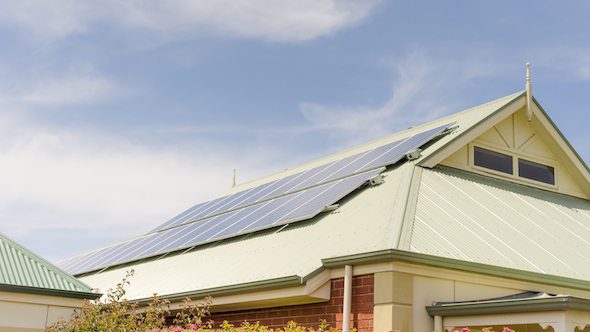
RNE has a look at progress for AGL's South Australian "virtual power plant" experiment - creating a cluster of buildings with solar panels, energy storage and software controlling when power is drawn from the storage systems - World’s largest virtual power plant trial a big hit with SA consumers.

AGL first announced plans to develop the ambitious VPP project in August – a centrally controlled network of 1,000 residential and business battery storage systems with a combined total of 7MWh capacity that would both store rooftop solar power and help manage grid stability in the state.

The hardware for the VPP – the 1,000 battery systems – and the energy management software are being supplied by US-based energy management company, Sunverge, which got the job through competitive tender.

AGL has said the finished product, which will have an output equivalent to a 5MW solar peaking plant, will work by using a cloud-connected intelligent control system that will allow the batteries to be directed in unison: a strategy aimed at helping both consumers to maximise solar self-consumption, and the broader community to manage state-wide peaks in electricity demand.

AGL chief Andy Vesey has said on various occasions that he believes such centrally controlled networks of rooftop solar and battery storage will be a key ingredient of energy systems of the future – systems that will be centred around the consumer.

AGL Energy's Andy Vesey sees batteries 'changing the world'  

Posted by Big Gav in ,

The SMH has an article on local utility AGL Energy's Andy Vesey and his belief that battery energy storage will "change the world" - AGL Energy's Andy Vesey sees batteries 'changing the world'.

AGL is expecting a 60 per cent reduction in the cost of batteries over the next five years, and that performance will improve as investment is poured into the chemistry and material science underpinning the technology.

The Utility Shift To Energy Solutions Provision  

Posted by Big Gav in , , , , ,

The Climate Spectator has a pair of articles looking at how Australian utilities are trying to avoid the utility death spiral - partly by resisting change and partly by trying to work out how to adapt to i. The first article looks at AGL, which has been marching backwards lately as it invests heavily in old (but very cheap) coal fired power plants - AGL's tense shift towards energy solutions provider.

Average household customer electricity consumption was down nearly 10 per cent for the year and this comes on top of similar falls in prior years (detailed in the chart below). Part of this year’s fall is attributed to the mild May and June but, nonetheless, “AGL expects average consumer demand to continue to be impacted by energy efficiency, solar and new technologies”.

With less volume AGL finds itself unable to make the kind of margin per customer which it has in the past in the retail end of its business. Earnings per 'customer account' were down 16.7 per cent compared to last year for AGL. At the same time, the reduced energy sales also flow down the line to lower prices and margins in the power generation part of its business as well.

The problem for AGL, and indeed other power companies, is that energy equipment suppliers for buildings – such as solar PV but also other products, such as energy efficient lighting – are cutting their lunch. These equipment suppliers are helping customers to reduce the amount of energy they need from the grid.

AGL’s chief executive Michael Fraser appears acutely aware of this challenge. He suggests that the company needs to transition from a conventional vertically integrated energy supplier which makes money through selling volume of energy, to what they term an integrated energy solutions provider, which they symbolise in the picture below.

Essentially, AGL believes it needs to vertically integrate yet another step beyond the centralised grid and into its customers’ homes. Under such a model the company would make money less by selling electrons from the grid and more by charging for services linked to equipment such as solar PV, batteries and devices which would improve a household’s energy efficiency and shift its electricity demand out of the periods when power is most costly, such as very hot and very cold days.

Boston Consulting Group released a paper recently looking at how this energy solution provision model may arise and the challenges it presents for traditional power utilities. BCG outlines in the diagram below how the revenues available upstream from the customer are likely to erode over time due to solar, cheaper batteries and more efficient and communication-enabled electrical equipment. It shows that while the revenue available to generation and power networks, declines, the available revenue for behind-the-meter equipment and services – as well as metering equipment – rises.

The second article looks at another of the big 3 Australian utility companies - Origin Energy - and how the rapid rise in east coast gas prices (caused by the export of coal seam gas as LNG) is impacting the generation mix - Origin hit by solar and efficiency demand drop.

Origin, like AGL, is also talking up its ability to vertically integrate into the customer-side of the grid to counter the loss of margins through lower grid-based electricity volumes. In its presentation to investors it states it is focusing on development of a “revitalised solar business, smart meter technology, electric vehicles, distributed generation and storage”.

However, Origin does not elaborate on what is meant by its “revitalised strategy in solar”. In its latest results it notes gross profit decreased in its non-energy commodity business dropped by 35 per cent, or $17 million, primarily due to lower demand for rooftop solar PV systems. Origin used to be the largest solar retailer in the country but in the last few years its market share has declined dramatically.

At the same time Origin’s presentation seems to indicate that it is hopeful regulatory changes might alleviate declines in power consumption, such as changes to the Renewable Energy Target and adjusting network charges away from being averaged across energy consumption to more of a fixed nature.

Also, the company notes they’d be looking to limit capital investment in their energy markets division. This seems to suggest they see better opportunities in oil and gas rather than funneling money into provision of innovative energy solution offerings to replace lost grid sales.

Also just like AGL, Origin see prospects for returns to improve in conventional power generation with large price rises possible. They believe that there will be a mass withdrawal of around 15 terrawatt-hours of gas fired generation from the NEM as LNG plants suck in this gas. They also expect some further power plant capacity to be retired.

The utilisation of their mix of power plants (detailed in the table below) underlies the shift we’ll see. Darling Downs and Mortlake are running at quite high capacity factors given their position in the power plant merit order while the coal-fired Eraring operated at less than half its full capacity (45 per cent capacity factor).

One can imagine with gas rising to around $8 per gigajoule these plants will almost drop off the grid while Eraring’s output will increase considerably.

AGL Energy wind farms running near 50% capacity  

Posted by Big Gav in , , ,

RNE has a look at some impressive capacity factors for wind power in southern Australia - AGL Energy wind farms running at near 50% capacity.

AGL Energy says some of its wind farms in South Australia have been operating at nearly 50 per cent capacity factors in the past six months, a very high rating for a wind farm and higher than many coal-fired generators.

This graph included in AGL Energy’s December half accounts show that the 95MW Hallett 1 and 71MW Hallett 2 wind farms – both located near the village of the same name in the state’s mid north region – achieved capacity factors of 48 per cent and 49 per cent respectively from July 1 to December 30.

AGL unveils Australia's biggest solar energy plants  

Posted by Big Gav in , , ,

The SMH reports on 2 large scale thin film solar power plants to be built in outback NSW using First Solar panels - AGL unveils Australia's biggest solar energy plants.

Australia’s biggest solar energy plants have been given the funding go-ahead, clearing the way for the installation of 2 million photovoltaic panels at two sites in the NSW outback.Power company AGL on Wednesday committed to proceed with the $450 million investment in the plants which will supply 50,000 homes with electricity and potentially pave the way for more such ventures.

Nyngan, north-west of Dubbo, will host the larger of the two plants, with a 102-megawatt capacity, while a 53-megawatt plant will be built near Broken Hill. Both should be supplying power to the eastern Australian grid by the end of 2015.

Gas prices to double in 20 years as demand explodes, Santos predicts  

Posted by Big Gav in , , , ,

Santos is tipping much higher natural gas prices for Australian consumers and a boom in unconventional gas - Gas prices to double in 20 years as demand explodes, Santos predicts.

The only way to meet a tripling in natural gas demand in eastern Australia is by allowing unconventional gas projects, such as coal seam gas, oil and gas producer Santos says.

Santos's eastern Australia vice-president James Baulderstone told a conference that he expected gas prices to more than double within two decades, driven by demand and linking it to oil prices. Soaring global demand for liquefied natural gas is expected to contribute to Australia's wealth and make it one of the world's biggest exporters of the commodity. ...

''The five LNG trains already sanctioned, with more planned, represent a quantum change in eastern Australian natural gas demand,'' Mr Baulderstone told the Opportunities and Challenges for Australian Gas conference yesterday. ''Provided natural gas development activity is allowed to proceed at the right pace, and the market is willing to pay the increased cost of extraction, there is sufficient gas in eastern Australia to meet this demand.'' But he added that it was not viable to develop much of the gas reserves to meet the new demand at current Australian gas prices of about $4 a gigajoule.

Australian gas prices were some of the cheapest in the developed world, Mr Baulderstone said. He predicted prices would move to $6 to $9 a gigajoule.

The Australian (now beginning to paywall itself into oblivion) reports that AGL are already seeing much higher prices - AGL secures east coast's most expensive gas deal.
AGL Energy has snared the east coast's most expensive domestic gas sales contract in what is thought to be a 50 per cent price jump forced by the expected demand from Queensland's coal-seam gas export plants. AGL is believed to have secured a price of about $6 a gigajoule for gas that will be used to supply miner Xstrata's Mount Isa operations for 10 years from 2013.

The SMh reports that fracking for coal seam gas now has a new cause for concern - earthquakes - Fracking shock reignites concern.
DEBATE over the safety of ''fracking'' in Australia has reignited after a gas project in Britain was named as the likely cause of 50 tremors this year.

A panel of seismic experts has found it ''highly probable'' that fracking conducted by Cuadrilla Resources - 41 per cent-owned by Australian drilling company AJ Lucas - was the cause of two significant tremors and 48 aftershocks near the British town of Blackpool in April and May. The findings come after the independent MP Tony Windsor told the federal government this week he would not support its mining tax unless more was done to investigate the safety of fracking in Australia.

Fracking, or hydraulic fracturing, is a controversial gas extraction technique that uses high pressure solutions to fracture rocks deep underground. The process is used in both coal seam gas and shale gas extraction and, if poorly executed, can contaminate groundwater and trigger seismic activity.

Fracking is most common in the United States but is fast spreading to other nations like Australia and Britain, where Cuadrilla hoped to develop a gas source near Blackpool. The company was forced to launch an investigation after tremors of magnitude 2.3 and 1.5 appeared to follow a series of fracks.

The report - commissioned by Cuadrilla - confirmed the fracking was ''most likely'' to have caused the tremors but said the region had ''rare'' geological factors that were one of ''many factors'' which ''coincided to induce these seismic events''.

AJ Lucas services the main coal and coal seam gas basins in Queensland and NSW, including in the Hunter Valley, Bowen Basin and Surat Basin.

The Cuadrilla revelations are not the first time fracking has been linked to tremors, with regulators in the US state of Arkansas expressing concern that two shale wells - now owned by BHP Billiton - were responsible for causing earthquakes.

Origin, AGL call for national energy scheme  

Posted by Big Gav in , , ,

The Australian has an article on utilities AGL and Origin calling for dynamic pricing of power in order to send energy consumers price signals which will make smart meters useful - Call for national energy scheme.

AGL Energy and Origin Energy have called for a national energy saving scheme to slash the costs they face to comply with fragmented state-based schemes. The nation's two biggest energy retailers have also renewed calls for an end to government control of retail power prices.

The companies have told a review, ordered by the Ministerial Council on Energy in response to increasing demand for power, that they are being saddled with compliance costs because of the lack of a national energy efficiency scheme.

Victoria, South Australia and NSW operate separate schemes that require energy and gas retailers to purchase and surrender energy efficiency certificates. In Queensland, a parliamentary committee has recommended consideration of a scheme. The schemes are expected to grow as the carbon tax is due to start next year and electricity prices are forecast to rise. ...

The review is being conducted by the Australian Energy Market Commission, which will release a discussion paper in November. It was ordered because demand for peak power -- most commonly on summer days when air-conditioning use soars -- is growing faster than normal demand, requiring multi-billion-dollar investments in energy infrastructure that is used only for a few hours a year. It is expected to propose measures to encourage users to manage their usage to reduce pressure for new spending.

But AGL and Origin argue that retail price regulation is the main barrier to more efficient electricity use as consumers are not exposed to price signals. "It is not realistic to talk about reforms to the electricity system involving new technologies (for example, smart meters) when the very value they provide cannot be extracted due to rigid pricing structures enforced through ongoing retail price regulation," AGL says.

Origin has told the review the price caps discouraged retailers from offering alternative price structures, such as time-of-use pricing, charging more for peak-time energy use. Controversy erupted in Victoria over price reforms proposed last year as part of the roll-out of smart meters, but the retailers say the meter rollout was mandatory.

Power Industry News reports that a display centre for the Newcastle Smart Grid demonstration project has been opened - Newcastle's Shopfront for Smart-Grid Technology.
The Smart Grid, Smart City Information Centre was today launched in Newcastle to engage consumers and business in new technologies that are being trialled in the region to use energy more efficiently.

The Smart Grid, Smart City project is a $100 million commitment by the Australian Government to work with industry to demonstrate and test the integration of a range of new technologies such as smart grids, smart meters, electric vehicles and ceramic fuel cells into an existing community.

The Minister for Resources and Energy, Martin Ferguson AM MP said the project will test the possibilities of smart grid technologies including the potential to help consumers reduce their energy use and ultimately reduce their electricity bills.

Meeting peak demand is one of the biggest pressures pushing up the cost of electricity, and smarter use of our appliances could help ease that pressure, Minister Ferguson said. … Further information on the project is available at www.ret.gov.au

Australia's Power Paradox  

Posted by Big Gav in , , , , ,

The SMH reports that Sydney's heatwave (which has been inducing a lot of lethargy here at Peak Energy headquarters) prompted record power consumption in NSW this week - Third day of heat is the one to beware of. At least we aren't about to be deluged by a flood or trashed by a cyclone, unlike our friends in Queensland.

The weather also pushed electricity consumption to a record level of 14,744 megawatts yesterday. This exceeded the previous summer peak of 14,101MW reached on February 6, 2009, and the state's all-time record of 14,289MW, which occurred during the winter of 2008. The increased use of airconditioners has pushed summer usage to new highs.

Given that building peak generation capacity and the associated transmission infrastructure is responsible for a significant slice of our rapidly rising power bills, you'd think some effort would be out into finding ways to reduce the peak (or follow the load locally by encouraging more solar PV) via demand management. The Climate Spectator has a few words to say about this - The easy way to cut power bills.
Energy highways don’t do pedestrian crossings, roundabouts or traffic lights – what the consumer wants, it gets. So, when they all want it at the same time, the energy market needs a Sydney Harbour bridge the equivalent of 50 lanes wide (actually, pick your own number, but it’s a lot) that will then remain unused for the rest of the year.

All of this costs a lot of money, and it’s the consumer who pays for it. The Australian energy regulator late last year estimated that 10 per cent of the country’s transmission infrastructure – assets worth some $3.5 billion – gets used for less than 1 per cent of the year. The rest of the time it sits idle. Not that this greatly upsets the infrastructure providers in the Australian energy market – the more poles they build and wires they hang, the more money they get. ...

The biggest challenge is how to manage the growth in peak demand, which is growing at a phenomenally faster rate than baseload power. It will come as something of a shock to most consumers that their soaring power bills are not the fault of green energy subsidies, but mostly because of the neighbour’s newly installed air conditioning unit. Or their own.

The conventional view of how to solve this problem has been to implement some sort of congestion tax, to try and reduce the need for a 50 lane bridge across the harbour to a 40 lane, or at least make it really expensive. The inevitable rollout of smart meters in coming years will allow for time-of-use billing. But is it fair?

Two economists working for AGL Energy suggest not, arguing that it disadvantages businesses and the less wealthy – why should these people, they ask, be subject to higher energy prices and cross-subsidise others who decide to switch on their air conditioners all at once?

The AGL economists suggest a more complex billing system that would calculate tariffs not just on the time of use, but the change in use. This protects people who have more-or-less constant usage from the worst price spikes, while imposing greater costs on those who ramp up demand at peak periods because they are switching on air conditioners or other appliances. It sounds immensely complicated, but not beyond the bounds of smart meters, because they are, well, smart. Most of all, smart meters will allow consumers, and producers, to change the way they think about pricing. The days of low-cost energy are over, and they are not coming back.

In the meantime, if you’re struggling through the heat wave and your neighbours switch on the air conditioning, you might as well go round and ask to join them in the cool. After all, you’re paying for it.

The AGL paper referred to above can be found here - A New Approach To Congestion Pricing (pdf).

This paper was the subject of an article in the Climate Spectator last year - Australia's power paradox.
Australians are about to pay the price of cheap energy.

A landmark report by a team of analysts from AGL Energy suggests cheap energy and soaring incomes has lured Australians into larger homes with massive increases household appliances, particularly air conditioners. Now they are exposed to a looming price shock that could send retail energy prices more than doubling in the next five years, sending many homes into “fuel poverty.”

The AGL team led by economist Paul Simshauser identifies four primary causes for surging energy prices. The first is Australia’s great wealth of energy resources, which have historically been sold to energy utilities at a margin above extraction cost, but are now being developed at such scale for export that they have a potential to link with global energy indices and potentially cause a fuel cost shock in the domestic market.

This has already occurred in WA, where domestic gas prices are linked with the export price. AGL says that with a dozen new major gas plants planned in eastern Australia, most of it on the export market, a similar scenario could have a profound impact on energy costs.

The second cause is the rising cost of power plants, which has surged over the past decade, and is now being worsened by the higher cost of capital following the global financial crisis.

Thirdly, network infrastructure is now being forced to expand at record rates to keep pace with rapidly rising peak loads caused mostly by domestic energy use.

The move to lower emission technology is also forcing a shift from coal to gas, and to the increased use of high-cost renewable energy sources, although the AGL report says the impact of climate change and renewable energy policies on electricity prices is minor relative to these other drivers.

AGL has produced the report to argue for a range of policy measures. This includes rebating the estimated $1 billion-plus windfall in GST collections from rising energy prices to needy households, and to encourage the purchase of more efficient appliances by granting special credit policies to low income families.

It also wants prices to be deregulated, allowing for time-of-use tariff structures and the introduction of smart meters – not just so that people can view the the rate and cost of their own usage, but to allow demand management that will help shift consumption away from the peak load times that are adding to overall costs.

“The paradox here is, of course, that rising wealth has actually caused the pre-conditions for fuel poverty,” the report notes.

“In many respects, it’s as if consumers in NSW and QLD have historically been provided with a mispriced illicit electricity drug for long enough to establish a chronic addiction, at which point the price will progressively more than double.”

The report said the overwhelming majority of households will readily adjust their budgets to incorporate rising energy costs, as they are not unusual by global standards. But lower income households would face energy bills that could equate to 10 per cent or more of their household budgets. It estimates more than 340,000 households in NSW and Queensland alone could be tipped into “fuel poverty” – the “boomerang paradox” as AGL calls it.

The report said electricity prices in NSW and QLD have the potential to rise from about $130/MWh in fiscal 2008 to $255/MWh in fiscal 2015. Those prices soared above $300/MWh in its worst case scenario. It could not find a single element in the electricity cost stack that was not increasing at a rate faster than prevailing inflation expectations.

But one of the most material, although least certain, cost shocks could come from the upstream coal seam gas industry and the development of LNG terminals in Queensland. If this causes a link to the oil price, then the cost of existing CSG contracts will be more than doubled when they mature and are replaced with new ones.

And as new generating plant is installed in NSW and Queensland, then the long range marginal cost of baseload gas turbines will set the wholesale market prices rather than coal. In its most simplistic terms, the report said, whole-of-system average cost will rise from the coal-based $44/MWh in fiscal 2008 to a gas-based $71/MWh in fiscal 2015, or up to $98/MWh in a high gas price scenario. When the extremely low load factor of households is taken into account, these numbers ramp up to $100 - $130/MWh, excluding carbon taxation. “Importantly, for the Federal Government, their proposed CPRS and RET are not the cause of fuel poverty.”

The wind farm that ate the RET  

Posted by Big Gav in , , , ,

Giles Parkinson at The Climate Spectator has a look at wind farm developments in Australia - The wind farm that ate the RET

In Australia’s renewable energy market, fortune favours the quick and the big. The $1 billion Macarthur wind farm to be built in south-western Victoria is being touted as the most significant renewable energy project in Australia since the Snowy Hydro. But don’t expect another project of similar ambition to follow anytime soon, even though there are a couple on the drawing board – there’s simply no room left in the market.

Macarthur has been a long time in the planning for AGL, it’s just been waiting for the opportunity provided by the passage of the Renewable Energy Target.

Just over a year ago, AGL suggested Macarthur would be around 330MW-360MW, but improving technology and the opportunity provided by the passage of the RET means it has been able to upgrade the size of the facility by a quarter over its original estimates.

Instead of using 2.1MW turbines it has used elsewhere, AGL announced on Thursday that it will use new model 3MW turbines manufactured by Vestas, enabling it to boost the size of the plant [to] 420MW and reduce the number of turbines to 140 from 174, providing a significant saving in operating costs.

That’s terrific news for AGL and its joint partner in the project, Meridian Energy, and for its suppliers and contractors Vestas and Leighton; but not so good for others, particularly the independent developers who are finding it difficult to get long-term power purchase agreements to satisfy their financiers.

In a single bound, the Macarthur wind farm takes the size of the committed wind farm pipeline to more than 1000MW. Wilson HTM analyst Jenny Cosgrove says the size of this pipeline – another 150MW from two projects due to be completed this year, another 382MW from five projects in 2011, and the 203MW Collgar wind farm in WA in 2012 – means that the price of renewable energy certificates could remain at current levels of $40/MWh for longer than expected. That’s not enough to get most projects off the ground.

Cosgrove says the wind farm pipeline means that LRET is rapidly approaching a balance of supply and demand in 2011-2013, and this is before the excess current banked supply of small-scale RECs, which she estimates to be more than 21 million by end 2010, is transferred into the large-scale RET.

“It will take a number of years before this excess supply is absorbed,” says Cosgrove. Which means that many other wind farms currently in the planning stage may struggle for a window of opportunity, of even financing, for a few years yet. ...

The real test of that estimation will come in years 2016 and beyond, when the RET target will scale up dramatically towards it 2020 target of 41 million MWh. By then, wind might have some serious competition from solar thermal, if Lend Lease is right about the pricing of solar PV, as well as some geothermal projects.

Australia's priceless dilemma  

Posted by Big Gav in , , , ,

AGL CEO Michael Fraser has a column in the Business Spectator on the need to transition to a clean energy economy - Our priceless dilemma.

The issue of climate change should be no different. We should be taking prudent, sensible and measured action today to ensure that the risks associated with climate change are managed properly. Given the risks, we would be failing as business and community leaders to ignore the quantitative evidence. It is a long-term issue that requires long-term solutions.

It is clear that all industries, including the energy sector, require a clear policy framework if we are to make that transformation to a low carbon future with as little disruption to the economy as possible.

There certainly appears to be a consensus around “community concern” over climate change when you consider that the Climate Institute and Auspoll recently found that 83 per cent of people are concerned that greenhouse gas emissions are making climate change worse.

However, there is not yet consensus among political, business and community leaders around the policy frameworks we need to establish to achieve the cuts required to manage the risks associated with greenhouse emissions.

Our government has agreed to a minimum 5 per cent reduction in emissions by 2020, relative to 2000 levels, or to a 2 per cent cut if countries collectively reduce emissions to achieve the objective of keeping temperature rises below 2 degrees Celsius.

If we take the midpoint – a 15 per cent reduction on 2000 levels – that would require a 29 per cent reduction in business-as-usual emissions, or about 190 million tonnes. Policy makers around the world believe the three main policy tools to address climate change are emissions trading, renewable energy targets and energy efficiency programs.

Australia’s 20 per cent renewable energy target can potentially achieve around 40 million tonnes of abatement. If energy efficiency measures manage to maintain a constant consumption of energy to 2020, it would save another 40 million tonnes.

This leaves a gap of 110 million tonnes still to cut. And this is where emissions trading, universally regarded as the least-cost way to reduce greenhouse gas emissions and a policy which had bipartisan support at the 2007 federal election, comes into play.

Reducing emissions is an economy-wide exercise. A market based solution will deliver a lower cost outcome. It is my firm view that a broad-based cap and trade emissions trading scheme is the best way to deliver least cost solutions for reducing emissions.

Emissions trading can achieve all of the abatement we would need to achieve our midpoint target of 15 per cent.

What is very clear, however, is that if we don’t put a price on carbon, as well as implement additional policy mechanisms, we won’t see the investment necessary to meet such a target.

We need a broad-based emissions trading scheme and the government should implement such a scheme as soon as a consensus can be achieved. But we don’t have much time.

The transition to a lower carbon economy is likely to take decades; but the earlier we begin, the greater the benefits and the lower the costs – a point that has been highlighted by the Climate Institute’s new report, which concludes that the lack of a price on carbon will cost Australian households an extra $2 billion a year in higher electricity prices by 2020.

Australian Renewable Energy target Increased to 20%  

Posted by Big Gav in , , ,

The Business Spectator has an article by Giles Parkinson on the government finally legislating an increase in the renewable energy target - Our renewables 'revolution' is not what it seems.

It has taken nearly three years, but the federal government finally has something to show for the climate and clean energy platform it took to the electorate in 2007.

The passage of amendments to the Renewable Energy Target after a series of last gasp negotiations with the opposition and the Greens (a sign of things to come, perhaps), means that billions of dollars of wind farm and other renewable investments should – in theory at least – now get the green light. It also means that Australia can now join the rest of the world and declare it has a renewable energy industry to call its own. It’s been a long time coming.

Having cut and run from an emissions trading scheme and blundered its way through the home insulation disaster, that would be a welcome development for the government, and paves the way for a host of photo opportunities for government ministers and wind turbines, solar panels and sugar mills.

But not so fast – one of the consequences of the government’s poorly conceived first attempt at the RET is that the market remains flooded by certificates issued firstly to solar hot water systems and then to rooftop solar panels.

The price of RECs remains below $40, way below the value necessary to support most wind farm developments, and some predict the market may remain flooded till 2014, because energy retailers have been stocking up while the price is cheap.

That means that power purchase agreements needed to finance big projects will be hard to come by, in the short time at least, and some developments will have to bide their time. Others, though, such as AGL’s $800 million Macarthur wind farm and up to $2 billion of other wind farm projects in coming years, will not be delayed, because AGL can use the RECS to satisfy its own obligations.

One of the great ironies of this piece of legislation is that it should make its way through parliament while the emissions trading scheme failed. After all, it prices saved emissions, at least on paper, at up to $65 a tonne, three times more than an ETS.

It’s the sort of maths that drives some companies, such as aspiring coal seam gas developers Origin and Santos, to the point of distraction. Both argue that they need a carbon price to make baseload power stations economically viable. There’s another $20 billion to $30 billion of investments in that pipeline.

And it seems that for every winner in a renewable energy scheme, there is a loser. Now it is the turn of the solar industry to lament the agreements that effectively restrain the growth of the industry. Austalia’s reliance on a single mechanism means its impossible to find the right balance.

Energy company AGL is happy with the news, fats tracking their proposed Macarthur wind plant - Renewable energy changes welcome: AGL.
AGL Energy Limited (AGL) plans to fast track its Macarthur wind farm project following changes to the Renewable Energy Target (RET) scheme approved by the Senate on Wednesday. The government's changes provide greater investment certainty for the renewable industry, AGL said in a statement on Thursday. ...

The government's changes have split the RET into two, effectively creating two markets - one for large-scale industry and one for small-scale consumer technology including solar photovoltaic.

AGL managing director Michael Fraser said it would give industry the certainty to make long-term investment decisions to transform the nations energy infrastructure to meet the target of sourcing 20 per cent of the nations electricity from renewable sources by 2020.

AGL 'forced electricity prices higher'  

Posted by Big Gav in

The SMH has an article on questions being asked about the role of AGL in high electricity prices in South Australia and gas prices in NSW - AGL 'forced electricity prices higher'.

AGL has been criticised by the Australian Energy Regulator after continued attempts to ''exercise market power'' by forcing the electricity price sharply higher earlier this year and in 2008. ...

Earlier this year, spot electricity wholesale prices exceeded $5000 a megawatt hour on 27 occasions in South Australia, accounting for about half of all high price events in the electricity market so far this year.

''The bidding behaviour of AGL has been a contributing factor on at least several occasions,'' Mr Willett said.

In early 2008, AGL often sought to set wholesale electricity prices at around the market price cap of $10,000 per megawatt hour, Mr Willett said, by changing the bidding practices of its Torrens Island power station in South Australia.

In the gas market, AGL was also involved in gas supply problems in 2007, when insuff-icient gas reserves were shipped to Sydney, causing shortages and disruption to industry.

At the time, there were claims AGL had diverted gas to the South Australian market to take advantage of higher gas prices; AGL subsequently agreed there were no physical reasons for the lack of supply.

AGL to Approve Coal Seam Gas and Wind Power Projects  

Posted by Big Gav in

Bloomberg has a report on AGL's plans to expand their clean energy generation capacity - AGL to Approve A$1.1 Billion Gas, Wind Power Projects.

AGL Energy Ltd., Australia’s biggest power and gas retailer, expects to approve about A$1.1 billion ($716 million) of wind- and gas-fired generation this year for construction as it boosts investments in cleaner electricity. ...

The Hallett 4 wind project may get the go-ahead “in the near future,” Fraser said. The Hallett 3 and Oaklands Hill wind ventures may be approved in the second half of the year, while the 360-megawatt Leafs Gully gas-fired generator in New South Wales should be sanctioned late this year or early 2010, he said.

The wind power projects, in South Australia and Victoria states, would cost about A$750 million, while the Leafs Gully project may cost between A$350 million and A$400 million, Fraser said in an interview. AGL’s options over the BG gas and power assets in Queensland expire on April 14.

AGL won’t delay planned investments waiting to see whether New South Wales goes ahead with a delayed privatization of power assets, Fraser said.

AGL is ready to go on acquisition trail  

Posted by Big Gav in , ,

The Australian reports that AGL is ready to expand further in the local energy sector, and notes their strong position in renewable generation already - AGL is ready to go on acquisition trail.

AGL chief executive Michael Fraser is not holding his breath for the long-debated privatisation of the NSW Government's energy assets.

But if Nathan Rees' Government does announce the timetable for the sale of the retail arms of its electricity distribution network, which could come as early as this month, AGL, Australia's largest energy company, is there ready, and able to borrow as much as $2 billion if needs be -- if the deal is right. ...

In December, the company announced it had raised another $1.127 billion from the sale of its oil and gas interests in Papua New Guinea.

That month provided another boost for the company, with the Rudd Government's confirmation of its mandatory renewable energy target -- that 20 per cent of Australia's energy supplies will have to come from renewable energy by 2020.

AGL is already Australia's largest owner of renewable energy, with about 27 per cent of its total generation capacity in clean energy investments such as wind farms and hydro-electric plants.

Fraser has big plans to boost the company's renewable energy assets to ride the expected long-term growth in the sector, with plans to expand in wind farms, hydro-power and coal seam gas as well as less proven technologies such as geothermal (hot rocks).

"We can see, in the long term, between 40 to 50 per cent of our generation capacity will come from renewables," he says, "We are the only Australian energy company generating from a full suite of proven renewable technologies. We are already the largest private owner and operator of renewable energy assets in Australia, with nearly 1000MW of renewable generation capacity. "We can see the potential for a fourfold increase in our renewable generation capacity over the longer term."

In October this year, AGL will commission its $234 million, 140MW Bogong hydro-power plant, in the mountains near the skifields of Victoria.

The largest hydro electric generating plant built in Australia in more than 20 years, the Bogong plant will provide electricity into the Victorian electricity grid for peak periods. It represents a major expansion of the company's Kiewa hydro-scheme, which AGL bought from Southern Hydro in 2005.

Fraser took a group of analysts to see the project -- which involve building a 6.9km tunnel through the rock that will allow "ultra fast" electricity generation when it flows down inside the mountain towards the generator -- in December to highlight the company's renewable energy commitment.

He says the federal Government's renewable energy targets will require the equivalent of 45,000GW hours of renewable energy or 10 Snowy Mountain hydro electricity schemes, which he predicts will prompt a new generation of investment in the renewable energy sector in Australia.

Coal Seam Gas Industry Consolidation Continues  

Posted by Big Gav in , , , ,

The coal seam gas sector continued to see plenty of action while I was on holidays. The Business Spectator has a look at the expansion ambitions of AGL and others - AGL moves into position

Trading halts for three companies this morning is a strong signal that the latest bout of consolidation of the coal seam gas sector is about to get underway. Unlike the flurry of large-scale activity throughout this year, however, this time the action is moving into NSW.

The securities of AGL, Sydney Gas and AJ Lucas Group were all placed in trading halts this morning: AGL’s and AJ Lucas’s because they are both involved in discussions concerning a "material transaction". Sydney Gas is in a trading halt "in relation to a takeover bid." AJ Lucas became Sydney Gas’s major shareholder, with about 20 per cent of its capital, this year.

As the joint venture partner of Sydney Gas in its Hunter Valley and Camden and Sydney projects, AGL already has its foot on the group’s key resources. Sydney Gas is potentially of real strategic consequence for AGL, the largest supplier of gas into Sydney and Newcastle.

There is an expectation of an increasing shortfall of gas for the Sydney market over the next decade that coal seam gas is expected to meet. With the more deeply explored and developed Queensland coal seam gas fields earmarked for the plethora of export LNG plants on the drawing boards, NSW gas will come into increasing focus.

Sydney Gas’s reserves and prospects are located close to the NSW electricity grid and the main gas transmission pipelines into Newcastle and Sydney. It already has long-term contracts to supply AGL. The joint venture partners have talked about an ambition of supplying up to 20 per cent of the existing NSW gas market by 2015 from its resources at Camden and the Hunter Valley and up to 50 per cent beyond 2015. ...

Sydney Gas wouldn’t be a major move for AGL. It has a market capitalisation of only about $110 million, although the spate of coal seam gas transactions – including Arrow Energy’s $551 million bid for Pure Energy this week – says that market prices aren’t much of a guide to takeover values in the sector. Arrow offered about $5.40 a share for Pure when the target’s shares had been trading at less than $1 only about six weeks ago.

In the current environment there is likely to be significant consolidation of the smaller and more weakly-funded players in coal seam gas as the Queensland LNG players look to secure the resources needed to under-pin two-train LNG projects and the bigger players move to pre-empt the likely positive (for producers) eventual impact of the LNG projects on domestic gas prices.

There are vast amounts of gas in the Sydney Basin so the prospect of rising gas prices and shortfalls in supply ought to see what has until now been a Queensland-focused land-grab spill into NSW.

There are some transmission constraints in supplying Queensland gas into NSW and there would be benefits for the sector in displacing Queensland gas contracted to NSW customers – freeing it up for the LNG plants – with local production.

More local CSG news :

* The Australian - AGL makes a $171 million bid for Sydney Gas
AGL Energy has continued to shore up its NSW coal seam gas (CSG) reserves during the current economic downturn. ... AGL last week agreed to pay $370 million for AJ Lucas and Molopo Gas's CSG acreage in the Gloucester Basin, north of Newcastle. AGL says the Hunter exploration project, which it already holds half of, is the main prize and Sydney Gas's 50 per cent stake was worth $115 million, or two-thirds of the purchase price. By taking Camden and the Hunter project, AGL substantially boosts its ability to supply Sydney, Newcastle and Wollongong with gas.

* The Age - Arrow to buy Pure for $673m
Arrow Energy, Royal Dutch Shell's partner in coal-seam gas in northeast Australia, agreed to buy Pure Energy Resources for $673 million in cash and stock. ... "A combination of Arrow and Pure will drive further upside from Pure's acreage, and provide a commercialization path for Pure's reserves as a result of Arrow's downstream exposure through both Arrow's existing domestic power generation projects and proposed LNG export projects," Arrow Managing Director Nick Davies said in the statement.

* Bloomberg - Blue Energy, Eastern Lead Australia Coal-Seam Gas Stocks Higher
Blue Energy Ltd. and Eastern Star Gas Ltd. led Australian coal-seam gas stocks higher in Sydney trading, boosted by two takeover bids in the industry last week that offered more than a 50 percent premium to the share prices. Perth-based Blue Energy jumped as much as 31 percent to 19 cents on the Australian Stock Exchange at 2:02 p.m. local time, while Sydney-based Eastern Star Gas gained as much as 22 percent. Rival coal-seam gas explorers Metgasco Ltd., Arrow Energy Ltd. and Bow Energy Ltd. also advanced.

* Darling Downs Chronicle - Downs to ride out slump
THERE'S no gloom and doom on the western horizons with Toowoomba set to be insulated from the slump, courtesy of the mining activity, particularly in the Surat Basin. Bust is the last thing on Easternwell Group commercial general manager Marco Waanders' agenda. He said yesterday the major resource industry player was on track to double its workforce. He joined the chorus of Surat Basin insiders declaring the global economic downturn would not substantially hurt their projects.

This is despite mining giants Xstrata, Oz Minerals and Macarthur Coal announcing 500 job cuts on Tuesday and an expected downturn in Central Queensland coking coal projects. Mr Waanders was confident the family-owned company would create up to 600 new Toowoomba jobs within 18 months. “Everyone still needs gas to fire power stations,” Mr Waanders said from one of the company's five Garden City sites.

* SMH - Cash-strapped Eden Energy finds a lifeline
EDEN ENERGY, an ASX-listed minnow that suspended itself from trading because of a cash shortage, may have found a lifeline by selling most of its overseas coal-seam gas business. In a sign of the capital shortage facing small explorers, the energy company said it had entered into a conditional contract to sell 90 per cent of its share in licences to explore coal fields in Wales to lower its cashflow needs.

* Adelaide Advertiser - Investors swimming with the fishes
Grand Private Equities stockbroker Wesley Legrand said the ASX had been "ravaged and decimated" this year. He said mum and dad investors had been "taken to the cleaners by immoral, unethical and unregulated hedge fund short selling in combination with the greatest global margin call in history".

Of the few companies to gain ground in the past year, four of the top 10 are in the energy sector which has been propelled by takeover speculation and the blossoming coal seam gas sector. "In the short term, LNG and coal seam gas are hot property," Mr Legrand said. Linc Energy is number one, up 120 per cent, while Origin Energy has climbed 93.5 per cent.

Statistics

Locations of visitors to this page

blogspot visitor
Stat Counter

Total Pageviews

Ads

Books

Followers

Blog Archive

Labels

australia (619) global warming (423) solar power (397) peak oil (355) renewable energy (302) electric vehicles (250) wind power (194) ocean energy (165) csp (159) solar thermal power (145) geothermal energy (144) energy storage (142) smart grids (140) oil (139) solar pv (138) tidal power (137) coal seam gas (131) nuclear power (129) china (120) lng (117) iraq (113) geothermal power (112) green buildings (110) natural gas (110) agriculture (91) oil price (80) biofuel (78) wave power (73) smart meters (72) coal (70) uk (69) electricity grid (67) energy efficiency (64) google (58) internet (50) surveillance (50) bicycle (49) big brother (49) shale gas (49) food prices (48) tesla (46) thin film solar (42) biomimicry (40) canada (40) scotland (38) ocean power (37) politics (37) shale oil (37) new zealand (35) air transport (34) algae (34) water (34) arctic ice (33) concentrating solar power (33) saudi arabia (33) queensland (32) california (31) credit crunch (31) bioplastic (30) offshore wind power (30) population (30) cogeneration (28) geoengineering (28) batteries (26) drought (26) resource wars (26) woodside (26) censorship (25) cleantech (25) bruce sterling (24) ctl (23) limits to growth (23) carbon tax (22) economics (22) exxon (22) lithium (22) buckminster fuller (21) distributed manufacturing (21) iraq oil law (21) coal to liquids (20) indonesia (20) origin energy (20) brightsource (19) rail transport (19) ultracapacitor (19) santos (18) ausra (17) collapse (17) electric bikes (17) michael klare (17) atlantis (16) cellulosic ethanol (16) iceland (16) lithium ion batteries (16) mapping (16) ucg (16) bees (15) concentrating solar thermal power (15) ethanol (15) geodynamics (15) psychology (15) al gore (14) brazil (14) bucky fuller (14) carbon emissions (14) fertiliser (14) matthew simmons (14) ambient energy (13) biodiesel (13) investment (13) kenya (13) public transport (13) big oil (12) biochar (12) chile (12) cities (12) desertec (12) internet of things (12) otec (12) texas (12) victoria (12) antarctica (11) cradle to cradle (11) energy policy (11) hybrid car (11) terra preta (11) tinfoil (11) toyota (11) amory lovins (10) fabber (10) gazprom (10) goldman sachs (10) gtl (10) severn estuary (10) volt (10) afghanistan (9) alaska (9) biomass (9) carbon trading (9) distributed generation (9) esolar (9) four day week (9) fuel cells (9) jeremy leggett (9) methane hydrates (9) pge (9) sweden (9) arrow energy (8) bolivia (8) eroei (8) fish (8) floating offshore wind power (8) guerilla gardening (8) linc energy (8) methane (8) nanosolar (8) natural gas pipelines (8) pentland firth (8) saul griffith (8) stirling engine (8) us elections (8) western australia (8) airborne wind turbines (7) bloom energy (7) boeing (7) chp (7) climategate (7) copenhagen (7) scenario planning (7) vinod khosla (7) apocaphilia (6) ceramic fuel cells (6) cigs (6) futurism (6) jatropha (6) nigeria (6) ocean acidification (6) relocalisation (6) somalia (6) t boone pickens (6) local currencies (5) space based solar power (5) varanus island (5) garbage (4) global energy grid (4) kevin kelly (4) low temperature geothermal power (4) oled (4) tim flannery (4) v2g (4) club of rome (3) norman borlaug (2) peak oil portfolio (1)