Showing posts with label australian politics. Show all posts

Greens dig a hole for Tony Abbott on farmers' rights  

Posted by Big Gav in , , , , ,

The Australian has an article on The Greens' canny exploiting of a new wedge issue for the Coalition, trying to get Tony Abbott to side with either farmers or mining companies over the impact of coal seam gas extraction on farmland - Greens dig a hole for Tony Abbott on farmers' rights. There was more today - Greens urge rethink of investment on coal seam gas; want scientific analysis of emissions and Greens question the science of gas for power generation .

THE Greens will move to give farmers veto powers over coal-seam gas operations on their land after seizing on comments from Tony Abbott, who last week backed the right of farmers to deny miners access to their properties.

After the Opposition Leader declined on Saturday to elaborate on remarks he made on Friday that farmers had "a right to say no", Greens leader Bob Brown said he would seek Mr Abbott's support for a private member's bill on the issue.

The bill, to be brought into the Senate in the next fortnight by Greens Queensland senator Larissa Waters, would require the written permission of landholders be obtained before companies could explore for, or extract, coal-seam gas.

As senior Coalition figures accused Senator Brown of trying to wedge the Coalition on the issue, which pits its rural constituency against the mining industry, Mr Abbott's spokesman said he "stands by his recent comments that the Coalition supports a vibrant coal-seam gas industry". ...

Resources Minister Martin Ferguson accused Mr Abbott of risking the $45 billion of investment in the Queensland industry through his comments on Friday and of dodging questions on the issue in Perth on Saturday.

He said Mr Abbott was a "rank opportunist" and an "economic vandal".

"Mr Abbott's comments jeopardise future investment, raise the spectre of sovereign risk and are contrary to Australia's policy of welcoming foreign investment -- a policy that has in no small way helped ensure the fundamental strength of our economy," Mr Ferguson said.

"Two of the major companies operating in the coal-seam gas industry -- Santos and Origin -- are Australian companies. Is Mr Abbott saying to other major companies in the energy sector, like British Gas or Chevron with their $43bn Gorgon project, that their investment is not welcome?"

The Greens move comes amid rising anger over coal-seam gas extraction in Queensland and NSW, where the rapid expansion of the industry has sparked protests amid concerns about the industry's impact on prime agricultural land and its effect on ground water reserves.

The Climate Spectator has a look at the issue of potential contamination of the Great Artesian Basin - A double-sided CSG dilemma.
Four years ago, fund manager John Abernethy wrote a prescient article for Business Spectator explaining how we were degrading our 'economic environment' just as much as the physical and biological environment.

Abernethy, executive director and chief investment officer of Clime Investment Management, knows plenty about money and his article, published in the throes of the initial 2007 sub-prime crisis, is worth re-reading as a reminder that we have been through the financial and economic equivalents of a Chernobyl, an Exxon Valdez and the American dustbowl of the early 1930s (Economic warming, November 2007).

Today we limp forward wondering whether the 'ecological system' of global finance and economics will collapse altogether.

Increasingly 'economics', the study of scarcity, and 'ecology', the study of the biological systems that fill our world, are different sides of the same coin.

Thus the Greens believe they are speaking great economic truths, but based on a much longer timeframe than conventional economists. If you'll bear with me for a moment, it's fair to say that in theory they are right – the fairly radical suite of policies they promote would, in theory, hand a better world to our great grandchildren than the one we inhabit. In theory. ...

The CSG majors have refined their extraction techniques in recent years to avoid the most hazardous chemicals – one, on condition of anonymity, explained to me yesterday that what is pumped down into the ground to release CSG is around 97 per cent water and sand, with the remaining 3 per cent being "essentially the kind of household chemicals you'd find in a normal home".

Sounds pretty benign, doesn't it. But the other view of that harmless mixture is this: imagine filling hundreds of water tankers with a 3 per cent chemical solution, then pouring the lot into an old quarry to create a wetland environment. It might do alright, but then again it might not.

Jim Cox, professor of hydrology at the University of Adelaide, explained to me yesterday the unique characteristics of the Great Artesian Basin that extends over much of the areas of Queensland and some of NSW where CSG extraction is occurring. (This report has a neat little map of where the water is.)

In many parts of the world, underground aquifers are quite discrete, so any pollution of one is likely to be contained. This is not necessarily true of the GAB – Cox explains that areas of heavy rainfall in the north create a long, percolating flow of water that makes its way south, taking perhaps 100 years to reach the southern regions.

And that is where the two sides of the ecology/economics coin come together. The flow of pollutants created by the 'fracking' process of extraction is either an unacceptable burden for future generations who may rely on this water to irrigate crops in an increasingly hungry world; or it is a cost that, with the right discount rate applied, is almost negligible alongside the immense benefit of the energy we extract from CSG.

Bob Brown yesterday questioned the science used by fans of CSG, who claim that as an energy source it releases 50 to 70 per cent less CO2 than coal.

The SMH has an article looking at the issue from a farmers viewpoint - Our food bowls should not be sacrificed to mining.
Australia is the driest continent on earth and as we push towards an ever increasing population we must be mindful of the fact the less than 9 per cent of our continent's surface is arable land: a far smaller portion of that is prime agricultural land, and an even smaller portion of that has underground water resources.

This limited area for producing food for the nation is under threat from coal seam gas mining and so far the pendulum has been firmly tilted towards the miners' interests. There is a way the two industries can co-exist, but it will require a moratorium on further mining exploration while a regional plan is formed.

I cannot overstate the importance to the country of our food producing areas. The Liverpool Plains in the north-west of NSW, where I am from, is an area of just 1.2 million hectares that produces about 37 per cent of the nation's cereal crops. After 185 years of working the land, locals now use some of the most advanced broad-acre farming practices in the world, while local irrigators led the state in water reform.

Many Australians have their wealth tied up in mining stocks and it is in their own interests to imagine that these companies will never affect the agricultural viability of our nation. A few well-run media campaigns have ensured that Australians hold this view. I too felt the same way until mining came into my life six years ago.

The truth is far different – pollution, damage and destruction are the norm, and water resources are being compromised and destroyed on an hourly basis. For far too long, this industry has been able to fix any problem by waving the cheque book.

The legislation in this area is totally inadequate to deal with the coal and gas rush in this nation. Farmers in the Liverpool Plains engaged in the process as set out by the Acts, but the process failed to protect our property and water rights and interrupted our ability to work our own land. We then went to NSW Supreme Court and won, only to have the NSW Labor government of the time retrospectively change the laws, with the full support of the opposition.

Yet while agricultural areas are under siege, Queensland will protect urban areas from mining. NSW and Victoria say they will not follow suit, but the issue of urban mining and the controversial extraction method of fracking is gaining prominence.

The issue of mining in agricultural areas, leading to questions of how the country will feed itself, sits alongside broader questions about how the nation will generate heat and light into the next millennium. ...

We still need a mining industry but, like other industries, it must be held accountable for the damage it inflicts. Until now, the nation has turned a blind eye – we love our wealth and we love our prosperity, and Australians have been unaware what they've been sacrificing to meet these ends.

Good fences make good neighbors, but at present the mining industry is not prepared to be fenced out of anywhere. They say they do no harm, but all around we see evidence to the contrary. Throughout the Hunter Valley wells are dry and rivers no longer run clean, while aquifers in central Queensland are predicted to drop more than 50 metres following coal seam gas extraction.

The only way agriculture and mining will be able to co-exist is if extractive industries are kept away from productive agricultural land and the precious water resources on which it relies. A regional plan is needed that sets out areas for certain land use, including agriculture, wine production, thoroughbred breeding and mining. Boundaries drawn in black are the only way to achieve a diverse regional Australia where the various industries can co-exist in peace.

Forcing the mining industry to be accountable could also serve to promote renewable energy policies and investment. We cannot eat money or coal, yet we still need light, warmth and industrial activity. Technologies to harvest energy from the sun, the wind and the ocean are advancing fast – if we cast our minds to it, who knows what wonders are ahead? The time to take action to preserve our future is now or there will be no turning back.

There is plenty more commentary on the subject with Robert Gottliebsen at The Business Spectator weighing in with Beware the CSG enfants terribles and Who'll take the CSG blame? and the ABC's "World Today" with Coal seam gas good for environment: Santos.

Crazy Bob Katter’s Australian Party  

Posted by Big Gav in , , ,

I saw independent Queensland MP Bob Katter being interviewed on the TV the other morning (I think on Channel 7’s Sunrise program), talking about his new rural populist “Australian Party". Katter’s base tends to be the people and small towns that are slowly being destroyed by globalisation and as a result his politics tend to be a weird mix of socialist / nationalist economic prescriptions combined with cultural conservatism (which has some similarities to the grassroots part of the Tea Party movement in the US, but without the fetishisation of free markets and the Republican party establishment pulling the strings behind the scenes).

Katter didn’t say anything new, but there was an interesting segment where the interviewer tried to derail his usual rant about how globalisation is hurting his constituents (which Katter resisted for a while by simply continuing to talk over the top of her interruptions) - a topic which simply isn’t allowed to be discussed in public it seems.

Once she’d managed to halt his stump speech she performed the classic mainstream media trick of trying to change the subject to an irrelevant culture war red herring, asking him how his supporters felt about boat people (refugees arriving by sea and/or illegal immigrants). To his credit, Bob simply blew her off, saying his supporters couldn’t care less about boat people - they were purely focused on the cost of living and their economic future.

Of course, Bob is opposed to carbon taxes and most other forms of environmental protection, so he’s clearly not much of a solution, but good on him for this particular effort anyway.

The Business Spectator has a fairly mainstream interpretation of the Australia Party’s prospects - Katter's moment has arrived.

In the midst of prosperity, then, Katter is sees political opportunity. While Treasurer Wayne Swan talked yesterday of Asian economies "growing markets for our services too – like finance, tourism and education, and for higher-end manufactured goods" Katter will target electorates that are seeing lower-value added industries crumbling.

He wants to protect agriculture because he knows the bilateral free trade deals we've signed with major trading partners are too often one-way streets for Australian farmers. While we allow genuine access to our markets, he argues, big players like the US and Japan find behind-the-border means to corral theirs – a problem greatly magnified by our sky-high dollar.

Katter's solution is to turn the clock back 30 years and rebuild trade barriers. That's no solution at all, but the idea will have a deep political resonance in communities that are watching farmers walk off the land, processing facilities closed down and debt, gambling, drinking and suicide problems escalate.

I must admit that I admire Katter's passion. Last September during the 17 day interregnum, I was wedged into a corner of Katter's office, alongside something like a hundred journalists, to hear his heartfelt concerns about every policy area under the sun. And whatever you might think of his atavistic policy agenda, hearing Katter speak about his constituents on suicide watch, or his deep affection for struggling indigenous communities, is very moving.

The Australian Party's pitch to voters in next year's Queensland election, and at the next federal poll – if he can find candidates to fly the AP flag – will tap into deep emotions.

He wants to break the Coles and Woolworths duopolies; cancel and possibly reverse recent privatisation of government assets, especially in power generation; block the carbon tax; get more ethanol into the nation's petrol tanks; rebuild protectionism for certain agricultural and manufacturing sectors and force Australian governments to buy products made at home.

Those are all strongly emotive topics. And on each, Katter's policy pronouncement would threaten grave damage to the Australian economy – making many more families worse off than at present.

But as a strategy for winning key seats, particularly at a federal level, it just might work.

It'll shake things up alright. But the collateral damage could be huge.

Guy Rundle at Crikey has a more in-depth look at the Katter phenomenon, noting it suffers the usual shortcomings of mixed right-left populist movements - Crazy Katter’s cut-price, fried policy chain
Bob Katter stood up on Friday and spoke for those sidelined, excluded and marginalised from politics, the real Australians who work hard and pay their taxes, and don’t ask for more than a fair shake. The plain-spoken rough diamond … oh look, this can’t be sustained.

Last week, crazy Bob Katter brought the crazy to federal politics, launching “Katter’s Australian Party" before a backdrop featuring the outfit’s new logo in dizzying red-and-white array — modelled, it would appear, on that of a cut-price, fried chicken chain.

Katter had eschewed his trademark hat, which keeps the sun off, and his head cool, the absence of said headgear perhaps explaining why he started calm and engaging, and then went off like a bottle rocket.

“The happy days are at an end my friend," he said smiling and laughing, and then his face hardened like Anthony Perkins hearing the shower start. “THE HAPPY DAYS ARE OVER MY FRIENDS! HAPPY DAYS! OVER!" he snarled, making everyone jump back a step or two.

The presser continued pretty much in this vein over all Bob’s favourite lines, promising a repeal of any carbon tax, attacking Anna Bligh’s privatisation plans, busting the supermarket Big Two, umm ethanol in everything, and the return of the tariff wall. It’s the usual grab-bag of policies that right-wing populist parties always rely on — a mix of right and left themes, put together without any real thought to a consistent line. In this case the ad-hoc nature of the outfit is more extreme than ever.

After all, even Pauline Hanson’s crazy outfit pitched itself towards the universal, calling itself One Nation — albeit one nation of white people. But by now the AEC must have run out of generic names, because the whole thing has to be branded “Katter’s Australian Party", which is scarcely a pitch towards a long-term future.

La Hanson herself, no doubt busy plotting a run for a spot on the Wendouree Tidy Town Committee, has already endorsed the party, but it’s a measure of how confused politics currently is that few of Katter’s principal positions come from the culture wars that John Howard put at the centre of right-wing politics. There’s nothing on refugees, law and order, war on terror, etc, etc — and opposition to the carbon tax appears to be based on mild climate change scepticism, but not the mad “international greens conspiracy" line of the Alan Joneses and Nick Minchins.

Indeed, many of the policies are really a revival of old nationalist Labor themes: a repudiation of free trade agreements, government buying Australian at first instance, control of food supply, with a bit of noise about the “nanny" state added in.

This morning, Katter added the idea of inalienable land tenure for indigenous people, although he hasn’t made clear whether this would be a collective title — which is a leftish policy — or a series of individual titles, which would amount to a forced dissolution of collective land tenure, which is something else.

The relative absence of the whining resentment that characterised One Nation makes KAP more of a stable proposition — and suggests Katter is actively courting support from some dissident trade union groups, such as the Victorian ETU. That would not be the most impossible thing — the remnant state branches of various unions that came from the Maoist breakaways in the ’70s, and that proved to be a halfway house to an Australian nationalism.

The problems for Katter in making his party viable — and if he could it would not be a bad thing — is that none of his policies match up very well. It’s one thing to argue for the control of capital — via opposing Bligh’s privatisation sell-off — while at the same time campaigning against the nanny state restrictions on huntin’, shootin’ and fishin’ — but it’s quite another to simultaneously campaign against the squeeze on cost of living while at the same time proposing tariffs and restrictions on food imports. …

The second problem for the KAP is, well, its likely membership. For the repeated failure of Australian right-wing parties to either take off, or stay together, is down to the very nature of hard-right psychology and personality. Unlike Europe, where the new breed of hard-right parties are drawing on deeper and shared traditions of monocultural national identity, the Australian hard right has virtually no collective being whatsoever.

It is, by and large, a loose and floating collection of obsessive individuals, filled with obscure resentments, paranoid fantasies and individual hurts channelled into a political form. The very act of trying to work together has the same effect as the old lunatic asylum trick of making two people who think they’re Jesus Christ share a room together.

Katter, while launching the party, noted that no one had expected One Nation to gain 11 seats in the Queensland parliament, which is true enough — just as it’s true that everyone who knew about these things expected them to fall apart almost immediately, and circle the drain.

The KAP may well gain a foothold in the 2012 Queensland poll — and if they can prevent Bligh’s great privatisation push, more power to their arm. As your correspondent noted here only a few weeks ago, Labor’s pathetic love affair with the neoliberal agenda of “free" trade will inevitably and finally provoke the rise of populist movements capable of grabbing votes from it in the heartland and key marginals.

Judging by the how quickly the launch brought the krazee, I doubt that Katter’s Australian Party will be able to stay on the straight and narrow. But if he can manage it, it will be interesting times indeed.

Pollution Taxes Not Income Taxes - Mass Support For a Carbon Tax  

Posted by Big Gav in , , , , ,

The latest manifestation of the bizarre anti-carbon tax "rallies" was held in Sydney today, attracting a somewhat motley crew of angry pensioners and various fringe right wing groups to listen to a gaggle of hate radio jocks and Senator Eric Abetz fulminating against climate science and the government's proposed carbon tax. The SMH has a report on the astro-turf groups organising the rally - Rally movers and shakers surf the astroturf of US-style politics.

It was the ''Ju-liar'' line that grabbed the attention for Alan Jones's recent interview with the Prime Minister. But more noteworthy was the prerecorded call he played her.

''Brad'' systematically hammered out a list of anti-government hot-button issues - ''the pink batts, the school halls, the bloody internet thing and now this''. He'd been up since 3am, he said, ''trying to earn money for these clowns to pee it up against the wall''.

Brad's gift for the soundbite raised the question: are we going the way of the US in the way we do politics?

Wednesday's events in Canberra suggest so: a street protest over an issue that's more about adverse effect on big business than little people. It was organised by an outfit with opaque links to conservative political interests. It was spruiked by a radio network that's long been the local answer to the Fox News Channel in the US. On the day, it saw many of the nation's highest-standing political hawks firing up the masses from the rostrum. And there in support were reps from even the most esoteric elements of the right.

The Consumers and Taxpayers Association was just two weeks old when its ''No Carbon Tax'' rally hit the nation's capital. The association describes itself on its website as ''a group of everyday working Australians who believe in democracy and good government for consumers and taxpayers'', none of whom identify themselves on the site. There is more than a whiff in there of that rising phenomenon of our time, the art-cum-science known as astroturfing. The term refers to fake grassroots movements - organised, big-dollar lobbying masquerading as street-level activism. It is not new, but it is finding increasing popularity and sophistication with growth in communications bandwidth.

The British journalist, George Monbiot, has found organisations calling for tenders on ''persona management'' systems, designed to flood online discussion sites with comments of predetermined slant from fake Joe Publics. They can even roll out complete identities across Facebook and other prospective validation media.

Astroturfing practitioners necessarily operate from the shadows. But they have found themselves uncomfortably spotlit for their role in the US Tea Party movement. The Tea Party is synonymous with grassroots mobilisation against Obama administration policies, especially the ''threat'' of universal health cover, and the temporary bailout of selected corporations and banks to reduce the fallout of the global financial crisis.

Last year's Astro Turf Wars was the Melbourne filmmaker Taki Oldham's expose of the movement's puppeteers. The stirrings of Atlanta's Tea Party Patriots in 2009 were genuine grassroots. But as Tea Party groups flickered to life across the US, big-brand right-wing organisations such as FreedomWorks and Americans for Prosperity stepped in with bellows and fuel - cash, infrastructure, media training and mascots, including the Republican wunderfrau Sarah Palin and the Fox jock Glenn Beck.

Identifying astroturf is not very hard. First, as Oldham points out, there is the incongruity between who is doing the protesting and what is at stake. Tea Party rallies see the poor and middle class shout the defence of a health cover system that demands their money or their lives. They demand the right of the rich to make more money and pay less tax at whatever social cost, and condemn climate science in defence of oil billionaires.

Monbiot has found notable spikes in online abuse and disruption around ''issues where companies stand to lose or gain billions: such as climate change, public health and corporate tax avoidance''.

Oldham's film traces a path through Americans for Prosperity to the Koch family, owners of America's largest private energy concern and one of the country's big air polluters.

Australia has not seen astroturfing on the grand scale of the US. In 2004 Westfield paid a $3.5 million settlement arising out of litigation over political strategist Ken Hooper's fake ''North Strathfield Residents' Action Group'' decrying the development of the old Arnotts factory in Homebush by a competitor. And last year the Alliance of Australian Retailers, convened to protest against plain cigarette packaging, was revealed as a front for the tobacco giant Philip Morris.

The activist group GetUp! has drawn fire for being less than forthcoming with on-demand details of the unions helping finance it. The Opposition's leader in the Senate, Eric Abetz, a supporter of Wednesday's rally, described GetUp! as a ''repugnant'' organisation ''which pretends to educate young people about policy issues while taking advantage of their political inexperience''. But what's missing from GetUp! is the ulterior motive, the misalignment between means and ends. Where is the equivalent of poor people baying for rich peoples' rights at their own manifest expense? In the US, the poor and downtrodden can be corralled into welfare-bashing for reasons best explained by John Steinbeck: ''The poor see themselves not as an exploited proletariat but as temporarily embarrassed millionaires.''

I went along to the alternative "pro carbon tax" rally organised by GetUp to see how many people could be coaxed into supporting a tax (admittedly the rhetoric at the rally was a lot better than the moron level fare served up by the astro-turfers - who need to recycle year old news to keep the fires burning - with the speakers talking about taxing pollution rather than income, which is how the carbon tax should be viewed). They seemed to do pretty well - Belmore Park was full, and GetUp's Simon Sheikh estimated there were 8000 people at the "pro" rally versus 2000 people at the "anti" rally, in spite of the skeptics rally being heavily promoted in the conservative media - Thousands demonstrate for and against carbon tax.
A short distance away in Belmore Park, thousands more people gathered to call for action on climate change: including putting a price on pollution and investing in renewable energy.

The Hyde Park demonstration mirrored in size and tone a rally held in Canberra recently. Organisers were hoping for 5000 people to turn up to today's event although it remains unclear what the exact head count was. ...

At the Belmore Park event organised by GetUp, the social action group's national director Simon Sheikh encouraged protesters by saying: "We are closer than ever to the future that we demand. "We are the last line of defence for Mother Nature," he said.

Despite leaked government papers revealing a carbon tax could set households back over $800, the message from protesters was that it was money worth spending to secure the future for upcoming generations. Many signs read "Carbon price, our kids are worth it".

"We must achieve a price on pollution and substantially invest in renewable energy," Mr Sheikh said. The Hyde Park rally left him unperturbed. "I literally can't see the back of this crowd," he shouted from the stage. "Eight thousand people can fit into this park and it is absolutely full."

Tony and the Tories  

Posted by Big Gav in , , ,

The Climate Spectator has a look at some of the glaring climate policy differences between Australian conservative leader Tony Abbott and his UK counterparts - Tony and the Tories.

Few people are expecting Opposition Leader Tony Abbott to travel the Road to Damascus on climate change and clean energy policies any time soon, but perhaps the Road to Birmingham may do the trick.

Two things might have struck Abbott as he arrived at the Tory Party annual conference being held in the Midlands city: The first, that he was among the youngest of delegates; the second, that they were all celebrating “green growth” day. And no, this was not about creating standing green armies to pick up rubbish from nature strips – this was about the transition to a low carbon economy.

He would have heard a speech from Oliver Letwin, the former shadow Chancellor and now minister of state, who vilified the UK's Labour Party for not being green enough, and for making little progress towards reducing Britain’s dependence on hydro-carbons. “We're not as green as we need to be,” he declared.

The Tories, on the other hand, have pledged that they will be the greenest government ever, and the Tory 'Green Deal' – to be introduced in Parliament before the end of the year will provide a “new, radical way of making energy efficiency affordable to all, reducing household energy bills at no upfront cost to the householder. It will hugely reduce the energy demands of Britain's households and create a whole new industry – with new jobs in every part of the country,” he said.

And he went on: “Our smart grid and the roll out of smart meters will transform the way energy is supplied and used. Our incentive for renewable heat will bring forward the generation of heat from waste and other renewable sources – a crucial part of cutting carbon and maintaining energy security.

“Our transformation of the Climate Change Levy into a proper Carbon price will pave the way for low carbon power stations, including a new generation of self-financing nuclear power. Our Green Investment Bank will support the next generation of British green technology investment – helping to re-balance the economy and generate new jobs and economic growth across the UK.

“Our system of feed-in tariffs will encourage micro-generation, stimulate diversity and decentralisation of our power supply, and turn hundreds of thousands of houses into sources of energy. Our high-speed rail network will bring Birmingham and London into the same travel-to-work area, and provide a real low carbon alternative to the aeroplane.

“Our support for electric cars and plug-in hybrids means that Britain is now the natural home-base for a new growth industry, which will begin to cut the link between cars and carbon.”

Hopefully, Abbott was listening.

Absolute carbon corrupts absolutely  

Posted by Big Gav in , , ,

Ian Dunlop has an article at the ABC looking at the influence of the fossil fuel industry on climate change policy in Australia - Absolute carbon corrupts absolutely.

The resource industries wield enormous power in Australia and their opposition to action on human-induced climate change is well documented.

At virtually every turn in the tortuous path of climate reform over the last two decades, resource interests have prevailed without regard to the increasing risk of catastrophic climate impacts. Gradually, as the evidence has mounted, outright denial has given way publicly to grudging lip service to the need for action, whilst privately delaying tactics continue.

The scientific consensus that, on the balance of probabilities, human activity is causing most of the warming occurring globally, is overwhelming. 

Prudent risk management suggests that an emergency response is now required.

To have a 50 per cent chance of not exceeding the “official” limit of 2 degrees Celsius global temperature increase relative to pre-industrial levels, Australia must stop emitting carbon completely in around eight years. This constraint only allows around 50 per cent of existing global fossil-fuel reserves to be consumed. So why continue expanding reserves of oil, gas and coal, with increasingly risky, and environmentally damaging, ventures such as deepwater oil exploration, tar sands, shale oil and underground coal gasification?

It begs the question whether the power of the resource industries is being used responsibly, or is this a case of “power tending to corrupt and absolute power corrupting absolutely”?

Buoyed by bullish demand forecasts, the resource sector is forging ahead with fossil fuel developments, doubling coal exports, expanding LNG exports, creating a coal seam gas industry - but with no proven means of sequestering the associated carbon emissions.

The supposed justification is that developing nations such as China and India, require our cheap resources to lift millions out of poverty, irrespective of their climate change impact. But fossil fuels are not cheap. Their real cost is only just becoming evident as the economic damage and human suffering caused by the upward trend of extreme weather events around the world demonstrates – for example in the USA, Russia, China, India and Pakistan this year alone.

The lack of accounting for these impacts represents “the greatest market failure the world has ever seen”; pricing carbon is not the imposition of a “great big new tax”, rather it is the removal of a “great big old subsidy”, a subsidy which is the major barrier to establishing low-carbon industries.

China and India are well down the track developing these industries, far more so than Australia. As the true cost of climate change hits home, their transformation away from fossil-fuels will accelerate, notwithstanding that they continue to make substantial fossil-fuel investments in the short term.

This should be cause for caution. Instead, the boosters are continually talking up the prospects of developing increasingly remote resources, and costly conversion technologies; fortunes are being made trading assets for inflated prices on which to build projects which will be largely uneconomic once the true price of carbon is incorporated.

But when national priorities, driven by escalating natural disasters, take precedence over short-term profit, authoritarian regimes such as China will change direction very fast. This is a world for which Australia is ill-prepared, as the hypocritical stance of our resource industries demonstrates.

Key industry players publicly proclaim that climate change is real and requires urgent action to reduce emissions. But the expansion of the coal industry is predicated on the success of carbon capture and storage (CCS) technology, which we are asked to take on faith by allowing mines and power stations to be built before these technologies are proven at the enormous scale now required. Unfortunately there is virtually no chance CCS will provide the hoped-for panacea to cut emissions in the time frame needed.

At the same time, the industries fight tooth and nail to prevent the introduction of a realistic carbon price, the lack of which undermines the viability of CCS, whilst excessive compensation rung out of a weak government dampens low-carbon technology innovation. The net effect is continuing rapid growth in carbon emissions, completely at odds with industry rhetoric.

The major investment required to transform Australia into a low-carbon economy should come in part from the super profits generated from the use of our non-renewable resources. However the rabid reaction against the proposed resource tax, suggests an industry hell-bent on preserving the status quo, rather than promoting the sustainable pathways which feature so prominently in company reporting. A sensible resource tax makes good sense for both industry and the community, and “sensible” means far more than the royalty replacement kite recently flown by Clive Palmer!

This is the context in which the recent comments by BHP Billiton CEO Marius Kloppers should be judged. Finally, a CEO of a major resource company has had the courage to publicly state what has been obvious for some time – human-induced climate change is a serious problem and we need a price on carbon to have any chance of addressing it. All credit to him for taking this long-overdue leadership position. But publicly crossing that threshold carries with it fiduciary responsibilities which he did not acknowledge in his speech.

High Speed Rail In Australia - Possible or Just A Mirage ?  

Posted by Big Gav in , , , ,

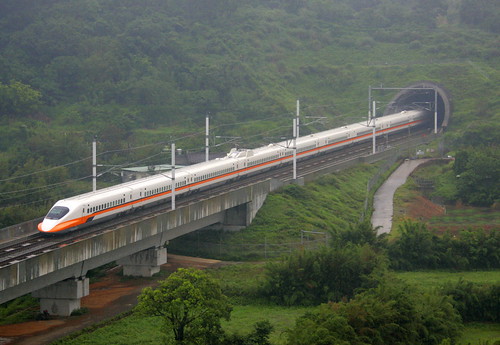
The issue of a high speed rail line down the east coast of Australia has recently been raised by each of the 4 major political parties as a potential solution to Australia's need to reduce greenhouse gas emissions, reduce road congestion, promote regional development and cater for a population that is expected to increase to 36 million people by 2050. As a step towards an electrified transport system it would also help as a peak oil mitigation measure, though this aspect only tends to get mentioned by the Greens.

Infrastructure Partnerships Australia and AECOM recently released a report (pdf) urging the federal government to identity new rail routes and then buy land or put in place planning protections to ensure future land price rises don't make a high-speed rail network a prohibitive option in future (the study indicates the likely land corridor is valued at $13.7 billion at today's prices but will expand to $57 billion by 2030).

The report won praise in editorials in the Fairfax press, with The Age opining "Whenever the inaugural service glides along its 180-minute path from Melbourne to Sydney and on to Brisbane, it will be worth the time and investment. For too long, rail has been treated as a second-class method of passenger transport, with scant attention paid to its energy efficiency and seamless ability to link city centres. It is time to make it a reality.".

The report took eight months to produce and outlines an indicative corridor where the stations could be located (but suggests that engineering studies would be required to determine the exact location of new routes). It recommends the corridor be built incrementally and shared with different types of infrastructure such as water, electricity and the NBN (national broadband network) to make it financially viable.


The study notes a high-speed rail network allowing a 10-minute trip between Sydney and Campbelltown and a 50 minute trip from Sydney to Canberra would avoid the $15 billion cost of developing a second Sydney airport if construction begins within 5 years, helping the overall economics of the project, as traffic on the Sydney-Melbourne and Sydney-Brisbane routes could be offloaded. The report says "Travelling between Sydney and Melbourne - currently the third busiest air corridor in the world - could be reduced to less than three hours, showing the exciting capability of fast rail to relieve the pressure on this route".

High Speed Rail As An Election Issue

The recent federal election saw the campaign launch for The Greens party included a promise to use their likely balance of power in the Senate to urge the government to reconsider a high-speed rail link along Australia's east coast, pointing to a new poll showing 74 per cent of people favour the idea.

The Greens are demanding a new $10 million study into the feasibility of a high-speed rail link connecting Melbourne to Brisbane.

The Labor party followed up shortly afterwards with their own announcement of a feasibility study, promising $20 million for a study that primarily focuses on an initial link between Sydney and Newcastle.


There was some cynicism expressed about the Labor announcement, with commenters noting the endless link of announced but never built rail projects for NSW, and the fact that the Rudd government announced in 2008 that a Very Fast Train for the Sydney-Melbourne corridor, estimated to cost AUD$25 billion, was the government's highest infrastructure priority (only to fall silent on the subject for the rest of their term in office, up until this announcement).

Not to be outdone on the nation building front, the coalition decided to announce their own backflip on the issue, calling for a report into high speed rail in response to those of the Greens and Labor, with Nationals leader Warren Truss announcing in waishy-washy fashion "In government the coalition will build upon this study to consider the viability of possible passenger routes along Australia's east coast between Melbourne, Canberra, Sydney and Brisbane".

Benefits

The Greens are claiming the following benefits for high speed rail, noting it reduces both oil dependence and greenhouse gas emissions :
1. Provides accessible fast, reliable, ecologically sustainable transport for the 75% of Australia’s population that live on or near the east coast

Travel between Melbourne or Brisbane and Sydney would take about four hours (with comfortable seats, phone and internet access).

2. Helps to reduce transport emissions and dependence on oil

HSR can and should be electric. This means much lower greenhouse gas emissions and unlike air travel, the cost of train travel would be immune from inevitable and inexorable increases in oil prices. It also means that as renewable electricity displaces coal and gas derived electricity, greenhouse gas emissions from transport can be further drastically reduced. To hasten this process the Greens support increasing the Renewable Energy Target by an amount equivalent to the HSR’s electricity demand.

3. Removes congestion and improves transport safety

The Melbourne-Sydney flight route is the fourth busiest in the world and business as usual projections anticipate high growth until at least 2020. The Pacific Highway between Brisbane and Sydney and the Hume and Princes Highways between Melbourne and Sydney have long standing reputations for being hazardous and accident prone, with heavy traffic congestion, which increases the risk of accidents.

4. Basis for future regional development

By reducing transport times relative to road-based transport, an HSR could open up new development opportunities along the route.

5. Opportunities for freight

In most instances traditional slower trains are likely to be the most cost-effective option for rail freight, however, there may be opportunities to use High Speed Rail for some urgent high value freight, such as mail.

6. Job creation

A High Speed Rail network would create a significant number of jobs during the construction phase as well as a smaller number of ongoing positions. During its peak construction period, the Adelaide to Darwin railway employed 1500 people. A larger number of people would likely be required for the construction of a HSR because there would be two tracks built to a much higher engineering standard.

Costs

The Greens are claiming the following costs for the proposal:
• For track work – a range of around $40 billion (inflated to 2008 figures) for a full double track the entire length. Savings could be made by partial use of single track – with variations in the range of -10% to +30%.The report noted that these estimates are in the lower half of international costs on a per kilometre basis.

• For rolling stock – estimate cost of a 400 seat train set around $50 to $120 million (2008 figures). These costs are for passenger stock, and not freight cars, which we could expect to be lower in costs.

• Operating costs assessed on average of about 7-9 cents (2008 figures) per passenger per kilometre.

The Department of Infrastructure and Transport notes that 2 previous studies (other than the recent AECOM/IPA report) have been conducted into high speed rail links for the east coast, however the earlier studies couldn't show the projects proposed to be "commercially viable" at the time (and continue to be used for ammunition by critics of high speed rail schemes).
The East Coast Very High Speed Train Scoping Study

A scoping study was commissioned by the Government in December 2000 to conduct a comprehensive examination of options for an East Coast very high speed train network connecting Brisbane, Sydney, Canberra and Melbourne with major regional centers along the way. The Study's Final Report was released in 2002 [PDFPDF: 41942 KB ].

Further information about this study can be found in the Executive Summary for the East Coast Very High Speed Train Scoping Study.

High Speed Rail: Strategic Information for an Australian Context

In 2009, the Cooperative Research Centre (CRC) for Rail Innovation commissioned a study to synthesis the current knowledge of High Speed Rail in the Australian context and to provide directions for further investigation. This report was released on 13 January 2010, and can be accessed on the CRC for Rail Innovation's website.

BHP Boss: Time For A Carbon Tax  

Posted by Big Gav in , , , ,

The SMH has an article on a recent speech by BHP CEO Marius Kloppers, calling for a carbon tax to be introduced to Australia - BHP boss dumps on future of coal.

THE world's largest miner, BHP Billiton, has weighed into the climate change debate, warning that Australia should ''look beyond coal'' and towards other energy sources.

The chief executive of BHP, Marius Kloppers, said Australia's economy will suffer if it does not significantly reduce its carbon emissions in anticipation of a global carbon price. ''Failure to do so will place us at a competitive disadvantage in a future where carbon is priced globally,'' he said.

BHP is one of the world's largest producers of thermal coal, which made up about 8 per cent of its revenue last year. And while BHP and the broader mining industry have acknowledged the need for action on climate change, Mr Kloppers is now calling for Australia to take a lead on the issue. ...

Mr Kloppers stressed the need for a clear price signal on carbon emissions and recommended a combination of a carbon tax, land use actions and a limited emissions trading system, which could apply to electricity generators. He said Australia's energy production was particularly carbon intensive and the highest among OECD countries in terms of tonnes of carbon emitted per unit of energy. Coal-fired power stations account for almost half of the country's emissions.

''Australia will need to look beyond just coal towards the full spectrum of available energy solutions,'' he said.

The Business Spectator also has a look at the Kloppers speech - Kloppers' big call.
There can be no doubting now that a carbon price is back on the political agenda. Big business – or, more to the point, the biggest business – has spoken, and there is now no hiding from the issue.

BHP Billiton CEO Marius Kloppers certainly made a dramatic intervention into the debate. He took three three pillars of the fossil fuel lobby’s defence of the status quo and threw them out the door. He didn’t just skirt around their Maginot Line, he ploughed straight through it. And he’s challenged the nation’s politicians to do something about it.

The three key elements from Kloppers speech was that it was clear that Australia did need to take strong action to reduce its emissions, it needed to look beyond coal and towards other energy sources, and it needed to do so to protect its international competitiveness.

The need for global action on climate change is not, apparently, just a left-wing conspiracy. And it is now, once again, a front page issue.

More from the Business Spectator - Kloppers outflanks the pollies on carbon.
News that BHP Billiton wants Australia to be a first-mover in imposing a carbon tax serves to underline the policy overlap that exists between the Greens, independents and a large part of corporate Australia – the desire to begin reducing carbon emissions sooner rather than later – but it also highlights the highly disparate levels of trust they have for market mechanisms to do the job. ...

Kloppers has outflanked both Labor and the Coalition with this announcement, pointing out that the major parties have been too timid on this issue: "If we get a global price for carbon and we have got a carbon-intensive generation centre, companies like BHP Billiton that consume the energy will eventually lose their competitiveness because it will pay a higher price for its energy.''

Taking stock of climate change — what now?  

Posted by Big Gav in , , ,

Bernard Keane from Crikey can sense a shift in momentum towards a carbon tax in Australia (something I've held for many years is a better option than an emissions trading scheme) - Taking stock of climate change — what now?.

The removal of Penny Wong from the climate change portfolio in favour of Greg Combet provides an opportunity to take stock of where we’re at on climate change and what should be the Government’s priority.

Opinion is undoubtedly swinging away from an emissions trading scheme toward a carbon tax, and it’s been happening both among progressive economists like John Quiggin and right-wing commentators like Michael Stutchbury. A similar change is going on within Cabinet, although the conversion isn’t yet complete. A carbon tax isn’t as elegant and economically pure as an emissions trading scheme, and not as efficient, but the original debate omitted the simple reality that politicians — or certainly the politicians we now have — can’t be relied upon to develop a complex policy without allowing every rentseeker in the country to defile it.

In short, a relatively simple carbon tax is superior to a badly designed ETS (exhibit #1, the CPRS), particularly if it applies to imports but not to exports, at a stroke removing much of the potential for whingeing from trade-exposed industries.

But where does a carbon tax — or even a revised CPRS stripped of its decades of handouts to polluters — fit within overall climate change policy?

The Rudd Government’s climate change policy was two-fold: implement its election commitment to establish an ETS (and increase the mandatory renewable energy target) and use climate change in the same way that Labor had used it before the 2007 election, to wedge the Coalition.

Its implementation of the ETS commitment was, initially, excellent — Ross Garnaut was engaged to prepare a comprehensive report on climate change, identify appropriate emissions targets and how best to achieve them. There was a Green Paper and White Paper process conducted by the Government to develop its ETS model. Wong’s technocratic air seemed to suit the process. But at that point, the interests of climate change action would have best been served by Kevin Rudd and Wayne Swan being mysteriously replaced by John Howard and Peter Costello — specifically, the second-term versions of both.

It was Howard and Costello’s skill and patience in resisting demands from rentseekers and special interests in relation to the GST that was needed in the face of demands from whingeing industries like the miners. Instead, Rudd and his Cabinet caved in — pre-emptively caved in on some issues, then caved in again later as the rentseekers sniffed blood and came to Canberra for a killing.

The relentless use of climate change as a political weapon also went well, with Brendan Nelson and then Malcolm Turnbull having to deal with a hopelessly divided party on the issue. But that, too, ended up going poorly. Tony Abbott may be a global cooling advocate who can barely maintain the fiction of “giving the planet the benefit of the doubt” for more than five seconds, but there was great justice in how he turned climate change back on Kevin Rudd. Penny Wong’s complete lack of political touch and robotic adherence to the Government line and talking points didn’t help the Government’s apparent helplessness in the face of the bad man yelling “great big new tax.”

Now there’s no commitment to an ETS, just a vague, years-long commitment to a carbon price, with the hung Parliament having delivered, via Christine Milne, an intra-Parliamentary mechanism for developing a model, with external “expert” input, including potentially from business.

That mechanism could progress things by developing a wide-ranging consensus on a model across parts of the political spectrum, economists, business representatives and unions, which Greg Combet is well-credentialled to facilitate. But it may not deliver anything of the sort, and more to the point it won’t obviate the need, at some point, for a political leader to demonstrate something approaching courage.

It thus might serve to take a step back and understand exactly what it is Australia should do on climate change.

Much of the debate around climate change is still skewed by the assumption that what we do matters; that, faced with say the slow drying up of the Murray-Darling Basin, we can control our fate by cutting our own emissions.

As the recalcitrants like to note, we only account for a tiny part of the world’s emissions. In climate change terms, we are a mendicant state. Our future is heavily dependent on the actions of the world’s biggest economies. As a country that will be more exposed, and more quickly exposed, to the impacts of climate change the highest priority is any sort of effective international regime that will reduce the growth in emissions, with the aim of stabilising carbon levels. ...

New Australian Government Formed  

Posted by Big Gav in

Crikey reports 2 of the 3 country independents have joined Labor, the Greens and Tasmanian independent Andrew Wilkie to form a new (likely much greener) Australian government - Labor to rule: Oakeshott, Windsor back Gillard.

Julia Gillard will cling to power by the narrowest possible margin after the independents Rob Oakeshott and Tony Windsor opted to back Labor, giving her 76 votes, after Bob Katter backed the Coalition earlier this afternoon.

The price of power is a substantial regional development package and an as-yet-unspecified role for Oakeshott, who says he is contemplating an offer — presumably from Gillard — for a role either as speaker or minister in the new government.

The two independents emphasised the importance of the government’s national broadband network project, in particular, and stability offered in both the House of Representatives and the Senate following Labor’s deals with the Greens and independent Andrew Wilkie last week. They also indicated the importance of Labor seeming to be the party more likely to commit to a full parliamentary term.

Windsor announced his decision first, specifying the importance of the NBN, and calling for country voters to seize this moment of relative strength to try to change the focus of a two-party system that Windsor said was performing poorly and not serving rural communities.

Oakeshott then followed with a long speech that tested the nerves of the attending journalists as he outlined the reasoning behind his decision, which he eventually announced was to support Labor. He also mentioned the importance of broadband, but also stressed the importance of regional and rural education, and specifically criticised the Coalition’s plan to cut funding to the school laptops program.

The decision brings to a close a dramatic post-election period of hung parliament in which both sides have courted the independents in a desperate bid to secure minority government. In the end, it appears that Kevin Rudd’s legacy was crucial to getting his assassin and successor Julia Gillard over the line.

Australia entering a new political dimension ?  

Posted by Big Gav in

Guy Rundle at Crikey has a few wrods about the negotiations around the formation of a new Australian government, amidst howling from the media establishment about the disruption to their beloved 2 party system - We're entering a new dimension here, people .

The 2010 election result has offered that rarest and most blessed of things, a rupture and a discontinuity in the process. It's one that makes it impossible to sell the line that the parliamentary electoral system we are ruled by has some deep-seated pole of wisdom that somehow expresses rather than imposes a political form. What the result is making clear to people is the inherent arbitrariness of the system, its closed nature, and the way in which that is obscured when a party is elected with an unchallengeable majority.

The difficulty for the business as usual crowd, is that they spend so much time celebrating the virtues of the single member electorate system, that when it throws up a number of actual single members, they can't damn it out of hand.

And when such members begin to suggest that the process by which they were chosen could be reflexively acted on by both MPs and the public, the business-as-usual crowd panic about stability. Weird, isn't it? Post-election Iraq has been without a government for several months, with no working coalition in sight, and this is an example of democracy at work. Australia has a few days or weeks with no majority party but a process of rational and open negotiation, and it's a disaster.

What has happened in Australia, in little more than the wink of an eye, is that the political question has been pushed into an entirely new dimension. Ever since the 1970s the economic question has lain moribund as a major political division, no matter what lip service is paid to the gulf separating etc etc, and the occasional flashpoint such as WorkChoices.

The political question who leads, how and through what institutions has barely been regarded as political at all, or cynically manipulated, as in Howard's handling of the Republic debate.

The virtual stasis of both these questions is one reason why so much political energy flows into cultural questions and why culture wars become the dominant mode of struggle.

Once an interruption such as the 2010 election makes it impossible for that stasis to be maintained, the energy flows back into the political question, and real change can be imagined by all except those whose job depends on nothing changing ever, ie the mainstream commentariat.

Once that happens, the left/right divisions based overwhelmingly on the economic (and social-cultural) question cease to be of primary importance, and there is the possibility of new processes, and new flows which make provisional blocs in different ways. It's the most imaginative solutions that become the most possible.

Thus, why should we not consider Rob Oakeshott's idea of a multi-party cabinet? Why is Dennis Shanalamadingdong's idea of a whole new election the 'sensible' idea, while Oakeshott's idea that the people who actually have been elected form a government seen as the whacky one? The Constitution recognises parliament, the GG as head-of-state, and her/his appointed ministers as government. It has nothing to say about prime ministers or parties.

So Shanahan's suggestion is that the system has failed because it worked.

What's happened in this election is that the process of parliamentary electoral politics which is minimally democratic and the party-based politics of interests, which isn't democratic in the slightest, have come into contradiction, in a situation where the system usually silently serves the interests. The profound cynicism and mild fear of the commentariat have caused them to back the interests against the system.

The process has left many people high and dry, desperate to catch up. Thus Paul Kelly, who disguises his cynical anti-democratic power elitism by sporadic attacks on cultural elites, is desperate for a cozy party system that can be nagged to impose a yet more neoliberal agenda, against the oft-expressed wishes of the mass of the Australian people.

The fetishisation of 'stability', as if the country was Bosnia-Herzegovina one heartbeat away from a shooting war, is a con. If we are so pusillanimous as to entirely subordinate our political process to the flickering of the global markets, then we may as well let Goldman Sachs choose the government.

Stability is the very achievement that allows a country the luxury of uncertainty, when isolated outbreaks of actual public will throw up an ensemble capable of creating a new situation. I'm under no illusion that the rural independents are about to put the whole constitution and political apparatus into play. But they don't need to.

The mere process over the last three days has done more to make visible the invisible structures of power, and their potential (if not straightforward) transformability, than a hundred civics lessons. Other gains, such as an increased role for private members bills, would serve to bang the wedge a little further into the old tree dead.

Stability is not the issue, nor is it the danger. The danger is a politics so deadened that only the most demented and monomaniacal, the Feeneys, Shortens, and Bitars, can stand it, and everyone else retires to their private lives. The more the commentariat shriek in fear, the more interesting the ride.

The independents and minor parties should push this process until the rivets are popping.

What does the hung parliament mean for climate policy ?  

Posted by Big Gav in ,

In the continuing uncertainty about who the new Australian government will be, I quite enjoyed this interview on Lateline with Rob Oakeshott - one of the 3 independent rural populists who seem likely to decide who gets to govern.

While Bob Windsor seems to just be a saner and nicer version of your typical National Party MP (albeit one with a seething hatred of Barnaby Joyce) and Bob Katter looks as mad as a hatter, Oakeshott seemed to be a pretty nice guy - and far more moderate on social issues than you'd expect from a country MP, saying he wanted both a carbon price and better treatment for refugees, amongst other things.

He named two major influences during the interview - the first was the last minister in Australia to be found guilty of heresy, the other South African activist Steve Biko. Clearly rural politics have changed over the years !

The Climate Spectator has a trio of article looking at the election result and the impact on climate policy. The first, from Giles Parkinson : Farm Force.

Australia may have a New Zealand-style emissions trading scheme – centred around agriculture – quicker than anyone might have expected before the election.

It is just one of the fascinating scenarios being painted by observers and analysts as the trio of country, or “populist agrarian”, independents prepare to begin negotiations with the mainstream political parties.

The very idea of an ETS, in any form, seemed inconceivable last Friday. But one focused on agriculture, and possibly the energy industry, could be a deal-maker, along with the broadband network.

The great irony of this would be that agriculture was excluded from the ill-fated CPRS because the leading farming bodies couldn’t get their mind around the matter.

But what has made a change entirely conceivable is the huge popularity of the recently introduced ETS among the farming community in New Zealand, and a wholesale change of attitude in the US.

This has been accompanied by a growing appreciation in Australia – including among the three independents in question – that a carbon trading scheme could provide enormous opportunities for farmers.

For the past several weeks, New Zealand government ministers and bureaucrats have barely missed an opportunity to trumpet the positive reception to that country’s ETS. The decline in forestry plantings has been dramatically reversed, and farmers are finding new and profitable uses for marginal lands, particularly those that have steep, erosion-prone and largely unproductive land.

Bloomberg reported late last week that New Zealand’s sheep farmers are flocking to a government carbon trading program because some of them are finding that it pays more to plant trees than sell wool and mutton.

“The New Zealand experience shows that bringing in an ETS could be very positive,” says Anthony Hobley, the head of climate change practice at legal firm Norton Rose. Hobley says that, while the US legislation didn’t get up, the idea of an ETS was receiving positive support from the agricultural community because of the way that it was designed.

One of the three country independents, Rob Oakeshott, made it clear yesterday that re-engaging the mainstream parties on the subject of an ETS would be one of his biggest priorities. The other two are likely to be sympathetic if it can be skewed in favour of their rural constituencies.

“The independents, on balance, seem to support action on climate change,” Deutsche Bank analyst Tim Jordan wrote in a report on Monday. He says an ETS could be accelerated, particularly under a minority Labor government. ...

An agricultural-based scheme would be relatively simple – at least compared to Labor's CPRS – and simplicity and clarity is key if a carbon price is to successfully introduced.

To make any sense at all, any ETS would need to include at least an energy-based carbon price, as either a tax or a market-based scheme. But that should not be too controversial, because it is now well accepted that the tens of billions of investment so desperately needed in the sector cannot be made without it.

In the energy industry, no one pretends that a carbon price of some sort will not emerge at some point: better for all to deal with it now.

The Greens, however, will be in a position from next July to demand less indulgence towards the heavy emitters than was offered in the CPRS, and might be convinced to allow a staged introduction – with mechanisms to bring in a softer tax-based scheme in other sectors over time – if that was the case. That is the sort of hybrid scheme that was entertained by US Congress before it was all put in the too-hard basket so close to the mid-term elections.

The influence of the country politicians, and their ability to guide the debate towards the substantive issues, rather than rhetoric, could provide a surprising and unique opportunity to develop good policy. That is the attraction of an influential third force.

The next : Whn push comes to shove.
If Labor ends up in coalition this time – which I think is most likely because otherwise the Senate becomes very difficult – the path is clear. Their best hope to turn things around will be to work with the independents and the Greens to fashion a sensible climate strategy.

The independents will most likely ensure this strategy is reasonably centrist and good for regional Australia, with renewables and agriculture being key focus areas. The Greens will ensure that the policy cuts CO2 emissions by 2020, a key result missing from the CPRS.

It is very hard to imagine Labor wanting to go the next election looking so incredibly lame on this issue again, especially given all the indications are the issue will build globally in this time frame.

If the Liberals end up in government, they are going to have a difficult time in the Senate, even if they can hold the lower house together. Accordingly, fashioning stronger climate action could become critical strategy to get the Greens on side on other issues. We might even see a Really Small New Tax! I look forward to the spin on that one.

Either way, the result should be very interesting. Who would have thought an election fought on climate change between Tweedle Don’t Now and Tweedle Don’t Ever would actually result in us doing something soon. A week is indeed a long time in politics.

And finally : Sowing seeds of change.
Given the results of this weekend's federal election, it is now likely that the whole of the Australian economy is going to suffer the same indecision and paralysis that members of the renewable energy community have been suffering for the last three years.

If anyone thinks that a hung parliament is going to be beneficial to Australia, they should think again. The clean energy industry has been crippled by indecision. With a selection of independents controlling the lower house and the Greens in control in the upper house, one can only suspect that this indecision is going to last considerably longer.

If Tony Abbott or Julia Gillard are to seriously consider forming a stable government they need to reach agreement with the Greens on a responsible policy to tackle climate change. It's already looking like support will come from Oakeshott, Bandt and the Greens. (Malcom Turnbull might even cross the floor to get the job done).

The type of policy could simply be a circular carbon tax with border controls (a tariff on carbon-intensive imports). I'm sure anything with border controls would excite Bob Katter, and a circular tax – where the revenue raised is returned to individuals – could not be classified as a 'great big tax' by Mr Abbott.

The independents should also be attracted by a leader that undertakes the necessary action to commence dealing with climate change in a way that benefits the farming sector.

Australian Election results In Hung Parliament  

Posted by Big Gav in

I found myself quite pleased with the hung parliament that resulted from the Australian election over the weekend. The Greens have the balance of power in the Senate (a good thing) and whichever party forms government will have to do so with the support of a bunch of rural populist independents and/or The Greens first lower house member Adam Bandt and (possibly) disgruntled ex-intelligence analyst Andrew Wilkie, who quit the ONA over the Iraq war.

Crikey's Guy Rundle had some notes on the possibility for some change to emerge as a result of the election result - You call this democracy? It’s time to start again.

Is it possible that any such result on Saturday will not be treated with the equanimity of earlier times? After all, from 1966 to 1996 we had a political culture that was bipartisan on a general notion of liberal progressivism. Whatever the differences, we were moving forward as a pluralist, liberal democratic society with a progressively more tolerant and humane public sphere.

Howard’s victory coincided with, and was in part a product of, the destruction of such a polity by the rapid advance of globalised capitalism. As social connection and solidarity was clobbered and fractured at the base economic level, conservatives presented a counterfeit social unity, based on formulaic patriotism and an unending series of enemies: the ‘politically correct’, the ‘elites’, and of course Muslims.

Thus a lot of the divisions between the party’s social bases are entirely imaginary — based around phantom fears of people in boats, the ‘fragility’ of Western civilisation, the godlessness of the elites, etc. But they are nevertheless more deeply felt as divisions of identity than were the real class divisions of an earlier era.

So, how will Labor’s core supporters, both working-class and ‘cultural producer’ class, feel if Tony Abbott has a free-ish hand (subject to Senate composition) to impose his vision on an Australian people, when he’d been rejected by a clear majority of them? And how will the Coalition base feel if they’re being ruled by an atheist, childless, shacked-up, etc w-w-w-woman, when a majority of Australians chose the most personally conservative prime ministerial candidate in our recent history?

I’m sure that collectively the power elite across the major parties, the media, and monopoly capital, would do their best to dampen down any public protest against a result that reveals the Australian system as a process of turn-taking by two major parties that are quasi-state apparatuses, maintained by compulsory voting, exhaustive preferences and public electoral funding matched to voting numbers.

But a ‘thwarted-majority’ vote would give Australians its best opportunity for years to outflank them, and start a genuine popular movement that puts the structure and content of the Australian political system on the table.

Such a movement could found itself on the cornerstone of the government’s lack of legitimacy. Instead of campaigning on a specific programme of change, it could campaign on the proposal for a process of public conversations similar to the 1890s movement that led to federation, and the particular constitutional form it took.

Such conventions — the genuine form of public debate for which Rudd and Gillard’s 2020s and ‘citizens assemblies’ are the elite counterfeit — could take in everything from the future of the federal system to voting systems in both houses, compulsory voting, different public funding models or none at all, separation of the executive from the legislative (and a consequent republic), media funding to ensure a pluralism of information sources, and a redrafting of the constitution.

The important point about such a campaign would be to emphasise the process of re-opening the Australian political system to conscious and reflective reconstruction, not to specify any specific formulation for change. That would create the opportunity to build a larger movement bridging people on left and right who believe the whole system to be desperately in need of change even if they worked in separate groups.

It’s vital to pop this pathetic Australian self-delusion that we are somehow good at democracy now, because we were at the forefront of it once. We’ve traded on that complacency for so long that it has become a fatal barrier to seeing the truth: the lower-house triple lock (compulsion, preferences, public funding), state powers and oligopolistic media power gives us one of the least effective manifestations of actually existing democracy in the West.

If you doubt this, imagine it elsewhere. Imagine, say, in the 1970s, a canny East European country had decided to channel dissident demands by creating a two-party state, instead of one. Thus, the Communist Party would be opposed by the Workers Party, both sharing the same economic philosophy, with some variations of emphasis and technique, the same foreign policy, and entertaining some differences on cultural policies, etc. Voting was compulsory, only those parties appear on the ballot, and each party then receives an allocation of funds for maintaining itself based on what split of the vote it got every three years. The media consists of a state broadcaster, and two quasi-state combines, whose minor differences mirror those of the official parties.

Yes, it is not the same as our system. But nor is it that different either in terms of outcome, and in terms of its ability to legitimate itself. “Look,” the oligarchs would say, “we combine political contestation with stability. We simply require that citizens fulfil their obligations and vote for one of the two parties, whose ongoing popularity surely suggests that they be supported by the public.”

Should the opportunity to throw this system, East Germany of the Pacific, into question at this poll maybe, just maybe, the mass of largely directionless left-liberals, Monthlyites, blogging libertarian hobbyists, ARM refugees, nu-skool ex-Eurocommunist social democrats, rural populists and the like will bestir themselves to a concerted politics that has a chance of real change.

For anyone interested in an Australia that is not only less undemocratic, but where energy flows between the political and social realm more effectively, there is now no other recourse, but to a civic politics focused on the system itself, rather than expressed through the parties (aside from the Greens, which remain the only genuine political movement standing).

But I can’t see this happening without some critical event that throws the legitimacy of the system into question for many people as a top-down movement. Like the ARM, it wouldn’t work. Nor could it be based merely within left-liberalism. It would have to make a genuine common cause with sections of the right, or simply with angry mass groups who see themselves as battlers, ordinary Aussies, blahblahblah, who (quite accurately) feel they are in no meaningful sense enfranchised.

As has become clear to most people in this dog of an election, the problem now lies not with the policies and intent of either party, but with the deep structural problems that disconnect social energy from political process and thus transform that energy into cynical anti-politics. The best result will be no clear result, and the possibility for new directions that may create.

Abbott's willful refusal to buy into global warming  

Posted by Big Gav in , , ,

Crikey's Bernard Keane has some comments on the low profile of global warming policy in the Australian election campaign - At least Abbott's honest about willful refusal to buy into global warming.

No person who seriously maintains that “the various measuring organisations” show that the planet is cooling is fit to occupy a position of leadership in public life. Such a capacity to let ideology filter out basic facts on anything, but most especially a critical area of public policy; such a willingness to balance, say Christopher Monckton and the world’s scientific community and prefer the former, is genuinely dangerous in anyone with proximity to power.

Tony Abbott maintains that his own views don’t matter because his policy is to reduce Australia’s emissions. Putting aside that therefore Abbott appears to want to accelerate global cooling, his policy – that relies on the supernatural powers of “soil carbon”, which at this point is little more than the climate change equivalent of biodynamic farming -- will oversee a substantial increase in our emissions and, better yet, spend billions of dollars of taxpayers’ money to achieve it.

Then again, at least Abbott is being honest – he is open about his willful refusal to accept basic scientific fact and prefer global conspiracy theories and rigid ideology. What is Julia Gillard’s excuse? The Prime Minister occupies an even worse position – she claims to believe in human-caused global warming, and accepts the need to address it, but proposes delay and half-baked measures drawn up to protect the interests of those responsible for pollution. Like Abbott, Gillard’s policies will oversee a rise in Australia’s emissions. Like Abbott, she’ll waste taxpayers’ money to achieve it.

The parties insist there are vast differences between them on climate change. The Liberals charge that Labor wants to introduce a big new tax. Labor charges that the Liberals don’t believe in climate change. The rhetoric hides a bipartisan policy of protecting the economic interests of polluters, which is why climate change has been almost entirely absent from the major parties’ campaigns.

Perhaps we should take the parties at their word and demand that the next debate should be held on climate change and the reform process of ending our addiction to carbon, not a debate about the economy that will merely provide the forum for repetition of the mantras of “risk to our $1.3 triliion economy” and “waste and mismanagement”.

When our kids and our grandkids demand to know why we did nothing while their planet cooked, even when we knew a relatively minor economic reform could have started the process of decarbonising our own economy and encouraged other, bigger polluters to do likewise, we can point to the 2010 election and say “because we let people like Tony Abbott and Julia Gillard run the country."

Farming profits in the rich soils of carbon sequestration  

Posted by Big Gav in , , ,

Crikey's Bernard Keane has a jaundiced look at sequesting soil in carbon (using techniques like biochar) - Farming profits in the rich soils of carbon sequestration.

On Saturday, Labor’s announcement of a “carbon farming initiative” received a cautious reception. “A welcome boost for regional Australians,” the Climate Institute called it, but warned that a carbon price was still necessary. The ACF similarly said the benefits of better land management wouldn’t be realised unless there was a carbon price. The NFF “acknowledged” the announcement, which “recognises that carbon abatement through the agricultural sector is an opportunity that should not be ignored.”

The initiative would be facilitatory – establishing a framework (including a new, unspecified, “independent regulator”) for accrediting carbon sequestration activities such as reafforestation, fertiliser reduction and soil carbon so the permits could be sold domestically or internationally to those who wanted to buy them.

Plainly that assumes that even in the absence of an emissions trading scheme there’ll be companies that want to buy permits. The Government estimates a possible market of $500 million.

It compares to the Coalition’s “direct action” plan, which will primarily depend on paying farmers $8-10 a tonne of CO2-equivalent emissions sequestered through soil carbon activities. The actual cost per tonne, according to independent experts, will be at least 3 times that, meaning the Coalition scheme relies on farmers being willing to spend $12-30 a tonne of their own money.

Soil carbon is the Coalition’s equivalent of Labor’s fixation with CCS. Labor loves CCS because it holds out the illusory promise that we -- and a lot of union members in coal mining communities -- can continue to be dependent on coal, with its consequences for climate change wished away to the bowels of the earth. Like CCS, soil carbon is a promising but unproven suite of technologies that is being treated as a magic cure by politicians too scared to tell voters that addressing climate change will have costs and require behavioural changes. Now Labor wants in on it, too.

There are significant unresolved questions about soil carbon -- whether simpler forms like no-till farming or more complex processes like the production and distribution of biochar. Just how stable carbon is in different types of soil under different conditions is not yet clear. There are problems about measurement, although the CSIRO is working on them. There are OH&S and efficiency issues about distributing biochar, finer varieties of which are susceptible to blowing away. Most problematic of all is that soil carbon isn’t counted under the Kyoto Protocol as a tradeable an emissions offset.

Indeed, Penny Wong was quick to point that out when Malcolm Turnbull first allowed Greg Hunt to base Liberal Party climate policy on it in January 2009. Now she has been spruiking it as a great means of taking action on climate change. Ain’t hypocrisy grand.

If there was an emissions trading scheme, there’d be real demand for agricultural offsets, driving the price up and encouraging farmers to explore sequestration options. But no one has proposed to include agriculture, which in 2008 accounted for 15% of Australia’s emissions, in any trading scheme. This means that any agricultural offsets would not be net of emissions produced by the same farm. That would not even be the case for emissions produced during the creation of the offset. For example, the process of pyrolysis, which produces biochar, would produce significant emissions unless it was powered by renewable energy. A tonne of sequestered emissions might therefore require tens or hundreds of kilos of carbon-equivalent emissions, but they won’t be counted.

Labor’s policy, which doesn’t go far beyond what it agreed with Malcolm Turnbull in negotiations over the CPRS, isn’t as egregious as the Coalition’s, but we’d be wise to be sceptical about both.

The push for the inclusion of agricultural offsets under the Kyoto Protocol has come from developed countries anxious to source offsets from developing countries that they can purchase in order to continue business-as-usual levels of carbon emissions at home. Of course, economic theory says this is the most efficient way to meet a global emissions target – if the cost of offsetting emissions in this manner becomes greater than the cost of decarbonising developed economies, it will drive genuine emissions reductions in developed economies.

But the behaviour of Australian politicians suggests this is less about economic efficiency than finding plausible excuses to delay action to reduce our heavy dependence on coal as long as possible, which is why they put their faith in magic solutions like soil carbon and CCS, when renewable energy technologies are much closer to commercial viability.

Stop beating about the bush and talk about Big Australia  

Posted by Big Gav in , ,

Ross Gittins has an interesting article in the SMH about the debate in Australia about appropriate population levels (noting its interesting the elite are starting to talk about it in public) - Stop beating about the bush and talk about Big Australia.

Something significant has happened in this hollow, populist election campaign: the long-standing bipartisan support for strong population growth - Big Australia - has collapsed. Though both sides imagine they're merely conning the punters, it's hard to see how they'll put Humpty Dumpty together again. Which will be no bad thing.

The original bipartisanship was a kind of conspiracy. The nation's business, economic and political elite has always believed in economic growth and, with it, population growth, meaning it has always believed in high immigration.

Trouble is, stretching back to the origins of the White Australia policy, the public has had its reservations about immigration. Hence the tacit decision of the parties to pursue continuing immigration, but not debate it in front of the children. That's why we've never had a formal population policy. ...

It's true politicians and economists have used the term [sustainability] to mean whatever they've wanted it to mean, but that's why it needs to be held up to the light. I suspect those scientists who argue we're close to the limits of our natural environment's ''carrying capacity'' are right, and the economists' airy argument that technological advance will solve all problems is wrong.

So let's get both sides out of their corners to debate the issue in front of us. We can't continue treating the economy like it exists in splendid isolation from the natural environment. Even when you ignore the environmental consequences, the proposition that population growth makes us better off materially isn't as self-evident as most business people, economists and politicians want us to accept. Business people like high immigration because it gives them an ever-growing market to sell to and profit from. But what's convenient for business is not necessarily good for the economy.

Since self-interest is no crime in conventional economics, the advocates of immigration need to answer the question: what's in it for us? A bigger population undoubtedly leads to a bigger economy (as measured by the nation's production of goods and services, which is also the nation's income), but it leaves people better off in narrow material terms only if it leads to higher national income per person.

So does it? The most recent study by the Productivity Commission found an increase in skilled migration led to only a minor increase in income per person, far less than could be gained from measures to increase the productivity of the workforce.

What's more, it found the gains actually went to the immigrants, leaving the original inhabitants a fraction worse off. So among business people, economists and politicians there is much blind faith in population growth, a belief in growth for its own sake, not because it makes you and me better off.

Why doesn't immigration lead to higher living standards? To shortcut the explanation, because each extra immigrant family requires more capital investment to put them at the same standard as the rest of us: homes to live in, machines to work with, hospitals and schools, public transport and so forth.

Little of that extra physical capital and infrastructure is paid for by the immigrants themselves. The rest is paid for by businesses and, particularly, governments. When the infrastructure is provided, taxes and public debt levels rise. When it isn't provided, the result is declining standards, rising house prices, overcrowding and congestion.

I suspect the punters' heightened resentment of immigration arises from governments' failure to keep up with the housing, transport and other infrastructure needs of the much higher numbers of immigrants in recent years.

This failure is explained partly by the rise of Costelloism - the belief all public debt is bad - but mainly because the federal hand has increased immigration while the state hand has failed to increase housing and infrastructure.

At its best, the message to the elite from the unwashed of the outer suburbs is: if you want more migrants, first get your act together.

Labor Going Nowhere  

Posted by Big Gav in

Guy undle seems to have disappeared from the Crikey staff, with just a lone appearance in the Fairfax press since, looking at the rudderless state of the Labor party - The Gillard transfer.

Ever since various roads to democratic socialism ran into the sand in the 1970s, the entire mainstream political spectrum has been reorganised on a single assumption. Effectively, in the 1980s, the Labor Party handed over the business of shaping the social and cultural frameworks by which we live to the market, and backed its deepest implication - that freedom was best and only expressed as a series of consumer choices.

The idea that there might be other forms of freedom and choice - collective choices around inherently collective enterprises such as the health system or the condition of cities, among others - fell by the wayside. To the naked eye this has occurred in a period of great prosperity within the West. Looked at more closely, one can see the smoke and mirrors. Tax cuts have shifted public development to private consumption - the plasma screen you can afford is the university place your state-educated kid won't get - and the expansion of debt has driven up the cost of living. Thus we have gadgets and petty luxuries early generations only dreamt of, but a home-owning family can barely be supported on a single wage, overtime has become necessary, commuting eats up the day (as unpaid labour), and so on.

Such a way of life is not only a disguised increase in labour and lack of control over one's own life, it is also places consumption at the heart of cultural meaning, and with it a degree of atomisation and isolation. The rather harsh, even vicious, culture we have developed - from border protection to Australian Idol - is one result of that, occurring so gradually that many people do not notice.

True, the process did not pass unnoticed. Paul Keating appears to have realised at some point that opening borders, capital flows etc could ultimately dissolve a country's identity - and came up with an electorally disastrous commitment to high culture and history to answer it. After that, and with the brief interregnum of Mark Latham, Labor spent a decade as an ideas-free zone.

Thus when Rudd came along with his abundant charts and plans for a series of revolutions, it was easy for a desperate party and a coterie of centre-left intellectuals to essentially treat his project as the intellectual renovation of Labor - even though behind the scenes not much had changed. Rudd's revolution, for all its genuine determination to make people's lives better, carried with it the same assumptions - that core economic processes could not be challenged, and that social power could not, and should not, be more widely distributed - except via rarefied elitist models such as the 20/20 summit.

Ruddism thus occupied the empty space in Labor where progressive and liberatory politics should be. When it collapsed, there was nothing of that nature to fill the space - and so the only recourse has been to stuff it with motifs of the Howard era, down to the Prime Minister, Julia Gillard, messing about on navy boats. No doubt this has stemmed the flow towards the Coalition in the polls to some degree. Yet it is a desperate strategy that concedes to the opposition the power to set the terms of the debate. Labor can only fight this way because it never used the victory of 2007 as a starting point to change the terms of the debate. This is something it should have done, not for moral reasons, but for political ones - a progressive and humanist party can never decisively win that sort of contest against a conservative party, since their ideology is merely an elevation of fear and xenophobia to the status of a general principle.

As Prime Minister, Gillard is therefore continuing on with most of what Labor was doing behind the razzmatazz of the Rudd spectacle, of change through elite review and ''implementation''. It is not that she has deserted the subfaction of the Left to which she belongs - it is simply that she has moved with it, as its lack of a gravitational centre, an alternative take on social possibilities, has drawn it remorselessly towards a dead centre. That drift has continued long past the point where even the most gullible person would believe in the cornucopia qualities of the new economy. It is looking more likely that the activist George Soros is right and that all the bubbles that surround us - real estate prices, dotcoms, derivatives - are contained within a ''super bubble'' of Western indebtedness. Indebtedness to the East, to itself, to its future earnings. That civilisation-wide focus on consumption - not merely as an economic driver but as a source of personal meaning - locks parties and governments into a mindset in which left and right have very little meaning in terms of governance.

What happens when that implicit social contract - carry a half million-dollar mortgage, win a TV - can no longer be delivered remains to be seen. But there is no doubt that its acceptance has emptied labour parties of even a vestigial capacity to suggest an alternative. Witness British Labour's current leadership battle, with four identical meat puppet contenders, all outdoing each other denouncing a government they were part of.

Should Labor win the coming poll, it will probably be able to patch itself together to win another. If it loses, it is through the floorboards, and it will stay there for quite some time. Its warlords of the so-called Right and Left have shown no interest in regrounding Labor intellectually and morally and they are now reaping the whirlwind - they have nothing left in the bag of tricks except a pallid Howard imitation.

The hopes that attach to Gillard are a trace memory of the politics Labor once pursued - that there could be some dialogue between party, ideas and people, nostalgia for a period when mainstream politics itself was not in question regarding its ability to address the national and global challenges we face.

Statistics

Locations of visitors to this page

blogspot visitor
Stat Counter

Total Pageviews

Ads

Books

Followers

Blog Archive

Labels

australia (619) global warming (423) solar power (397) peak oil (355) renewable energy (302) electric vehicles (250) wind power (194) ocean energy (165) csp (159) solar thermal power (145) geothermal energy (144) energy storage (142) smart grids (140) oil (139) solar pv (138) tidal power (137) coal seam gas (131) nuclear power (129) china (120) lng (117) iraq (113) geothermal power (112) green buildings (110) natural gas (110) agriculture (91) oil price (80) biofuel (78) wave power (73) smart meters (72) coal (70) uk (69) electricity grid (67) energy efficiency (64) google (58) internet (50) surveillance (50) bicycle (49) big brother (49) shale gas (49) food prices (48) tesla (46) thin film solar (42) biomimicry (40) canada (40) scotland (38) ocean power (37) politics (37) shale oil (37) new zealand (35) air transport (34) algae (34) water (34) arctic ice (33) concentrating solar power (33) saudi arabia (33) queensland (32) california (31) credit crunch (31) bioplastic (30) offshore wind power (30) population (30) cogeneration (28) geoengineering (28) batteries (26) drought (26) resource wars (26) woodside (26) censorship (25) cleantech (25) bruce sterling (24) ctl (23) limits to growth (23) carbon tax (22) economics (22) exxon (22) lithium (22) buckminster fuller (21) distributed manufacturing (21) iraq oil law (21) coal to liquids (20) indonesia (20) origin energy (20) brightsource (19) rail transport (19) ultracapacitor (19) santos (18) ausra (17) collapse (17) electric bikes (17) michael klare (17) atlantis (16) cellulosic ethanol (16) iceland (16) lithium ion batteries (16) mapping (16) ucg (16) bees (15) concentrating solar thermal power (15) ethanol (15) geodynamics (15) psychology (15) al gore (14) brazil (14) bucky fuller (14) carbon emissions (14) fertiliser (14) matthew simmons (14) ambient energy (13) biodiesel (13) investment (13) kenya (13) public transport (13) big oil (12) biochar (12) chile (12) cities (12) desertec (12) internet of things (12) otec (12) texas (12) victoria (12) antarctica (11) cradle to cradle (11) energy policy (11) hybrid car (11) terra preta (11) tinfoil (11) toyota (11) amory lovins (10) fabber (10) gazprom (10) goldman sachs (10) gtl (10) severn estuary (10) volt (10) afghanistan (9) alaska (9) biomass (9) carbon trading (9) distributed generation (9) esolar (9) four day week (9) fuel cells (9) jeremy leggett (9) methane hydrates (9) pge (9) sweden (9) arrow energy (8) bolivia (8) eroei (8) fish (8) floating offshore wind power (8) guerilla gardening (8) linc energy (8) methane (8) nanosolar (8) natural gas pipelines (8) pentland firth (8) saul griffith (8) stirling engine (8) us elections (8) western australia (8) airborne wind turbines (7) bloom energy (7) boeing (7) chp (7) climategate (7) copenhagen (7) scenario planning (7) vinod khosla (7) apocaphilia (6) ceramic fuel cells (6) cigs (6) futurism (6) jatropha (6) nigeria (6) ocean acidification (6) relocalisation (6) somalia (6) t boone pickens (6) local currencies (5) space based solar power (5) varanus island (5) garbage (4) global energy grid (4) kevin kelly (4) low temperature geothermal power (4) oled (4) tim flannery (4) v2g (4) club of rome (3) norman borlaug (2) peak oil portfolio (1)