Deepwater Horizon - The Movie
Posted by Big Gav in bp, deepwater horizon, gom, gulf of mexico, oil
Due out in September apparently.
0
comments »

Posted by Big Gav in bp, deepwater horizon, gom, gulf of mexico, oil
Due out in September apparently.
Posted by Big Gav in bp, gom, gulf of mexico, oil, pollution
TomDispatch has an article on the history of oil pollution around the globe - Ellen Cantarow, Blowback Crude. From Tom's introduction:
I don’t know about you, but when I see a headline like this one (from the July 11th Washington Post), “White House Confident Latest BP Effort Will Work,” my heart immediately sinks. Of course, there’s a first time for everything, but amid the ever worsening news from the Gulf of Mexico’s waters about astonishingly high methane concentrations, dangerous levels of arsenic, the lack of testing of seafood for absorption of toxic compounds from the dispersant BP has been massively pumping out, the National Oceanic and Atmospheric Administration’s “hoarding” of raw scientific data about the disaster, and both BP's and the government's “stranglehold on media access” in the Gulf, that oily undercurrent of a positive narrative has been relentless (even as press coverage slowly begins to drop off). At the end of the storm lies hope and a rainbow. Or at least a permanently sealed well on the floor of the Gulf of Mexico.
Of course, three days after that confident headline, the same government showed something less than confidence in BP. It suddenly moved to freeze that company’s work on closing the new version of “top hat,” the massive "3 ram capping stack" meant to seal off the well, until further testing could be done. Secretary of Energy Stephen Chu and his experts feared that closing the cap’s valves might actually cause even more harm to a possibly already damaged well bore. In the meantime, the oil, essentially cap-less, continued to gush forth, as it had for days, even as work on the first relief well, the supposed permanent solution to the problem, was halted for fear of further problems while the testing went on.
Late Wednesday, the test of the cap finally began, only to be briefly interrupted by the discovery of a leak on a line attached to one of its valves. Everything was again halted briefly before those valves were finally closed and the oil did stop for the first time in 87 days; and yes, in the next few days, for all we know, that seal may hold, or maybe this nightmare won’t really end until the dog days of late July or mid-August, all dates repeatedly promised for the completion of the relief well. Or maybe not then either. The positive story line has been offered up and deep-sixed so many times already that, as with warnings on a cigarette pack, even with good news coming in, caution is still advised. Worse yet, if the happy ending does come, we already have a reasonable hint about how this story works out. As with the Exxon Valdez spill, big oil may prefer to learn remarkably few lessons from this disaster, as it prepares to head into far rougher waters in search of ever tougher oil to extract. After all, the big oil companies have preferred to learn next to nothing, as Ellen Cantarow makes clear, from a 50-year history of disastrous spills in Nigeria and a decades-long version of the same in the Amazon.
And of course, in these last weeks when the Northeast has been sizzling under record temperatures (with more to come), and researchers at the University of Alabama’s Earth System Science Center have concluded that the first five months of 2010 were the second hottest in human history (runner-up only to 1998) -- and this decade the warmest on record for the planet -- the worst disaster may prove to be not the gusher in the Gulf, but the gas in our tanks.
Posted by Big Gav in bp, gom, gulf of mexico, horizon, libya
The SMH reports that BP are claiming a new cap fitted over the leaking Macondo well has is capturing the oil flow - After three months, oil gusher plugged, says BP. The SMH also reports that BP's role in the release of the Lockerbie bomber is being viewed with suspicion in the US as the companmy looks to expand operations in Libya - BP faces grilling over oil deal links to Lockerbie.
Engineers have stopped oil flowing freely into the Gulf of Mexico for the first time in almost three months - but stress tests over the next 48 hours will determine whether the new cap on the deep-sea well will hold.
The chief operating officer of BP, Doug Suttles, was cautiously optimistic. "Clearly, it's encouraging for the first time in 86 days not to see oil gushing out of this well ... But it's way too early to celebrate," he said.
Officials claimed the next two days would be critical as engineers keep a close watch on pressure levels within the well. The new construction includes a containment cap with a built-in "blow-out preventer", the device that failed to cut off the oil flow when the Deepwater Horizon drill rig caught fire after an explosion in April.
BP, the well operator, hopes that pressure levels beneath the cap remain high, indicating there are no leaks beneath the sea bed. Six-hourly tests are planned over the next 48 hours.
The discovery of a new leak would force the company to resume recovering as much oil as possible through lines from the well to vessels on the surface of the Gulf, Coast Guard boss Thad Allen said.
"The number one goal is to shut in the well and kill it and stop it at the source," Admiral Allen told reporters in New Orleans. "This is merely an intermediate step to plugging the hole."
Stopping the oil is a long-awaited milestone in the worst environmental disaster in US history. The well has been spewing between 35,000 and 60,000 barrels of crude a day into the Gulf, according to a US government-led panel of scientists, inundating sensitive coastal habitats and disrupting fishing and tourism across four Gulf states.
The cost of the mishap has been put at several billions of dollars with Louisiana and Mississippi bearing the brunt of the disaster.
Plugging the well for good will depend on relief wells being drilled simultaneously. The first is within 30 metres of intercepting the well, which taps into the rich Macondo oil field, and could be in a position to divert the flow by the end of the month, BP said.

Posted by Big Gav in desalination, gom, gulf of mexico, ocean energy, wave power
CNet has an article on a wave powered desalination device in the Gulf Of Mexico (hopefully it will work even when covered in a coating of BP provided oil) - Wave-powered desalination pump permitted in Gulf.
The waters of the Gulf of Mexico will see a novel offshore platform later this year, one that will use wave power to desalinate water.
Independent Natural Resources, which makes the Seadog water pump, on Wednesday said that it has received a permit for a wave power generation facility off the coast of Freeport, Texas. The company says it's the first to receive a "section 10 permit" from the U.S. Army Corps of Engineers to operate a wave generator in the U.S.
The facility, which the company hopes to put in the water by the end of the year, will be a platform with 18 wave pumps underneath it. Each pump, which is about seven feet in diameter, will send water up through three water wheels connected to a generator. The electricity from the generator will be used to power a standard reverse osmosis desalination machine.
The wave energy generator is larger than Independent Natural Resource's prototype machines which it installed in 2007 but this new facility is sized to operate at commercial scale in Gulf waters. Rather than sell electricity or water, though, operators will be taking data to measure impact on sea life, the generator's performance, and the cost of operation, said Douglas Sandberg, the vice president of the privately funded company.
The platform will be about 150 feet by 75 feet in area and be 1 mile offshore to take advantage of swells. The pumps themselves will work 25 feet below the surface of the water and be able to generate about 60 kilowatts.
The efficiency of the system in converting wave energy to electrical energy is about 22 percent but can get over 50 percent, Sandberg said. Rather than only convert the energy of an incoming wave, the pump also captures some of the potential energy of air movement in the pump, he explained. The electricity generated on board will be used to power the facility and desalinate 3,000 gallons of water a day for testing, although it's capable of doing 20 times that, according to the company.

Posted by Big Gav in bp, gom, gulf of mexico, horizon, matthew simmons, pollution
The SMH reports that BP's "top kill" approach to stopping the Deepwater Horizon leak in the gulf of mexico has failed - BP's gulf well plug fails.
BP's "top kill" operation to plug the ruptured well in the Gulf of Mexico has failed, in a stunning setback to efforts to stem the worst oil spill in US history.
BP and federal authorities are now turning to a new strategy to stop the leak, but it will take at least four to seven days before it can be put in place.
At least 75 million gallons are now estimated to have gushed into the ocean since the disaster unfolded five weeks ago, threatening an environmental and economic catastrophe across hundreds of kilometres of the US Gulf Coast.
"After three full days of attempting 'top kill', we have been unable to overcome the flow from the well, so we now believe it's time to move on to the next of our options," BP Chief Operations Officer Doug Suttles told a news briefing.
Engineers had spent days pumping some 30,000 barrels of heavy drilling fluid into the leaking well head on the ocean floor in a high-pressure bid to smother the gushing crude and ultimately seal the well with cement. ....
The announcement marks the latest failure for BP, which despite a series of high-tech operations over the past month has appeared powerless to bring the disaster to heel since an explosion on the BP-leased Deepwater Horizon oil rig on April 20 that killed eleven workers. The rig sank two days later.
The British energy giant had stressed that "top kill" was the best chance at stopping the leak other than drilling an entirely new relief well, a process that has already begun but is expected to take another two months.

BP said preparations have been made for the possible deployment of the lower marine riser package (LMRP) cap containment system, which would be complex because of the depth of the oil leak.
Deployment would first involve removing the damaged riser from the top of the failed BOP to leave a cleanly-cut pipe at the top of the BOP's LMRP.
The cap, a containment device with a sealing grommet, will be connected to a riser from the Discoverer Enterprise drillship, 5,000 feet above on the surface, and placed over the LMRP with the intention of capturing most of the oil and gas flowing from the well.
Mr Suttles said it should capture "most of the oil" and was expected to last at least four days but "we cannot guarantee success at this time."
In his May 28th interview with Bloomberg's Mark Crumpton and Lori Rothman, Matt Simmons of energy investment bank Simmons & Company, provides some stunning revelations on what is really occurring in the Gulf of Mexico, and proposes that the only effective way to contain the leak is to relieve BP, bring in the military, and do what the Russians have done on comparable occasions, namely explode nuclear weapons within the wellbore. Simmons knows what he is talking about. As Jim Bianco points out: "Matt Simmons gained fame with his book 2005 Twilight in the Desert where he claimed that the Saudis were overstating their oil output because they hit “peak oil.” Right or wrong Simmons claimed the price of oil was going to skyrocket and three years after the book’s release the crude oil hit $147/Barrel.
op Hat, Top Kill, Junk Shot, Hail Mary. I don't know about you but it sure feels like nobody's going to stop this leak. Even BP CEO and chief spinmeister Tony Hayward is lowering expectations. This mess is officially out of control.
"Plug the damn hole"
Presidents don't do impotence -- usually. But while BP pipes spew non-stop on webcams, President Obama reduced to sending Cabinet members to the scene where they hold daily press briefings to explain what BP is (or is not) doing. Should we be surprised then at Obama's "Plug the damn hole" outburst at a recent White House meeting?
In his Washington Post blog Joel Achenbach calls BP the ballerina and the federal government the Stage Mom. But here's an alt analogy: BP is the teen learning to drive and the government is the parent in the front seat. Only he doesn't know how to drive either.
They got nothin'
The speculation in Washington is that if BP can't pull off its "top kill" gambit tomorrow, the White House will need to do something dramatic, like take over.
The feds do have the authority. But what would they do if they took charge of the unstoppable spill? The government's top man in the field, Coast Guard Commandant Thad Allen, flat out concedes that the feds are out of their league-technically-when it comes to plugging the damn hole.
Got any ideas?
Andrew Revkin, in his Dot Earth blog in the New York Times, wants a swat team, of gung-ho geologists and engineers. David Gergen, writing for CNN, wants to rally the country's best and brightest to brainstorm a solution.
Sen. Bill Nelson (D-Fla.) wants to send in the troops. Let the U.S. military take over the cleanup operation.
Screw the army, we want Bruce Willis!
There is one other option out there, a dark option that BP wants nothing to do with. Nuclear weapons. Hey, we're serious here, people! The Soviet Union has used nukes four times in the past to cap leaking oil and gas wells. Sure it sounds crazy, but according to Russian writer Vladimir Lagovsky, the explosion "compresses the rock and squeezes the channel shut."
Of course, resorting to nukes could be a tough call for a Nobel Peace Prize winner, notes Christopher Brownfield, writing in The Daily Beast.... using nuclear weapons, even for peaceful purposes, would be problematic for a president who stood in Prague and declared that the world should rid itself of such devices. If President Obama were to use a nuke to close this well, he would give other states an excuse to seek nuclear weapons of their own.
n September of 1968, Union Oil Company of California, which later became Unocal and is now part of Chevron, erected a drilling platform off the coast near Santa Barbara. Over the next four months, four wells were constructed. Work on a fifth had begun and was proceeding uneventfully until, on January 28, 1969, the new well suffered a blowout. It took ten days’ effort before it was finally plugged, with cement slurry. By the time the flow had stopped completely, an estimated hundred thousand barrels of oil had poured into the Santa Barbara Channel. The slick it created covered eight hundred square miles. The area’s fishing industry was shut down, and pictures of blackened beaches filled the news.
Americans had never seen a spill like this, and they were shocked by it. There were protests—Californians stuck their gasoline credit cards on skewers and lit them on fire—followed by new horrors. In June of 1969, Ohio’s spectacularly polluted Cuyahoga River burst into flame. By the end of the year, Congress had passed the National Environmental Policy Act, known by the acronym NEPA, which requires federal agencies to file impact statements for all actions that could have a significant ecological effect. The following spring, millions of people took to the streets for Earth Day, and by the second anniversary of the spill President Richard Nixon had created the Environmental Protection Agency and signed into law the Clean Air Act.
BP’s Deepwater Horizon spill makes the Santa Barbara spill look like a puddle. By some estimates, the BP spill is spewing as much oil into the Gulf of Mexico each day as the Union well spewed into the Santa Barbara Channel in all, and the BP spill is now in its second month. The news out of the Gulf continues to range from grim to grimmer. Recently, it was revealed that the spill has created an undersea plume of oil ten miles long, and that some of the oil has already entered the loop current and is being carried toward Florida. Then the federal government doubled the area of the Gulf that had been closed to fishing. On Friday, the government increased that area again, to forty-eight thousand square miles. President Barack Obama has called the spill a “massive and potentially unprecedented environmental disaster,” a characterization that, if anything, probably understates the case.
In an immediate sense, the causes of the catastrophe are technical. Apparently, the Deepwater Horizon well was inadequately sealed, and natural gas built up inside it. When workers on the rig tried to activate the well’s blowout preventer, it failed. An attempt to activate the blowout preventer after the fact, using undersea robots, also proved unsuccessful. Another effort to cap the leak, by using what amounted to a hundred-ton steel funnel, flopped as well. Last week, BP finally succeeded in inserting a mile-long tube into the riser leading from the well. The company said that it was capturing a thousand barrels of oil a day, which is what it originally claimed that the well was leaking; nevertheless, crude continued to pour into the Gulf. (In a recent column in the Miami Herald, the author Carl Hiaasen joked that BP’s next move would be to try to seal the well with thousands of tons of instant oatmeal.)
But the real causes of the disaster go, as it were, much deeper. Having consumed most of the world’s readily accessible oil, we are now compelled to look for fuel in ever more remote places, and to extract it in ever riskier and more damaging ways. The Deepwater Horizon well was being drilled in five thousand feet of water, to a total depth of eighteen thousand feet. (By contrast, the Santa Barbara well was drilled in less than two hundred feet of water, to a total depth of thirty-five hundred feet.) While the point of “peak oil” may or may not have been reached, what Michael Klare, a professor at Hampshire College, has dubbed the Age of Tough Oil has clearly begun. This year, the United States’ largest single source of imported oil is expected to be the Canadian tar sands. Oil from the tar sands comes in what is essentially a solid form: it has to be either strip-mined, a process that leaves behind a devastated landscape, or melted out of the earth using vast quantities of natural gas.
Meanwhile, as everyone knows, no matter where oil comes from or how it has been extracted, burning it is destructive: oil combustion accounts for nearly a third of the greenhouse-gas emissions in the United States. A report issued last week by the National Academy of Sciences called on Congress to enact legislation to dramatically reduce greenhouse-gas emissions, by, among other things, “reducing oil use.”
Posted by Big Gav in bp, gom, gulf of mexico, horizon, pollution
The NYT reports that huge columns of oil are floating under the surface of the Gulf of Mexico - Giant Plumes of Oil Forming Under the Gulf.
Scientists are finding enormous oil plumes in the deep waters of the Gulf of Mexico, including one as large as 10 miles long, 3 miles wide and 300 feet thick in spots. The discovery is fresh evidence that the leak from the broken undersea well could be substantially worse than estimates that the government and BP have given.
“There’s a shocking amount of oil in the deep water, relative to what you see in the surface water,” said Samantha Joye, a researcher at the University of Georgia who is involved in one of the first scientific missions to gather details about what is happening in the gulf. “There’s a tremendous amount of oil in multiple layers, three or four or five layers deep in the water column.”
The plumes are depleting the oxygen dissolved in the gulf, worrying scientists, who fear that the oxygen level could eventually fall so low as to kill off much of the sea life near the plumes.
Dr. Joye said the oxygen had already dropped 30 percent near some of the plumes in the month that the broken oil well had been flowing. “If you keep those kinds of rates up, you could draw the oxygen down to very low levels that are dangerous to animals in a couple of months,” she said Saturday. “That is alarming.”
The plumes were discovered by scientists from several universities working aboard the research vessel Pelican, which sailed from Cocodrie, La., on May 3 and has gathered extensive samples and information about the disaster in the gulf.
Scientists studying video of the gushing oil well have tentatively calculated that it could be flowing at a rate of 25,000 to 80,000 barrels of oil a day. The latter figure would be 3.4 million gallons a day. But the government, working from satellite images of the ocean surface, has calculated a flow rate of only 5,000 barrels a day.
BP has resisted entreaties from scientists that they be allowed to use sophisticated instruments at the ocean floor that would give a far more accurate picture of how much oil is really gushing from the well.
“The answer is no to that,” a BP spokesman, Tom Mueller, said on Saturday. “We’re not going to take any extra efforts now to calculate flow there at this point. It’s not relevant to the response effort, and it might even detract from the response effort.”
The undersea plumes may go a long way toward explaining the discrepancy between the flow estimates, suggesting that much of the oil emerging from the well could be lingering far below the sea surface.
The scientists on the Pelican mission, which is backed by the National Oceanic and Atmospheric Administration, the federal agency that monitors the health of the oceans, are not certain why that would be. They say they suspect the heavy use of chemical dispersants, which BP has injected into the stream of oil emerging from the well, may have broken the oil up into droplets too small to rise rapidly.
Posted by Big Gav in bp, gom, gulf of mexico, horizon, pollution
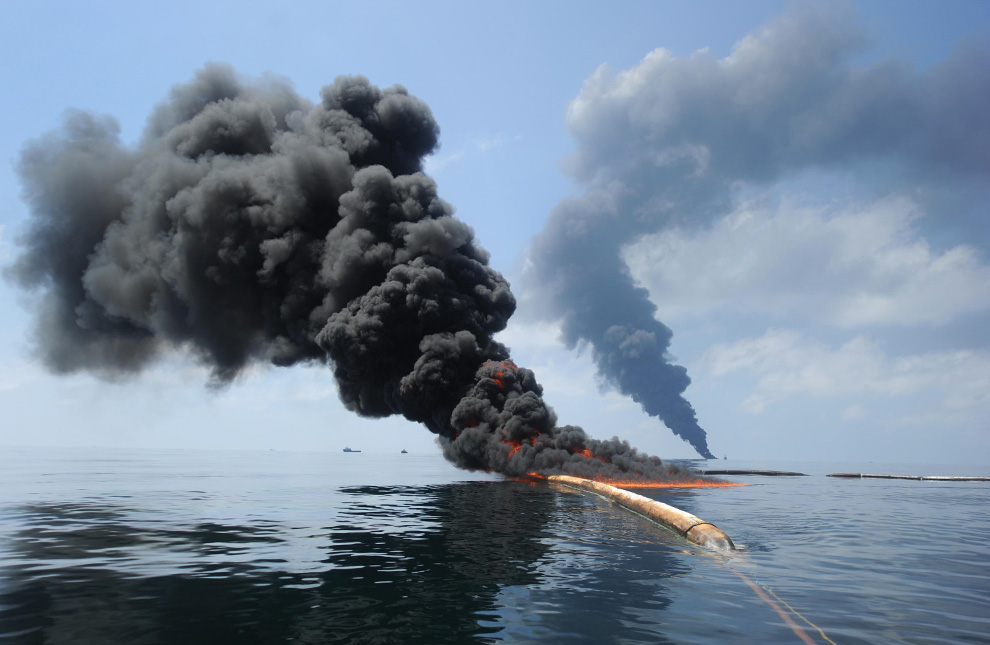
The Boston Globe has a great montage of photos of the oil spill in the gulf of mexico - Disaster unfolds slowly in the Gulf of Mexico.
Posted by Big Gav in bp, gom, gulf of mexico, horizon, pollution, prawns
The Guardian has an interview with BP CEO Tony Hayward, who argues "the Gulf of Mexico is a very big ocean. The amount of volume of oil and dispersant we are putting into it is tiny in relation to the total water volume" - BP boss admits job on the line over Gulf oil spill. Presumably the same line of argument still holds true even when the whole gulf is covered in a foot thick layer of oil - you might even be able to faintly smell the aroma in London by then.
In an bullish interview with the Guardian at BP's crisis centre in Houston, Hayward insisted that the leaked oil and the estimated 400,000 gallons of dispersant that BP has pumped into the sea to try to tackle the slick should be put in context. "The Gulf of Mexico is a very big ocean. The amount of volume of oil and dispersant we are putting into it is tiny in relation to the total water volume," he said. ...
The spill began just over three weeks ago when a buildup of gas erupted from a well being drilled by BP in seabed about 1,500 metres (5,000 ft) below sea level. When the gas ignited at the surface, the explosion sunk the rig, the Deepwater Horizon, and 11 workers were killed.
Hayward promised that BP would "fix" the disaster, which is on course to eclipse the 1989 Exxon Valdez oil spill as the biggest US oil spill in history. "We will fix it. I guarantee it. The only question is we do not know when."
The amount of oil spilling into the Gulf of Mexico is far greater than official estimates suggest, according to an exclusive NPR analysis.
At NPR's request, experts analyzed video that BP released Wednesday. Their findings suggest the BP spill is already far larger than the 1989 Exxon Valdez accident in Alaska, which spilled at least 250,000 barrels of oil.
BP has said repeatedly that there is no reliable way to measure the oil spill in the Gulf of Mexico by looking at the oil gushing out of the pipe. But scientists say there are actually many proven techniques for doing just that.
Steven Wereley, an associate professor of mechanical engineering at Purdue University, analyzed videotape of the seafloor gusher using a technique called particle image velocimetry.
A computer program simply tracks particles and calculates how fast they are moving. Wereley put the BP video of the gusher into his computer. He made a few simple calculations and came up with an astonishing value for the rate of the oil spill: 70,000 barrels a day — much higher than the official estimate of 5,000 barrels a day.
The method is accurate to a degree of plus or minus 20 percent.
Given that uncertainty, the amount of material spewing from the pipe could range from 56,000 barrels to 84,000 barrels a day. It is important to note that it's not all oil. The short video BP released starts out with a shot of methane, but at the end it seems to be mostly oil.
"There's potentially some fluctuation back and forth between methane and oil," Wereley said.
But assuming that the lion's share of the material coming out of the pipe is oil, Wereley's calculations show that the official estimates are too low. "We're talking more than a factor-of-10 difference between what I calculate and the number that's being thrown around," he said.
At least two other calculations support him.
Timothy Crone, an associate research scientist at the Lamont-Doherty Earth Observatory, used another well-accepted method to calculate fluid flows. Crone arrived at a similar figure, but he said he'd like better video from BP before drawing a firm conclusion.
Eugene Chiang, a professor of astrophysics at the University of California, Berkeley, also got a similar answer, using just pencil and paper.
Without even having a sense of scale from the BP video, he correctly deduced that the diameter of the pipe was about 20 inches. And though his calculation is less precise than Wereley's, it is in the same ballpark.
THE oil spill in the Gulf of Mexico has provided the struggling Far Northern prawn fleet with an unexpected boon after the US yesterday lifted a ban on imports.
The deal-clincher, which followed nearly four years of negotiations between the US and the Australian industry, opens the door to a $4.1 billion market, but consumers at home will be forced to pay more.

Just in case you were wondering if it was appropriate to use the phrase “oil spill” to describe the unrelenting seabed gusher in the Macondo prospect 50 miles off the Gulf coast, have a look at the video shot on Tuesday and released today.
There’s more background on the images on The Lede blog, including an explanation of the light and dark variations (resulting from the mix of natural gas and oil).
The video below was shot as the response team lowered the giant containment structure on the main leak. I’ve set the clip to play starting near the end, where you can see the oil boiling up from beneath the walls of the device. In the end, a slush of methane and seawater, called hydrates, clogged the container, putting this idea on the growing scrap heap of solutions.
A cascade of human and mechanical failures likely caused last month's deadly offshore rig explosion and an undersea oil gusher that could be the worst U.S. environmental disaster, according to data gathered by congressional investigators and reviewed by experts. ...
Hours before the explosion, set off by flammable methane gas that surged up the drill pipe, forces were already in motion on the drill deck and beneath the ocean surface that opened the door to catastrophe.
"There was a series of failures -- human and mechanical," said Satish Nagarajaiah, professor in civil and mechanical engineering at Rice University in Houston. "This was the perfect storm."
According to information from BP, Transocean, and rig contractor Halliburton Co gathered by investigators from the House Energy and Commerce Committee, rig workers pressed ahead to put the finishing touches on the well despite potentially alarming test results that signalled a build-up of gas pressure deep in the well's reservoir.
And on the ocean floor, a 450-ton series of valves and pipes called a blowout preventer -- meant to be the last line of defence in the event of a blowout -- was disabled after being significantly modified.
"This catastrophe appears to have been caused by a calamitous series of equipment and operational failures," Representative Henry Waxman, chairman of the committee, said at a hearing on the spill on Wednesday.
Even though most investors have soured on BP, driving down its stock price by 19 percent and wiping out $36.7 billion of its market value since the explosion, the business remains a behemoth. The company has a market value of $152.6 billion, bolstered by a global marketing network, a lucrative oil venture in Russia, a promising contract to boost production in a giant Iraqi field and scores of other large interests. It remains the largest oil producer in the Gulf of Mexico. Measured by revenue or assets, it is among the world's five largest companies.
Citigroup analysts said stockholders' reactions seem "disproportionate to the likely costs to the company." It noted that punitive damages against Exxon for the 1989 Exxon Valdez oil-tanker spill were originally set at $5 billion in 1994 but were reduced on appeal. The company agreed last year to pay less than $1 billion, including interest.
For now, at least, BP's prodigious costs combating the oil spill in the Gulf are outweighed by prodigious profits.
On Monday, BP said it spent $350 million in the first 20 days of the spill response, about $17.5 million a day. It has paid 295 of the 4,700 claims received, for a total of $3.5 million. By contrast, in the first quarter of the year, the London-based oil giant's profits averaged $93 million a day.
The amount of oil leaking into the Gulf of Mexico has been estimated at 5,000 to 25,000 barrels a day. In the first quarter, BP produced 2.5 million barrels of crude oil a day worldwide -- and it received $71.86 for every barrel.
Posted by Big Gav in al gore, bp, gom, gulf of mexico, horizon, pollution
 True Slant has an intersting (albeit insane) idea for dealing with BP's ever-growing environmental disaster in the gulf of mexico, proposing that they follow the Soviet example and nuke the leaking well head - Nuke that slick.
As BP prepares to lower a four-story, 70-ton dome over the oil gusher under the Gulf of Mexico, the Russians — the world’s biggest oil producers — have some advice for their American counterparts: nuke it.
Komsomoloskaya Pravda, the best-selling Russian daily, reports that in Soviet times such leaks were plugged with controlled nuclear blasts underground. The idea is simple, KP writes: “the underground explosion moves the rock, presses on it, and, in essence, squeezes the well’s channel.”
Yes! It’s so simple, in fact, that the Soviet Union, a major oil exporter, used this method five times to deal with petrocalamities. The first happened in Uzbekistan, on September 30, 1966 with a blast 1.5 times the strength of the Hiroshima bomb and at a depth of 1.5 kilometers. KP also notes that subterranean nuclear blasts were used as much as 169 times in the Soviet Union to accomplish fairly mundane tasks like creating underground storage spaces for gas or building canals.
These kinds of surgical strikes to shut off underground leaks, however, were carried out only five times, with the last one occuring in 1979. And there was only one misfire, near Kharkov, Ukraine, where a nuclear blast was unable to stanch a gas leak.
The continuing undersea gusher of oil 50 miles off the shores of Louisiana is not the only source of dangerous uncontrolled pollution spewing into the environment. Worldwide, the amount of man-made CO2 being spilled every three seconds into the thin shell of atmosphere surrounding the planet equals the highest current estimate of the amount of oil spilling from the Macondo well every day. Indeed, the average American coal-fired power generating plant gushes more than three times as much global-warming pollution into the atmosphere each day—and there are over 1,400 of them.
Just as the oil companies told us that deep-water drilling was safe, they tell us that it’s perfectly all right to dump 90 million tons of CO2 into the air of the world every 24 hours. Even as the oil spill continues to grow—even as BP warns that the flow could increase multi-fold, to 60,000 barrels per day, and that it may continue for months—the head of the American Petroleum Institute, Jack Gerard, says, "Nothing has changed. When we get back to the politics of energy, oil and natural gas are essential to the economy and our way of life." His reaction reminds me of the day Elvis Presley died. Upon hearing the tragic news, Presley’s manager, Colonel Tom Parker, said, “This changes nothing.”
However, both the oil spill in the Gulf of Mexico and the CO2 spill into the global atmosphere are causing profound and harmful changes—directly and indirectly. The oil is having a direct impact on fish, shellfish, turtles, seabirds, coral reefs, marshes, and the entire web of life in the Gulf Coast. The indirect effects include the loss of jobs in the fishing and tourism industries; the destruction of the health, vitality, and rich culture of communities in the region; imminent bankruptcies; vast environmental damage expected to persist for decades; and the disruption of seafood markets nationwide.
And, of course, the consequences of our ravenous consumption of oil are even larger. Starting 40 years ago, when America's domestic oil production peaked, our dependence on foreign oil has steadily grown. We are now draining our economy of several hundred billion dollars a year in order to purchase foreign oil in a global market dominated by the huge reserves owned by sovereign states in the Persian Gulf. This enormous and increasing transfer of wealth contributes heavily to our trade and current-account deficits, and enriches regimes in the most unstable region of the world, helping to finance both terrorism and Iran’s relentless effort to build a nuclear arsenal.
The profound risk to our national and economic security posed by the prospect of the world’s sudden loss of access to Persian Gulf oil contributed greatly to the strategic miscalculations and public deceptions that led to our costly invasion of Iraq, including the reckless diversion of military and intelligence assets from Afghanistan before our mission there was accomplished.
I am far from the only one who believes that it is not too much of a stretch to link the ongoing wars in Iraq, Afghanistan, and northwestern Pakistan—and even last week’s attempted bombing in Times Square—to a long chain of events triggered in part by our decision to allow ourselves to become so dependent on foreign oil.
Here at home, the illusion that we can meaningfully reduce our dependence on foreign oil by taking extraordinary risks to develop deep reserves in the Outer Continental Shelf is illuminated by the illustration below. The addition to oil company profits may be significant, but the benefits to our national security are trivial.


Posted by Big Gav in bp, gom, gulf of mexico, horizon, pollution
The SMH reports that BP have commenced pumping chemical dispersants into the oil flowing from the seabed in the gulf of mexico - BP ignores fears: chemical dispersants pumped into oil leak.
BP on Monday restarted operations to stream dispersants directly into the main Gulf of Mexico oil leak despite fears the chemicals could themselves be harmful to the environment.
A 1.6km-long tube was fed down to the leaking pipe on the sea floor and directly shot the dispersant into the flow, guided by remotely-operated robotic submarines.
State and federal agencies "consented to the third test today of subsea dispersant", BP spokesman John Curry said.
The test began at 4.30am (1930 AEST) "and will continue for 24 hours. After the test is concluded, further evaluations will be conducted", said Curry.
The dispersant is meant to break down the oil so that over time, the slick is reduced to smaller particles that biodegrade instead of being left as chunky, thick globs that can choke both wildlife and vegetation.
Critics however say the dispersant causes just as many problems as it solves, and affects undersea life from the smallest microorganism on up.
Posted by Big Gav in bp, gom, gulf of mexico, horizon, methane hydrates, pollution
The SMH reports BP's "containment box" idea to try to reduce the flow of oil into the gulf of mexico has failed, with methane hydrates clogging the top of the structure - Oil spill: new scale of disaster looms as containment box clogs.
Concern has grown that the US Gulf coast is facing a whole new level of environmental disaster after the best short-term fix for a massive oil spill ran into serious trouble.
BP's giant containment box lay idle on the seabed as engineers furiously tried to figure out how to stop it from clogging with ice crystals, preparing for attempts to resuscitate their vital mission in the next day or so.
The British energy giant, which owns the lion's share of the leaking oil and has accepted responsibility for the clean-up, has tried to banish the notion that the so-called "dome" is a "silver bullet" to end the crisis.
But should efforts fail to make the giant funnel system effective, there is no solid plan B to prevent potentially tens of millions of gallons of crude from causing one of the worst environmental catastrophes ever.
Untold damage is already being done by the 83,000 barrels estimated to be in the sea so far, but the extent of that harm will rise exponentially if the only solution is a relief well that will take months to drill.
There are also fears that the slick, which covers an area of about 5200 square kilometres, could be carried around the Florida peninsula if it spreads far enough south to pick up a special current.
"If this gusher continues for several months, it's going to cover up the Gulf coast and it's going to get down into the loop current and that's going to take it down the Florida Keys and up the east coast of Florida," warned Florida senator Bill Nelson.
"You are talking about massive economic loss to our tourism, our beaches, to our fisheries, very possibly disruption of our military testing and training, which is in the Gulf of Mexico," he told CNN's State of the Union program.
Posted by Big Gav in bp, gom, gulf of mexico, horizon, pollution
The SMH has an article on the lack of regulation (and corruption of the regulator - "US government workers accepted gifts and gratuities at least 135 times from oil and gas corporations") of the oil industry in the US - Dark tales emerge of oil cesspool.
Though indemnified against the clean-up cost by BP, the US government faces billions of dollars of flow-on expenses at a time when the budget deficit is running above $US1 trillion ($1.1 trillion) a year.
Rising political opposition to renewed exploration drilling off the east coast looks likely to throw a spanner in the Obama administration's wider energy program, finely balanced to capture Republican support for measures to fight climate change. ''No additional drilling has been authorised and none will until we find out what happened,'' the White House adviser David Axelrod assured an anxious public. With 800,000 litres of oil pouring into the Gulf daily, a common refrain was to forget offshore drilling altogether, at least ''until we get some answers'', argued William Galston, a fellow of the Brookings Institution in Washington.
And a sinister theory was emerging, with the Wall Street Journal casting doubt on a procedure known as cementing, aimed at sealing gaps between the well pipe and the drill hole to prevent oil and gas escaping.
The technique has been implicated in a study by the US Minerals Management Service (MMS), an arm of the Interior Department responsible for offshore drilling, in almost half of the 39 blowouts in the Gulf of Mexico in 14 years before 2007.
Recognising its limitations, the MMS issued a safety notice in 2000 recommending use of a back-up device, an acoustic shut-off switch common to oil rigs in Norway and Brazil. But in the face of industry opposition, and an industry-sympathetic Bush administration, the regulators stalled the requirement, citing the $US500,000 cost per rig as cause for a rethink.
Suspicions deepened when it emerged that Halliburton, the Texas oilfields company once headed by the former US vice-president Dick Cheney, handled the cementing for BP's Deepwater Horizon well. [Halliburton was also the cementer on a rig in the Montara oilfield off Western Australia that caught fire last August and spewed oil into the Timor Sea.] ''So here's my question,'' asked Galston, citing evidence the MMS had become ''a cesspool of corruption and conflicts of interest'', with employees on at least 135 occasions accepting gifts and gratuities from oil and gas corporations.
''What is responsible for MMS's change of heart between 2000 and 2003 on the crucial issue of requiring a remote control switch for offshore rigs?
''What we do know is that unfettered oil drilling was to Dick Cheney's domestic concerns what the invasion of Iraq was to his foreign policy - a core objective, implacably pursued regardless of the risks.''
Certainly, the disaster was putting paid to the ''drill-baby-drill'' energy policy mantra of conservatives, popularised by the former Alaskan governor Sarah Palin and other Republicans during the 2008 presidential election campaign.
A week into the spill she tempered her message: ''I repeat the slogan 'drill here, drill now' not out of naivete or disregard for the tragic consequences of oil spills - my family and my state and I know firsthand those consequences.''
Posted by Big Gav in bp, gom, gulf of mexico, horizon, pollution
Mounting a quick about-face in the wake of BP's oil spill, Arnie has decided maybe drilling offshore California isn't such a good idea after all - Schwarzenegger turns against oil drilling.
California's Governor Arnold Schwarzenegger has withdrawn his support for a plan to expand oil exploration off the state's coast. He said the spill in the Gulf of Mexico had changed his mind about the safety of oil platforms in the Pacific Ocean.
Last year he pushed for more oil drilling off California's coastline. But he said after seeing television pictures of the Gulf of Mexico spill he asked himself: "Why would we want to take that kind of risk?"
The state already knows the dangers of offshore drilling. In 1969 a leak from an undersea well just six miles (9.6km) off the coast of Santa Barbara coated pristine beaches with oil and killed thousands of animals. It led to a ban on new offshore development and helped galvanise the state's environmental lobby into the powerful voice it is today.
Governor Schwarzenegger - who has championed the green economy and environmental protection - angered many when he proposed new exploration as a way to raise $100m (£65.6m) towards the huge state budget deficit. Now he says he would rather find another way to make up the money.
President Barack Obama so far has said nothing about the screamingly obvious connection between the spoils of fossil-fuel dependency and the vision of a clean-energy economy that he's been sporadically promoting. Instead he had this tepid statement on the Gulf oil spill Friday morning: "I continue to believe that domestic oil production is an important part of our overall strategy for energy security."
What happened to never letting a crisis go to waste? This mother of a crisis runs straight into our fossil-fuel addiction. It's a prime opportunity for progressives and clean-energy advocates to demonstrate the desperate need for new forms of energy. It's a prime opportunity to pressure the Senate to put a price on carbon pollution and invest in the R&D necessary to jump-start a clean energy economy. It's a prime opportunity to do all this without the corrupting influence of Big Oil, which had a hand in writing the elusive Kerry-Graham-Lieberman energy bill. Executives from BP--the company responsible for this mess--and Chevron and ConocoPhillips were planning to stand in support at the rollout of the KGL bill this week. Now's the chance to move a bill that isn't contorted by concessions to the dirty energy industries.
The president doesn't get this, according to his public actions and words so far. He's promised investigations and inspections and put new offshore drilling projects on temporary hold, until we can get more assurances of safety from the drilling industry. But on the big energy picture ... nothing.
Andrew Sullivan gets it half right: "If the Democrats do not use this disaster to advance the energy bill ASAP, they may miss a critical moment to escape the oil-addiction even George W. Bush acknowledged in his final years."
It is a critical moment that Democrats are insane not to use, but the KGL energy bill isn't the plan we need--it's the least-terrible bill that was believed to have a chance of passing in the Senate. Now, with this ongoing crisis changing the political climate, there should be an opening for a better bill.
Says Maggie Fox, president of Al Gore's Alliance for Climate Protection: "This tragic event is a deafening wakeup call that America's dependence on fossil fuels cannot continue. We know this dependence is a direct threat to our national security. This massive spill is a stark reminder of the environmental and economic dangers we face as well."
It's now being acknowledged that BP's disaster in the Gulf threatens plans to expand offshore drilling. It might even make things difficult for existing offshore drilling to continue. Super. But if that's all we can accomplish in the wake of this crisis--if the end result is that we just pipe in more Canadian oil and ferry in more Venezuelan, Nigerian, and Middle Eastern oil in tankers (the Exxon Valdez was one such tanker)--we're still in trouble. Still addicted.
While the BP oil geyser pumps millions of gallons of petroleum into the Gulf of Mexico, President Barack Obama and members of Congress may have to answer for the millions in campaign contributions they’ve taken from the oil and gas giant over the years.
BP and its employees have given more than $3.5 million to federal candidates over the past 20 years, with the largest chunk of their money going to Obama, according to the Center for Responsive Politics. Donations come from a mix of employees and the company’s political action committees — $2.89 million flowed to campaigns from BP-related PACs and about $638,000 came from individuals.
On top of that, the oil giant has spent millions each year on lobbying — including $15.9 million last year alone — as it has tried to influence energy policy.
During his time in the Senate and while running for president, Obama received a total of $77,051 from the oil giant and is the top recipient of BP PAC and individual money over the past 20 years, according to financial disclosure records.
In Congress, Sen. Mary Landrieu (D-La.), who last week cautioned that the incident should “not be used inappropriately” to halt Obama’s push for expansion of offshore drilling, has been one of the biggest beneficiaries of BP’s largesse. Her comments created some blowback, with critics complaining that she is too blasé about the impact of the disaster, even though she was among the first lawmakers to call for a federal investigation into the spill.
As oil began approaching the coast of the United States, environmental scientists said the effects of the spill in the Gulf of Mexico could have ecological and biological consequences for years, if not decades.
The intricate ecosystem is a major source of seafood for the United States and hundreds of species of animals and plants are at risk, experts said.
Some areas in the path of the slick are particularly sensitive to problems because unlike the rocky coast of Alaska hit by oil from the Exxon Valdez disaster, much of the coastline that will be hit by the BP spill consists of marshy areas where the water is calmer and more difficult to clean.
The marshes are in extreme danger, said a biologist with the University of Houston who studies coastal wetlands.
"It's likely going to persist for decades because it will get into the marsh where there is very little wave action and the soil is oxygen poor," said Steve Pennings. "The immediate acute impact might not be that severe because there is not much oil getting to a certain spot, but because the oil might stick around [in the sediment] for 20 years you might have a real chronic effect."
Almost two weeks after the disaster started, the Deepwater Horizon in the Gulf of Mexico is still gushing up to 10,000 barrels of oil into the ocean every day. Efforts by BP and the US government to stop leakage have come up with empty hands, however it turns out one of the keys to cleanup might already exist in the now oil-infested waters. Natural microbes present in every ocean are superb cleaners, and with the addition of a bit of fertilizer they could prove successful in removing oil from the Gulf. A quick dusting would help the microbes multiply and then they would dine on oil en masse until it’s gone.
The process of using naturally present microorganisms to clean up oil spills is called bioremediation. Unfortunately the process won’t work out at sea and can only be used when the oil reaches shore — which is what the coast guard and clean-up workers are currently trying to prevent. The microorganisms, even without fertilizers, will begin to chow down on the oil when it enters their natural habitat. So, with the addition of sulfate or nitrate fertilizers the microorganism multiply beyond their natural state and eat up the toxic metals invading their home at up to five times the rate that they would without assistance.
There is a side effect to this process, however — Isn’t there always? It is possible that after the microorganisms devour the massive oil spill they could introduce the heavy metals present in the spill into the food chain. Larger organisms eat them and on up the ladder until it reaches humans. So though bioremediation may be lessening the initial impact of oil spills on the surrounding waters it could be introducing that very oil spill into our diets.

On Friday, radio talk show host and former Reagan cabinet advisor Mark Levin accused the Obama administration of a plot to nationalize the oil industry. “I think those SWAT teams are there in coordination with the attorney general’s office, the Interior Department, Homeland Security, maybe the EPA….to seize records at these sites and to lay the foundation for more government takeover,” said Levin.
Obama said on Thursday he was dispatching SWAT teams to inspect oil rigs in the Gulf, a response that struck many observers as odd.
This is a public relations stunt designed to make Americans think the federal government is responding to the disaster. In fact, the government has no intention of doing anything significant. Obama’s response if purely cosmetic and for public consumption.
Levin and many Republicans think Obama is a Marxist and wants a Soviet-like centralized economy. Obama, however, is not surrounded by textbook Marxists who want a revolution in the name of the proles. He is surrounded by bankers and monopoly men. The Obama administration is a creature of the CFR, Trilateral Commission, the Federal Reserve, and Wall Street banks, not the Comintern.
Oil rigs are being attacked in order to shut down oil production, not nationalize it. The name of the game is artificial scarcity designed to further cripple the economy. ...
“Publicly available CFR and Club of Rome strategy manuals from 30 years ago say that a global government needs to control the world population through neo-feudalism by creating artificial scarcity,” Steve Watson, Alex Jones and Paul Watson wrote in 2005. “Now that the social architects have de-industrialized the United States, they are going to blame our economic disintegration on lack of energy supplies.”
On Apr. 30, the Huffington Post published a story stating:In what is looming as another public relations predicament for Goldman Sachs, the banking giant admitted today that it made "a substantial financial bet against the Gulf of Mexico" one day before the sinking of an oil rig in that body of water.
The new revelations came to light after government investigators turned up new emails from Goldman employee Fabrice "Fabulous Fab" Tourre in which he bragged to a girlfriend that the firm was taking a "big short" position on the Gulf.
"One oil rig goes down and we're going to be rolling in dough," Mr. Tourre wrote in one email. "Suck it, fishies and birdies!"
Not being aware that the author, Andy Borowitz, is a comedian, scores of Internet sites ran with the story as being genuine. As of today, Google search onpulls up 207,000 returns, beginning with the Huffington Post link. Many, such as Infowars, pulled their stories when they realized the mistake. ...
However, just because his piece was satire, doesn't mean there isn't something to it. The reason humor is funny is because it lampoons reality, providing an exaggerative and simplified caricature to bring out the key issues in a non-threatening way. Historically, especially in times of heavy oppression, the best truth tellers have been the comedians. Benjamin Franklin certainly used humor to his advantage in helping to win America's Independence.
A. True Ott, Ph.D., wrote the following to me last night:I have confirmed that there were indeed numerous "shorts" placed on TransOcean stock just days before the "problem". Was it Goldman Sachs? That is yet to be conclusively determined (there is indeed a SEC investigation ongoing) -- but labeling something as "satire" is a lawyer's shrewd trick to keep from being sued for slander -- even if it is all true. Moreover, there were massive shorts placed literally seconds after the news hit the airwaves.
Who would dare to quote the actual e-mails from "Fabulous Fab", unless the writer would post them as a "satire" - especially after what happened to the Wall Street Journal writers who dared expose the 9-11 short sales involving Goldman Sachs. (They were assigned to Afghanistan, and had fatal "accidents" there.)
Dr. Ott has subsequently confirmed from two sources that Goldman Sachs was indeed in on the shorts being placed on TransOcean stock. And he has confirmed that the comedian was aware of that as well.
I got to know Jaron Lanier a little bit in the 1990s, when Virtual Reality was becoming a craze. Jaron was one of the very first people to talk about VR—see his April, 2001, Scientific American article, “Virtually There.” By the mid 1990s, his company VPL Research was making one of the first “Data Glove” devices, and the Advanced Technology group at Autodesk was using these gloves for their so-called Cyberspace project. ...
In the last section of his latest book Jaron hints that he seems odd because he’s an alien cephalopod—“More than one student has pointed out that with my hair as it is, I am looking more and more like a cephalopod as time goes by.” The truth is coming out! But maybe I’m overinterpreting! I do love cuttlefish a lot…I pretty much try and work one into every novel that I write…
The book I’m talking about is You Are Not a Gadget. He’s trying to put his finger on some things that might keep the Web from being as wonderful as we’d like it to be. Cephalopod or not, Jaron does a good job of promoting his work, see his recent interview on “The Wisdom of the Hive” in Scientific American, and many more pages and links on his book site. ...
Jaron advocates a very nice solution to the problem that was proposed by Ted Nelson many years ago: this is that there be, in effect, only “one” copy of each artistic creation on the Web, and that whenever anyone access this copy, their browser automatically makes a smallish micropayment to the author. In practice there wouldn’t literally be only one copy of, say, a photo, a song, or a book—but it would be possible to make the system seem to behave as if this were in fact the case.
As things now stand, artists now seem fated to be selling our out-of-print or more obscure creations through things like Google Books or iTunes. These “Lords of the Cloud” (as Jaron calls them) collect the viewing fees and the revenue from sidebar ads and pass on whatever cut they deem reasonable to the actual authors. But why do we need Lords of the Cloud? An iron-clad, possibly government-backed, micropayment system would be cleaner, more open, and more fair.
Though maybe we don’t want the government, per se, involved. But, as Jaron also points out, it’s kind of crappy the way that the main, inviolable thing on so many web pages is ADs, ever more personalized, ever more intrusive and easy-to-mistake-for-something-real.
One more remark about cephalopods like octopi and cuttlefish. Jaron argues that their brains might in fact be comparable to ours, but they don’t get to have a childhood during which their elders teach them things. The edge that they do have is that, with their intensely variable skins, they are in some sense born masters of virtual reality. Jaron encapsulates these thoughts in an equation:
Cephalopods + Childhood = Humans + Virtual Reality.
Or, to quote the title of the great Talking Heads movie: “Stop Making Sense.” You go, Jaron! Lead the fight against bland consensus reality.
Posted by Big Gav in bp, gom, gulf of mexico, horizon, oilpocalypse, pollution
The SMH reports that the oil slick from the BP Horizon disaster (now dubbed oilpocalypse on Twitter) is about to hit the coast - Coastal fears for oil's impact on fishing, resorts.
Fishing and resort communities dotting the coastline of four southern American states are bracing for environmental and economic catastrophe from the uncontrolled oil leak in the Gulf of Mexico.
As authorities increased efforts to counter the slick bearing down on sensitive wetlands in Louisiana and Mississippi, as well as sandy beaches as far as Alabama and Florida, at least one expert suggested the leak could already have poured more than 38 million litres of oil into the sea. The Exxon Valdez spill in Alaska in 1989 was about 41 million litres.
With the area's $US2.4 billion-a-year ($2.6 billion) fishing industry brought to a standstill, comparisons were swiftly drawn with the devastating Hurricane Katrina of 2005, the effect of which is still being felt in the wider region.
On the eve of a visit to the region by the President, Barack Obama, the Louisiana Governor, Bobby Jindal, issued a grim prognosis: "This oil spill threatens not only our wetlands and our fisheries, but also our way of life."
Pleasure-boat owners were pulling their craft from the water in anticipation of the slick's arrival some time yesterday. Some communities were building sand banks to prevent the oil from intruding beyond the shore. About 5000 people had been co-opted by the federal government to protect the coast. ...
The oil leak, which followed an explosion on April 20 that killed 11 men, and later led to the sinking of the BP-owned Deepwater Horizon rig, has forced Mr Obama to suspend politically sensitive plans to expand offshore oil drilling, unveiled last month partly to woo Republican support for climate legislation.
The BP PLC (BP) oil spill in the U.S. Gulf of Mexico may be worse that the 1989 ExxonMobil Corp. (XOM) Valdez spill in Alaska, Interior Secretary Ken Salazar said on CNN Sunday. "The worst-case scenario is we could have 100,000 barrels or more of oil flowing out," Salazar said on CNN's "State of the Union."
BP and the U.S. government have over the past week stuck to their raised estimate of 5,000 barrels a day spilling out of the deepwater well.
But Homeland Security chief Janet Napolitano said on ABC News that the current spill rate could currently be much higher. "Right now that could be in the tens of thousands of gallons per day, of barrels per day," she said.
Coast Guard Admiral Thad Allen said their worst fear is that the well could leak at 100,000 barrels a day, if the well head breaks. Industry experts say that the well pipe appears to be crimped, curbing the potential leak rate.
Friday, industry experts said based on satellite images and standard measuring indexes, they estimate the spill rate at 20,000 barrels a day to 25,000 barrels a day. If those rates are accurate, the spill could already rival the 11-million gallon Valdez slick that economically and environmentally devastated part of Alaska. Allen said three leaks have now been found at the well.

The US government banned Sunday for 10 days all commercial and recreational fishing in parts of the Gulf of Mexico due to health risks from the massive crude oil spill.
"NOAA is restricting fishing for a minimum of ten days in federal waters most affected by the BP oil spill, largely between Louisiana state waters at the mouth of the Mississippi River to waters off Florida?s Pensacola Bay. The closure is effective immediately," said the National Oceanic and Atmospheric Administration.
Louisiana accounts for an estimated one-third of the country's total oyster output, and the Gulf of Mexico are prime spawning waters for fish, shrimp and crabs, as well as a major stop for migratory birds.

The situation could become even more grave if the oil gets into the Gulf Stream and flows to the beaches of Florida—and potentially whips around the state's southern tip and up the Eastern Seaboard. Tourist-magnet beaches and countless wildlife could be ruined. Crist has declared a state of emergency for six counties in Florida. Louisiana also has declared an emergency.
Obama has halted any new offshore drilling projects unless rigs have new safeguards to prevent another disaster. On Sunday he called the spill a "massive and potentially unprecedented environmental disaster," and made clear that he was not accepting blame. "BP is responsible for this leak. BP will be paying the bill," he said.

I had the pleasure of listening in to a phone conference earlier today organized by Morgan Stanley’s oil field services’ analyst, Ole Sorer. The topic was the Deepwater Horizon disaster, including what went wrong, who is liable, and what some of the longer-term impacts to the E&P industry might be. The discussion leaders included Mike Smith, a 15-year veteran of Transocean (since retired) and two attorneys who have dealt with oil spill litigation in the past. I learned a lot, and thought I’d share some of their perspectives with the readers of Seis Matters.
According to the Transocean veteran, BP had discovered significant quantities of oil and gas at Macondo, the name of the field that the Deepwater Horizon rig was drilling. BP had reached total depth and penetrated the reservoir horizon at 18,000 feet. Halliburton had cemented the last casing string in the well and inserted several cement plugs within it which BP intended to drill out at some future point when they returned to Macondo to begin full-field development.
With the cement plugs in place, Transocean had begun the process of removing the drill string in the well (used during the cementing operation) and had begun to replace the heavier mud in the wellbore with less dense sea water. This is apparently a common practice, as the plugs are designed to contain the reservoir fluids downhole. Effectively, the Deepwater Horizon was hours away from moving off the Macondo location.
At this point, some speculation begins. The leading hypothesis is that the cement plugs failed. The drilling crew wouldn’t be expecting a failure and perhaps weren’t monitoring the systems that detect an influx of fluids into the well, drill string, and drill pipe riser. Unbeknownst to those on the rig, a mixture of gas and water was coming up the drill string and riser to the surface and the deck of the Deepwater Horizon. The volatile mixture of high-pressure hydrocarbons likely ignited quickly and unexpectedly, killing the 11 individuals who were on the drilling floor itself.
Normally, one of these drillers would have hit the “panic button” that closed the blowout preventers (BOP) on the seabed, but likely didn’t have the time to do it. The toolpusher a bit farther away also has access to a panic button, but himself may have been incapacitated in the explosion or, if the electrical switches to the BOP were cut when the riser exploded, may have been unsuccessful in his attempt.
The next line of defense is called a “dead man’s switch” and is supposed to activate the BOP on the sea floor if electrical and hydraulic communications with the rig are lost. If this switch had activated properly, five hydraulic “rams” under thousands of pounds of pressure, including one “shear ram” that acts like a pair of scissors, should have cut the drill string and closed in the well. The shear ram is designed to cut up to 13-3/8″ casing, which is far larger than what was in the well at the time.
For reasons not understood, the BOP’s either didn’t activate at all or didn’t do their job as intended. ROV pictures from the seabed show drill pipe extending out of the BOP (which should have been sheared off) and the oil is leaking at this point, as well as at several points above it where a part of the drilling riser remains.
I thought that it might be useful to explain where and how at least part of the problem with the Transocean Deepwater Horizon fire and sinking spreading oil across the Gulf of Mexico might have started. I am going to start by repeating one of my previous technical posts, where I explain what a blow-out preventer is, then I will add some comments in an update relating to the current leak.
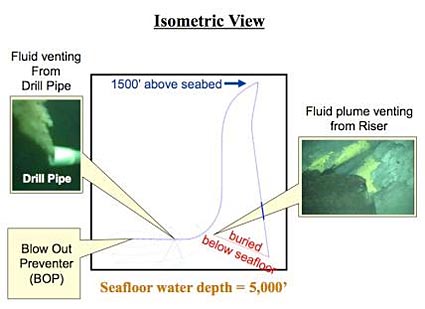
BP is looking at installing a new BOP on top of the existing well, which could then be used to shut the well, BP executive Bob Fryar said. Fryar normally heads BP offshore exploration operations in Angola.
Sometime in the next three days, BP will try to install a metre to gauge the pressure on the lower marine riser package (LMRP), which sits on top of the existing BOP, to see if it might be possible to install a new BOP on top.
If pressures are not too high, Fryar said crews could shear off the broken riser and LMRP unit and then "stab" or stack a second BOP unit on top of the original BOP. The new BOP is already on board the Transocean drillship Discoverer Enterprise, which is believed to be on location.
However, if it does not work it could cause the flow from the well to increase by eliminating the back pressure created by the crimped riser.
Imagine a pipe 5 feet wide spewing crude oil like a fire hose from what could be the planets' largest, high-pressure oil and gas reserve. With the best technology available to man, the Deepwater Horizon rig popped a hole into that reserve and was overwhelmed. If this isn't contained, it could poison all the oceans of the world. ...
The BP people are not talking, but this well is into a deposit that easily could top 500,000 barrels production per day for 10 or 15 years. Letting that all go in one blast seems more than foolish.
The deposit is one I have known about since 1988. The deposit is very big. The central pressure in the deposit is 165 to 170 thousand PSI. It contains so much hydrocarbon that you simply cannot imagine it. In published reports, BP estimated a blow out could reach near 200,000 Barrels per day (165,000) They may have estimated a flow rate on a 5 foot pipe. The deposit is well able to surpass this.
The oil industry has knowledge of the deposit more than they admit. The deposit is 100 miles off shore. They are drilling into the edge of the deposit to leak it down gently to be able to produce from the deposit. The deposit is so large that while I have never heard exact numbers it was described to me to be either the largest or the second largest oil deposit ever found. It is mostly a natural gas deposit. That is another reason not to blast too willy nilly there. The natural gas that could be released is really way beyond the oil in quantity. It is like 10,000 times the oil in the deposit.
It is this deposit that has me reminding people of what the Shell geologist told me about the deposit. This was the quote, "Energy shortage..., Hell! We are afraid of running out of air to burn." The deposit is very large. It covers an area off shore something like 25,000 square miles. Natural Gas and Oil is leaking out of the deposit as far inland as Central Alabama and way over into Florida and even over to Louisiana almost as far as Texas. This is a really massive deposit. Punching holes in the deposit is a really scary event as we are now seeing.
Posted by Big Gav in bp, gom, gulf of mexico, horizon, pollution
The Australian has an update on BP's disaster in the GOM - BP Gulf of Mexico oil slick declared a national disaster. More at BP under fire as Gulf of Mexico oil spill costs soar and Obama acts to mop up Lousiana oil spill overflow.
THE giant Gulf of Mexico oil slick has been declared a national disaster, as it nears the Louisiana coast and threatens economic and environmental devastation. Louisiana governor Bobby Jindal declared a state of emergency and called for urgent help to prevent fragile wetlands and vital fishing communities along the coast from pollution on a massive scale.
The wind started to strengthen and blow the 1550 sq km slick directly onto the coast, where a rich variety of wildlife were at risk in the maze of marshes that amounts to 40 per cent of the US wetlands.
“Satellite imagery from this morning indicates the western edge of the oil is 7-8 miles from the (Mississippi) Delta,” the US government's National Oceanographic and Atmospheric Administration said. “Shoreline impacts become increasingly likely later in the day and into Friday with the strengthening onshore winds.”
Despite frantic efforts to stave off an environmental catastrophe many of those dependent on the region's vital fisheries and nature reserves had already given up hope due to strong onshore squalls forecast for several days to come. “It is a question of when, not if, the oil is going to come on shore,” Doug Helton, NOAA's incident operations coordinator, told AFP. ...
With 11 workers dead and an environmental disaster brewing along the shoreline of four US states, dealing with the aftermath of the deadly blast on the Deepwater Horizon rig is likely to be the biggest challenge of his career - and one of the greatest in the 101-year history of Britain's most famous company.
So far it is not going well. Anger is mounting in the US over BP's refusal publicly to acknowledge the true scale of the catastrophe unfolding in the Gulf of Mexico.
About 10 billion pounds has been wiped off BP's value since the explosion, much of it yesterday, when its shares fell 40.8p, or 6.5 per cent, to 584p as investors took fright at the spill's potentially enormous scale, costs and consequences.

Posted by Big Gav in bp, gom, gulf of mexico, horizon, pollution
CNN reports the volume of oil spilling into the gulf of Mexico from BP's Horizon disaster has risen to 5000 barrels per day - Oil spill from rig explosion at 5,000 barrels a day.
The oil spill from last week's deadly rig explosion in the Gulf of Mexico has increased to 5,000 barrels a day -- five times more than the original estimate, said Coast Guard Rear Adm. Mary Landry.
A third underwater oil leak has been located in the pipeline that connected the rig to the oil well, said Doug Suttles, chief operating officer for BP.
The head of BP Groups said the explosion could have been prevented, and he is focusing blame on rig owner Transocean Ltd.
CEO Tony Hayward told CNN's Brian Todd in an exclusive interview that Transocean's "blowout preventer" failed to operate before the explosion. A blowout preventer is a large valve at the top of a well, and activating it will stop the flow of oil. The valve may be closed during drilling if underground pressure drives up oil or natural gas, threatening the rig.
"That is the ultimate fail-safe mechanism," Hayward said. "And for whatever reason -- and we don't understand that yet, but we clearly will as a consequence of both our investigation and federal investigations -- it failed to operate. ...
BP owns the oil well. Before the explosion, Hayward had announced a significant discovery of at least 50 million barrels of oil. "Of course, all of that is completely irrelevant in the context of what we're now dealing with."
EMERGENCY crews have begun controlled burns of a giant oil slick in the Gulf of Mexico, but a cruel wind shift raised fears the spill could hit Louisiana's fragile shores by the weekend. ...
Two skimming vessels dispatched by the US Coast Guard and energy giant BP swept the thickest concentrations of oil into a 150m fire-resistant boom. They then towed it to a 8km “burn zone” set up inside the slick roughly 80km south of the mouth of the Mississippi where it was set alight a few hours before nightfall. “They lit it with a little float that has a fuel source on it that floats into the oil and ignites. It did successfully ignite,” Coast Guard petty officer Cory Mendenhall told AFP. ...
As a back-up, engineers are frantically building a giant dome that could be placed over the leaks to trap the oil, allowing it to be pumped up to container ships on the surface.
Another Transocean drilling rig is also on stand-by to drill two relief wells that could divert the oil flow to new pipes and storage vessels.
But that would take up to three months and the dome is seen as a better interim bet even though engineers need two to four weeks to build it.
Coast Guard Rear Admiral Mary Landry, who is leading the government's response to the disaster, warned on Tuesday that if BP fails to secure the well it could end up being “one of the most significant oil spills in US history.”
Posted by Big Gav in bp, gom, oil, pollution
The Guardian has a look at BP's disaster drilling in the Gulf Of Mexico, with the rig sunk, 11 people dead and the well leaking oil into the waters and looking rather difficult to stop anytime soon - Deepwater Horizon oil spill: Underwater robots trying to seal well. More at the Wall Street Journal and Houston Chronicle.
Underwater robots dived to the ocean floor yesterday in a new effort to staunch the 42,000 gallons of oil a day being pumped into the Gulf of Mexico in America's worst offshore oil rig spill in 40 years.
The robots will attempt to activate a blowout preventer, a 450-tonne valve on the ocean floor that offers the only timely option for stemming the flow.
With the oil now coating 1,800 square miles of water, BP officials acknowledge it could take months to entirely contain two separate leaks from the wrecked oil rig.
The US coastguard discovered the leaks on Saturday, two days after the Deepwater Horizon oil rig leased by BP sank off the coast of Louisiana. The rig was destroyed in an explosion last Tuesday, with 11 workers missing and presumed dead.
What initially seemed a manageable spill is now rated by the US coastguard as a serious environmental problem, with 1,000 barrels of oil a day being pumped into the Gulf of Mexico, an area rich with dolphins, whales and other marine life.
Three sperm whales have been sighted in the area of the slick, officials said yesterday.
The spill, which occurred just as senators were preparing to roll out energy and climate proposals, has deepened debate about America's energy policies.
In an effort to win support for the proposals, Barack Obama had come out in favour of more oil and gas drilling in the Gulf of Mexico.
High winds and big waves forced clean-up vessels, which have been trying to skim the oil from the surface of the water before it washes up on shore, to remain in port at the weekend.
But Mary Landry, the coast guard commander, insisted the four states that lie in the path of the slick would have ample warning to protect fragile wetlands. Forecasts suggest the oil will make landfall on Thursday.
The plan put into operation yesterday called for four underwater robots to dive 1,500 metres (5,000 ft) below the surface of the water to try to activate the gargantuan system of pipes and valves that sits next to the well on the ocean floor.
BP said it was the first time such an operation had been mounted at this depth.

 Posts




