Thousands of tons of garbage washed down by recent torrential rain are threatening to jam the locks of China's massive Three Gorges Dam, and is in places so thick people can stand on it, state media said on Monday.
Chen Lei, a senior official at the China Three Gorges Corporation, told the China Daily that 3,000 tons of rubbish was being collected at the dam every day, but there was still not enough manpower to clean it all up.
"The large amount of waste in the dam area could jam the miter gate of the Three Gorges Dam," Chen said, referring to the gates of the locks which allow shipping to pass through the Yangtze River.
The river is a crucial commercial artery for the upstream city of Chongqing and other areas in China's less-developed western interior provinces.
Pictures showed a huge swathe of the waters by the dam crammed full of debris, with cranes brought in to fish out a tangled mess, including shoes, bottles, branches and Styrofoam.
Some 50,000 square meters of water (more than half a million square feet) had been covered by trash washed down since the start of the rainy season in July, the report said. The trash is around 60 centimeters (two feet) deep, and in some parts so compacted people can walk on it, the Hubei Daily added. ...
The Three Gorges Dam is the world's largest hydropower project, and was built partly to tame flooding along the Yangtze, which killed over 4,000 people in 1998 and countless more over the centuries.
The Boston Globe has a set of images from an oil spill in Dalian in China as well - Cleaning Dalian Harbour.
The SMH has an article about the new BP COO saying he'll happily eat seafood from the Gulf of Mexico - BP chief happy to eat Gulf seafood. For some reason I can't get the image of Mr Burns being served a three eyed fish from downstream of his nuclear power plant out of my mind...
BP will begin a legal offensive this month to cap its liabilities from disaster by offering those affected one-off compensation payouts in return for them waiving the right to sue.
It is also continuing its public relations efforts, with its chief operating officer, Doug Suttles, saying on Sunday he would ''absolutely'' eat Gulf of Mexico seafood. ...
Doug Suttles gave his vote of confidence two days after Louisiana state authorities re-opened 6200 square kilometres of coastal waters for fishing, with the Food and Drug Administration saying Gulf seafood harvested from such open areas is safe for human consumption.
Environmentalists worry that not enough testing has been done on the seafood as the use of chemicals to dissipate the oil from the surface leaves lingering questions about toxicity in the fish.
When asked whether he would eat the Gulf's bounty, Mr Suttles didn't flinch. ''I absolutely would,'' he said. ''There's been a tremendous amount of testing done …
''I have a lot of confidence in those agencies and I trust their recommendations and I would eat their food - the seafood out of the Gulf - and I would feed it to my family.''
BP's new boss says it's time for a "scaleback" in cleaning up the Gulf of Mexico oil spill. Federal officials say there is no way the crude could reach the East Coast. And fishing areas are starting to reopen.
There were several signs Friday that the era of thousands of oil-skimming boats and hazmat-suited beach crews is giving way to long-term efforts to clean up, compensate people for their losses and understand the damage wrought. Local fishermen are doubtful, however, and say oil remains a bigger problem than BP and the federal government are letting on.
Other people contend the impact of the spill has been overblown, given that little oil remains on the Gulf surface, but Bob Dudley, who heads BP's oil spill recovery and will take over as CEO in October, rejected those claims.
"Anyone who thinks this wasn't a catastrophe must be far away from it," he said in Biloxi, where he announced that former Federal Emergency Management Agency chief James Lee Witt will be supporting BP's Gulf restoration work.
After an April 20 rig explosion that killed 11 workers, BP's blown-out well gushed an estimated 94 million to 184 million gallons of oil before a temporary cap stopped it July 15. Efforts to permanently plug the gusher had been expected to begin as early as Sunday, but the government's point man for the spill said Friday that those plans hit a snag.
Crews found debris in the bottom of the relief well that ultimately will be used to plug the leak for good, retired Coast Guard Adm. Thad Allen said. The debris must be fished out before crews can begin a procedure known as a static kill that hopefully will make the rest of the job easier.
"It's not a huge problem, but it has to be removed before we can put the pipe casing down," Allen said.
The sediment settled in the relief well last week when crews popped in a plug to keep it safe ahead of Tropical Storm Bonnie. Removing it will take 24 to 36 hours and likely push the kill back to Tuesday, Allen said.
Once the relief well is ready, crews can begin the static kill, in which mud, and possibly cement, are pumped in through the temporary cap. The better that procedure seals the blown-out well, the easier it will be to plug it forever by pumping in cement from below using the relief well. The blown-out well could be killed for good by late August, though a tropical storm could set the timetable back.
TomDispatch has an article on the history of oil pollution around the globe - Ellen Cantarow, Blowback Crude. From Tom's introduction:
I don’t know about you, but when I see a headline like this one (from the July 11th Washington Post), “White House Confident Latest BP Effort Will Work,” my heart immediately sinks. Of course, there’s a first time for everything, but amid the ever worsening news from the Gulf of Mexico’s waters about astonishingly high methane concentrations, dangerous levels of arsenic, the lack of testing of seafood for absorption of toxic compounds from the dispersant BP has been massively pumping out, the National Oceanic and Atmospheric Administration’s “hoarding” of raw scientific data about the disaster, and both BP's and the government's “stranglehold on media access” in the Gulf, that oily undercurrent of a positive narrative has been relentless (even as press coverage slowly begins to drop off). At the end of the storm lies hope and a rainbow. Or at least a permanently sealed well on the floor of the Gulf of Mexico.
Of course, three days after that confident headline, the same government showed something less than confidence in BP. It suddenly moved to freeze that company’s work on closing the new version of “top hat,” the massive "3 ram capping stack" meant to seal off the well, until further testing could be done. Secretary of Energy Stephen Chu and his experts feared that closing the cap’s valves might actually cause even more harm to a possibly already damaged well bore. In the meantime, the oil, essentially cap-less, continued to gush forth, as it had for days, even as work on the first relief well, the supposed permanent solution to the problem, was halted for fear of further problems while the testing went on.
Late Wednesday, the test of the cap finally began, only to be briefly interrupted by the discovery of a leak on a line attached to one of its valves. Everything was again halted briefly before those valves were finally closed and the oil did stop for the first time in 87 days; and yes, in the next few days, for all we know, that seal may hold, or maybe this nightmare won’t really end until the dog days of late July or mid-August, all dates repeatedly promised for the completion of the relief well. Or maybe not then either. The positive story line has been offered up and deep-sixed so many times already that, as with warnings on a cigarette pack, even with good news coming in, caution is still advised. Worse yet, if the happy ending does come, we already have a reasonable hint about how this story works out. As with the Exxon Valdez spill, big oil may prefer to learn remarkably few lessons from this disaster, as it prepares to head into far rougher waters in search of ever tougher oil to extract. After all, the big oil companies have preferred to learn next to nothing, as Ellen Cantarow makes clear, from a 50-year history of disastrous spills in Nigeria and a decades-long version of the same in the Amazon.
And of course, in these last weeks when the Northeast has been sizzling under record temperatures (with more to come), and researchers at the University of Alabama’s Earth System Science Center have concluded that the first five months of 2010 were the second hottest in human history (runner-up only to 1998) -- and this decade the warmest on record for the planet -- the worst disaster may prove to be not the gusher in the Gulf, but the gas in our tanks.
Newsy.com reports there are some concerns about the cap that BP has put on the Macondo well - BP Halts Oil Leak During Test.
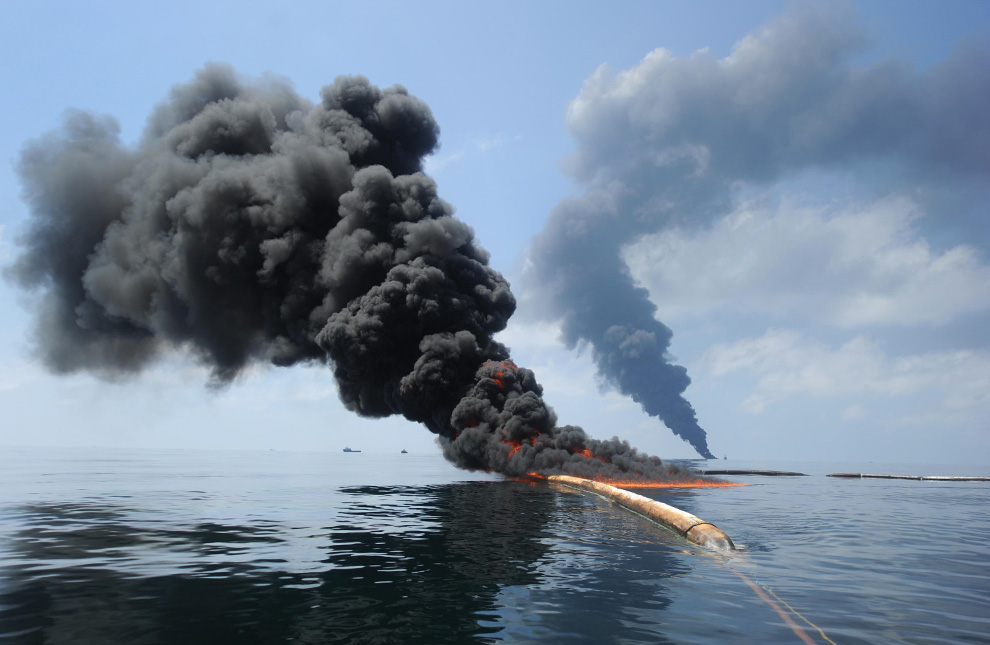
The SMH has a report on the collateral damage being created by BP's burn off efforts for the oil spill - BP sued for burning turtles alive.
Animal welfare groups are suing BP for burning endangered sea turtles and are asking a US court to stop the oil giant's "controlled burns" on the Gulf of Mexico spill.
The lawsuit filed on Wednesday says BP is violating the Endangered Species Act and other laws with their "controlled burns" in the Gulf of Mexico.
The complainants, Animal Welfare Institute (AWI), Centre for Biological Diversity, Turtle Island Restoration Network and Animal Legal Defence Fund, have asked the federal court for a temporary restraining order to stop all burning activities "until ... mechanisms are implemented that will prevent any additional sea turtles from being burned alive."
"It is horrifying that these innocent creatures whose habitat has already been devastated by the oil spill are now being burned alive," AWI president Cathy Liss told the court in Louisiana.
Containment efforts put in place since a BP-leased offshore oil rig exploded April 20 unleashing the worst oil spill in US history include "controlled burns", in which oil is gathered by ship-towed floating booms and set on fire.
"Endangered sea turtles, including the Kemp's ridley, one of the rarest sea turtles on Earth, are caught in the gathered oil and unable to escape when the oil is set ablaze," the animal welfare groups said.
BIG oil spills are no longer news in the Niger Delta, where the wealth underground is out of all proportion with the poverty on the surface. This once-verdant area has endured the equivalent of the Exxon Valdez spill every year for 50 years by some estimates. The oil pours out nearly every week, and some swamps are lifeless.
Perhaps no place on earth has been as battered by oil, experts say, leaving residents here astonished at the non-stop attention paid to the gusher half a world away in the Gulf of Mexico. It was only a few weeks ago, they say, that a burst pipe, belonging to Shell, was finally shut after flowing for two months. Now nothing living moves in a black-and-brown world once teeming with shrimp and crab.
Not far away, there is still black crude on Gio Creek from an April spill, and just across the state line in Akwa Ibom the fishermen curse their oil-blackened nets, doubly useless in a barren sea buffeted by a spill from an offshore Exxon Mobil pipe in May that lasted for weeks.
The oil spews from rusted and ageing pipes, unchecked by what analysts say is ineffectual or collusive regulation, and abetted by deficient maintenance and sabotage. In the face of this black tide is an infrequent protest - soldiers guarding an Exxon Mobil facility beat women who were demonstrating last month, according to witnesses - but mostly resentful resignation.
Small children swim in the polluted estuary here, fishermen take their skiffs out ever further - ''There's nothing we can catch here,'' said Pius Doron, perched anxiously over his boat - and market women trudge through oily streams.
''There is Shell oil on my body,'' said Hannah Baage, emerging from Gio Creek with a machete to cut the cassava stalks balanced on her head.
That the Gulf of Mexico disaster has transfixed a country and president they so admire is a matter of wonder for people here, living among the palm-fringed estuaries in conditions as abject as any in Nigeria, according to the United Nations. Although their region contributes nearly 80 per cent of the government's revenue, they have hardly benefited from it; life expectancy is the lowest in Nigeria.
''President Obama is worried about that one,'' Claytus Kanyie, a local official, said of the Gulf spill, standing among dead mangroves in the soft oily muck outside Bodo. ''Nobody is worried about this one.''
In the distance, smoke rose from what Mr Kanyie and environmental activists said was an illegal refining business run by local oil thieves and protected, they said, by Nigerian security forces.
The Niger Delta has suddenly become a cautionary tale for the US. As many as 546 million gallons of oil spilled into the Niger Delta over the past five decades, or nearly 11 million gallons a year, a team of experts for the Nigerian government and international and local environmental groups concluded in a 2006 report. By comparison, the Exxon Valdez spill in 1989 dumped an estimated 10.8 million gallons of oil into the waters off Alaska.
The spills here are all the more devastating because this ecologically sensitive wetland region, the source of 10 per cent of US oil imports, has most of Africa's mangroves and, like the Louisiana coast, has fed the interior for generations with its abundance of fish and crops.
Billmon has a post at Daily Kos looking at some of the stranger theories floating around about the compensation fund BP has set up to deal with the oil spill aftermath - Dear Teabaggers.
Your stupidity, fanaticism and all around mean spiritedness continue to astound, with your bizarre and – dare I say it – unpatriotic defense of British Petroleum only the latest example.
While I realize facts and logic are completely lost on you, can you at least TRY to get it through your tiny, floresiensis-like skulls that:
1.) The Constitution in your head notwithstanding, the REAL one doesn't forbid the president and/or his Attorney General from negotiating settlements of this kind. The Justice Department does it in environmental enforcement actions all the time, although usually without the 24/7 hysteria.
2.) The money is going to be held in an ESCROW account. Are you familiar with the term? Have you ever closed on a house? It means the money cannot be spent or disbursed without the approval of the trustee, who in turn will need to get approval from the courts. Again, this is a completely standard way of handling settlements in environmental cases.
3.) The money is NOT going to ACORN, your favorite all-purpose boogeyman. ACORN doesn't exist any more. Deal with it.
4.) BP agreed to the deal BECAUSE IT IS IN ITS OWN CORPORATE INTEREST. Lately investors have been shunning BP until they have some kind of idea of the company's potential legal liability. This has caused yields on BP bonds to soar and made it hard for the company to roll over short-term debt, threatening the company (and the entire financial system) with insolvency. While the settlement is not final, it does give investors some reason to hope the company will remain viable -- which in turn makes it more likely that it WILL remain viable.
5.) BP, its shareholders, and the wildlife in the Gulf of Mexico aren't the only ones at risk here. Do you by chance remember what happened to a company called Lehman Brothers when it couldn't roll over its short-term debt a couple of years ago? Do want to see a repeat of that fun-filled episode?
6.) If anything, Obama is doing BP a favor by coming to terms so quickly. The fact that BP was so eager to accept those terms is a clear sign it understands just how MORE humongeous its liabilities could be if this ends up in court. If you want to blame Obama for subverting the course of justice, go right ahead (although I'm not sure he had any realistic choice) but it's ridiculous to blame him for that with one breath and then accuse him of "shaking down" BP in the next. There was no shakedown – or, if there was, the muscle behind it was provided by Wall Street, not Chicago (unless you mean the futures pits).
Even for you, this is mendacity on a pathological scale, amounting practically to a psychotic break from reality. Your movement has become the social equivalent of BP’s blown out well: completely out of control and spewing toxic crap in every direction. Joe Barton, at least, had the excuse of being a well paid prostitute on permanent retainer to the oil industry. What’s yours? Only fools give it away for free.
Phil Hart has a post at The Oil Drum on the Montara oil spill off Australia last year - The Australian Oil Spill.
The Age in Melbourne today has an article about a possible moratorium on oil and gas drilling in Australian waters, as a result of the BP spill in the Gulf of Mexico and the Montara oil spill in the Timor Sea off Australia last year. A review into the Montara accident has just been completed but has not been released, for 'legal reasons'. Apparently prosecutions may be in order. It's a pity as the review may highlight some common factors with the Gulf of Mexico spill, particularly in relation to the failure of the BOPs to seal the well. ...
Given how much outrage the BP spill has caused in the United States, it's remarkable that after the first few days, the Montara oil spill was largely ignored by everyone in Australia and was probably never heard of in most parts of the world. This despite being our nation's largest oil spill and causing an oil slick 180 km (110 mi) wide (not bad for what was really a gas well and considering that much of the oil burnt at the wellhead). With so little public outrage, there has been very little pressure on the operators PTTEP to release details of the incident to the public. The official review has now been completed but even that may not be available for quite sometime:
The Age: Why the oil minister doesn't feel too well right now
We have not heard much about the Montara incident. No one was killed and maybe 30,000 barrels of oil spilled into the sea over a few months … that's less than BP's Deepwater Horizon was thought to be gushing into the Gulf of Mexico per day. And Australian-listed companies were not involved in Montara. The key companies involved were PTTEP of Thailand, and Atlas and Halliburton, both of the US.
But as luck would have it, an extended investigation of the Timor Sea incident has just been completed. The report was handed to Martin Ferguson last Friday … and the first thing the minister did was hold on to the document for ''a legal review''. Now you might think that is an easy way out for a government that will be damned if it responds to the Greens and doubly damned by a raging multinational resources sector. But the report has been delayed for public release on advice of the Solicitor-General. In other words, there is the real possibility of prosecutions following the Montara incident.
That's a pity because there is likely to be a lot of information in this inquiry relevant to the Deepwater Horizon blowout. But already it adds weight to the idea that there have been a large number of accidents and 'near misses' and that a serious blowout and failure of the BOP was not as 'unforseeable' as some in the industry have claimed. If prosecutions are a 'real possibility', then clearly somebody or some companies have not been doing their jobs very well. Some of the companies involved in the Deepwater Horizon blowout will surely be a little worried at the moment?
President Obama’s administration and BP’s critics in Congress will be keen to read the Montara oil spill report that Mr David Borthwick, AO PSM gives to Australia’s Minister for Resources, Martin Ferguson today.
Mr Ferguson has been a staunch defender of the operator of the Montara facility and a proud booster of the oil industry generally. It is surprising then, that Australia is not one of the 17 countries who have offered to help clean up the oil spill in the Gulf of Mexico, according to the US State Department (Although BP has used some Australian resources in the clean up.)
Minister Ferguson is under pressure to release the Montara report quickly, because of the the disaster in the Gulf of Mexico. The Minister’s office has said that he needs ‘a few days’ to read the report, after which it will be put in the public domain.
As Crikey reported Halliburton built the concrete wellhead on both BP Mississippi Canyon 252 well (MC252) in the Gulf of Mexico and the Montara Wellhead Platform at the West Atlas site in the Timor Sea.
Halliburton ranks number 2 among oilfield services companies globally and was ranked as 310 in a Fortune 500 listing, with revenues around US$18 billion. The company is best known for allegations of nepotism, corruption, human rights abuse and overcharging the US military, through its subsidiary Kellogg Brown & Root (KBR), which it sold in 2007. KBR was the business division responsible for military logistics support.
Halliburton’s Tim Probert (President, Global Business Lines and Chief Health, Safety and Environmental Officer) has told the US House Committee on Energy hearings that there was no connection between Montara and Deepwater, but his wording is a matter of some concern.
When Probert was asked if Hallliburton was involved in cementing the Montara wellhead and whether this is relevant to the MC252 failure he replied with an interesting qualification, “We were involved in the well cementing. But what we do know from the public testimony is that a 5-month period elapsed between the time the cementing was completed and that the well control issue took place. [emphasis added]”
Probert continues but the gist is that he refers only to the ‘public testimony’ that his company gave to the Montara inquiry. My understanding is that he was appearing before the House on the basis of his ‘sufficient knowledge’ of technical issues, not merely his ability to inform the House about information already on the public record in another country.
This is curious, because if Probert was confident that there was no connection between Montara and Deepwater, surely he would state this simply and unconditionally. By restricting his assurance to only the public evidence, it raises the question of what other evidence exists.
It is easy to understand American hostility to BP, but it is fundamentally misplaced. Never mind that Transocean and Halliburton were also involved and it seems there is plenty of blame to go round. Never mind that more oil is spilled every year in the Niger Delta, where Shell and Exxon are the big operators, and which supplies 40 per cent of US oil imports, without a peep of American protest. Never mind that despite the hyperventilation the slick is still relatively small by historical and international comparison. The plain fact is BP is not uniquely culpable, just unlucky. ...
The fact that BP was drilling for Macondo – a tiny field under a mile of water containing less than 12 hours' global consumption – tells us all we need to know about the state of oil depletion. Deepwater production – anything under more than 500 metres of sea water, far too deep for divers to work should anything go wrong – has quadrupled from less than 2 million barrels per day (mb/d) in 2000 to 8 mb/d today, precisely because onshore and shallow offshore supplies are running down. The industry only drills at such extreme depths because there are very few alternatives – the Canadian tar sands and Iraq are equally unpalatable – and it is a clear sign of impending peak oil.
Ironically one impact of the BP spill, the US moratorium on deepwater drilling, is likely to hasten and worsen the effects of the global production peak. One analyst forecasts the ban could deprive the world of an additional one million barrels per day from 2016. City forecasts of $175 per barrel by mid-decade may now prove conservative. So, how is any of this good news?
First, it could have been so much worse. Had BP suffered a similar accident while drilling for Tiber, a three-billion-barrel field it discovered in the Gulf of Mexico last year under two miles of water, reservoir pressures and oil volumes would have been far higher, and there would be many fewer remotely operated submarines capable of working at this depth. Likewise, had such a spill occurred in the remote Arctic, galvanising a speedy response would have been still harder and impacts yet more devastating. Now at least regulations will be tightened, making such accidents less likely.
More important, the spill may finally spur Americans, who make up 5 per cent of the world's population but guzzle 25 per cent of the oil supply, to get serious about cutting their consumption. America has always been an obstacle to international progress on climate change, but the problem is no longer the country's leadership, as it was under President Bush, but popular opinion. In a poll taken after Climategate, almost half of all Americans said they believe there is no scientific consensus around climate change or that it is not happening. But the images of the devastation caused by the slick may finally force them to confront the real costs of their own way of life – the more so when dolphins begin to be washed up on Florida beaches – if President Obama can frame the debate correctly.
For over a month Obama has been caught uncharacteristically flat-footed by the spill. But last week he finally started to heed the old maxim about never wasting a perfectly good crisis. During a visit to a solar power plant in California, he said: "With the increased risks, the increased costs ... We're not going to be able to sustain this kind of fossil fuel use".
Obama conceded to expanding offshore drilling to buy off Republican opposition to his much watered down Climate Change Bill. He now has an opportunity to outflank the "drill baby, drill" brigade using the calamitous results of their own moronic credo. It is also the perfect opportunity to ram home that American "energy independence" is a fantasy when based on fast-depleting oil, but entirely feasible with a shift to electrification of ground transport and massive investment in renewables. To pull it off, the President will have to resist the temptation to succumb to a xenophobic blame game, but if he does, and uses the slick to steer America towards a more sustainable energy policy, we should all be thanking BP.
A British-owned company has failed publicly and massively in sovereign US waters, having outsourced an ill prepared charge into dangerous underwater territory. Hence the reference to Lord Tennyson's "Charge of the Light Brigade" - Light Crude Brigade...get it?
While it is hard to imagine how exactly they got process safety so wrong - drilling a mile below sea level without frequently testing and certifying that the system would actually shut the flow off when needed? - we should not miss the larger point, that this failed charge signifies the arrival of Peak Oil.
Everyone was expecting a steep and sustained run-up in oil price would mark the onset of Peak Oil. Not happening because of the economic downturn. Instead we get a Gulf-wide gusher. See below for ideas on how government regulation should be deployed under the Peak Oil reality.
You'd think that the engineers in charge of Horizon rig would have been constantly focused on how important process safety was to sustaining corporate productivity. Millions of barrels leaked, times around $65 per barrel, represents a huge profit loss even without the cleanup cost added in. (So much for the power of free markets to encourage companies to 'do the right thing.')
The SMH reports that BP's "top kill" approach to stopping the Deepwater Horizon leak in the gulf of mexico has failed - BP's gulf well plug fails.
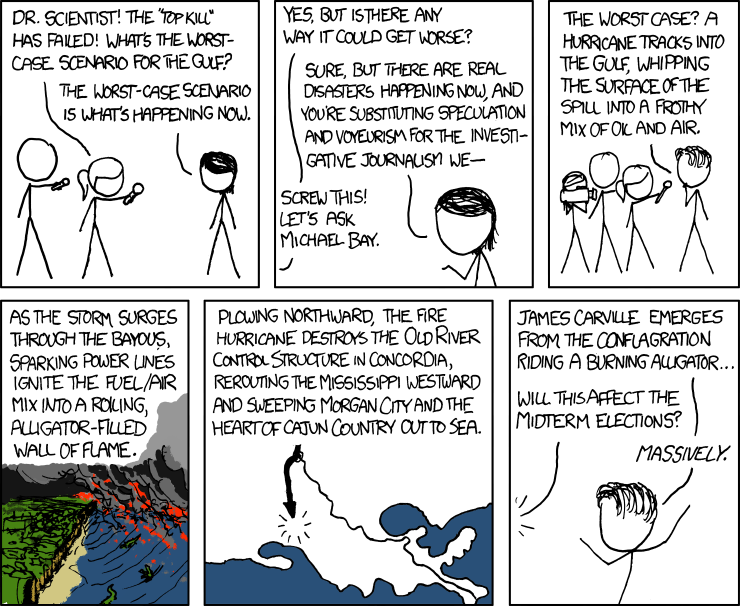
BP's "top kill" operation to plug the ruptured well in the Gulf of Mexico has failed, in a stunning setback to efforts to stem the worst oil spill in US history.
BP and federal authorities are now turning to a new strategy to stop the leak, but it will take at least four to seven days before it can be put in place.
At least 75 million gallons are now estimated to have gushed into the ocean since the disaster unfolded five weeks ago, threatening an environmental and economic catastrophe across hundreds of kilometres of the US Gulf Coast.
"After three full days of attempting 'top kill', we have been unable to overcome the flow from the well, so we now believe it's time to move on to the next of our options," BP Chief Operations Officer Doug Suttles told a news briefing.
Engineers had spent days pumping some 30,000 barrels of heavy drilling fluid into the leaking well head on the ocean floor in a high-pressure bid to smother the gushing crude and ultimately seal the well with cement. ....
The announcement marks the latest failure for BP, which despite a series of high-tech operations over the past month has appeared powerless to bring the disaster to heel since an explosion on the BP-leased Deepwater Horizon oil rig on April 20 that killed eleven workers. The rig sank two days later.
The British energy giant had stressed that "top kill" was the best chance at stopping the leak other than drilling an entirely new relief well, a process that has already begun but is expected to take another two months.
The Oil Drum has been doing continuous coverage of the spill lately (with traffic starting to head back to the record levels of 2008), and reports BP's latest tactical plan is to try another containment dome style approach while waiting for relief wells to be drilled, this one dubbed the LMRP (lower marine riser package) - Deepwater Oil Spill - The LMRP Attempt Continued and Sunday's Open Thread .
BP said preparations have been made for the possible deployment of the lower marine riser package (LMRP) cap containment system, which would be complex because of the depth of the oil leak.
Deployment would first involve removing the damaged riser from the top of the failed BOP to leave a cleanly-cut pipe at the top of the BOP's LMRP.
The cap, a containment device with a sealing grommet, will be connected to a riser from the Discoverer Enterprise drillship, 5,000 feet above on the surface, and placed over the LMRP with the intention of capturing most of the oil and gas flowing from the well.
Mr Suttles said it should capture "most of the oil" and was expected to last at least four days but "we cannot guarantee success at this time."
In his May 28th interview with Bloomberg's Mark Crumpton and Lori Rothman, Matt Simmons of energy investment bank Simmons & Company, provides some stunning revelations on what is really occurring in the Gulf of Mexico, and proposes that the only effective way to contain the leak is to relieve BP, bring in the military, and do what the Russians have done on comparable occasions, namely explode nuclear weapons within the wellbore. Simmons knows what he is talking about. As Jim Bianco points out: "Matt Simmons gained fame with his book 2005 Twilight in the Desert where he claimed that the Saudis were overstating their oil output because they hit “peak oil.” Right or wrong Simmons claimed the price of oil was going to skyrocket and three years after the book’s release the crude oil hit $147/Barrel.
op Hat, Top Kill, Junk Shot, Hail Mary. I don't know about you but it sure feels like nobody's going to stop this leak. Even BP CEO and chief spinmeister Tony Hayward is lowering expectations. This mess is officially out of control.
"Plug the damn hole"
Presidents don't do impotence -- usually. But while BP pipes spew non-stop on webcams, President Obama reduced to sending Cabinet members to the scene where they hold daily press briefings to explain what BP is (or is not) doing. Should we be surprised then at Obama's "Plug the damn hole" outburst at a recent White House meeting?
In his Washington Post blog Joel Achenbach calls BP the ballerina and the federal government the Stage Mom. But here's an alt analogy: BP is the teen learning to drive and the government is the parent in the front seat. Only he doesn't know how to drive either.
They got nothin'
The speculation in Washington is that if BP can't pull off its "top kill" gambit tomorrow, the White House will need to do something dramatic, like take over.
The feds do have the authority. But what would they do if they took charge of the unstoppable spill? The government's top man in the field, Coast Guard Commandant Thad Allen, flat out concedes that the feds are out of their league-technically-when it comes to plugging the damn hole.
Got any ideas?
Andrew Revkin, in his Dot Earth blog in the New York Times, wants a swat team, of gung-ho geologists and engineers. David Gergen, writing for CNN, wants to rally the country's best and brightest to brainstorm a solution.
Sen. Bill Nelson (D-Fla.) wants to send in the troops. Let the U.S. military take over the cleanup operation.
Screw the army, we want Bruce Willis!
There is one other option out there, a dark option that BP wants nothing to do with. Nuclear weapons. Hey, we're serious here, people! The Soviet Union has used nukes four times in the past to cap leaking oil and gas wells. Sure it sounds crazy, but according to Russian writer Vladimir Lagovsky, the explosion "compresses the rock and squeezes the channel shut."
Of course, resorting to nukes could be a tough call for a Nobel Peace Prize winner, notes Christopher Brownfield, writing in The Daily Beast.
... using nuclear weapons, even for peaceful purposes, would be problematic for a president who stood in Prague and declared that the world should rid itself of such devices. If President Obama were to use a nuke to close this well, he would give other states an excuse to seek nuclear weapons of their own.
Elizabeth Kolbert has some background on oil spills and why these may become more common due to peak oil at The New Yorker - Oil Shocks.
n September of 1968, Union Oil Company of California, which later became Unocal and is now part of Chevron, erected a drilling platform off the coast near Santa Barbara. Over the next four months, four wells were constructed. Work on a fifth had begun and was proceeding uneventfully until, on January 28, 1969, the new well suffered a blowout. It took ten days’ effort before it was finally plugged, with cement slurry. By the time the flow had stopped completely, an estimated hundred thousand barrels of oil had poured into the Santa Barbara Channel. The slick it created covered eight hundred square miles. The area’s fishing industry was shut down, and pictures of blackened beaches filled the news.
Americans had never seen a spill like this, and they were shocked by it. There were protests—Californians stuck their gasoline credit cards on skewers and lit them on fire—followed by new horrors. In June of 1969, Ohio’s spectacularly polluted Cuyahoga River burst into flame. By the end of the year, Congress had passed the National Environmental Policy Act, known by the acronym NEPA, which requires federal agencies to file impact statements for all actions that could have a significant ecological effect. The following spring, millions of people took to the streets for Earth Day, and by the second anniversary of the spill President Richard Nixon had created the Environmental Protection Agency and signed into law the Clean Air Act.
BP’s Deepwater Horizon spill makes the Santa Barbara spill look like a puddle. By some estimates, the BP spill is spewing as much oil into the Gulf of Mexico each day as the Union well spewed into the Santa Barbara Channel in all, and the BP spill is now in its second month. The news out of the Gulf continues to range from grim to grimmer. Recently, it was revealed that the spill has created an undersea plume of oil ten miles long, and that some of the oil has already entered the loop current and is being carried toward Florida. Then the federal government doubled the area of the Gulf that had been closed to fishing. On Friday, the government increased that area again, to forty-eight thousand square miles. President Barack Obama has called the spill a “massive and potentially unprecedented environmental disaster,” a characterization that, if anything, probably understates the case.
In an immediate sense, the causes of the catastrophe are technical. Apparently, the Deepwater Horizon well was inadequately sealed, and natural gas built up inside it. When workers on the rig tried to activate the well’s blowout preventer, it failed. An attempt to activate the blowout preventer after the fact, using undersea robots, also proved unsuccessful. Another effort to cap the leak, by using what amounted to a hundred-ton steel funnel, flopped as well. Last week, BP finally succeeded in inserting a mile-long tube into the riser leading from the well. The company said that it was capturing a thousand barrels of oil a day, which is what it originally claimed that the well was leaking; nevertheless, crude continued to pour into the Gulf. (In a recent column in the Miami Herald, the author Carl Hiaasen joked that BP’s next move would be to try to seal the well with thousands of tons of instant oatmeal.)
But the real causes of the disaster go, as it were, much deeper. Having consumed most of the world’s readily accessible oil, we are now compelled to look for fuel in ever more remote places, and to extract it in ever riskier and more damaging ways. The Deepwater Horizon well was being drilled in five thousand feet of water, to a total depth of eighteen thousand feet. (By contrast, the Santa Barbara well was drilled in less than two hundred feet of water, to a total depth of thirty-five hundred feet.) While the point of “peak oil” may or may not have been reached, what Michael Klare, a professor at Hampshire College, has dubbed the Age of Tough Oil has clearly begun. This year, the United States’ largest single source of imported oil is expected to be the Canadian tar sands. Oil from the tar sands comes in what is essentially a solid form: it has to be either strip-mined, a process that leaves behind a devastated landscape, or melted out of the earth using vast quantities of natural gas.
Meanwhile, as everyone knows, no matter where oil comes from or how it has been extracted, burning it is destructive: oil combustion accounts for nearly a third of the greenhouse-gas emissions in the United States. A report issued last week by the National Academy of Sciences called on Congress to enact legislation to dramatically reduce greenhouse-gas emissions, by, among other things, “reducing oil use.”
The Trans-Alaska Pipeline, partly owned by BP, shut down on Tuesday after spilling several thousand barrels of crude oil into backup containers, drastically cutting supply down the main artery between refineries and Alaska's oilfields.
The accident comes at a difficult time for BP -- the largest single owner of the pipeline operator, holding 47 percent -- as it struggles to plug a gushing Gulf of Mexico oil well.
The shutdown followed a series of mishaps that resulted from a scheduled fire-command system test at Pump Station 9, about 100 miles south of Fairbanks, said Alyeska Pipeline Service Co, the operator of the 800-mile oil line.
The power outage triggered opening of relief valves, causing an unspecified volume of crude oil to overflow a storage tank into a secondary containment. There were no injuries, but the approximately 40 people at the work site were evacuated, Alyeska spokeswoman Michele Egan said.
North Slope oil producers have cut their flow into the pipeline's Prudhoe Bay intake station to 16 percent of their normal rates, Egan said. There is enough storage capacity to allow the line to be shut down for 48 hours as long as producers maintain the 16 percent flow rate, she said.
Scientists are finding enormous oil plumes in the deep waters of the Gulf of Mexico, including one as large as 10 miles long, 3 miles wide and 300 feet thick in spots. The discovery is fresh evidence that the leak from the broken undersea well could be substantially worse than estimates that the government and BP have given.
“There’s a shocking amount of oil in the deep water, relative to what you see in the surface water,” said Samantha Joye, a researcher at the University of Georgia who is involved in one of the first scientific missions to gather details about what is happening in the gulf. “There’s a tremendous amount of oil in multiple layers, three or four or five layers deep in the water column.”
The plumes are depleting the oxygen dissolved in the gulf, worrying scientists, who fear that the oxygen level could eventually fall so low as to kill off much of the sea life near the plumes.
Dr. Joye said the oxygen had already dropped 30 percent near some of the plumes in the month that the broken oil well had been flowing. “If you keep those kinds of rates up, you could draw the oxygen down to very low levels that are dangerous to animals in a couple of months,” she said Saturday. “That is alarming.”
The plumes were discovered by scientists from several universities working aboard the research vessel Pelican, which sailed from Cocodrie, La., on May 3 and has gathered extensive samples and information about the disaster in the gulf.
Scientists studying video of the gushing oil well have tentatively calculated that it could be flowing at a rate of 25,000 to 80,000 barrels of oil a day. The latter figure would be 3.4 million gallons a day. But the government, working from satellite images of the ocean surface, has calculated a flow rate of only 5,000 barrels a day.
BP has resisted entreaties from scientists that they be allowed to use sophisticated instruments at the ocean floor that would give a far more accurate picture of how much oil is really gushing from the well.
“The answer is no to that,” a BP spokesman, Tom Mueller, said on Saturday. “We’re not going to take any extra efforts now to calculate flow there at this point. It’s not relevant to the response effort, and it might even detract from the response effort.”
The undersea plumes may go a long way toward explaining the discrepancy between the flow estimates, suggesting that much of the oil emerging from the well could be lingering far below the sea surface.
The scientists on the Pelican mission, which is backed by the National Oceanic and Atmospheric Administration, the federal agency that monitors the health of the oceans, are not certain why that would be. They say they suspect the heavy use of chemical dispersants, which BP has injected into the stream of oil emerging from the well, may have broken the oil up into droplets too small to rise rapidly.





 Posts




