Posted
by Big Gav
in
electricity grid,
ireland,
supergrid,
uk
Recharge has a look at interest in interconnecting the Irish grid to the UK grid to allow further expansion of renewable energy projects - UK and Ireland eye subsea links to boost green-power sharing.
Senior politicians from the UK and Ireland are meeting to discuss building a series of subsea interconnectors around the British Isles, in a bid to boost the commercial prospects of offshore renewables.
Closer integration of the two nations' power networks could open new markets for Irish-generated renewable electricity and help the UK meet its green energy targets.
Development of the offshore wind, wave and tidal sectors in Ireland has been stymied by the modest size of its local electricity market.
UK energy minister Charles Hendry notes that the west coast of Ireland has some of the most consistently fierce winds in Europe, yet hosts no offshore wind farms. Ireland’s only existing offshore wind facility is the seven-turbine Arklow Bank array in the Irish Sea – the world’s first commercial project.
"The Irish market for electricity is less than a tenth of that in Britain," Hendry says. "That means that companies cannot afford to build wind farms in Ireland because there is no market for their power. We want to put that right."
The only interconnector currently linking the Irish and UK grids is the 250MW Moyle line running between Northern Ireland and Scotland. Irish state-run grid operator EirGrid is currently building a 500MW link between County Fingal and North Wales.
But the politicians involved in the talks in London – including UK Deputy Prime Minister Nick Clegg, Irish Taoiseach (Prime Minister) Enda Kenny and Scottish First Minister Alex Salmond – believe those two lines should only represent a start.
The talks will include plans to better integrate a host of wave- and tide-rich islands into the UK grid, including the Isle of Islay, the Isle of Man and the Orkneys in Scotland – as well as the Channel Islands of Guernsey and Jersey, which are also represented at the discussions.
Posted
by Big Gav
in
geothermal energy,
geothermal power,
ireland
REVE reports that a geothermal power plant is to be built in Ireland (with surprisingly deep wells of 400m being quoted) - First geothermal power plant was authorized in Ireland.
The geothermal energy plant will be put into service at the end of 2012 in Dublin. Its permit was issued in only four months and, although it is not large (4.5 MW).
First geothermal power plant was authorized in Ireland
The authorization process for the country’s first geothermal energy plant was successfully completed in Ireland, only four months after the application. The approval process was exceptionally short also because nobody objected to the project.
The plant, whose cost is estimated at 30 million euros for an electricity capacity of 4.5 MW, will be developed by Ireland-based GT Energy at Greenogue, close to Newcastle (County of Dublin).
Construction is scheduled to begin in the coming weeks with the drilling of two wells about 4,000 metres deep, which will be used for the extraction and re-injection of geothermal fluid. The plant is planned to be put into service and grid-connected by the end of 2012.
Based on tests carried out since 2007, GT Energy estimates that at Greenogue three plants can be developed, with a total capacity of 100 thermal MW.
Although the Greenogue plant is not large-scaled, it is considered significant as a forerunner for the development of this industry. It will provide useful guidance for the exploitation of a renewable resource that is considered important to increase the diversity of the Irish energy mix.
Posted
by Big Gav
in
ireland,
ocean energy,
wave power
The Irish Herald reports that a 250 MW wave power plant is to be built on Ireland's west coast - Boost for wave power
A joint Irish-Swedish multinational company is preparing to develop a wave energy project along the Atlantic coast which could generate enough energy to power Cork city by 2020. The new venture with Tonn Energy, which is backed by the Swedish multinational utility company Vattenfall and indigenous Irish technology firm Wavebob, is hoping to generate up to 250MWs of electricity, enough for 180,000 homes and employ around 250 people.
Planning, installation, operation and maintenance work of pre-commercial devices at the national wave-energy test site at Belmullet, Co Mayo, will now begin. "Ireland could be to wave energy what Saudi Arabia is to oil," Wavebob chief executive Andrew Parish said yesterday.
The NYT has a report from the other side of the irish sea, noting that Aberdeen is starting to prepare for life after oil -
Scottish City Prepares for Life Beyond Oil.
With British North Sea production of oil and natural gas 44 percent below its peak, Aberdeen, the self-styled oil capital of Europe, fears the slowdown is not simply cyclical. An oil industry that at one stage inspired talk of Scotland as “the Kuwait of the West” has already outlived most predictions, having enjoyed a hydrocarbon heyday of almost five decades. As it prepares for the end of oil, Aberdeen is remaking itself, putting its hopes in renewable energy and tourism. “I’m steering my kids away from anything to do with oil,” said John Irvine, a truck driver who used to work on the rigs. “It’s not going to last forever.” ...
When the oil finally does run out, the decommissioning of hundreds of offshore platforms and thousands of pipelines will be an opportunity in itself. The infrastructure will need to be disassembled and returned to shore for disposal, creating a market worth at least £23 billion, estimates Oil and Gas UK, an industry lobbying group. “It could be the beginning of a whole new industry,” said Lewis MacDonald, a member of the Scottish Parliament representing Aberdeen Central.
Posted
by Big Gav
in
energy storage,
ireland,
wind power
The Times has an article from a Trinity College professor on making Ireland energy self sufficient using wind power and cliff top hydro storage on the west coast - Think tank: A high energy solution.
Ireland has to generate more than 95% of its energy from imported fossil fuels. This arises from our geographical and geological position as a rocky outcrop in the Atlantic Ocean, where fossils fuels could not accumulate to any great extent. But our location is a great asset in terms of power generation. Along with Scotland, Ireland is among the most favourable locations in Europe for wind-power generation.
It is estimated that we use about 24 billion kilowatts (kwh) of energy every year. So if you covered four regions of 12 square kilometres with wind turbines of a cumulative capacity of 12 megawatts (mw) per square kilometre, operating at 40% efficiency, you could provide all of Ireland’s electricity requirements.
This could be an attractive proposition for farmers in the west whose income base is under stress — they could earn additional income by allowing wind turbines to be located on their land. They could still farm the land with the turbines installed. Farmers in the west often think that their main asset is their land. In fact, it’s the wind that blows over it. ...
Whatever energy-generating source we use has to be able to deal with the massive fluctuation in demand during the day. There are peaks between 4pm and 9pm but overnight demand is relatively low.
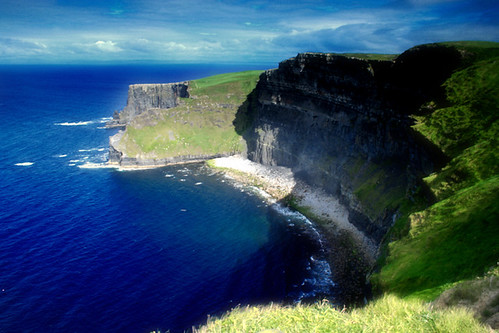
Ireland has many high cliff areas, so my proposal would be to build vast reservoirs on top of these cliffs and use wind power to pump salt water to them from the ocean. These reservoirs can be thought of as energy-storage areas.
The principle is simple: during times of high-wind activity, turbines would provide the energy to pump the sea water from the ocean, thus filling the reservoirs. In times of peak-energy demand, the reservoirs could be emptied.
The sea water, which is heavier than fresh water, would travel down the connecting pipes, through turbines, thus generating energy.
If water was pumped to a height of 250 metres above sea level and stored in a 2km x 2km, 20 metre-deep reservoir, it could supply all of Ireland’s energy requirements. We can realistically break this down into 10 reservoirs, each measuring 700 by 700 metres and 20 metres deep — we have identified more than 20 possible locations for such reservoirs.
How realistic in purely economic terms is such a project? Well, Ireland requires 2,700 mws of power and in Bath County, Virginia, there is a 2,100 mw pumped/ storage system which cost $1.7 billion (€1.3 billion) to build. We probably do not need to build our reservoirs from scratch because of the unique Irish landscape. This would greatly reduce the construction costs.
The proposal could even be instrumental in helping Ireland out of recession. Consider the impact the Hoover Dam had on the American economy in the 1930s. Some 21,000 people worked on the project and today it is visited by 7m tourists a year. Building reservoirs would give much-needed employment to the construction industry and the resulting structures could add to tourism numbers in the west of Ireland.
Once we have demonstrated that we can achieve energy independence, it should be possible to turn our attention to developing Ireland as a net exporter of energy.
Posted
by Big Gav
in
britain,
energy,
ireland,
marine current turbines,
ocean power
The Independent has a look at the latest news in British ocean power generation. Meanwhile Gordon Brown and Nicolas Sarkozy are wasting time and money talking about building expensive and unpopular nuclear power plants (see here for more on ocean energy).
Britain is set this week to enter a new age, generating energy directly from the seas that surge around its shores. On Saturday a strange, 122ft- long contraption – looking like an upside-down windmill – will set off from the Belfast dock that built the Titanic to produce the first electricity ever brought ashore from British tides.
The device – the first of its kind anywhere in the world – is expected to start a revolution which could lead to our island nation getting a fifth of its power from its surrounding waters, and to the far north of Scotland becoming "the Saudi Arabia of marine energy".
Remarkably, the pioneering device, which will start producing power from predictable and clean tidal energy, is the fruit of the vision and persistence of a single campaigning engineer, and has been developed by a small West Country firm. Though it has recently had some Government support, ministers have traditionally preferred to pour resources into much bigger projects, such as nuclear power stations. Indeed, the installation of the new device – near the mouth of Northern Ireland's Strangford Lough – is scheduled to take place only days after the Prime Minister, Gordon Brown, and the French President, Nicolas Sarkozy, are expected to sign a deal to jointly construct a new generation of reactors and to sell the technology around the world.
Yet the inauguration of a tidal turbine, dubbed SeaGen – which will generate enough electricity to power 1,140 homes by being placed directly in the tide race that rushes in and out of the lough – may unexpectedly prove to be the more significant event. While the much-vaunted Severn Barrage has only just begun to undergo a two-year feasibility study, experts are hailing the new turbine as the start of a giant leap in exploiting marine energy, where Britain, for once, is now leading the world.
Later this year, in another global first, a wave energy power station developed by an Edinburgh firm is to be installed in the Atlantic Ocean off the coast of Portugal. Next year, an even bigger one, off Cornwall, is expected to start feeding electricity into the national grid, and yet another is planned for the Orkneys. And Marine Current Turbines, the firm behind SeaGen, has joined with the utility company npower to develop a tidal power station off Anglesey.
Britain has the best tide and wave energy resources in the world – the official Carbon Trust estimates that they could together provide a fifth of our electricity. Yet, until recently, successive governments have set their face against developing them.
In the 1980s the then Department of Energy killed off promising proposals for exploiting the waves amid evidence that it did so because they threatened its (never realised) plans to expand nuclear power. In 1992 an official report concluded that it "did not see any justification for significant public expenditure" on offshore energy, and as recently as 2003 a Government White Paper ruled out the development of a Severn Barrage.
The tide only turned decisively about a year ago when, as The Independent on Sunday exclusively reported, ministers began backing plans for the £14bn, 10-mile barrage. Gordon Brown officially announced a feasibility study at the last Labour Party conference, and this got under way in January.
Launching the study, which will continue until 2010, the Secretary of State for Business, John Hutton, described the barrage's potential as "breathtaking". But though it could alone provide 5 per cent of the country's electricity from a completely dependable, renewable resource it could not be in operation until at least 2020.
And the Government's official environmental advisers – the Environment Agency, Natural England and the Countryside Council for Wales – have warned that the barrage would "cause irreversible impacts" to the estuary's "internationally important habitats" for wildlife and to its "unique ecology".
The scheme in Northern Ireland avoids these drawbacks by using a radically different technology. While the barrage impounds the rising tide behind a dam – letting it out, as it falls, through some 200 turbines in the structure – SeaGen sits in the tidal currents like an inverted windmill, capturing some of the energy by letting the water, rather than air, turn its sails as it flows.
While the barrage is a mammoth and expensive structure, which takes many years to build and then cannot be moved, the turbines can be constructed and sited relatively quickly, cheaply and flexibly. And while damming the Severn estuary inevitably fundamentally alters its ecology, SeaGen is expected to have far less impact on wildlife and the environment. But its technology's potential is no smaller. A report by the Sustainable Development Commission last year estimated that exploiting Britain's tidal currents could generate at least 5 per cent of the nation's electricity. Other authorities put it even higher.
Professor Stephen Salter of Edinburgh University, one of Britain's leading marine energy experts, estimates that the Pentland Firth alone could generate up to a quarter of Britain's electricity – more than is now being provided by all the country's nuclear power stations – making the channel between Orkney and the north Scottish mainland "the Saudi Arabia of marine energy."
Martin Wright, managing director of Marine Current Turbines, calls the firth, the "Mount Everest" of the industry, and describes its tidal currents as "the equivalent of an underwater hurricane". Every second, about 2.5 million cubic metres of water – enough to fill 1,000 Olympic swimming pools – passes at a speed of up to 12 knots across a line traced across the Firth.
This is just the biggest of a host of potential sites, usually where the tides are speeded up by being squeezed through narrow channels, forming one of the most intense resources provided by any form of renewable energy. In all, the Government estimates, Britain has about half of all Europe's such "tidal stream" potential and between 10 and 15 per cent of what has been identified worldwide, making it uniquely blessed.
Some 24 technologies, at various stages of research and development, have been put forward for exploiting tidal currents, but SeaGen – invented by Peter Fraenkel – a renewable energy pioneer who is now Marine Current Turbines' technical director (see right) is well in the lead.
In 2003 a smaller prototype, called Seaflow, was installed off Lynmouth in Devon becoming the first renewable energy device, powered by the sea, to be installed in the open ocean anywhere in the world. It operated through three winters, with regular force 8 gales, without any important technical failures – with an overall performance that exceeded expectations. Dr Fraenkel says it "proved the feasibility" of the technology.
He adds that SeaGen – four times as powerful, with a capacity of 1.2 megawatts – "is the world's first commercial scale system for generating electricity from marine currents" – and is "needed to prove economic and commercial feasibility".
Originally designed to be installed in 2006, it was held up by a series of events including the commercial takeover of the company due to install it, and an accident to a vessel due to carry it.
Hmmm - sounds like there is some good tinfoil potential in that story !
The Independent also says that "
Sea levels are rising too fast for the Thames Barrier".
A fear that sea levels will rise far faster than predicted this century has led to a revision of the plan to protect London from a devastating flood caused by the sort of storm surge in the North Sea that resulted in the closure of the Thames Barrier yesterday.
It was the 108th time that the barrier had to be closed since it became operational in 1982 but scientists are concerned that rapidly rising sea levels could significantly shorten the expected lifespan of one of the world's biggest anti-flood structures.
When the Thames Barrier was being designed in the 1970s, global average sea levels were rising at about 1.8 millimetres a year and global warming was not seen as a threat, but in the past 15 years the rate has nearly doubled to about 3.1mm a year and many scientists expect it to accelerate still further.
Sea levels are rising even faster in south-east England because of local effects, such as land sinking, but officials for the Environment Agency said that the barrier is designed to cope with an 8mm-per-year rate of sea level increase yet still meet its design specifications – such as coping with a one-in-a-thousand-year storm surge by 2030. ...
The Thames Barrier protects about £80bn worth of buildings and capital infrastructure in London. Some 1.25 million people live or work in the at-risk area.
Posted
by Big Gav
in
ireland,
wind power
CNet's Green Tech Blog has a post on Ireland's wind power rush, noting the country has a good chance of generating a large percentage of power from clean energy sources.

Peak demand for electricity in the Republic of Ireland comes to about 5,000 megawatts, Graham Brennan, program manager for renewable-energy research and development at Sustainable Energy Ireland, the government's green-technology arm, said in an interview in SEI's Dublin offices. The peak occurred last December, at 4,907 megawatts.
Studies show that onshore and offshore wind turbines located in the republic could deliver approximately 5,000 megawatts of power over both parts of the island, he added. This figure takes into account only sites where it would be somewhat practical to put wind turbines, wind speeds, the geography, and the transmission grid. If Northern Ireland is counted, the figure jumps to 6,000 megawatts. In all, the wind blowing over the island contains 8,000 megawatts of power.
"There is enough onshore-accessible wind for about 100 percent of our electricity requirements," he said. "In terms of our accessible resources, the biggest and most successful so far is wind."
The blustery situation has created a rush toward wind in the nation. The Republic of Ireland already has installed about 800 megawatts worth of wind turbines, and wind park developers have or are expected to file applications to put an additional 3,700 megawatts worth of wind onto the grid. The government will likely surpass its goal of having 1,200 megawatts of wind by 2010. (Ireland's ultimate goal is to get 33 percent to 42 percent of its electricity from renewable sources by 2020, a fairly high figure for an industrialized nation.)
While most of the turbines are located on land, developers are also looking at offshore wind, similar to the Arklow Bank park developed by General Electric and Airtricity. Tidal-power companies are also receiving a lot of attention. ...
The island is one of the first landfalls for winds crossing the Atlantic, so wind hits harder and more constantly than most places in continental Europe. The capacity factory for onshore wind turbines--the measure of how much of the time the turbine is actually cranking out power--comes to 35 percent in Ireland. In Europe, the average is about 25 percent.
That means cheaper power. Electricity from wind costs about 6.2 euro cents a kilowatt-hour here--less than the 8.3 cents a kilowatt-hour that electricity from gas-fired plants costs, Brennan said. The wind figure doesn't include the costs of having a reserve (i.e. a gas facility that can produce power in slack times). Still, it costs less to generate power from wind than from gas.
Posted
by Big Gav
in
flow battery,
ireland,
smart grids,
wind power
Renewable Energy Access has an article on Ireland's plans to use flow batteries to provide energy storage for wind farms on the west coast.
The gigantic wind turbines in Donegal on the west coast of Ireland are not only standing on the geographical limits of Europe -- they are also on the cutting edge of a revolutionary technology for storing large amounts of energy from wind power.
Battery storage could be especially useful when wind power feeds into a grid that belongs to a so-called "island" such as in the UK and Ireland, but also in Spain on the Iberian Peninsula— in effect an electrical island with limited interconnections with France in the north and Morocco in North Africa.
The 32-megawatt (MW) wind park in Sorne Hill will be the first in Europe to integrate a big back-up battery system that will ensure a reliable supply of electricity no matter how big the fluctuations in the wind might be.
"The battery enables large amounts of energy from wind or solar power to be stored, managed, controlled and sent into the electricity grid when it is needed. It doesn't matter whether the wind is blowing or not, the battery makes the electricity output predictable and reliable," said Tim Hennessy, CEO of VRB Power Systems, the Canadian manufacturers of the battery.
Analysts say the potential market for technology that can provide reliable storage for large amounts of energy from wind and solar power is huge.
Battery storage could be especially useful when wind power feeds into a grid that belongs to a so-called "island" such as in the UK and Ireland, but also in Spain on the Iberian Peninsula — in effect an electrical island with limited interconnections with France in the north and Morocco in North Africa.
By contrast, the electricity grids of the big European wind nations of Germany and Denmark are interconnected with their northern neighbors. Excess wind power from these countries goes all over Europe with the grid effectively acting as a huge storage system.
Also, Germany is harnessing the full spectrum of renewable sources such as hydropower with dams and biomass to provide a back up to wind. It also has lots of salt mines to store energy in the form of compressed air.
However, the "electrical islands" of Ireland and Great Britain with little hydropower and a scarcity of salt mines could need huge amounts of battery storage as they expand their use of wind power so that the ingress of wind power into the system doesn't lead to grid instability.
Wind parks on a colossal scale are being planned in the UK and Ireland. The UK is planning to install 33 GW of capacity of offshore wind power by 2020. Ireland has 1000 MW of wind power but is planning to install 2,400 MW of wind by 2016 and 4,300 MW by 2020 to reduce the country's reliance on imported fossil fuels and cut harmful greenhouse gas emissions.
That means the 2-MW battery in Sorne Hill, Buncara, due to be in operation in 2009, could be just the start. Hugh Sharman of Incoteco ApS, Denmark, a contractor with VRB, estimates that Ireland could need as much as 1000 MW of battery storage capacity by 2016.
As oil and gas prices continue to rise, the battery storage system will become more cost effective.
A Mwh of electricity generated by wind turbines in Ireland costs 70 euros [US $106], making it much cheaper than the equivalent electricity generated by natural gas, said Sharman. These prices offset the high initial investment costs of the battery.
The battery could also be used to capitalize on different tariffs for peak and off-peak electricity: electricity could be stored during off-peak hours when the cost is low and fed into the system in peak hours when the price is high.
The UK would need up to 12,000 MW of battery storage to balance out the system if the country goes ahead with its plan to install 33 GW of wind capacity by 2020 and decides to use batteries as a back up, Sharman said.


 Posts




