Showing posts with label mit. Show all posts

New concept turns flow battery technology upside-down  

Posted by Big Gav in , ,

MIT News has a report on a new paper describing a pump free flow battery - New concept turns battery technology upside-down. The new design could offer improved cost and reliability.

The Hydrogen Economy and Peak Platinum  

Posted by Big Gav in , , , , , , , , , ,

One Bullroarer at TOD ANZ a week or two ago featured an article from the ABC on the possibility of mining low grade Australian platinum reserves to supply rising demand for catalytic converters and hydrogen fuel cells - World 'needs Australia's platinum to build cleaner cars'.

An Australian researcher has warned that the drive to put cleaner, hydrogen-fuelled cars on the road will stall unless new reserves of platinum are found. Platinum is one of the key components of catalytic converters, catalysing carbon monoxide from exhaust fumes. It is also a critical component of fuel cells for hydrogen-powered cars. However 80 per cent of the world's reserves come from just three mines.

John Mavrogenes says a team of geochemists from the Australian National University has identified new methods to detect platinum deposits. They are simulating the intense heat and pressure of the Earth's magma to discover whether platinum can be extracted from other minerals. "This work may help geologists find new reserves around the world in places that haven't been searched before," he said. Professor Mavrogenes says if the platinum price remains at its current high, Australia could mine lower-grade deposits. ...

The three major mines that produce platinum are in South Africa, Siberia and the United States. "If we go to more and more uses of platinum we're going to need more than they can produce," Professor Mavrogenes said. "Existing reserves would meet less than 20 per cent of the world's platinum demand if all cars went hydrogen."

The Hydrogen Economy

The dream of the hydrogen economy is one that has been around since the 1970's, and has been heavily hyped by sources ranging from Wired (as a key component to their long boom vision), the European Hydrogen Association and Jeremy Rifkin to George W Bush (who seemed primarily interested in supporting the gas and nuclear industries).

The term was originally coined by chemistry professor John Bockris (also an alchemist, cold fusion researcher and winner of the Ig Nobel prize).

The basic vision is that hydrogen is used to fuel vehicles containing hydrogen fuel cells, rather than internal combustion engines, creating no pollution other than water.


Global hydrogen production is currently derived from natural gas (48%), oil (30%), coal (18%) and electrolysis of water (4%). Given that hydrogen is currently largely derived from fossil fuels, the first obstacle facing the "hydrogen economy" dream is shifting away from these sources to extracting hydrogen from water.

Hydrogen is also used for producing ammonia and cracking heavier grades of oil, which means that peak oil and gas pose a number of problems to the hydrogen dream - the primary sources of present day hydrogen become less plentiful, and demand for hydrogen increases as we resort to heavier grades of oil (and coal to liquids) to keep the habit going.

Criticisms of the hydrogen economy

Critics of the hydrogen economy aren't hard to find, with frequently raised objections including:

* The use of natural gas (both from a global warming point of view and a depletion point of view)
* The inefficiency of electrolysis techniques in converting other forms of energy into hydrogen
* The difficulty of distributing and storing hydrogen
* The cost of setting up a hydrogen based infrastructure to replace the existing oil based infrastructure
* Safety concerns about storing hydrogen on board vehicles
* The cost and complexity of hydrogen fuel cells
* Availability of platinum for large scale use in fuel cells

Amory Lovins' Rocky Mountain Institute (pdf) argues that many of these objections are either myths or can be overcome.

Fuel cell expert Ulf Bossel and energy commentator Joe Romm (author of The Hype About Hydrogen) are probably the most frequently cited critics, arguing that the inefficiency of the hydrogen conversion process is wasteful and compares unfavourably to alternatives - specifically the "electron economy" where electricity is the energy carrier of choice.

Bossel says "In a sustainable energy future, electricity will become the prime energy carrier. We now have to focus our research on electricity storage, electric cars and the modernization of the existing electricity infrastructure".


The diagram above shows that both the efficiency of electrolysis and the efficiency of fuel cells are key factors in making hydrogen as a transport fuel less attractive than the electric transport option.

Peak Platinum

If we assumed that hydrogen fuel cells could be made significantly more efficient, and thus more competitive with the electric vehicle option, we still have the issue of the scarcity (and thus the cost) of platinum to deal with, as platinum is the material traditionally used as the catalyst in cells.


In 2005, South Africa was the top producer of platinum, accounting for around 80% of world production, followed by Russia and Canada. Significant deposits are also found in Zimbabwe, the United States and, as noted in the introduction, Australia. South Africa has been expanding production rapidly to take advantage of soaring prices - causing some controversy in affected townships.

When discussing rare metals, the subject of peak minerals is usually quick to arise. The idea has been covered at a number of venues in recent years - including The Oil Drum, New Scientist (with some good graphics here and here) and WorldChanging.

The New Scientist article estimated that there are 360 years of platinum reserves available if we continue to extract it at the current rate of production - however this drops to 15 years if predicted growth in demand is taken into account.

One analyst at Resource Investor has predicted that we may have already reached "peak platinum" production, though this seems to be predicated on the belief that production of hybrid and electric vehicles will remove the demand for both fuel cells and catalytic converters in future years, rather than a firm belief in supply constraints.

Another analyst at the UK Department For Transport, looked at the platinum supply situation for fuel cell vehicles and concluded:
The above projections, coupled with the statements from Cawthorn (1999) about accessible platinum reserves in South Africa, suggest that platinum availability should not be a constraint to the introduction of hydrogen fuel cell cars. If South Africa alone can deliver up to 5% per year additional platinum supply between 2000 and 2050, this equates to an additional 13.6 million oz in 2030, 24.8 million oz in 2040 and 42.9 million oz in 2050, which is sufficient to meet demand under any of the scenarios considered.

However there are many important assumptions and uncertainties built into this model. For example, this additional South African platinum supply would be insufficient to meet worldwide platinum demand by 2040 under Scenario 2 (realistic penetration) if any one of the following alternative assumptions is made:

* South African supply can only be increased by 4% per annum instead of 5%.
* Jewellery demand grows at more than 2% per annum - it is currently assumed to remain constant but grew by an average of 6% per annum between 1994 and 2001.
* Fuel cell stacks require more than 0.3 oz of platinum per car in 2040 - it is currently assumed that only 0.2 oz will be required but this is a factor of 10 less than current stack technology.
* The demand for cars grows by more than 55% per decade - it is currently assumed to increase by 45% per decade based on USDOE projections.

The platinum loading for fuel cell stacks is an important factor in determining the commercial viability of fuel cell cars as well as determining potential platinum demand constraints. The price of platinum is not likely to be a constraint to the introduction of fuel cell vehicles if the expected reductions in platinum loadings are achieved. At current platinum prices and the target platinum loading of 0.2 oz per car, the platinum required for a single car would cost about $90 or $1.5/kW, compared to a cost target of $50/kW for the whole fuel cell engine.

In the wake of the New Scientist article, the Wall Street Journal noted that if the most dire predictions are true, recycling of rare metals will be the only way to manufacture some types of machinery. Hazel Prichard, a geologist at the University of Cardiff in the UK, is developing ways to extract platinum from the dust and grime of city streets - apparently, urban grit contains 1.5 parts per million of platinum.

Its worth noting the contrarian view of metals depletion, expressed by Herman Kahn in his book "The Next 200 Years", which points out that reserves data for minerals is often very dubious when there is sufficient known supply available to meet hundreds of years of demand - and that recycling can change the picture dramatically in any case.

Either way, the platinum supply concern may not be an insoluble problem, as recent reports from Japan claim Nisshinbo Industries and the Tokyo Institute of Technology have developed a platinum-free, carbon-based catalyst for fuel cells which they hope to commercialise in 2009 (first for home use, later for use in vehicles). Their catalyst is made from nanospheres of carbon. While 10 times as much carbon is required compared to the platinum equivalent, the cost is one 10th of using platinum. Diahatsu also claims to have a platinum free catalyst, using cobalt or nickel.

Another platinum free alternative being pursued is being researched at Monash University, where chemist Bjorn Winther-Jensen is looking at layering an active conducting polymer onto Gore-tex to make a cheap catalyst.

Alternative Methods For Producing Hydrogen

The discussion following the Australian platinum supply article at TOD ANZ noted the recent, highly publicised, research into a new catalyst for electrolysis at room temperature using cobalt and phosphate which MIT modestly described as a
"'Major discovery' from MIT primed to unleash solar revolution". The process also requires platinum, which seems to limit the potential for cheap and universal application of the technique.

The news was covered extensively pretty much everywhere - see Technology Review, Green Car Congress, The Guardian, The Press Association, Wired, Renewable Energy World, EE Times and Scientific American, with much of the coverage being heavy on hype and short on facts and accuracy.

Joules Burn at The Oil Drum was less impressed, cynically commenting on the story in Local Scientist Splits Water, Saves World, Gets On TV. Bruce Sterling didn't see what the big deal was either, and nor did Joe Romm, who was positively scathing about the news.


There are other schemes for generating hydrogen that don't require electrolysis, at various stages of maturity.

A group at the University of Birmingham in England is looking at using microbes to produce "biohydrogen" from waste, and claim their technology has an added bonus - leftover enzymes can be used to scavenge precious metals from spent automotive catalysts that can then be used to make fuel cells.

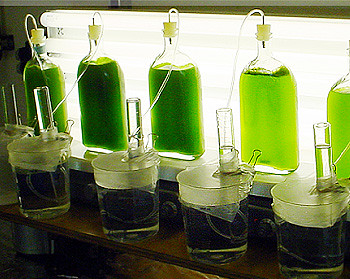
Another biotechnology based approach to hydrogen generation is being pursued at the University of Queensland and Berkeley University, in this case using algae.


So Is Hydrogen Worth Pursuing At All ?

Whether or not the MIT discovery, or any of the other alternatives, really does lead to cheap, abundant hydrogen seems open for debate for the time being.

If we assume for a moment that it is possible to generate hydrogen on a large scale in a reasonably cost effective manner, the issues around distribution, storage and fuel cells still remain - particularly when comparing a hydrogen fueled transport system to one using electric cars.

The car industry, apart from BMW and Honda, seems to have pretty much given up on using hydrogen for vehicles, but enthusiasm remains for using fuel cells in some niche applications where problems are minimised, such as buses, which are refueled at a central location and have fewer concerns about weight and storage size.

Another niche where distributed hydrogen generation may be applicable is cogeneration (CHP) at home, something Jamais Cascio noted in his comment on the MIT announcement. Japan would seem a likely candidate for proving this on a large scale given that they seem to be the most enthusiastic about using hydrogen at home.


The other likely candidate for using hydrogen is energy storage in renewable energy generation - though perhaps not for home scale PV the way Nocera has been suggesting. An Australian company called WHL (previously Wind Hydrogen) has been looking at building wind farms which store excess energy in the form of hydrogen and use it to generate power later, when the wind isn't blowing. The Lolland Hydrogen Community in Denmark has been experimenting with a similar concept, as has a ship called the Hydrogen Challenger.

Melbourne based company Solar Systems is also looking to combine hydrogen energy storage with a solar power plant, using excess heat to improve the efficiency of electrolysis.

Colourful Concentrators: Organic Solar  

Posted by Big Gav in , , , ,

Technology Review has an article on advanced organic dyes that more efficiently concentrate sunlight, which MIT researchers believe will reduce the cost of producing solar power - A Better Solar Collector.

Looking to make solar panels cheaper, MIT researchers have created sheets of glass coated with advanced organic dyes that more efficiently concentrate sunlight. The researchers, whose results appear in this week's issue of Science, say that the coated glass sheets could eventually make solar power as cheap as electricity from fossil fuels.

The researchers show that the glass sheets can reduce the amount of expensive semiconducting material needed in solar panels and provide a cheap way to extract more energy from high-energy photons, such as those at the blue end of the spectrum. "This could be the cheapest solar technology," says Marc Baldo, a professor of electrical engineering at MIT. "And I think one day, it could be competitive with coal."

The simple, flat sheets of glass have a number of advantages over previous solar concentrators, devices that gather sunlight over a large area and focus it onto a small solar cell that converts the light into electricity. Solar concentrators in use now employ mirrors or lenses to focus the light. Because the new glass sheets are lighter and flat, they can easily be incorporated into solar panels on roofs or building facades. They could also be used as windows, which, connected to solar cells, could generate electricity. What's more, mirrors and lenses require mechanical systems for tracking the sun to keep the light focused on a small solar cell. These tracking systems add cost and can break down over the decades that solar panels are made to be in service. The flat glass concentrators don't require a tracking system.

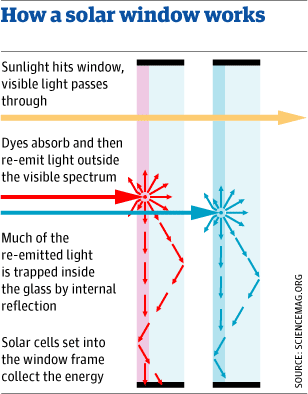
Instead of using optics, the glass sheets concentrate light using combinations of organic dyes specially designed by Baldo and his coworkers. Light is absorbed by the organic dyes coating one side of the glass sheet. The dyes then emit the light into the glass. The glass channels the light emitted by the dye to the edges of the glass, in the same way that fiber-optic cables channel light over long distances. Narrow solar cells laminated to the edges of the glass collect the light and convert it into electricity. The amount of light concentration depends on the size of the sheet--specifically, the ratio between the size of the surface of the glass and the edges. To a point, the greater the concentration, the less semiconductor material is needed, and the cheaper the solar power.

The story has been reported in a lot of mainstream media outlets too, like this one at The Guardian - Dyes turn windows into powerful solar panels.

Windows could be used as powerful solar panels thanks to a clever new technology that concentrates the sun's rays. The technique uses transparent dyes to capture, concentrate and redirect light along the surface of the glass to photovoltaic (PV) cells in the frame, which convert the light into electricity. The breakthrough means that there is a tenfold increase in power output compared to use of the PV cell alone.

The team, from the Massachusetts Institute of Technology (MIT), claims the technology could slash the cost of generating electricity from sunlight, making it more competitive with standard grid power. This is because the expensive PV cells only need to be installed at the sides of the panels, rather than across the whole surface.

Sunlight is concentrated in existing solar power devices using large, mobile mirrors that track the sun as it moves across the sky. But these can be expensive to deploy and maintain. In the MIT device, called an "organic solar concentrator" and described in the latest issue of Science, the researchers painted a mixture of organic dyes onto the surface of a pane of glass. The dyes trap different wavelengths of sunlight and then guide the energy along the glass towards the PV cells at the edges.

"The point of all this is to get away with using far fewer solar cells," said Marc Baldo, an electrical engineer at MIT. "The concentrator collects light over its whole front surface, but the solar cells need only cover the area of the edges."

As the edges of a glass panel can often be 100 times smaller in area than the surface itself, he added, solar panels would need 100 times fewer PV cells to collect the same energy. "So we can save money. Since industry can't produce enough solar cells to satisfy demand, this might also be a good way to stretch production." ...

Greenpeace's chief scientist, Doug Parr, said: "Innovations like this show renewable technologies can take a quantum leap forward if given proper financial support from governments. Rather than betting the farm on outdated nuclear technology and hoping that coal will one day be 'clean', Gordon Brown should be creating green jobs and pushing at the real technological frontier of the 21st century - renewables."

Continuing the solar theme, the San Francisco Chronicle reports the biggest U.S. photovoltaic power plant is to b built in Florida.
SunPower Corp. of San Jose will announce plans today to build the country's largest photovoltaic solar power plant in Florida. Unlike most large-scale solar plants, which use big mirrors to concentrate sunlight, the SunPower project will use the same solar panels that homeowners install on their rooftops.

It will be built in Florida's DeSoto County and will generate up to 25 megawatts of electricity, enough to power 18,750 homes. SunPower also will build a smaller facility, generating 10 megawatts, at Kennedy Space Center.

Geothermia Revisited  

Posted by Big Gav in , , ,

Australian geothermal energy company Geodynamics was an unusual subject of attention in the energy press last week, after cornerstone shareholder Origin Energy expanded their stake in their Cooper Basin hot rocks project, including Geodynamics' giant Lightning drilling rig, Australia's biggest onshore rig.

Origin is hoping to leverage its experience in gas exploration, production and power generation and exposure to geothermal power generation in New Zealand.

I've been following the (slow) progress of this endeavour for a number of years now, as the field has the potential to supply a large amount of clean energy over a considerable period of time.

Geodynamics was floated on the stock exchange back in 2002 and has been drilling in the Cooper Basin ever since. Origin believes the company had the best potential of the several Australian geothermal proposals and that "geothermal energy will play an increasing role in the security the world's future for clean energy".

The company has been working towards tapping heat from granites buried up to 5km underground between Innamincka and Moomba to generate electricity. Geodynamics aims to bring in a pilot one megawatt generator at the site within 12 months. Further drilling should enable a decision in 2009 to invest in a 50 megawatt demonstration plant. If successful, that would be followed by a 500-megawatt plant operating by 2016.

The project has been delayed by heat and pressure problems, which have caused drilling difficulties and led to the construction of the specialised drill rig - and to the departure of founding CEO Bertus de Graaf, who is now with uranium company Uranoz and looking to develop the Limestone Coast geothermal energy project elsewhere in South Australia and prospects in the India state of Maharashtra and in Kyrgyzstan.

The Kyrgyzstan development is reported to have very hot granites at relatively shallow depths - estimated to be between 2km and 3km compared to the 4km to 5km depth of the Geodynamics project.

Geothermal energy is unusual compared to other large renewable power sources, in that it provides "baseload" power (thus placating those suffering from the "baseload fallacy") unlike other more intermittent sources like solar, wind and ocean power.

Tim Flannery dubbed this region of South Australia "geothermia" last year, pondering a future where a large proportion of the nation's power supply comes from the region, with an industrial and mineral processing hub developing to exploit the large quantities of energy available.

Imagine an Australia that decides to build on this natural wealth, creating a centre for minerals processing and natural gas conversion by using emissions-free power. Imagine linking the north-south railway with Queensland and Western Australia in order to bring bauxite and other minerals to the processors, and then to market them through the Port of Darwin. Imagine the exports of gas and of processed minerals from the mammoth Olympic Dam mine, which is nearby. And finally, imagine Australia with a fully linked and freight rail and electricity grid, all powered from zero-emissions sources. If you can do this, then you can imagine a nation transformed from climate-change pariah to leader in the fight for the survival of our planet.

All of this would require a new city in the desert - let's call it Geothermia. What might it look like? I imagine a solar collector towering over a low-rise city, providing shade and conserving soil moisture. Perhaps the infrastructure would be underground. Geothermia would be a city not of thousands but of hundreds of thousands - a place with its own critical mass. And most importantly it would be a fully sustainable city - Australia's very first.


Flannery appeared on "Democracy Now" recently to talk about global warming, geothermal energy and the geothermia vision.
AMY GOODMAN: Talk about geothermia and the hot rocks.

TIM FLANNERY: Well, look, it is so important that we get this new industrial revolution happening and move from the dirty fossil fuels to clean sources of energy. One of the most promising is geothermal energy. You know, it’s an old source, really. We’ve had some geothermal plants around the world for a long time. But recently there’s been astonishing discoveries of massive reserves of heat energy in the earth's crust. One of the biggest is in Australia. And I’ve proposed to our government that we try to exploit this clean and sustainable energy resource to run a lot of our heavy industrial needs, such as mineral processing. We could have a new city in central Australia that I’ve sort of called Geothermia, you know, based around the use of this resource, and use our national rail system to bring in minerals to be cleanly processed and then shipped out.

AMY GOODMAN: Now, explain how this was discovered, where it is in the earth.

TIM FLANNERY: Look, it’s in the most dismal spot in Australia. It’s right in the dead center of our continent, near Lake Eyre, which is a huge salt pan, and it’s four kilometers down in the earth. And it was discovered by an oil and gas company, who had discovered a ring of oil-bearing rocks and then a ring of gas-bearing rocks and, in the middle of this, really hot rocks.

They spent hundreds of millions of dollars drilling. And being an oil and gas company, they thought, “We like the oil, we like the gas, but these hot rocks, we can just post that information publicly.” And, of course, someone else came up and said, well, the amount of energy in the hot rocks is actually probably a hundred times greater than the energy in the oil and gas they discovered, so this is the real gem. And so, they got a free ride. They got a couple hundred million dollars worth of free drilling, and now they're going out trying to exploit this resource.

And we’ll know by Christmas, I think, whether this can be successfully done. The second drill bit is now deep in the earth. It’s getting close to those hot rocks. And if we can get circulation happening of the hot fluids, as projected, then we will have unlocked an enormous energy resource at about the price of coal. And that will change everything for Australia.

AMY GOODMAN: And how long would it last?

TIM FLANNERY: If you run the whole Australian economy on it, it will last at least a century. And that’s the one deposit, you know. This is -- there’s ten companies looking for more of these hot rocks in Australia now. And in China there’s great prospects, as well. There’s prospects in Europe and, doubtless, in parts of the US. So as we shift away from coal and take a medium to long-term view, we can’t just imagine the choices between clean coal technologies and nuclear power. There are other very formidable sources of power that can deliver large volumes of what’s called baseload electricity, you know, the stuff you need twenty-four hours a day, at low cost.

AMY GOODMAN: Let's talk about your proposals around a green electrical grid, green transportation.

TIM FLANNERY: Yeah, look, we know that in order to beat this problem we have to reduce our emissions on the order of 80% in the next forty years. Now, forty years might sound like it’s a long way off, but it isn’t really, you know. I suppose just to drive home to people what that means, it means that in forty years from now we can’t be driving cars that are fueled with fossil fuels, with oil. We can’t be generating our electricity by burning coal and natural gas. We have to have shifted decisively from those polluting sources of power to clean sources of power. So that’s why the race is on now for new affordable takes to harness energy of the sun, which is massive, to harness wind energy, wave energy, geothermal energy, all of these sources that will drive this new clean and prosperous economy of ours, if we can reach out, make the investments and push forward to avoid dangerous climate change.


The idea of shifting energy intensive industries to areas where there is abundant renewable energy (which is a good way to hedge against rising fossil fuel prices) is one which has started being put into practice already, with aluminium (sometimes called "congealed electricity") producers looking to set up smelters close to hydro power stations in Canada, Iceland, Greenland, and the Congo.

If HFR geothermal turns out to be practical on a large scale, South Australia may be a big beneficiary of this trend, as it also has high potential for generating power from solar and ocean (wave) energy - not to mention the world's largest uranium mine and some residual (albeit declining) oil and gas production. Another region which may have large scale generation potential is the Hunter Valley region, conveniently located next to a lot of existing coal fired power stations.

Other companies looking to development geothermal energy in Australia include:
  • Petratherm - looking to develop another HFR resource in northern South Australia, initially to power the Beverley uranium mine. Managing Director Terry Kallis expects the cost of power "to consumers would be somewhere between $50 to $60 a megawatt hour or five to six cents per kilowatt hour". The company is also looking to develop projects in China.
  • Green Rock Energy - operating in the area around the Olympic Dam mine and in Hungary
  • Scope Energy (now part of Uranoz) - looking to develop a 100MW plant near Millicent in the south-east of South Australia. Principal Roger Massey-Greene expects the cost of power to be "very competitive with combined-cycle gas power plants"
  • Torrens Energy
  • Pacific Hydro
  • Greenearth Energy
  • Osiris
  • Eden Energy
  • Geopower


The industry is already fighting against "clean coal" backers for government funding and has formed the Australian Geothermal Energy Association, representing at least 16 companies operating in the sector. The organisation will have its inaugural meeting on November 21.

More data about geothermal resources in Australia is being gathered by Geoscience Australia's Geothermal energy project and the Research Institute for Sustainable Energy (RISE).

Background

Geothermal energy has been used for centuries for heating, cooking, and medicinal bathing. The first geothermal power generation plant was constructed in 1904 in Larderello, Italy, followed by Wairakei, New Zealand in the 1950's then the Geysers in California in the 1960’s.

There is currently an estimated 12,000 MW of direct use and over 8,000 MW of power generation using geothermal resources around the world. This generation capacity represents about 0.4% of the world total. The US is the largest producer, followed by the Philippines, Mexico, Indonesia, Italy, Japan and New Zealand.

If heat recovered by ground heat pumps is included, the non-electric generating capacity of geothermal energy is estimated at more than 100 GW (gigawatts of thermal power) and is used commercially in over 70 countries.


Existing geothermal power generation is sometimes called "wet" geothermal power - using natural hot water sources close to the surface to generate power using energy conversion technologies like dry steam, flash steam and binary cycle systems.

Hot Dry Rock / Hot Fractured Rock (HFR) power is still at the experimental stage, with the Geodynamics project being the most advanced in terms of commercial development. Besides the various projects underway in Australia, Swiss company Geopower Basel has tried drilling under the city of Basel - however this has been halted due to concerns about the drilling causing earthquakes - and other experiments are being performed in Germany and the french village of Soultz-sous-Forêts.

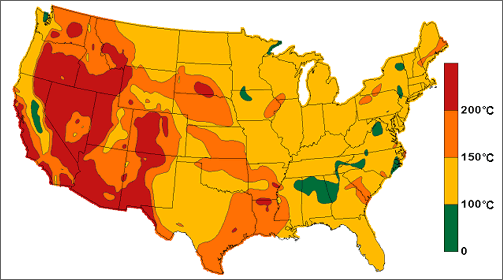
An MIT led study (funded by the US Department of Energy) last year said that if 40 percent of the heat under the United States could be tapped, it would meet demand 56,000 times over. The report estimated that an investment of $800 million to $1 billion could produce more than 100 gigawatts of electricity by 2050, equaling the combined output of all 104 nuclear power plants in the US.

The report noted that geothermal energy is important for several key reasons:

* fossil fuels (coal, oil and natural gas) are increasingly expensive and consumed in ever-increasing amounts
* oil and gas imports from foreign sources raise concerns over long-term energy security
* burning fossil fuels dumps carbon dioxide and other pollutants into the atmosphere

Herman Kahn was also very enthusiastic about the potential of geothermal energy, rating it as by far the largest available power source we have, dwarfing any demand for energy we are likely to have even with a massively increased population.

Technology Review had an interview with the MIT report author Jefferson Tester last year which noted that the amount of energy available is "thousands of times more than we now consume each year".
The figure for the whole world is on the order of 100 million exojoules or quads [a quad is one quadrillion BTUs]. This is the part that would be useable. We now use worldwide just over 400 exojoules per year. So you do the math, and you know you've got a very big source of energy.

How much of that massive resource base could we usefully extract? Imagine that only a fraction of a percent comes out. It's still big. A tenth of a percent is 100,000 quads. You have access to a tremendous amount of stored energy. And assessment studies have shown that this is thousands of times in excess of the amount of energy we consume per-year in the country. The trick is to get it out of the ground economically and efficiently and to do it in an environmentally sustainable manner.

A recent report from the Geothermal Energy Association (pdf) showed that the amount of geothermal power being generated is already increasing significantly.
"The number of countries producing geothermal power and total worldwide geothermal capacity under development appear to be increasing significantly in the first decade of the 21st century," according to the report. "The number of countries producing power from geothermal resources could increase 120 per cent, from 21 in 2000 to as many as 46 in 2010. Total geothermal capacity online could increase over 55 per cent, from 8,661 megawatts in 2000 to 13,500 megawatts or more."

New Zealand

New Zealand’s geothermal generating capacity (as of 2000) of over 400 MW (far exceeding that of Australia currently). The coutry has significant expansion plans for new geothermal power generation. New permits have been approved for a 60 MW power station in the Wairakei-Tauhara geothermal field and a 70 MW plant at the Kawerau field, with more permits expected to be issued in the future as part of the country's move to be the world’s first carbon neutral nation. Rod Oram reports the country could easily increase geothermal generation by a factor of 4.

Iceland

Byron King at The Rude Awakening recently had a look at the prime mover towards the use of "hot and steamy" geothermal energy - Iceland. Byron notes that the country is now energy self sufficient and is a good example of locations with large renewable energy supplies attracting energy intensive industries (one recent case in point is companies like Microsoft and Cisco considering using the country to host "green server farms").
When it comes to harnessing geothermal power, the go-to place on the planet right now is the Republic of Iceland. Yes, Iceland. It is a large island at high latitude, composed mostly of dense basalt lava flows. Iceland straddles the Mid-Atlantic Ridge, which provides that country with an almost direct link to the primordial heat energy within the mantle of our planet. And that is one all-but-immeasurable store of energy. Thus, Iceland is the world’s leading nation in terms of exploiting its local geothermal power resources. In Iceland, the insiders refer to the process of extracting geothermal energy as “heat-mining,” and they are getting rich from the effort.

Recently, the president of Iceland, Olafur Grimsson, visited the U.S. to speak at a number of events and testify before the U.S. Senate Committee on Energy and Natural Resources. In a speech delivered at Harvard on Sept. 26, President Grimsson emphasized the importance of geothermal energy to the economy and society of Iceland. He stated that Iceland has undergone a “radical transformation” from dependence on coal and oil in the past 30 years. As recently as the 1970s, Iceland was among the poorest countries within what was then known as the European Common Market (now called the European Union). That is, by most measures of gross domestic product and other economic output, Iceland was an economic laggard.

But then Iceland made a conscious, strategic commitment to develop its domestic geothermal energy resources. From large industrial projects down to the level of family housing, Iceland focused its public and private energy investment on making a geothermal energy vision into an energy reality. Now, according to what President Grimsson told his Harvard audience, Iceland is one of the most affluent nations in the world. Fully 100% of Iceland’s electricity now comes from renewable sources, geothermal and hydroelectric, and almost all buildings in Iceland are heated with geothermal energy. On the whole, about 72% of Iceland’s total energy usage is tied to geothermal sources, which eliminates essentially all carbon emissions and dramatically reduces reliance on imported fossil fuels of any type.

According to President Grimsson, Iceland has “turned this [geothermal power production] into an extremely profitable business.” For example, electricity is so inexpensive in Iceland that there is a booming business on the island that imports bauxite from the Caribbean area for the purposes of refining aluminum, a highly energy-intensive process.

In comments after his prepared speech at Harvard, President Grimsson expressed his “astonishment” at the utter paucity of geothermal power generation in the U.S., merely 0.3% of all electricity generated across 50 states. And much of that power comes from one location in California, called the Geysers. President Grimsson noted that the U.S. sits atop “the second largest geothermal resources in the world, following only Indonesia.”

President Grimsson concluded that by harnessing the “fireball on which we sit,” mankind could revolutionize energy production across the globe.


Iceland is not only making extensive use of its own geothermal resources but is looking to export technology and expertise to other promising regions, including Indonesia, the Philippines and the US - particularly a new company called Reykjavik Energy Invest.

Indonesia

With its hundreds of active and extinct volcanoes, Indonesia has the potential to produce an estimated 27,000 MW of electricity from geothermal sources. Reuters recently reported that Chevron is looking to expand its geothermal generation capacity in the country as part of the country's efforts to tap alternative energy sources to meet rising power demand and to cut consumption of crude oil as its own reserves dwindle.

Simon Sembiring, the Indonesia director general of geothermal and mineral resources, said earlier this year many foreign firms were interested in investing in geothermal energy projects in Indonesia, with the Icelandic invasion now underway - Reykjavik Energy Invest have already signed a preliminary deal to develop a geothermal power plant with Indonesian oil company Pertamina.

The Philippines

Another country astride the 'ring of fire" is The Philippines, where Chevron also run a number of geothermal power plants (including Tiwi, which is currently impacted by water shortages). The country currently generates around 8% of its electricity from geothermal energy - and another 15% from hydro power - making it the world's second largest producer of geothermal power.

The Icelanders are also looking to help expand the local industry here, with officials from Reykjavik Energy Invest visiting recently to discuss partnering in the development of other geothermal areas and bidding for a stake in power company PNOC-EDC (along with 23 other groups).

Papua New Guinea

Another country in the Asia-Pacific region looking to exploit geothermal energy is PNG, where gold miner Lihir Gold already has a geothermal plant powering mine operations. Bismarck Energy managing director Karl Yalo recently appealed to the PNG government to encourage geothermal power as high and rising fossil fuel prices hit the local economy hard.
“Several developing countries have well-entrenched geothermal plants complimenting traditional energy sources, thereby increasing energy output and enhancing economic growth. In PNG, we have seen the Lihir Gold Mine increase its base load capacity through geothermal energy, thereby reducing substantially use of fossil fuel and consequently converting the savings to sound profit,” Mr Yalo said.

Mr Yalo said numerous naturally occurring hot steams throughout New Britain and New Ireland showed the abundance of these opportunities and that serious consideration had to be given to examining the commercial development of geothermal as an alternative energy source particularly given the present high crude oil prices.

He appealed to the National Government to support the project as it will contribute meaningfully to the national economy through fiscal and other benefits. “With world crude oil price now trading at a record US$90 per barrel, there is no price relief in sight. “I believe fossil fuel prices will not come down to the late 90’s prices. The end result is that countries like PNG whose economies depend entirely on fossil fuel, will continue to face economic hardship, particularly people in the rural communities where bulk of them reside,” Mr Yalo said.

United States

While the US today makes only limited use of geothermal energy, it has a number of areas containing large energy resources, particularly Alaska and western states like California and Nevada. The Intermountain West Geothermal Consortium estimates geothermal resources of around 13,000 MW in the western states.

Producing geothermal power from oil and gas wells in the Gulf of Mexico is also being considered.


The largest geothermal plant in the US (and the world) at present is in Northern California, generating enough power for 800,000 homes, with the plant currently undergoing further expansion.

Iceland's Glitnir Bank plans to invest $1 billion in U.S. geothermal energy projects over the next five years in order to exploit some of the $40 billion market that they predict will develop over the next 25 years.

Another company from Iceland, Iceland America, plans to develop geothermal plants in the Salton Sea area in California.

While geothermal power generation is relatively limited in the US so far, passive use of geothermal energy in the form of ground heat pumps appears to be quite widespread, with estimates ranging between 500,000 and 1 million units already installed - Oklahoma is apparently leading the way in this regard.

Mexico

Mexico is currently producing around 950 MW - about 3% of the country's annual electricity consumption. By 2010 it is expected that an addition 220 MWe will be available - the total capacity of known resources is estimated at around 8,000 MW.

Germany

Hochtief and Exorka are looking at opportunities in the Molasse Basin of Bavaria.

Statistics

Locations of visitors to this page

blogspot visitor
Stat Counter

Total Pageviews

Ads

Books

Followers

Blog Archive

Labels

australia (619) global warming (423) solar power (397) peak oil (355) renewable energy (302) electric vehicles (250) wind power (194) ocean energy (165) csp (159) solar thermal power (145) geothermal energy (144) energy storage (142) smart grids (140) oil (139) solar pv (138) tidal power (137) coal seam gas (131) nuclear power (129) china (120) lng (117) iraq (113) geothermal power (112) green buildings (110) natural gas (110) agriculture (91) oil price (80) biofuel (78) wave power (73) smart meters (72) coal (70) uk (69) electricity grid (67) energy efficiency (64) google (58) internet (50) surveillance (50) bicycle (49) big brother (49) shale gas (49) food prices (48) tesla (46) thin film solar (42) biomimicry (40) canada (40) scotland (38) ocean power (37) politics (37) shale oil (37) new zealand (35) air transport (34) algae (34) water (34) arctic ice (33) concentrating solar power (33) saudi arabia (33) queensland (32) california (31) credit crunch (31) bioplastic (30) offshore wind power (30) population (30) cogeneration (28) geoengineering (28) batteries (26) drought (26) resource wars (26) woodside (26) censorship (25) cleantech (25) bruce sterling (24) ctl (23) limits to growth (23) carbon tax (22) economics (22) exxon (22) lithium (22) buckminster fuller (21) distributed manufacturing (21) iraq oil law (21) coal to liquids (20) indonesia (20) origin energy (20) brightsource (19) rail transport (19) ultracapacitor (19) santos (18) ausra (17) collapse (17) electric bikes (17) michael klare (17) atlantis (16) cellulosic ethanol (16) iceland (16) lithium ion batteries (16) mapping (16) ucg (16) bees (15) concentrating solar thermal power (15) ethanol (15) geodynamics (15) psychology (15) al gore (14) brazil (14) bucky fuller (14) carbon emissions (14) fertiliser (14) matthew simmons (14) ambient energy (13) biodiesel (13) investment (13) kenya (13) public transport (13) big oil (12) biochar (12) chile (12) cities (12) desertec (12) internet of things (12) otec (12) texas (12) victoria (12) antarctica (11) cradle to cradle (11) energy policy (11) hybrid car (11) terra preta (11) tinfoil (11) toyota (11) amory lovins (10) fabber (10) gazprom (10) goldman sachs (10) gtl (10) severn estuary (10) volt (10) afghanistan (9) alaska (9) biomass (9) carbon trading (9) distributed generation (9) esolar (9) four day week (9) fuel cells (9) jeremy leggett (9) methane hydrates (9) pge (9) sweden (9) arrow energy (8) bolivia (8) eroei (8) fish (8) floating offshore wind power (8) guerilla gardening (8) linc energy (8) methane (8) nanosolar (8) natural gas pipelines (8) pentland firth (8) saul griffith (8) stirling engine (8) us elections (8) western australia (8) airborne wind turbines (7) bloom energy (7) boeing (7) chp (7) climategate (7) copenhagen (7) scenario planning (7) vinod khosla (7) apocaphilia (6) ceramic fuel cells (6) cigs (6) futurism (6) jatropha (6) nigeria (6) ocean acidification (6) relocalisation (6) somalia (6) t boone pickens (6) local currencies (5) space based solar power (5) varanus island (5) garbage (4) global energy grid (4) kevin kelly (4) low temperature geothermal power (4) oled (4) tim flannery (4) v2g (4) club of rome (3) norman borlaug (2) peak oil portfolio (1)